 |
|
|
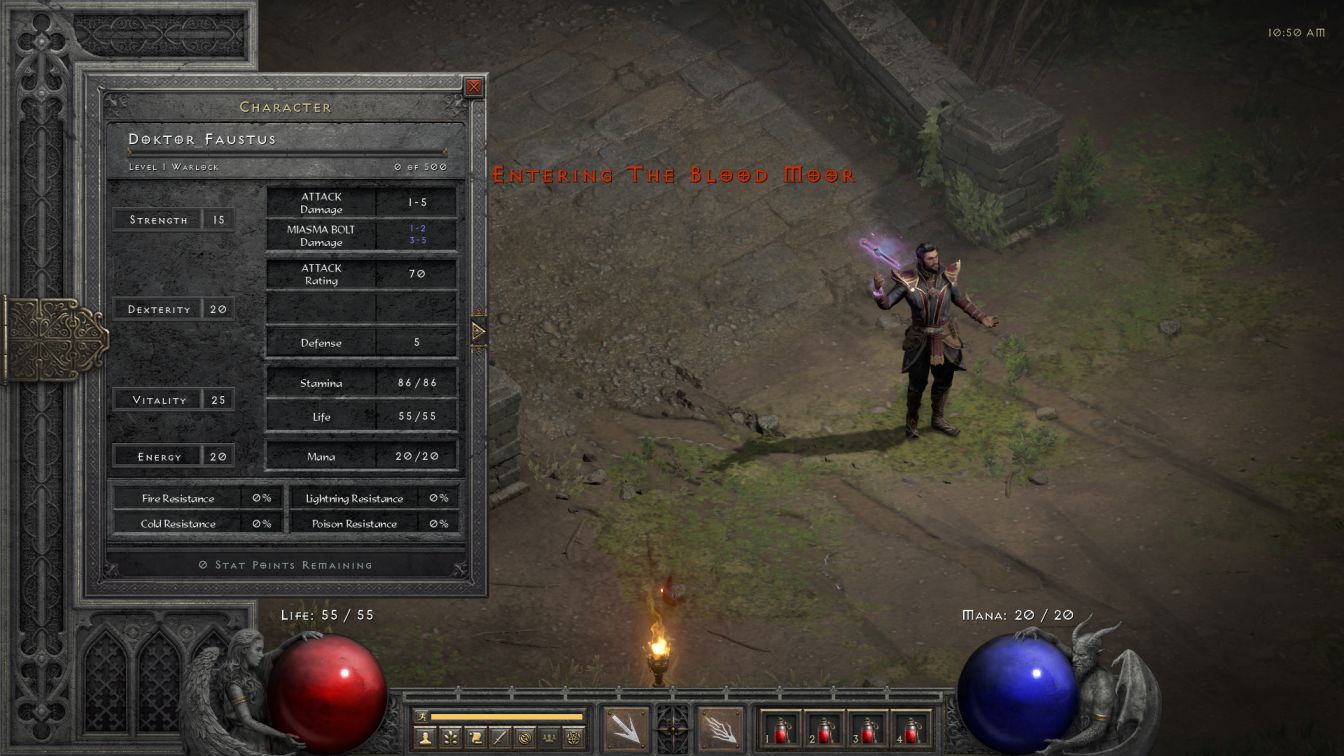
This was a feeling that I hadn't experienced for the last two decades: heading out into the Blood Moor with a Diablo 2 class that I'd never played before. I even enjoyed listening to the Warlock voiceovers that took place for each new quest as opposed to ignoring the same ones that I'd normally heard so many times before. The Warlock doesn't start with any points in the Demon skill tree which meant relying on the starting dagger with +1 to Miasma for the first level. I briefly tested this skill which seemed like it would be fun to base a character around later; Miasma deals initial magic damage when its projectile hits something, then leaves behind a small cloud that deals more magic damage per second. Every aspect of this skill can be improved with more skill points (the base damage, the size of the miasma cloud, the duration of the cloud, etc.) so what starts out as a weak ability can end up being pretty powerful.
It didn't take very long though for Faustus to reach CLVL 2 and place a skill point into the Summon Goatman skill. This allowed Faustus to summon a single goatman which dealt melee damage to its foes, starting at a mere 4-6 damage here in Act One Normal and then scaling upwards from there:
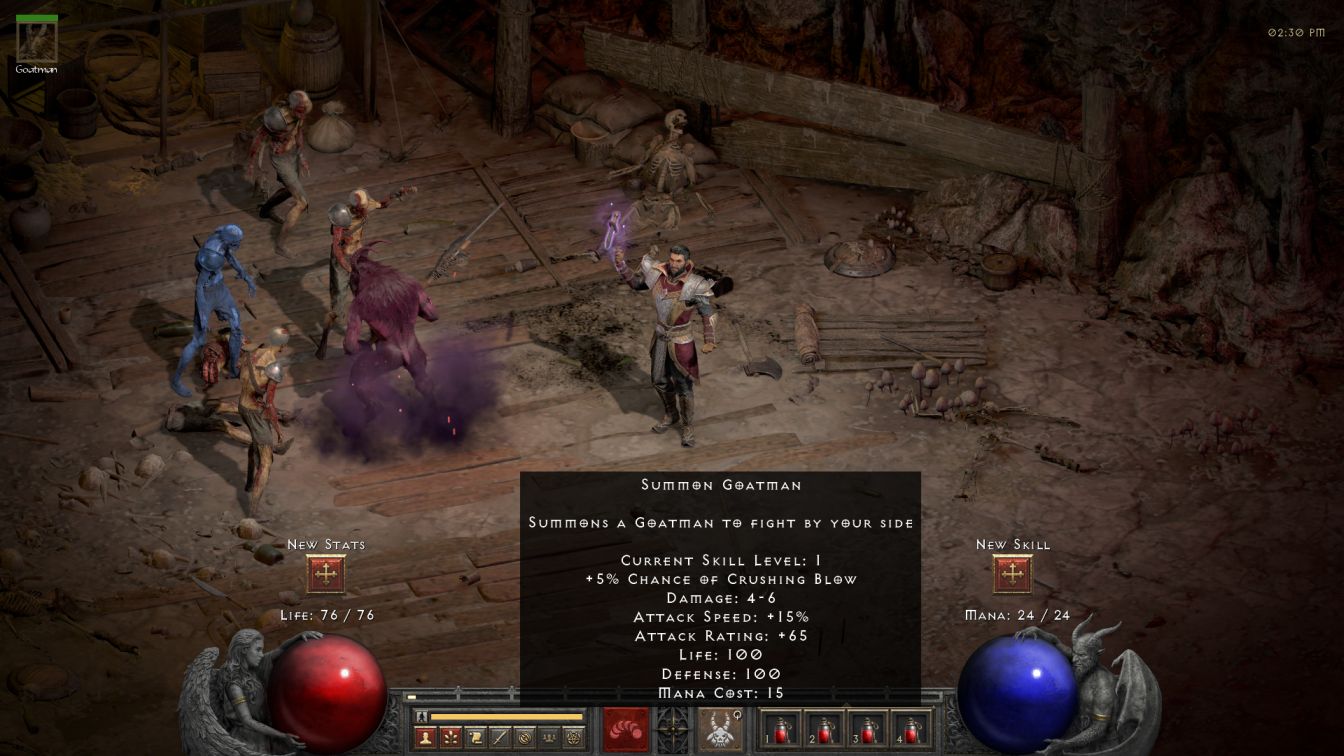
Although that damage might not sound impressive, it was sufficient to one-shot pretty much everything in the Blood Moor and Den of Evil because the initial monster HP also starts out incredibly low. The goatman minion also began the game with 100 life which was almost double what Faustus himself had for the moment, making the goatman almost impossibly tanky. That thing never died and never even dropped below 80% health while clearing through these early areas. I found that the goatman skill felt a lot like the Summon Grizzly skill on the Druid class, if the grizzly bear was somehow available at CLVL 1 instead of CLVL 30. In both cases, the player has access to a single extremely strong minion that deals immense damage to one target while struggling a bit with swarms of small opponents. In particular, the goatman wasn't very good at focusing the enemy shamans and spent long stretches of time swatting one fallen after another only to see them get revived endlessly. The minion would pick one target and then never deviate from it until it was dead, then retarget and stick on the next foe, etc. I had to run Faustus himself in lots of crazy circles trying to get the goatman to focus on the shamans and the net result was that the Den of Evil and Cold Plains were both pretty slow to complete due to the presence of so many shamans.
I alternated skilling both Summon Goatman and Demonic Mastery for Faustus' first few levels. Summon Goatman did more to make the goatman minion directly more powerful since it added more base damage and base health, plus attack speed, attack rating, and defense. However, Demonic Mastery was also very important to increase because more points in that passive skill would unlock additional summons. The Warlock gains a second demon at SLVL 5 and then a third demon at SLVL 10, with only base skill points counting for these extra summons. Getting more +skills stuff from items won't suffice here, it requires the full 10 actual skill points to have the maximum three summons. (This is a change from the release version of the Warlock which required SLVL 10 for the second demon and SLVL 20 for the third one, but +skills gear did count towards those targets. It's quite common for high end gear to grant +20 to all skills so this change was definitely intended as a nerf.) Demonic Mastery also provided extra damage, attack speed, attack rating, and run/walk speed for all Warlock summons which meant that skill points were far from wasted in the passive ability, it just didn't provide as much upfront benefit as skilling Summon Goatman itself.
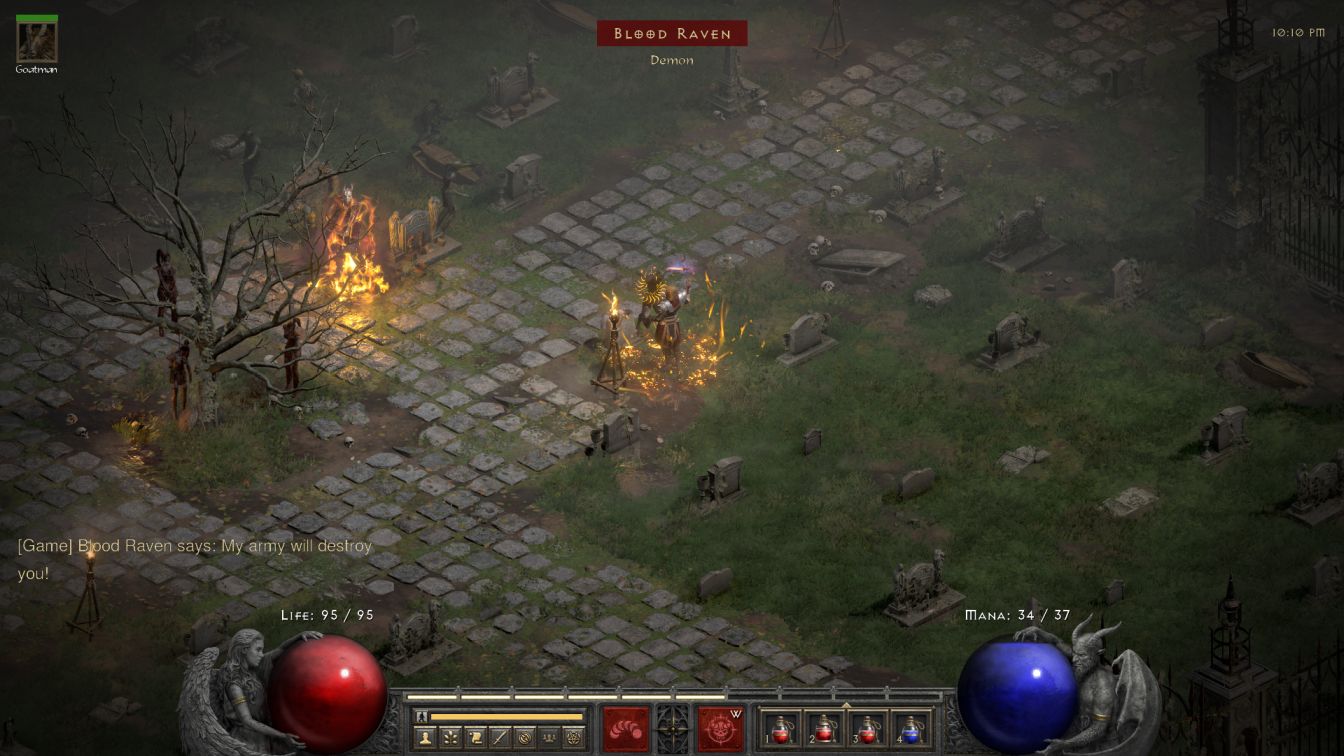
Faustus reached CLVL 6 while finishing up in the Caves which unlocked the Death Mark skill. This one was a real game changer for Faustus as it's essentially a teleport ability for the Warlock's minions. Casting Death Mark will cause his summons to blink over to the mouse cursor's position and immediately attack whatever is nearby. It does not require having vision on the location which allows the Warlock to toss his minions blindly through doorways and around corners. I really can't put into words how amazing this skill is for a summoning character, allowing the player to have pinpoint control over their minions and ensure that they're always focusing on the desired target - the Necromancer would absolutely kill to have this ability! Now those pesky shamans were no longer an issue as Faustus could cast Death Mark right on top of them and ensure that they always died first, something that was reminiscient of the Telekill move back in the original Diablo. Back in 1997, Warriors liked to Teleport on top of Soul Burners and Advocates and then melee them to death; I never thought that this tactical move would be recreated using demonic goatman some three decades later!
Leveling to 6 also unlocked the Blood Oath passive skill which I intended to leave at a single skill point for Faustus. Blood Oath grants addition life and resist all to the Warlock's summons, both of which are nice to have but not as important as increasing their damage output. Faustus could always summon more demons if the ones he had were to perish, though so far his single goatman was barely getting scratched. Blood Oath also has an additional passive function: a small amount of the damage taken by the Warlock himself gets redirected to the demons, starting at 3% and eventually increasing up to a cap of 25%. This functions a bit like a Warlock version of the Sorceress' Energy Shield and obviously any form of damage reduction is fantastic for keeping your character alive. There are severely diminishing returns on the damage reduction granted to the Warlock, however, so Faustus could keep this at SLVL 1 and then get roughly 20% damage redirected to his minions via +skills gear later on.
Access to Death Mark greatly sped up the rate at which Faustus was clearing the first half of Act One as I spammed the ability constantly to reposition the goatman. Shamans or archers off in the back causing trouble? Death Mark over there to take them out, then instantly Death Mark back to the Warlock's position for protection. There was a 0.8 second casting delay on Death Mark but that was so short that it never caused Faustus any issues. I also noticed that the goatman seemed to be using some melee abilities of its own as Faustus invested more skill points. When I looked this up online, it turns out that the goatmen unlock the following abilities:
SLVL 2: Stun
SLVL 3: Berserk
SLVL 4: Frenzy
SLVL 5: Cleave
Stun and Frenzy are Barbarian skills, with the first one simply stunning the target while the second one I knew about thanks to experience with the Frenzy minotaurs in Act Five. Frenzy is a really dangerous skill that stacks increasing damage, attack speed, and movement speed over several consecutive hits; you really need to be careful once Frenzy has been stacked a few times! Berserk is another Barbarian skill that increases damage dealt at the cost of decreasing defense, something that would be more relevant if Defense rating actually meant something in this game. This ability was harder to spot but I had to believe that it was doing something to boost the damage of the goatman. Cleave is a Warlock skill that deals increased damage, attack rating, and attack speed in a crescent arc which was always really obvious when the goatman used it. Cleave looked awesome when the demon would use it to harvest two or three carvers at the same time, chopping them down like wheat before the scythe. While Faustus had no control over which abilities his demons chose to use, the addition of these bonus effects only served to make Act One fly past even faster.
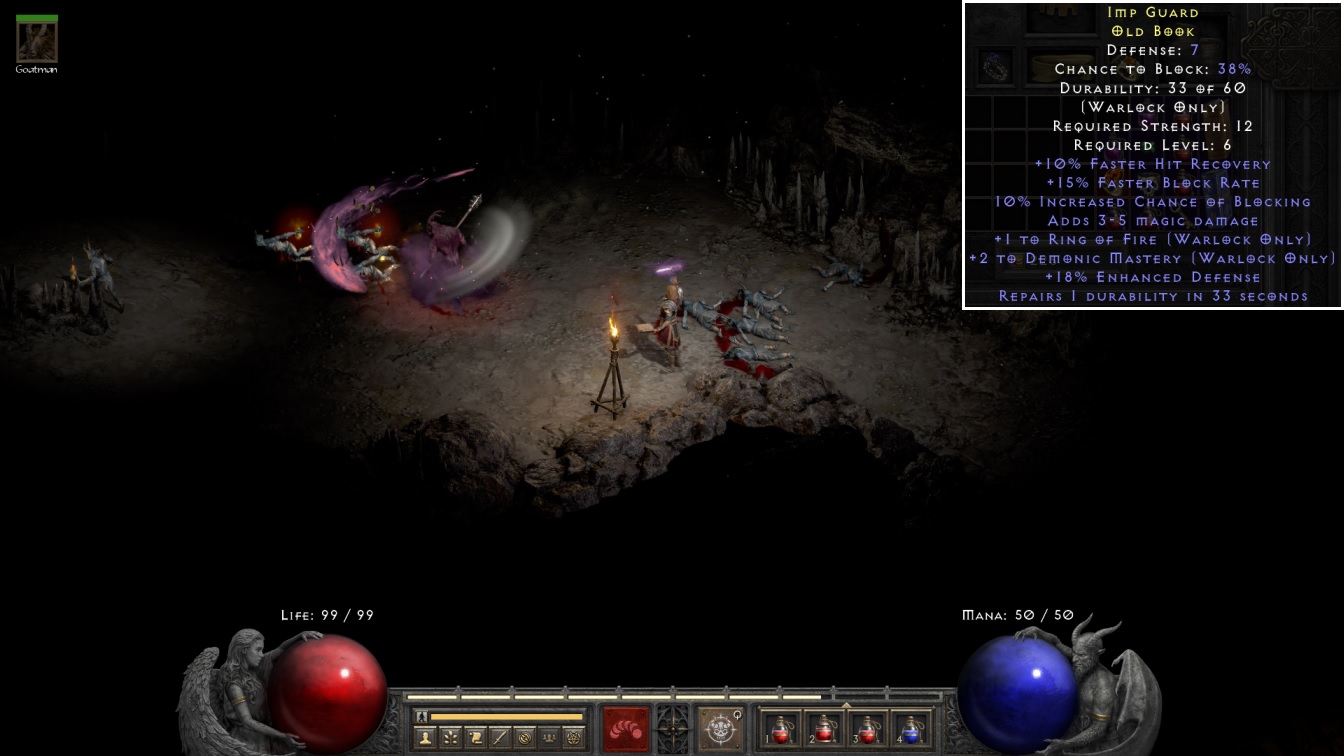
In terms of equipment, Faustus had purchased a basic dagger with +1 Summon Goatman on his first trip back to town. I'm still adjusting to the fact that daggers now contain skills associated with the Warlock class attached, which means that they are always worth carting back to town for sale purposes and of course became highly desirable on this character. I was going to spend some time shopping Akara for a dagger with +3 to Summon Goatman or Demonic Mastery, whichever popped up first, only for that to be unnecessary since a dagger appeared in the Stony Field with +1 to Demonic Mastery and +2 to Summon Goatman. That was plenty good enough for now and I used it for the remainder of Act One. There are also Warlock-specific books/tomes for use in the shield slot which can also have +skills on them for the class. Faustus initially found one with +1 Demonic Mastery, then replaced it with this far superior offering which was dropped by Treehead Woodfist. Imp Guard had some bonuses to blocking and hit recovery along with another +2 to Demonic Mastery. That was more than good enough for the moment until I could find something later that added +1 to the whole Demon skill tree.
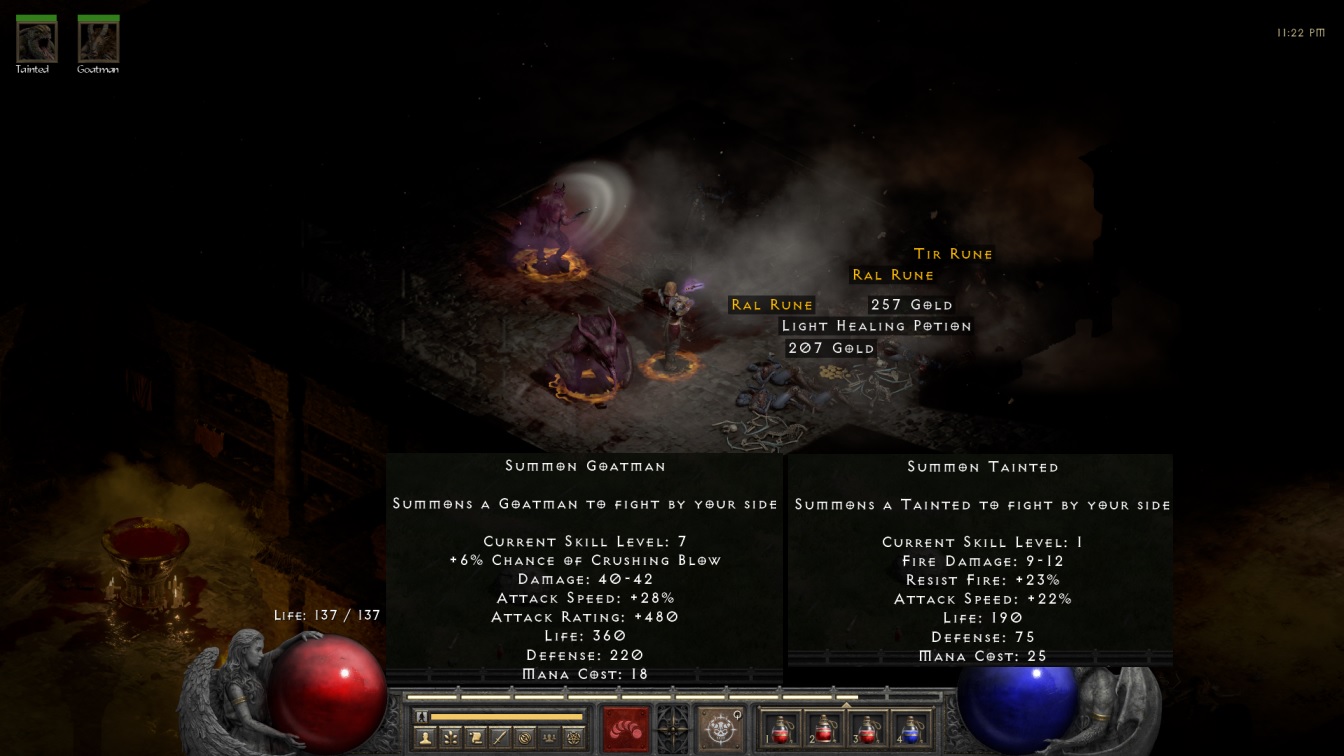
I emphasized skilling Demonic Mastery over the next few levels with the goal of unlocking the second demonic summon. Again, the Warlock class requires BASE skill points, not +skills gear, to enable more demons which was why Faustus still lacked another goatman despite having three extra points in the skill. He reached SLVL 5+3 Demonic Mastery in Tristram at CLVL 10 which allowed for a second goatman minion, immediately doubling Faustus' already fast clear speed. Having two goatmen on hand was a major improvement to Faustus' damage output, not least because they were growing in strength exponentially with points in both Demonic Mastery and Summon Goatman, while also using their skills to roll through monsters. I can't emphasize enough that I barely had to do anything while the two goatman cleared a path through everything, just using Death Mark to ensure that they picked the correct targets while keeping Faustus himself safely out of trouble.
The next milestone level took place at CLVL 12 at which point in time the Summon Tainted skill unlocked for Faustus. This was the ranged minion designed to complement the melee goatmen and I intended these pudgy demons to become the core of Faustus' offense eventually. However, at the moment the tainted demons were clearly inferior to the goatmen by virtue of only being SLVL 1. They had half of the health of the goatmen, a third of their defense rating, and only a quarter of their current damage output. I tested out the tainted for a little bit, including landing this pretty nice rune drop from the Countess, then switched back to double goatmen for the moment since their stats were so much better. I planned to start skilling Summon Tainted to beef these things up, though it was also important to get Demonic Mastery to SVL 10 first to unlock the third and final demon summon. Eventually the tainted would significantly outdamage the goatmen since they benefited from scaling on three skills instead of two (Summon Tainted, Demonic Mastery, plus a damage synergy on Blood Boil) though Faustus would have to wait for the moment until reaching that point.
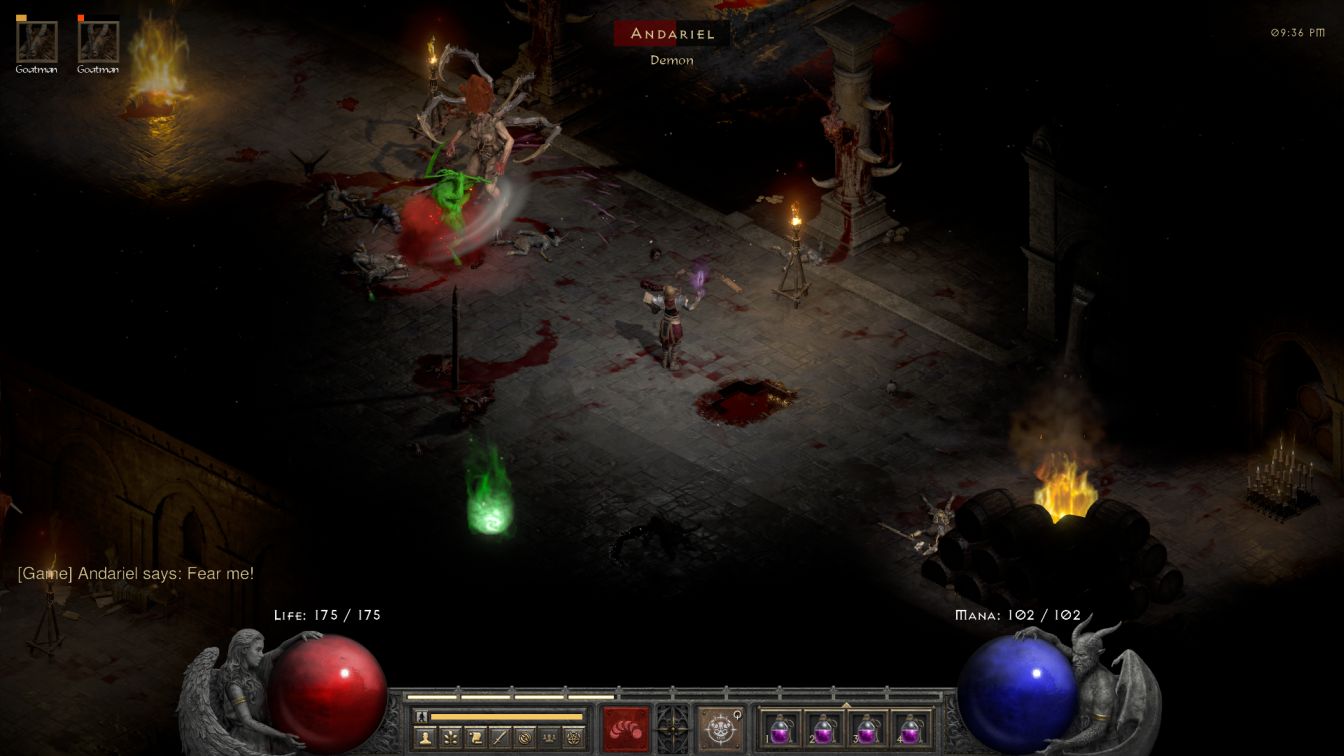
The rest of the Act really did fly past with the two goatman demons hacking their way past all opposition. They were sitting around 50 base damage per attack before accounting for whatever extra effects they received from Frenzy and Cleave and the like, with their damage output high enough to one-shot virtually everything in Act One Normal. Places that are often tricky like the Pit 2 were a total breeze, with Faustus using Death Mark to surgically remove the shamans and walk easily down the steps in the wake of his Frenzied minions. The Smith was encountered through a doorway in the Jail and I barely registered its presence before the goatmen hacked it apart in four or five hits. Pitspawn Fouldog briefly chilled the pair of demons before succumbing to more melee blows. On and on it went with Faustus having to do next to nothing while his summons played the game for him. Eventually it would start to get harder so I enjoyed the relaxing pace of these early areas.
Andariel was the only foe who was able to inflict real damage on the two demon summons. Her poison always destroys the various summons of every class and it was no different here, with the two goatman turning green and experiencing their healthbars plummet into the red. For the first time I had to summon more replacement goatman with Faustus as the initial two fell, not that this was particularly difficult to do. Those defeated goatmen were leaving their mark on the Maiden of Anguish though, as she had also lost half of her healthbar before her initial "Fear me!" message had even finished playing and then collapsed into a fiery death a few seconds later. I think that the clear tactic for the Act end bosses will be one goatman summon to distract them while most of the damage comes from tainted demons firing away at a safe distance; I'll have to test that plan against Duriel.
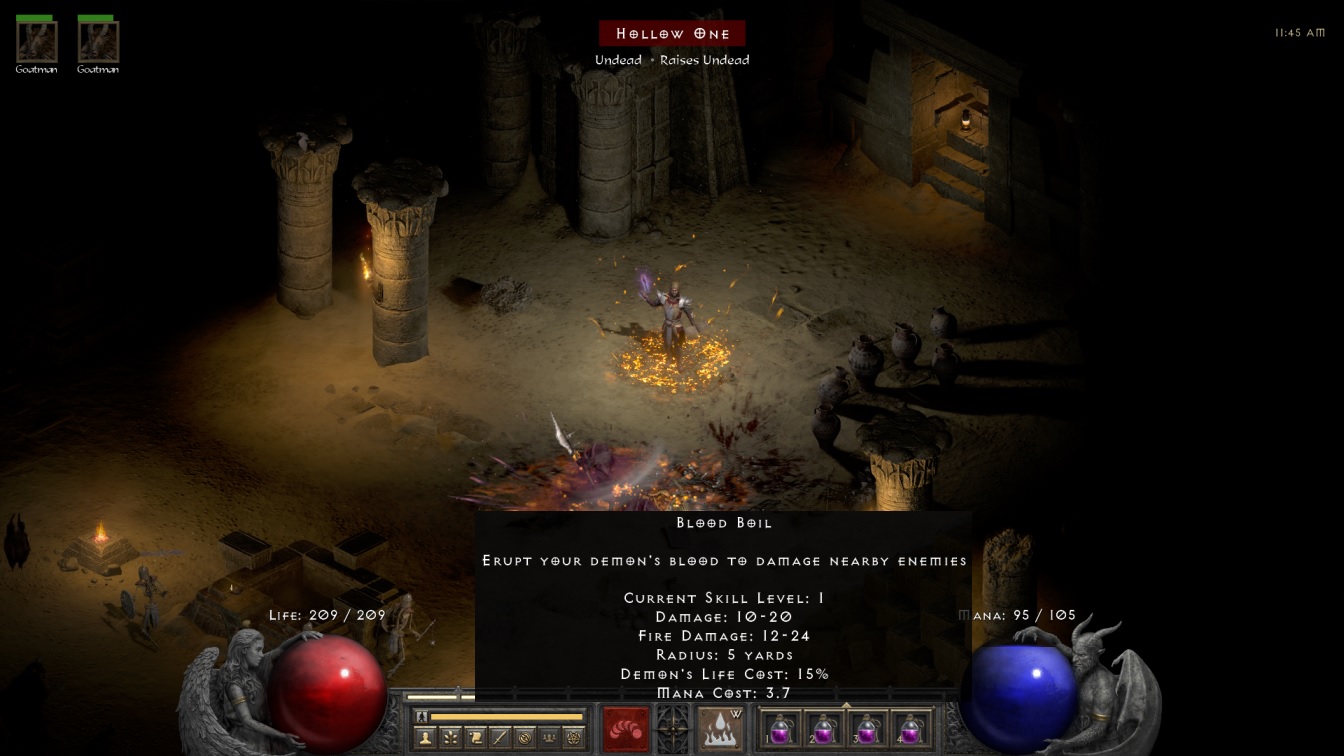
Faustus continued into Act Two where his goatman pair enjoyed themselves smashing apart Burning Dead skeletons in the Sewers underneath Lut Gholein. I lured away Radament's skeleton minions and then teleported the demon minions right into his face with Death Mark for the easy kill. The outdoor desert areas were easy as always and Faustus quickly cleared a path forward behind his summoned pets. This was where he reached CLVL 18 and unlocked another skill in the form of Blood Boil. This ability damages all of the Warlock's summoned demons on screen in exchange for dealing area of effect physical and fire damage around their position. It is not a targeted skill and the damage simply gets applied automatically around the location of the minions; the whole thing is kind of like a reverse Corpse Explosion where the Warlock is detonating his own minions rather than bodies on the ground to deal that physical / fire combination that Necromancers have been using for decades.
I experimented a bit with this skill in the desert wastelands and then in the Halls of the Dead. Blood Boil was certainly a fun skill to use and looks like it could legitimately be the core skill of a character build, with the damage reaching something like 2000 fire / 2000 physical on an ability with zero casting delay once buffed up with full synergies and +skills items. The self-inflicted damage to the Warlock's demons actually decreases with more points in the skill, though it always inflicts at least 5% of the demon's health. However, Blood Boil wasn't a skill that I wanted to emphasize with Faustus because I was trying to play through his various summons, not simply use them as target dummies for Blood Boil explosions. My goal was to see how well these demons could actually kill things on their own which meant that I would be refraining from this kind of bonus damage. I would later place skill points into Blood Boil since it has a damage synergy for the Summon Tainted skill, but only for that synergy purpose. Maybe another time I'll explore this ability in more detail.
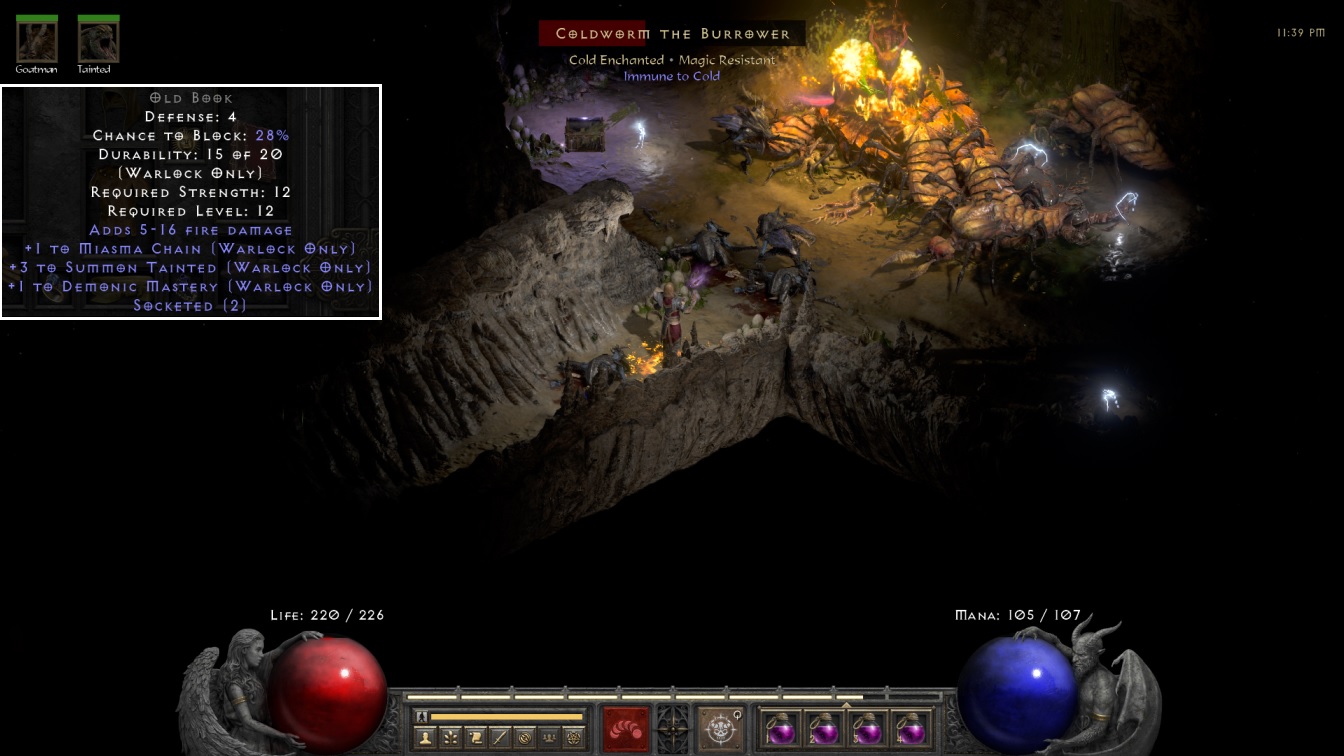
Faustus was continuing to add more skill points into Demonic Mastery for the moment as he worked towards unlocking his third demon summon. I found that these minions handled the tight spaces of the Maggot Lair much better than other summoned pets, with Faustus able to teleport them wherever he wanted using the power of Death Mark. That is a truly insane skill for a summoning build, if I haven't already said so half a dozen times, and I used it constantly for positioning purposes. The tainted demons also turned out to have piercing property on their firebolts (which I had not expected) causing them to pass right through the beetles and maggots hanging out in the tunnels. This was useful enough that I switched over from two goatmen to one goatman and one tainted since the ranged demons were so well suited to the Maggot Lair. I blinked the pair of them on top of Coldworm and she was dead in mere seconds from their damage - that focused targeting on the demons makes them really strong against bosses since they don't get distracted with diversions.
There was also a new item drop that caused me to switch up my demon summons. This incredible Old Book appeared that had +1 to Demonic Mastery along with +3 to Summon Tainted, plus two empty sockets as well! That was about as good as I possibly could have expected to find and could legitimately be an endgame piece of gear if I were to make a Splendor runeword out of it. I decided that it would still be better to create a Spirit shield for this character, even at the cost of having to sink an extra 120 stat points into Strength, simply because Faustus rarely took hits and didn't need the extra Vitality, but it was a close enough choice that I wavered back and forth a bit. I also shopped the merchants in town and turned up a dagger with another +1 to Demonic Mastery and +2 to Summon Tainted, for 5 extra skill points on the ranged demons. This flipped the math from earlier and now the tainted were far stronger than the goatmen, with more health and damage and even armor, thus I swapped over to an all-tainted setup for the moment.
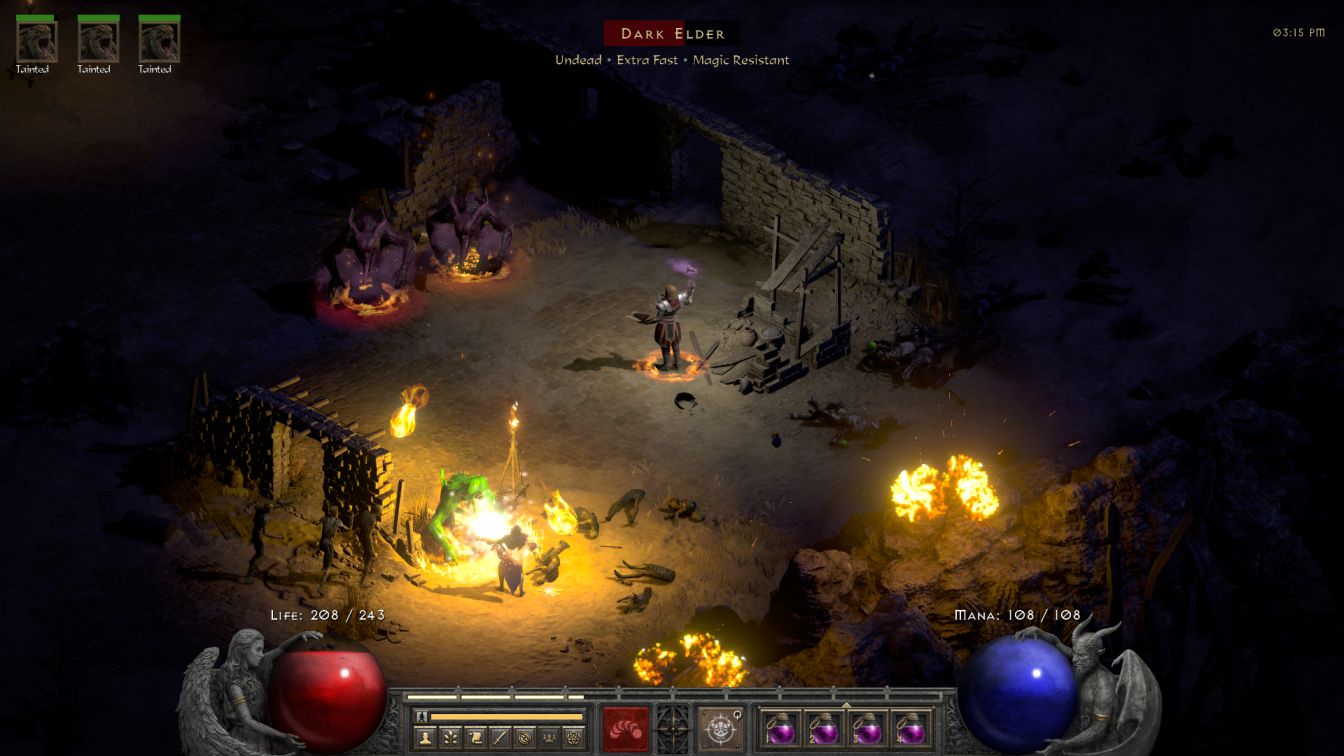
At the same time, Faustus also reached 10 base skill points invested into Demonic Mastery to grant his third and final demon summon. Therefore he now had triple tainted minions at his disposal while clearing the Lost City and Claw Viper Temple. And... IT. WAS. AWESOME!!!  The tainted raced around shooting off fireballs at a very fast rate of attack. Those fiery bolts pierced through anything that they hit and dealt massive death to anything unfortunate enough to be standing in their way. Whenever an enemy mob started to collect together, the tainted would blast the living daylights out of them and send them all collapsing to the ground in a split second. To put some numbers on this, each of the tainted was dealing about 80 damage per shot at a rapid rate of fire against monsters that almost uniformly had under 100 HP and zero fire resistance. Plus Faustus could teleport the tainted wherever he wanted on screen at the click of a button! The slaughter was just incredible, with normally dangerous enemies like Fangskin dying so quickly that I couldn't even capture a screenshot. Sheesh!
Now you might be thinking, why even bother with the goatmen demons since the tainted seemed like they were so far superior? And for the moment that was certainly true since the tainted were better in every possible way. However, while it may be true that the tainted deal more damage than the goatmen, they also deal a specific damage type: fire damage. Anyone who has spent any time in Hell difficulty knows that heavy fire resistance is extremely common there and outright fire immunity is also widespread. Therefore the tainted can't clear the game on their own (not without the fire sundering charm anyway) and I knew that Faustus would need to fall back on the goatmen at times. I was also planning on using Bind Demon for situations where both fire and physical damage weren't good options though that would have to wait until reaching CLVL 30.

The Palace floors can often be difficult for ranged spellcasters due to their blind corners and the prevalence of skeleton archers lurking down there. They weren't an issue though for Faustus who didn't need to have line of sight to summon his minions. In the screenshot above, Faustus had used Death Mark to blink his three tainted demons into the room below where they were busy killing everything inside while Faustus caught up on his reading in complete safety. This was really weird from a visual perspective: Faustus couldn't see his demons or any of the monsters inside the room, however he could inexplicably see the fireballs shot by the tainted and then view the death animations of the creatures that they slew. Video game logic at its finest, I guess. This ability really trivialized the Palace levels and then I abused it again in the Tombs of Tal Rasha. Unopened door up ahead? Send in the demons without even needing to see what's inside! I'd probably need more tactics as the difficulty level increased but this was just silly for the moment.
It was dawning on me that the summoning Warlock appears to be just a better version of the summoning Necromancer, with the two classes functioning similarly but the Warlock having it easier in every way. The goatman and tainted demons are much better statwise than the melee skeletons and necromages raised by the Necromancer, plus they aren't limited by needing the presence of corpses to raise! Yes the skeleton minions can have larger numbers than the demons but that largely serves to make them more unwieldy and difficult to control, with nothing like Death Mark to teleport them or Engorge to heal them. Blood Boil feels like a better version of Corpse Explosion that doesn't require having bodies to detonate, Bind Demon is a better version of Revive, and so on. Don't get me wrong, I love the Necromancer class but it still feels like the Warlock was deliberately engineered to be an overpowered version of this existing character archetype.
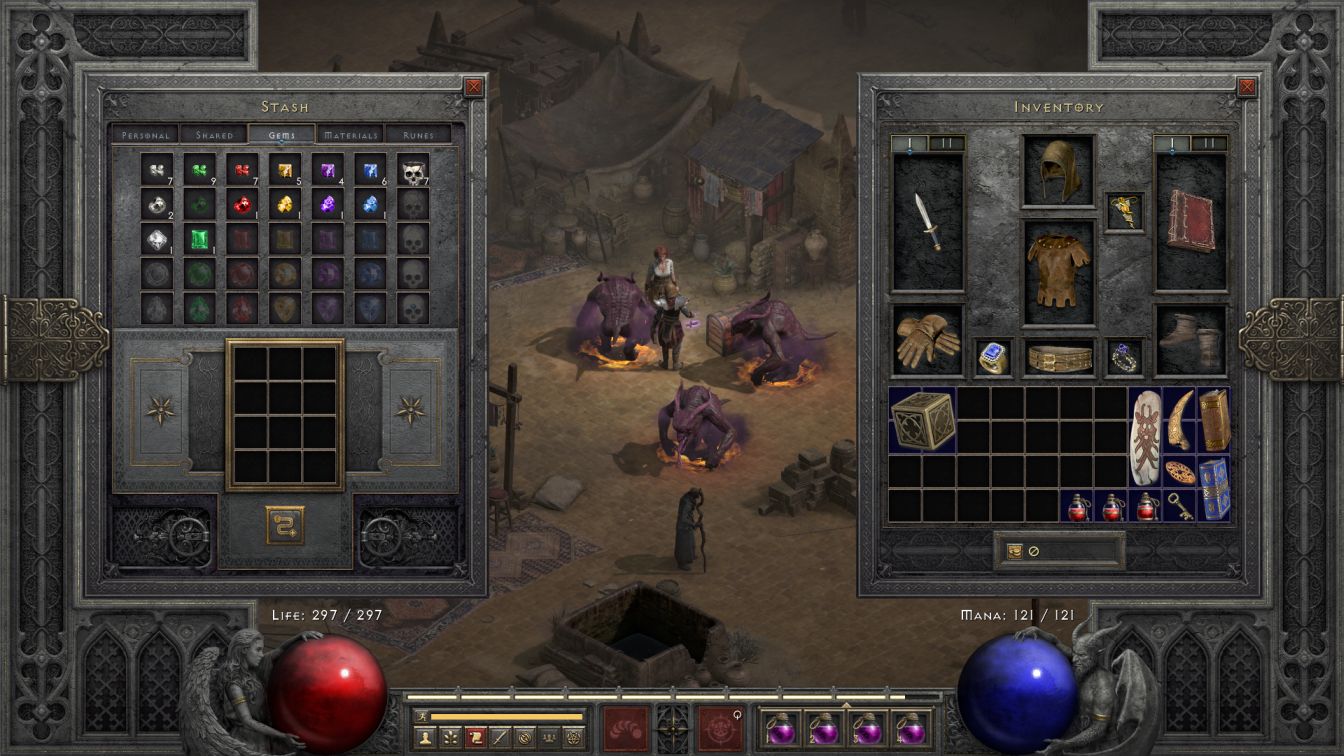
Balance concerns about the Warlock class aside, this update to Diablo 2 Resurrected was more than worth purchasing due to the improvements to the stash system. For anyone who missed this portion of the DLC announcement, the Reign of the Warlock update adds these tabs to the stash for gems, crafting materials, and runes. The new system allows gems and runes of the same type to stack on top of one another, which is a MASSIVE improvement over the limitations that have been in place since back in 2000. Every one of my solo characters always had to tie up huge amounts of stash space by ensuring that they had at least one copy of every gem at every tier (since some of the crafting recipes require them and you don't want to have to wait three acts for a Flawed Sapphire to drop) and then I would always hold an extra 15 full rejuvs for emergency situations. Plus each character would need to hold several copies of every rune since you never knew when a high end rune would drop and then suddenly you need an Ith rune or something... it was a freaking nightmare!
This situation is infinitely better now as everything stacks neatly together without taking up room. Faustus simply brought all of his gems and minor rejuv potions and runes back to town where they could be grouped together by the dozen. To make things even easier, the updated stash also links together with the Horadric Cube so that the player can Cube things together right on the gems / materials / runes screen without even needing to open the big square device. For someone who operates off limited resources like me, this should make it much easier to use crafting recipes as my characters don't need to occupy 15 stash tiles holding various stages of rubies for use in making Blood items. It's one of those things where you simply cannot go back to the old system after getting a taste of the updated interface - many thanks to the developers on this one! 
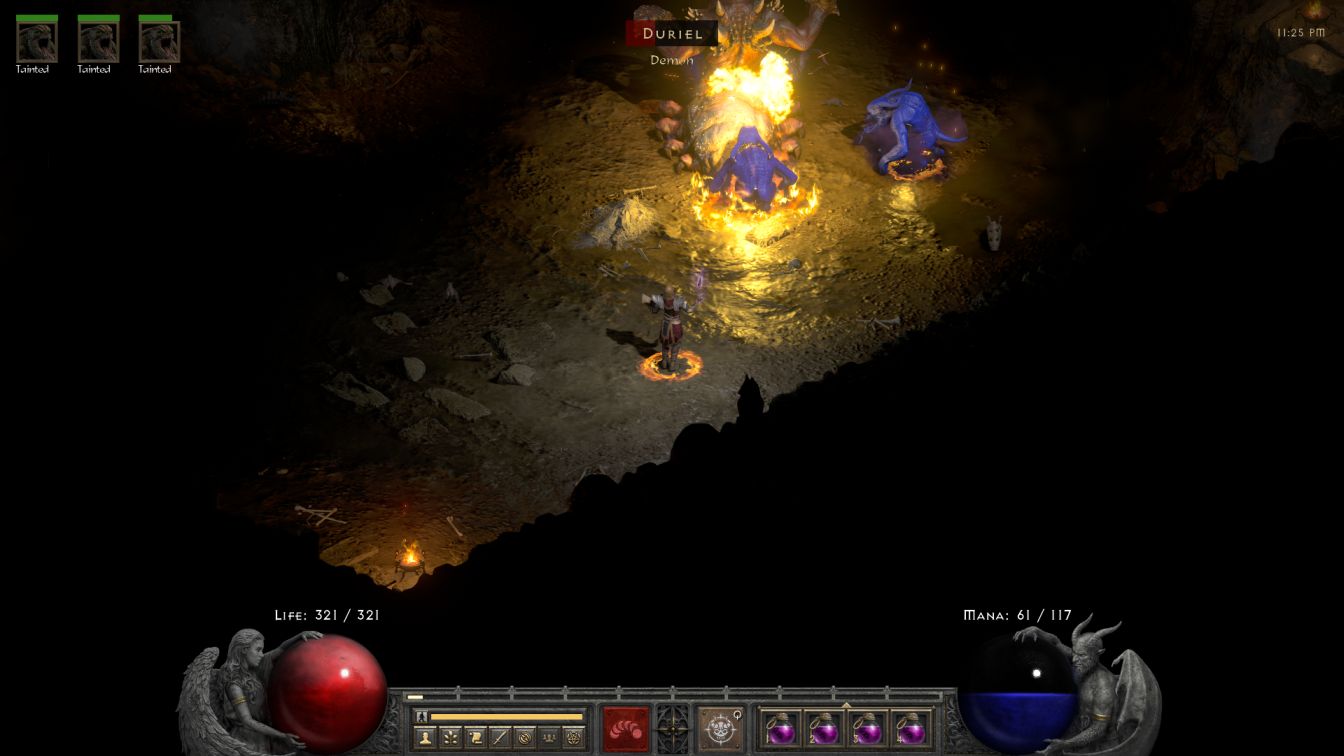
In gameplay terms, Faustus blasted his way right through the second half of Act Two about as fast as any character of mine has ever gone. I full cleared everything from the start of the Palace to the end of the Act in under two hours, and remember, that meant completely emptying out all four quadrants of the Arcane Sanctuary along with all six of the False Tombs in addition to the True Tomb. Most everything died in seconds (with the Summoner dying offscreen before I could even get Faustus into view) and Fire Eye stood out because his 75% fire resistance allowed him to last for about 15 seconds. There wasn't enough fire resistance here in Normal difficulty for the monsters in the Arcane Sanctuary to slow down Faustus and then everything was mowed down in the various Tombs without issue. Burning Dead skeletons had 50% fire resistance... but they also only had 50 HP and easily fell in two tainted shots. Whenever an Unraveler appeared, Faustus used Death Mark to teleport his demons right onto them for the instant telekill. I barely even managed to get a picture of Kaa before the overeager minions tore him to shreds.
Duriel fared a bit better while still remaining far short of a real challenge. His Holy Freeze aura notably reduced the attack speed of the tainted and his melee attacks dealt enough damage that he was able to start downing them. Faustus' demons had been so sturdy that it was a bit of a shock to see their healthbars drop into the yellow and then red zones. However, these were not Necromancer skeletons and Faustus simply summoned new tainted demons to replace the ones that fell, trying to target them outside the range of the freezing aura if possible. Duriel managed to defeat two tainted before collapsing under the fireballs of their brethren.

The jungles of Act Three played out similarly to the back half of Act Two, with Faustus' trio of tainted demons relentlessly running over everything in their path. The jungles tend to have lots of low health enemies present between the fetishes and flayers and mosquitos and gloams, all of which would die from a single fireball launched by any of the minions. Here in Normal difficulty there was barely any fire resistance at all which meant that Faustus often passed through these areas at a run, stopping only to search through the treasures left behind from defeated foes. The tainted still continued to take virtually no damage whatsoever and were effectively immortal against this level of monster threats. Faustus could summon them once at the beginning of a gaming session and have all three of them still alive an hour later. The whole thing was about as easy as this game ever gets.
The underground portions of the jungle didn't have any noticeable differences. Yes, the spiders took two tainted shots to defeat, but that wasn't exactly a serious danger. Everything was still dying so fast that it was tough for me to capture boss screenshots before they were splatted on the floor. When Faustus reached the Flayer Dungeon, I found to no surprise that the demons were very good at stopping the undead exploding dolls from hitting Faustus himself. He could cast them ahead into the next room or around corners into blind spots where they would start firing to indicate that danger was present. Or if the undead flayers charged out from an unexpected direction, a fast Death Mark could reposition the tainted directly into the path of the tiny dolls where they would detonate in safety. I was on total cruise control until making it down to the bottom of the Flayer Dungeon and finding this obstacle:
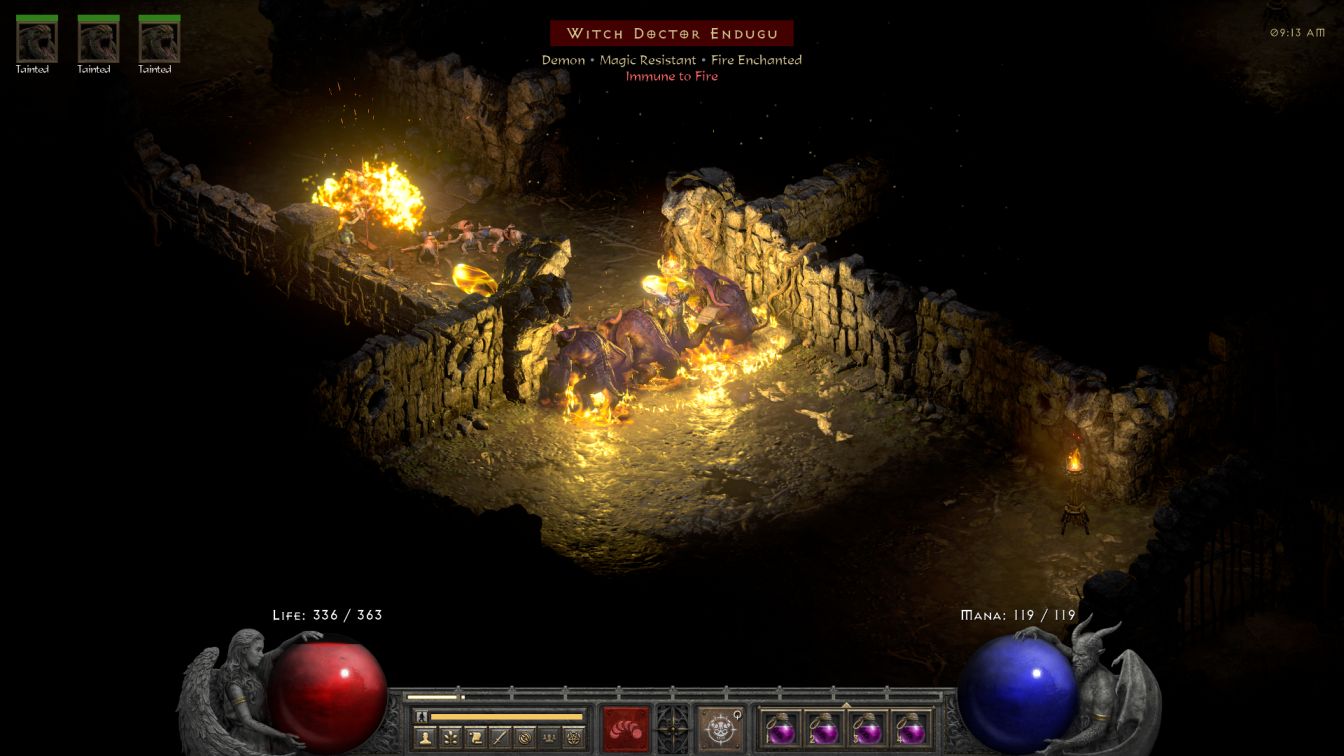
Witch Doctor Endugu is always Magic Resistant / Fire Enchanted to create a permanent fire immunity - whoops. This meant that the tainted that ripped apart everything else were totally useless against Endugu; I watched them attack fruitlessly for a little bit just to verify that the demons only dealt fire element damage. Fortunately Faustus had a solution as he could simply replace the tainted with his old goatman demons, with the melee creatures dealing less than half the damage but attuned to the physical type so that it actually made it through to Endugu. See, there was a real need for the goatmen after all! (I wrote that earlier paragraph before running into Endugu but it certainly proved to be prescient.) This was going to happen more and more as Faustus progressed further into the gameplay, with more and more fire resistance on the various enemy types. One of the fun aspects of the Warlock class is that it can change its minion composition on the fly since there's no need to worry about having sufficient corpses present.
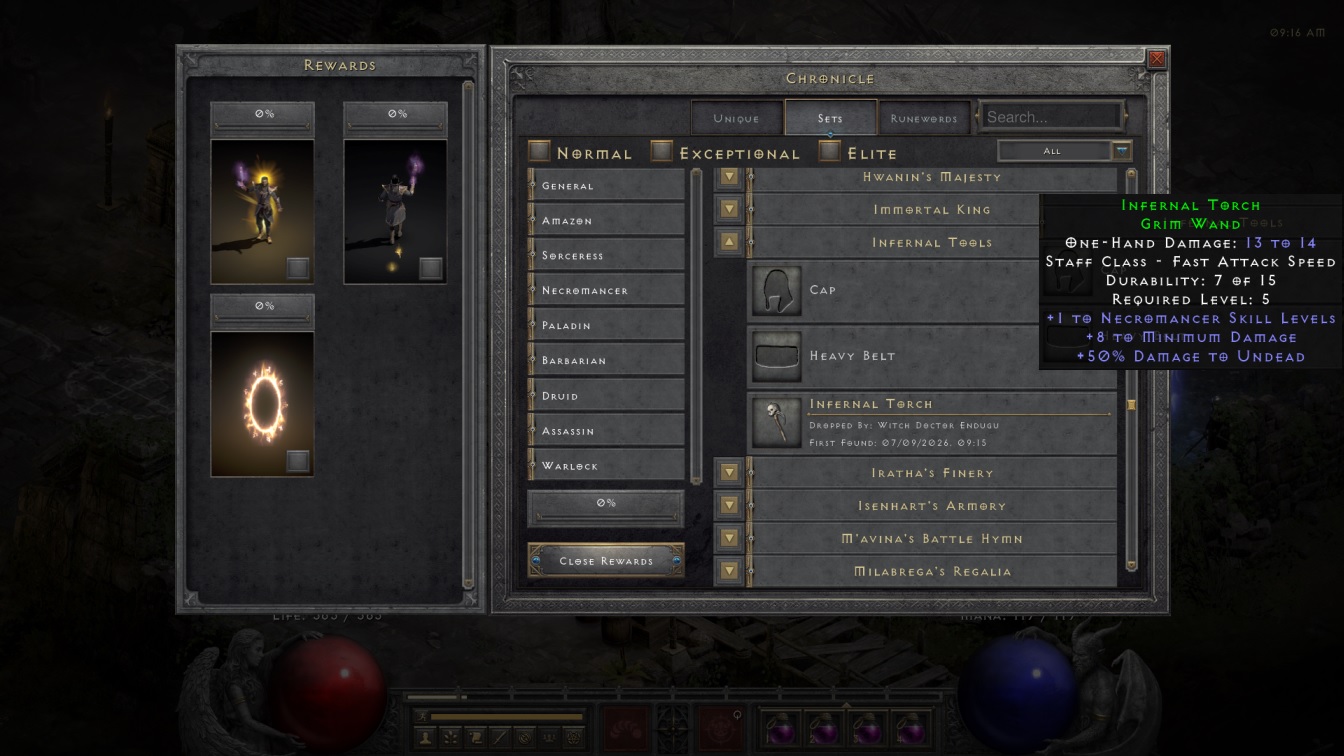
Endugu was noteworthy for another reason as he personally dropped the first unique item of Faustus' journey. This was the Infernal Torch set item from the Infernal Tools set, intended for a Necromancer and not something that would be useful for Faustus. It allowed me to showcase another new feature from Reign of the Warlorck in the form of this Chronicle menu. The developers added this lorebook that tracks every unique item, every set item, and every unique runeword that the player has found across all of their various characters. There's even a graphical set of rewards for finding everything in each category, like a glowing aura for discovering every unique item and a burning town portal for making or finding every runeword. That would never happen for me, of course, as it's virtually impossible to find all of the high-end stuff without doing a *LOT* of trading with other players online. (There are now three different runewords made out of the Zod rune - have fun making all of them on your own!) None of this is necessary or affects the gameplay in any tangible sense but it's definitely fun to see these items popping up in the Chronicle as your characters discover more uniques.
I cleared most of the jungle in a single gaming session with Faustus and continued onwards into Tristram. Stormtree at the gates was another boss with no fire resistance who I couldn't even capture in an image before it had been defeated. The denizens of Kurast also kept collapsing immediately to the tainted trio, with the zealots unable to flee when they fell low on health and the sextons left with nothing to revive. They might be harder on the next difficulty level but didn't do much of anything here in Normal. Faustus also finally turned up a Tal rune in the Kurast Bazaar to make his Stealth armor; he had already found three Rals before he managed to get the first Tal, heh. He lacked an Eth rune but that was fixed by Cubing three Nefs together; at one point, Faustus literally had multiple copies of the first eight runes except zero Eths and zero Tals. Although Stealth didn't fit the character build for Faustus that well, the 25% faster movement and 25% faster hit recovery were better than anything else I'd found in the armor slot thus far. Now he needed to keep an eye out for Hel and Shael runes to make the new Warlock-based Authority runeword which would likely happen at some point in early Nightmare.
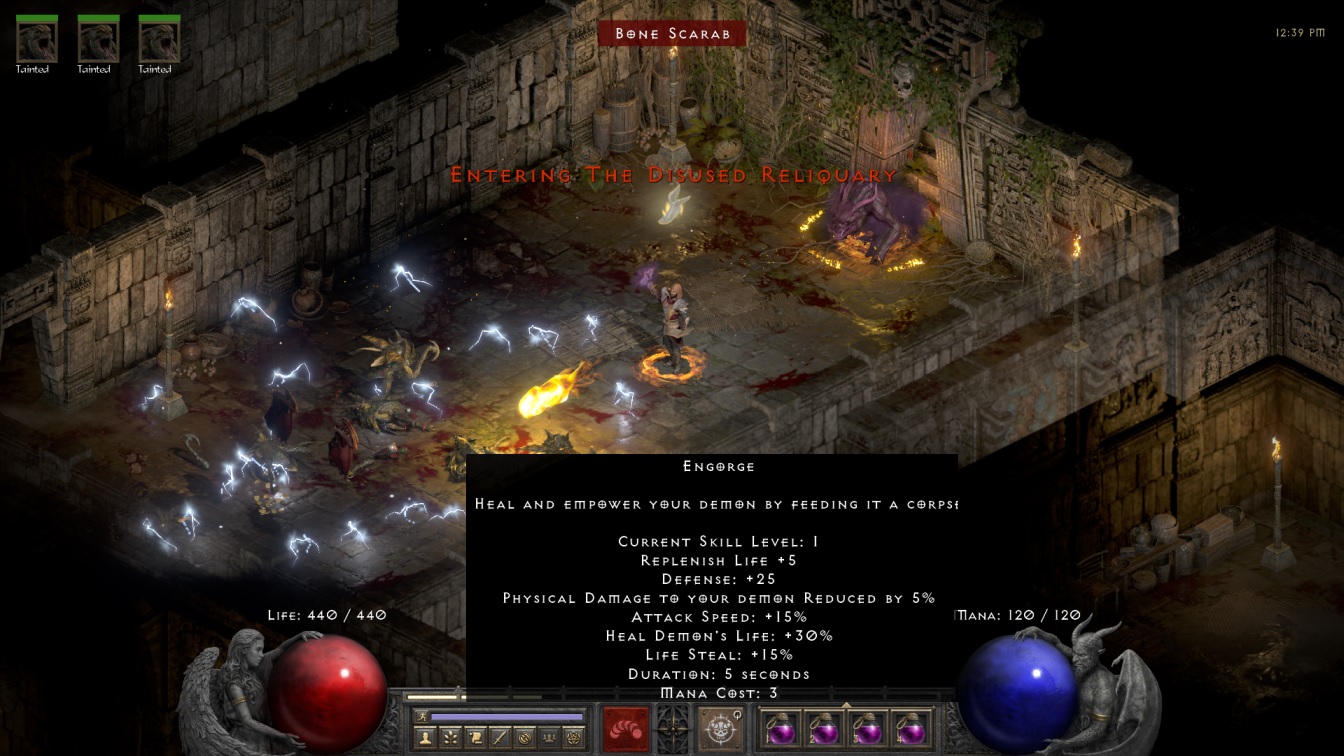
Summoning character builds tend to be some of the safest and easiest to deal with the stairs traps that are so common underneath Kurast. This was very much the case in the Ruined Temple where there were bunches of Flesh Hunter corrupted rogues jumping Faustus as soon as he entered the subdungeon. The tainted blasted a path through them and took most of the hits intended for Faustus in a scenario that could have been ugly on a higher difficulty. The rest of the place was much easier and Sarina never managed to get anywhere close to Faustus. Most of the other Kurast Temples were relatively tame this time around and several of them had no monsters lurking at the entrance at all. The pictured Disused Reliquary was probably the worst one after the Ruined Temple and it was handled without much fuss. One minor issue with the tainted is that their ranged attacks sometimes causes them to clump up on top of one another; this happens more frequently when teleporting them with Death Mark as they all lock onto the same new target simultaneously. I generally preferred for them to spread out since that made them more effective at tanking incoming threats to Faustus.
I also highlighted a new Warlock skill that Faustus had aquired at CLVL 24 though this one was used mostly for prerequisite purposes. Engorge does the opposite of Blood Boil, healing the Warlock's demons by sacrificing a corpse. The chosen monster remains don't have to be near the summoned demons who get a series of decent stats: an instant heal along with attack speed, life steal, and physical damage reduction. The mana cost was dirt cheap at 3 MP (all of the Warlock utility skills seem to cost virtually no mana) though unfortunately the duration was extremely short for the moment at only 5 seconds. I didn't bother using Engorge right now because the tainted demons were simply killing things too quickly; they never needed the health restoration or any of the extra stats. This would become a more useful ability as Faustus gained some +skills equipment to extend the duration since I wasn't going to drop more than the single skill point into it. I also thought this could be very useful against later shamans and greater mummies to clean up the corpses left behind by their minions and prevent revivals, we'd have to see what later difficulties would bring there.
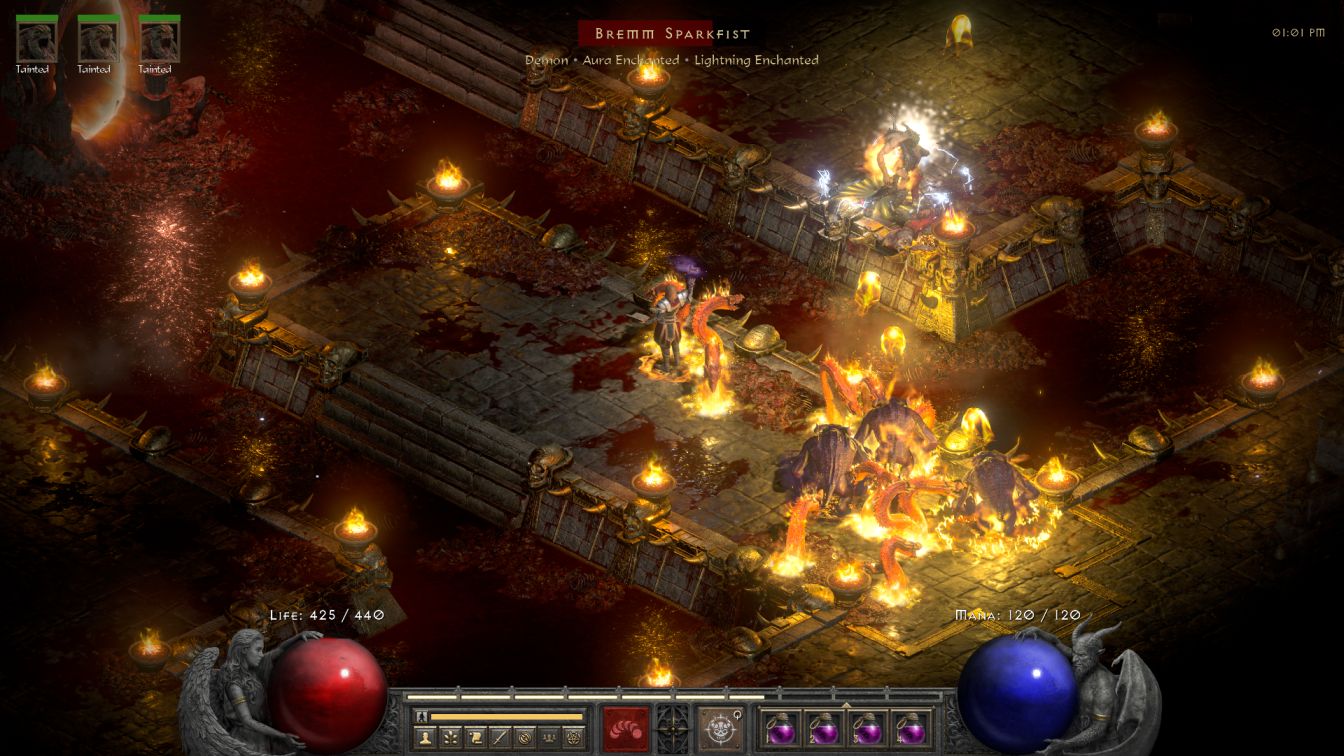
Travincal was a lot of fun with this character, as demon fireballs were pitted against hierophant blizzards and vampire meteors. None of the normal enemies in Travincal had any fire resistance which meant that everything still died in two shots and the city's defenses rapidly crumbled before Faustus' assault. Geleb was the first Council member to chase out of the central building and he took the longest to kill thanks to his own Fire Enchanted trait. I replaced one of the tainted with a goatman temporarily which sped things up considerably. This was Normal difficulty which meant a small-sized Durance 2 which Faustus was able to clear quickly. He was using Death Mark to toss the demons into each new room before entering which once again really cut down on the danger from the undead stygian dolls (which were present on both of the two Durance floors). I was able to full clear the pair of them in ten minutes of real world time, heh. Some of my solo characters have spent more than three hours on Durance 2 alone in Hell difficulty.
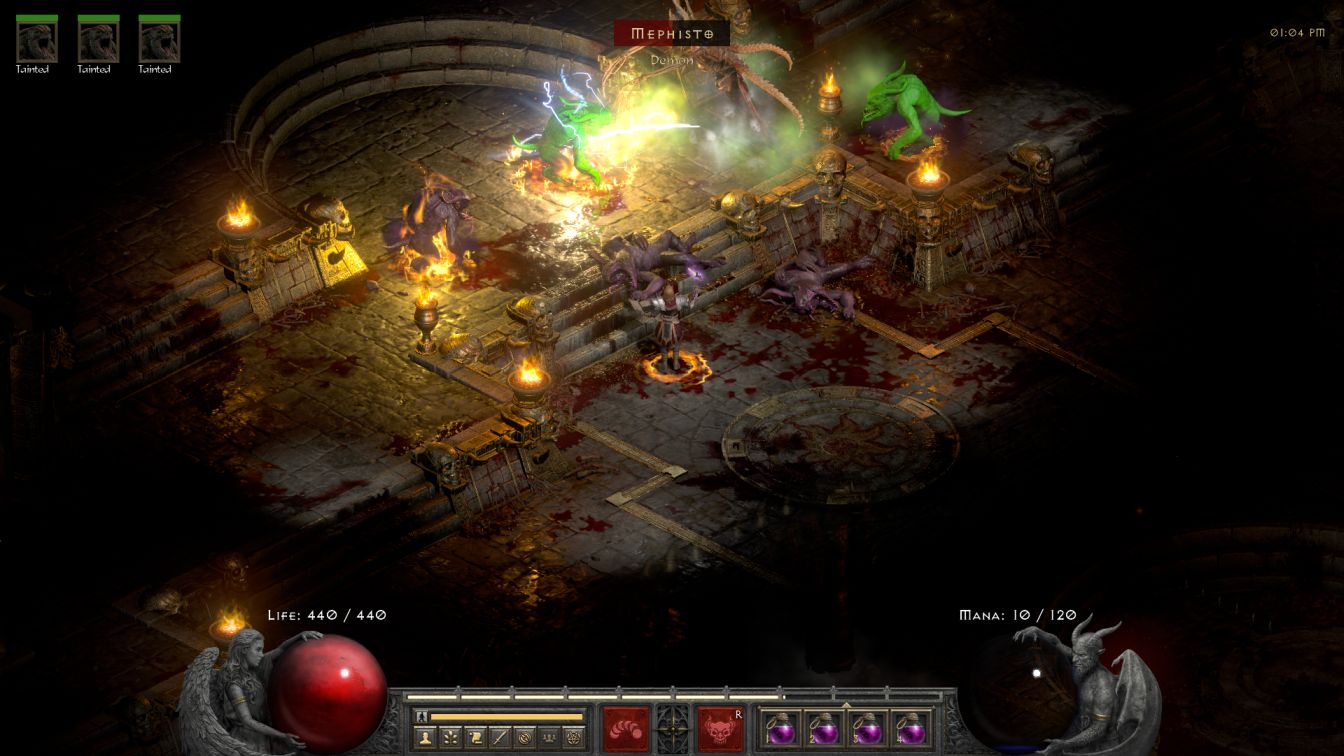
There was a crew of vampires near the stairs on Durance 3 which were rapidly dispersed followed by Faustus managing to catch Bremm and his minions on the opposite side of the central lava pool. This was one of those fun moments where Faustus had ranged minions and the enemies on the other side were stuck with only melee damage - sucked to be them! Maffer and Wyand fell quickly on their respective sides and then it was time to face Mephisto. He also had the act end boss damage bonus against player minions which meant that the tainted were suddenly not immortal anymore, instead wilting under the poison cloud and lightning bolts of the Lord of Hatred. Faustus watched the initial three tainted perish, then summoned three more which also died... only to realize that I didn't have any mana potions on hand to summon more of them! Whoops.  The gameplay had been so easy that I hadn't been bothering to carry the blue potions. That was fixed with a town portal resupply trip and then the tainted minions downed Mephisto shortly thereafter. I should have used some of the vampire corpses on the ground nearby to cast Engorge which would have been useful for the minion healing.

Act Four is often where the gameplay starts to get serious and that was very much the case for Faustus. He was still relying on his tainted minions only to run smack into the reality check of heavy, heavy fire resistance on the denizens of hell. Even here in Normal difficulty the Venom Lords had 70% fire resistance, the Doom Knights had 80% fire resistance, and even the ranged finger mages had 40-50% fire resistance as well! This didn't stop the tainted from being able to defeat the local monsters and in fact they remained virtually untouchable due to having more than 700 HP apiece (!) here on the initial difficulty level. However, it did take them significantly longer to down these fire-resistant opponents with as many as five or six shots needed for each Venom Lord. The process was slow enough that I could take my time acting as a combat reporter and snap zoomed in screenshots like the one above, which wasn't really possible when everything was falling in a single hit earlier.
The first few outdoor areas passed by quickly for Faustus. Izual took about a minute to defeat with his enormous health bar while doing nothing whatsoever in terms of damage. There were Stygian Hags present in the City of the Damned which fortunately had no fire resistance and therefore died quickly even with their minion spawning. The piercing property on the tainted fireballs was really helpful against this enemy type. There were also Damned demons in the City which had the same graphical depiction as Faustus' tainted minions aside from slighly different coloring, demonic brother against brother action! Meanwhile, Faustus managed to find a dagger with the Fiendish affix on it for +1 skills in the Warlock Demon tree while shopping the town vendors. That would have been great, except that it was on a Blade weapon that required 51 Dexterity so Faustus would have to pass.
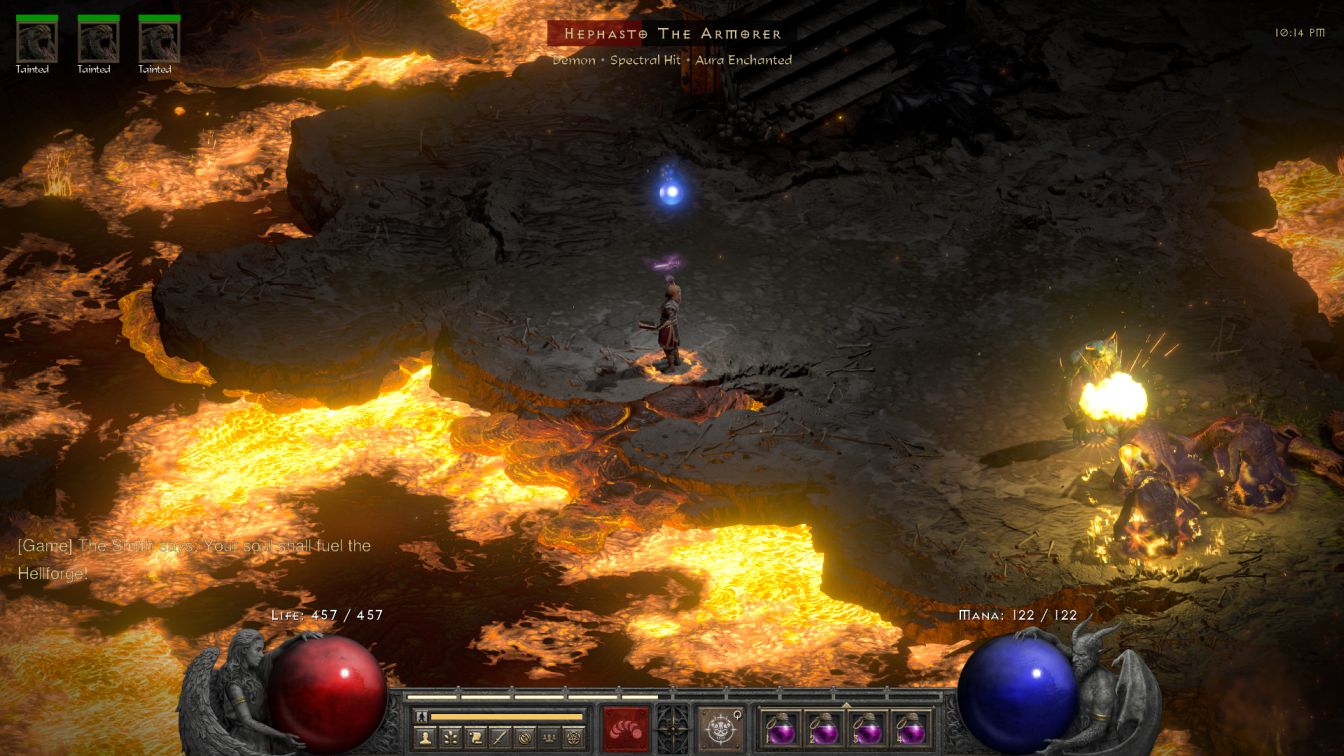
The River of Flame annoyingly contained both Grotesque breeders and Blood Maggots which made for tons of hostile enemy minions crawling around. The tainted handled them pretty well thanks to their piercing damage and I think the goatmen would have struggled here. Hephasto was shockingly easy due to his weak (20%) fire resistance and inability to get anywhere near Faustus himself, with the forge demon failing to scratch the tainted summons much less come close to slaying any of them. The Hellforge quest reward had both good news and bad news: the good news was a Perfect Diamond which could be slotted right into Faustus' offhand tome for 19% resist all, nice! The bad news is that the rune drop was an El rune, the single lowest tier rune possible that could have appeared. Well it's the Nightmare and Hell quest rewards that actually matter, not the Normal one, though getting an early Sol or Amn rune would have been nice. (On that note, a normal Crystal Sword dropped in the River of Flame which should be in the correct item level range to produce 4 sockets for future Spirit use, excellent.)
The Chaos Sanctuary was packed with enemies as always and took a bit longer to clear due to all that fire resistance on every monster type. The opposition was tough enough when the Oblivion Knights appeared that I found myself using some Engorge heals for the first time, removing corpses on the ground for a burst heal on the tainted demons. Although those things were super tanky, they did have an eventual limit to how much of a pounding they could take. Amusingly they were able to tank the entire Infector's mob and down all of the minions plus the boss itself without having to retreat; I thought that Faustus would have to pull them out via a town portal and it simply wasn't necessary. The Vizier was Fire Immune which meant slaying all of the non-immune minions with the tainted followed by replacing them all with goatman who hacked apart the boss in no time at all. I was continuing to drop skill points into both Summon Goatman and Summon Tainted for exactly this reason.
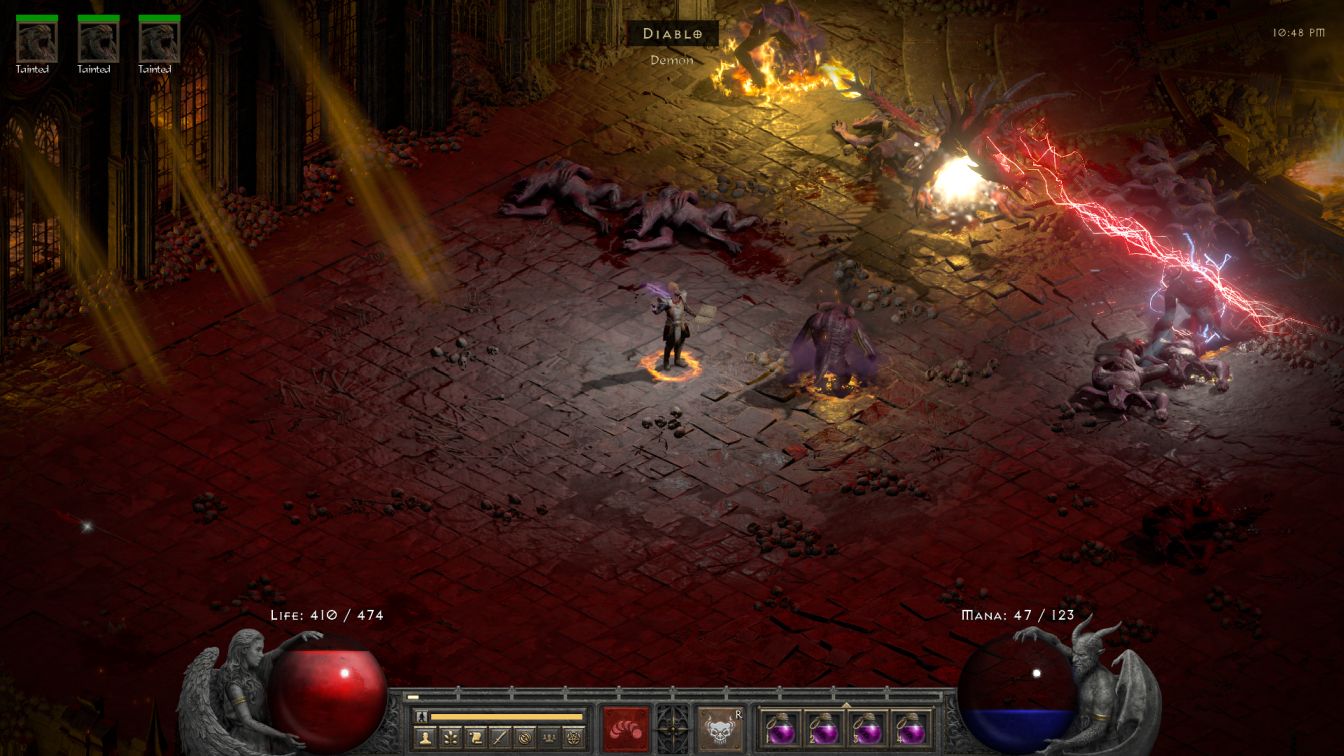
Diablo was a fun challenge for Faustus, one which his minions absolutely could handle while still requiring some diligence on my part. Their fireballs did plenty of damage against Diablo's mere 33% fire resistance and started taking big chunks out of his lifebar, that wasn't the issue. The boss fight required a bit of care because Diablo could smash the tainted very quickly as well, either with his melee attack or more frequently with his Lightning Breath of Doom. That would instantly eliminate any tainted that it hit (since they never bothered to move out of the way) and I did my best to counter by summoning each of the three tainted on a different side of Diablo so that they couldn't be focused together. The River of Flame and Flame Nova attacks used by Diablo didn't seem to bother the tainted, perhaps because they have some innate protection against fire damage, but the lightning breath always splattered at least one of them. I had made sure to bring half a dozen mana potions with me for this opponent, then stayed at a safe distance with Faustus and kept summoning more demons. Faustus never saw his life drop under 400 HP and won the battle in just over a minute of real-world time.
Diablo dropped Sander's Riprap boots which wasn't a great fit for Faustus but was still worth equipping for the moment thanks to the 40% faster run speed. I also want to point out one little tidbit: every time that a demon summon dies, it leaves a body behind on the ground. This technically happens for the Necromancer as well, however it's difficult to see the smashed skeleton bones and leftover ash piles from when a Flame Golem disappears. The tainted bodies were really obvious and piled up in droves where the fighting against Diablo had taken place. You could basically see where Big D had been standing by the stack of tainted bodies on the floor, ugh!
The first few areas of Act Five were easier than Act Four which is normally the case for most builds. All of that mass fire resistance melted away completely and Faustus' tainted minions had a field day against the Enslaved and Death Maulers. The imps in the Frigid Highlands were especially pathetic since they had all of 80 HP and would die to a single fireball. Even the minotaurs in the Abbadon dungeon weren't too bad yet since they lacked any fire resistance and collapsed quickly under a hail of tainted projectiles. Things started getting more interesting towards the end of the Arreat Plateau when Faustus reached CLVL 30 and unlocked his final core skill: Bind Demon.
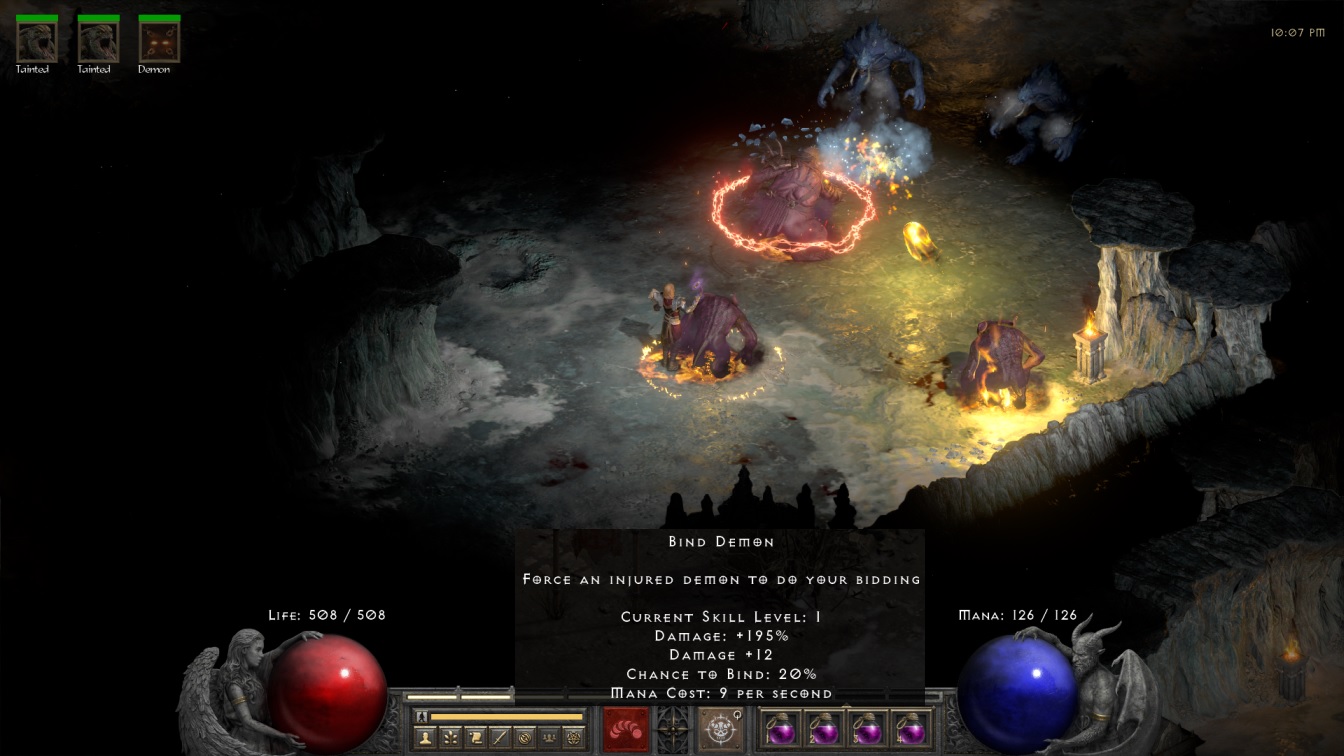
This is easily the most complicated skill in the Warlock toolset and has to fall on the short list of the deepest and most strategically interesting abilities in the whole game. As the skill text indicates, Bind Demon allows the Warlock to take control of an enemy demon and bring it over into his service, thereafter acting like a normal summon. While it only works on "demon" type enemies and nothing else, that still gives the Warlock potential control over about of quarter of D2's monster mix. The actual use of the skill is a bit wonky and it took me some trial and error to figure out how the actual binding functions in practice. To get this to work, the demon in question first has to be damaged (the ability doesn't work if they're at full health) and then the Warlock right-clicks on them with the Bind Demon skill. A red tether then forms between the two of them and the skill attempts to bring the demon under the Warlock's control. It appears to make a check once every second using the "chance to bind" percentage (currently 20% for Faustus) and then keeps making that check repeatedly until the demon dies or is brought under control. The mana cost in the skill description is the per-second cost while attempting to bind; fortunately it doesn't cost any mana once the demon has been captured. Only one enemy demon can be controlled at a time and it's subject to the same limit of three total demons that the goatmen and tainted operate under.
Once the demon has been seized, it uses the actual stats and abilities of that particular monster. This leads to some amusing results, such as the Grotesques from Act Five breeding little pups that also get controlled by the Warlock and the Fallen Shamans from Act One raising fallens that similarly get controlled by the player. Putting more skill points into Bind Demon results in a twofold damage increase, both a flat damage amount (the +12 listed here) and a percentage increase over the base damage of the monster in question. I found that this scaled up the damage of the bound demon very, very quickly to enormous amounts; SLVL 1 had +12 damage but then SLVL 2 had +76 damage! The flat amount would keep going up by 74 damage with each additional skill point which was just insane given that enemies in Act Five Normal only deal about 25-30 damage per hit. More skill levels in Bind Demon quickly turn whatever creature gets bound into a merciless avatar of death.

And fortunately Faustus wasn't lacking for skill points as an Amn rune dropped in the Crystalline Passage and allowed him to socket quest that Crystal Sword from earlier to create his Spirit runeword. (It looked ridiculous having the sword float in midair next to his head, heh.) Even though this was a poor roll on the faster casting speed at the minimum value of 25%, Faustus didn't particularly need speedier casting and everything else here was outstanding. +2 skills was the headliner ability but he also benefited from 55% faster hit recovery, 22 Vitality (66 HP), and 112 more mana. Those extra skill points meant stronger tainted minions, stronger goatmen, more points in Demonic Mastery, and two free ranks in Bind Demon. It was particularly helpful to get more free skill points in abilities that Faustus was never going to level up, stuff like Blood Oath for more life on all of the demons and Engorge for a larger instant heal and lengthier duration. Going up to SLVL 1+2 Engorge doubled the skill's length from 5 seconds to 11 seconds and made it more worthwhile to have the minion buff running in any big fight.
Bind Demon also gets more powerful with additional skill points in two different ways. The first is that the bound demon starts to pick up extra boss affixes: first Extra Strong at SLVL 5, then Extra Fast at SLVL 10, Spectral Hit at SLVL 15, and finally a random aura at SLVL 20. These abilities function exactly the same way as the various boss traits that should be familiar to anyone who has played Diablo 2 and the aura in particular can be really powerful if it rolls something like Might or Fanaticism or Conviction for an elemental damage-based build. The second way that Bind Demon improves is that the player can start taking control of more powerful enemies. Initially the Warlock can only grab your standard monsters, however starting at 10 skill points invested he can take control of champions, then bosses (or officially "elites" in the game's terminology) with 15 skill points, and then finally the "super elite" enemies with the full 20 skill points spent. If you ever wanted to have the Smith or Lister under your control, now you can do it! Somewhat confusingly, +skills gear will unlock the additional boss affixes for the Bind Demon skill but it will not allow the Warlock to control stronger monsters, that requires actual skill points spent. This was a change in patches since the release version of Reign of the Warlock let player stick a single skill point here and control everything with enough high end +skills nonsense which was definitely overpowered.
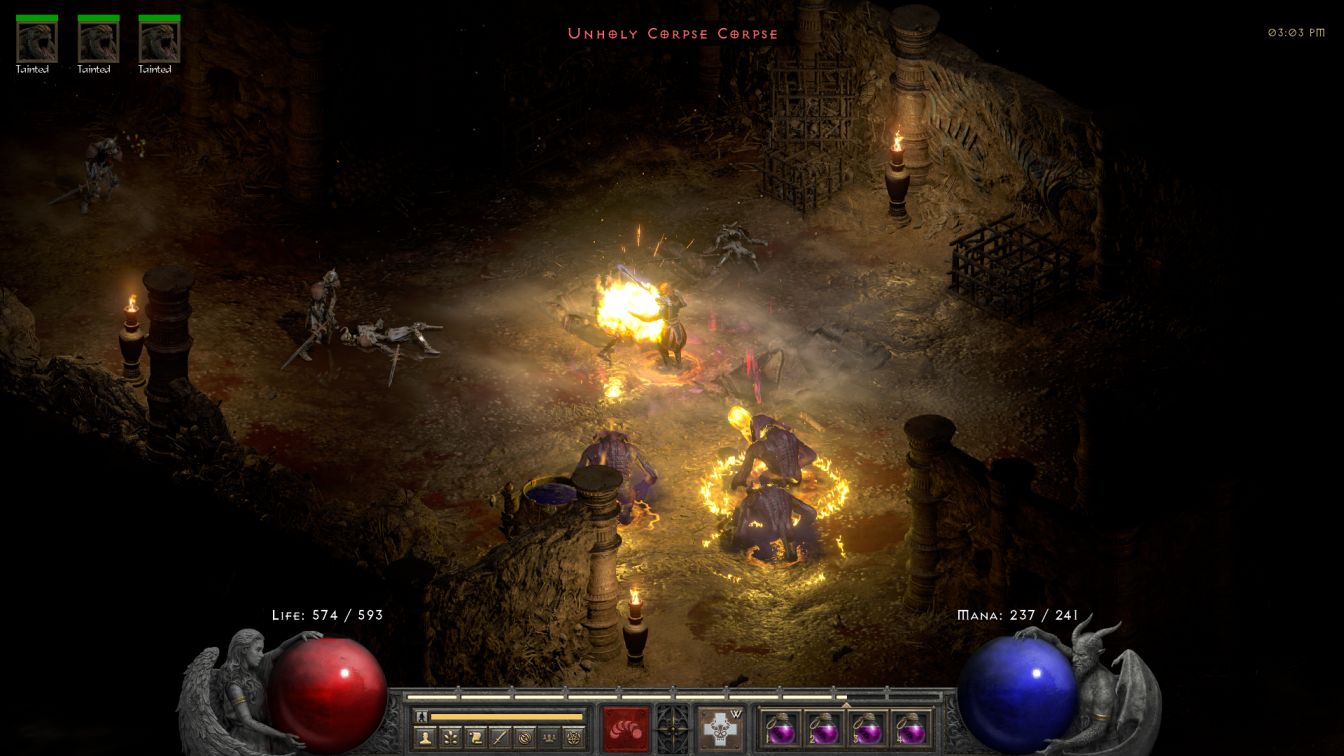
So what's the catch here? There's one very big drawback to the Bind Demon skill: if the demon in question dies, the Warlock doesn't get it back again. He can always bind another target but once a monster is lost, it's gone forever. In that respect the skill reminds me of the Iron Golem summon for the Necromancer. Some players with very elite gear can make an iron golem out of something really expensive and have it stick around for game after game, persisting between sessions as long as it doesn't perish. That's the same deal here although more realistically the demons that Faustus would be binding wouldn't benefit from SLVL 45 skills and would not have that kind of functional immortality. I expected that I would be changing the bound demon pretty frequently whenever it fell in combat which seemed like it would be a lot of fun. Now there was more of a use than ever for the Engorge skill and its healing powers, since Faustus could use it to extend the life of his bound demon. Plus he would always have his goatmen and tainted minions to fall back upon if there were no demons available to bind, all of which made for a fascinating summoner build that kept me on my toes.
I had some success at using an Overseer demon for quite a while in the ice caverns during the middle portion of Act Five. Eventually it died against a Death Slasher boss (one of the underground tentacle monsters) at the end of the Glacial Trail since their ability ignores all defensive rating. I was going to replace it during Nihlathak's Temple only to discover that there were no demons inside it whatsoever, not here in Normal difficulty, and therefore ended up clearing the place with three tainted demons instead. Faustus spent most of his time using Engorge to clear the corpses of the Prowling Dead to stop them from rising again, which was tedious but not as tedious as having to kill them a second time. Engorge was the star of the show as well against Nihlathak, clearing the ground and denying fuel for his Corpse Explosion. The tainted tore through his protecting minions and then fireballed the traitor to death as well.
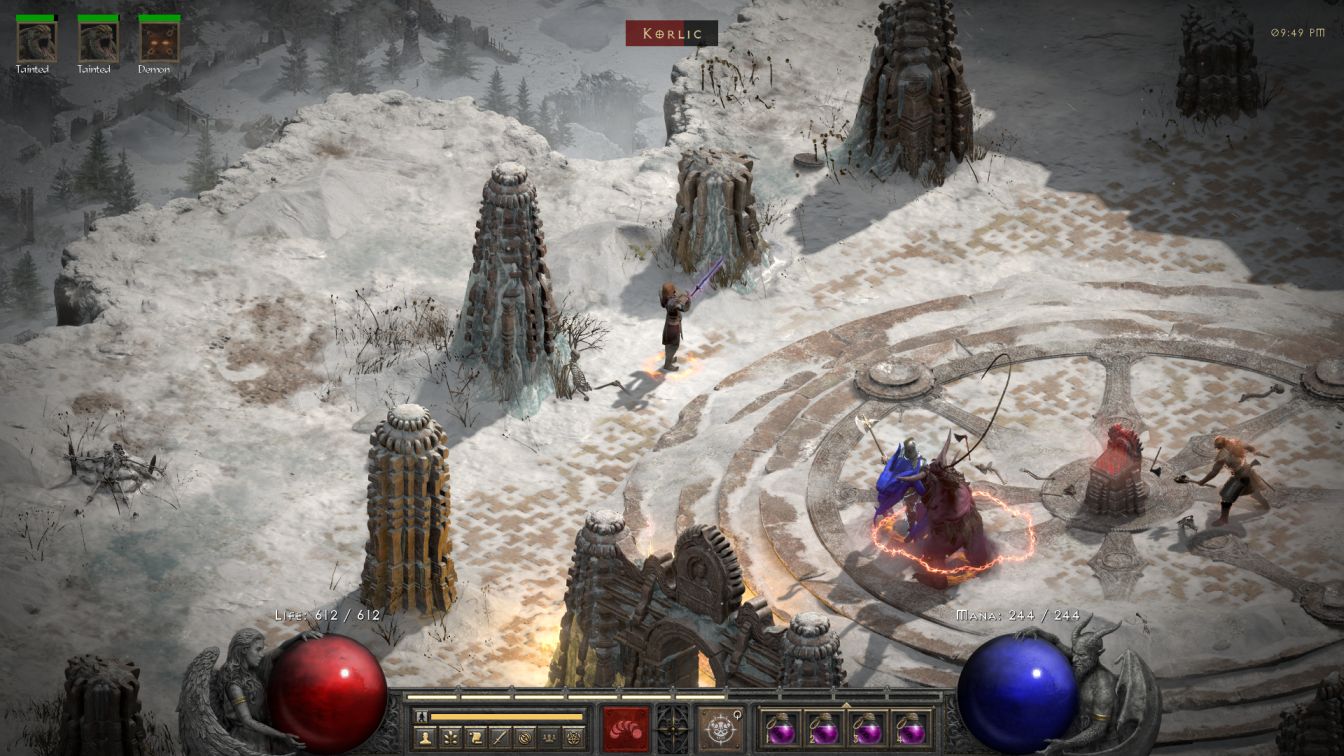
The remaining portions of Act Five flew past in a rush as I was able to clear from the Glacial Trail waypoint to the end of the Act in a single session that lasted under two hours. Faustus was able to acquire a new Blood Boss overseer demon within the Infernal Pit subdungeon; I actually tried to bind an imp for sake of amusement but couldn't pull it off because they always died in a single hit and Bind Demon requires the target to take damage before it can take effect. The normal tainted summons weren't too effective against the Ancients since Talic and Korlic both have 70% fire resistance. However, the bound overseer demon was dealing immense damage and turned into the star of the show here. I had Bind Demon sitting at SLVL 4+2 which granted a 110% increase over the base 35 damage on the overseer, plus 332 additional base damage (!), plus Extra Strong trait which was another boost of 90% attack rating and 135% damage in Normal difficulty. It was normally tough to see how much damage the overseer was doing since the average monster died in one hit regardless, but here against the Ancients with their sturdier lifebars, the effects were obvious. Korlic could only survive about eight hits despite having 70% physical resistance, and then poor Madawc literally fell in two hits! That overseer whip was no joke, heh. Just how strong was this ability going to be at higher skill levels?
The Worldstone Keep floors were straightforward and Faustus passed through them at a gallop. I was annoyed at having to Engorge all of the Defiled Warriors on the first floor to keep them from rising again, thankfully those things aren't as common with the guest monsters on the next two difficulties. The Death Lord minotaurs on the third floor were surprisingly easy to handle once again, I guess their stats hadn't been buffed up enough to cause issues yet. It's too bad those things aren't classified as demons since they would make amazing targets for binding. The Throne of Destruction was easily cleared out and then the first few bosses quickly defeated by using Engorge to remove the minions from Colenzo and Achmel. I believe that it was possible to bind Achmel in an earlier patch even though the greater mummy is undead and not a demon, though that bug has supposedly been fixed by now. Then all of the bodies on the ground served as Engorge fodder to heal Faustus' minions as they tanked first Bartuc, then Ventar, then Lister:

This was legitimately shocking to me as the tainted and the bound overseer were able to stand and tank Lister's whole mob without perishing. I had to spam the Engorge spell for healing and several of the tainted died in the process but the overseer remained alive the entire time, wow. I even mismanaged this fight from a tactical perspective because it was taking place close enough to Baal's throne for him to cast Decrepify on the Warlock's minions, whoops. By the next time that Faustus comes back here in Nightmare, hopefully Bind Demon will have reached SLVL 20 and he can take control of Lister to throw the monstrous creature against Baal on the next floor.

The final boss was really easy, definitely easier than Mephisto and Diablo had been. Faustus used Death Mark to blink his demons into the face of Baal (and yes, the bound demons can also be teleported by that ability) which was not something that the Lord of Destruction seemed to like. Baal often gets confused when enemy threats are summoned in his grill and he didn't handle the demons pounding on him very well. The overseer died after a short while and there was no way to bind another demon here, though it managed to get in some big hits before it went down. I replaced it with a goatman and used the pairing of one goatman plus two tainted for the rest of the fight, wanting to keep a melee threat on top of Baal at all times. The boss teleported around a bit, threw out his frost nova and big orange crush spell, but never summoned hit clone for whatever reason and generally felt ineffective. I don't think he managed to kill anything other than the bound overseer before the fight was over in about two minutes of real world time:
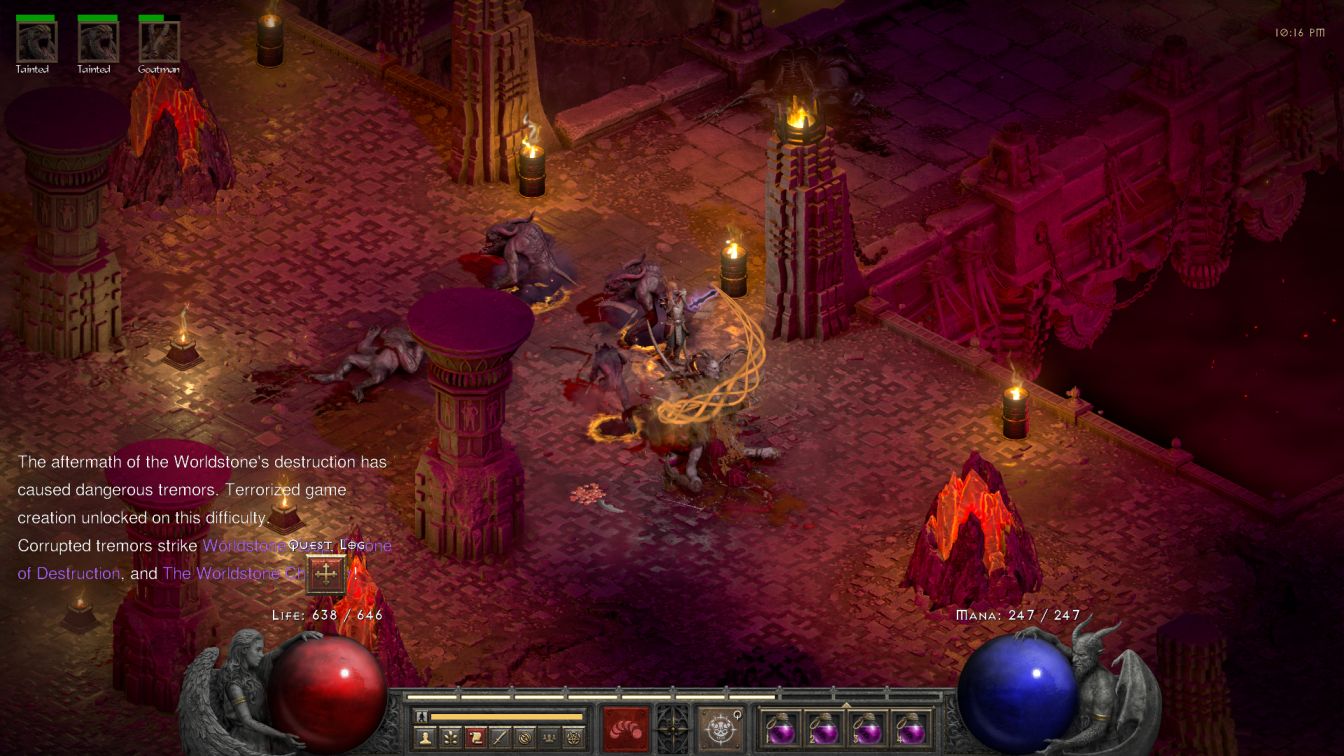
Definitely not much of an opponent and he didn't drop anything of note either, not even an unusable unique or set item to fill out another entry in the Chronicle. What a waste of space. In any case, Faustus wrapped up Normal difficulty with all areas full cleared, zero deaths incurred, virtually no damage faced at any point in time. The summoning Warlock felt like a very potent character build and I looked forward to continuing to build out this unusual set of abilities in the upcoming difficulties. Tutorial mode was ending and more serious challenges were about to begin.