Playoff Game Two Alternate Histories Spreadsheet
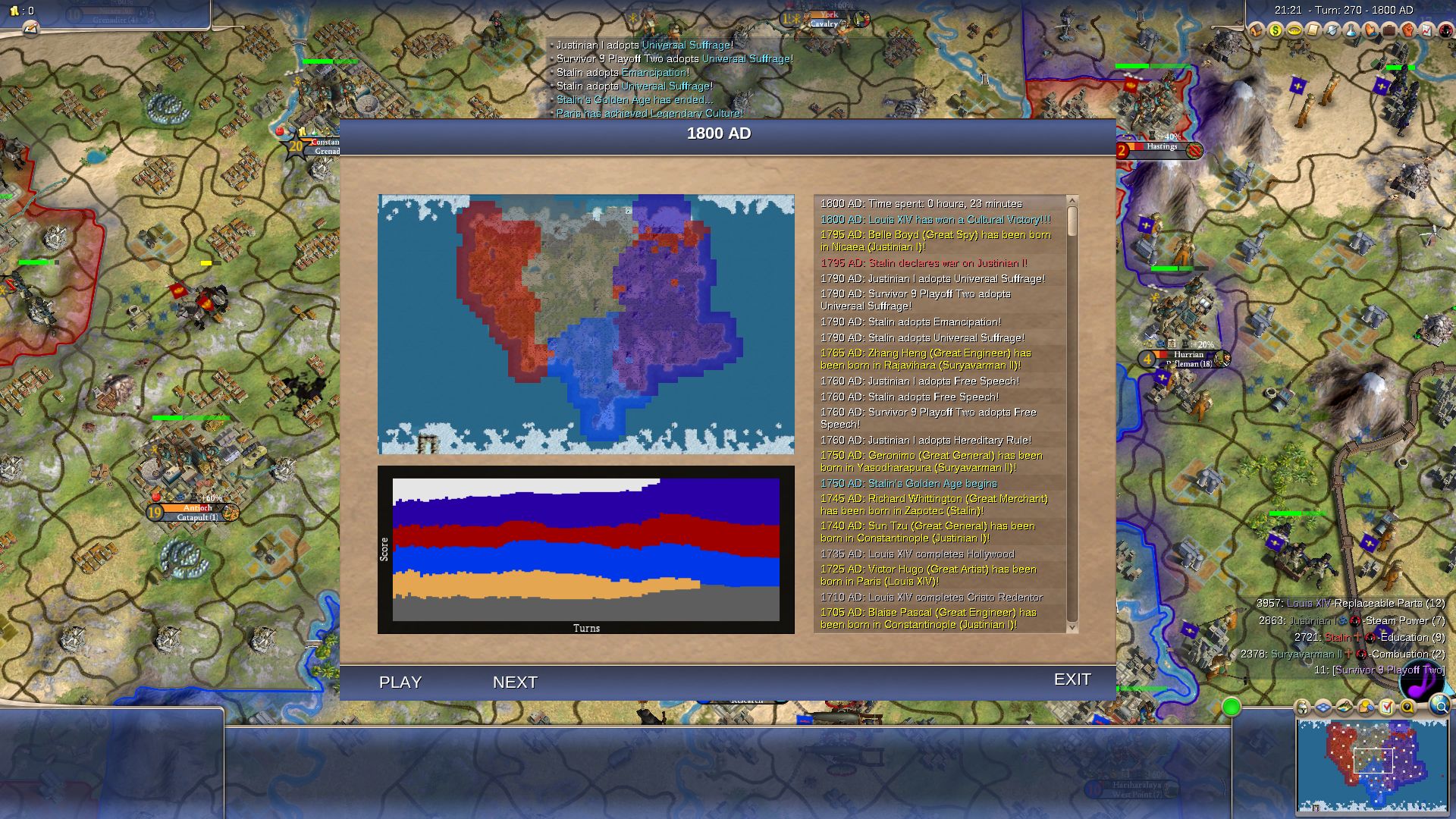
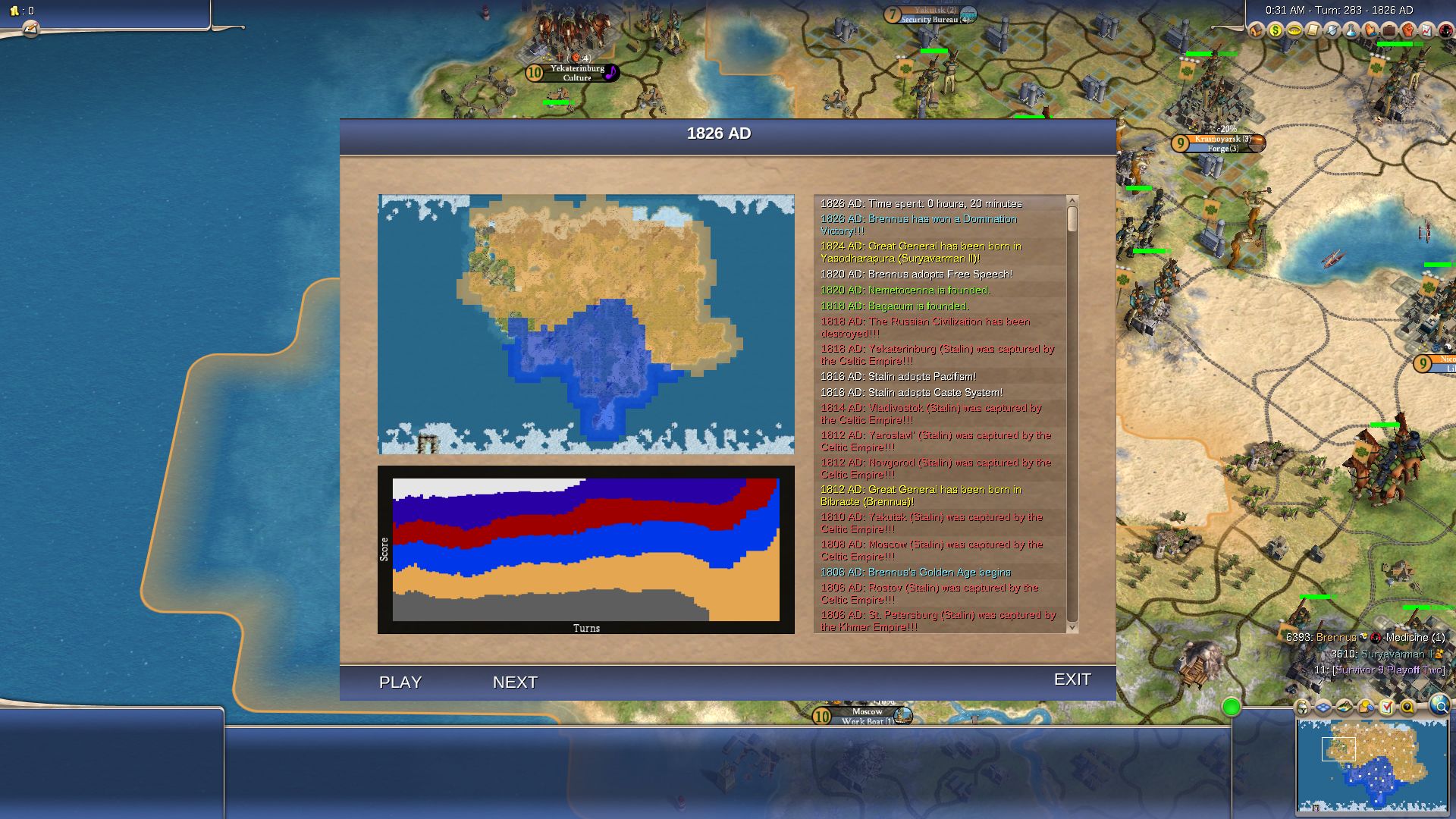
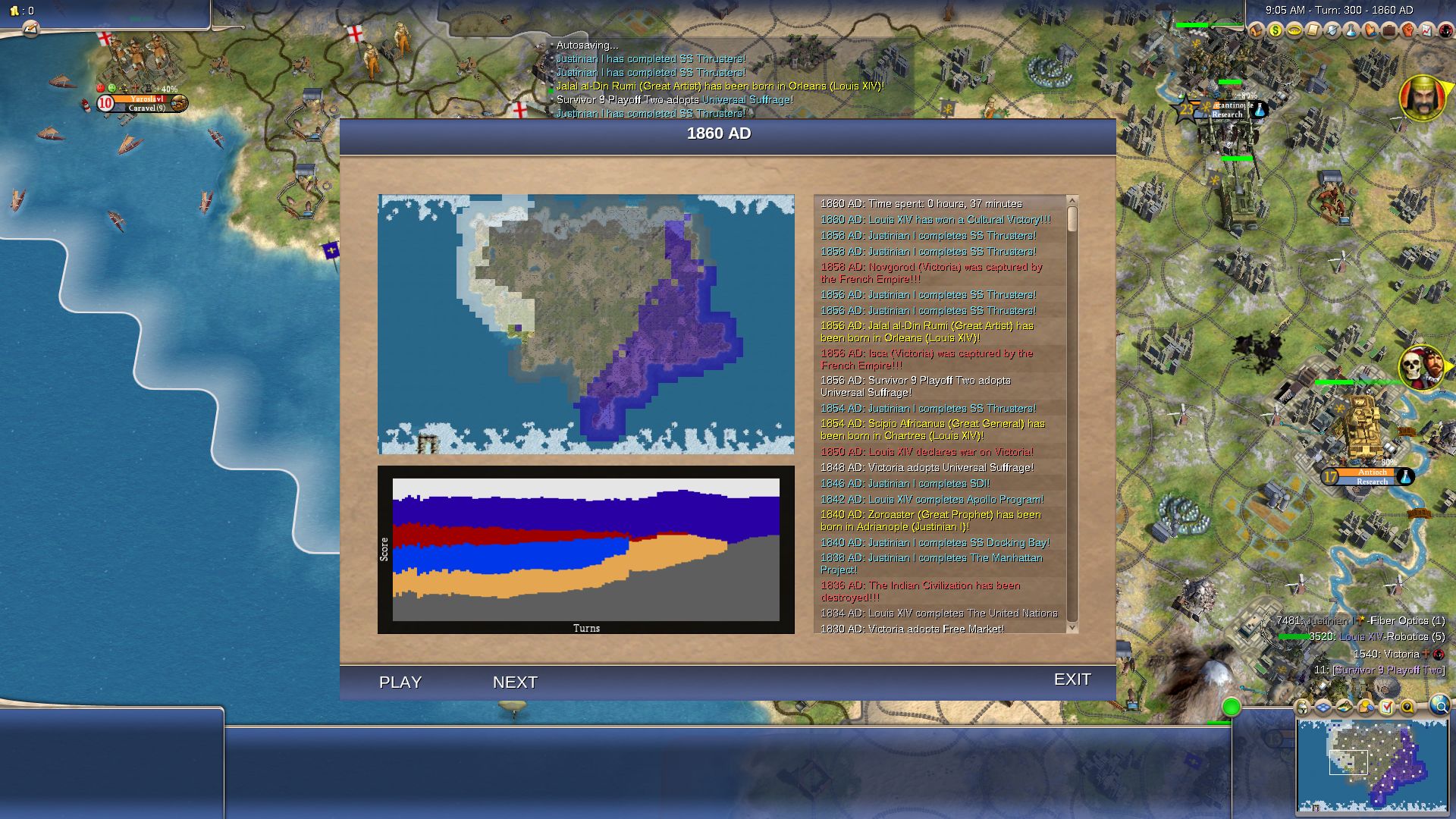
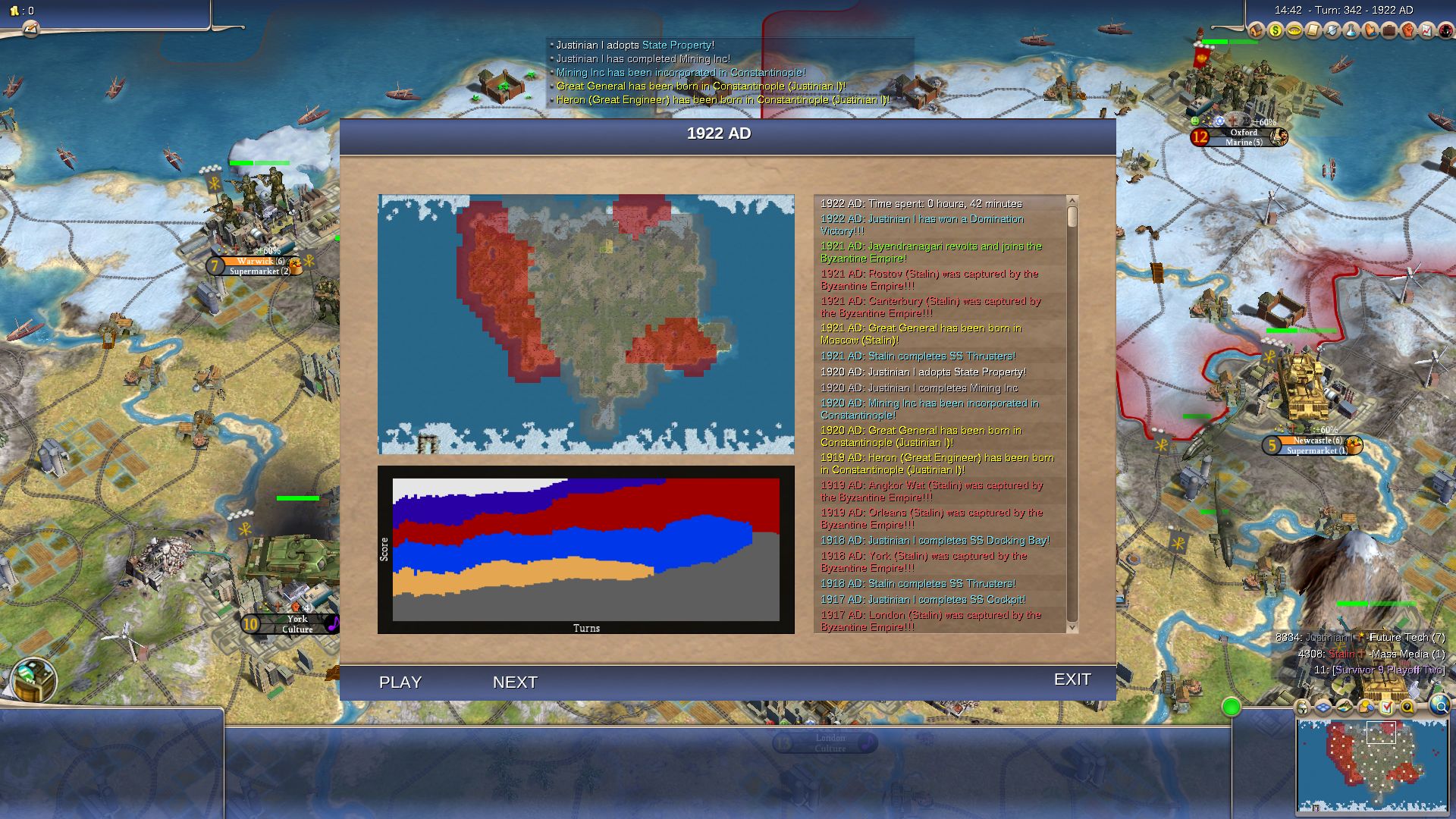
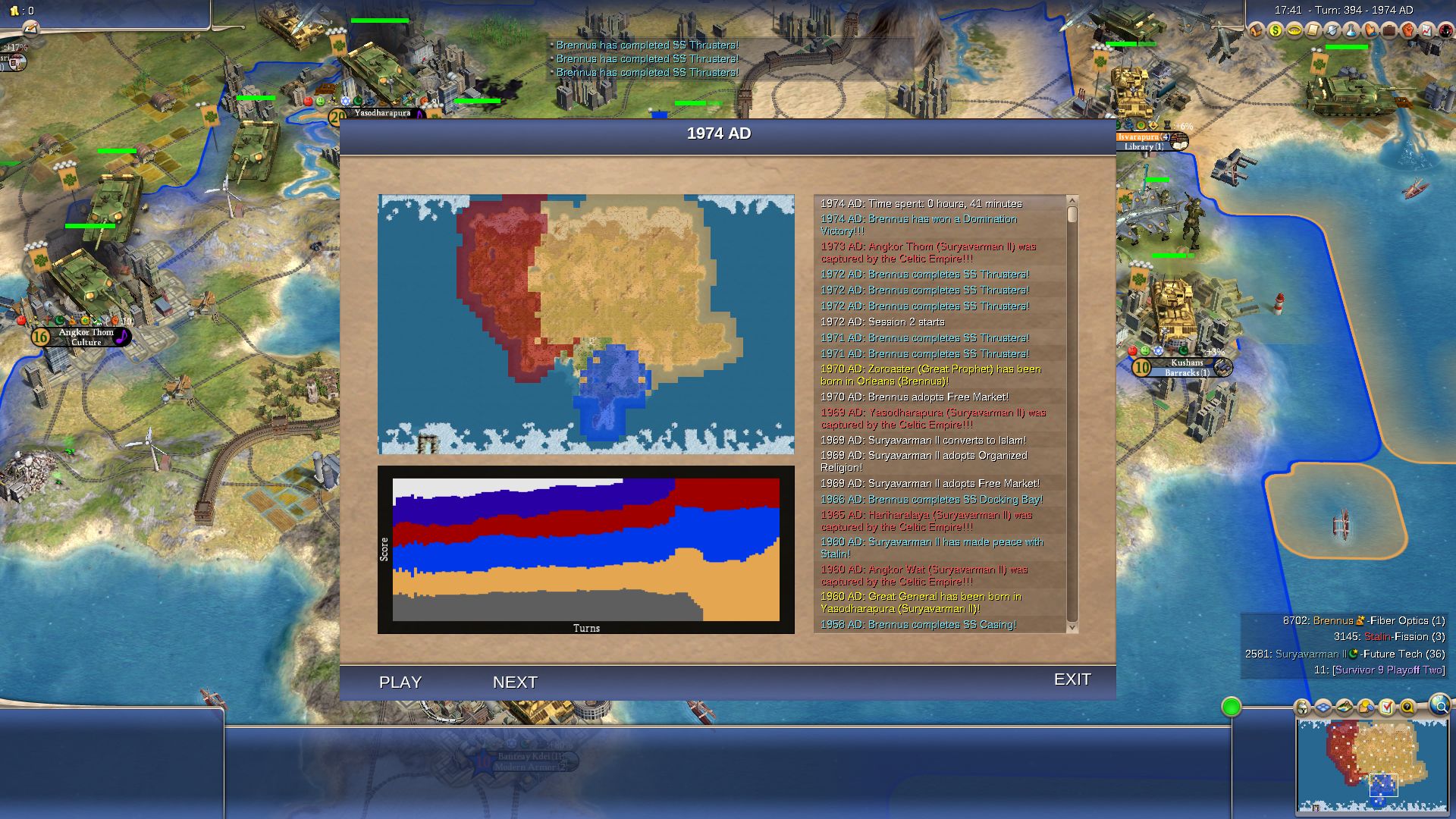
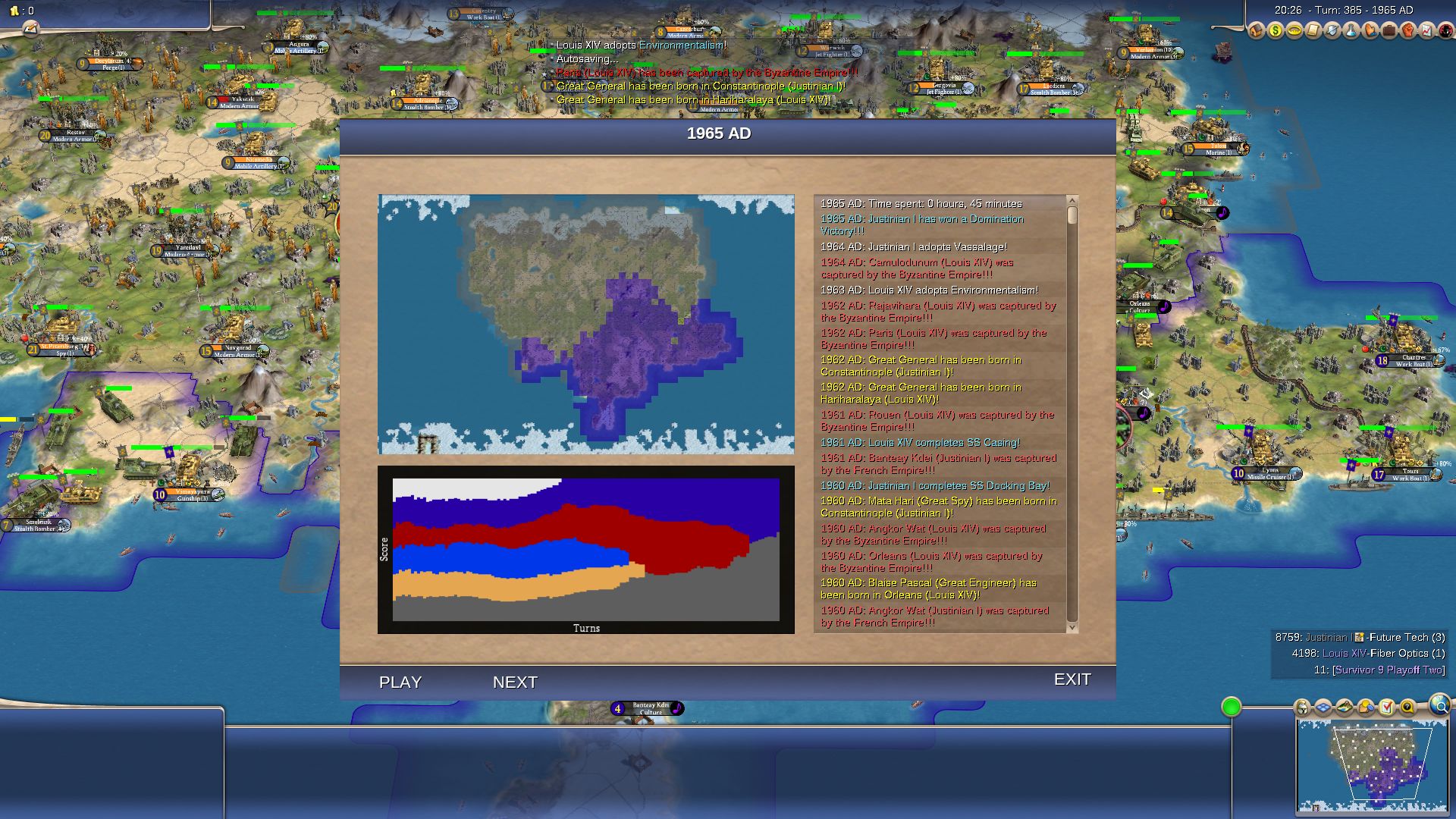
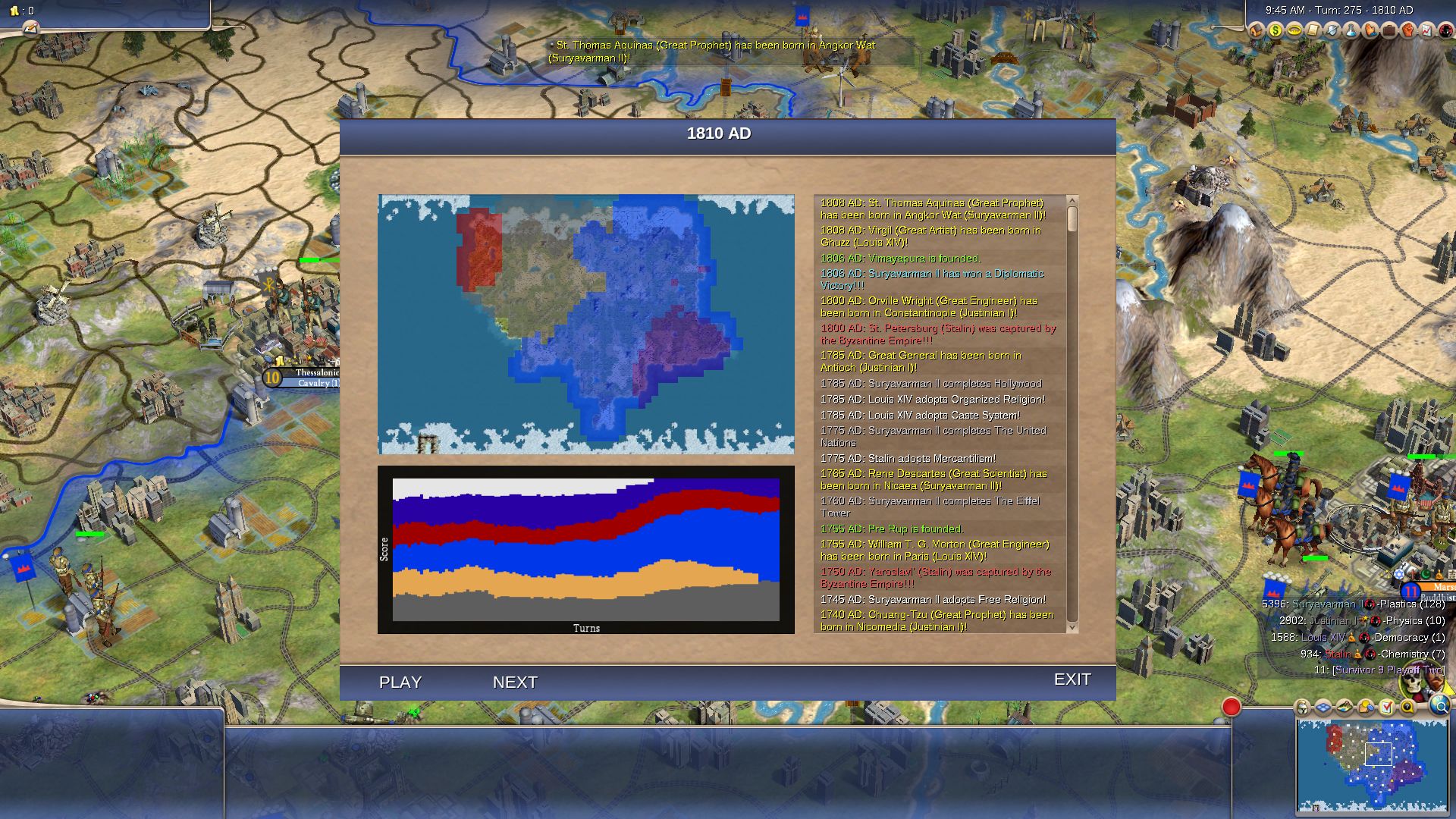
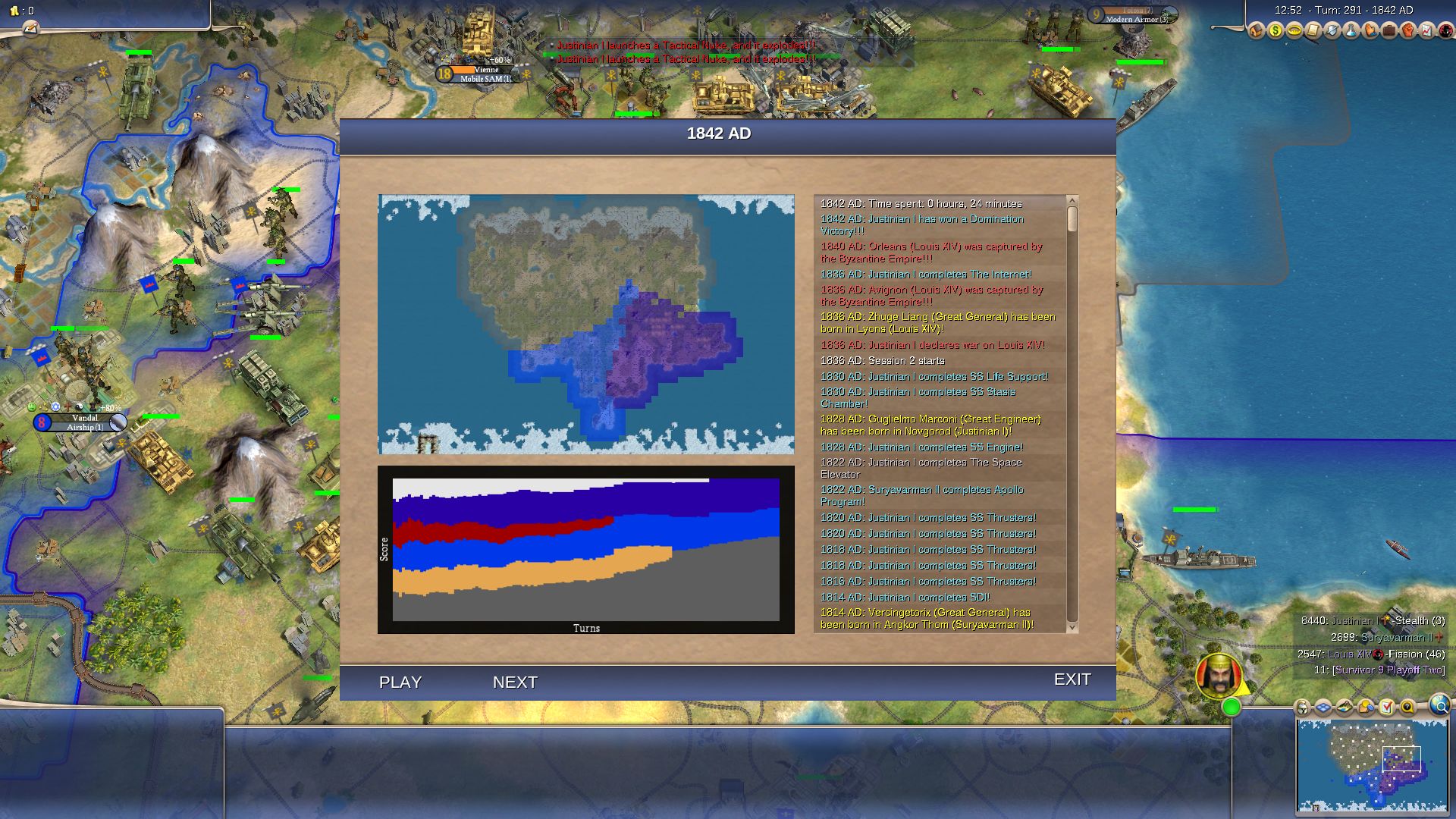
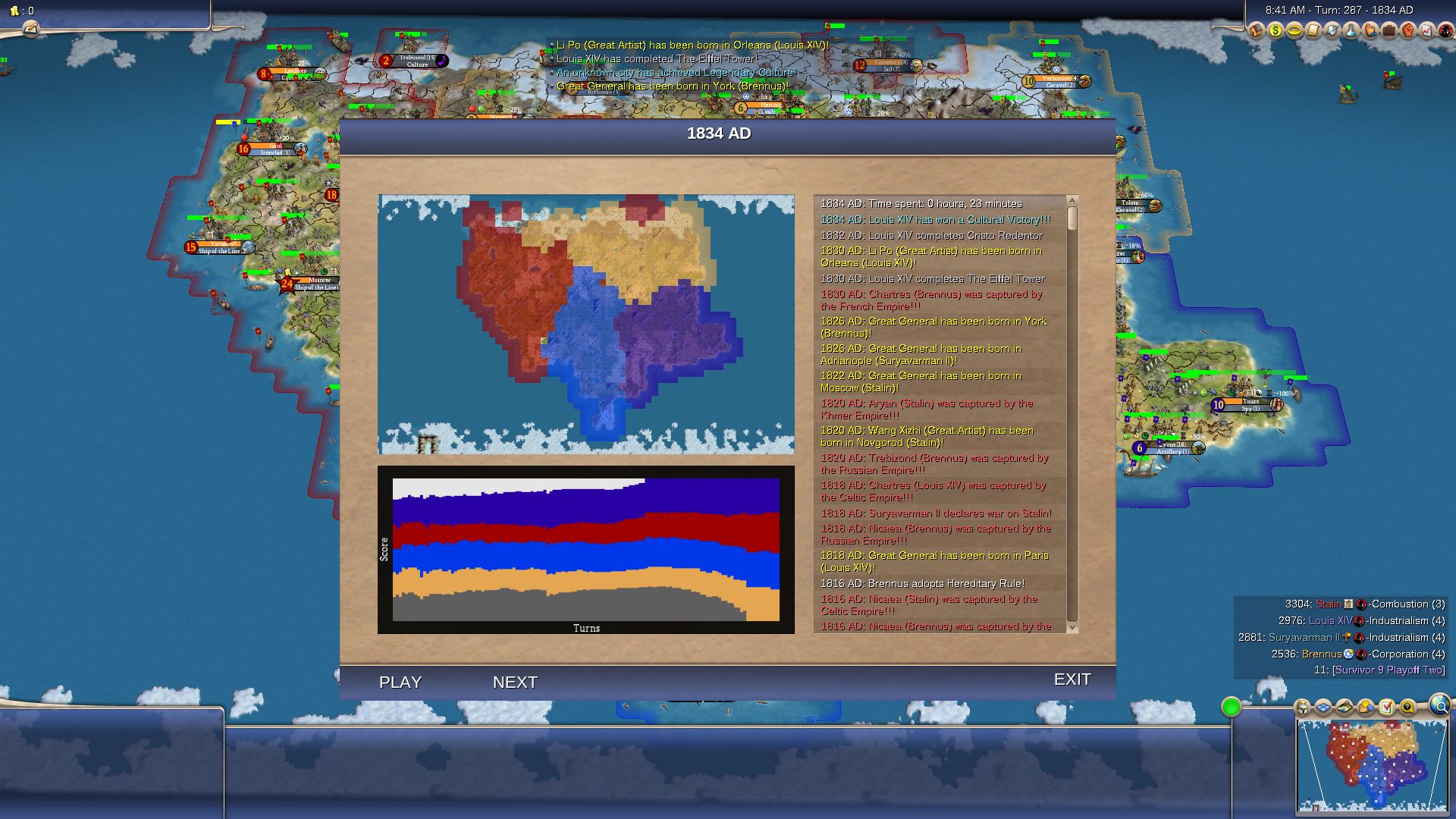
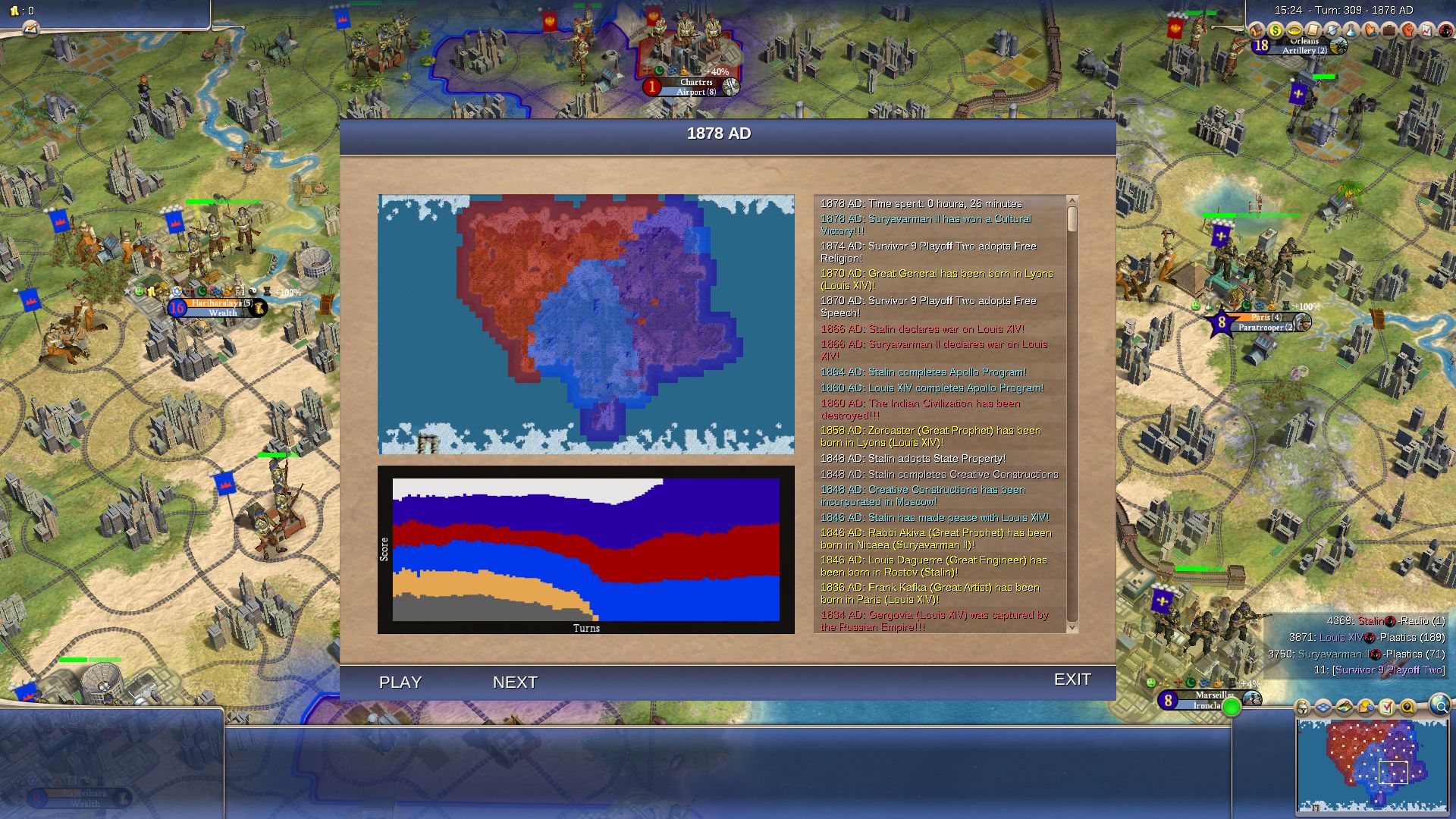
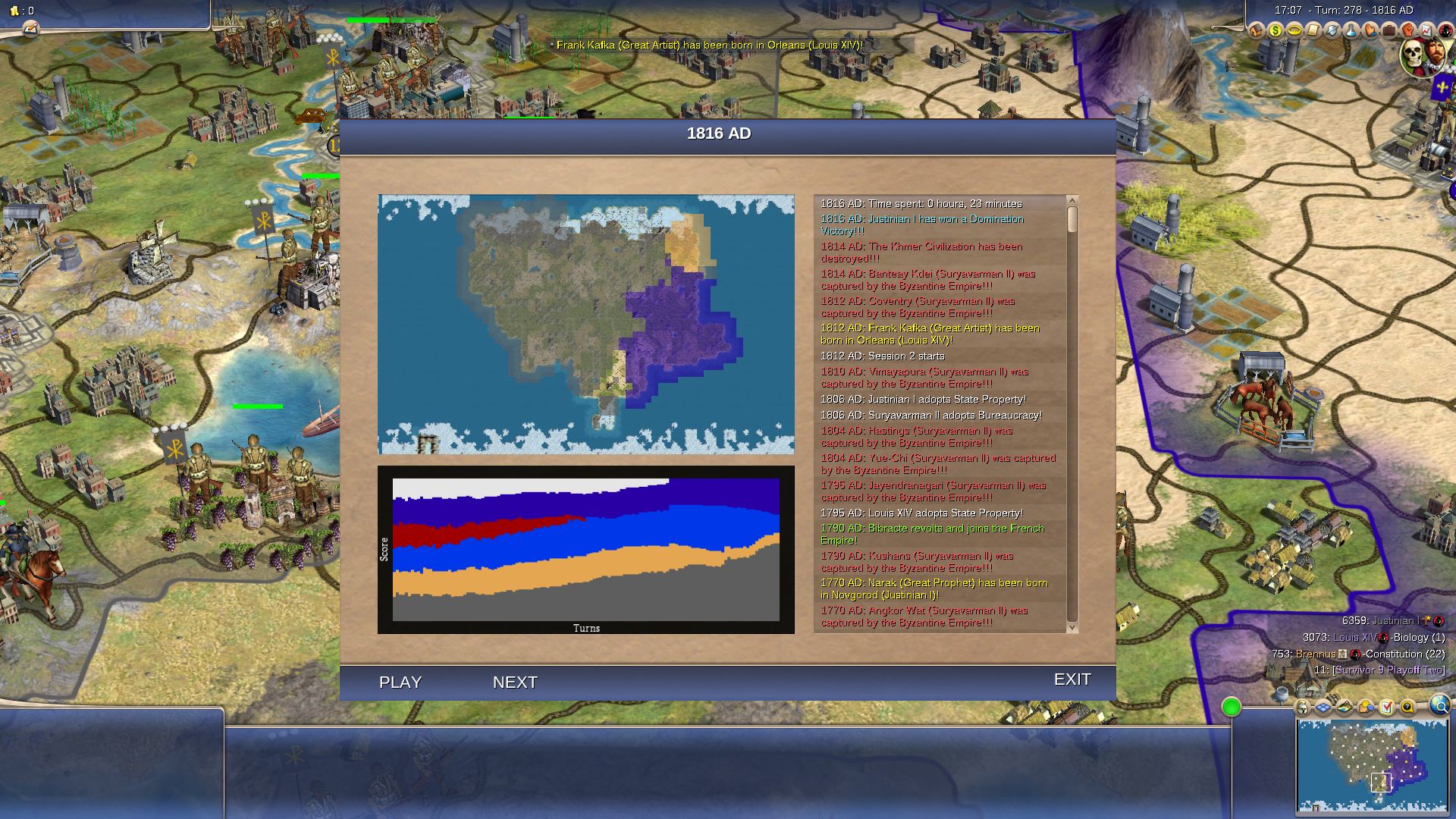
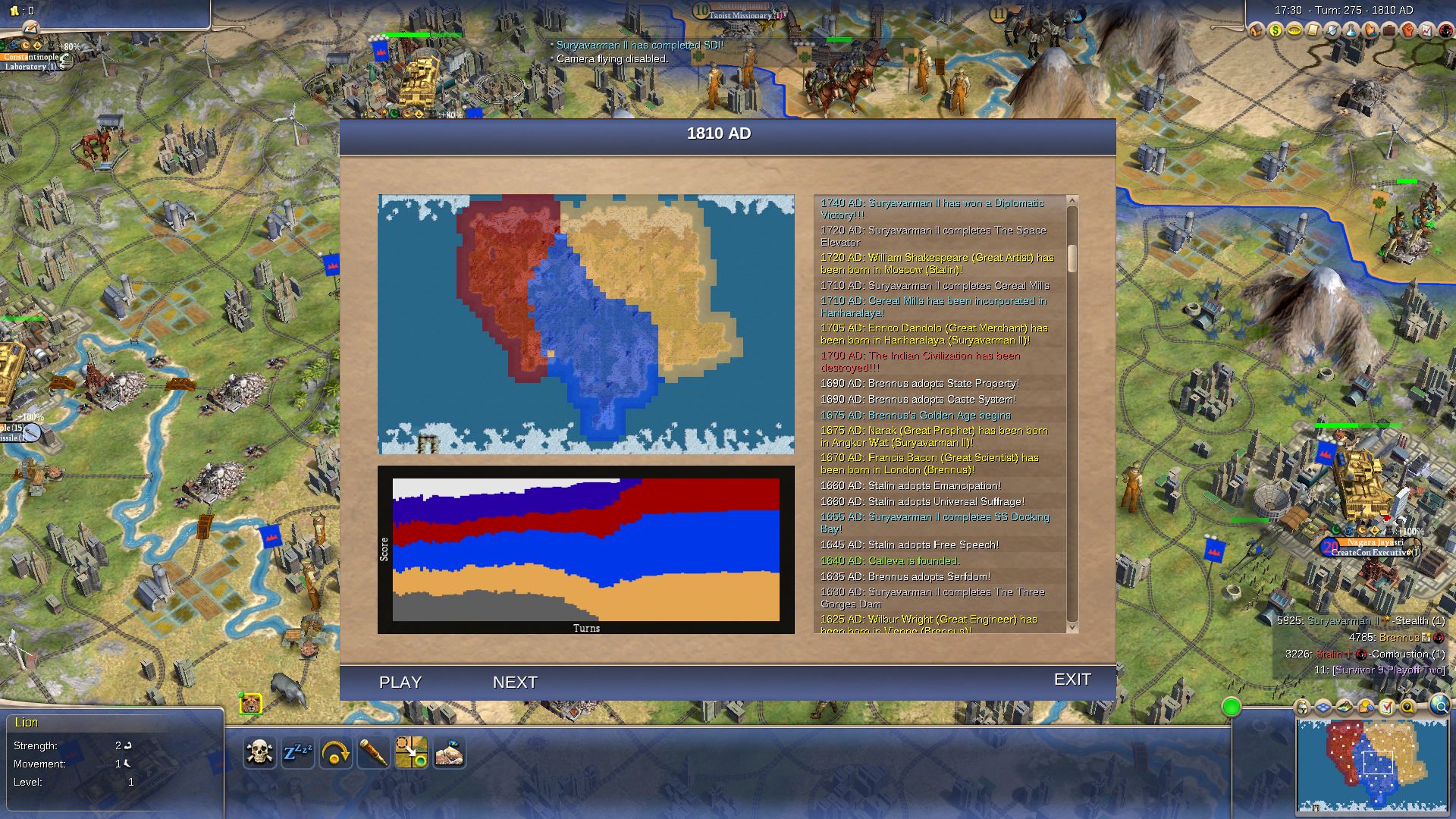
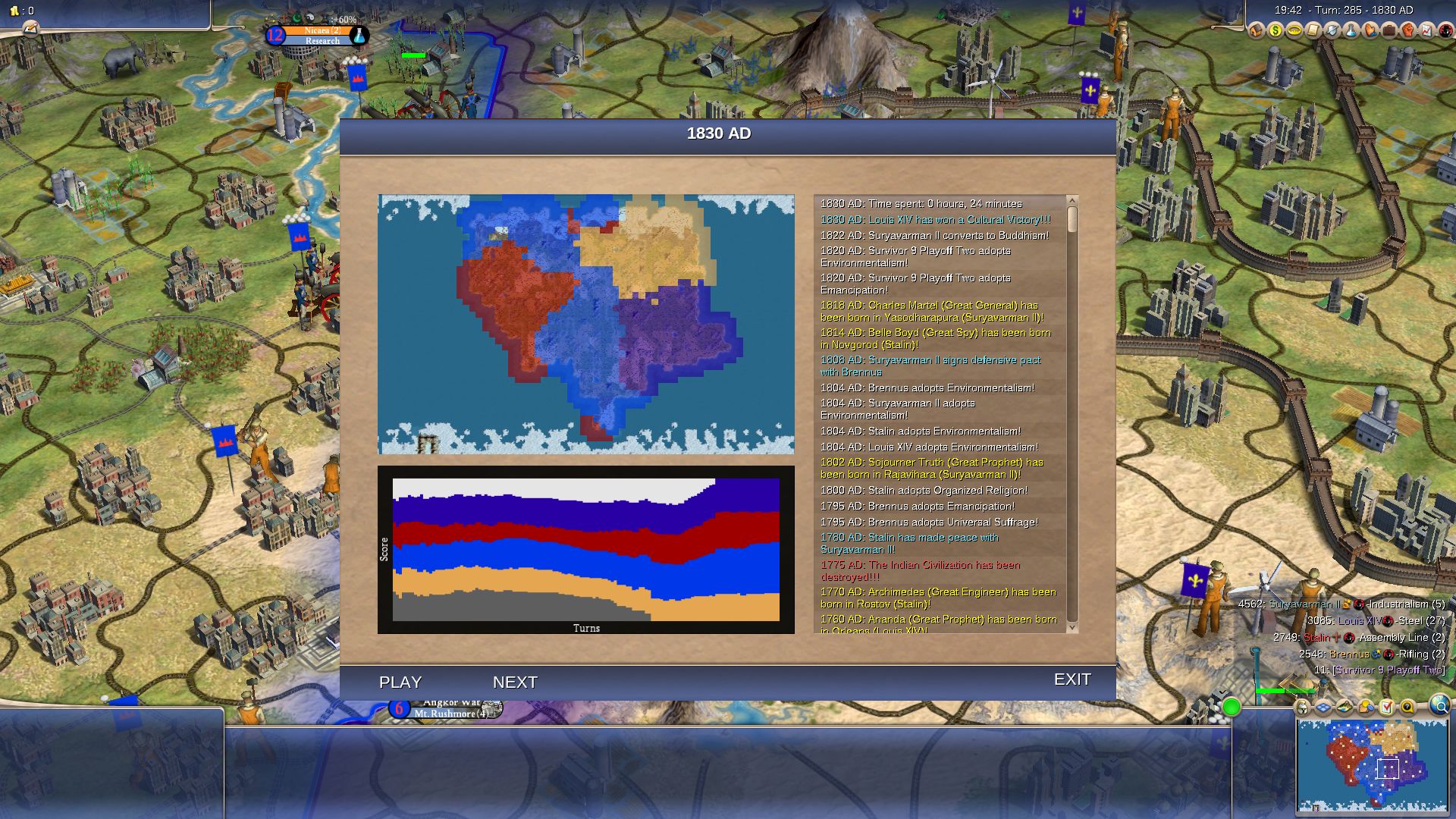
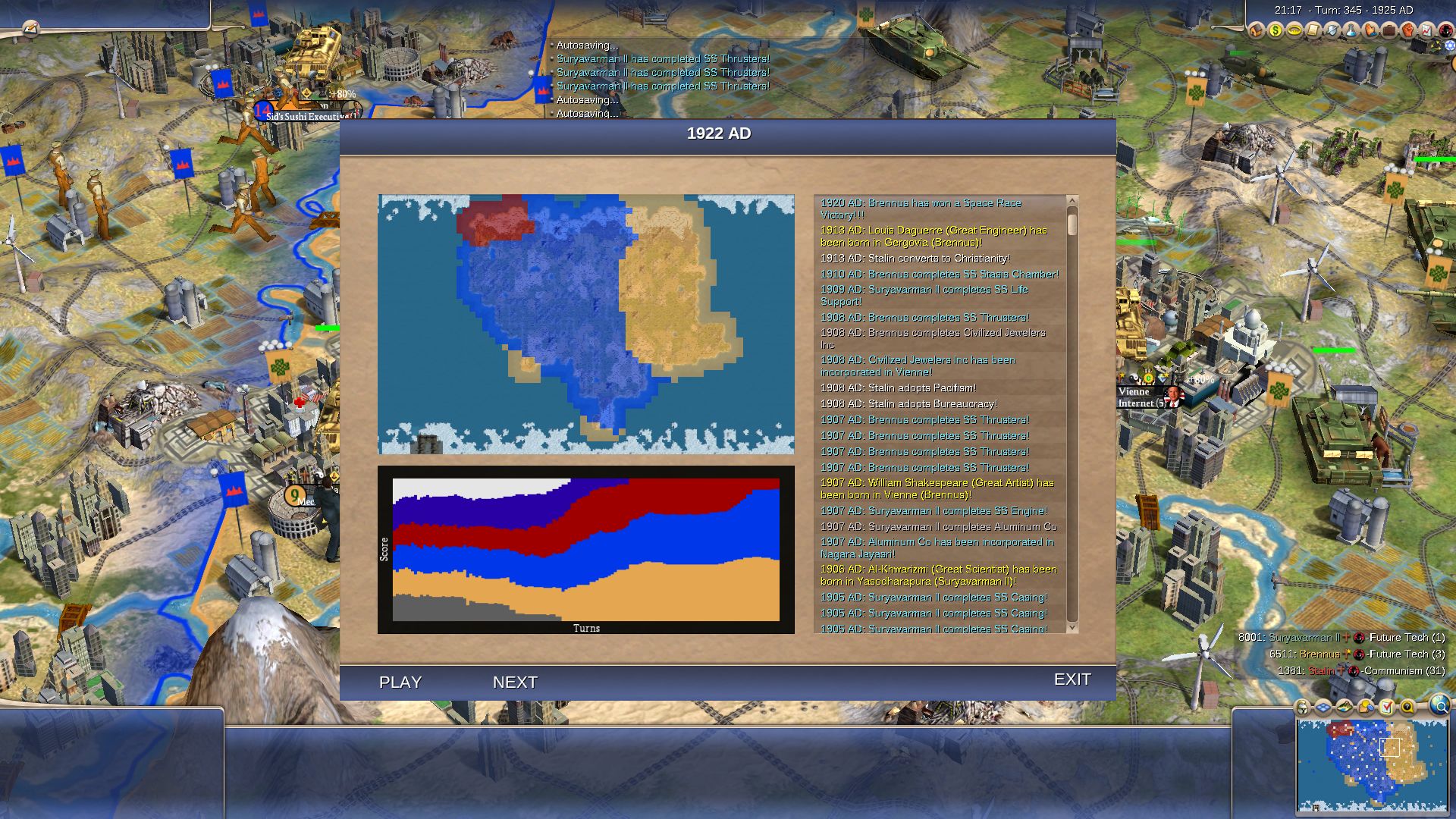
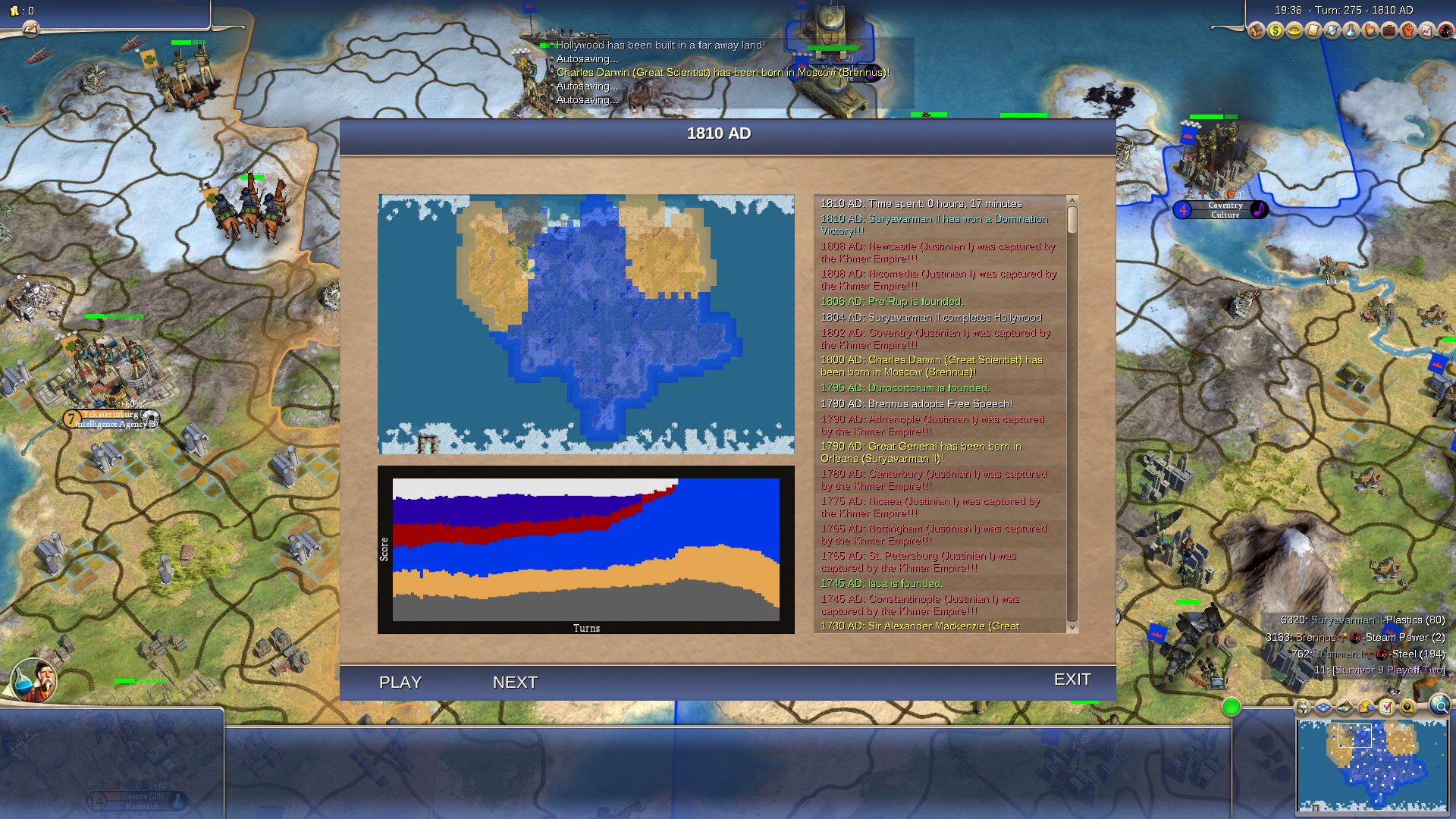
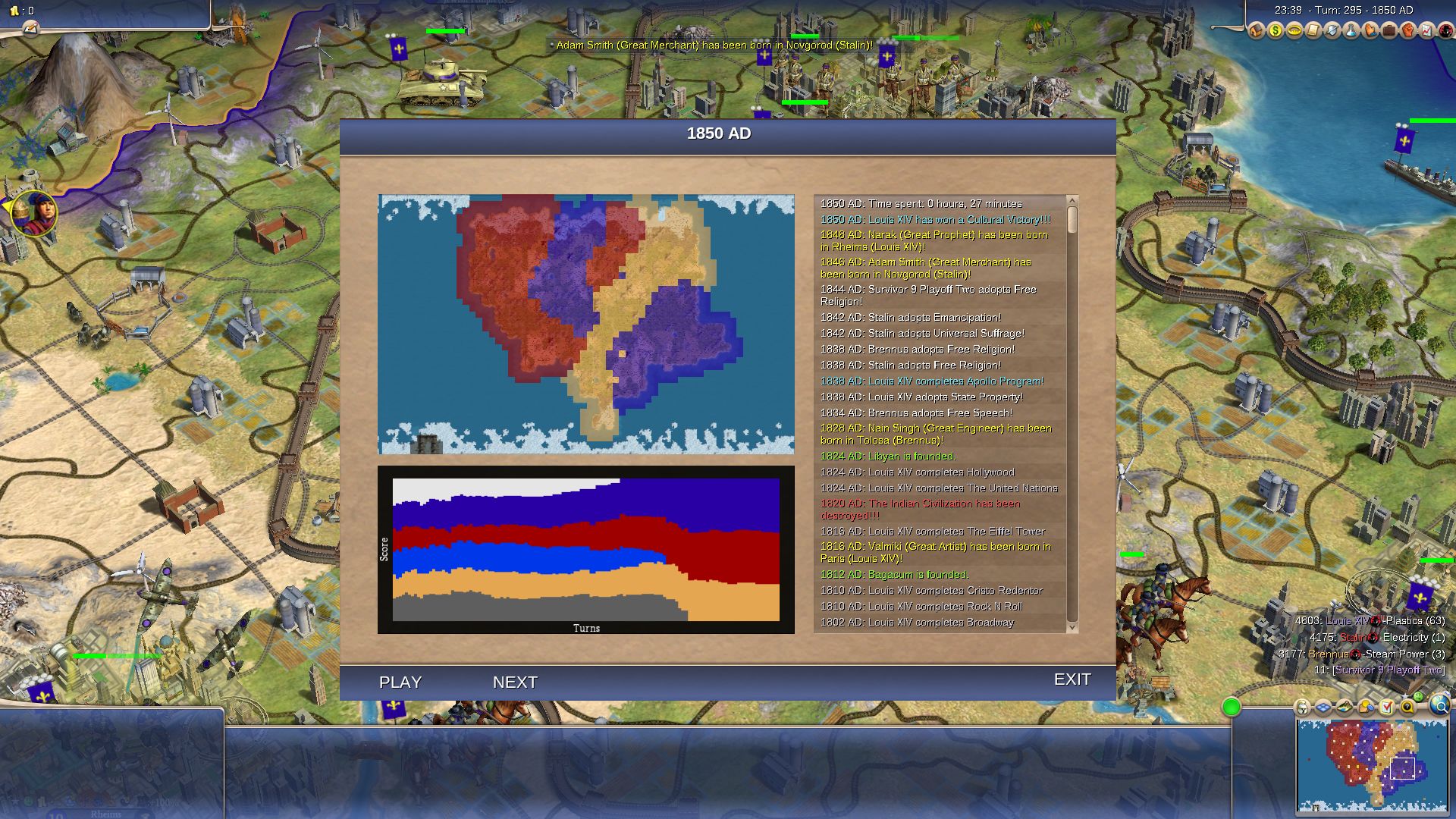
One of the recurring features of past seasons of AI Survivor have been our "alternate histories", running additional iterations on the same maps to see if the same events would play out again. Playoff Game Two had one of the most shocking results in recent memory, with overwhelming First to Die favorite Victoria instead crushing the rest of the field in a runaway Domination victory. Was that something which would unfold in each game? This was a topic that called for more investigation with alternate history scenarios. Following the conclusion of previous seasons of AI Survivor, I had gone back and investigated some of the completed games and found that they tended to play out in the same patterns over and over again. While there was definitely some variation from game to game, and occasionally an unlikely outcome took place, for the most part the games were fairly predictable based on the personality of the AI leaders and the terrain of each particular map. Would we see the same patterns play out again and again on this particular map?
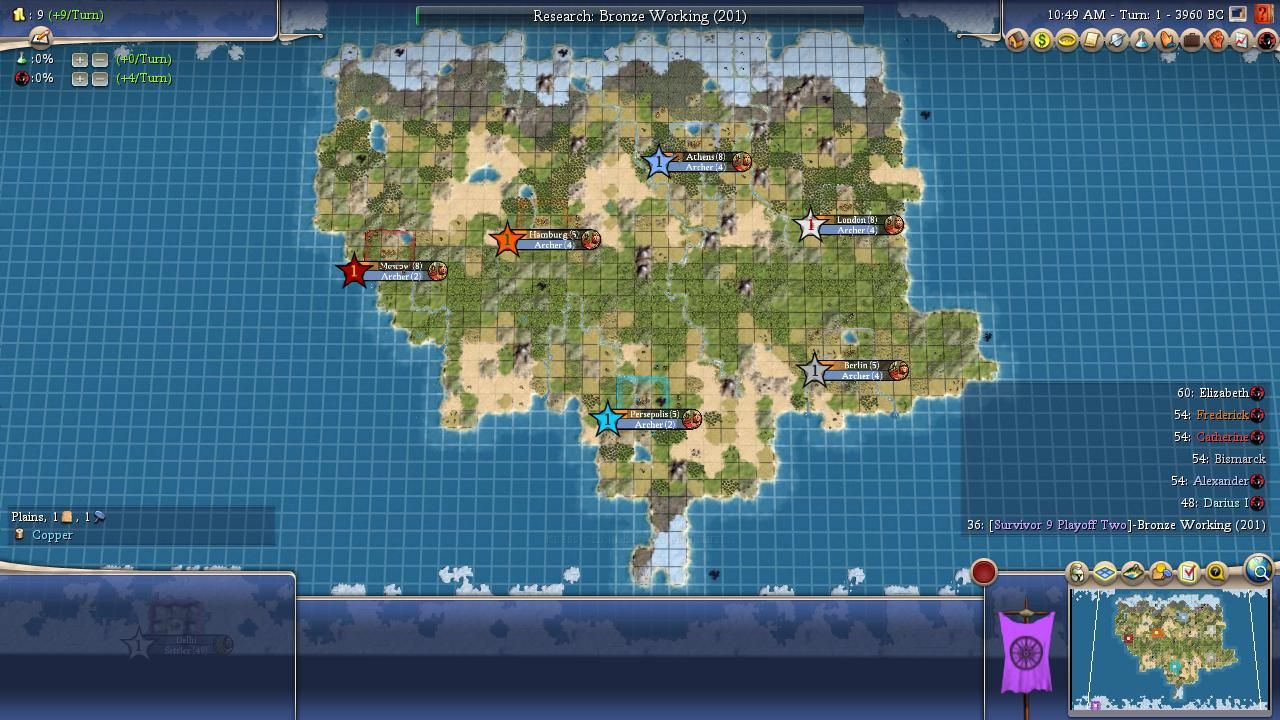
The original inspiration to run these alternate histories came from Wyatan. He decided to rerun the Season Four games 20 times each and publish the results. The objective in his words was twofold:
- See how random the prediction game actually is. There's a natural tendency when your predictions come true to go "See! Told you!", and on the contrary to dismiss the result as a mere fluke when things don't go the way you expected them to (pleading guilty there, Your Honour). Hopefully, with 20 iterations, we'll get a sense of how flukey the actual result was, and of how actually predictable each game was.
- Get a more accurate idea of each leader's performance. Over 6 seasons, we'll have a 75 game sample. That might seem a lot, but it's actually a very small sample, with each leader appearing 5-10 times only. With this much larger sample, we'll be able able to better gauge each leader's performance, in the specific context of each game. So if an AI is given a dud start, or really tough neighbours, it won't perform well. Which will only be an indication about the balance of that map, and not really about that AI's general performance. But conversely, by running the game 20 times, we'll get dumb luck out of the equation.
Wyatan did a fantastic job of putting together data for the Season Four games and since then we've continued to use the same general format. This particular set of alternate histories were run by Eauxps I. Fourgott - many thanks for spending so much time on this task!  Eauxps posted the resulting data from the alternate histories and then discusses some of the findings below in more detail. Keep in mind that everything we discuss in these alternate histories is map-specific: it pertains to these leaders with these starting positions in this game. As Wyatan mentioned, an AI leader could be a powerful figure on this particular map while still being a weak leader in more general terms. Now on to the results:
Game One | Game Two | Game Three | Game Four | Game Five
Game Six | Game Seven | Game Eight | Game Nine | Game Ten
Game Eleven | Game Twelve | Game Thirteen | Game Fourteen | Game Fifteen
Game Sixteen | Game Seventeen | Game Eighteen | Game Nineteen | Game Twenty
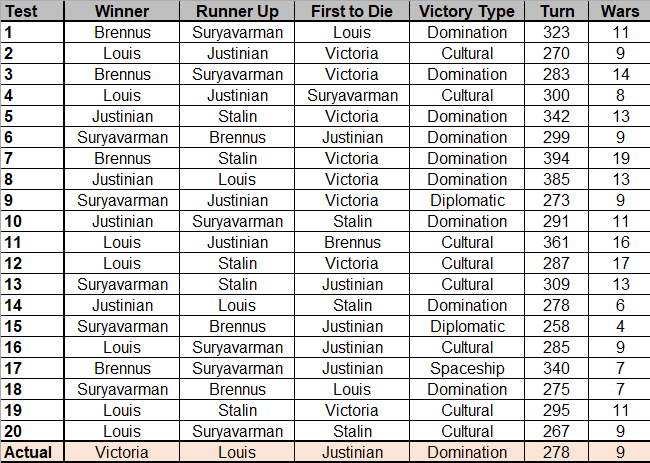
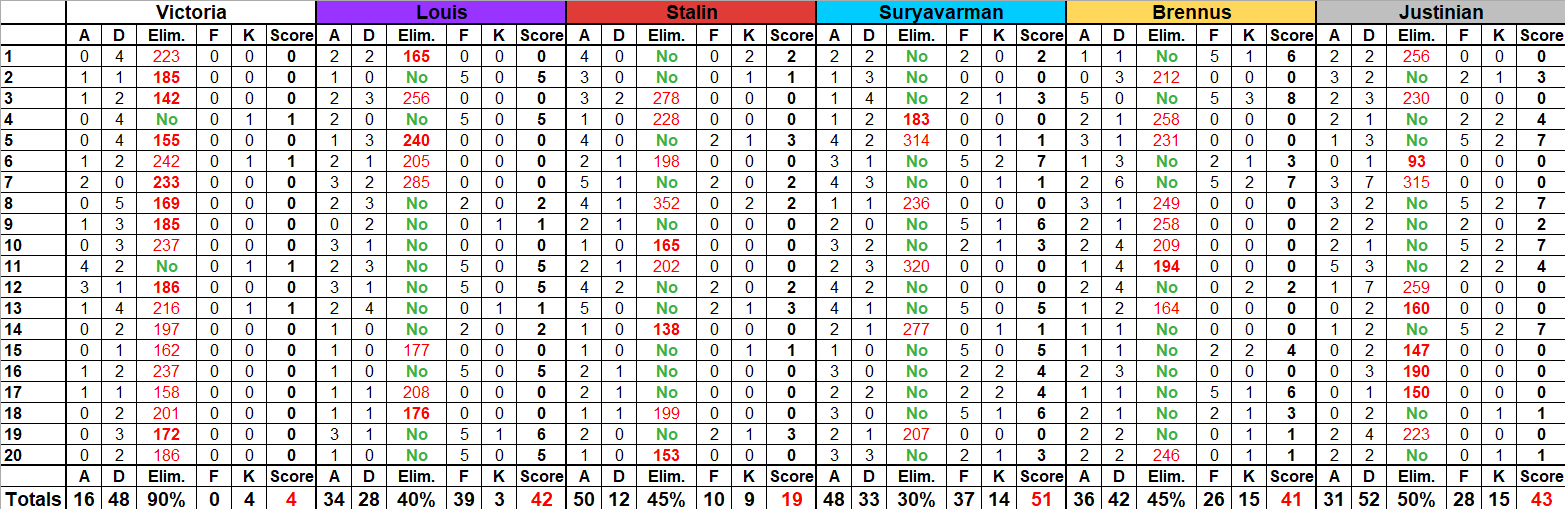
(Note : "A" column tracks the number of war declarations initiated by the AI, "D" the number of times the AI is declared upon, "F" the points for finish ranking, and "K" the number of kills.)
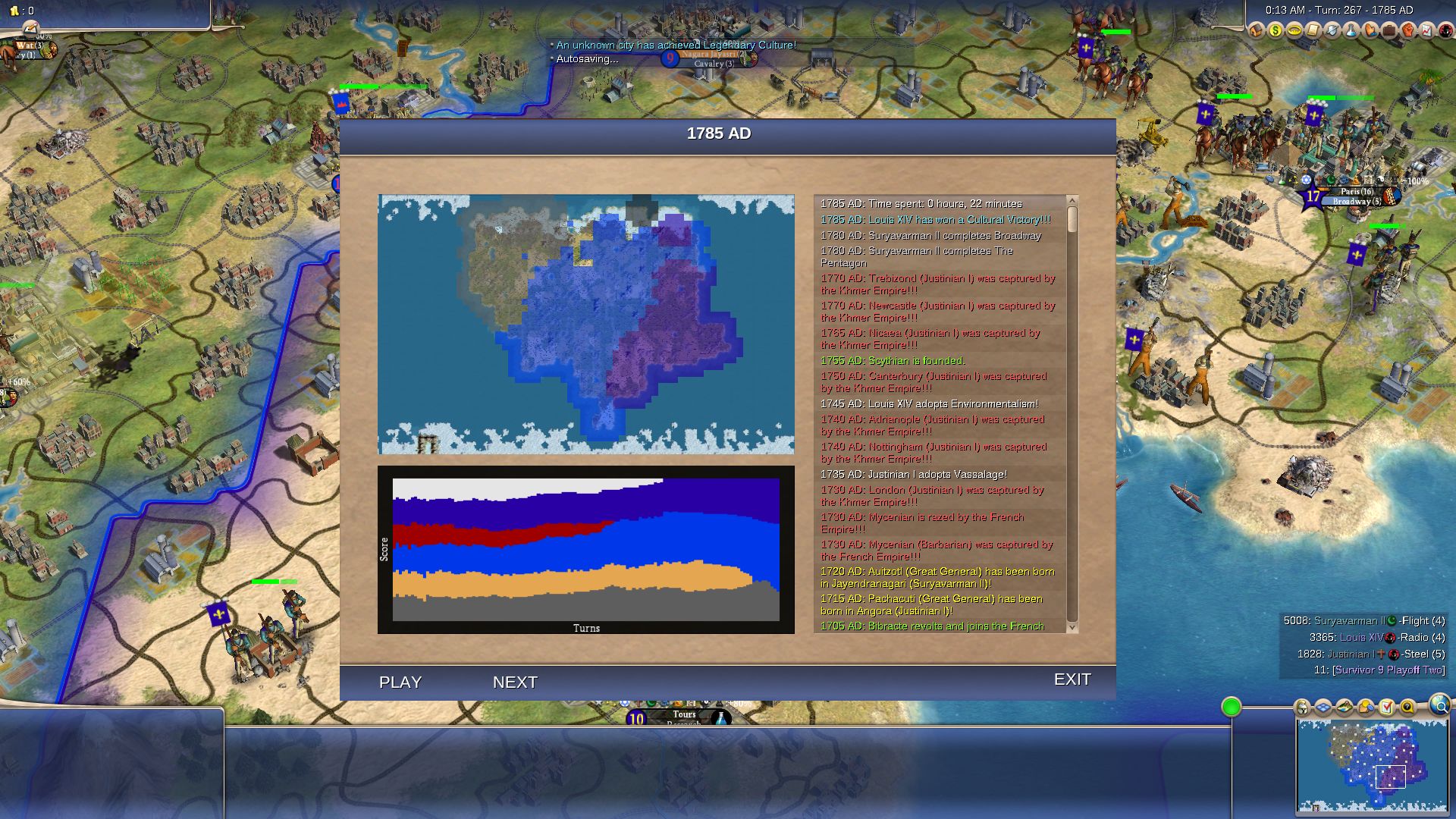
Eauxps I. Fourgott: I think we all knew from the moment it played out that Victoria's dominant win in the real Playoff 2 was an unusual result. The real question was: was it an unlikely but plausible outcome, such that we'd see it repeated several times in the alternate histories, or was it a real fluke result that she would struggle to ever replicate?
It turned out that the latter was the case: Vicky's win is indicated to be an extremely lucky result, as she never had another game like the real one, failing to ever record so much as a second place finish and even only surviving to the end in a mere two replays. Per this set, she had about 35% odds of early events playing in a favorable manner, so that she had a shot to get something done... but a 0% rate of actually capitalizing on these situations and pulling out in front. This included a replay where she hit Justinian before he got metals, only to be dogpiled by Suryavarman/Stalin and die first anyway, plus multiple replays that started in similar fashion to the real game, with her expanding well and avoiding early wars... only for her backstab of Brennus to completely fail and her to go nowhere from there. Vicky suffered from a difficult position here that rarely offered her the openings she got in the real game, but she herself also failed to play to the same level, and the result was a hopeless set of games.
So what was different? How come she did so much better in the real game? I identified three main factors, the first two of which were repeated in the alternate histories, but only rarely. One was her unusually peaceful early game. Vicky only had to fight one early war in the real game, and this emphatically did not happen most of the time in the alternate histories. As one would expect from a centrally located peaceweight outlier, she much more often had to deal with early dogpiles, which swiftly snuffed out any chance she had of victory; even if she made friends with Justin and/or Brennus through religion, Suryavarman and Stalin (and more rarely Louis) would still be more than happy to come attack her! And usually something would happen to cool relations with her allies later in the game. Multiple of her stronger games saw her emerge from the first set of wars in a solid position, only to immediately be dogpiled by every remaining leader and swiftly eliminated. But in the real game, everybody instead went off and did their own thing, allowing her to take them on at her own pace! As mentioned above, this occassionally happened in the replays (albeit with much worse end results for Vicky). But most of the time, she wasn't even afforded that luxury.
Another significant factor was her pursuit of an early religion. Now, I don't know that the fact that she got the early religion made a difference - but what mattered was that she chased it out of the gate, which means that she picked up Mysticism right away and thus had a source of culture from the get-go. This only rarely happened in the replays, and Vicky tended to have significantly weaker openings when she did not have Mysticism on hand. The aggressive settling of the tundra, for example, was something that I pretty much only ever saw happening when she had the early culture unlocked. So the fateful decision to target Polytheism out of the gate resulted in Victoria having a much stronger opening on stream, paving the way for her to be stronger later on, compared to what usually happened, as well as setting up the third and biggest point of divergence.
I think the most important factor, one that really changed the course of the live game and that never played out in the alternate histories, was her early conquest of Justinian. Justin's strength was hugely variable in these games, but he rarely played as poorly as he did in the real game - and crucially, even on the occassions where he did, it wasn't Vicky taking over his territory. As a reminder, Vicky was quite culturally strong in the real game, due to both her early religion and a related Temple of Artemis build in a border city, and that gave her the cultural presence to flip two conquered Byzantine cities from Suryavarman, in addition to her dogpiling Justinian to take the other two good ones for herself, thus effectively doubling her core from an early date and becoming a frontrunner in that manner. Nothing like this ever happened in the alternate histories; Vicky was culturally weaker, and she wasn't in position to dogpile Justinian at the perfect moment like she did in the real game, and so she wasn't ever able to grow to the same strength, relative to the other leaders, that she enjoyed in the real game. (And of course, it was only rarely that Justinian was in a position to die very early like this at all!) Not only did this strengthen her position, but it weakened Suryvarman's: had Vicky not interfered, he was in great position to take all of Justinian's land for himself and start to snowball. Without it, he was weaker and Stalin was able to stalemate him, buying time for Vicky to become dominant in the east. I think this is what really defined the trajectory of the game we saw play out on stream; without it ever happening in the alternate histories, Vicky was left without a chance.
So if the result we saw wasn't plausible, what was? The short answer is: almost anything else! While Vicky being hopeless was pretty much a constant, everything else for this game was up in the air. It was a very open match that played out in quite different fashion from replay to replay, and as a result everybody got their time in the sun. All five low peaceweights had reasonable odds - anywhere between 25-55% - to advance to the Championship, and all except Stalin had solid odds of taking home the win. They could follow a variety of different trajectories to reach that point as well, as opposed to having to take one path with one specific other leader to succeed; the most common Championship pairing (Sury/Brennus) only advanced together in 30% of contests. At the same time, nobody was truly safe on this map and it could swing against any of them; while the more centrally located Justinian and Victoria were by far the most likely to see an early exit, it could happen to anybody and all six leaders were First to Die at least once. Even the broad characteristics of the games varied wildly from replay to replay; they ran the entire gamut from a mess of a game with 19 (!) war declarations and a nail-biting finish, to a particularly boring and straightforward one with a mere four wars in the game. This game could go in almost any direction and Vicky's unlikely win in the real game only emphasizes that fact.
With that said, one mostly consistent trait of these games was that they rarely tended to be close. We only had a few narrow finishes, and otherwise it was a matter of one leader accelerating far, far beyond the rest of the pack. Most of the time this tended to take the form of military conquest, with the winner only truly pushing out in front when he was able to carve himself a much large swath of territory than the others, and pulling ahead that way. More rarely, someone (usually Suryavarman) would manage to break free in tech and become a runaway that way. Or it might be Louis breaking free in culture, and absolutely running the table to easily take a win that way so long as he escaped notice for long enough. Whatever the means, though, there were only a few close finishes. It didn't help that this group rarely stayed peaceful throughout the game, given their aggressive natures. A military or territory runaway would keep pressing his advantage until he won by Domination; even if somebody pulled ahead in tech, he usually tended to use that advantage on the battlefield, and win by Domination anyway. This interestingly resulted in the Spaceship victory condition being the least likely way for somebody to win on this map; if the game stayed peaceful long enough for it to become a possibility, that usually meant that there was a lot of good feeling on the map, making it likely that even Diplomatic would trigger before we got to the space race!
Now for a look at the individual leaders:

Suryavarman of the Khmer
Wars Declared: 48
Wars Declared Upon: 33
Survival Percentage: 70%
Finishes: 5 Firsts, 6 Seconds (37 points)
Kills: 14
Overall Score: 51 points
The general community read was that Suryavarman had the most advantageous position on this map, and that read turned out to be correct. Sury had a strong central start with plenty of available land, allowing him to expand to a solid size even in his worst games. His land seemed to be pretty strong economically as well, with no concern of him crashing his economy before he could fill him out, and the result was that in most games, he was one of the score and GNP leaders by the end of the landgrab phase, with only Louis able to reliably keep up with him in tech. That left the door open for him to surge forward in whatever way suited him, and in theory he had a lot of options thanks to his central position. In his good games, he would leverage this advantageous start to snowball ahead early, and if he was able to do that, then it was an easy road from there - the only way anybody could stop him was by Louis winning culture. Justinian turned out to be Sury's best early target, and in a couple of games he was able to successfully hit the Byzantines before they connected metals, leading to particularly easy wins.
However, these successful games were, in the end, a minority of Sury's results. Much of the time, he struggled to get the snowball going, stalemating in his early wars instead, and this usually meant that he wasn't able to pull ahead and was consigned to second place or worse. Often he still did perfectly fine here, but other times he was overwhelmed by a dogpile or the dominant AI. Like anybody else, his outcomes were highly variable from game to game, but he did seem to have a real problem converting what should have been a major advantage into actual wins. It was a pretty unimpressive outcome given the strength of his position.
If I had to guess, I would say that this set probably undersold Sury's true strength somewhat. In particular, he lost quite a few games in unusual manners: once Justinian unlocked cataphracts just in time to hold Sury off and make inroads against him instead, once Sury was the tech runaway, only to be dogpiled and overwhelmed by a backwards but larger Brennus and Stalin, once he narrowly missed Domination and instead lost to Brennus's spaceship (the only space victory in the entire set), and twice more he had dominant games, only to lose to pre-Turn 300 Cultural wins by Louis. I think we can add the real game to this pile as well, as it was in most respects similar to a standard Sury win, with an early conquest of Justinian - only Victoria somehow got all the cities instead, leaving Sury weaker than normal and paving the way for her unusual snowball. All this indicates that he probably normally would win more games out of 20 than he did here; regardless, though, it's clear that while this was a highly variable setup and he was very capable of disappointing, he still had the map's best overall position and got pretty unlucky in the real game.

Justinian of the Byzantines
Wars Declared: 31
Wars Declared Upon: 52
Survival Percentage: 50%
Finishes: 4 Firsts, 4 Seconds (28 points)
Kills: 15
Overall Score: 43 points
Justinian's terrible performance in the real game turned out to be unusually bad for him, and really represented a worst-case scenario: he had a few other bad starts, but in particular never failed to expand quite as badly as he did in the real game. Overall, Justinian's openings and how they translated into real performances ranged all over the place. His starting tech path could go a variety of directions, from completely ignoring religions for a long time, to founding one right away, to chasing one to no effect for a long time as in the real game, but there were no direct correlations between what he did here and how successful he was - I saw him found a religion and still die first, and also saw him fruitlessly chase up to Monotheism and yet win the game anyway. His expansion similarly could sometimes just be limited to a half-dozen cities or so, or be much better, and his paths to success varied widely from game to game - he needed to snowball ahead one way or another, but that could come through any leader except for Louis. In Justin's good games, he avoided bad early wars and saw the right doors open to snowball. This led to four wins and two more runner-up finishes to Louis's culture, and he managed two more second place finishes in lesser but still decent performances. Other times, though, he got attacked at the wrong time or was dogpiled in his treacherous central position, usually with lethal results.
The most consistent thing about Justinian's performance came when he was attacked early by Suryavarman. This didn't happen all the time, but pretty much any time it happened, it was bad news for Byzantium; Sury would attack early enough to either hamstring Justin's expansion, or worse, hit him without metals, and that dug him into a hole that he could recover from. Justinian died first five times in addition to his real performance, and in all of these cases he had been attacked early by Sury. (Included in those results is a particularly embarassing Turn 93 elimination in Game 6!) The other main pitfall for Justinian was the fact that his land was fairly weak, especially from an economic standpoint. This made him a slow starter in economy, making it that much harder to get a snowball going, and sometimes proved too much of a hurdle to overcome, with a promising start tanked by poor teching. In the end, then, this was a very difficult position, but Justinian showed his strength as an AI by still making a good show of it and seriously contending for the top position in this set. He didn't manage that in the end, but even second place is much better than many expected from him after the real game.

Louis of France
Wars Declared: 34
Wars Declared Upon: 28
Survival Percentage: 60%
Finishes: 7 Firsts, 2 Seconds (39 points)
Kills: 3
Overall Score: 42 points
Louis's gameplan on this map was much different from that of the rest of the field. Everywhere else, it was about fighting and snowballing to a winning position, while Louis was all about hunkering down on his original core and using his early economic edge to race out to a cultural victory. He was well-situated for this, with his backlines guaranteeing that he could settle enough cities to put together an engine, his corner position keeping him relatively out of trouble, and reasonably strong land that allowed him to usually be one of the score and GNP leaders by the end of the landgrab phase, along with Suryavarman. His path to victory was then to simply hold tight on his land and stay out of trouble for long enough for his cultural engine to hand him a win; he was aided in this by his economic strength, which sometimes allowed him to tech ahead to military superiority to increase his safety. The actual efficacy of his cultural attempts varied from game to game, and had little to do with his early pushes for religion (or lack thereof); sometimes he would completely ignore the early religions, other times found two of the first three, but whether founding zero, one, or two, he was capable of winning - or of just getting beat up. Usually Louis was in good shape for the cultural attempt as long as he survived for long enough, but there were a couple of games where he got as far as the slider, only to still be stuck behind somebody else's victory.
It was a good thing for Louis that he could win this way, because he was never much good at actual military activity. He fought a decent amount, but rarely accomplished much in these fights, as can be attested to by the paltry 3 kills he had to his name. Sometimes he stalemated and sometimes he died, but in any case he was never snowballing ahead this way. This also made him the non-Victoria leader who was least likely to come in second place, as he was never amassing the strong territory base to vie for that finish; in this respect his real game was highly unusual, but his two additional second places came to pass the same way that this one did: via everybody else getting killed. Overall, Louis on this map is pretty simple to understand: a strong economy fueled cultural pushes, but he could accomplish little else. It was reasonably successful this time around and led to him having the highest winrate in the Alternate Histories, but the fact that he was only running even with the other strong leaders despite this shows how one-trick of a pony he was.

Brennus of the Celts
Wars Declared: 36
Wars Declared Upon: 42
Survival Percentage: 55%
Finishes: 4 Firsts, 3 Seconds (26 points)
Kills: 15
Overall Score: 41 points
Brennus was largely dismissed by the community before and in the aftermath of this game, but he proved himself in these replays to be a true competitor and had roughly as much of a chance of snowballing in front as anybody. The weaknesses of Brennus's position were on clear display in these games: he was pretty boxed in, rarely expanded to more than six cities or so, and had a pretty narrow range of options, having to conquer either Vicky or Louis in order to be successful. However, roughly a third of the time he was able to conquer one or both of them early enough to establish a strong position for himself. Just how competitive he was in the aftermath depended on what was going on elsewhere on the map; sometimes somebody else would have done even better and Brennus was stuck in second place, but other times he was the strongest in the field and leveraged that to a Domination victory - or in one case, the set's only Spaceship win when he remained peaceful and surged forward in tech while the others fought. Brennus also had one unusual success story when he managed to conquer Stalin from across the map, which gave him enough land to backdoor second place. Unfortunately, the rest of the time, Brennus either got overwhelmed early, stalemated, or took to long to get going, leaving him as an irrelevant or worse.
Brennus was also the most consistent AI in this game as far as founding a religion goes: he targeted one out of the gate in most games, but even when he went for Archery or Masonry first instead, he usually got one of the opening pair of religions. There was only a single game when he didn't. He also always sent his second city to the same spot to his west, using his Holy City culture to gain a large amount of good territory and box in Victoria. Unfortunately for him, he wasn't great at spreading his religion, and sometimes found himself as the odd-man-out and dogpiled as a religious pariah. Overall, Brennus lacked the skill of Justinian or the favorable starts of Suryavarman or Louis, causing him to indeed feel like the fourth-best AI in this field, but he still was a legitimate competitor.

Stalin of Russia
Wars Declared: 50
Wars Declared Upon: 12
Survival Percentage: 55%
Finishes: 0 Firsts, 5 Seconds (10 points)
Kills: 9
Overall Score: 19 points
Stalin was the only one of the low peaceweights to never record a win, a fact which seems to be primarily tied to his starting position. Stalin was a weak economic leader saddled with weak land, and to make matters worse, he always lacked early culture - he was the only leader in this field to NEVER target a religion out of the gate. The end result was that Stalin always struggled with his economy early on; this was understandable when he was expanding rapidly, but sometimes he would only have four or so cities and STILL have a lousy economy! This seemed to hold Stalin back too far for him to be truly competitive for the win. On the plus side, his position was fairly spacious; if he played his cards right, he could expand to a strong size to become a formidable force as the game went on, as we saw hints of in the real game. The real key to success for Stalin was to conquer some land from either Justinian or Victoria; all of his best games saw him really get off and running this way, leading to him being a major force, and even roughly tied for the lead several times! This allowed him to amass a respectable kill total and runner-up rate, even if he could never actually win.
Like the other leaders on this map, Stalin's results ran all over the spectrum. On the one hand, several times he expanded terribly and was killed quickly by Justinian, which tended to result in good games for the Byzantines. On the other hand, in several other games he was so successful that he ended the game in the score lead, only losing to a Cultural attempt by Sury or Louis. While if you include the real game, Stalin was the only leader to never gain a win, I do think that, while small, his odds of winning were still greater than Victoria's; several times in this set, he was in position to potentially come out on top if he made the right moves at the right times, whereas I can't say the same for Victoria. I think Stalin on average would get more opportunities to pull in front, leading to, in a larger sample size, a higher winrate than Vicky. In any case, his actual odds of winning were quite low, but he was at least a respectable competitor and had decent odds of advancing to the Championship. It could have been much worse.

Victoria of England
Wars Declared: 16
Wars Declared Upon: 48
Survival Percentage: 10%
Finishes: 0 Firsts, 0 Seconds (0 points)
Kills: 4
Overall Score: 4 points
I covered above how Vicky failed to replicate her real result, so what did she normally do in these games? Not a whole lot except for fighting usually ineffective wars. Some of the community (myself included) had pegged her as having a strong starting position, but this didn't seem to play out at all in the replays; perhaps it was because Brennus always claimed the river valley to her east, but she never had that dynamic of a start, and even in her better games was never more than about even with the pack. Financial or no Financial, she was never really pushing ahead in tech, instead playing a thoroughly mediocre game in all respects. Her expansion was also quite poor most of the time; usually it was only when she chased an early religion and thus had some culture in her cities that she started settling a bunch of the tundra as in the real game.
The best that can be said for her performance here is that, despite her unfavorable position, she was first to die less than half of the time, and indeed managed to pick up a smattering of kills when she was on the right side of wars. However, sooner or later the map dynamics would catch up to her, and she would be taken out either by a single enemy in her weaker games, or else by several working together. Vicky only survived two games in this set: one where she conquered Stalin and survived on his cities with Justinian's help, and one where she took cities from Brennus, Justinian, and Louis... only to fall behind Louis in tech, stonewall on his superior military forces, and thus fall out of contention for the win. The rest of the time, she was getting massacred by the warmongers here. There was nothing at all resembling her crushing success for the real game, and I think we saw something truly remarkable play out on stream.

This seems to have been a really good setup for an AI Survivor match; throughout these replays, I saw all sorts of different outcomes, and the cool thing was that when watching most of the games, I thought "this would have been a pretty great game to have on the livestream". The map and competitors combined to provide a game of twists and turns regardless of who was doing better in each particular replay. But we got a particularly special match in the real game, with Victoria's unicorn of a win. This set indicated strongly that this was a complete outlier of a result - and even Louis was the least likely of the other five leaders to come in second place! The unlikely combination of Vicky chasing after an early religion, successfully landing Polytheism, and going on to build the Temple of Artemis in the best possible border city, all while largely getting left alone - and then having Justinian put on one of his worse performances, culturally flipping multiple conquests, and jumping in for the kill herself - made for a game like none that I witnessed. The most typical aspects of the real game were Justinian's early exit thanks to Suryavarman's involvement, which was by no means the expected outcome but was still reasonable, and the Domination finish. We'll see if Victoria can make the most of this extraordinary opportunity in the Championship next week. Until then, thanks for reading!
Eauxps I. Fourgott included full written summaries for each game, which can be accessed here for anyone who wants to read them. Thanks again!