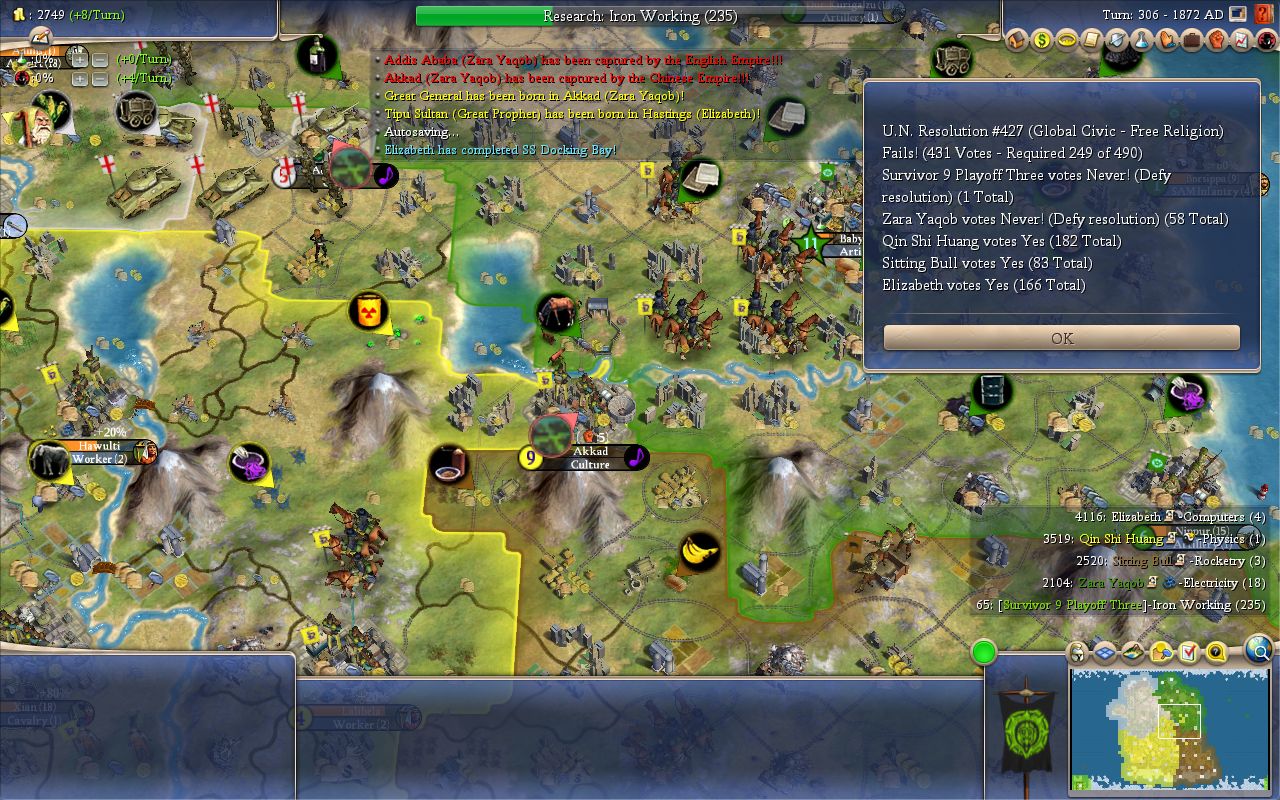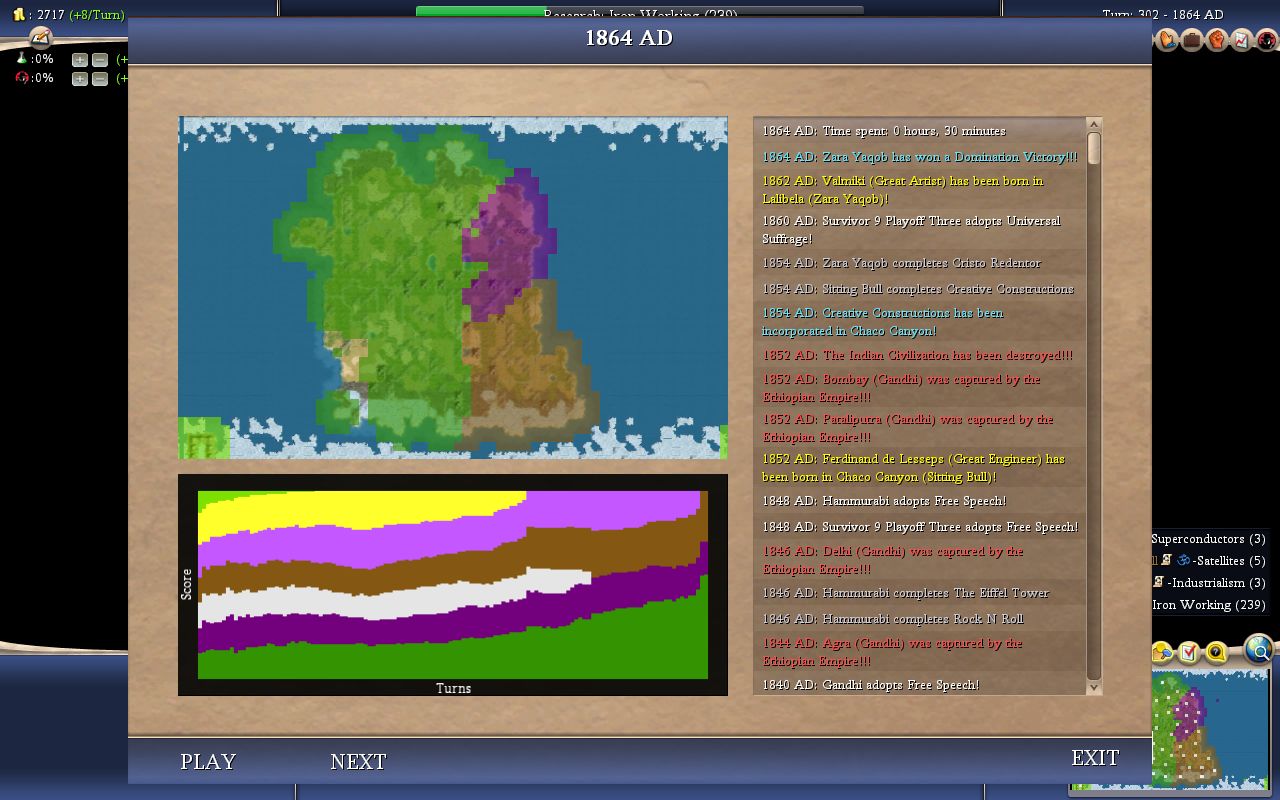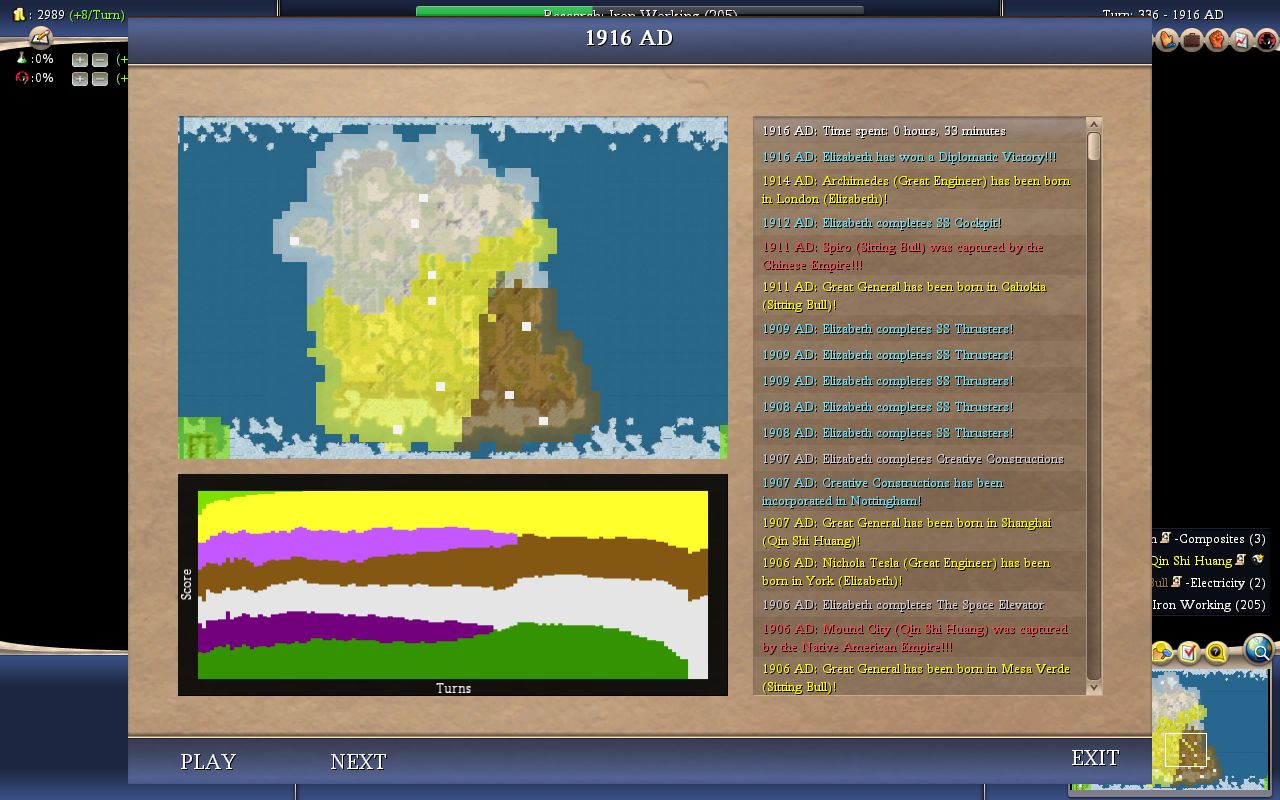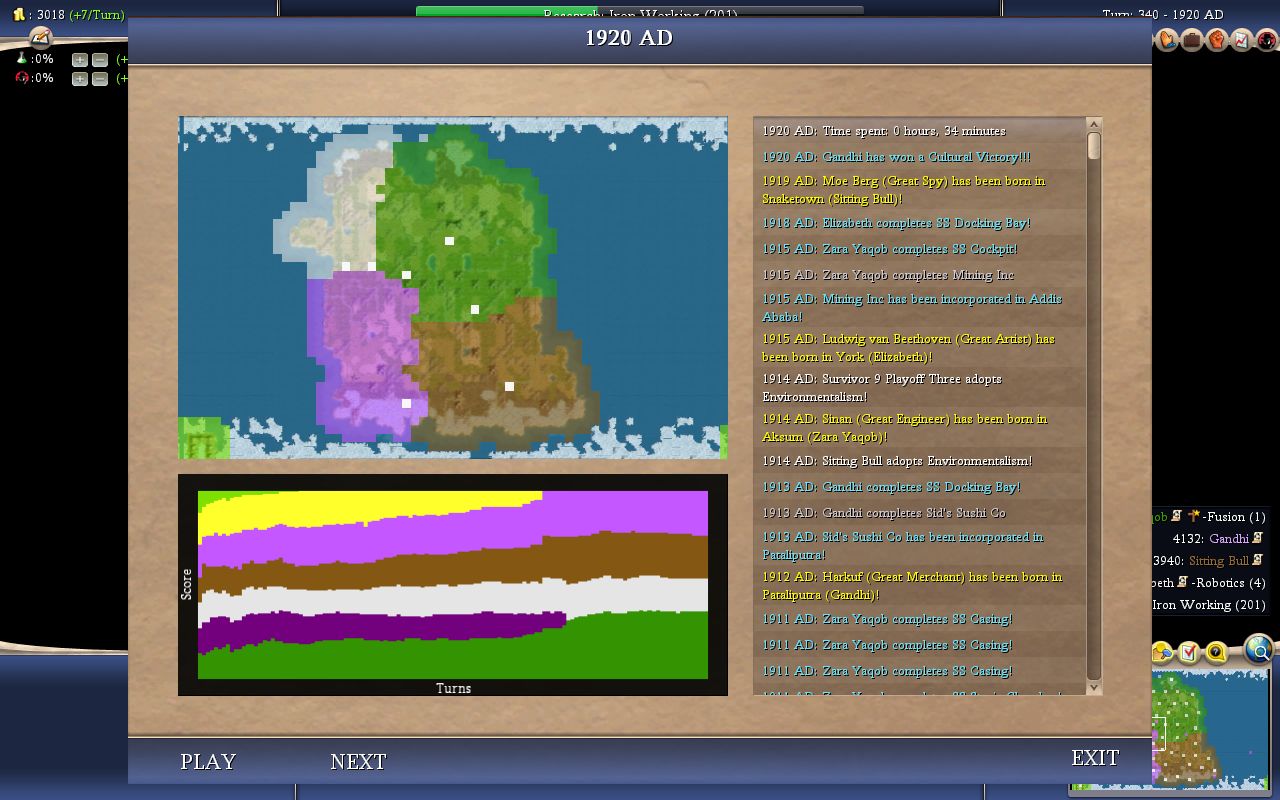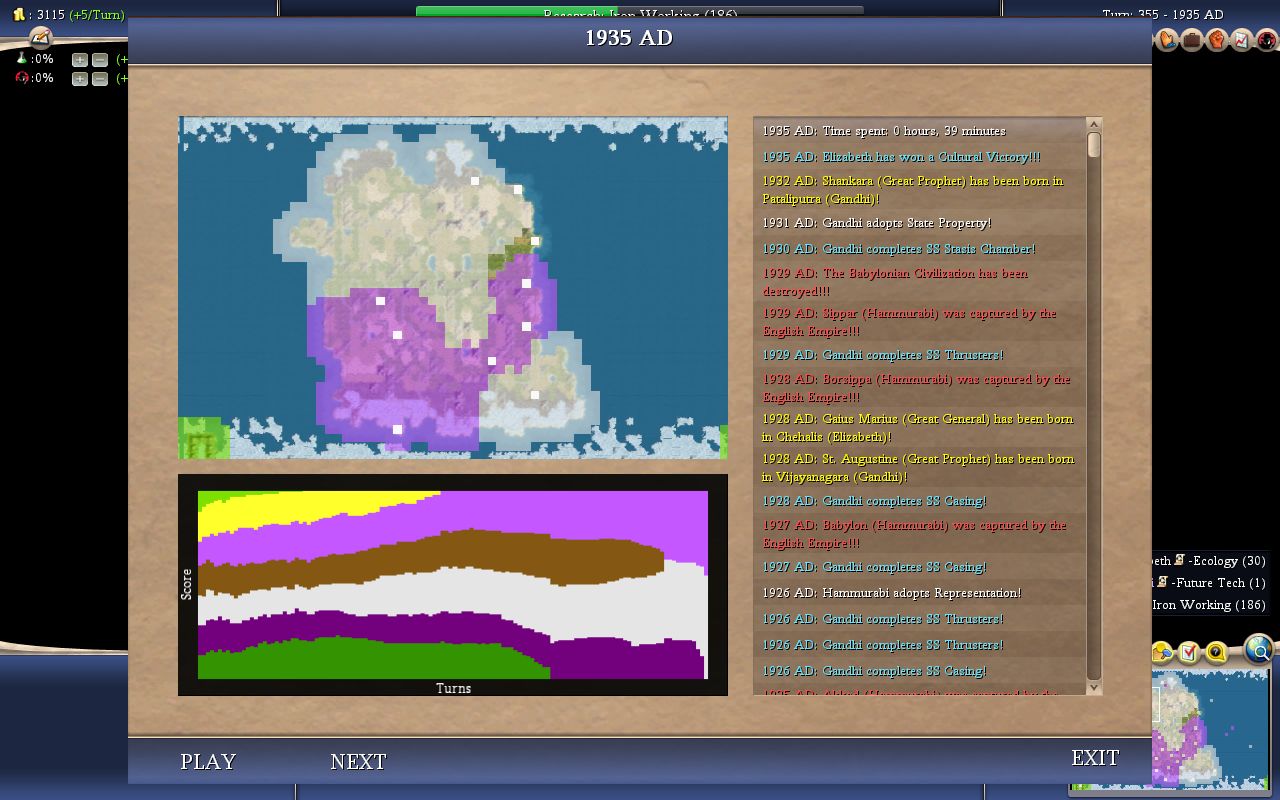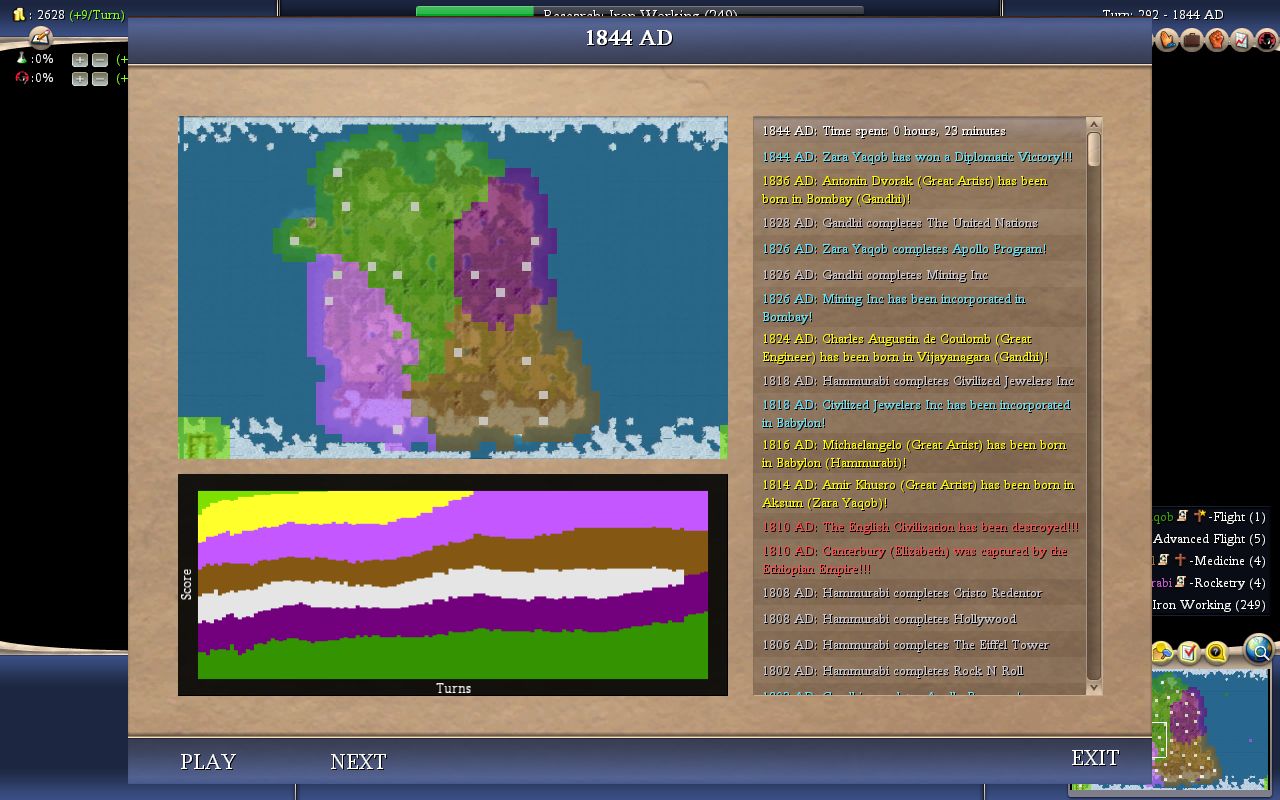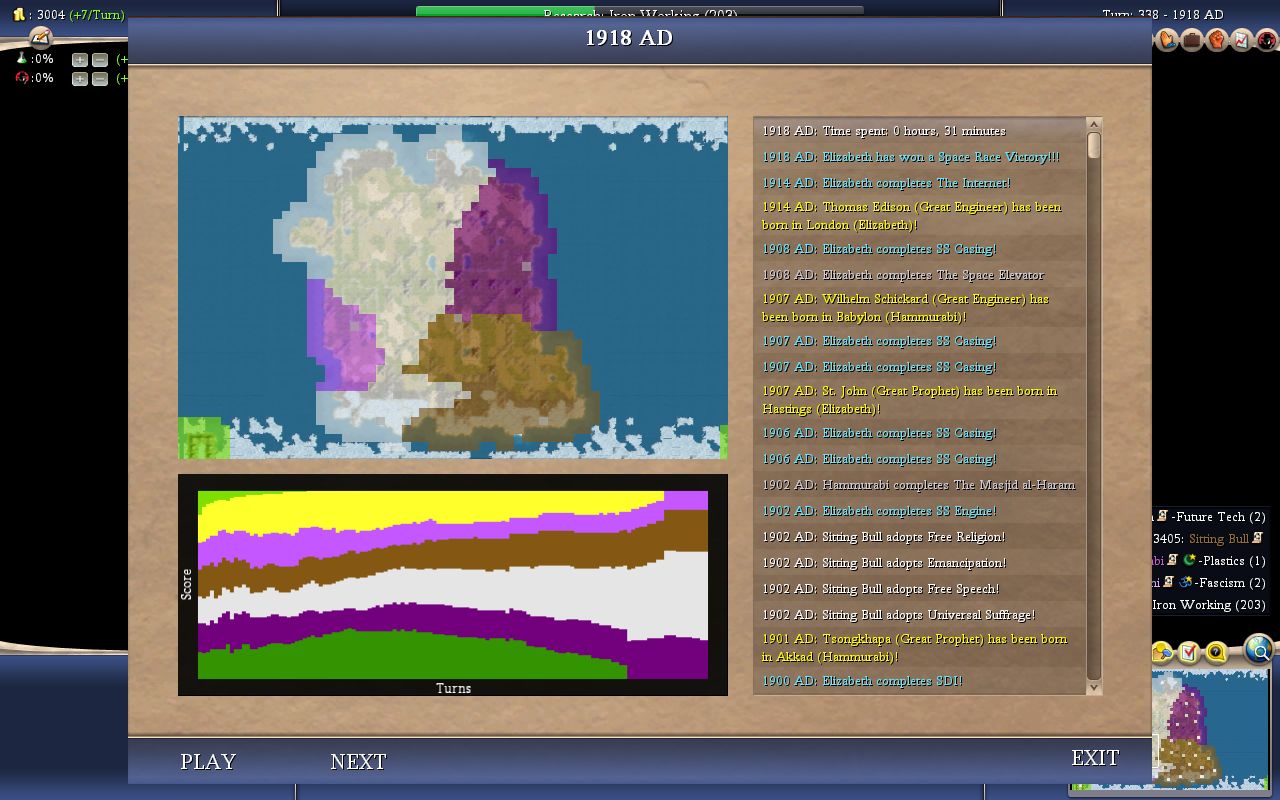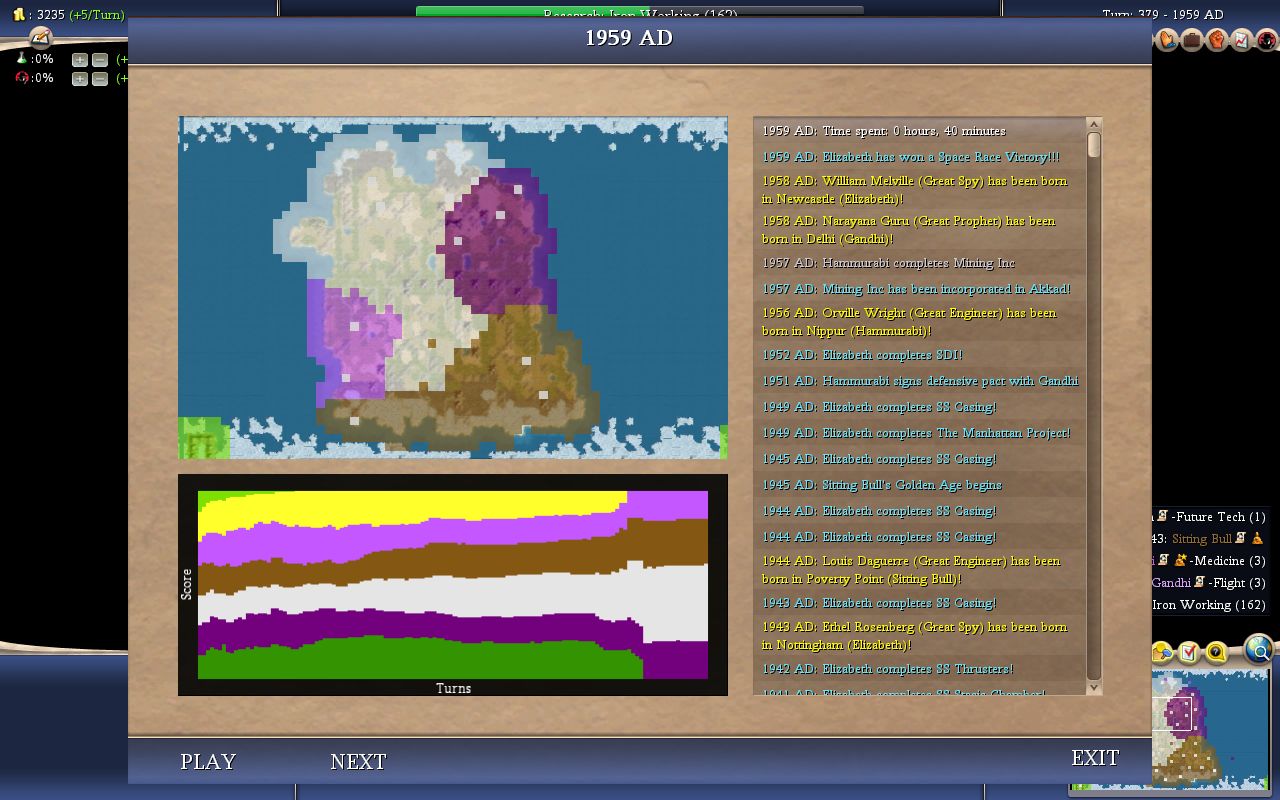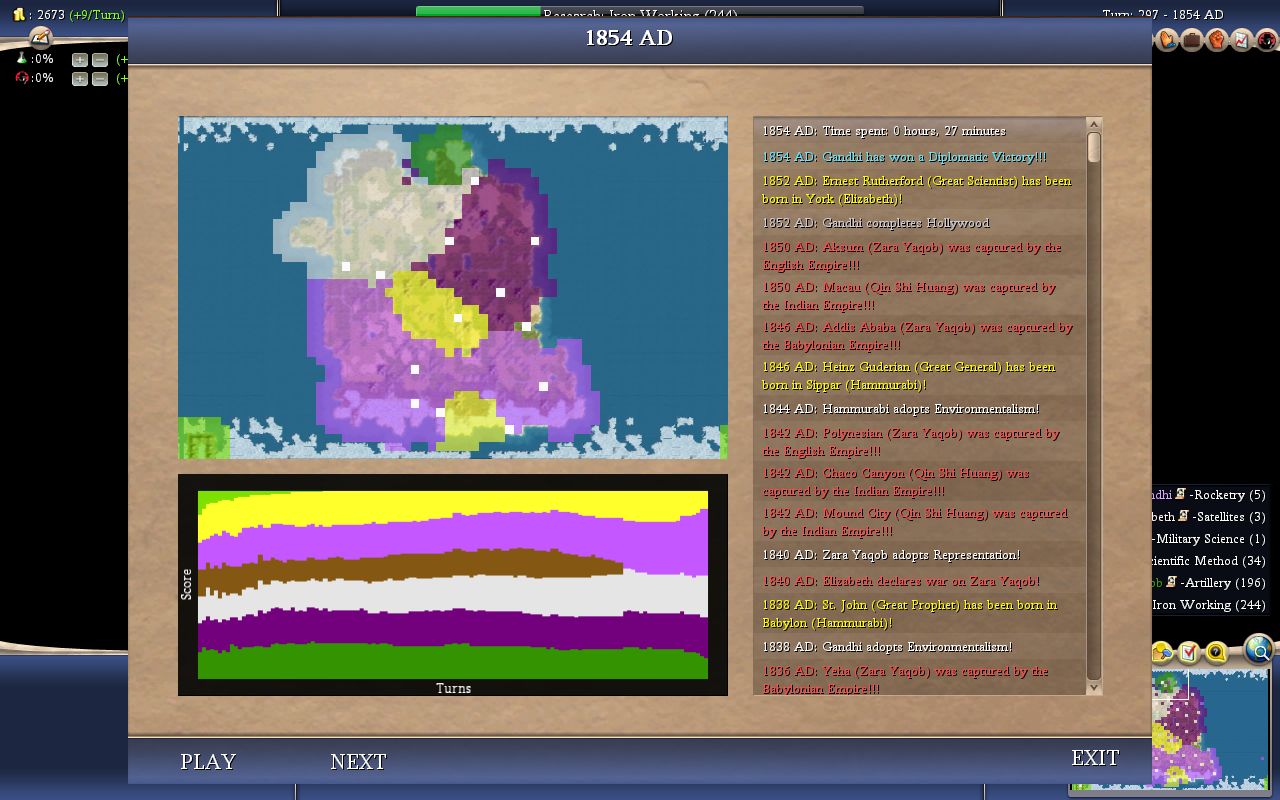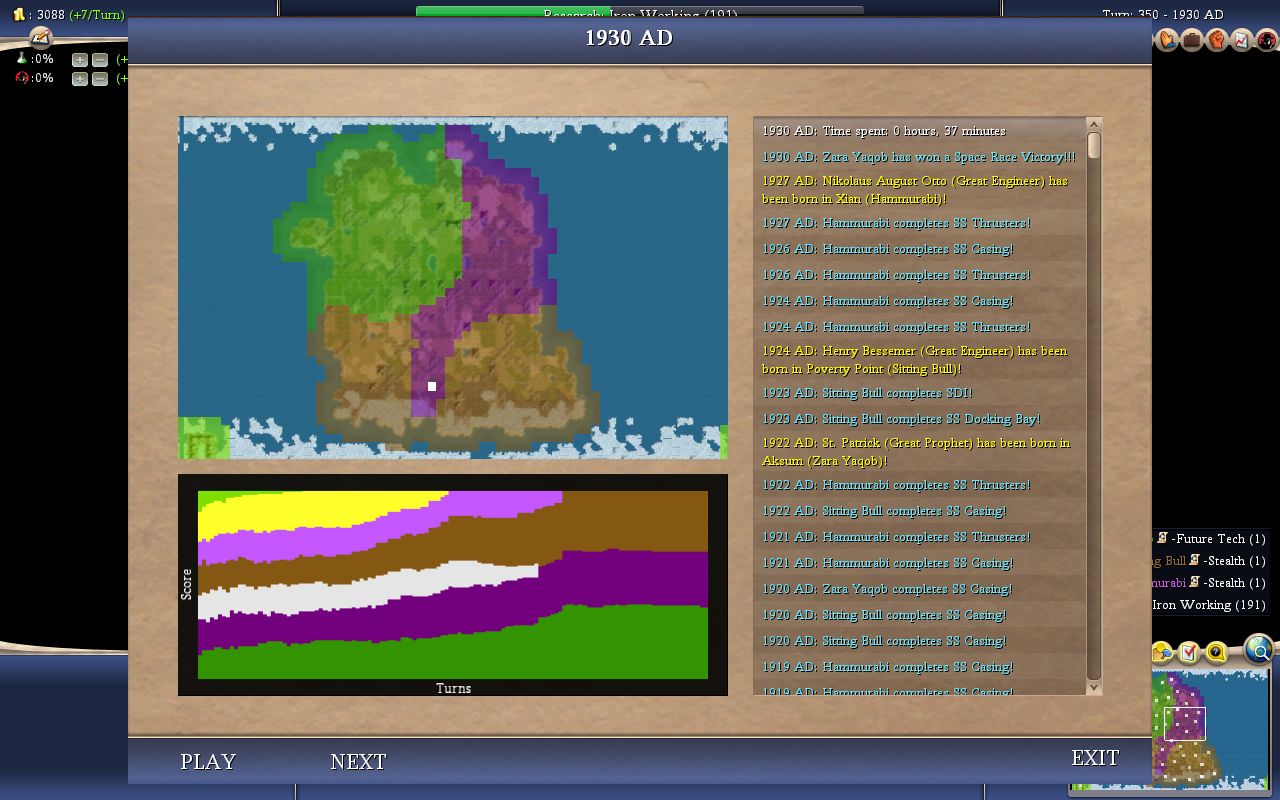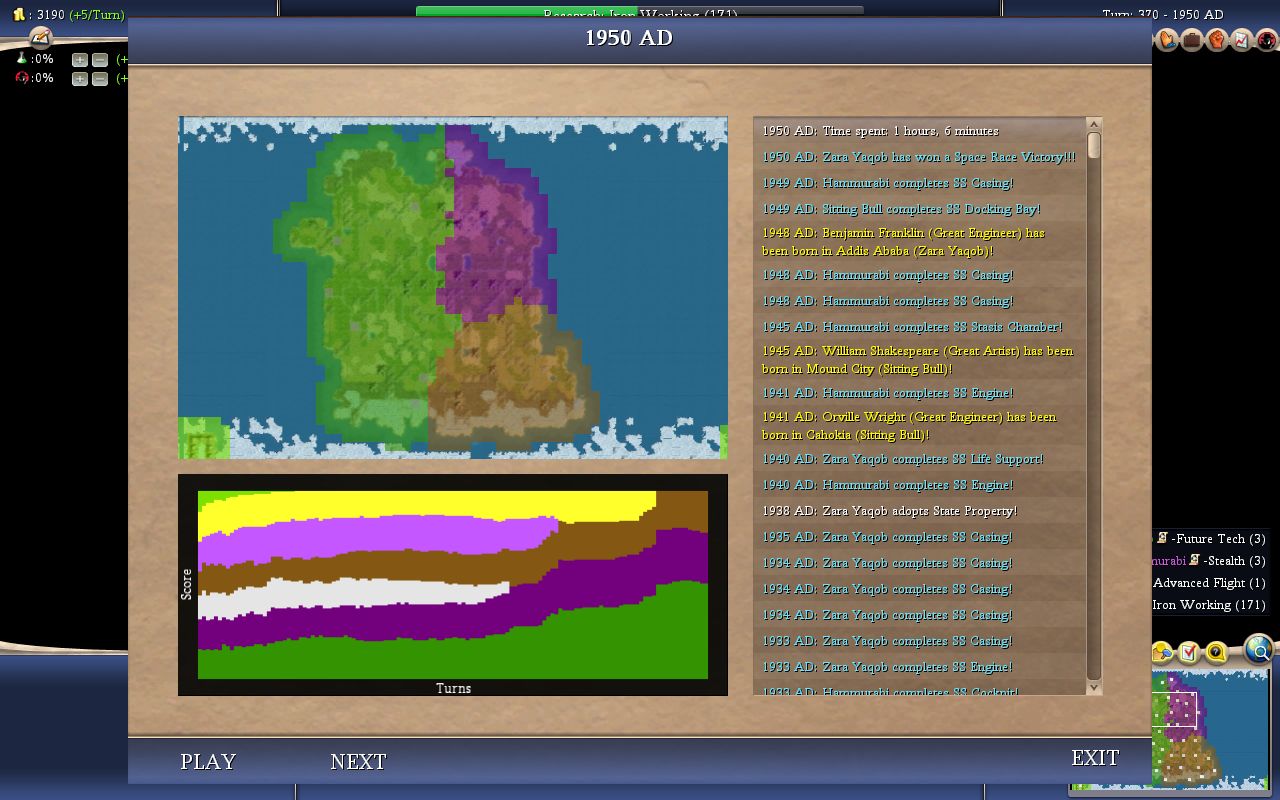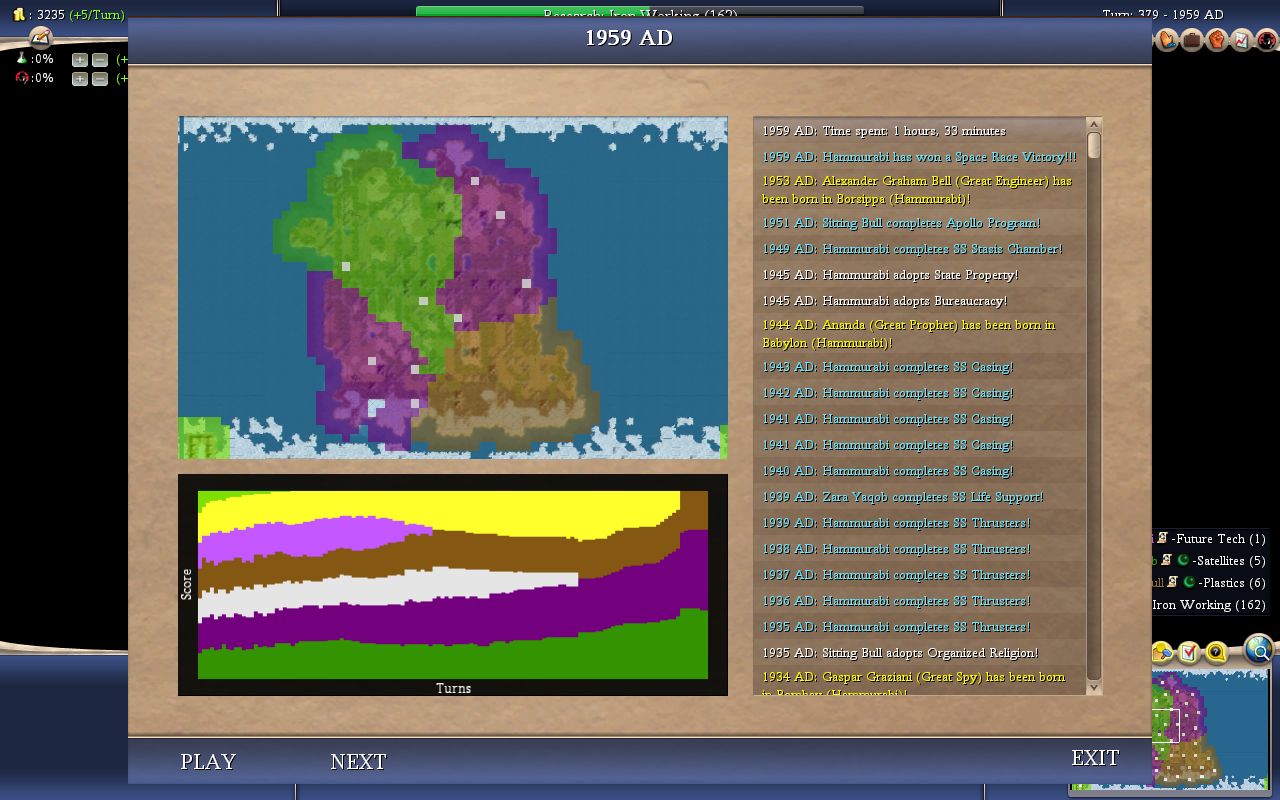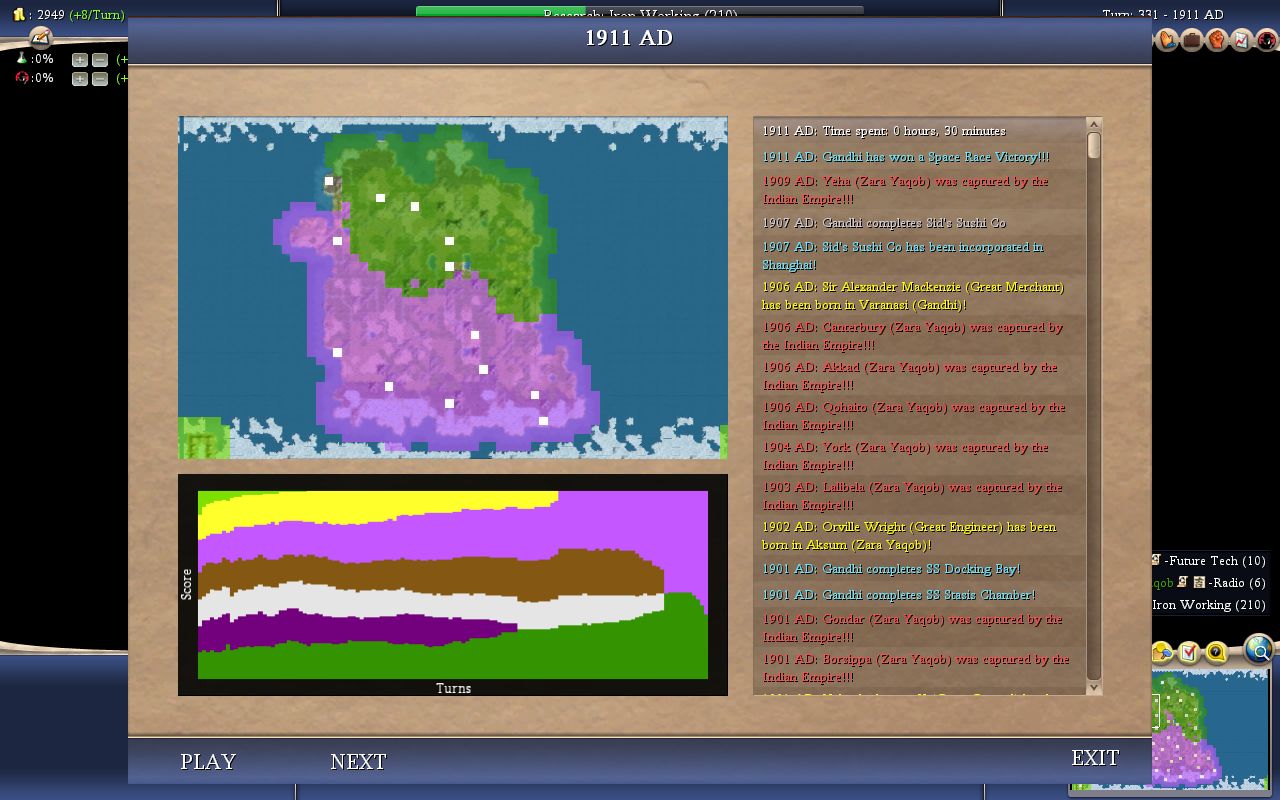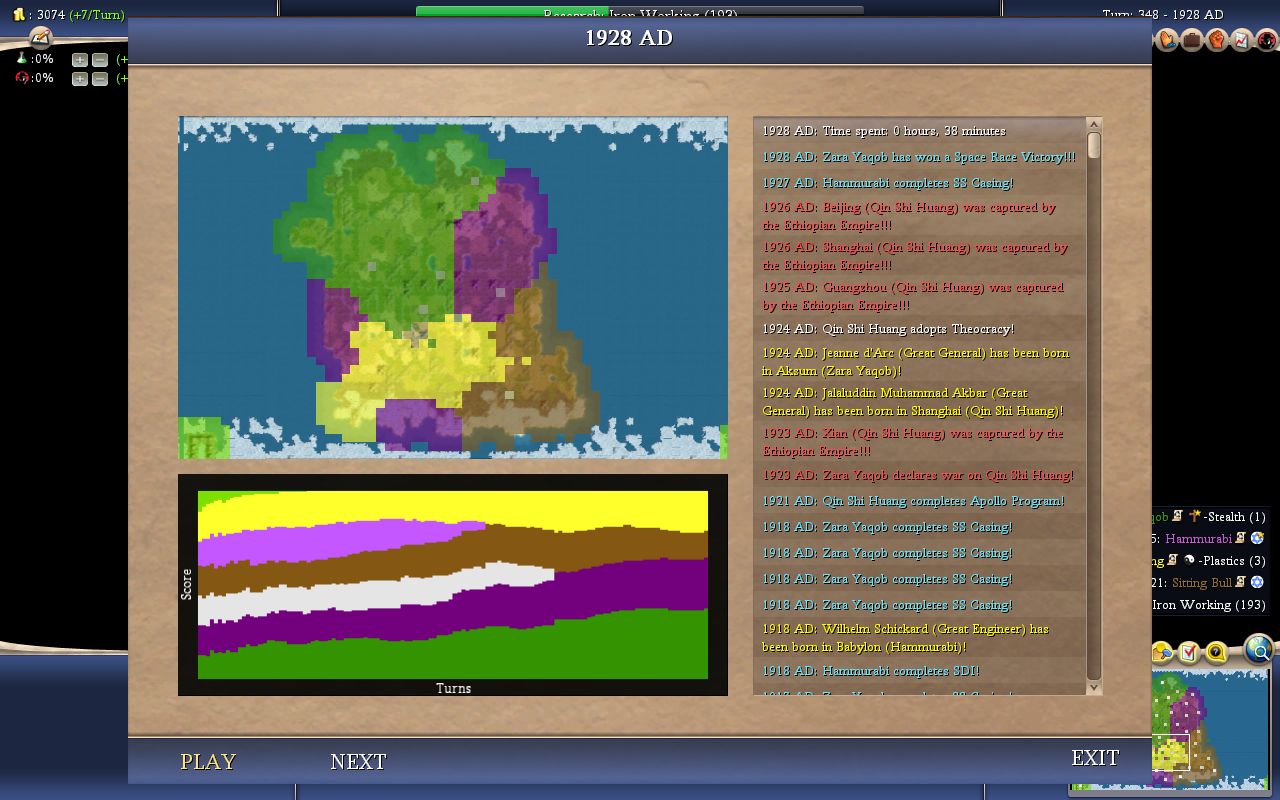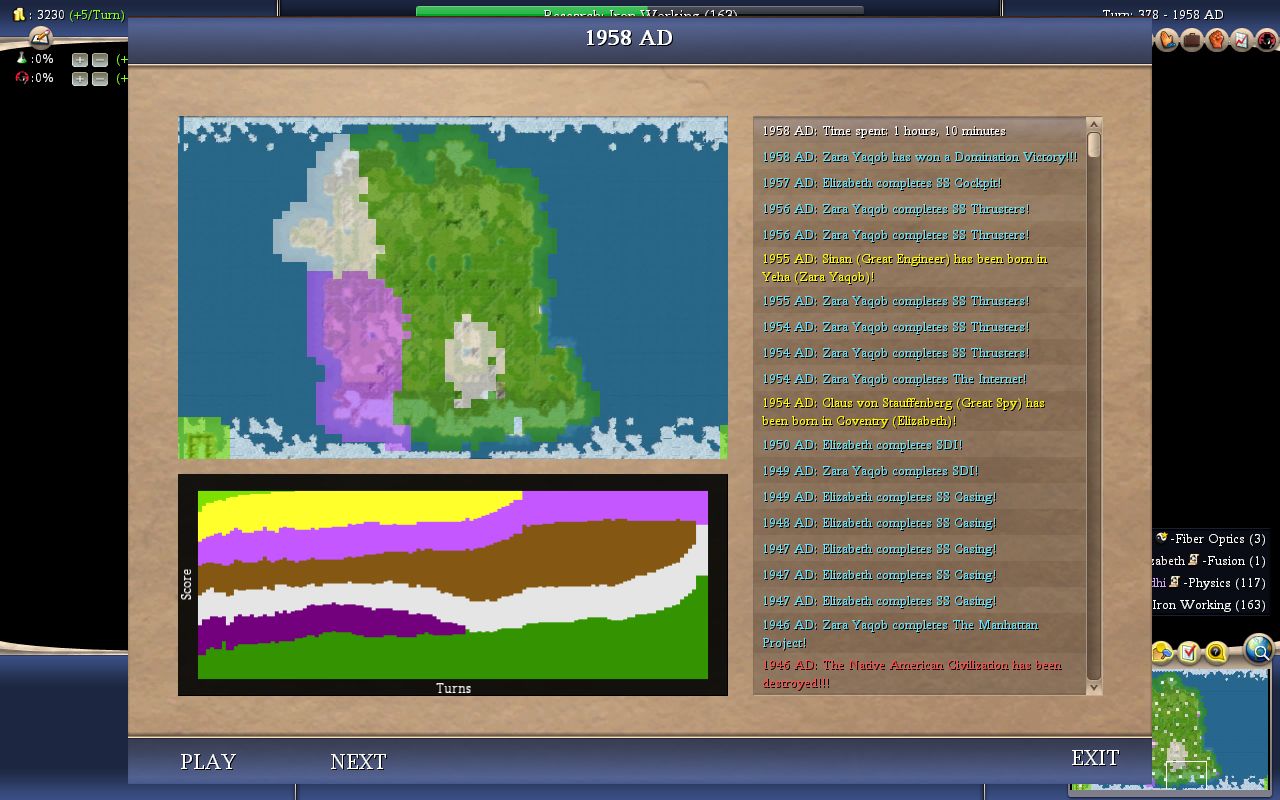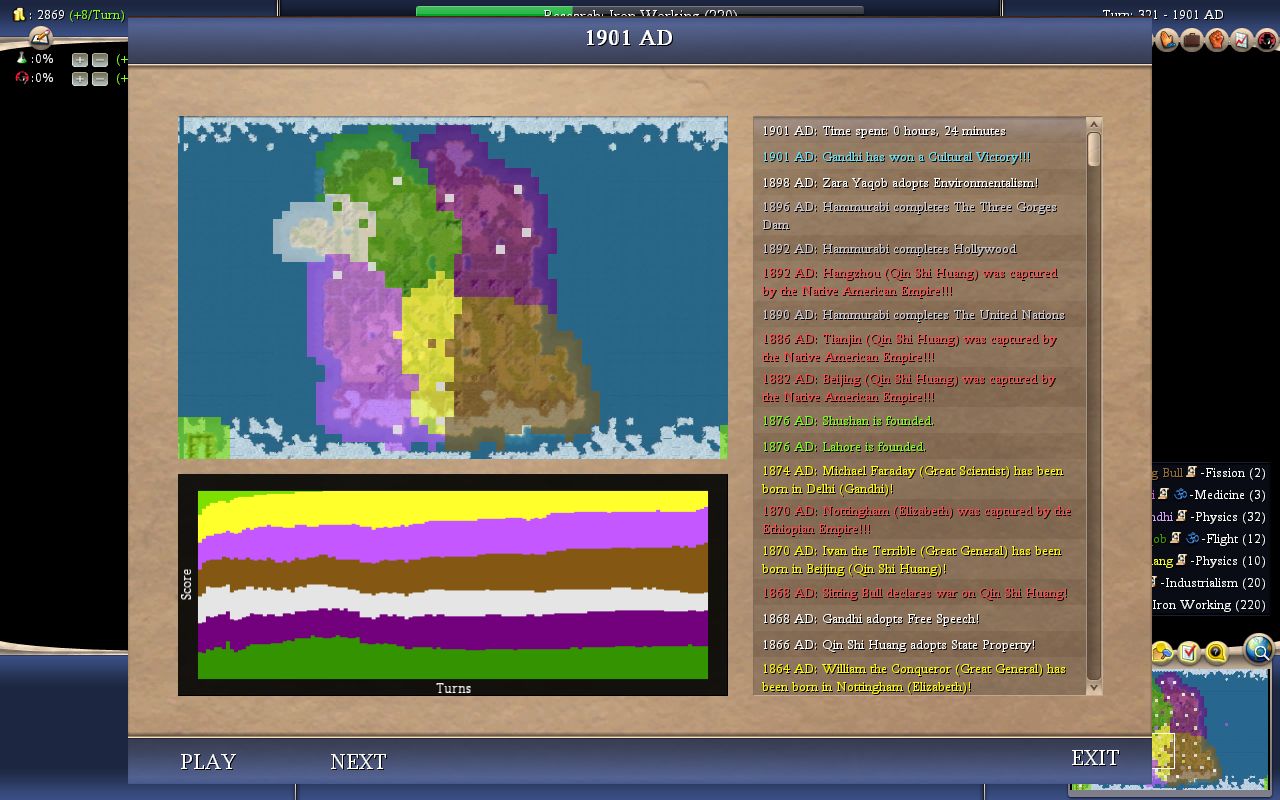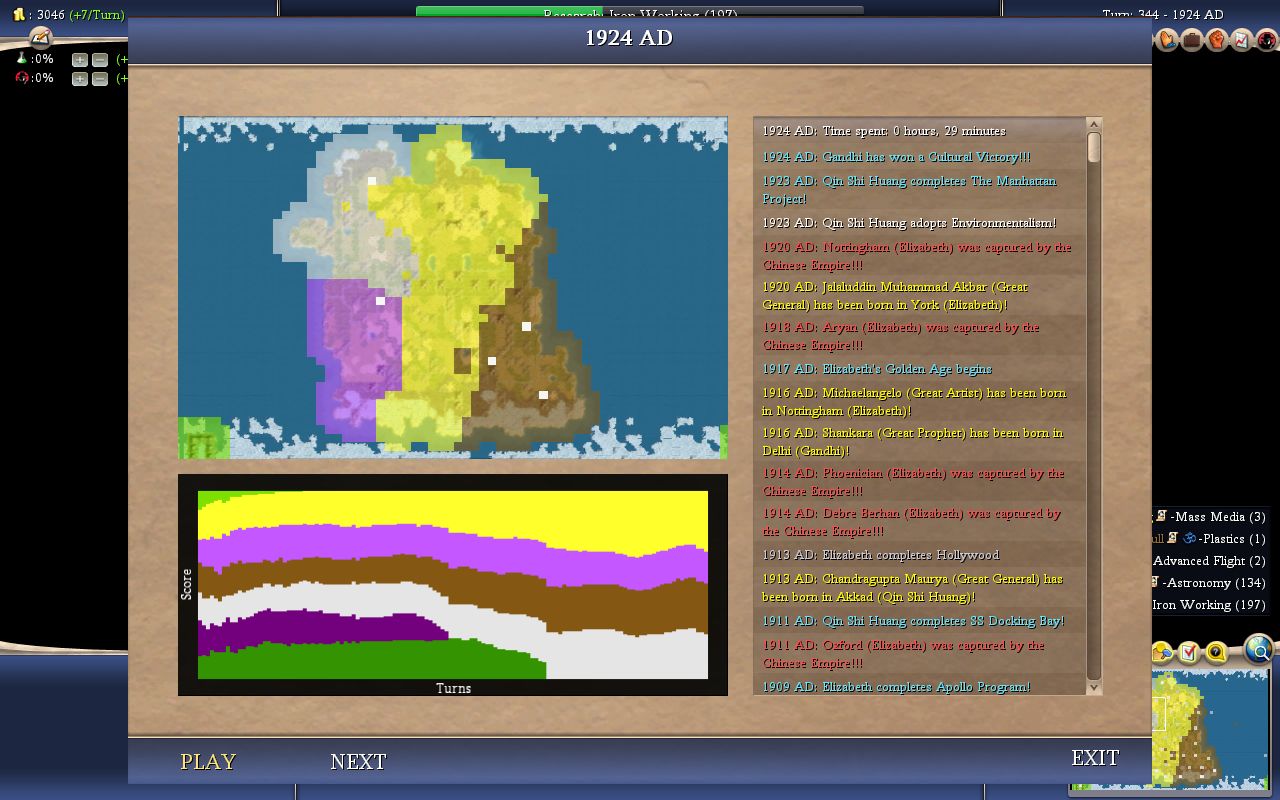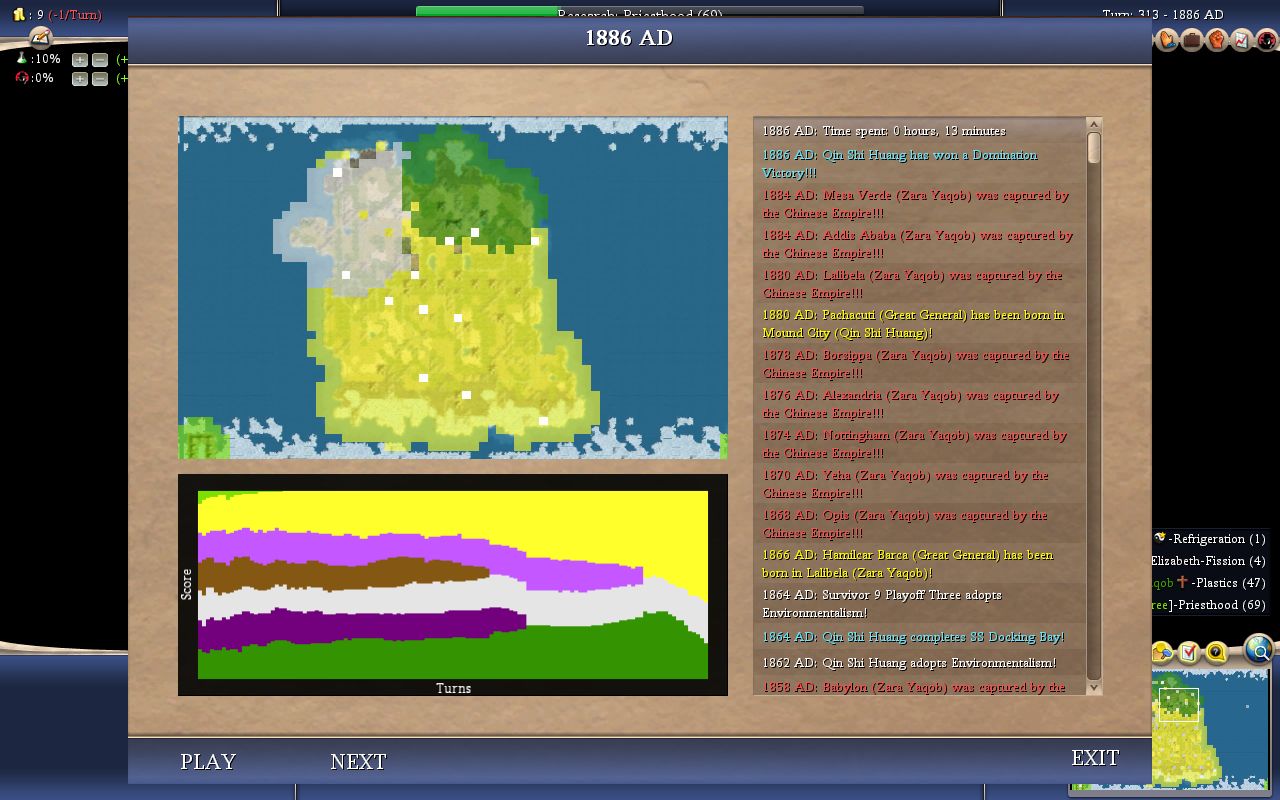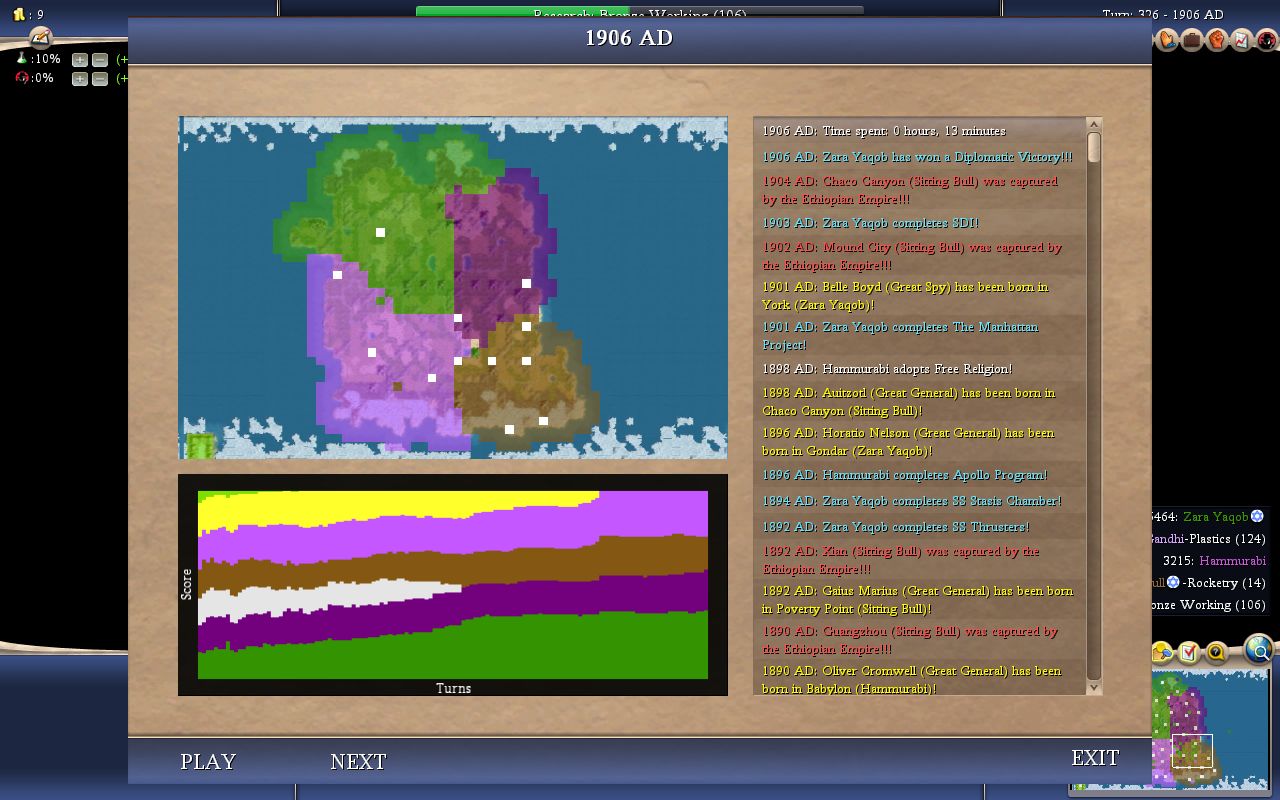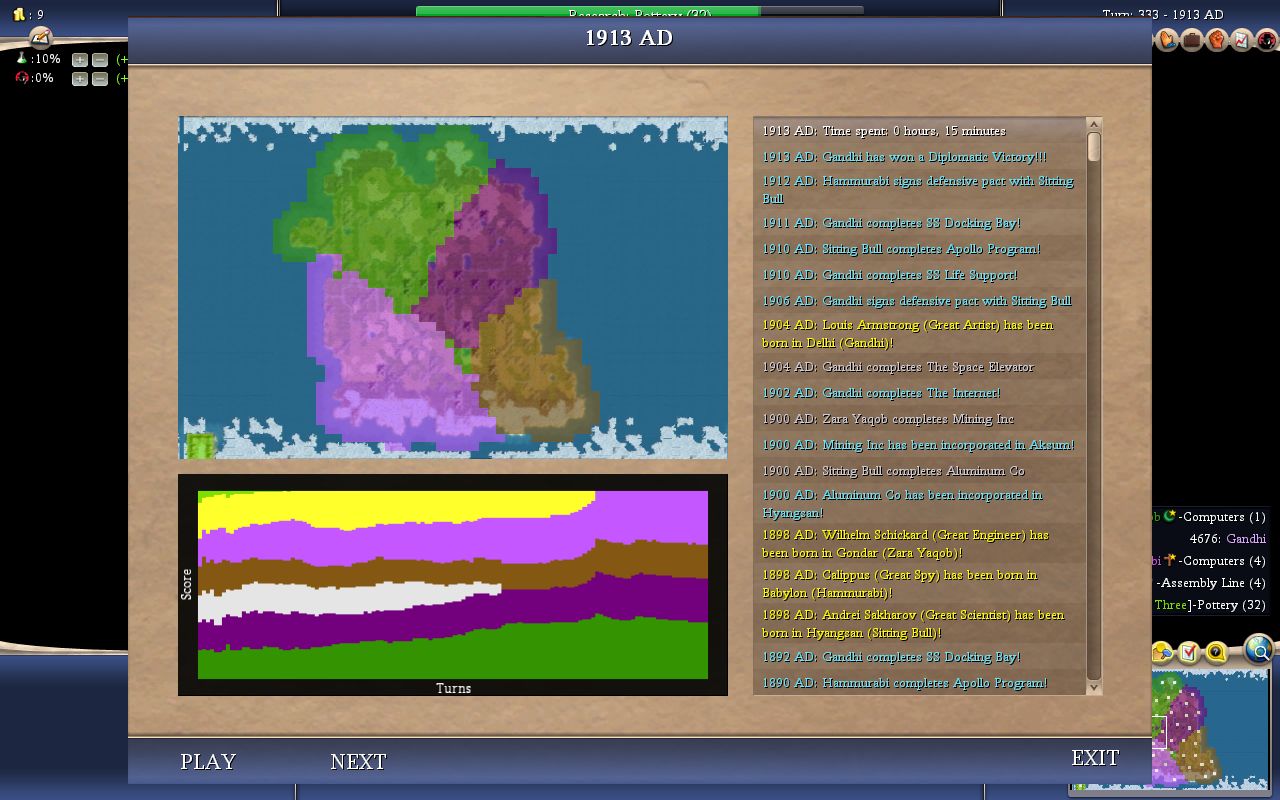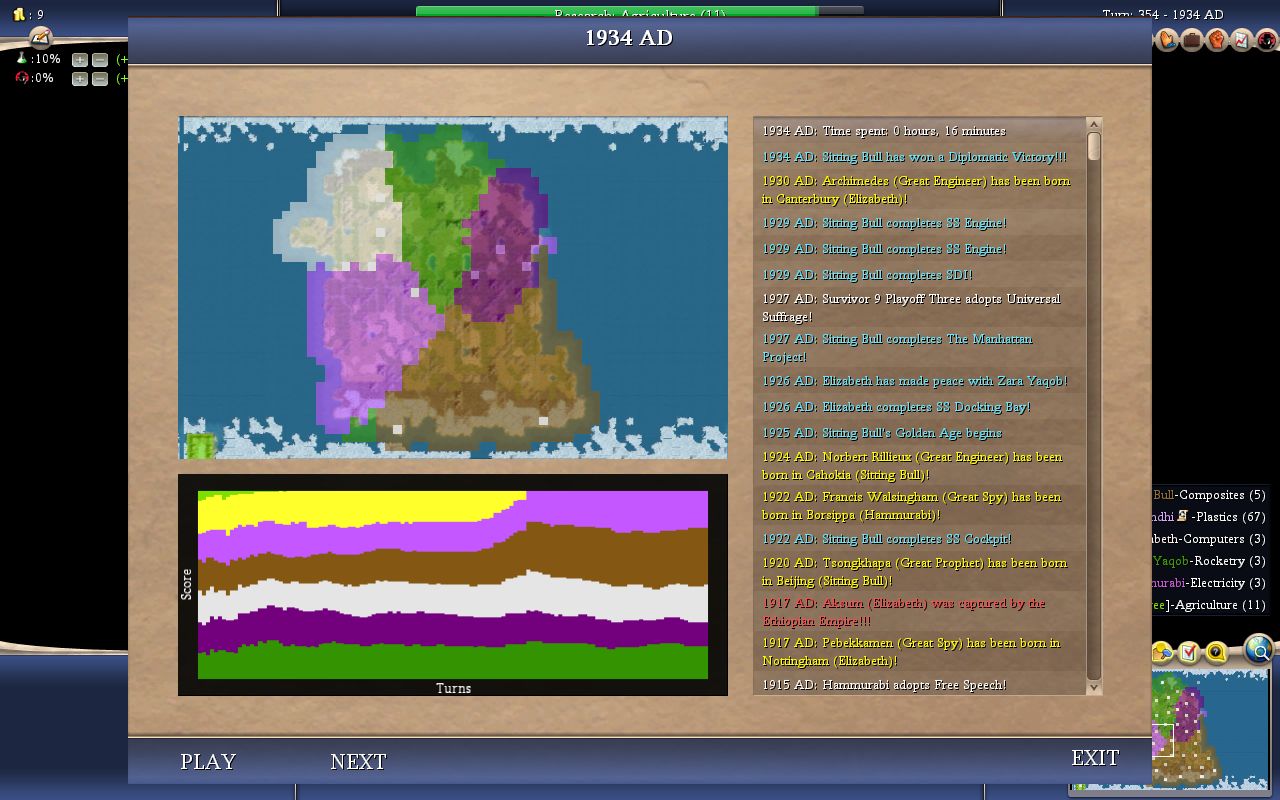
One of the recurring features of past seasons of AI Survivor have been our "alternate histories", running additional iterations on the same maps to see if the same events would play out again. The third playoff game was widely seen as overwhelmingly favorable for Gandhi, something that was seemingly confirmed when Gandhi did indeed with the Livestream match. Was that something which would unfold in each game? This was a topic that called for more investigation with alternate history scenarios. Following the conclusion of previous seasons of AI Survivor, I had gone back and investigated some of the completed games and found that they tended to play out in the same patterns over and over again. While there was definitely some variation from game to game, and occasionally an unlikely outcome took place, for the most part the games were fairly predictable based on the personality of the AI leaders and the terrain of each particular map. Would we see the same patterns play out again and again on this particular map?

The original inspiration to run these alternate histories came from Wyatan. He decided to rerun the Season Four games 20 times each and publish the results. The objective in his words was twofold:
- See how random the prediction game actually is. There's a natural tendency when your predictions come true to go "See! Told you!", and on the contrary to dismiss the result as a mere fluke when things don't go the way you expected them to (pleading guilty there, Your Honour). Hopefully, with 20 iterations, we'll get a sense of how flukey the actual result was, and of how actually predictable each game was.
- Get a more accurate idea of each leader's performance. Over 6 seasons, we'll have a 75 game sample. That might seem a lot, but it's actually a very small sample, with each leader appearing 5-10 times only. With this much larger sample, we'll be able able to better gauge each leader's performance, in the specific context of each game. So if an AI is given a dud start, or really tough neighbours, it won't perform well. Which will only be an indication about the balance of that map, and not really about that AI's general performance. But conversely, by running the game 20 times, we'll get dumb luck out of the equation.
Wyatan did a fantastic job of putting together data for the Season Four games and since then we've continued to use the same general format. First we'll post the resulting data and then discuss some of the findings in more detail. Keep in mind that everything we discuss in these alternate histories is map-specific: it pertains to these leaders with these starting positions in this game. As Wyatan mentioned, an AI leader could be a powerful figure on this particular map while still being a weak leader in more general terms. This particular set of alternate histories were run by TheOneAndOnlyAtesh - many thanks for spending so much time on this task!  Now on to the results:
Game One | Game Two | Game Three | Game Four | Game Five
Game Six | Game Seven | Game Eight | Game Nine | Game Ten
Game Eleven | Game Twelve | Game Thirteen | Game Fourteen | Game Fifteen
Game Sixteen | Game Seventeen | Game Eighteen | Game Nineteen | Game Twenty
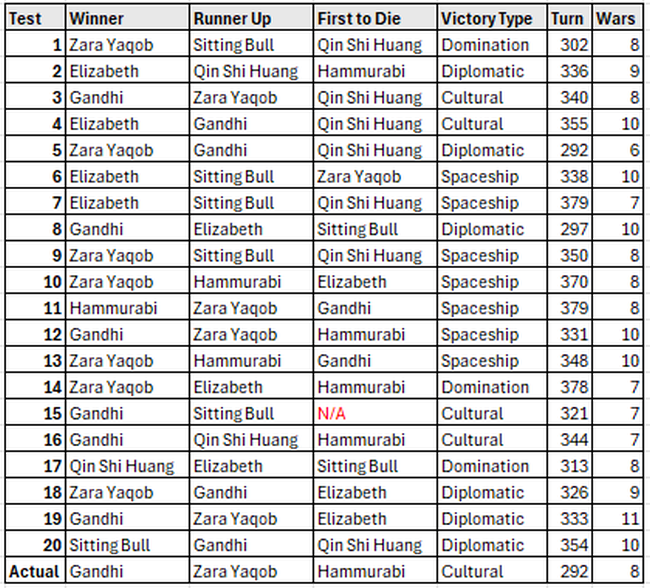
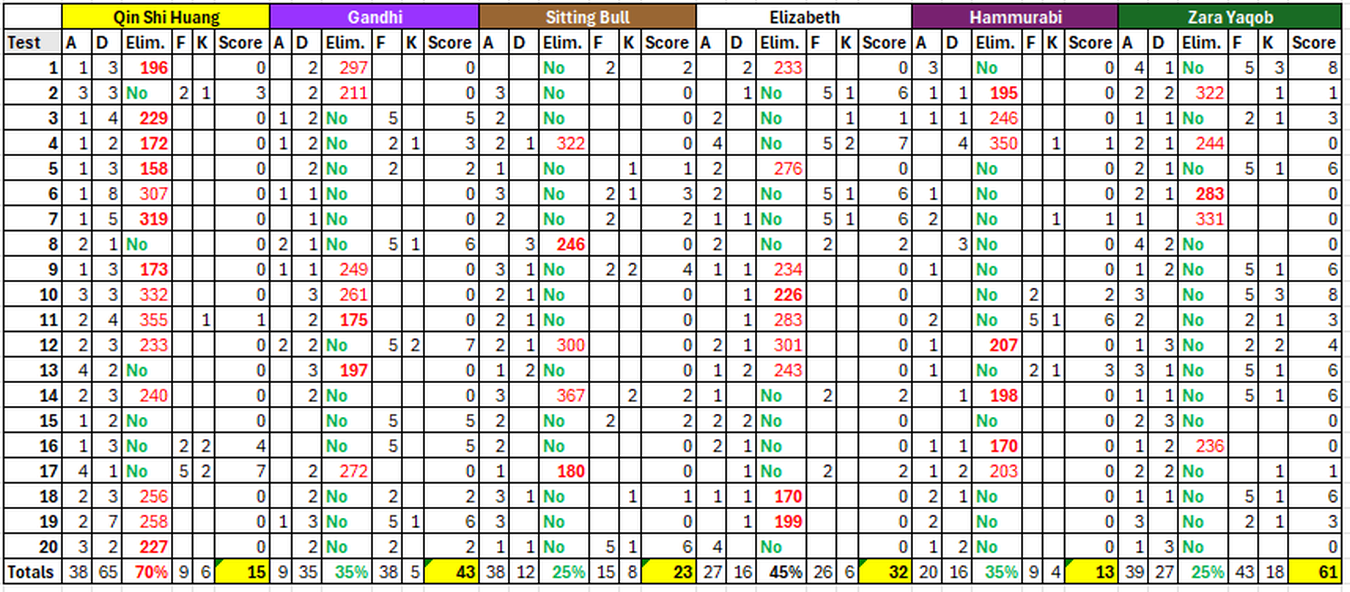
(Note : "A" column tracks the number of war declarations initiated by the AI, "D" the number of times the AI is declared upon, "F" the points for finish ranking, and "K" the number of kills.)
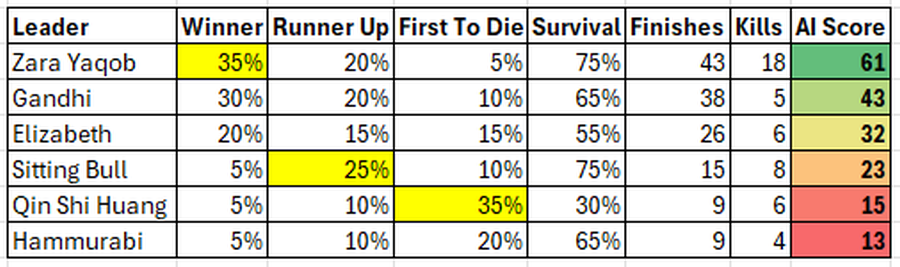
TheOneAndOnlyAtesh: I came into this set expecting to witness a million variations of "Gandhi cultures away in a corner against these noobs", and was pleasantly surprised to instead see an open-ended setup that offered a variety of possibilities for these games. Although Gandhi and Zara, the two Championship qualifiers from the Actual Game, were the co-favorites in this setup, every single leader here had some tangible chances, and there were lots of very close games to make this quite an exciting series of matches. If one were to run another twenty games their results might have looked quite different from this one.
This map had one major quirk: it was a VERY small map, one of the most cramped that I have ever analyzed, and the resultant border tensions formed a pressure cooker that, even amongst a seemingly peaceful bunch, could explode at any moment considering the religious, cultural, and expansionist nature of this map's contestants. Generally these leader's second and third cities would already be touching each other and all the prime real estate was claimed within 50-75 turns.
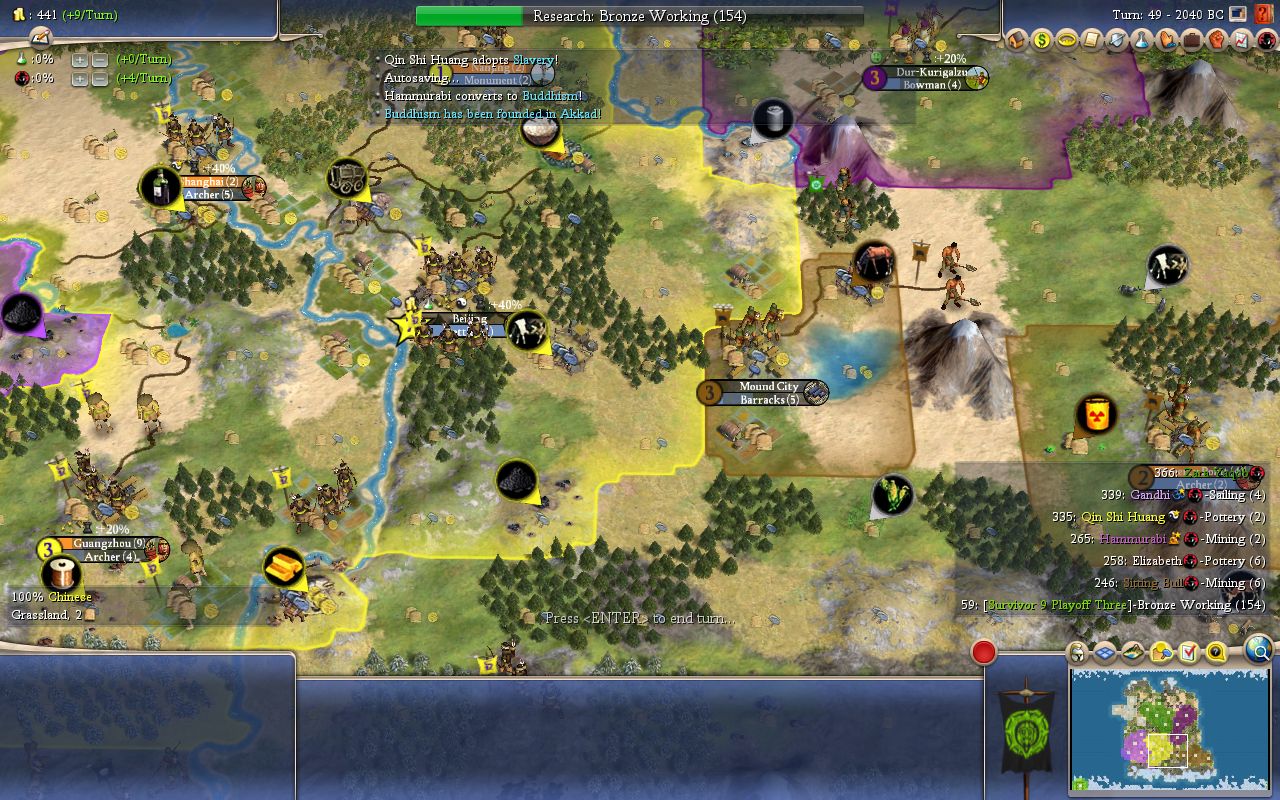
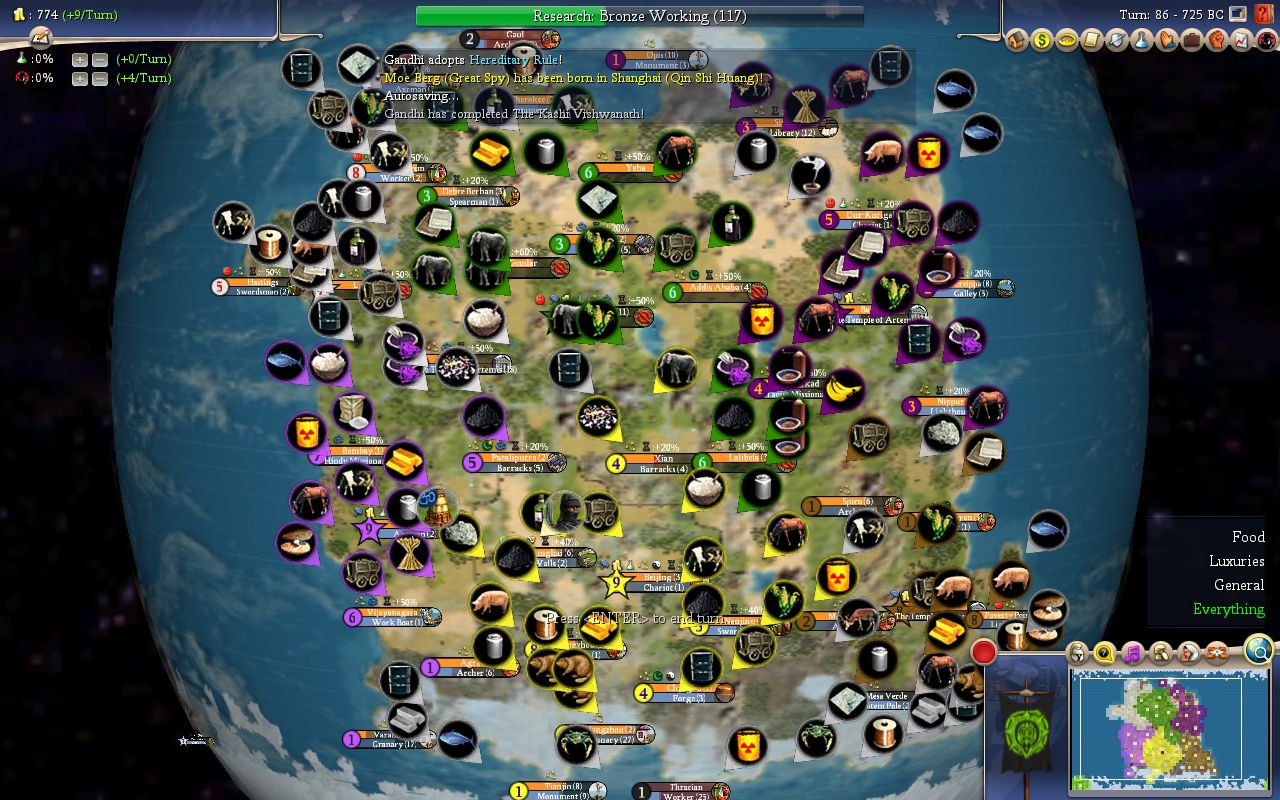
With how tightly contested all the quality land was, the first 20 or so turns had a heightened importance in this map. In particular, Lizzy and Zara were competing for the same land, while Gandhi and Qin were also settling on top of each other, and for each pair there was usually one member already effectively out of contention by Turn 25 as the other had established firm control over their respective domains.
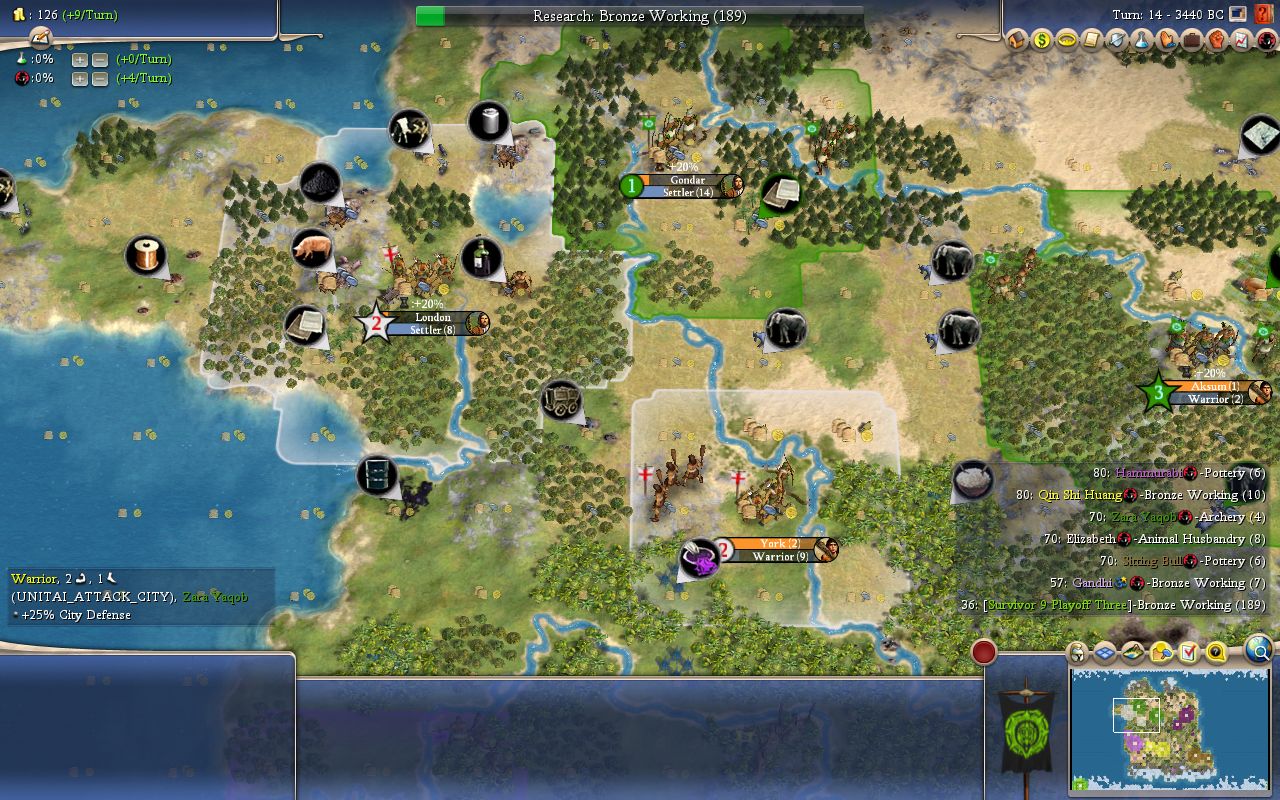
Religion was also of utmost importance in these games. At times it felt like I was watching six Isabellas duke it out here, with pretty much everything diplomatically hinging on religion. The one given was that Gandhi would found Hinduism, which he did in all twenty replays. His most common religious rivals were Hammurabi (like in the Actual Game), and, I kid you not, QIN. Yes, Qin, a notorious Mysticism avoider, was on this map a religious leader, and even without a religion he was good at finding sources of culture, especially through wonder building. This phenomenon had huge ramifications for this map, and I would venture that Qin not avoiding culture and thus being far stronger in the early game was the primary reason why Gandhi was not as dominant as many expected him to be here.
Add religion to the mix, alongside a centrally located low peaceweight magnet in Qin, and these games were more violent than one might have expected, at least in the early and middle stages of these games. The combination of heavy warring and comically inept fighting created an interesting phenomenon where these relatively small, 6-10 city enclaves were stalemating each other, dragging the global tech pace down considerably as without any ways to get large easily these small empires would really sputter economically in the late game.
Yet another unexpected stat I observed was that First To Die turned out to be somewhat of a tossup. While Qin ostensibly had the highest early elimination rate on the map, he was very streaky in that regard, only being First To Die once over the final ten games. Rather than being determined by peaceweight, First To Die tended to stem from two factors: 1) a religious pariah, like what happened in the Actual Game with Hammurabi, or 2) over 200 turns of stalemated wars only broken with a late dogpile (often after modernized civics redrew the diplomatic lines) or through technological/numerical superiority. There were also some very late First To Die dates, including Game 7 where the first casualty came on Turn 319! I personally think a post Turn 300 FTD is more absurd than having zero deaths; fittingly, Game 15 had no deaths, not because the world held hands and sang Kumbaya, but because the wars that did take place just did not accomplish anything.
A typical game would see the map divided into two theatres, one revolving around Zara and the other around Qin. Zara would fight one of his neighbors (usually Lizzy, but occasionally Qin or Hammurabi depending on religious dynamics), and the outcome of this fight usually decided one of the Championship spots. The other aspect of the map was the inevitable dogpile of Qin, and the other Championship slot usually depended on who got the most spoils from the anti-Chinese coalition, or if such a conflict stalemated, which was usually to Gandhi's benefit. As I had mentioned, these were slow games, especially by the standards of this field. The only halfway decent economic performances I saw on this map by any leader took place in Game 12 and the Actual Game, both Gandhi wins, and the only way these games were likely to end before Turn 300 was through a premature UN vote. Speaking of which, this set had six Diplomatic victories, making that the second most common victory condition behind Spaceship. The conditions here in fact were quite ripe for Diplomatic wins, with factors such as game length, peaceweight, civics (Gandhi, Lizzy, and Sitting Bull have endgame favorite civics which proved quite relevant in these matches), and mutual military bonuses helping these leaders form VERY strong bonds with each other. Moreover, due to Gandhi and Hammurabi's research preferences, it was not uncommon for a relatively small empire to build the UN as pure Culture flavors led to some ridiculously early Mass Media dates, making it easier for the bigger empire to get over the hump - think what can happen when the second largest empire votes for the largest one - while also giving more opportunities for Diplo votes to be called.
Onto the individual leader summaries!

Zara Yaqob of Ethiopia
Wars Declared: 39
Wars Declared Upon: 27
Survival Percentage: 75%
Finishes: 7 Firsts, 4 Seconds (43 points)
Kills: 18
Overall Score: 61 points
Myth put it best when I put the teaser on the Discord: 18 kills is insane in this field, and should explain everything about why Zara was so strong here. One thing I have learned over the course of running these games is that larger maps tend to favor more peaceful builder personalities while punishing warmongers - see the Game Four or Championship Game Alternate Histories for examples. As you can guess, the opposite is true for smaller maps, as when everyone is small it is easier to make successful conquests, stalemates tend to be less punishing, and if one does get off a conquest being at least 1.5x the size of everyone else becomes a massive advantage. As it turned out on this cramped map, Zara was by FAR the best fighter on this map, helped by a lush central position with the map's only major source of elephants alongside a litany of potential conquests in the form of his weak and/or unpopular neighbors. Add in an excellent diplomatic situation that allowed him to befriend anyone, (Zara is the best diplomat in AI Survivor), and all the ingredients were there for Zara to be the strongest leader despite his steep economic competition. On the military end, Lizzy was the most effective target for Zara, who would frequently utilize his Creative + Stele combination to completely crowd her out, leaving her easy pickings. An added bonus was that England was a gateway to India, the primary obstacle to an Ethiopian victory. Zara won three of the four games where Lizzy was First To Die and nearly won the other, and it was no accident that his most dominant stretch happened to coincide with Lizzy's weakest one.
While the English were his best springboard to success, Qin was a less common and more risky initial target, but a Chinese conquest could still prove to be lucrative, like it did in Game 1, probably his best game of the set. The problem with fighting Qin however was that the Chinese were better at defending themselves and weakening Qin could help Gandhi or Elizabeth. The third option, Hammurabi, was the least good option, as it ruined a potentially useful friendship and turning eastward bought a lot of time for Mr. and Mrs. Gandhi in the west to run away with the game. Games 2 and 4 were good examples of how attacking Hammurabi could go disastrously, as the 200 or so turns it took to kill or cripple Babylon gave Lizzy all the time she needed to Financial/Alive and then backstab him with Infantry or Tanks. Zara's worst games saw him just not get enough from his early warring to compete, his most common "failure" outcome seeing him fight one of his neighbors to irrelevance and eventual elimination, either from a late war or from a survival. Nevertheless, this was a pretty impressive display that showed all of Zara's strengths as a leader. There is a reason Zara has two Top 3 season finishes in his AI Survivor career.
These Are Not The Droids You Are Looking For Award: Teching Robotics before Flight in Game 13.
Squid Game Celebration Award: In Game 14 Zara hit Domination ONE TURN before Gandhi was about to bullshit a Cultural victory from a completely losing position, locking the Indians out of the Championship Game.
Sorry For Killing You Award:

Gandhi of India
Wars Declared: 9
Wars Declared Upon: 35
Survival Percentage: 65%
Finishes: 6 Firsts, 4 Seconds (38 points)
Kills: 5
Overall Score: 43 points
This was quite the unexpected result. Gandhi looked too good in the Actual Game to seemingly underperform like this. It turned out the livestream was an absolute best case scenario and Gandhi struggled GREATLY in the repeat playthroughs. Even his victories were pretty ugly, including a Game 3 slog where he won a sliderless culture victory after losing his capital and Game 19 where he was teetering on the edge of military disaster until he managed to get tanks. Until his strong finish to this set it was looking like yet another game where Gandhi had trolled us again. So what happened? To start, peaceweight 10 is such a liability. Amicalola's statement about him becoming the "least mostly good leader" especially after Qin was dispatched reared its ugly head over and over again, as despite his seemingly friendly field, Gandhi faced quite a few invasions from his supposed bodyguards. Sitting Bull attacking Gandhi in the livestream was shocking at the time, but it turned out to be not that uncommon an occurrence. Given unfavorable peaceweight RNG and some border tensions, Sitting Bull could frequently be tempted to take a stab at the Indians, especially since he cares little about religion, putting a cap on how warm Indian-Sioux relations could get. Hammurabi, Gandhi's most common religious rival, was also a pretty significant problem, his two First To Die performances stemming from the Babylonians marching from across the map and running him over.
There was another huge problem with Gandhi's situation here.
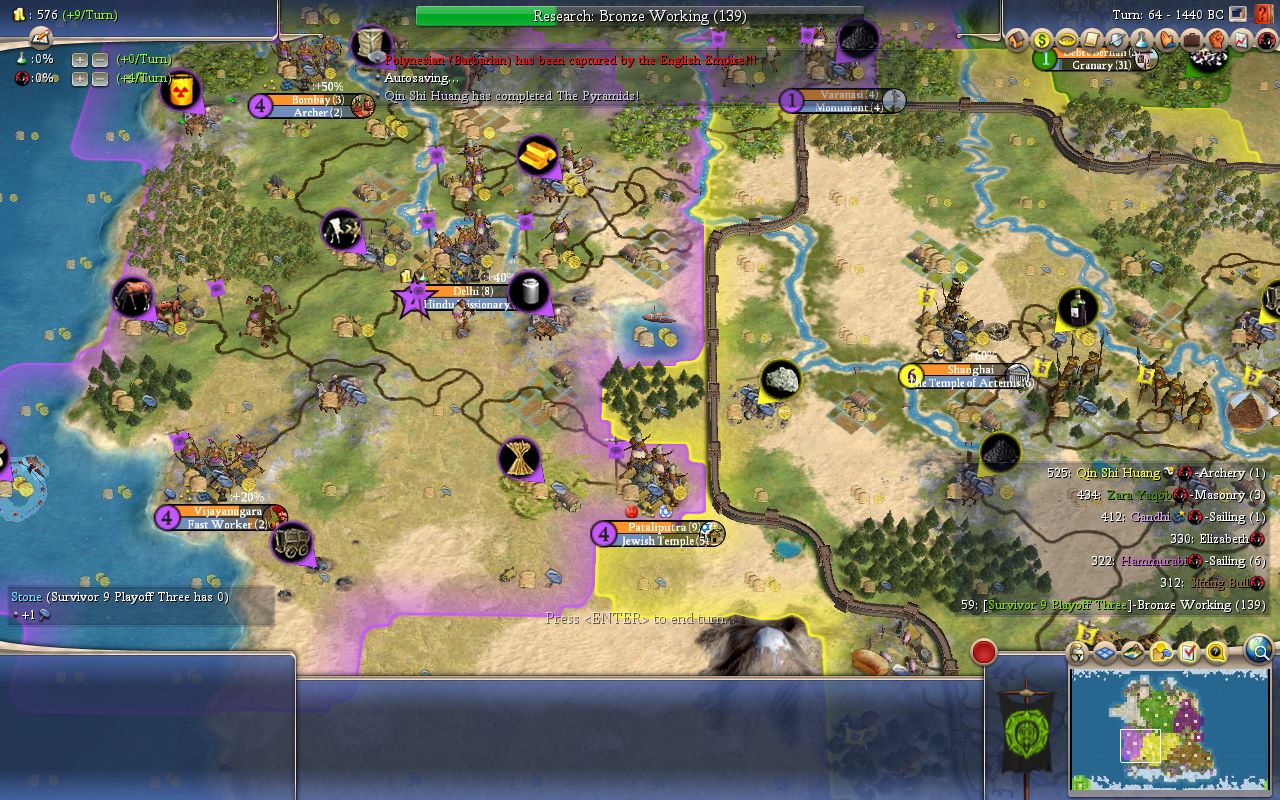
It turns out, Gandhi's start was pretty bad! The main problem was it was extremely squeezed, even by the standards of this map. Gandhi's only good land was the contested river region between him and Qin, and if he was locked out of that (which happened a lot since, as I had mentioned, Qin was unexpectedly one of his most common religious rivals) all he had were a bunch of low production fishing villages. There was another consequence of Gandhi's precarious start - if you followed my prompt above, you might have noticed that the Hindu Holy City is India's capital. This is almost unheard of for Deity games, requiring that the leader be too slow to settle their second city - yet "Hinduism has been founded in Delhi" occurred in around a third of these games! This was due to a myriad of factors, including having Fast Workers and an instantly improvable source of Gold in the capital, but the principal reason was that Qin and Gandhi often sent their starting settler towards each other, and because the Game 3 Winner Qin went before the Game 6 Winner Gandhi in turn order, Shanghai could sometimes bounce the Bombay settler in such a way that Gandhi would have to trek it to the West Coast, meaning he had finished researching Meditation or Polytheism before founding the city.
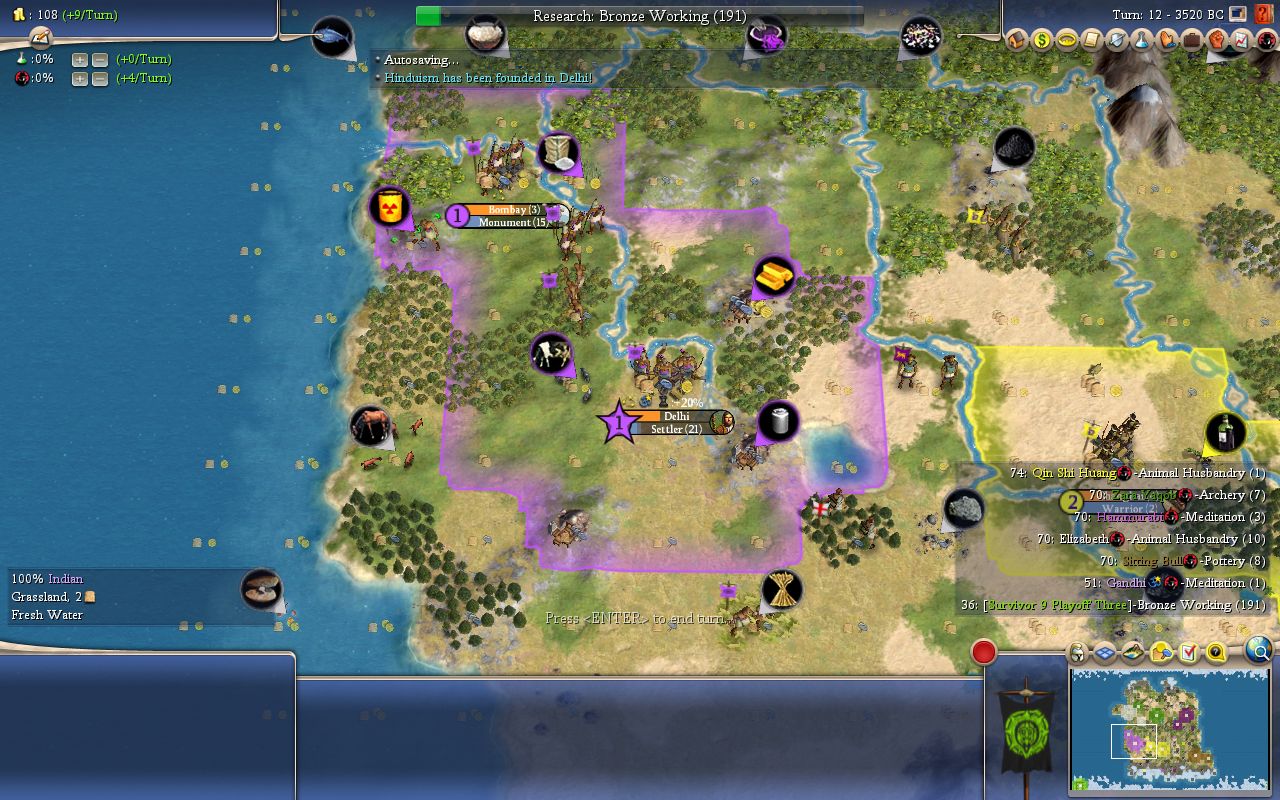
This was almost always disastrous for Gandhi, as when this occurred he would have great difficulty spreading his religion and be left a pariah, and he would only win one game (which is described later) where Delhi was the Hindu Holy City. India frequently found itself one of the tiniest nations on the planet, with little production and not much scaling potential, and I would venture that without that capital gold his start would have been completely unplayable. His predicament reminded me a lot of Pacal in his Opening Round, a setup where the Mayans struggled with a cramped and low production corner with a backstab happy Qin breathing down their neck. He was quite lucky to have Lizzy as a docile neighbor, as the two did not fight once and were almost always steadfast allies.
I say all this, yet Gandhi had a 50% Championship qualification rate and nearly won or was competitive in all his second place finishes - I must especially highlight Game 20, where Gandhi lost his holy city alongside half of his empire to China, yet managed to reconquer it and come back to nearly win, only coming in second when Sitting Bull won a Diplomatic victory. No matter how tired we may be of this guy, we have to begrudgingly admit that he is an excellent AI Survivor player. Gandhi was pretty much playing without his primary win condition, as he was really bad at executing the cultural gameplan due to his stiff competition for religions (Hammurabi in particular really gimps these culturephiles), his low production land that made it difficult for him to build wonders, and having to spend many of these games fighting for his life. He was also really bad at timing the cultural slider, either switching it up too early or too late in most cases. In that aspect, his quick Cultural victory in the livestream was a total anomaly. Yet he compensated by being an amazing techer, maintaining a top notch research rate despite a small empire (in one case winning Liberalism on THREE CITIES). The Actual Game provided a good, if best-case scenario, template of how he could succeed: culturally squeeze his neighbors, let his competition fight each other, and spread his religion everywhere, even turning Qin into Qindu the Hindu. If you are still unconvinced about Gandhi's skill, just compare him to fellow Purple Leader Hammurabi, a leader with the exact same research and religious preferences, and who was given better territory and a far better neighbor situation, and just consider how he was the worst scoring leader in this field. Yeah, Gandhi is pretty good, even if he has transformed into one of the villains of the tournament.
67 Hydra Award: In Game 15, Gandhi founded Hinduism in Delhi and looked like yet another dud. Except, HE THEN FOUNDED THE MEDITATION RELIGION IN BOMBAY! From there, he managed to get the "Hydra" by founding the Monotheism religion, and would go on to found six of the seven religions en route to an easy, if surprisingly lengthy, victory.
Gandhi Award:

Elizabeth of England
Wars Declared: 27
Wars Declared Upon: 16
Survival Percentage: 55%
Finishes: 4 Firsts, 3 Seconds (26 points)
Kills: 6
Overall Score: 32 points
This set had an interesting progression, with Lizzy being the star of the first third, Zara dominating the middle section, and Gandhi finishing strong. Of the three "primary" contenders, however, Lizzy is the leader I am the most skeptical about, as following what was effectively a tie for the win in Game 8 (as she and Gandhi were extremely close in the space race and Gandhi only prematurely ended the game through the UN), she was a complete non-entity over the remaining twelve games, her only points coming from a couple of backdoor second place finishes, by far the weakest leader in the field over that stretch. One red flag of overperformance for me is streakiness, and the chasm between her first half and second half is too high for me to be confident in her chances here. I should also note that she was attacked ONLY FIVE TIMES over the first eight games, and when the war ratio evened itself out her results plummeted. I seriously think that in a different set of twenty there is a possibility she ended up one of the lowest scoring leaders here.
Lizzy had one massive issue here, and it rhymed with "Mara Jacob". (Note how inversely proportional their successes were - Lizzy's best games coincided with Zara's worst, and vice versa). She happened to be the favorite snack of the Ethiopian menace to her east, and she was remarkably easy to kill if the two fell to blows early, which happened often. It was that simple: Lizzy, already a rather slow starter in a cramped corner, just could not handle any fighting without a serious military tech edge, and Zara had both the land and the capability to keep up. When it came to Financial/Alive, she did a pretty poor job at the "Alive" part, with the lowest survival rate of all the non-Chinese leaders, and to be frank she was not that great at the Financial part either, in many games getting outteched by non-Financial leaders with worse land. In the big picture, Lizzy's role was to either be enough of a buffer for the Indians to win or to be a springboard for an Ethiopian snowball.
He Should Have Sat A Little Longer Award: In Game 4, Lizzy got dragged into a Defensive Pact war with Sitting Bull. Sad for the Sioux, as she attacked Hammurabi one turn later.

Sitting Bull of the Native Americans
Wars Declared: 38
Wars Declared Upon: 12
Survival Percentage: 75%
Finishes: 1 First, 5 Seconds (15 points)
Kills: 8
Overall Score: 23 points

Qin Shi Huang of China
Wars Declared: 38
Wars Declared Upon: 65
Survival Percentage: 30%
Finishes: 1 First, 2 Seconds (9 points)
Kills: 6
Overall Score: 15 points

Hammurabi of Babylon
Wars Declared: 20
Wars Declared Upon: 16
Survival Percentage: 65%
Finishes: 1 First, 2 Seconds (9 points)
Kills: 4
Overall Score: 13 points
The remaining three leaders can all be lumped into the same category, being capable of pulling off a successful game once in a while if the dominoes fell their way, but each having one major flaw (economy for Sitting Bull, diplomacy for Qin, fighting for Hammurabi) that prevented them from being truly competitive. Sitting Bull did have the highest championship advancement rate, but he benefited greatly from the AI Survivor scoring system; had second place been decided by who was actually the second closest to victory, rather than score, Hammurabi would have had the most Runner Up finishes in this set. Sitting Bull was a legitimately excellent fighter, especially adept at killing Qin and leveraging the Chinese territory into a second place finish, but woof, his economy was horrific, and it felt like I was watching a high peaceweight Genghis Khan at times. One particularly stark showing was Game 14, where Sitting Bull SOLO KILLED Hammurabi. Almost any leader would have easily won from there, except Sitting Bull's economy was so bad, when he made his next move on Zara, Zara was able to turn the tide with more advanced units and kill the Sioux. He was probably the least likely leader of all six to win this game, with even his one win in Game 20 being a second place showing where he won by Diplo right before Gandhi was about to win by Culture.
Conversely, I have to hand it to Qin who put on a masterclass on how to maximize one's chances in a horrifying diplomatic situation. He had an insane war counter, having the most offensive AND defensive wars, and ultimately fighting a total of 103 conflicts. For reference, the next highest total was Zara at 66. Those are high numbers for even Shaka type leaders, let alone one with a 3.9 aggression rating. Qin really pulled off all the stops, showing how effective he could be if he did not avoid Mysticism like he is prone to doing. He fought Gandhi admirably on the culture front, while also doing an excellent job fighting everyone else, and it often required a dedicated coalition to bring him down. Qin's path to success was usually to get enough room to solo-conquer someone. He put out two winning performances in Games 16 and 17, the former from working with Gandhi to kill Sitting Bull (and then completely ignoring the Indian cultural countdown for the rest of the game, allowing Gandhi to pull off an undeserved Cultural victory) and the latter from first taking half of India and then turning on the Sioux to become a runaway. His other second place finish in Game 2 was a backdoor where Lizzy beat Zara in the victory showdown, but the fact he could even backdoor second showed that he could keep up if he played his diplomatic cards right. He also had a couple of other strong showings in Games 6, 7 and 20 that were only undone by his diplomatic situation. I will say, I do think Qin's spot on the map was very strong and had Pericles, the rightful Game 3 Winner, been here the Greeks would have completely run away here.
Finally, there was Hammurabi, the useful idiot who continues to believe that he can barely participate and still succeed. He was a jack-of-all-trades, master of none here: Lizzy was better at teching, Gandhi was better at the religious game, Zara was better at expanding, and Sitting Bull was better at fighting. His livestream First To Die result was absolutely realistic, repeating itself four times and following a similar script of him being a religious pariah while so hilariously incompetent at the military end that he melted in nearly any 1v1 conflict. It is pretty inexcusable for someone in a corner and in such a good diplomatic position to have virtually the same results as Qin, a leader in a central position and much worse diplomacy, especially when fighting the fewest wars of any leader. He had two second place finishes, both in games where he managed to convert Zara and then let the Ethiopians handle the rest, and his one win came in a game where he spread his religion all over and then took a good chunk of INDIA (he marched all the way to the opposite corner a few times, often because that was the only leader he would attack) to maintain his tech lead. He also nearly won Game 9 by stealing a Diplo win, coming within seven votes of winning but instead being eliminated from third place. To be frank this set only cemented my belief that Hammurabi is one of AI Survivor's worst performers.
Giving Bull Award: Sitting Bull blew a Game 5 Championship spot by voting Zara the winner through the UN before Zara could conquer enough of Gandhi to backdoor the Sioux in.
Qindu The Hindu Throwing A Victory Out Of The Mace Windu Award:
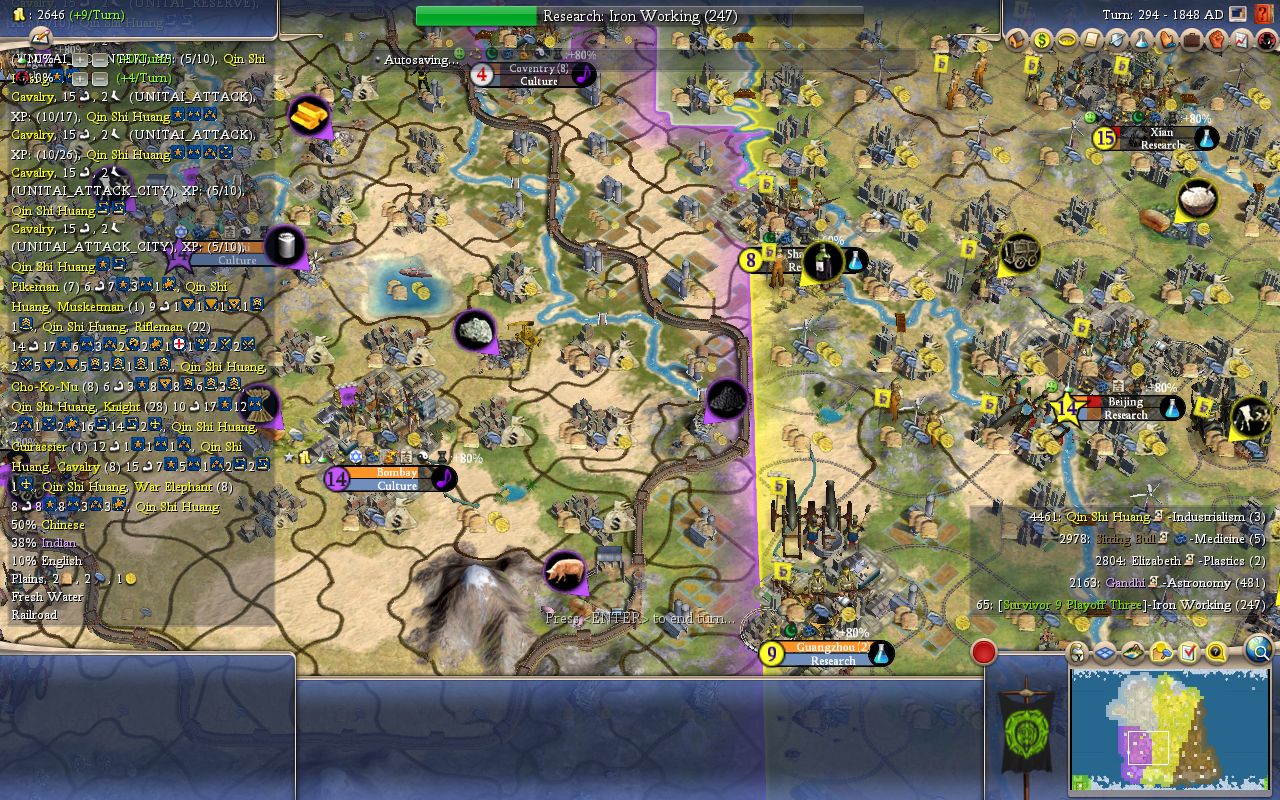
Frederick Award: Qin starved himself out of Championship contention in Game 11.
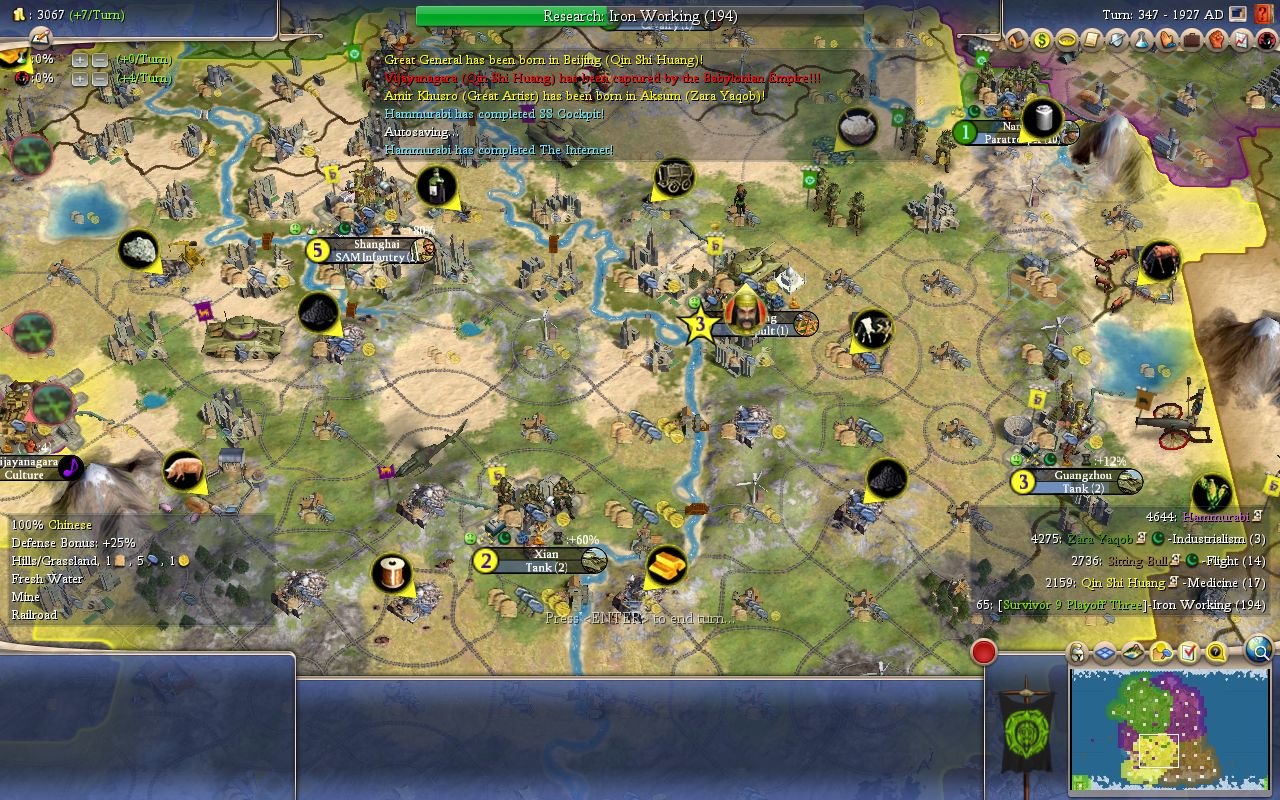
A Purple Nurple For A Purple Nurple Award: Hammurabi tried to march across the map to attack Gandhi in Game 20. Slight problem however: Qin attacked him, and then everyone else attacked Qin. By the time the dust had settled and Qin was dead, Gandhi was still at war with the Babylonians, their army was destroyed and Gandhi had turned the tide, seizing three core Babylonian cities until the UN shut down the conflict.
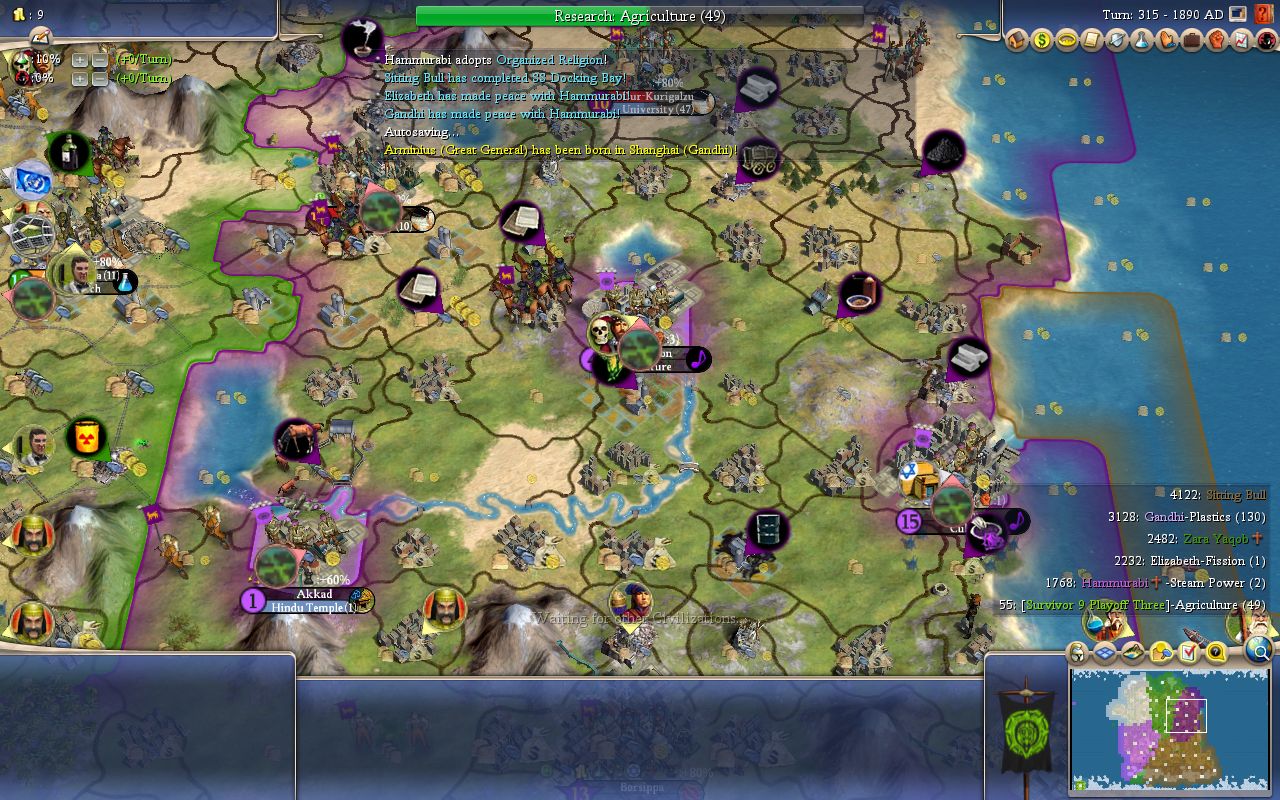
Someone needs to investigate Gandhi for bribery, because almost every time it seems the livestream does whatever it can to ensure everything goes exactly his way. Pretty much everything that could have gone his way went his way. Gandhi not only trounced Qin in the culture battle, but also managed to avoid any Chinese retribution until it was far too late to stop him. He managed to spread his religion all over the globe. Zara crippled Lizzy, but not fast enough to deal with Gandhi. He managed to build essentially every wonder under the sun, while perfectly timing the culture slider. While he still found some success in the replays it was NEVER remotely that easy.
All in all, this was a very fun set to run and it showed that just because a game is primarily composed of builders does not mean it cannot have a riveting set of games. There was a good amount of intrigue in these games and every leader looked like they had a chance to be competitive. Nice map find!
Click the link above to read full summaries of each individual game!
Appendix B: Observer Blooper!