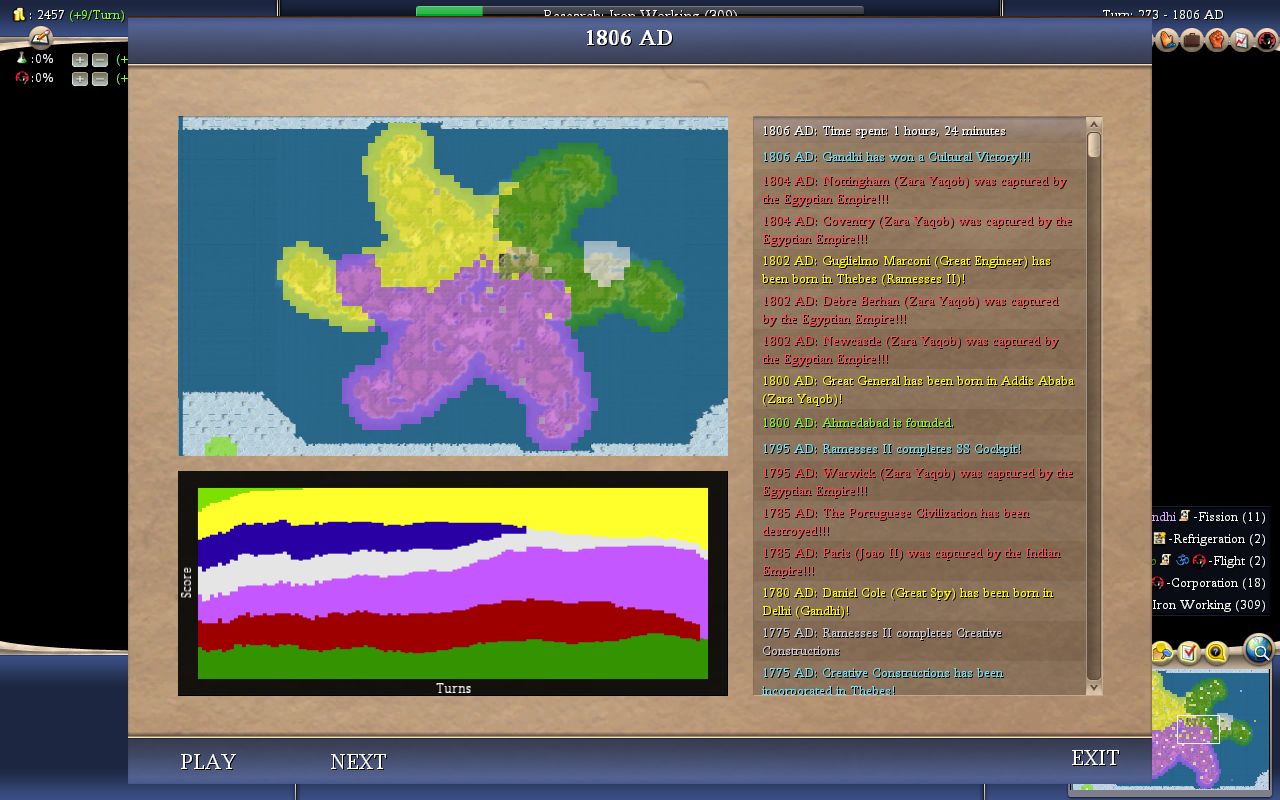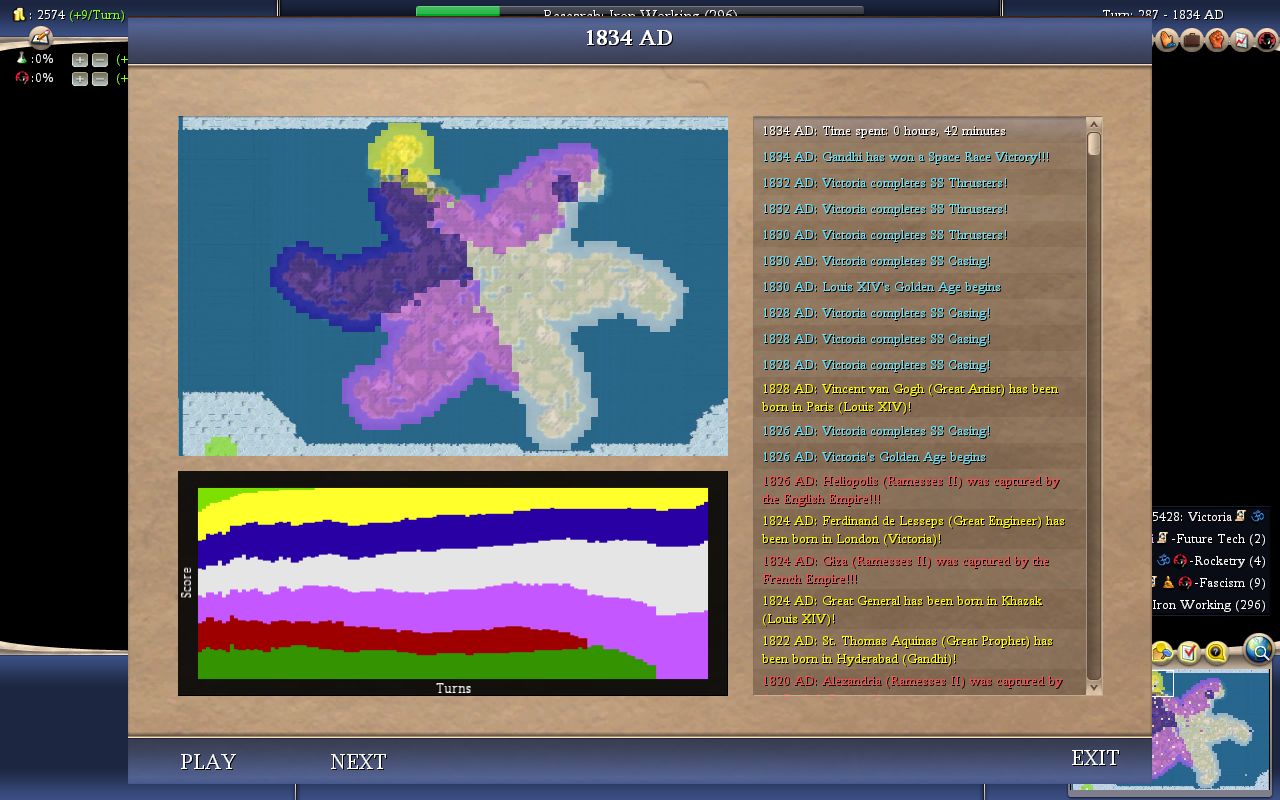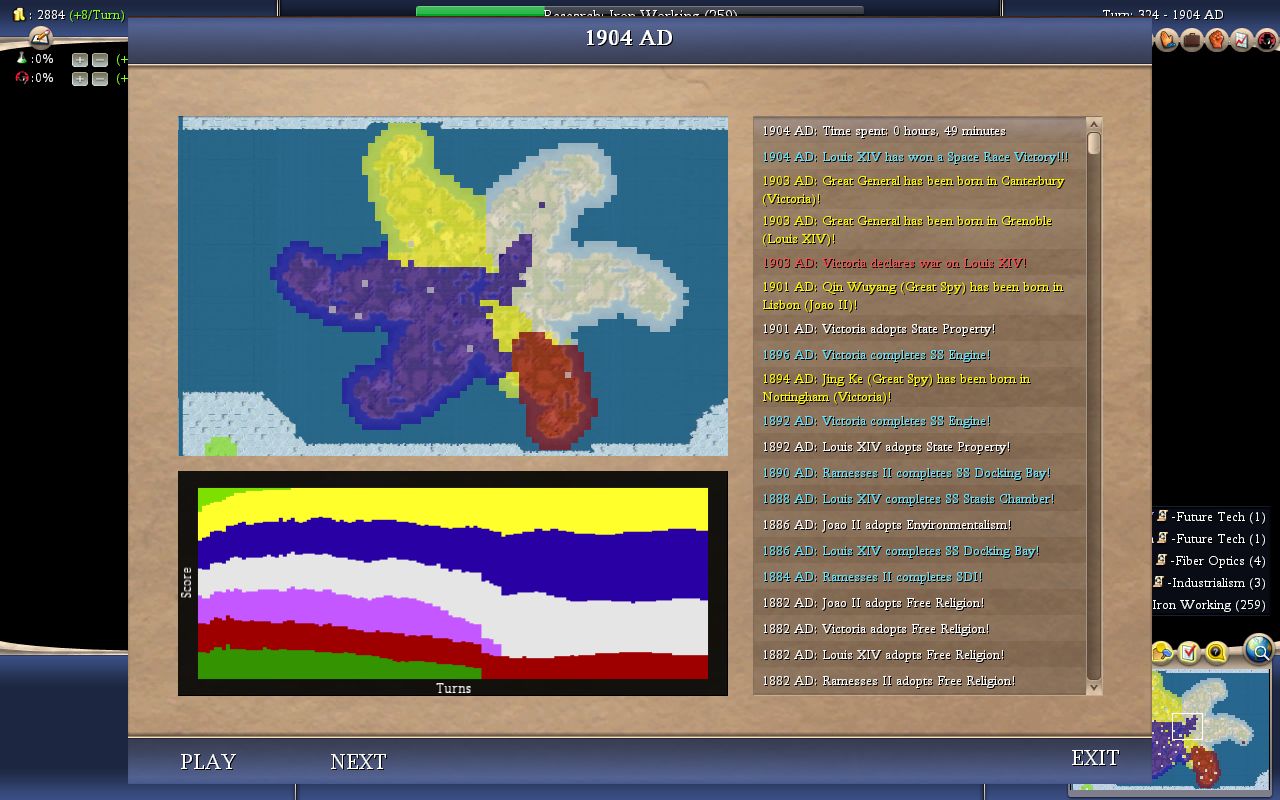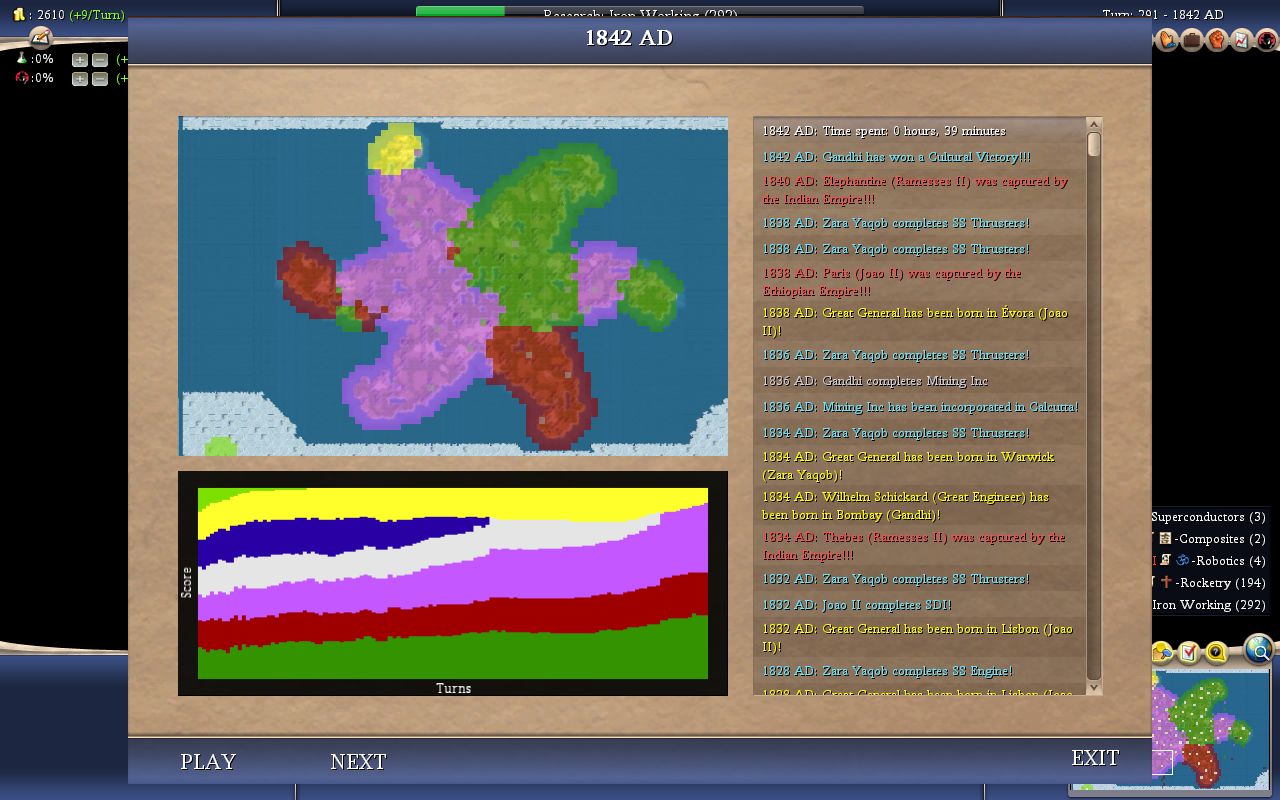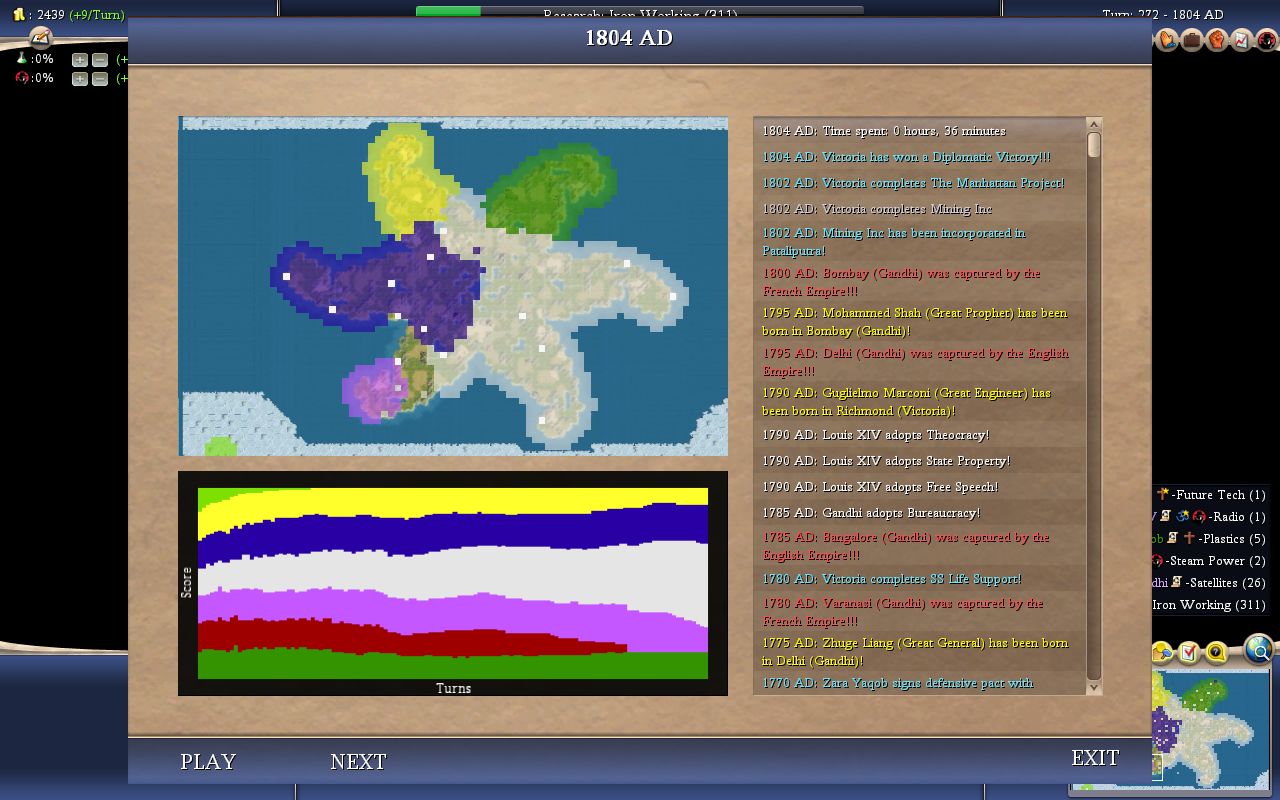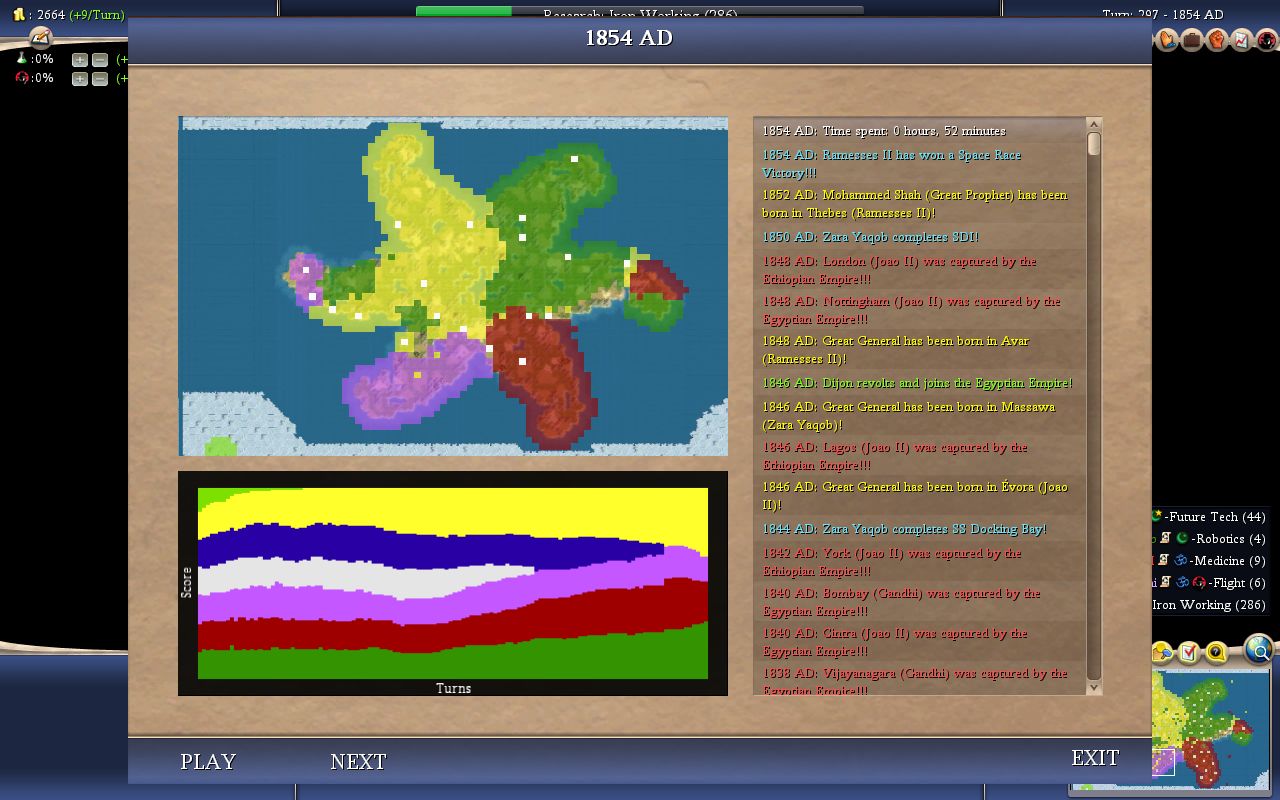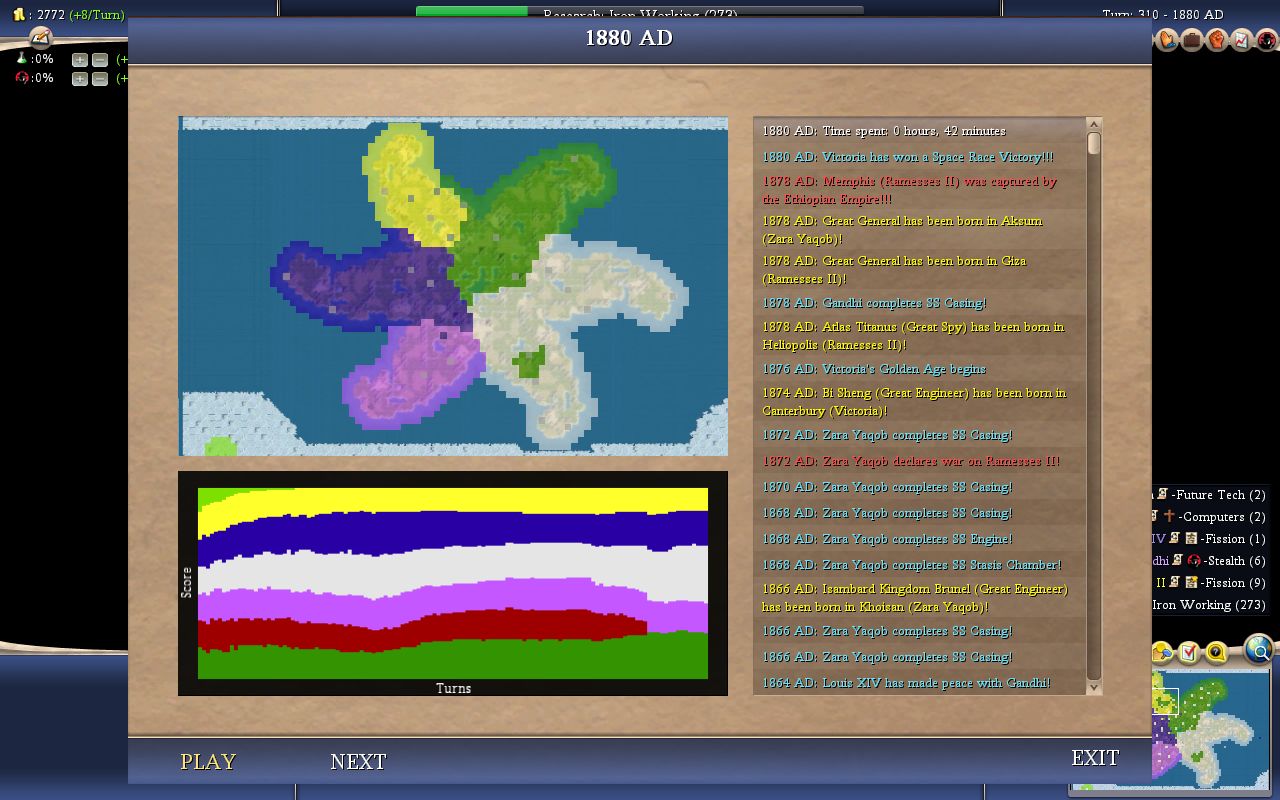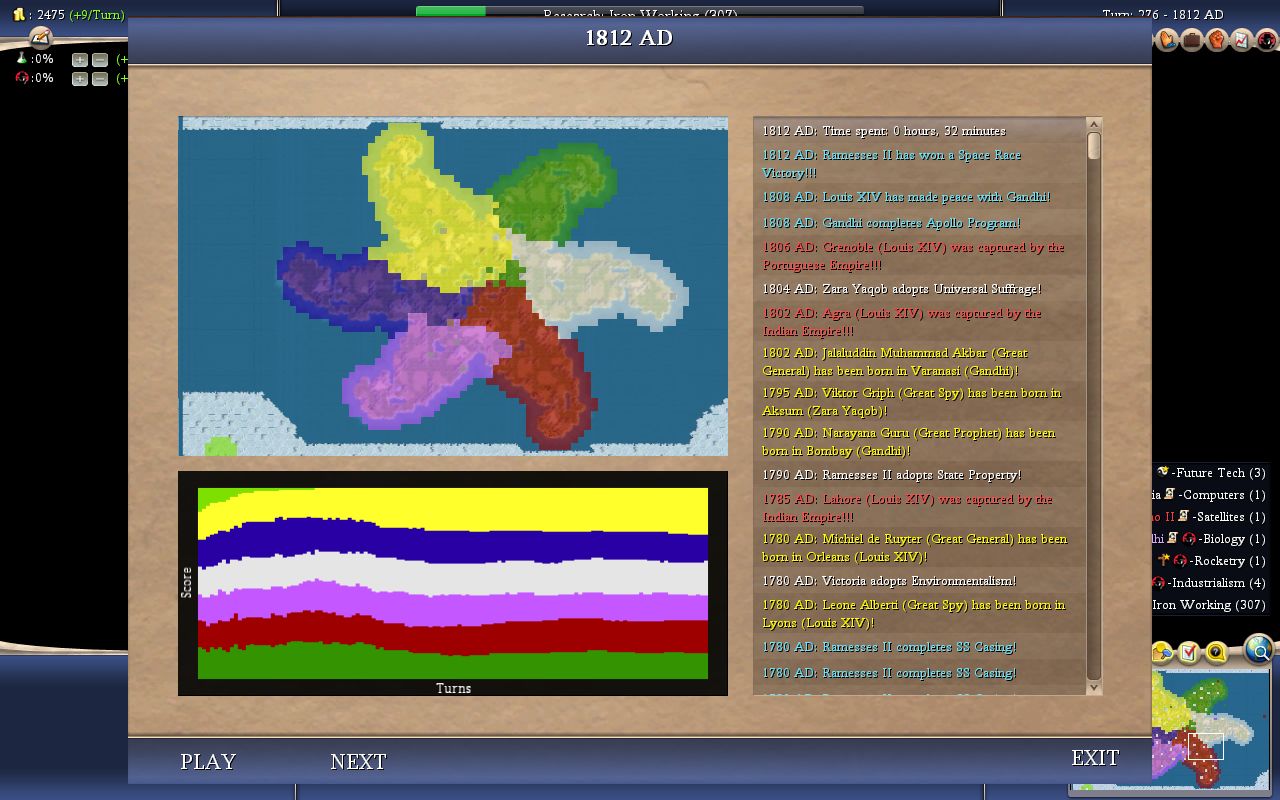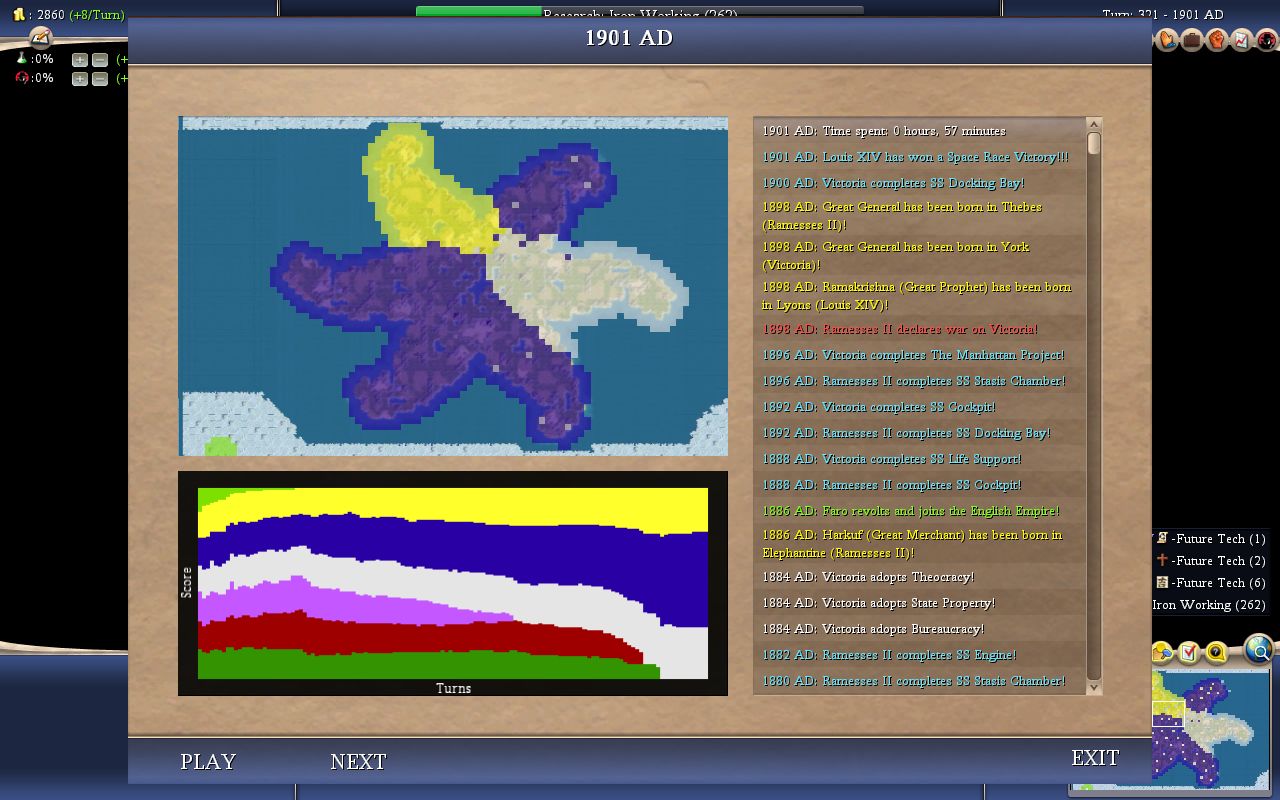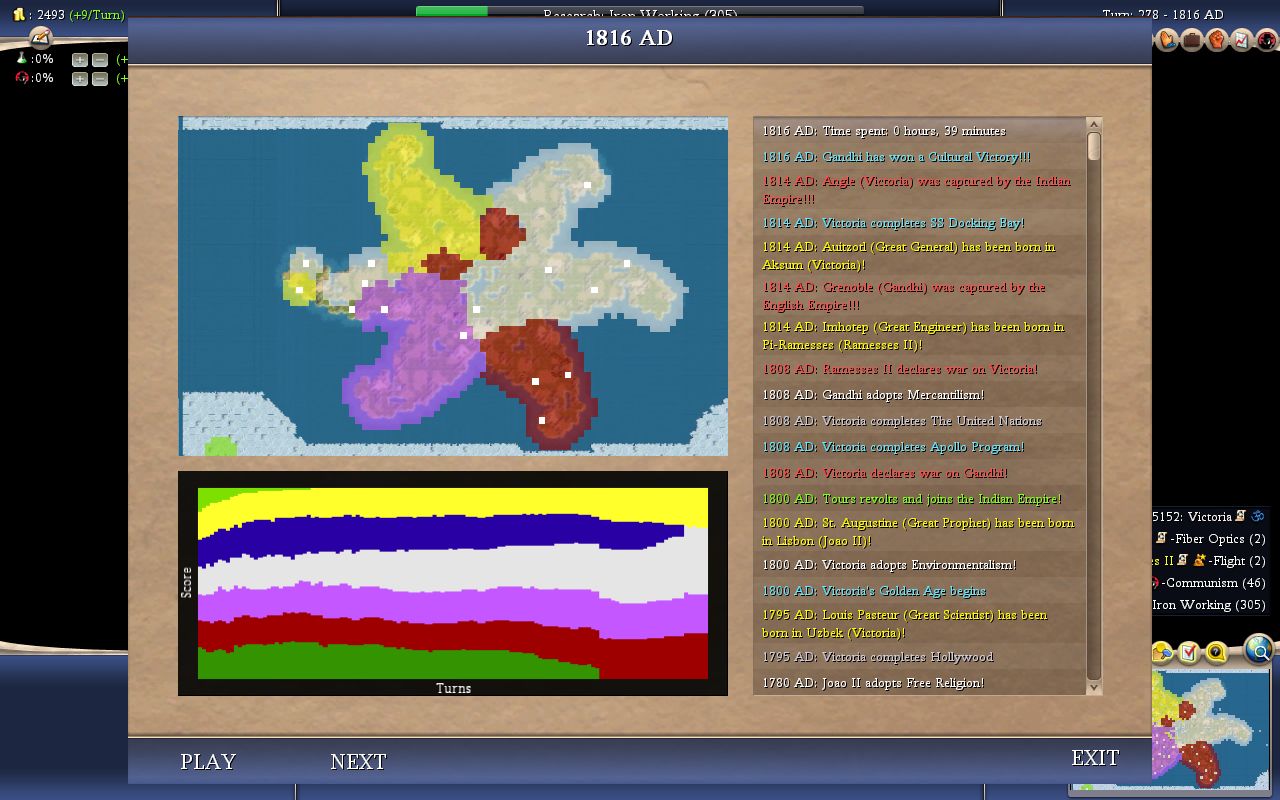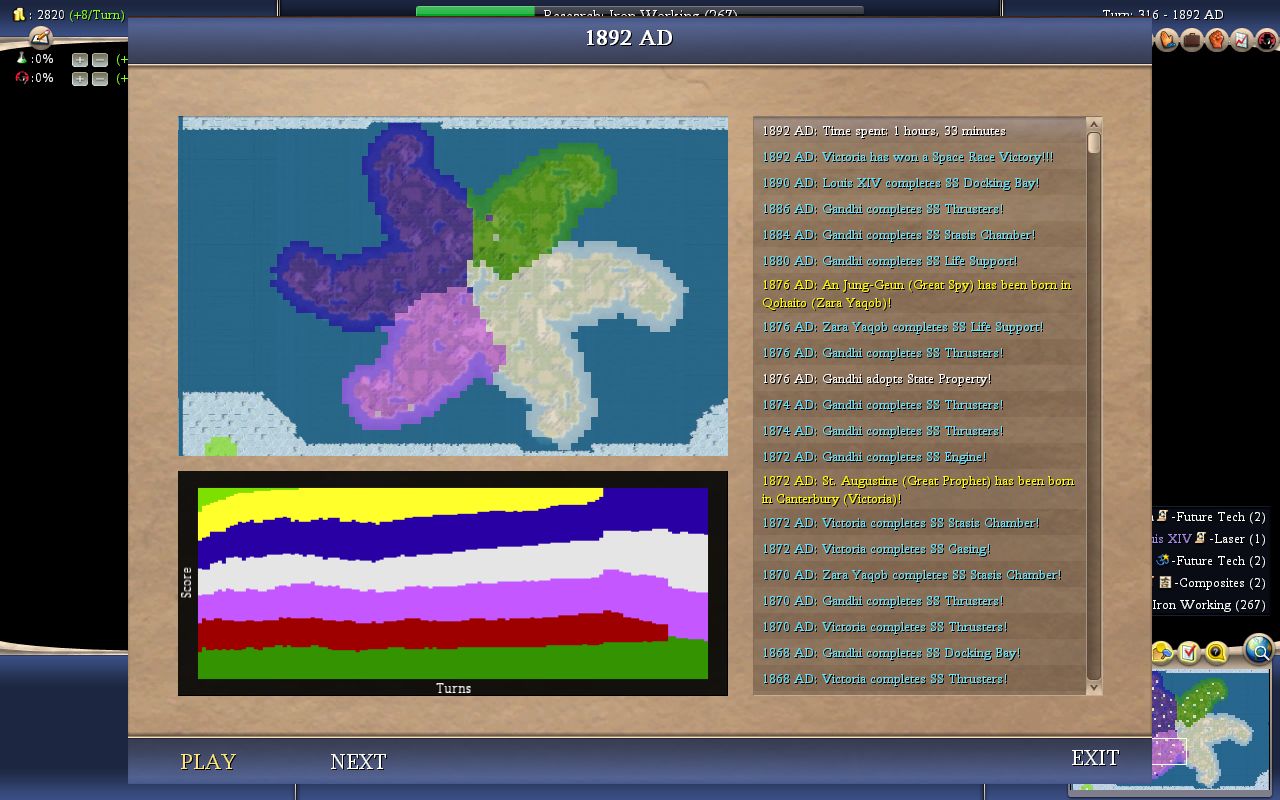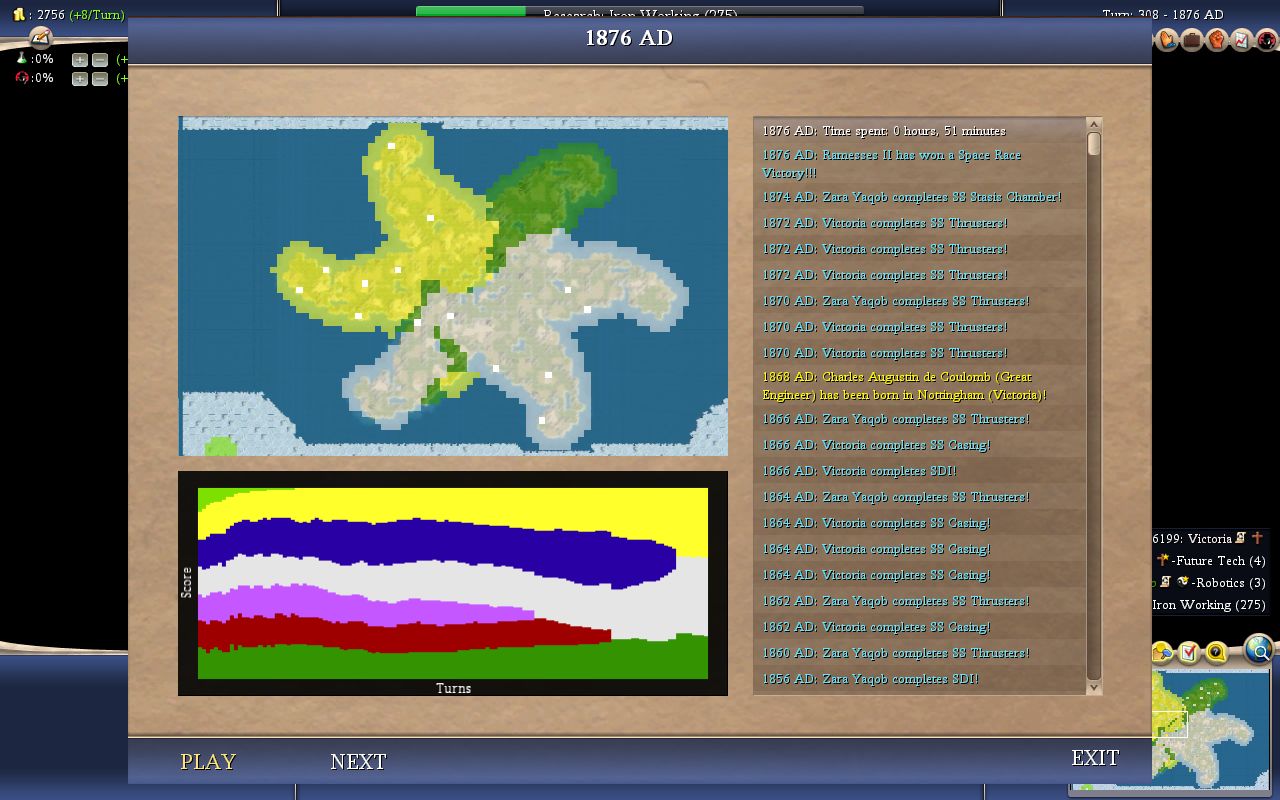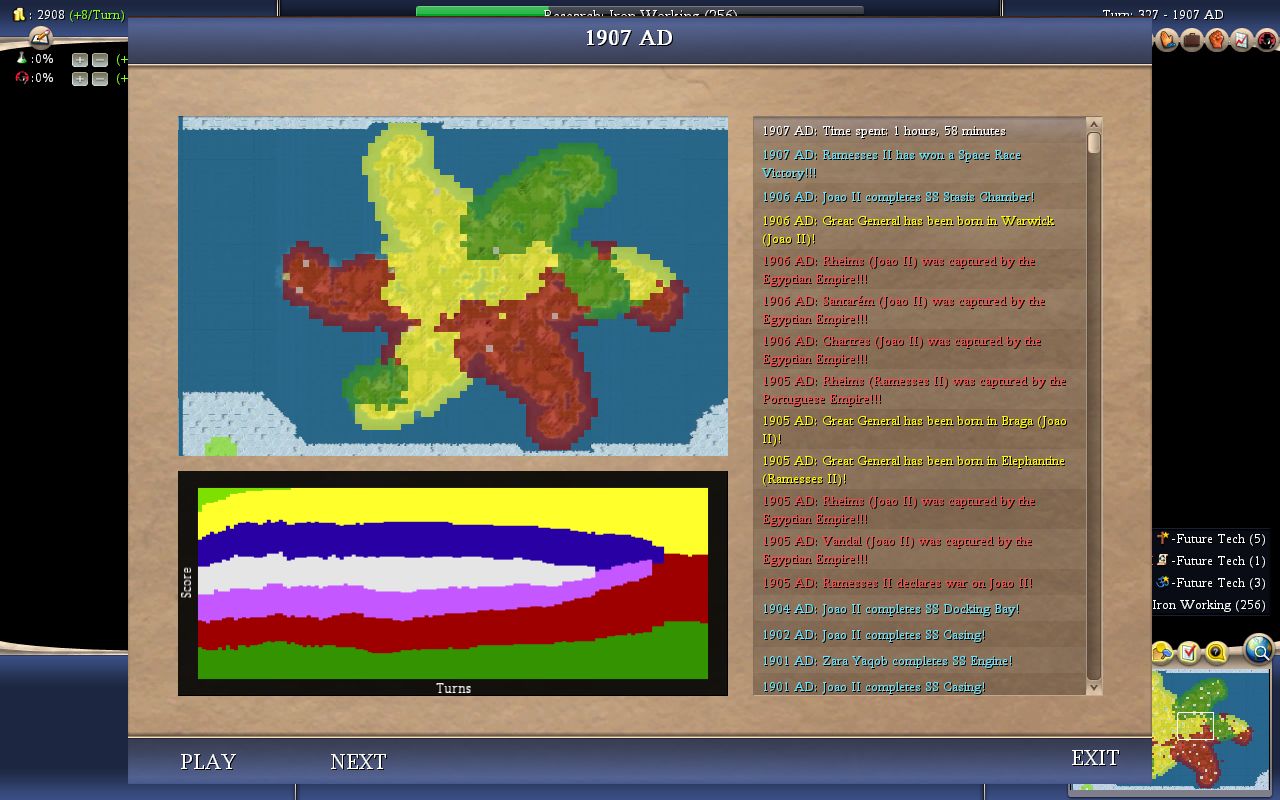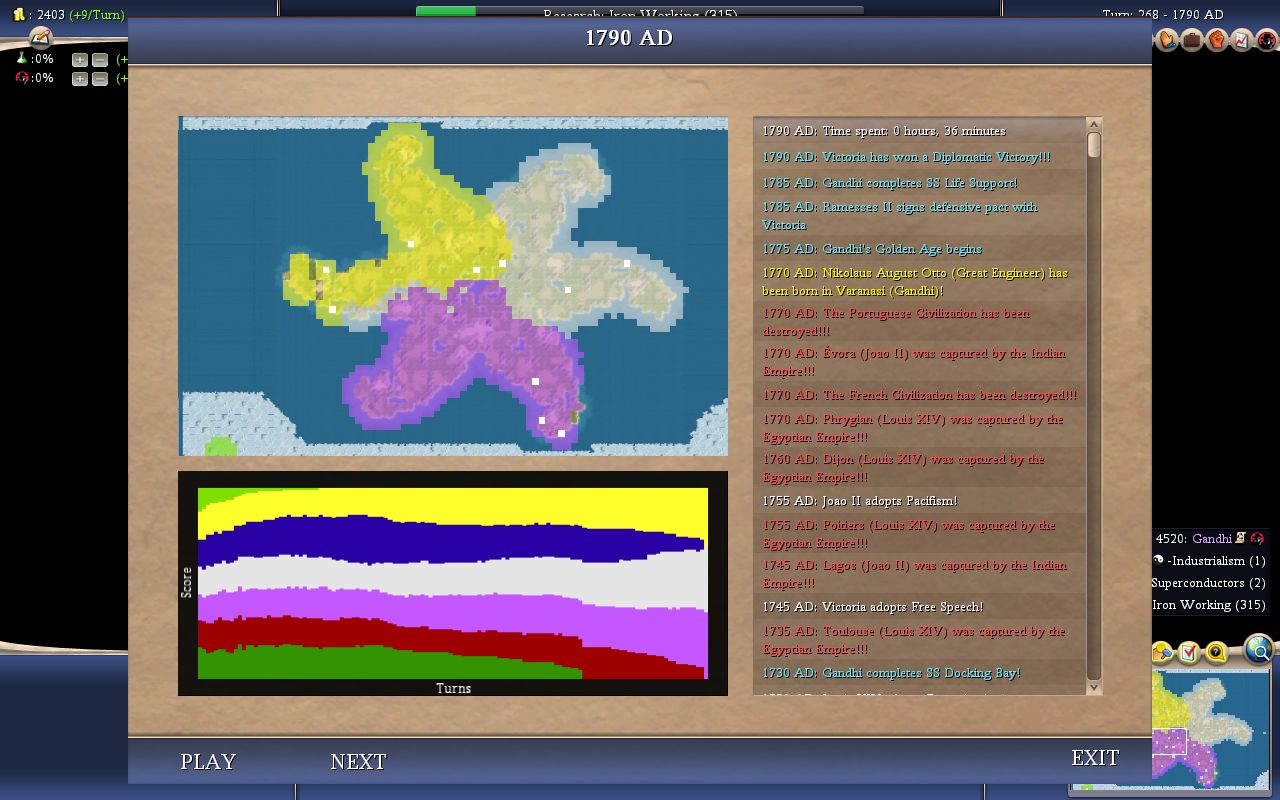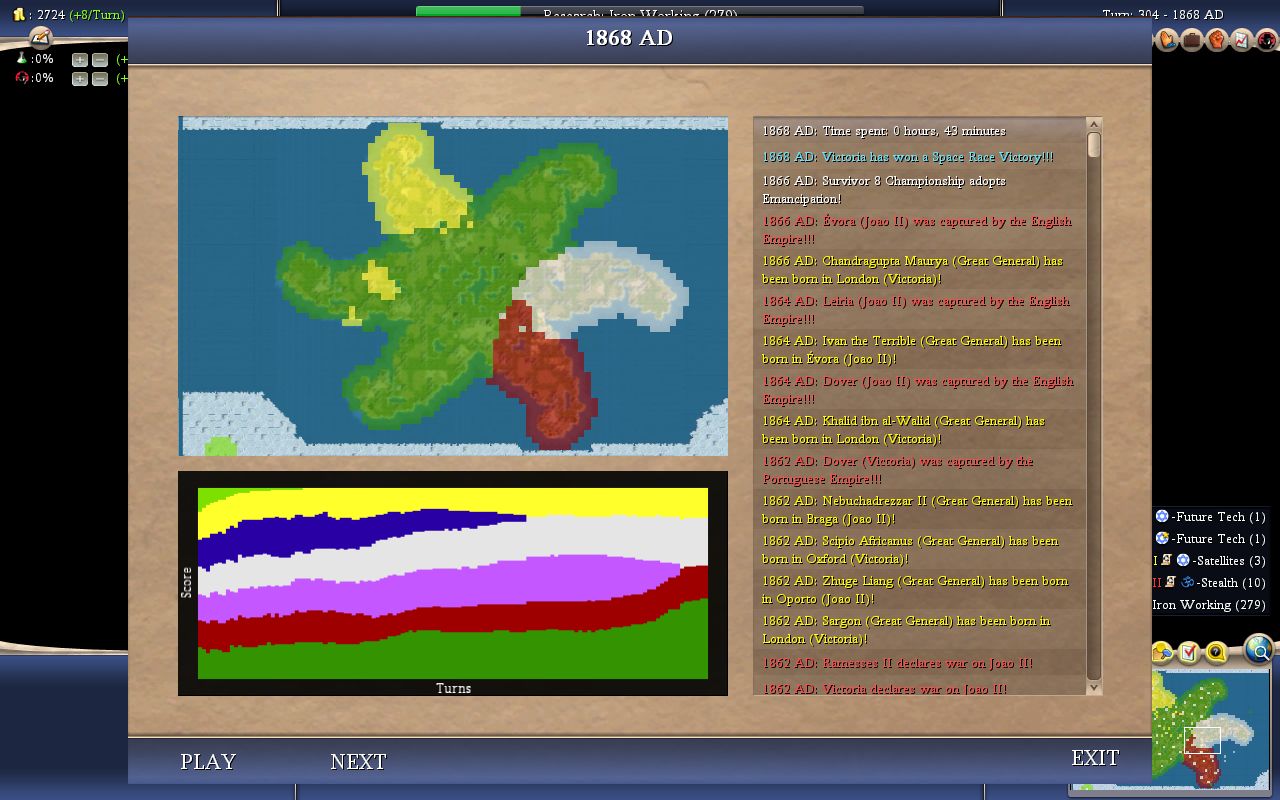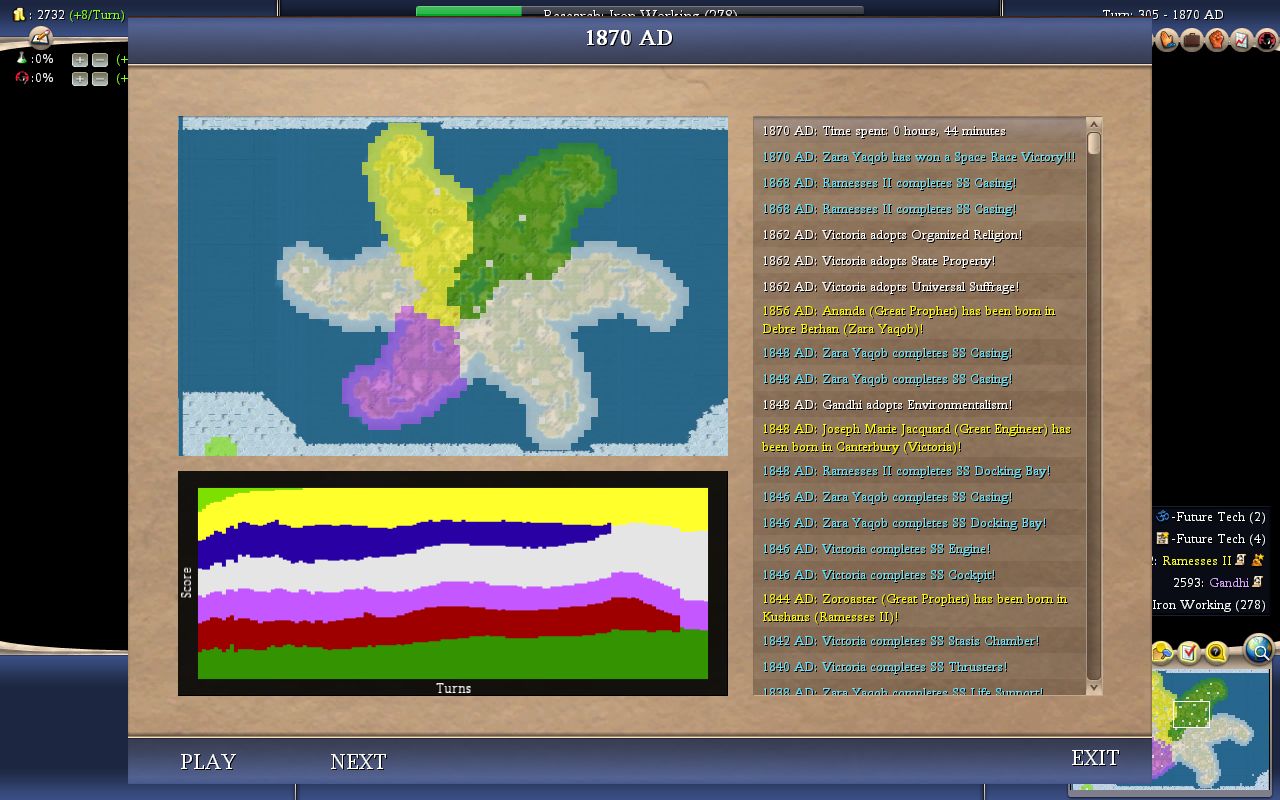
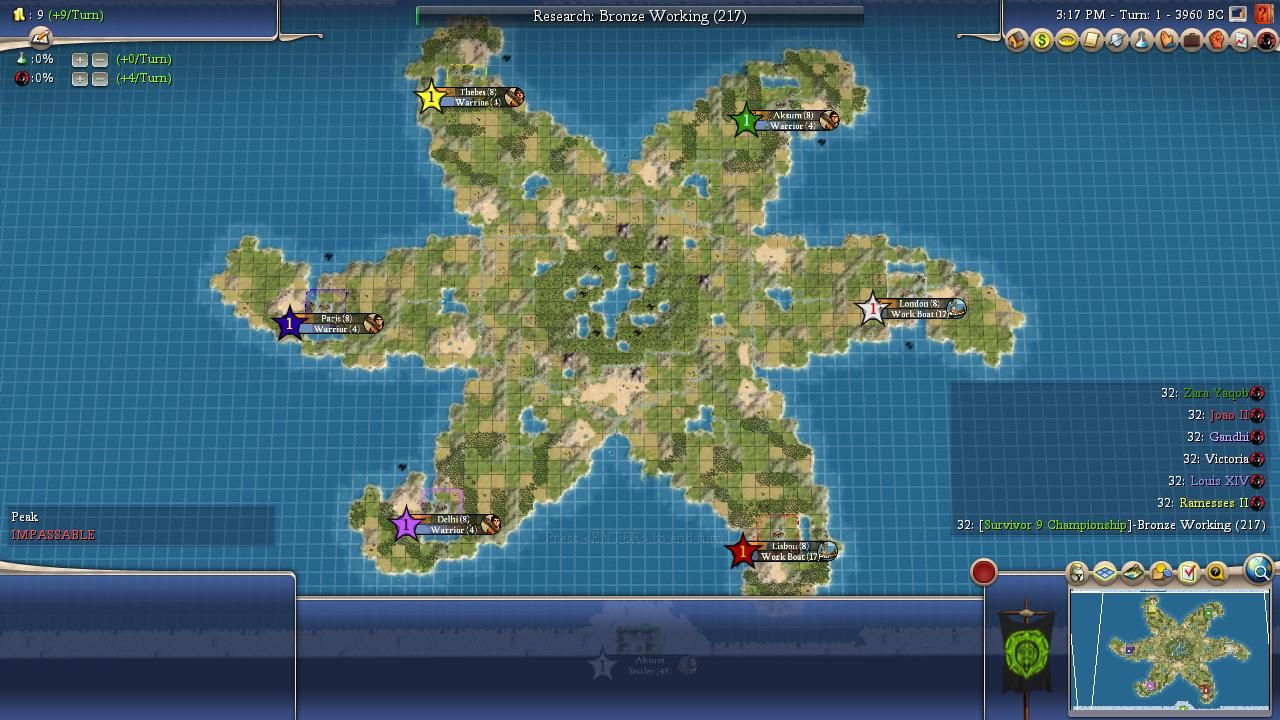
One of the recurring features of past seasons of AI Survivor have been our "alternate histories", running additional iterations on the same maps to see if the same events would play out again. The Season Nine Championship was a complete runaway performance from Ramesses, with the Egyptian leader taking over the entire western half of the continent and nearly winning by Domination before exiting via a very fast Spaceship. Was that something which would unfold in each game? This was a topic that called for more investigation with alternate history scenarios. Following the conclusion of previous seasons of AI Survivor, I had gone back and investigated some of the completed games and found that they tended to play out in the same patterns over and over again. While there was definitely some variation from game to game, and occasionally an unlikely outcome took place, for the most part the games were fairly predictable based on the personality of the AI leaders and the terrain of each particular map. Would we see the same patterns play out again and again on this particular map?
The original inspiration to run these alternate histories came from Wyatan. He decided to rerun the Season Four games 20 times each and publish the results. The objective in his words was twofold:
- See how random the prediction game actually is. There's a natural tendency when your predictions come true to go "See! Told you!", and on the contrary to dismiss the result as a mere fluke when things don't go the way you expected them to (pleading guilty there, Your Honour). Hopefully, with 20 iterations, we'll get a sense of how flukey the actual result was, and of how actually predictable each game was.
- Get a more accurate idea of each leader's performance. Over 6 seasons, we'll have a 75 game sample. That might seem a lot, but it's actually a very small sample, with each leader appearing 5-10 times only. With this much larger sample, we'll be able able to better gauge each leader's performance, in the specific context of each game. So if an AI is given a dud start, or really tough neighbours, it won't perform well. Which will only be an indication about the balance of that map, and not really about that AI's general performance. But conversely, by running the game 20 times, we'll get dumb luck out of the equation.
Wyatan did a fantastic job of putting together data for the Season Four games and since then we've continued to use the same general format. First we'll post the resulting data and then discuss some of the findings in more detail. Keep in mind that everything we discuss in these alternate histories is map-specific: it pertains to these leaders with these starting positions in this game. As Wyatan mentioned, an AI leader could be a powerful figure on this particular map while still being a weak leader in more general terms. This particular set of alternate histories were run by TheOneAndOnlyAtesh - many thanks for spending so much time on this task!  Now on to the results:
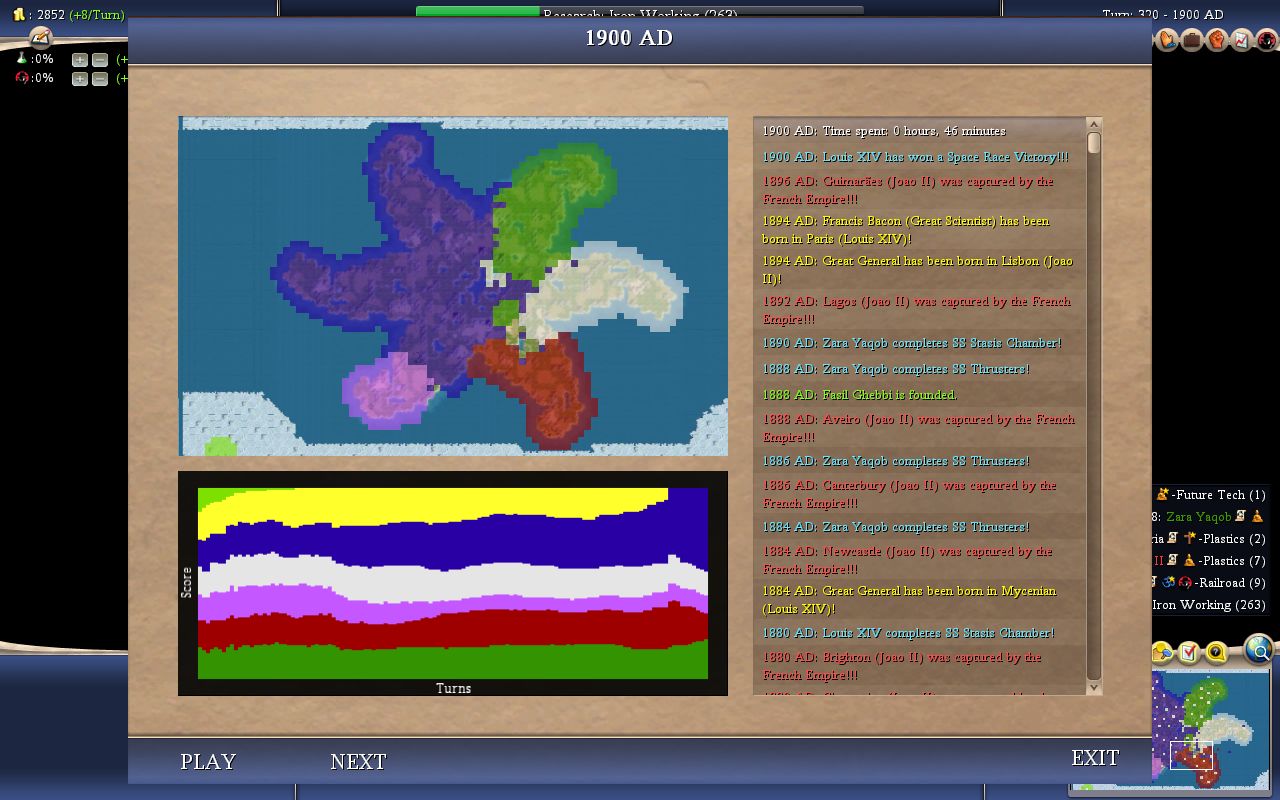
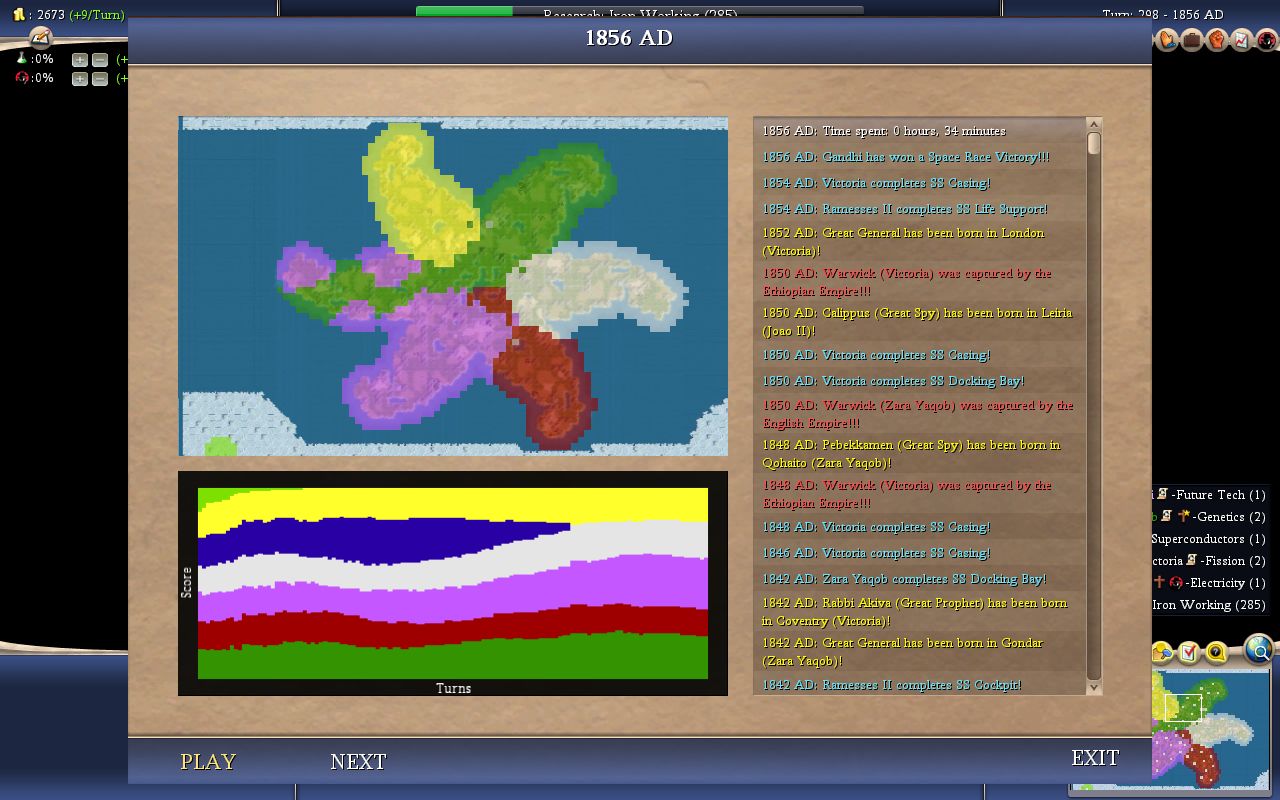
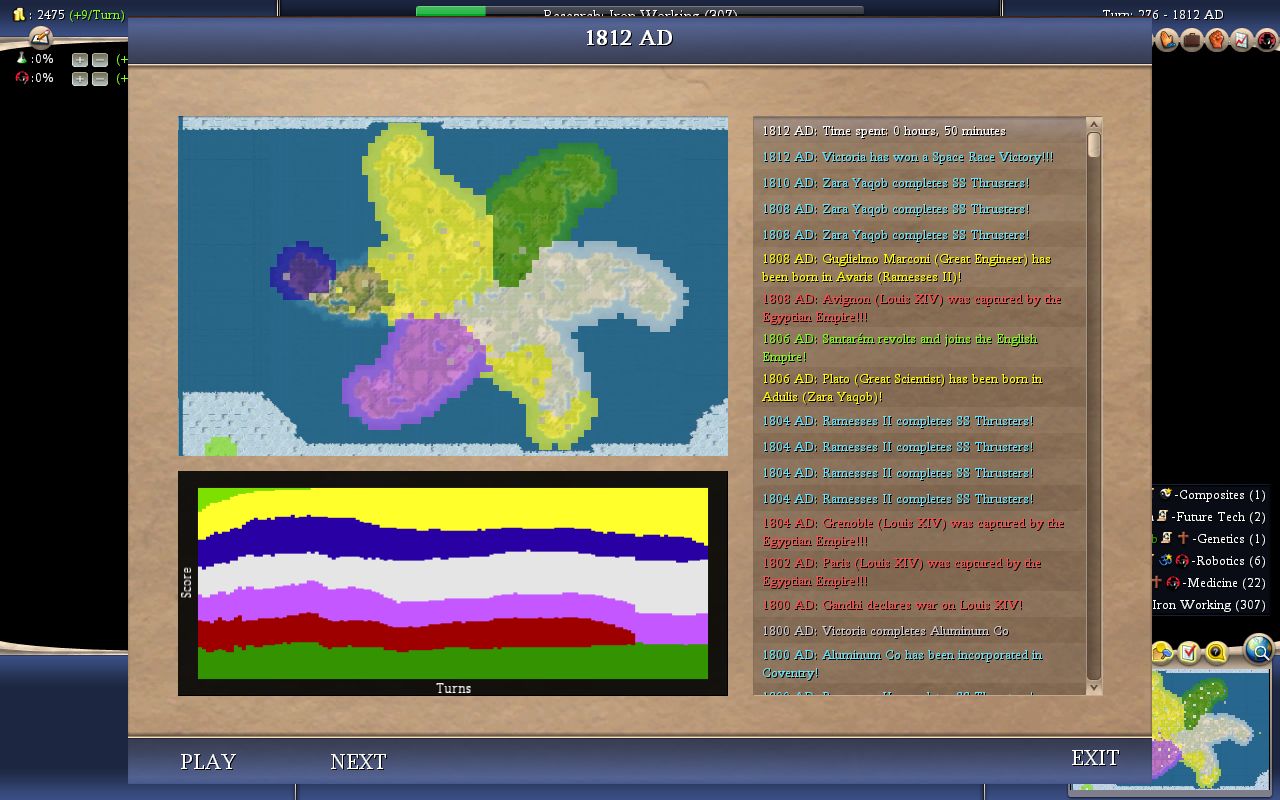
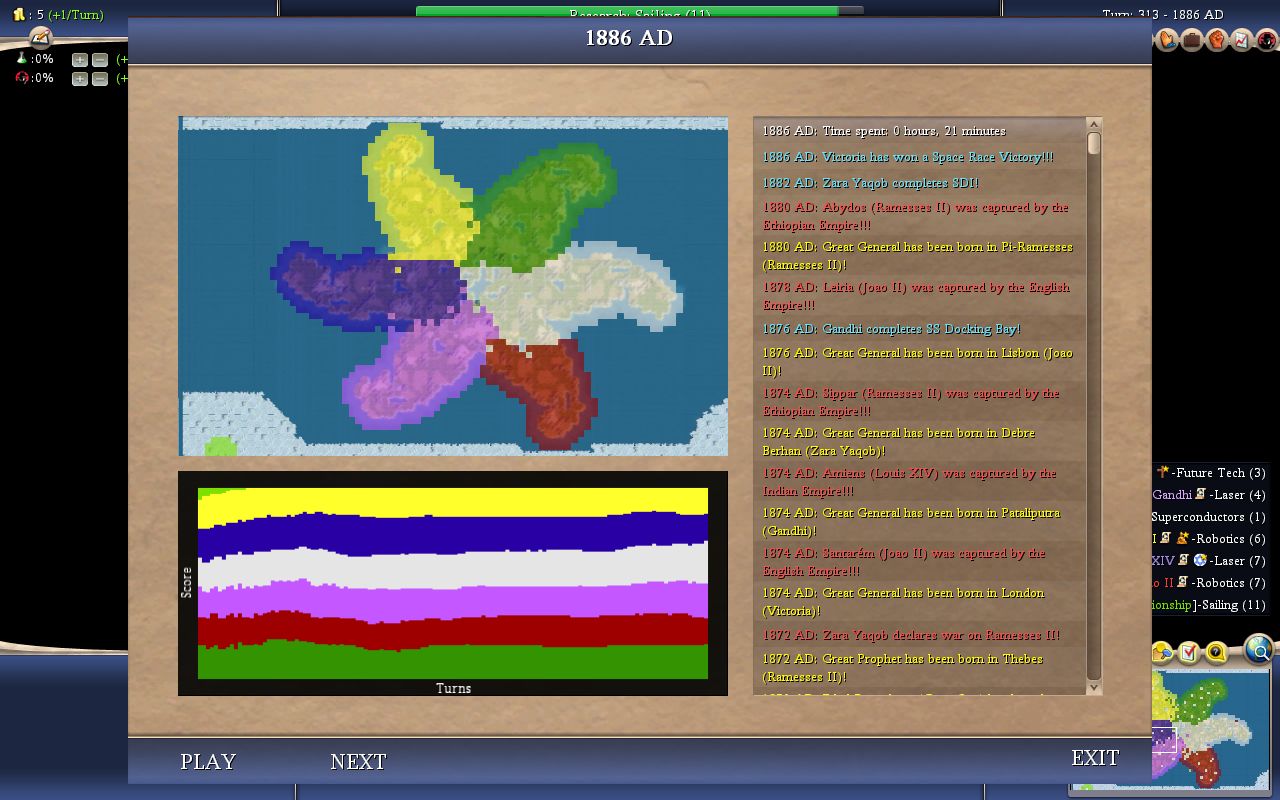
Game One | Game Two | Game Three | Game Four | Game Five
Game Six | Game Seven | Game Eight | Game Nine | Game Ten
Game Eleven | Game Twelve | Game Thirteen | Game Fourteen | Game Fifteen
Game Sixteen | Game Seventeen | Game Eighteen | Game Nineteen | Game Twenty
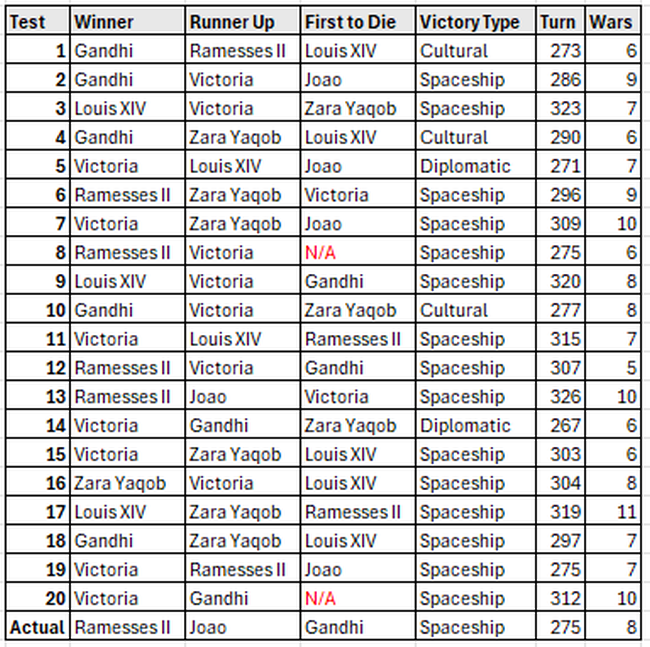
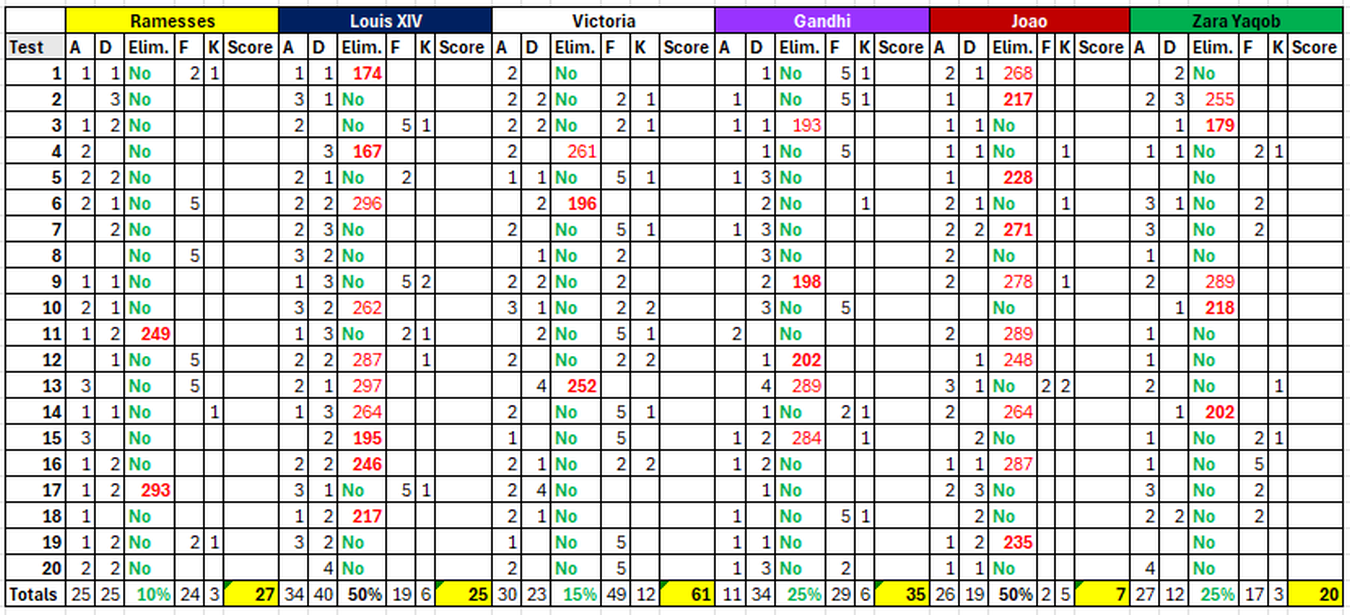
(Note : "A" column tracks the number of war declarations initiated by the AI, "D" the number of times the AI is declared upon, "F" the points for finish ranking, and "K" the number of kills.)
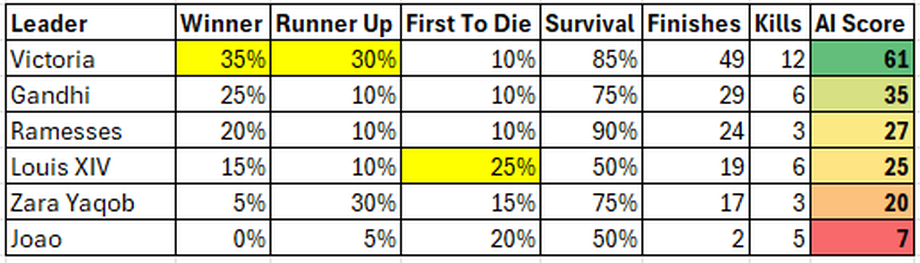
TheOneAndOnlyAtesh: The community consensus was that Vicky, Ramesses, and Gandhi had the best odds to bring home a trophy from this setup, and these playthroughs by and large validated this sentiment, with Louis (!) the only other leader to be competitive with the Big Three. Further validating the community sentiment, Vicky turned out to be the strongest leader, being both the most dominant AND consistent leader on the map, her 61 points essentially matching Ramesses and Gandhi's combined 62. To be fair, this set could have easily seen Rammy or Gandhi win the most games instead, but I would still say that, given many trials, Vicky would ultimately be the leader most likely to secure a top two finish and score the highest under Sullla's system.
Usually, Gandhi would found Hinduism (he only ignored religion in two games), and then some combination of Ramesses, Louis, and Vicky would found the other two (or one leader would bury the Monotheism religion), and religion and civics would draw the diplomatic lines. In fact, peaceweight was surprisingly not that relevant, and Gandhi and Louis could definitely work together if the circumstances lined up. Indeed, Louis was a major wildcard and many games orbited around the actions of the Sun King. Generally, there would be a battle for supremacy between the three Western civs (Ramesses, Louis, Gandhi) that would determine the rest of the game. Sometimes, they just brutalized each other out of contention, a common theme in most of Vicky's wins. Other times, Louis was an attack dog, for example in Game 1 for Gandhi or Games 6 and 12 for Ramesses. Still more times, Louis was ripped apart by an early dogpile, with Gandhi almost always the beneficiary as he tended to be better at expansion than Ramesses and was better positioned to culture flip former French cities. Ramesses, on the other hand, tended to fare better in more stalemated situations.
Vicky generally was the Queen of the East, out-expanding and out-econning her peers, and would by default get a top two spot unless Zara or Joao (or sometimes Vicky herself) had other ideas. As a general rule of thumb, however, the strongest Eastern leader and the strongest Western leader would take the top two spots, a pattern that took place in 17/20 replays. To my surprise, there was no true runaway for First To Die, every leader getting that distinction at least once despite two games with no deaths. Usually, this was because a leader either was following the wrong faith, or had fallen too behind in tech and was dispatched by an opportunistic foe.
I will use this section of the writeup to detail my "Starfish Suppositions", or, my personal observations of the intricacies of this championship map. For one, I would say that the perception of it was a bit skewed by the lopsided Season 8 field. That field was solely a buildoff, with even the sole low peaceweight being having that archtype, and considering Mansa is the best pure builder in AI Survivor, it was no wonder that he dominated that set. In a balanced field that is far more willing to throw hands and consider bloodshed, there is a lot more that can be gleaned from observing these games, and the games were not only more unpredictable but also more warlike. Here are my Starfish Suppositions:
Starfish Supposition 1: Shrines, while powerful, are not the end-all-be-all, and religion carries more benefits than just a profitable shrine.
It is no accident that the Big Four happened to be the four leaders most likely to found one of the first three religions, while the two lesser leaders (Zara, Joao) were in turn much less likely to do so (and noticeably stronger when they either founded or attempted to found one). However, I would not necessarily pinpoint the cause of this to shrine income. In fact, I NEVER witnessed the obscene 80 GPT shrines from Season 8; rather, for most of the game shrine income usually hovered around the normal 20-40 GPT levels that we find in regular games, only reaching 50 GPT either in the endgame or if one leader was a total runaway. As it turns out, when leaders play Civilization instead of SimCity, spreading religion across the globe in such a large map is trickier than you think.
Shrines were still a massive economic boost, but there were other key benefits from having a religion. First, it was a critical source of early happiness. On that note, the religious techs were also on the path to Monarchy, the biggest powerspike tech in this map (see Starfish Supposition 3). Secondly, it was the primary factor in diplomacy and a key way to make allies and dodge disastrous conflicts and dogpiles. However, I would say that the biggest advantage of religion was that it was an early source of culture. Many thought Sullla was harping too much on Vicky and Joao's lack of Mysticism in the livestream, but actually, I think avoiding early culture is pretty catastrophic here, and those two had suffered greatly from it in the Actual Game. Vicky in particular was much stronger on average in the replays because she was much better about getting Mysticism in a timely manner and, surprisingly, more willing than usual to pursue an early religion. A leader's early game was noticeably better when their cities had access to their 2nd ring tiles, and in a snowball game in a map with its snowball aspects exacerbated, a leader could ill afford having low quality early cities.
Starfish Supposition 2: Expansion is absolutely critical on this map.
I mean, duh. Expansion is absolutely critical in Civ4 in general. But this effect was magnified on this map, and by Turn 100 or so the 2-3 leaders who had a shot were the ones who were able to expand to a double-digit number of cities, and preferably towards the center of the map. Vicky's Imperialistic trait absolutely shined here, Gandhi and Ramesses were frequently held back by expansion issues, and a major reason Louis exceeded expectations here was that he was one of the best expanders on this map, while the primary reason Zara disappointed was that he was one of the slower expanders.
Starfish Supposition 3: The sooner a leader can secure long-term happiness, the better.
Eaxups I. Fourgott had already made this astute observation, and I can corroborate. Like he had stated in the S8 Championship AHs, Monarchy was a power tech here, literally the difference between the capital being unhappy at size 6 and having over a dozen flourishing size 15+ cities. Every leader's strong game saw them research techs like Monarchy and Calendar in a quick timeframe, and conversely, delaying those techs for too long left a leader irreversibly behind the curve.
Starfish Supposition 4: Wonders like the Great Lighthouse are extremely strong on this map. Probably.
Before the S8 Championship Game, much hype was put on the power of the "water economy" for good reason: every leader had coastal capitals and enough space for at least ten high quality coastal cities. The actual game and subsequent Alternate Histories seemed to suggest that the effects of the GLH were way overblown, but some, myself included, chalked that up to the nature of the field (not to mention, according to Eaxups, the hopelessly doomed Qin frequently building the wonder). One of my biggest personal curiosities was that regarding the actual impact of GLH and the answer was... it's definitely extremely strong. There was a noticeable correlation between building that wonder and having a good game. Vicky seemed to build it the most, and the results speak for themselves. Zara built it in his sole victory. Ramesses and Gandhi nabbed the GLH in some of their strongest games too, including Ramesses' livestream victory.
However, in our (or mine, there is a chance this is pure projection on my part) singleminded focus on the Great Lighthouse, we overlooked the fact that... wonders in general are overpowered due to the nature of this map. Just think about it. Stonehenge is a guaranteed early shrine and free Creative trait for all intents and purposes. Pyramids was an extremely early way to get Hereditary Rule or Representation for an empire with a dozen cities before Turn 100. Do NOT get me started on the Taj, a free Golden Age for an empire that may possibly have upwards of twenty size twenty cities by that point, or the Statue of Liberty, or any wonder that gets better the larger and richer an empire is.
The question is, however, is one of the chicken or the egg though. Are wonders truly game changingly strong, or do the strongest leaders get to those wonders first? The answer is probably both, and the lesson is that we should not overhype the effects of one singular wonder.
Starfish Supposition 5: Wars are high risk, high reward, especially early wars.
These games, despite the low war count, were surprisingly bloody. In fact, there were very few games that saw these leaders go in a build-off for 200 turns, and the primary reason for the low war counter was that these leaders were more than content to stalemate each other for all of eternity, or when one leader had a decisive advantage there were still 15 or so cities to grind through. Now, stalemates, especially early on, were disastrous, but that generally is the case in regular maps too. If anything, a decisive war offered lots of rewards, as getting a second empire's worth of territory meant at least a dozen or so more future super cities. This was not like S8 where a prolonged war meant Mansa and Lizzy were leaving everyone in the dust. Most games, the largest civ ended up winning, and in some of these games the extra territory was the difference maker.
There were two games with no deaths, but those were not peaceful lovefests (just look at Game 20 and its 10 wars, pretty darn high for this map) - those two games saw every leader be evenly matched militarily and just stalemate in their wars.
Starfish Supposition 6: Due to the immense amount of space and resources, barbarians have an outsized impact on this map.
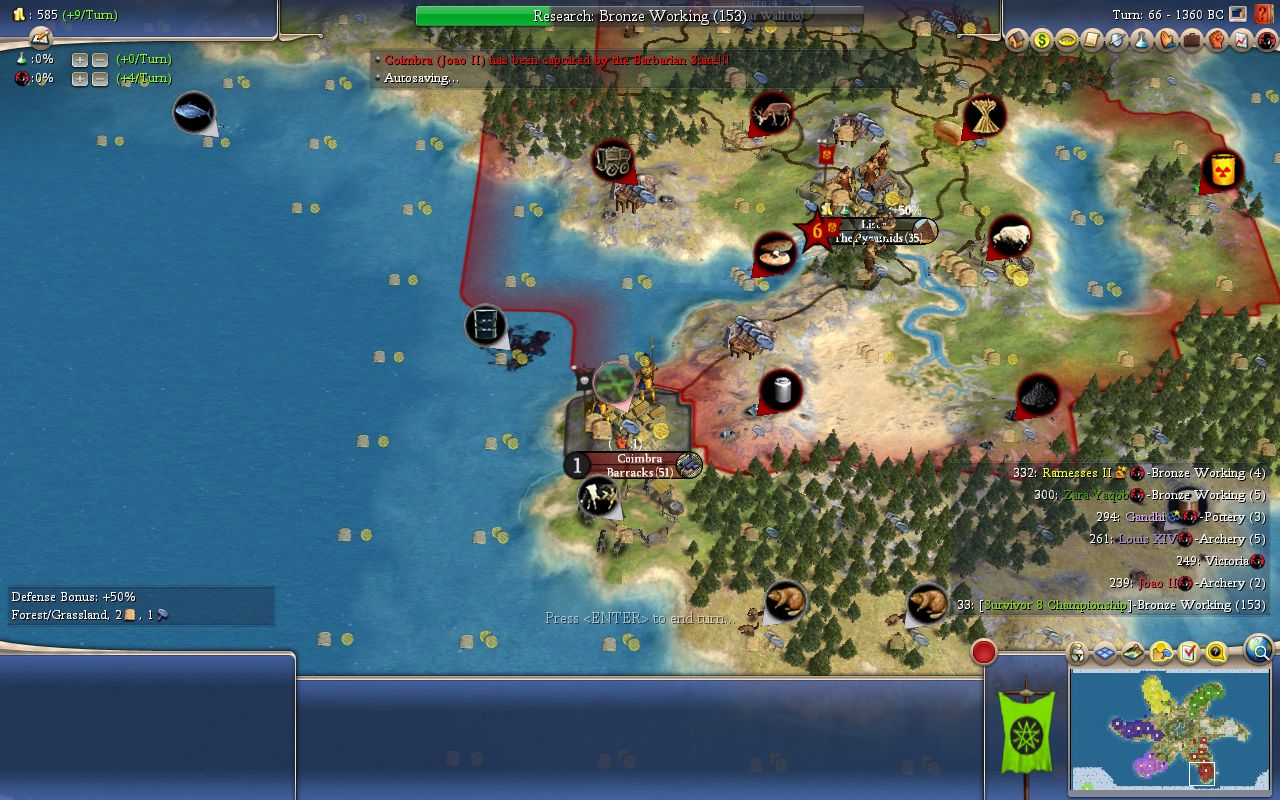
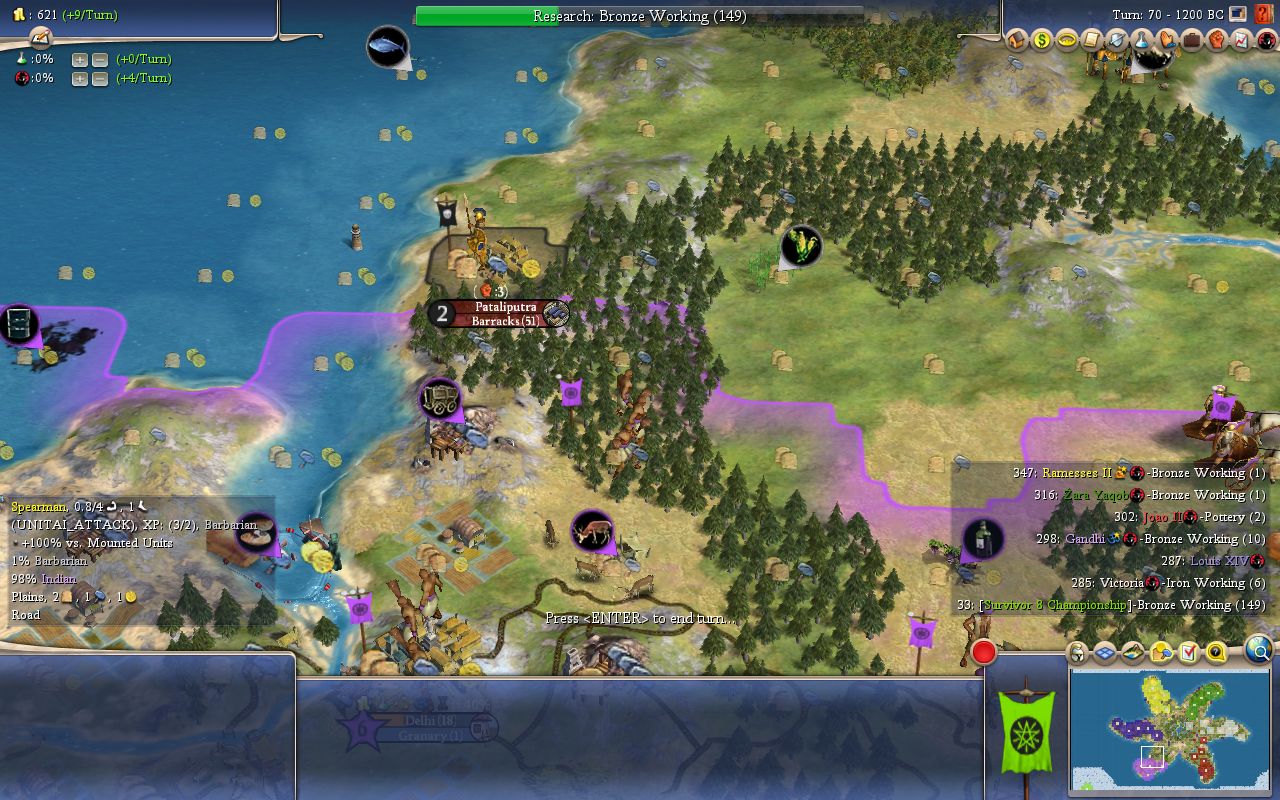
This should not come as a surprise. Mansa Musa lost an early city to the barbarians in the Season 8 Championship to completely alter the trajectory of that game, coming in 3rd when he smashed the Alternate Histories. Vicky came close to losing a city in this season's championship livestream as well. In replay after replay, the barbarians affected the game through some combination of pillaging, city captures, and inopportune city spawns. Now, these barb cities tended to sprout up in gorgeous locations, and capturing them was key to finding success. One had to be careful, however; faraway barb city captures turned out to be major poison pills that incited unnecessary early conflicts with a cross map neighbor. The general rule of thumb was to capture barb cities, but only if they can connect to one's territory.
Fun little tidbit I learned: the barbs would much prefer to use Archers to guard their cities, and will release their Spearmen back into the wild once they have an Archer as a garrison.
Starfish Supposition 7: Yeah, these games will probably end in a Spaceship.
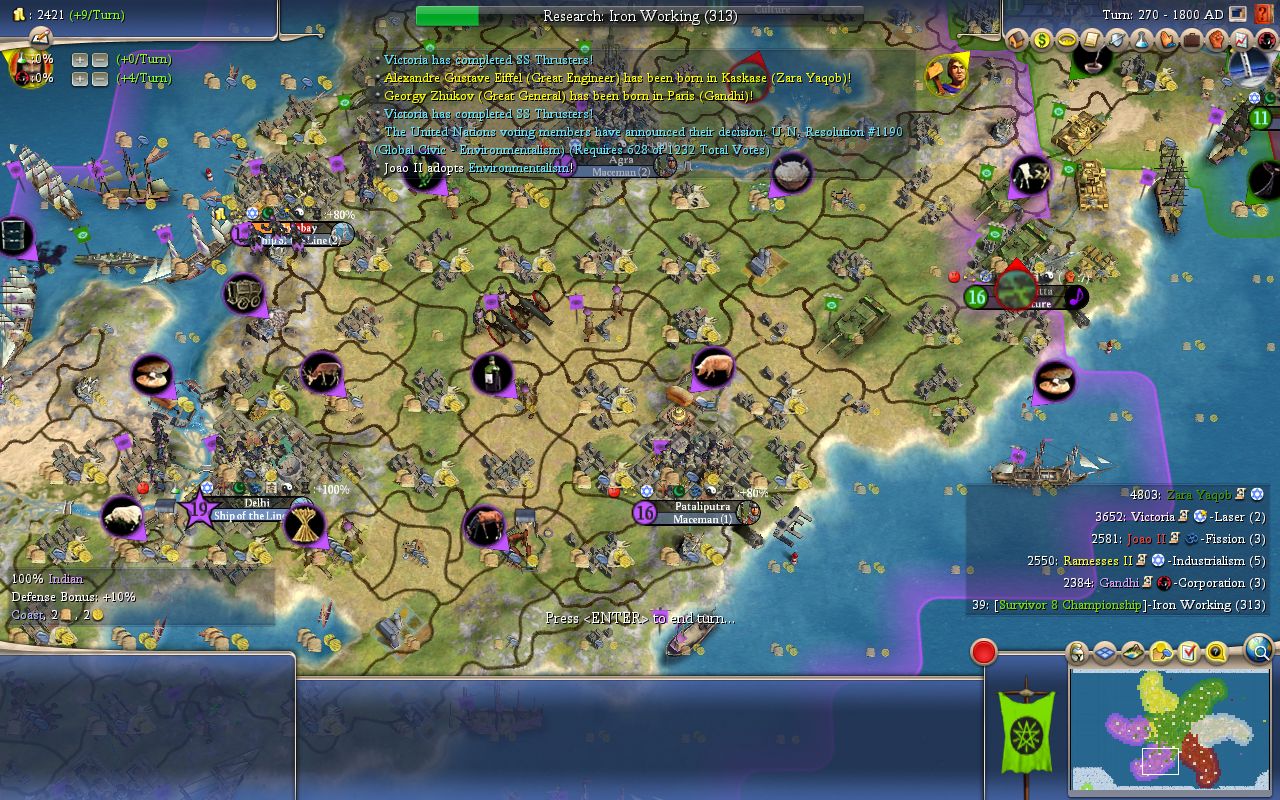
Gandhi was the only leader who ever tried to win by culture, and he needed to amass a large number of Holy Cities (at least five typically) to consider that avenue, which was easier said than done in this field. The only time I ever witnessed a non-Gandhi leader flip up the cultural slider was Ramesses at Future Tech, kind of like what South Korea is doing right now in the real world. As is often the case in large maps, Domination victories were exceedingly difficult; Louis managed to be within three percentage points of the limit in Game 9, but no other leader was particularly close. What happens is, as the maps get larger and richer, Spaceship timings converge closer and closer to Cultural timings. In fact, pursuing a Cultural victory in this map is quite dubious because it was much easier to get outscaled; Gandhi in particular threw Game 15 by switching up the Culture slider and allowing Zara to run him over (getting to MODERN ARMOR vs. MUSKETS) when he easily would have won if he continued teching. To be fair, that does balance itself out, as Gandhi would have won Game 20 if he turned up the slider.
I will say, there were quite a few close calls on Diplomatic victories, including Game 3 where Louis (!) was literally a singular vote away from winning through the UN:
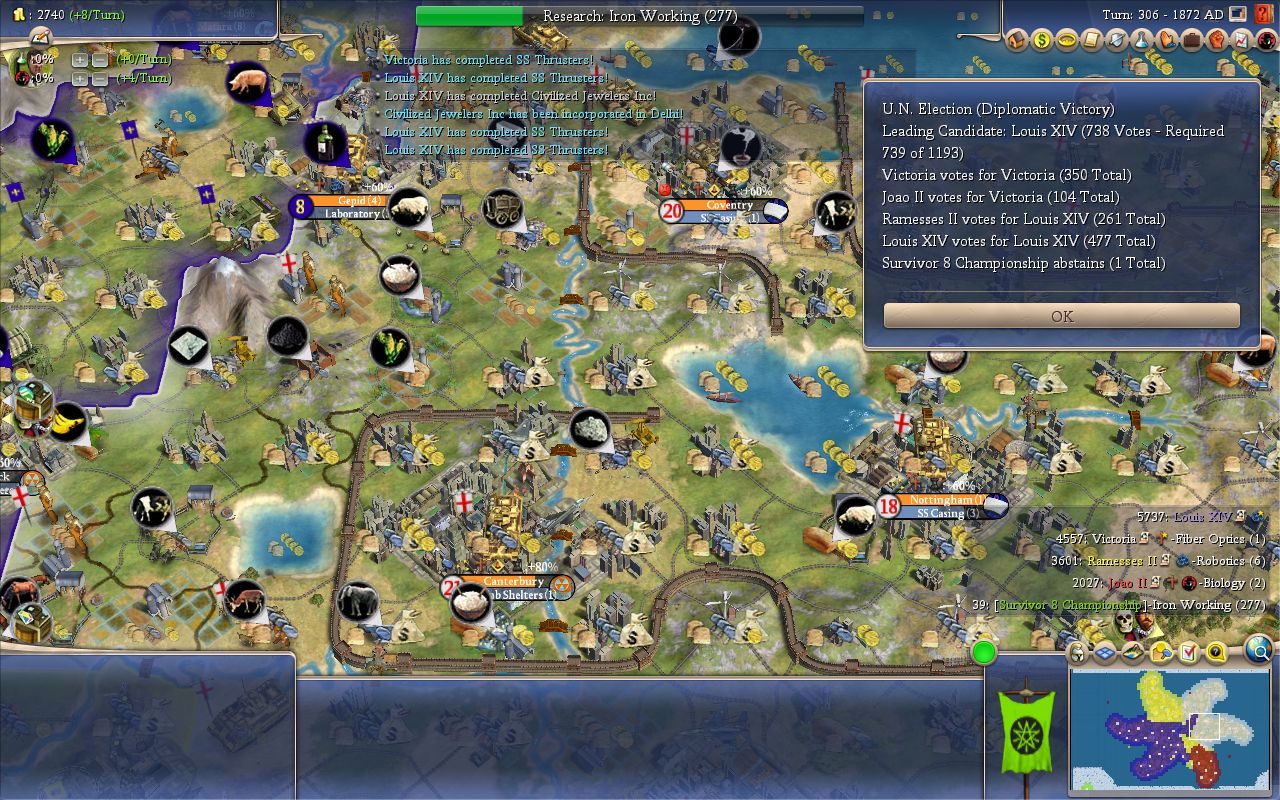
It so happened that Vicky won both Diplomatic victories in this set, one when her spaceship was a few turns from arriving and another where she was evenly matched with both Ramesses and Gandhi but the Egyptians voted her the winner to rob me of an exciting three-way space race. I would estimate a Diplomatic victory to be a 10-15% outcome in this specific setup, and there were a few other somewhat close calls. With all that said, though, a typical game is going to end with a leader's spaceship arriving between Turn 280 and Turn 315.
If we end up using the starfish for Season 10 once again, hopefully these axioms are helpful for future predictions.
Onto the individual leader summaries!

Victoria of England
Wars Declared: 30
Wars Declared Upon: 23
Survival Percentage: 85%
Finishes: 7 Firsts, 7 Seconds (49 points)
Kills: 12
Overall Score: 61 points
Sorry Sullla, you truly are cursed. Vicky was the strongest leader on this map according to my eye test and the results, including her double digit kill count, support this notion. Vicky had three major advantages over the Gandhi/Ramesses duo. First, her game was much less reliant on religion. If Gandhi and Ramesses failed to found or spread their religion, they generally were either irrelevant or would get dogpiled out of contention, while Vicky did not need a religion at all to succeed, winning four games (and nearly winning a fifth, instead coming 2nd to Zara in a SAME TURN SPACESHIP TIE) without one. Religion, of course, was an insane power multiplier for her Financial civ if she was able to get past potential diplomatic hurdles. Secondly was her positioning between the two weakest leaders on the map, as compared to Ramesses and Gandhi who had to contend with Louis breathing down their neck over and over again. While Joao and Zara could be fickle neighbors and Vicky was sometimes worn down fighting them like in the livestream, they were still much easier than Louis. Finally, Vicky might have the single best set of tools for this map. With a coastal capital and a hill sheep, Mining/Fishing is a fantastic pair of starting techs for this map. This is compounded by the Imperialistic trait, and Vicky was the best expander on the map in game after game. In fact, I would say her expansion was too good sometimes, as the pace in which she churned out settlers at times could not keep up with her ability to actually protect them, which led to a few disastrous early games.
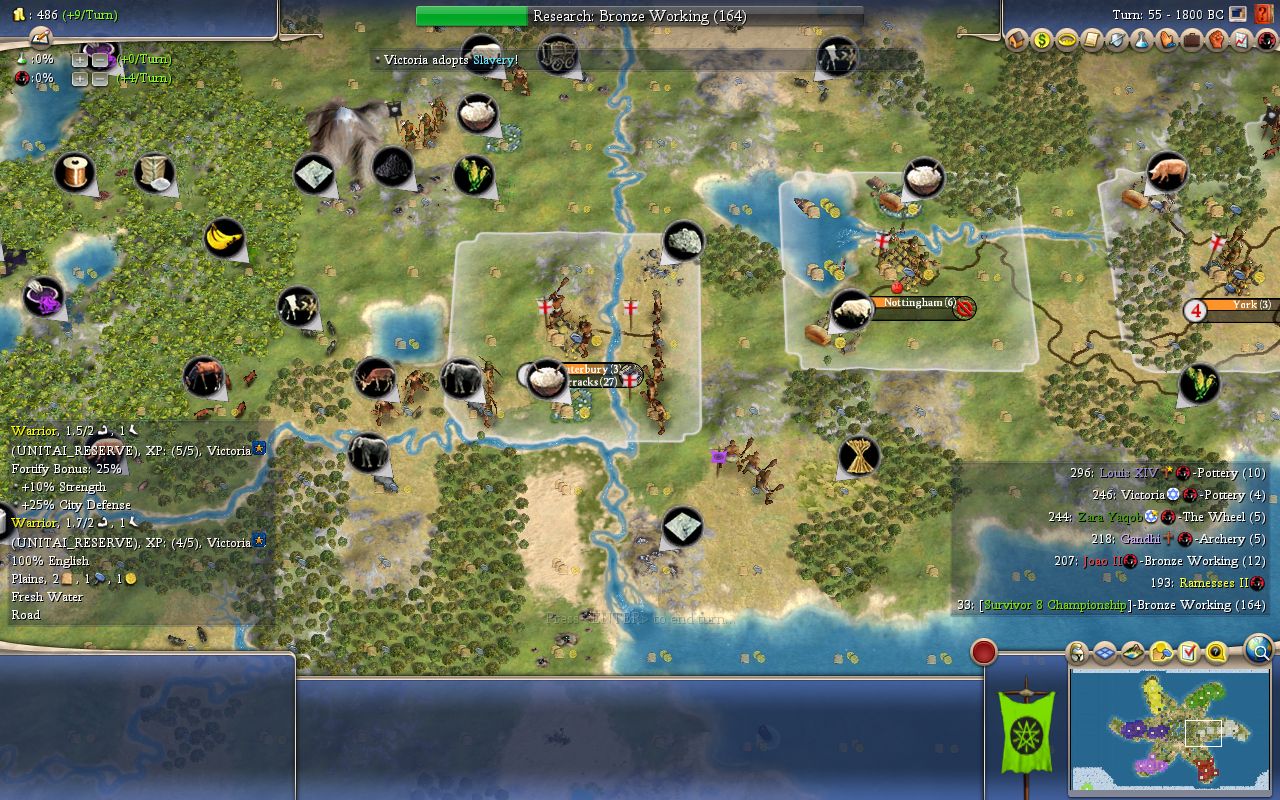
In general, however, Vicky's failures generally stemmed from two things. First, like in the livestream, she could adopt the wrong religion, either a random minority religion or a self-founded Code of Laws religion or something, and then end up mired in endless conflicts while other leaders zoom ahead in tech. The other, less common source of failure, was more self-inflicted, as Vicky sometimes decided to go all in on a fruitless pre-Catapult war that did nothing but drag its contestants down. One such game was Game 4, where Vicky marched halfway across the world to attack Louis on Turn 95, went irrelevant despite running him over (as two other leaders dogpiled and then Gandhi culture-flipped most of her holdings), and then suicided into her religious ally Zara late. Nonetheless, Vicky was clearly the "default" winner here - just look at the deathless Game 20, a total stalemate that Vicky just was able to win through sheer teching.
Vicky has been a rather peculiar leader as of late, having some insane livestream games that are proven to be low odds outcomes at best in Alternate Histories. In fact, this is her first strong alternate histories result since Season 3 (now, as of this writing, Season Nine Game Two alternate histories are yet to be published, but looking at her land and diplomatic situation I am not bullish on her chances.) Thus, I am not quite sure what to think of her after this set turned the tables. To be fair, most of Vicky's success have come from difficult diplomatic positions, so her replicability issues are understandable. However, it cannot be denied that due to the tools she is blessed with, she is one of those leaders who, much like Gandhi, always has a shot to win. All in all, this was a fitting conclusion to the Golden Spear winner, one of the megastars of this season.
Canterbury Fails Award:
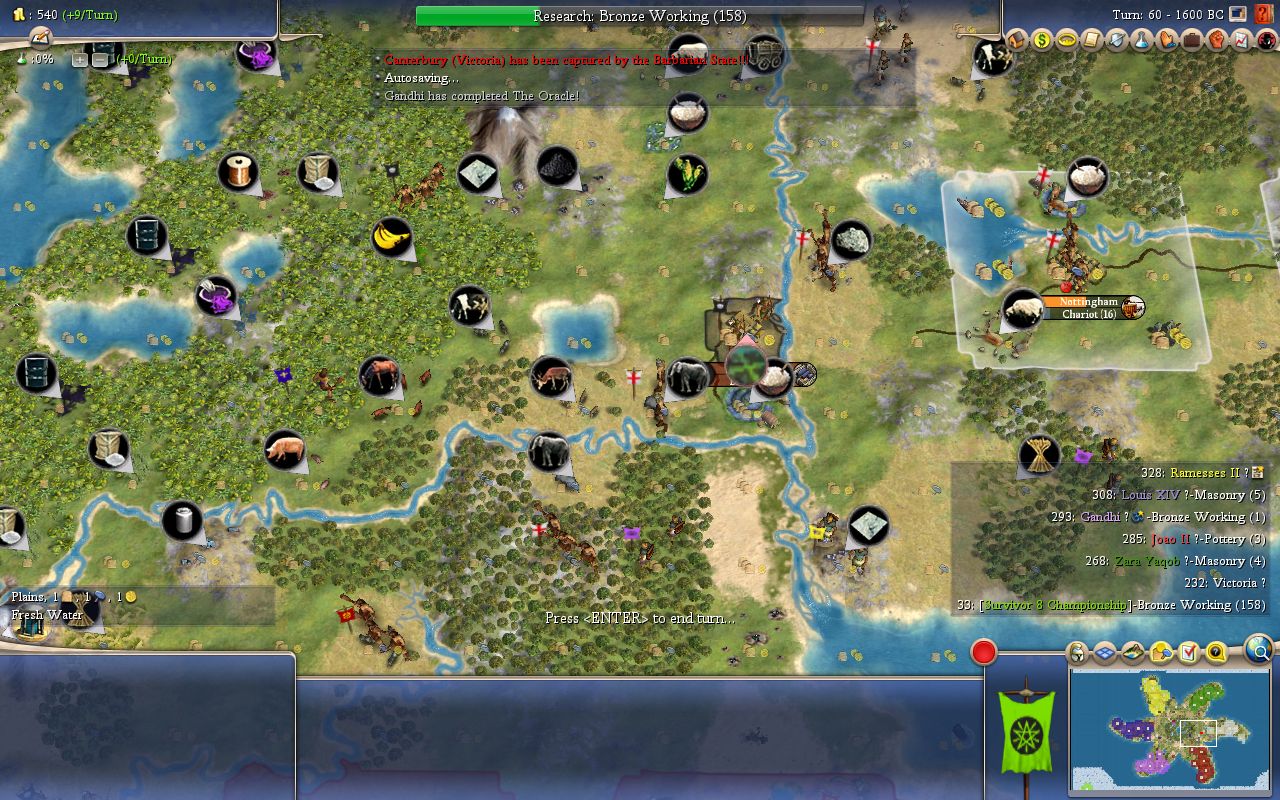
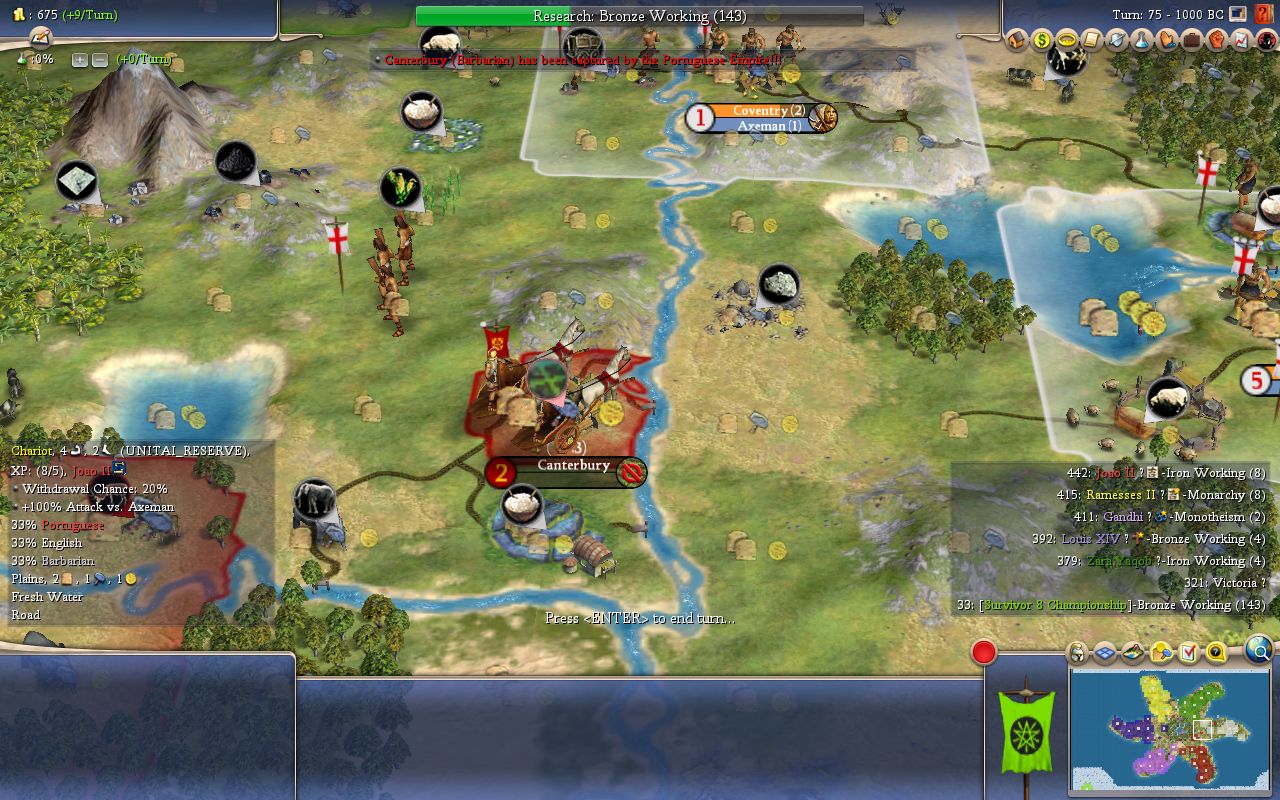
That Still Lasted Longer Than The Truss Ministry Award:
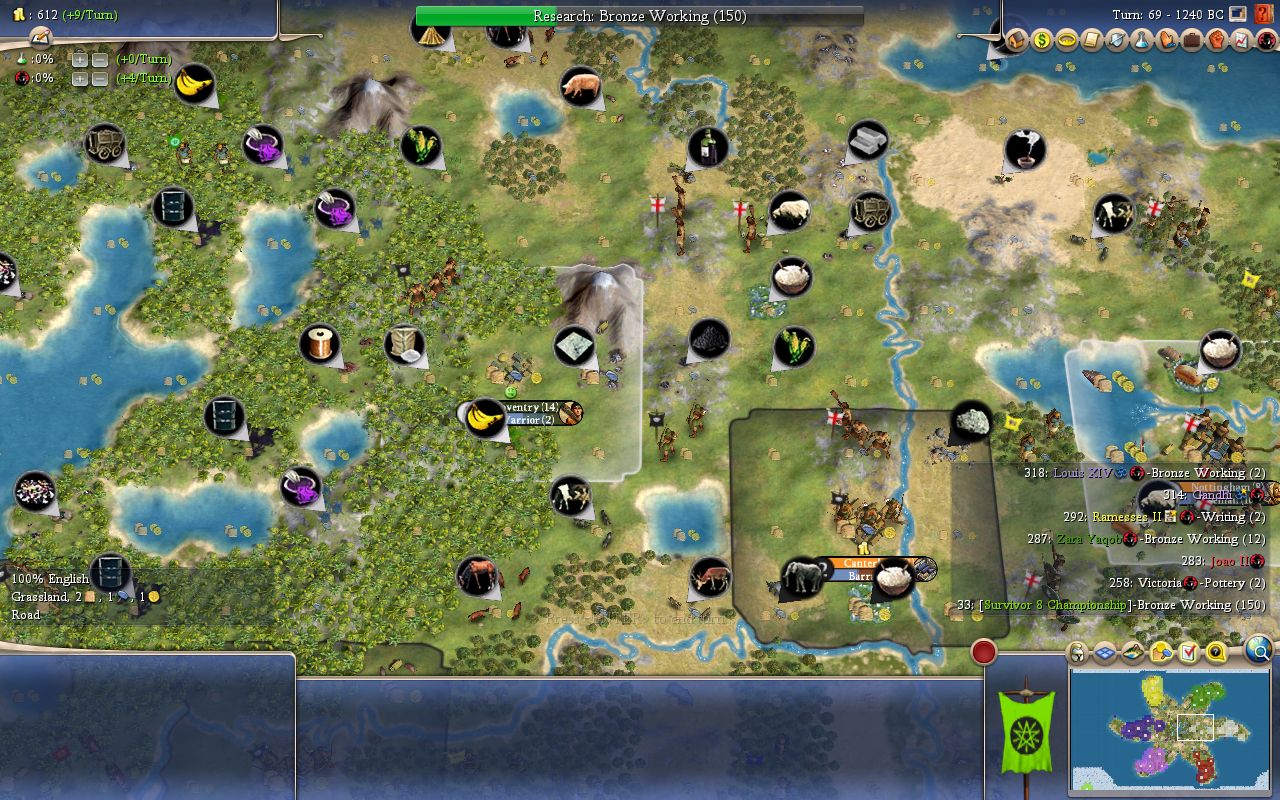
Yes, Vicky actually lost two cities to the barbs in that game, and left the poor settlers of Coventry precariously exposed.
Victorious Lettuce Award: Vicky won that game.

Gandhi of India
Wars Declared: 11
Wars Declared Upon: 34
Survival Percentage: 75%
Finishes: 5 Firsts, 2 Seconds (29 points)
Kills: 6
Overall Score: 35 points

Ramesses of Egypt
Wars Declared: 25
Wars Declared Upon: 25
Survival Percentage: 90%
Finishes: 4 Firsts, 2 Seconds (24 points)
Kills: 3
Overall Score: 27 points
I will discuss these two leaders together as they had similar strategies and approaches which ultimately led to similar results. Both leaders went all-in on the religious gameplan, using religion as a source of diplomacy, culture, and economy, and then choosing (or being dragged into) the correct religious conflicts to truly establish their position. If religious diplomacy went in their favor, they had as good a shot as anybody. If not, at best they got stuck in fruitless religious wars and at worst they did not make it out intact (note that Ramesses' survival rate is extremely misleading, as there were a few games where he was saved by the UN or the end of the game. His "true" survival rate is around Gandhi's.) A personal source of curiosity was how strong Stonehenge would be in Ramesses' hands, and to my surprise, it turned out to be less impactful for spreading religion than I thought. Gandhi was generally much better at spreading his religion in the repeat playthroughs than he was in the live, and overall Gandhi got pretty screwed with the peaceweight rolls in that game, with Ramesses Annoyed at just -2, making things much more difficult for him. As stated in the overview, Louis was a key factor for these two, and could either be the source of their successes or major thorns in their sides - but on average, he tended to make their lives difficult and they would have been stronger if you switched him with, say, Joao.
It is impossible to conclude which leader is actually stronger, as Gandhi won three out of the first four replays and then only mustered two over the remainder of the set (I am always a little more skeptical of overly streaky leaders), but he definitely was the better performer in this particular Alternate Histories, hence his higher score (and kill count!) There were a couple of reasons for this. First, Gandhi, being the only leader to start with Mysticism, had an inside track to founding his own religion, doing so in 18/20 games and having a guaranteed shrine when he did so. Ramesses, on the other hand, while still decently likely to found a religion, was less consistent in doing so (Agriculture/Wheel is a slightly awkward starting tech combo in this map - this is good by the way, it means every leader has a chance regardless of starting techs), and if he failed to found a religion he was typically irrelevant. Conversely, Gandhi actually won one of the two games he eschewed his Hindu ways (Game 18). The other sign that Gandhi was better was that he had a couple of near-wins that Ramesses never had, including the Game 15 throw and Game 14 where Gandhi probably would have won by space if Ramesses had not voted Vicky the winner. Ramesses was irrelevant or in a distant second place in most of the games he failed to win.
In fact, the Egyptians were pretty disappointing. With the tools at his disposal, Ramesses should have had better results in my opinion. Unfortunately, Ramesses had a massive flaw: he clearly forgot to study Starfish Supposition 2. In his zeal for religion and wonders, he frequently failed to expand. In many replays, I noticed inopportune barb cities would spawn near his territory:
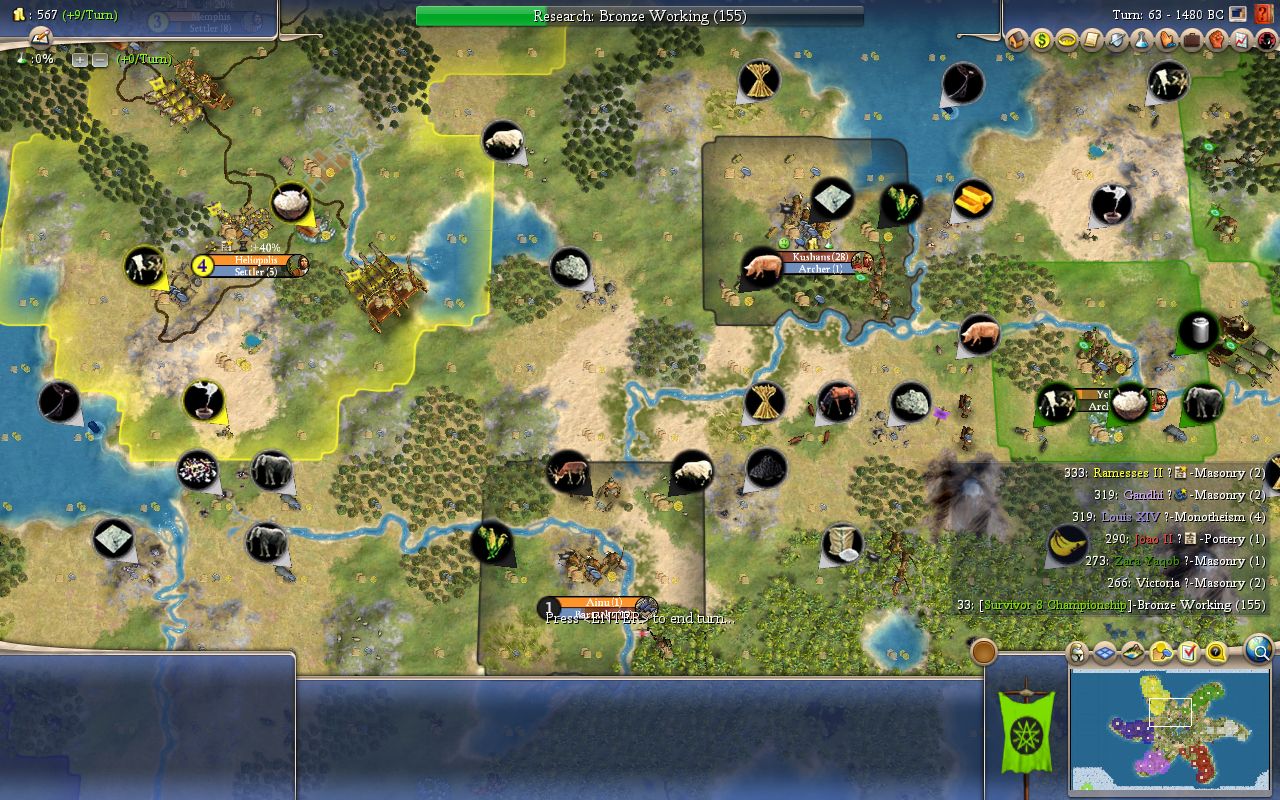
At first, I thought this was bad luck, but the more this pattern repeated, the more I realized that Ramesses, in his zeal for religions and wonders, would do a poor job at fogbusting the map and expanding, and there were too many replays where the guy ended up boxed into eight or so cities. Even the most profitable shrine in the world could not overcome being too small to compete. Ramesses aced every other aspect of civ - in particular he had great tech preferences for this map, and won at least one close game by securing the Internet - but without the most important fundamental of expansion, he failed more often than he should have. Considering how impressive his livestream game was, I expected more from the Season 9 Champion. All in all though, he felt like a thematic champion for this season, and I enjoyed watching him compete with the other playoff winners in this set.
Myth Ragequit Award:
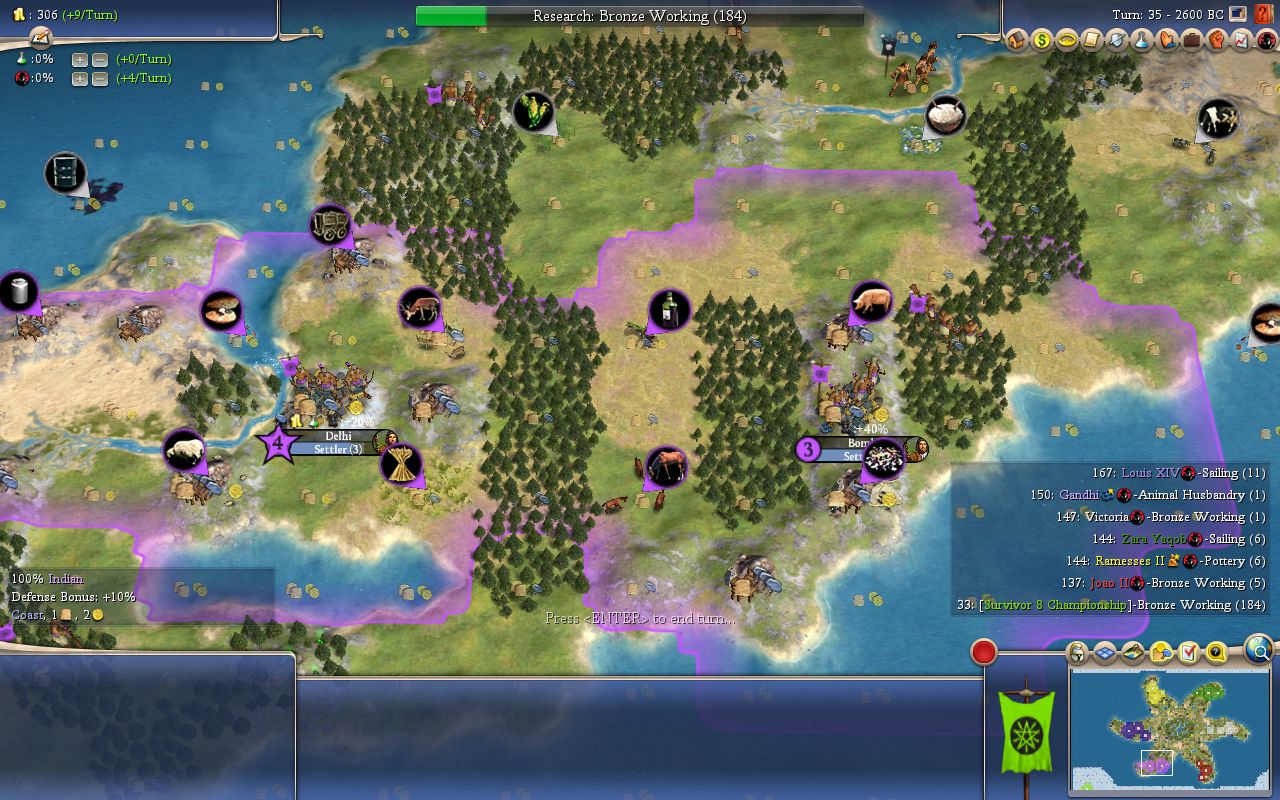
I don't think those Gems were there! Gandhi easily won this game, and he furthermore was blessed with an extremely favorable peaceweight roll where he only needed to bring Louis to +2 to reach Cautious.
Slashin Punching Air Award: Gandhi threw a large Game 11 lead by failing to tech Computers (losing Internet to Vicky), unnecessarily attacking Louis to further fall behind (and ultimately ceding 2nd place to Louis), and then Stealth poison pilling himself.
Showing Hatshepsut How To Use War Chariots Award: In Game 8, Ramesses once again was boxed in by barbarians and looked irrelevant, until he massed a large army of War Chariots, took every single barb city that sprouted nearby for himself, and ran away with the game.
Showing Hatshepsut How Not To Use War Chariots Award: Ramesses completely threw his game away in Game 15 with an all-out War Chariot rush on Louis.

Louis of France
Wars Declared: 34
Wars Declared Upon: 40
Survival Percentage: 50%
Finishes: 3 Firsts, 2 Seconds (19 points)
Kills: 6
Overall Score: 25 points
This was one of the more impressive Alternate Histories performances I have witnessed, one that, in my opinion, should firmly cement Louis as one of the best leaders in modern AI Survivor. This guy had the most offensive AND defensive wars, had to fight tooth and nail to succeed in a map where fighting is a dicey proposition, and had pretty useless allies (Joao and Zara are natural allies with Louis due to warmonger respect and/or civics), yet he still managed to be competitive in this set and would have been a deserving champion. Louis' path to victory was simple:
1) Expand like an Imperialistic leader. Louis was routinely one of the best expanders in the map, sometimes rivaling Vicky. In some instances he was able to expand to 16 or so cities before Turn 100.
2) Kill either Ramesses or Gandhi, and get himself a highly developed second empire with a likely profitable shrine. It was no accident that most of Louis' strong performances saw one of those two be First To Die or close.
3) Just beat Vicky. Louis' two second place finishes saw him do the first two steps but just get outraced by the English anyways.
In fact, Louis' victories were some of the best played, most awe-inspiring games I have ever seen. In Game 3, he backstabbed Gandhi at the perfect time, absorbed his territory, converted to Gandhi's Hinduism, and then struck a runaway Vicky (who had completely Willemed her game, teching Fascism before Rifling) at the perfect time to seize the lead for himself. In Game 9, he decisively won an early 3v1 and nearly won a Domination victory. Game 17 also saw him fend off or straight up win multi-front wars with ease. (Check out the Appendix A game summaries for more details!)
This brings me to my general point: from watching him and running other Alternate Histories, the best version of Louis is the warmongering one. His traits and civ already make him strong as a builder, and he should take full advantage of being a Creative warmonger like Gilgamesh and Catherine do (I actually consider Creative the best warmonger's trait, even better than Financial and Imperialistic). Culture victory too often serves as a distraction, and in a situation where that avenue was unavailable to him, he truly showed his potential. Had he played like a pure builder, his results would have been as pathetic as Qin's was last year. Instead, he zigged while everyone else zagged and proved his mettle. It did not always work - after all, his 50% survival rate is paltry for this map - but, much like in the livestream, he gave it his best shot.
Wrath of a Thousand Suns Award:
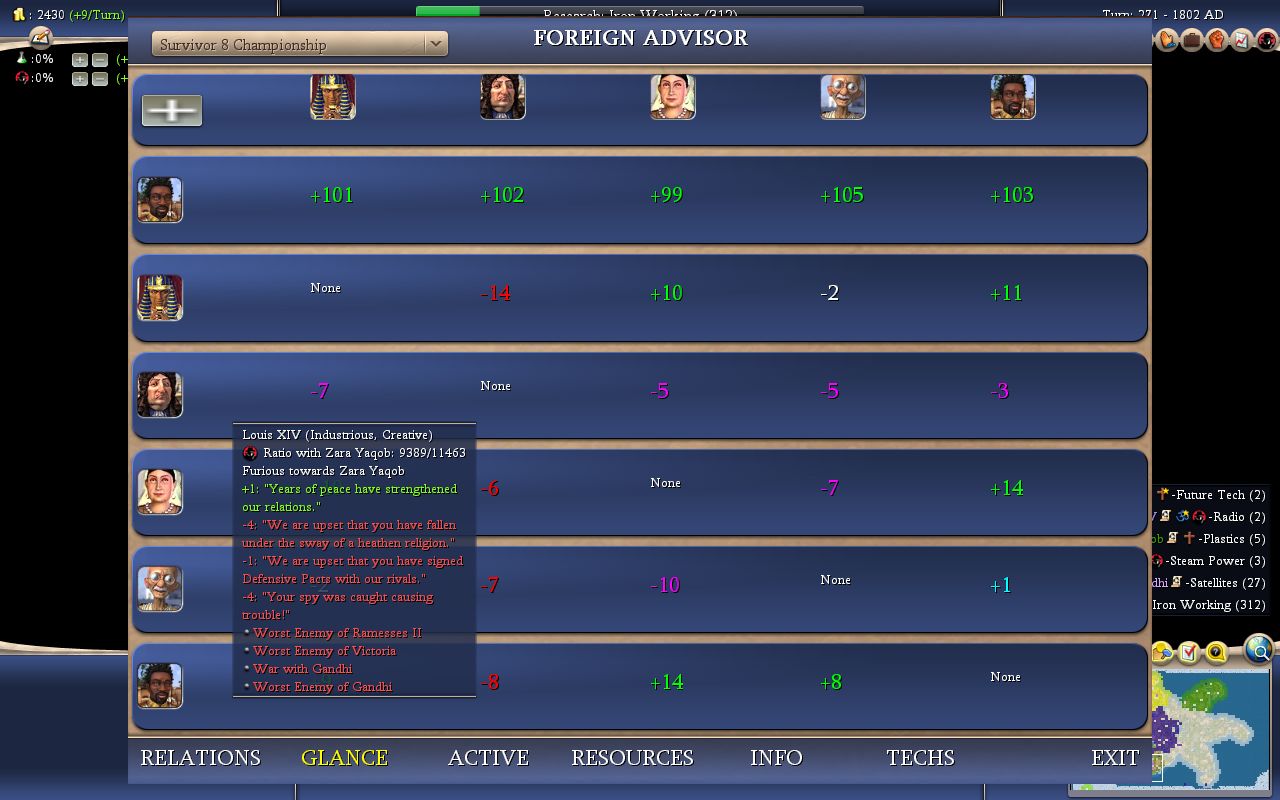
Getting Revenge For Losing To Portugal In The Euro Cup Award: Joao should have easily gotten 2nd place in Game 17, except Louis, fresh off killing Ramesses while also in a war against Zara that he would have easily won, signed peace with Zara, and IMMEDIATELY turned on Joao for absolutely no reason, knocking the poor guy out of the podium.

Zara Yaqob of Ethiopia
Wars Declared: 27
Wars Declared Upon: 12
Survival Percentage: 75%
Finishes: 1 First, 6 Seconds (17 points)
Kills: 3
Overall Score: 20 points
Zara was the most forgettable leader of the bunch, demonstrating precisely why he has never won a game since Season 1. He might be the most jack-of-all-trades, master-of-none leader in AI Survivor. Despite having the best diplomatic situation in the map, one where he could easily befriend every single one of his opponents, all he could muster was one victory (that saw him launch his Spaceship with three Casings and hit the 30% chance to win), fewer kills than GANDHI, and a few silver medals of varying quality. Just look at the final minimap screenshots of some of his second place finishes, where he was the largest civ by a country mile yet still unable to convert that to a victory. Even his one win should not have been that close, as that game saw Zara straight up lose a military conflict to a MUCH smaller and less technologically advanced Ramesses, blow his lead to Vicky, and get lucky enough that the English were too lazy to build both engines. Maybe his most embarrassing failure to win came in Game 15, where he peacefully settled to 19 cities, managed to build the Internet, and STILL lost to a much smaller Vicky.
The problem with Zara was, he just does not have any aces up his sleeve. He was routinely one of the slowest expanders on the map. In that regard, I noticed bouts of Suryavarman Syndrome, where he would build too many Warriors and hurt his economy as a result. Despite being a zealot, he has poor tech preferences and starting techs for pursuing a religion, and rarely participated in the religious game. He also seemed to have poor tech preferences for hitting key techs like Monarchy and Assembly Line. His fighting was not particularly effective, and he typically required either a lot of help or a massive technological advantage to make any significant headway. For whatever reason, Zara has been content to be forever a bridesmaid, never a bride, and that has been the general story of his AI Survivor career.
Zara YaCobwebs For Brains Award:
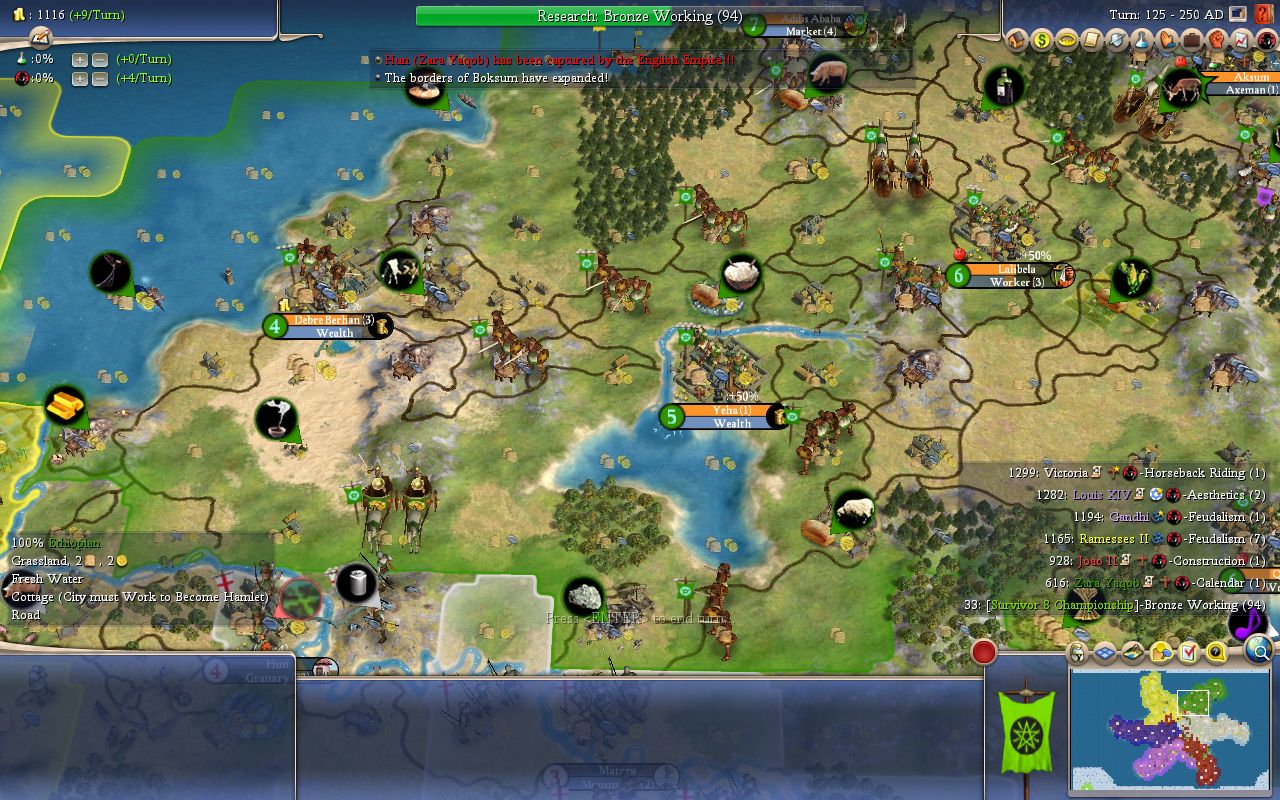
Macedonian PTSD Award:
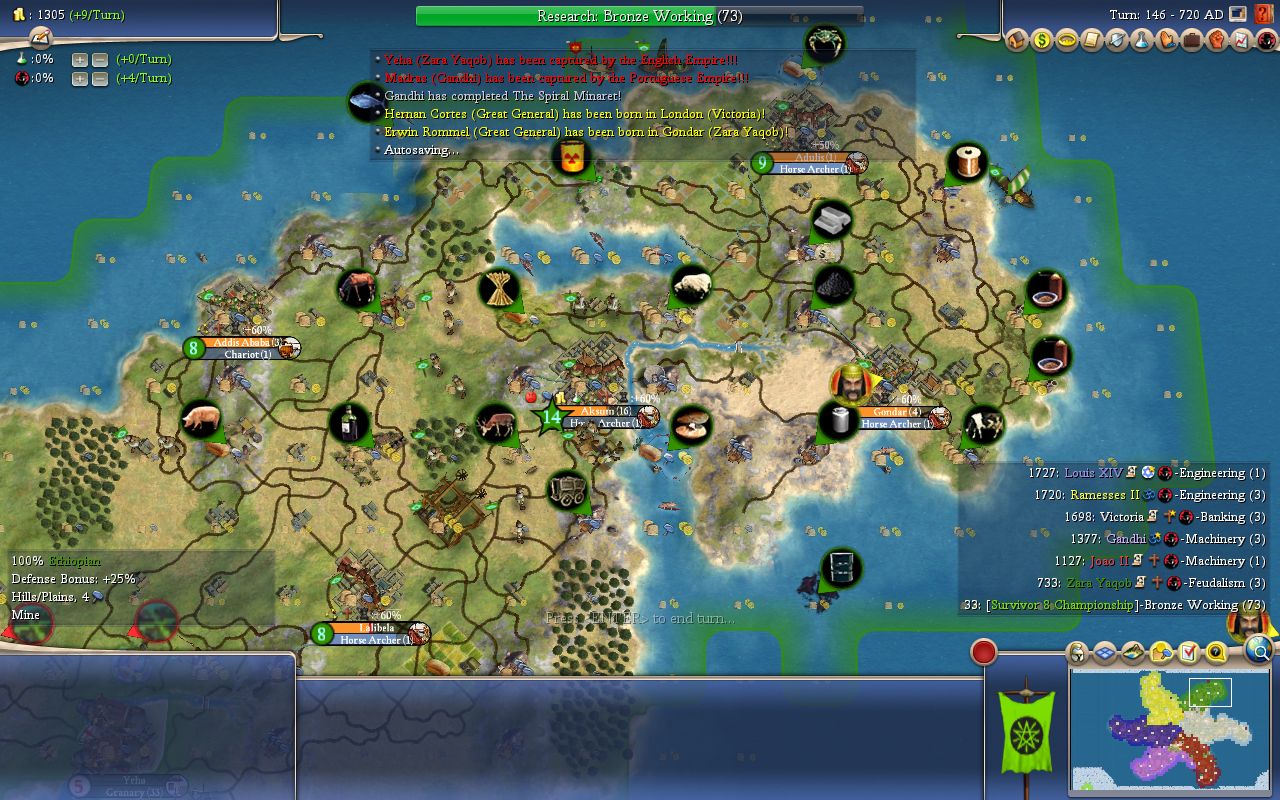

Joao of Portugal
Wars Declared: 26
Wars Declared Upon: 19
Survival Percentage: 50%
Finishes: 0 Firsts, 1 Second (2 points)
Kills: 5
Overall Score: 7 points
Joao was not as hopeless as these results make him seem, but... woof, this was an awful look. After seeing how nicely he rebounded from his disastrous start to claim the official silver medal, I thought he would be an interesting leader to watch. After all, he has excellent expansionist traits with ample high quality room, a dream diplomatic field, and starting techs that synergize excellently with his setup, precisely the situation he has succeeded in the past with. Yet, he was supremely disappointing in all aspects. To his credit, he typically expanded well, but his Stalin-esque avoidance of culture in game after game rendered said expansion a moot point, as he would typically get out to 8-10 or so mediocre cities, lag behind economically, and then not hit benchmarks like Pottery and Monarchy in a fast enough timeframe to keep up. I also thought he was a top contender for Great Lighthouse, and, shockingly, I do not remember him ever building it! He may have once, but far more often it was one of the Big Four building that wonder. Occasionally, Joao could play spoiler, siccing a massive army at one of his neighbors to cause trouble and drag them down, but ultimately it would not amount to much. The end result was a horrid 50% survival and 20% First To Die rate, which considering his diplomatic position is pretty inexcusable. It really shows that under these settings, the AIs can sniff out weakness, and no matter what will ruthlessly punish it at any moment.
I have gone over a lot of negatives, but it is not all bad. Joao legitimately did have fathomable victory chances here; he nearly won Game 13, losing in a tight race to Joao (notably he teched Mysticism early which made him FAR stronger than normal). Joao was also extremely strong in Game 1, except he wasted his advantage on a cross map attack on Louis, got nothing from the partition, and then later suicided into Gandhi when he at least would have gotten second place. Speaking of which, Joao was more a contender for second place than you think, as this set found some rather comical ways to screw him out of a silver medal, as if punishing him for undeservedly swiping it in the Actual Game. Some examples included Game 6, where Joao attacked a much weaker Zara... only to draw the ire of a runaway Ramesses through a Defensive Pact, and Game 8, where Ramesses won before Joao could conquer enough territory to beat Vicky to second place. There is a chance that if you ran many simulations, Joao is around Zara's level: a longshot to take home the trophy, with a moderate chance to finish in second. That feels fitting for one of AI Survivor's classic "king of second place" type of leaders, a moniker that has never been more fitting for this patron saint of mediocrities.
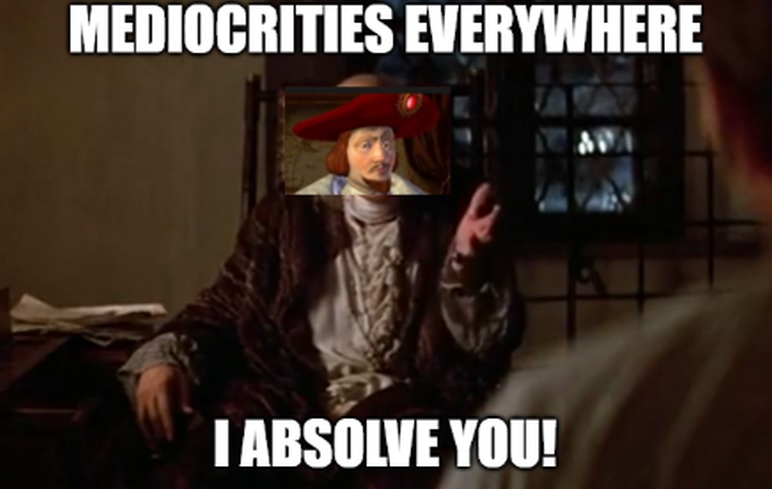
Why Did The Joao Cross The Road Award:
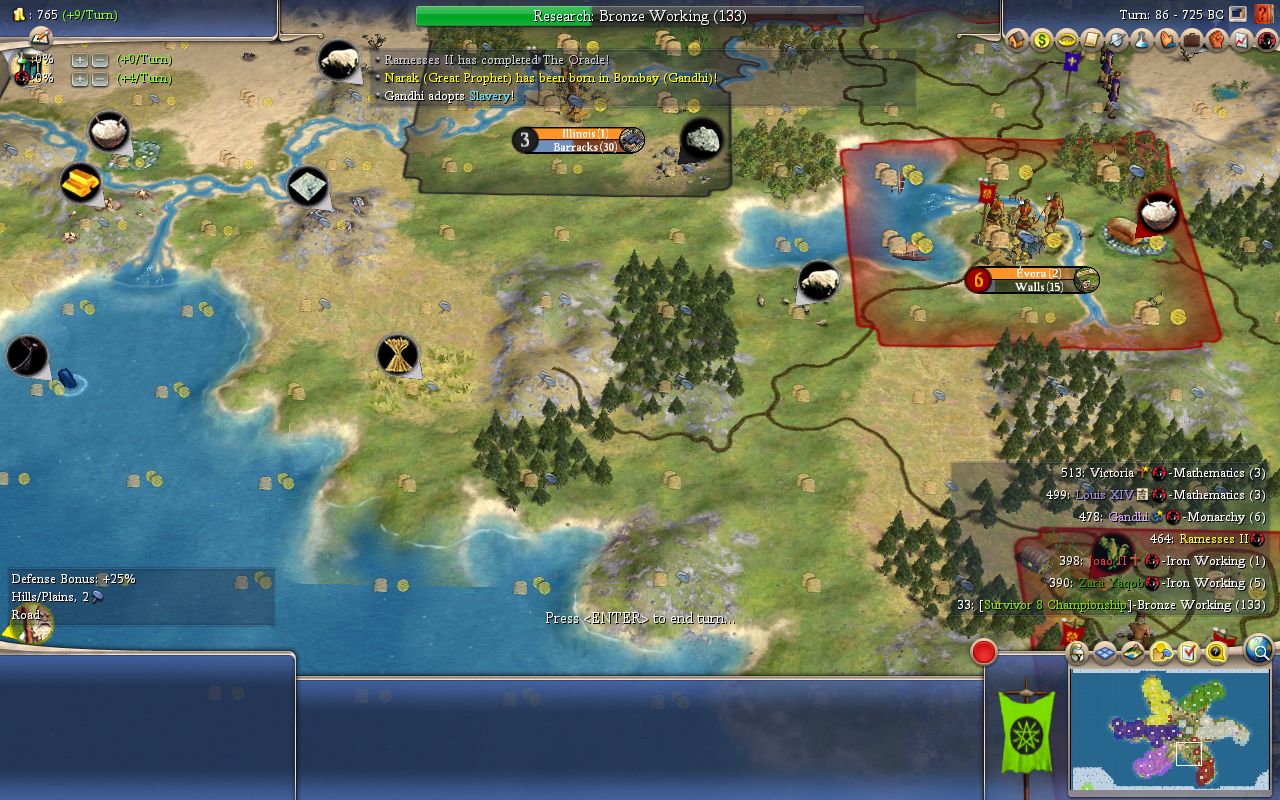
To Get To Bangalore Award:
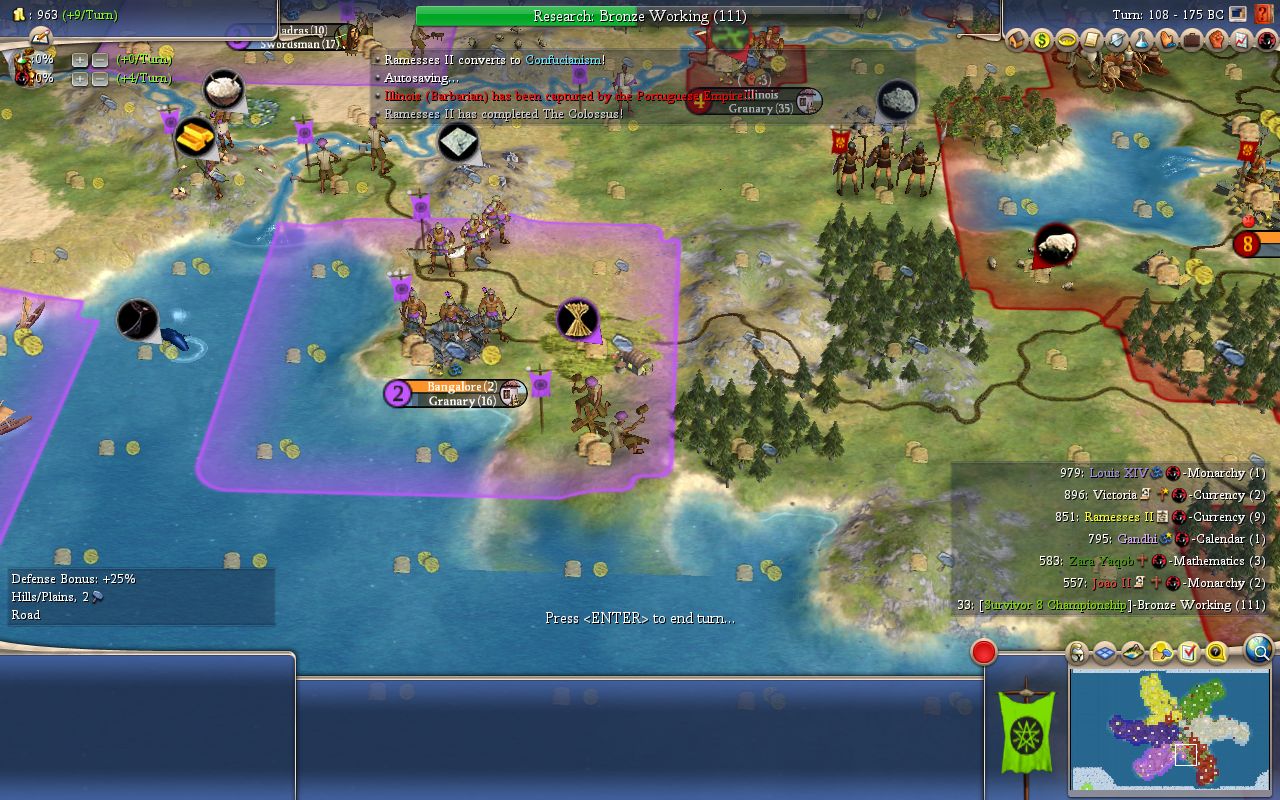
Killing Kittens Award:
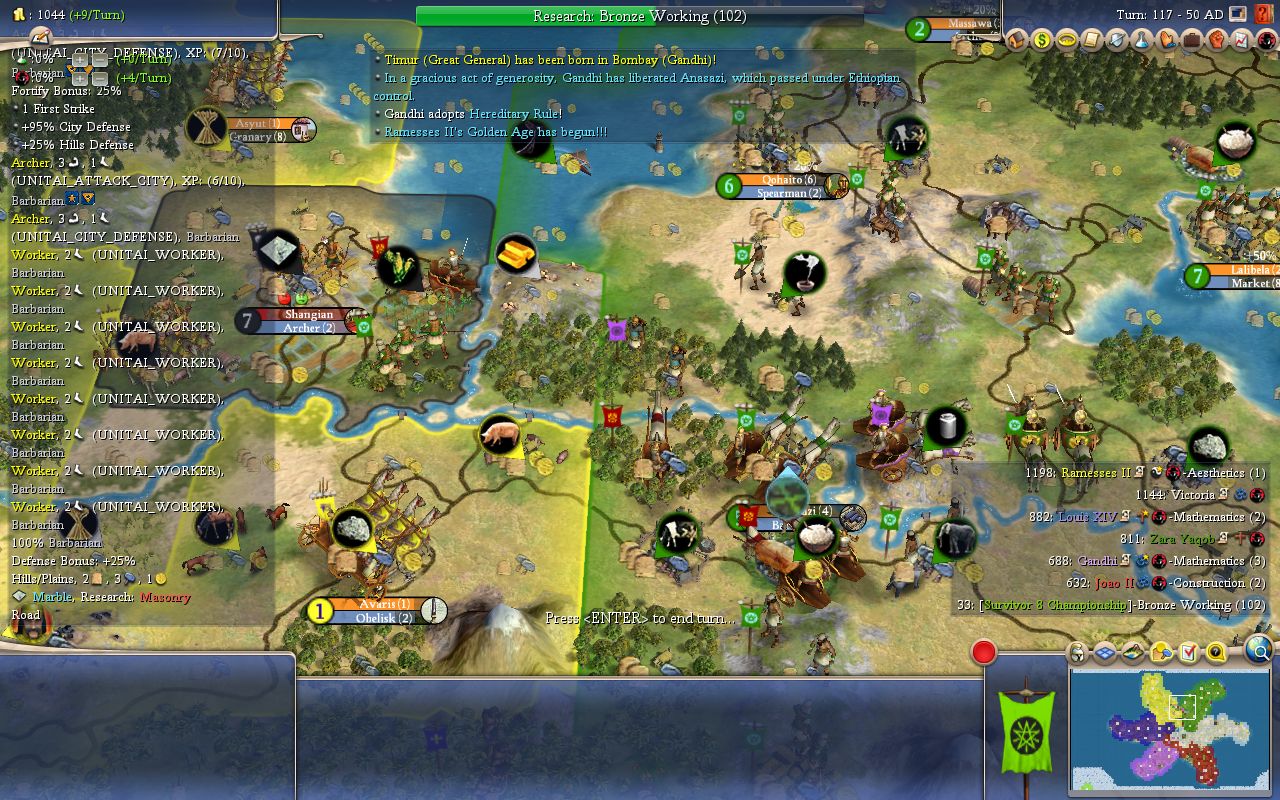
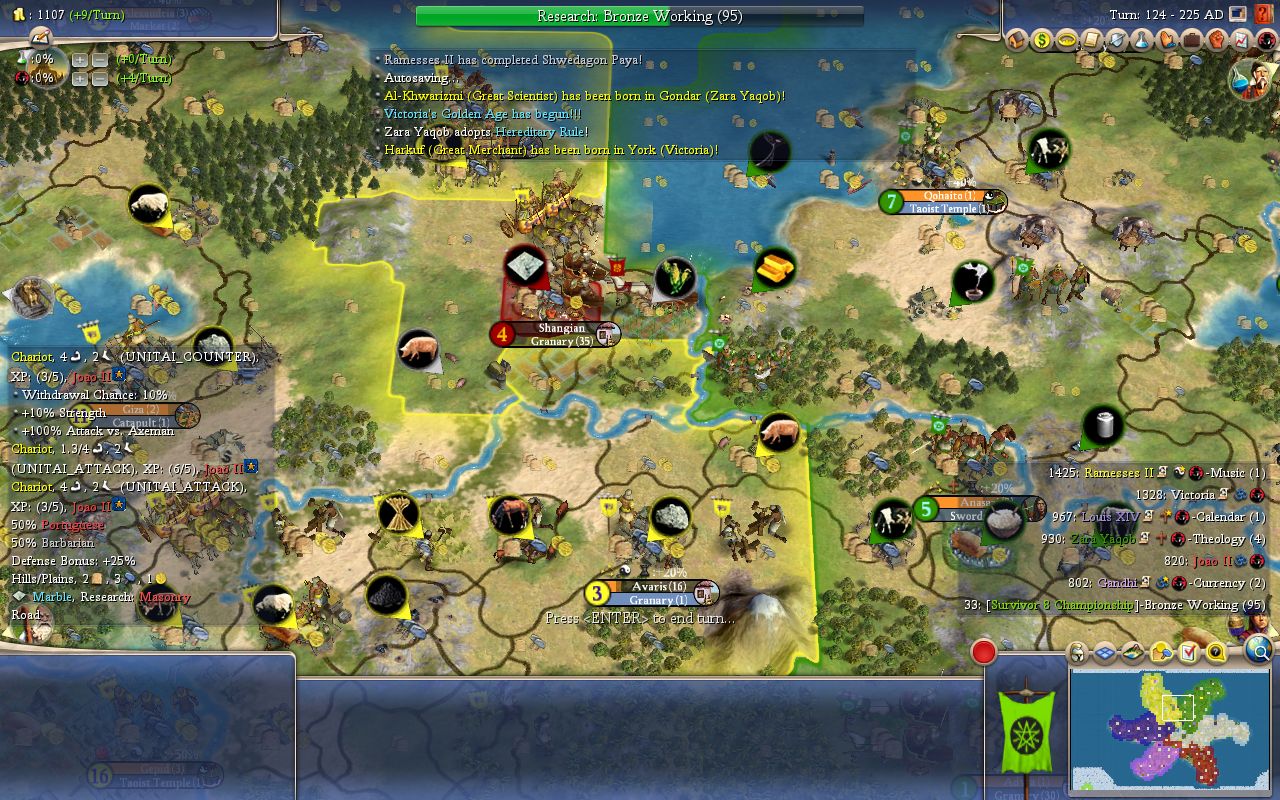
While the livestream was a pretty good template of a Ramesses victory, it was unusual in that both Gandhi and Vicky had bottom tier performances, which allowed Joao to sneak in a second place finish when he only replicated that result once in these games (he was unlucky, but still). Moreover, Ramesses never approached the same level of military success in the replays, getting three kills in 20 games when he had two in the live. I would not say it was a total outlier - Game 12 played out in a similar fashion, down to Louis suiciding into the Egyptians late, but it definitely was an unusual game. All in all though, Ramesses was a thematic champion, and the top three performing leaders in this set were probably the three most memorable leaders this season for better or for worse. I hope this is a memorable conclusion to what has, in my opinion, been an utterly fantastic season of AI Survivor.
Click the link above to read full summaries of each individual game!
Appendix B: Keler's Apostalic Palace Set
Before the Championship game, CFC fan Keler ran a set with the Apostalic Palace that got these results:
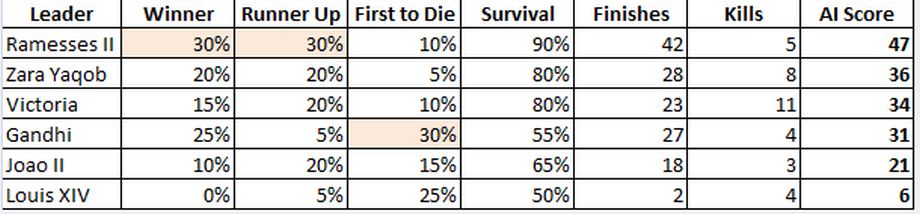
This set included a Turn 281 Zara Domination victory and a ludicrous Gandhi Turn 233 Cultural Victory.
These results actually make some sense based on what I watched. In such a large map with a religion oriented field, the AP would be very warping. For one, it would be a ridiculously overpowered wonder, giving at least four hammers per city for the leaders benefitting from it. It makes sense Vicky is nerfed here, not having enough religious inclinations, while Zara, who has a pull to Theology, would be more likely to have a strong game. I would guess there were a ton of games affected by AP dogpiles, particularly on Gandhi and Louis. The most stark difference, however, is Louis, who was hopelessly screwed here. This is unsurprising to me, as Louis' path to success in my set required significant amounts of bloodshed, so any chance for Louis to get ahead would get squashed by "stop the war" resolutions. It is safe to say, AI Survivor is healthier without the AP.