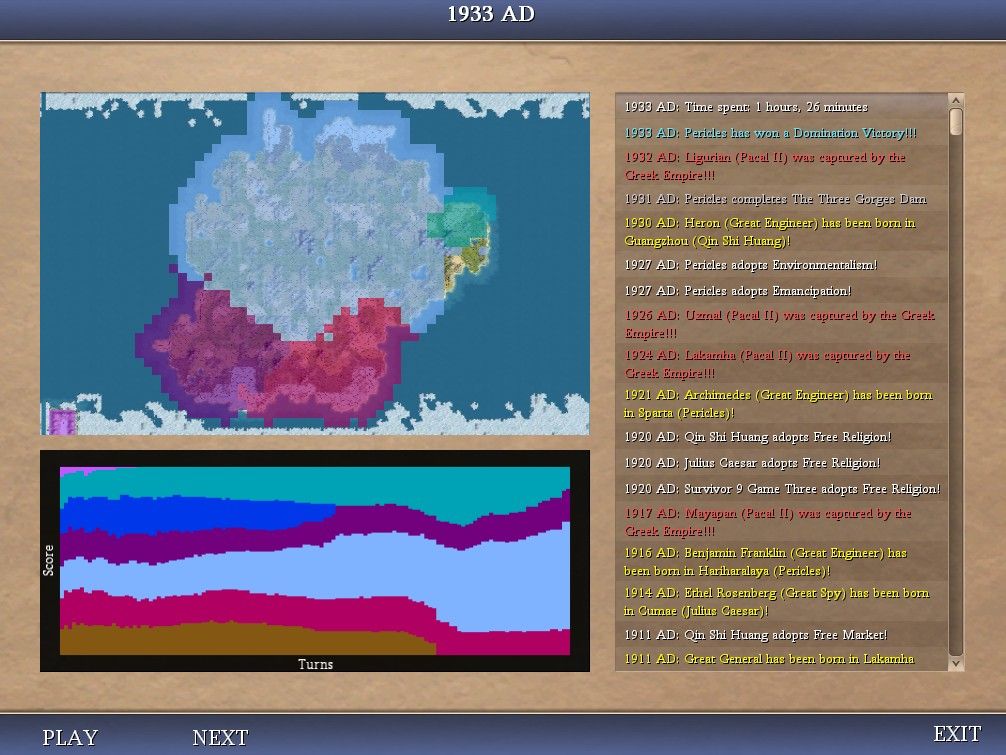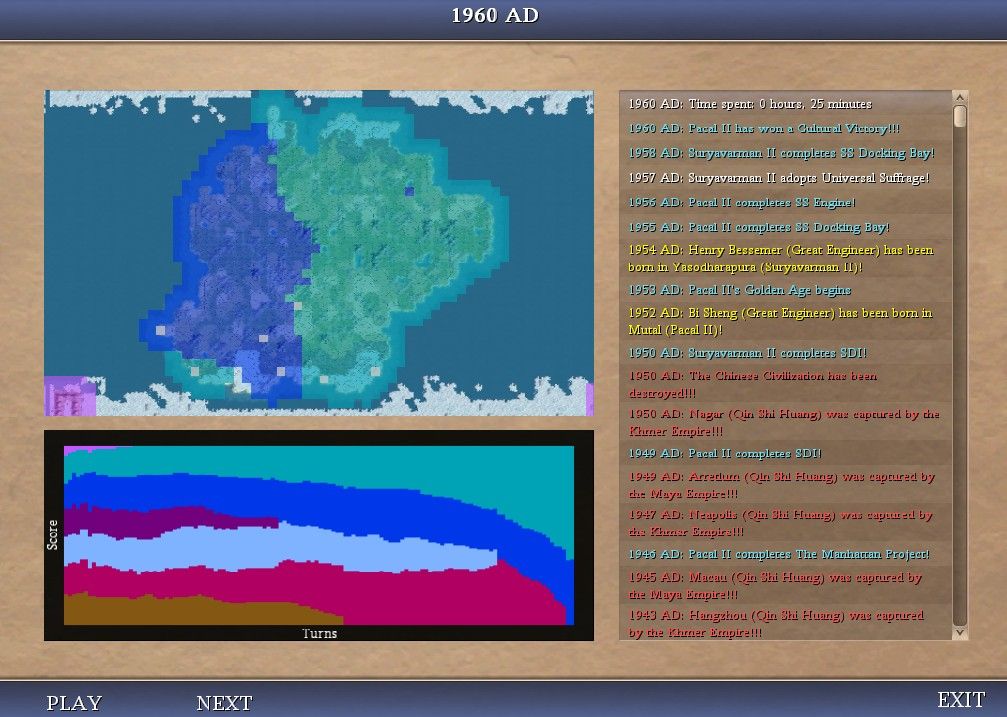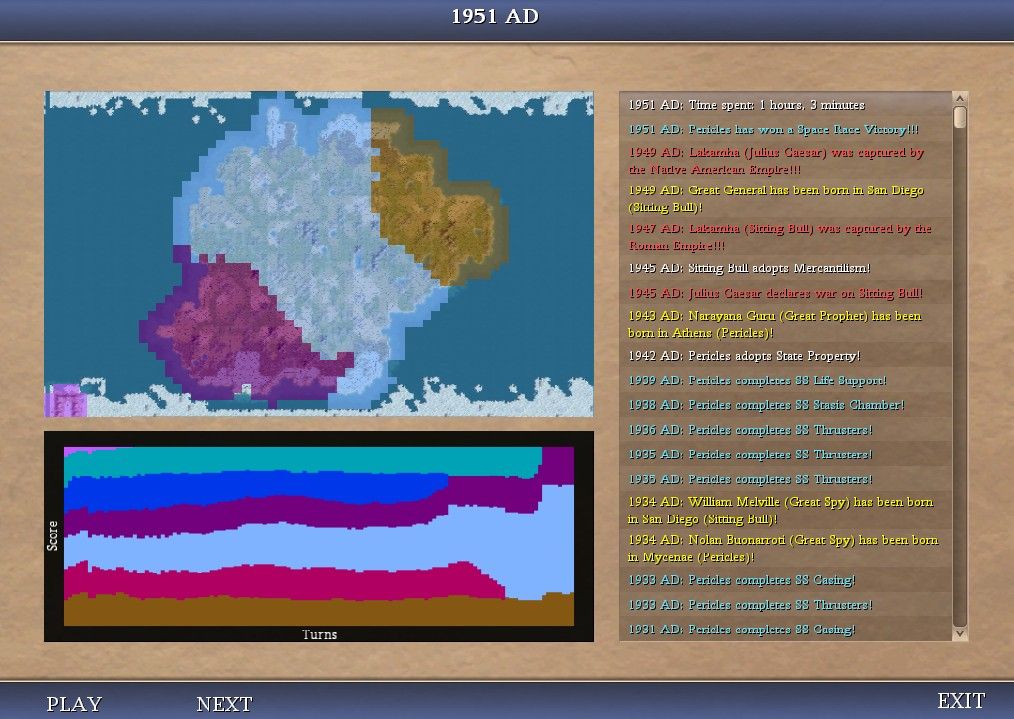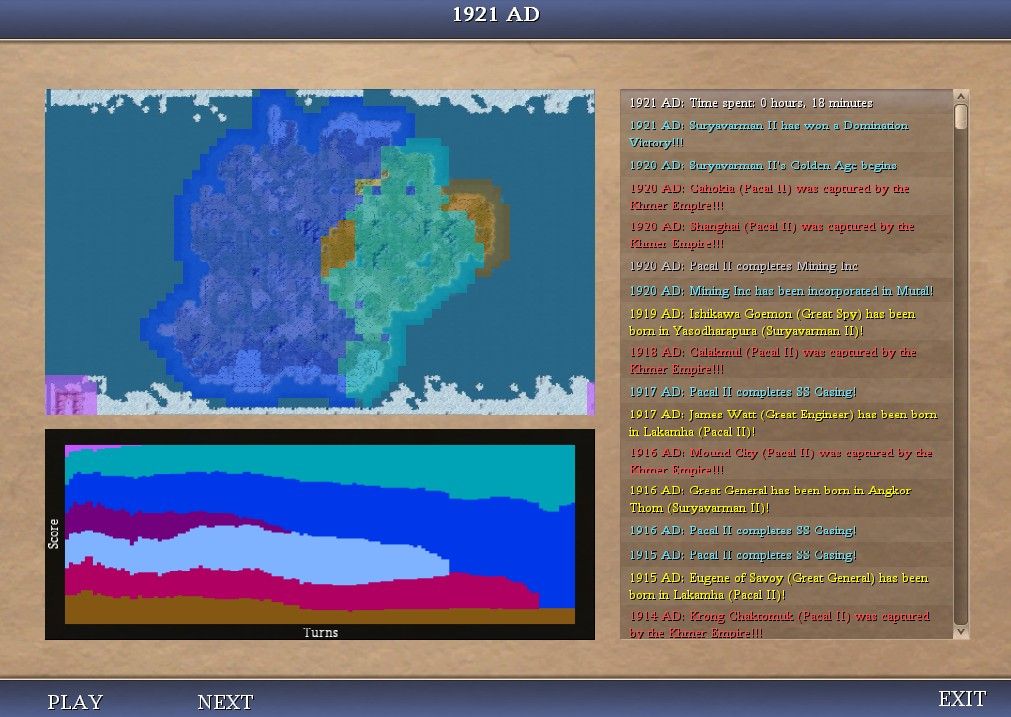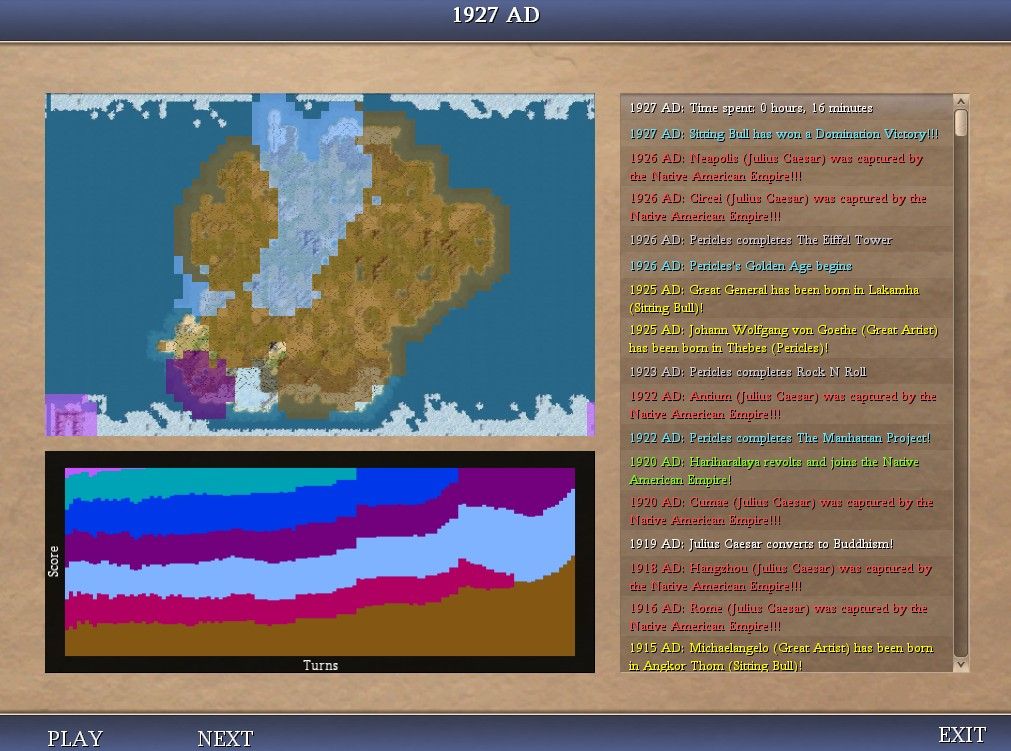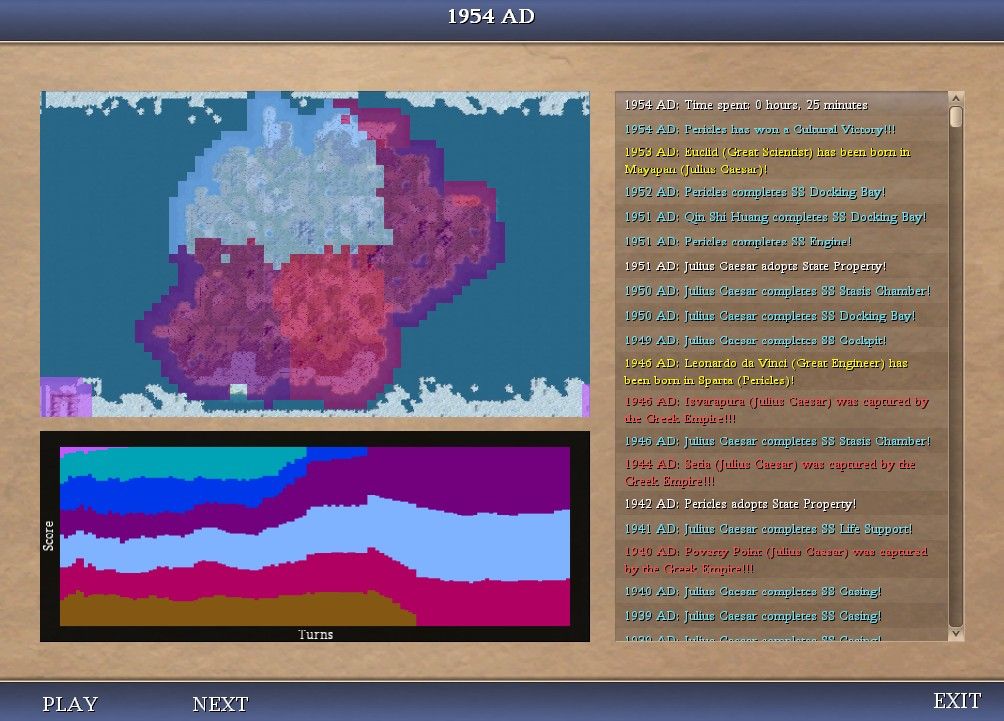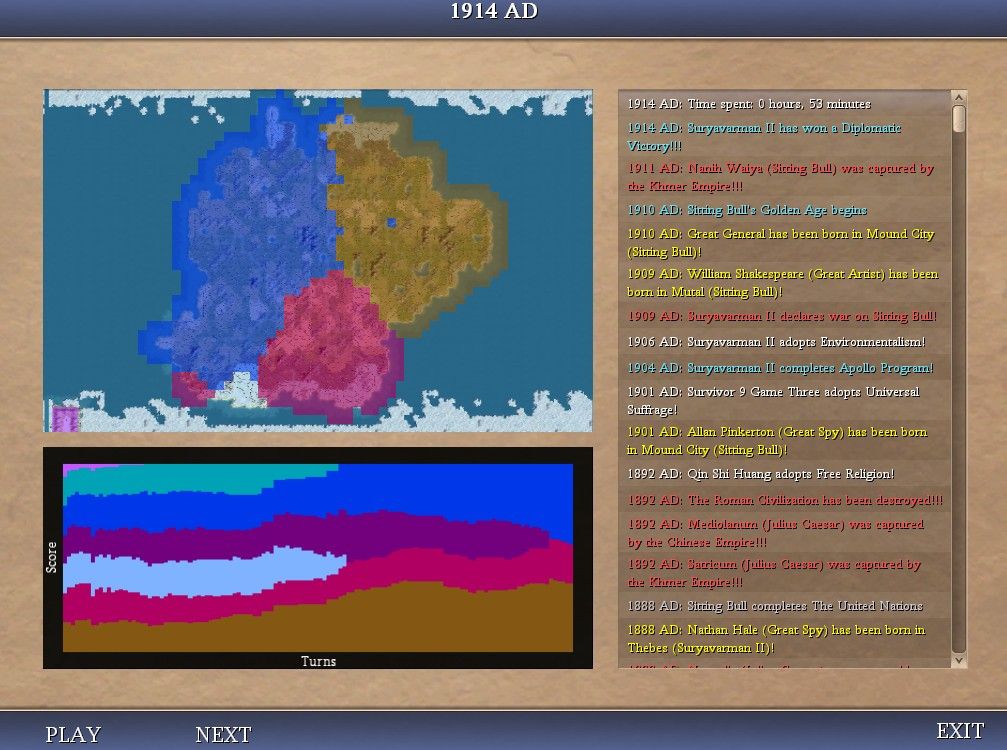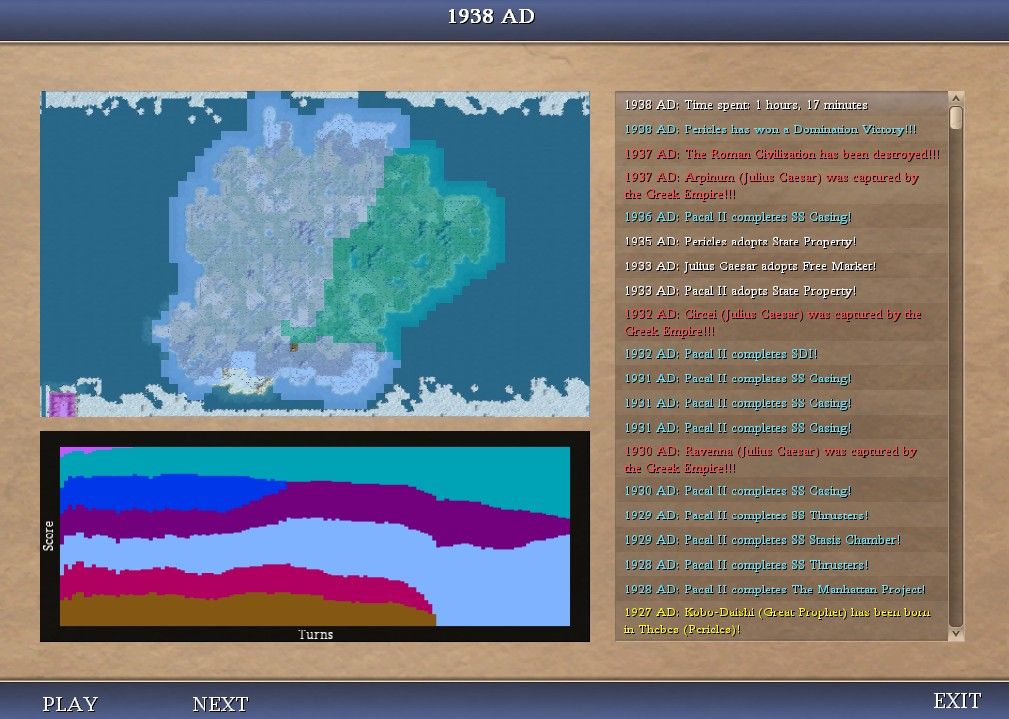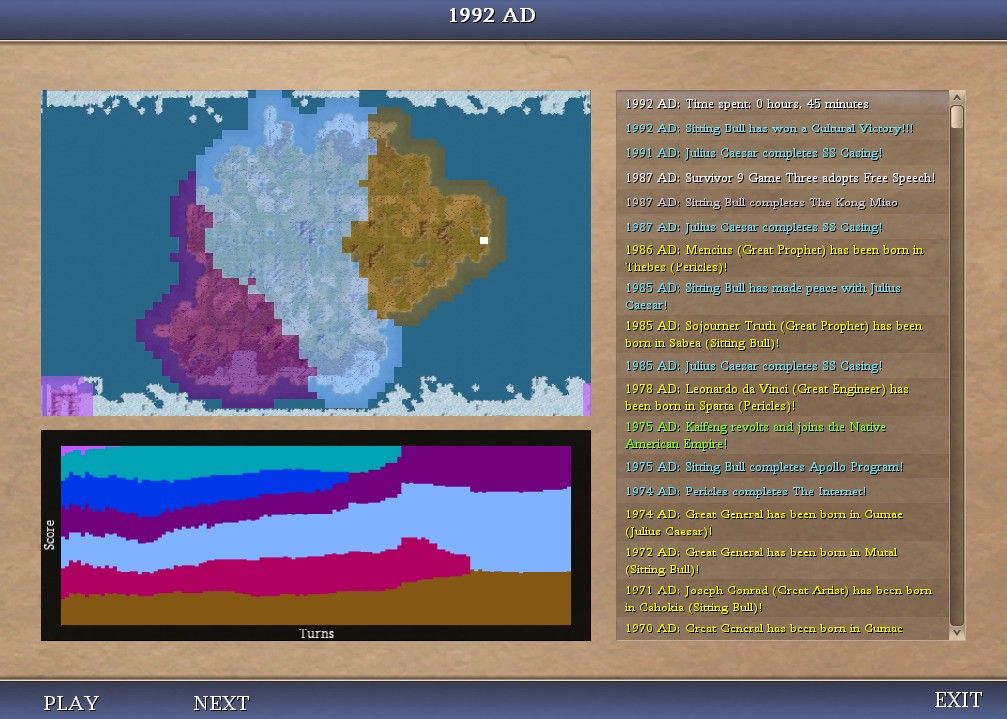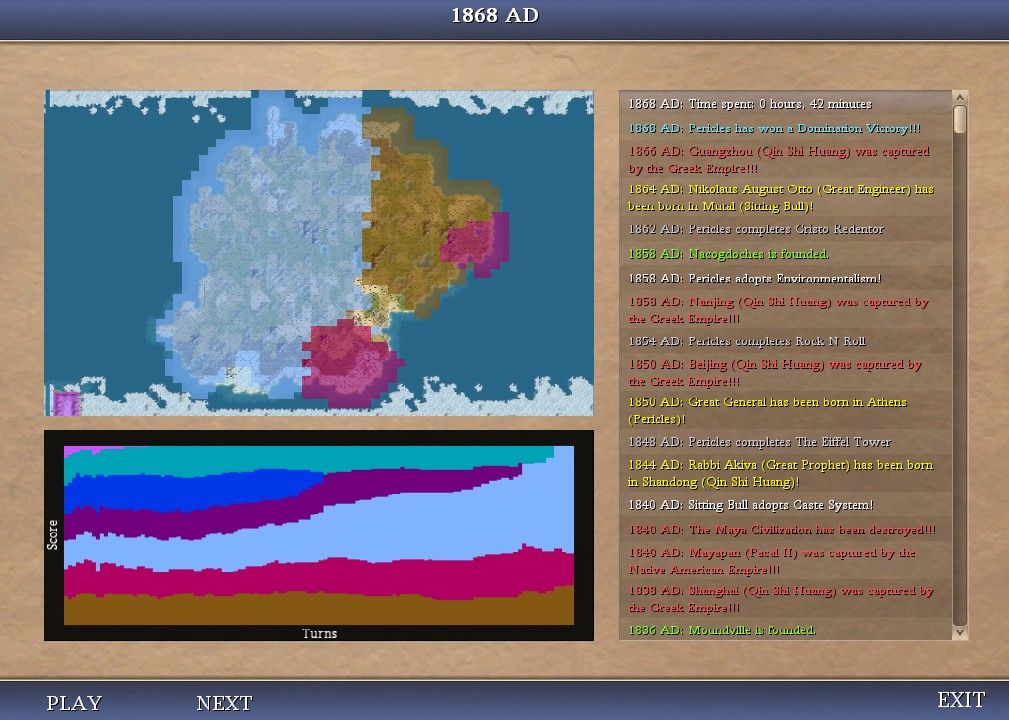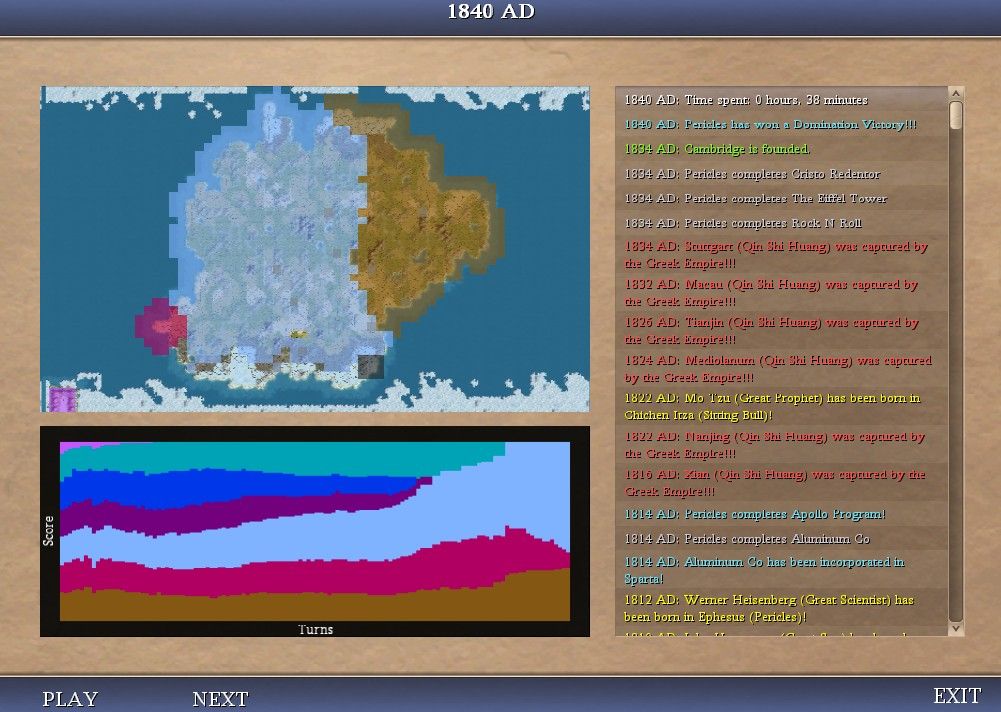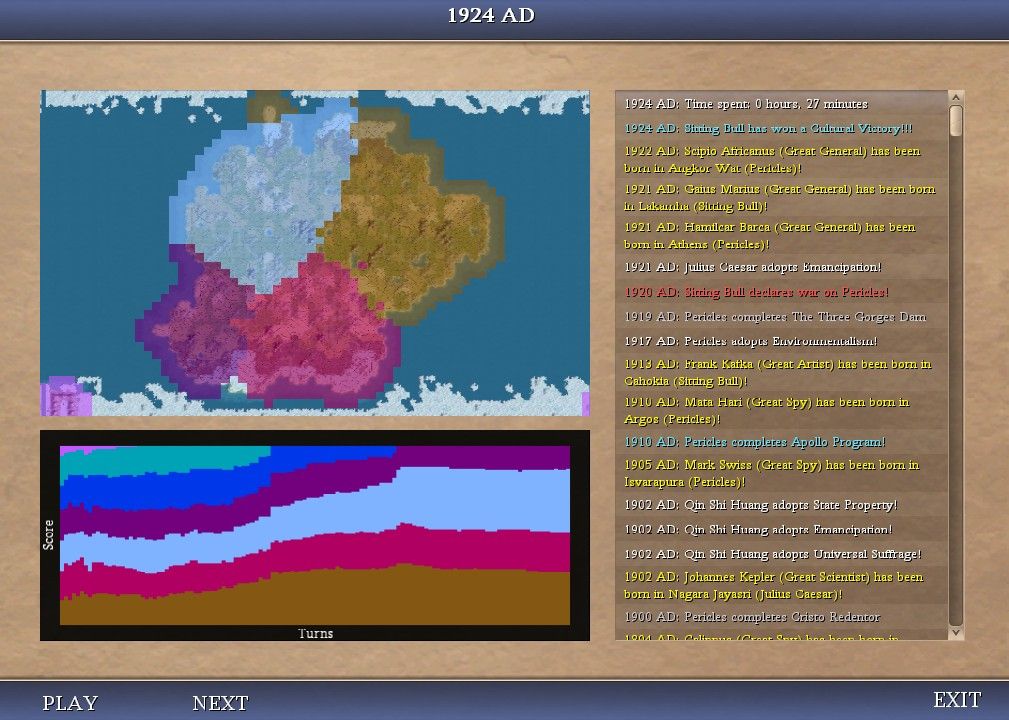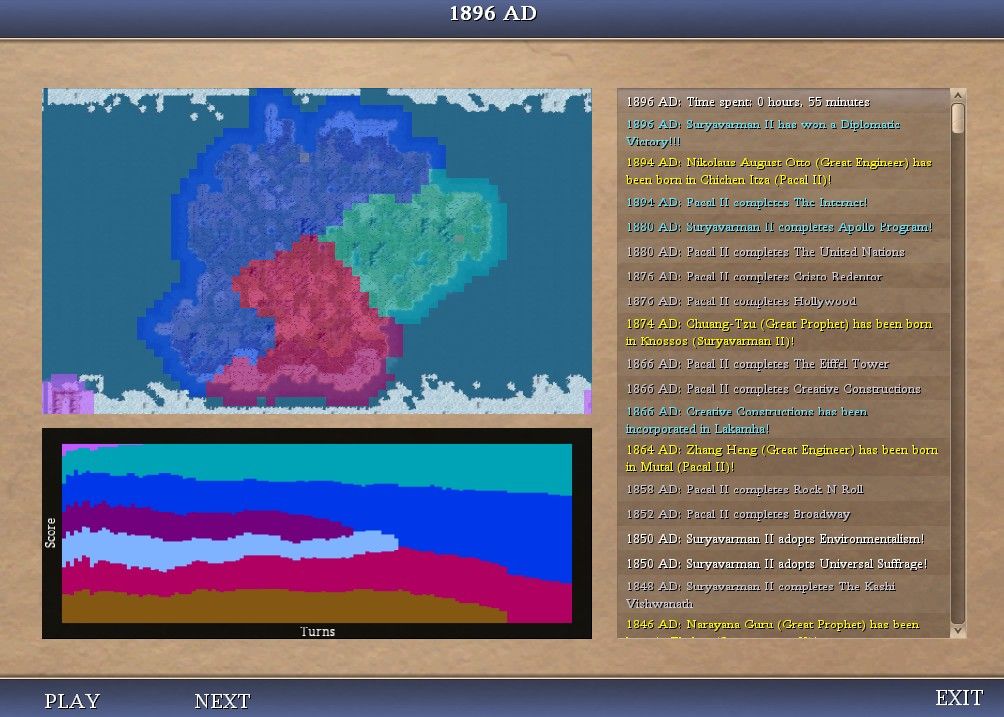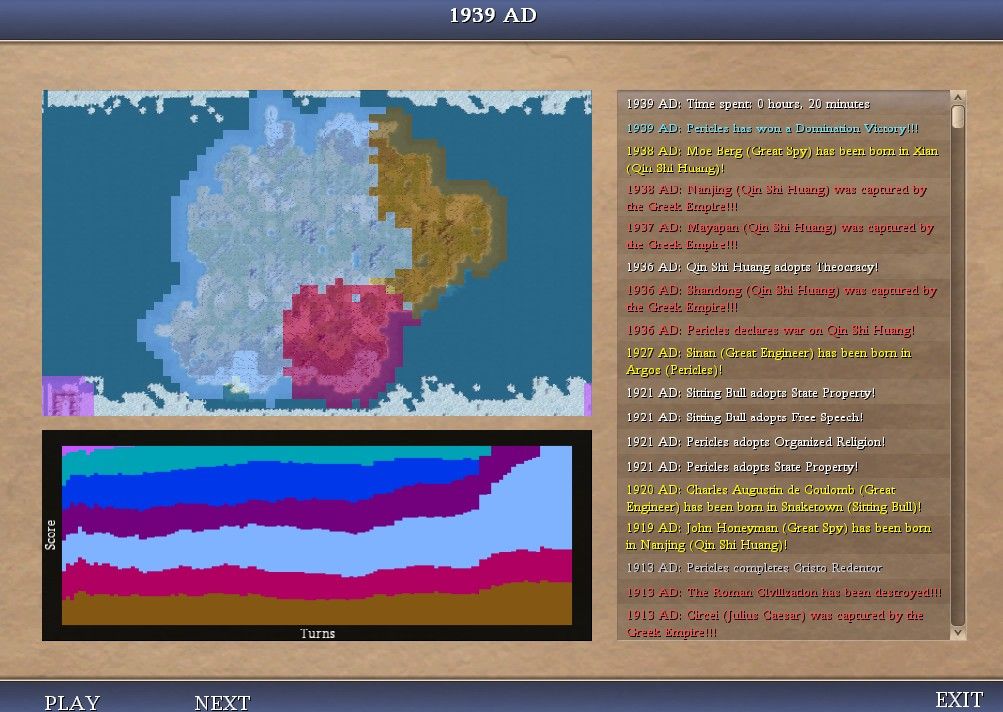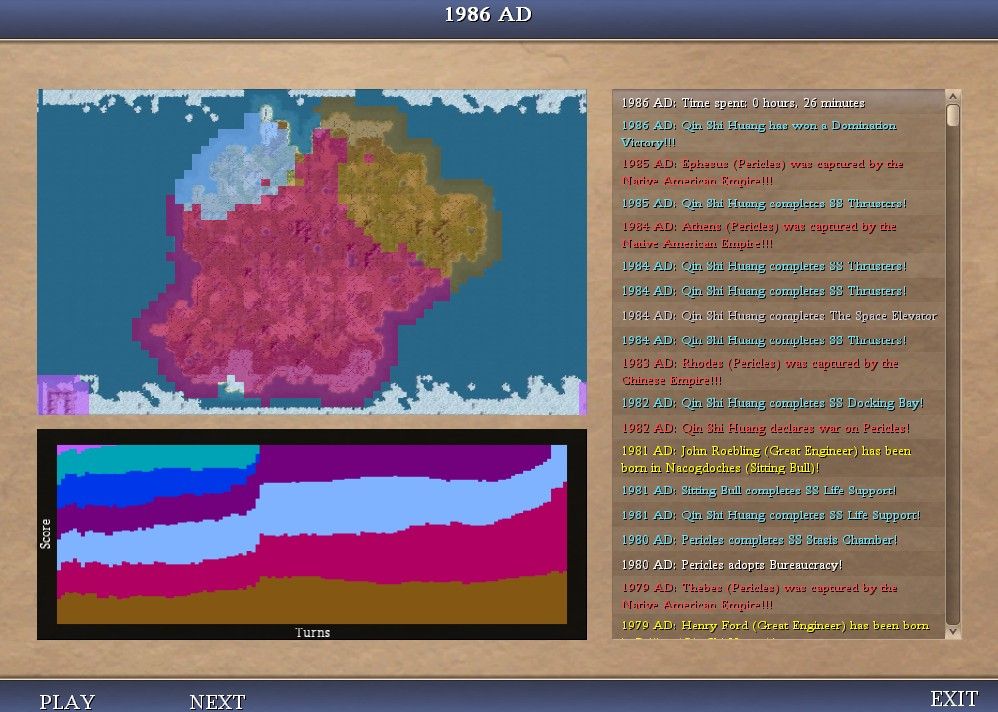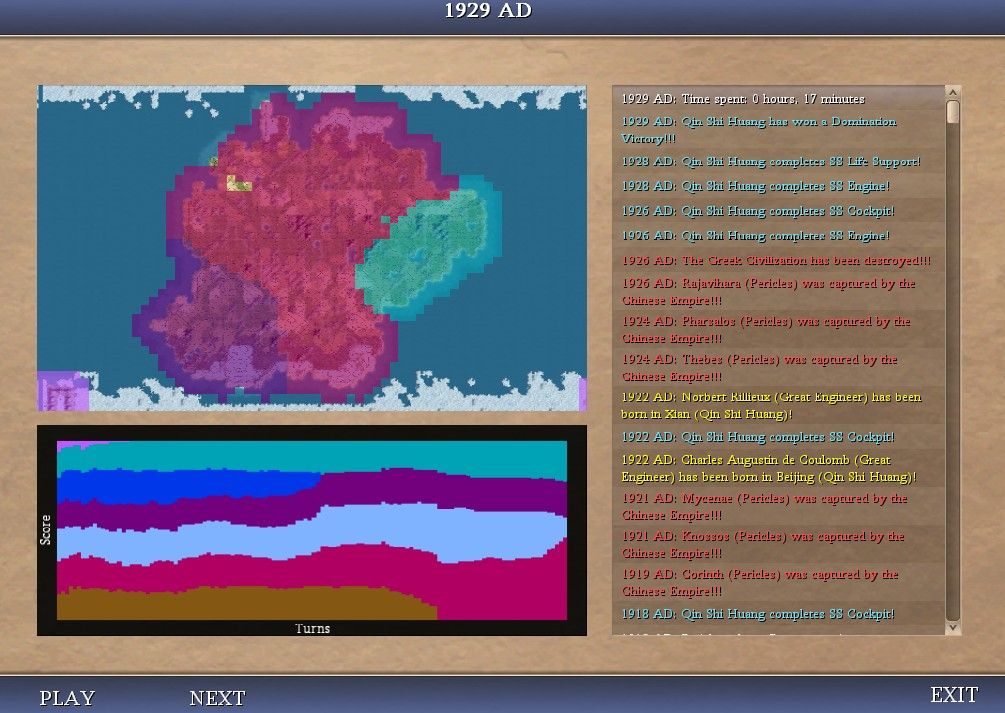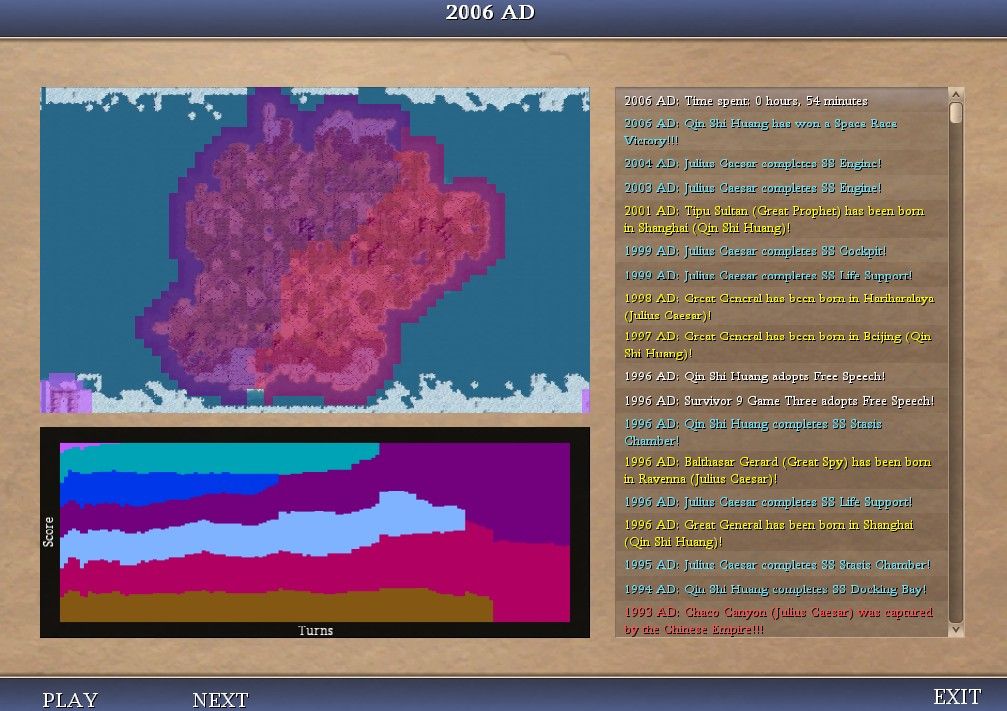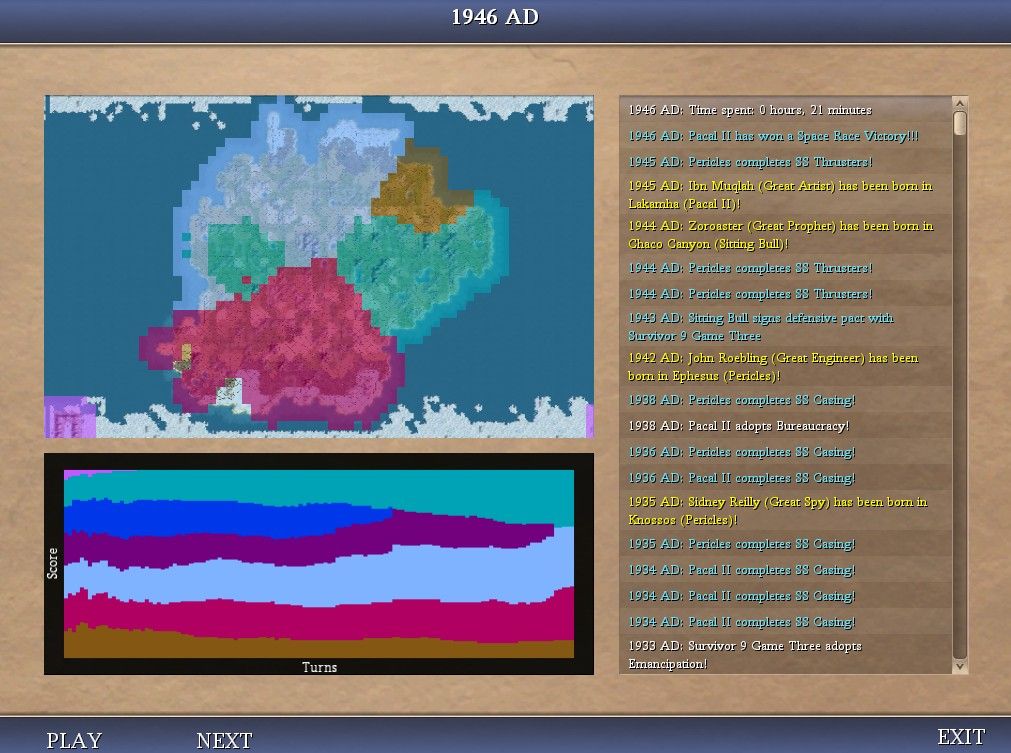
One of the recurring features of past seasons of AI Survivor have been our "alternate histories", running additional iterations on the same maps to see if the same events would play out again. Game Three was a true shocker as massive pregame favorite Pacal was eliminated at an early date, clearing the field for the surprising emergence of Qin Shi Huang. Was that something which would unfold in each game? This was a topic that called for more investigation with alternate history scenarios. Following the conclusion of previous seasons of AI Survivor, I had gone back and investigated some of the completed games and found that they tended to play out in the same patterns over and over again. While there was definitely some variation from game to game, and occasionally an unlikely outcome took place, for the most part the games were fairly predictable based on the personality of the AI leaders and the terrain of each particular map. Would we see the same patterns play out again and again on this particular map?

The original inspiration to run these alternate histories came from Wyatan. He decided to rerun the Season Four games 20 times each and publish the results. The objective in his words was twofold:
- See how random the prediction game actually is. There's a natural tendency when your predictions come true to go "See! Told you!", and on the contrary to dismiss the result as a mere fluke when things don't go the way you expected them to (pleading guilty there, Your Honour). Hopefully, with 20 iterations, we'll get a sense of how flukey the actual result was, and of how actually predictable each game was.
- Get a more accurate idea of each leader's performance. Over 6 seasons, we'll have a 75 game sample. That might seem a lot, but it's actually a very small sample, with each leader appearing 5-10 times only. With this much larger sample, we'll be able able to better gauge each leader's performance, in the specific context of each game. So if an AI is given a dud start, or really tough neighbours, it won't perform well. Which will only be an indication about the balance of that map, and not really about that AI's general performance. But conversely, by running the game 20 times, we'll get dumb luck out of the equation.
Wyatan did a fantastic job of putting together data for the Season Four games and since then we've continued to use the same general format. First we'll post the resulting data and then discuss some of the findings in more detail. Keep in mind that everything we discuss in these alternate histories is map-specific: it pertains to these leaders with these starting positions in this game. As Wyatan mentioned, an AI leader could be a powerful figure on this particular map while still being a weak leader in more general terms. This particular set of alternate histories were run by Vincarius with some assistance from TheOneAndOnlyAtesh - many thanks for spending so much time on this task!  Now on to the results:
Game One | Game Two | Game Three | Game Four | Game Five
Game Six | Game Seven | Game Eight | Game Nine | Game Ten
Game Eleven | Game Twelve | Game Thirteen | Game Fourteen | Game Fifteen
Game Sixteen | Game Seventeen | Game Eighteen | Game Nineteen | Game Twenty
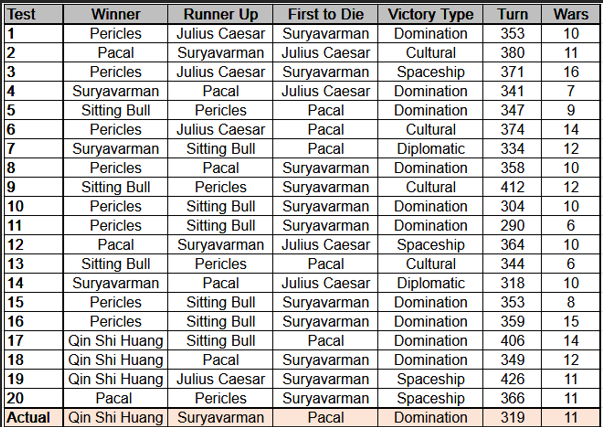
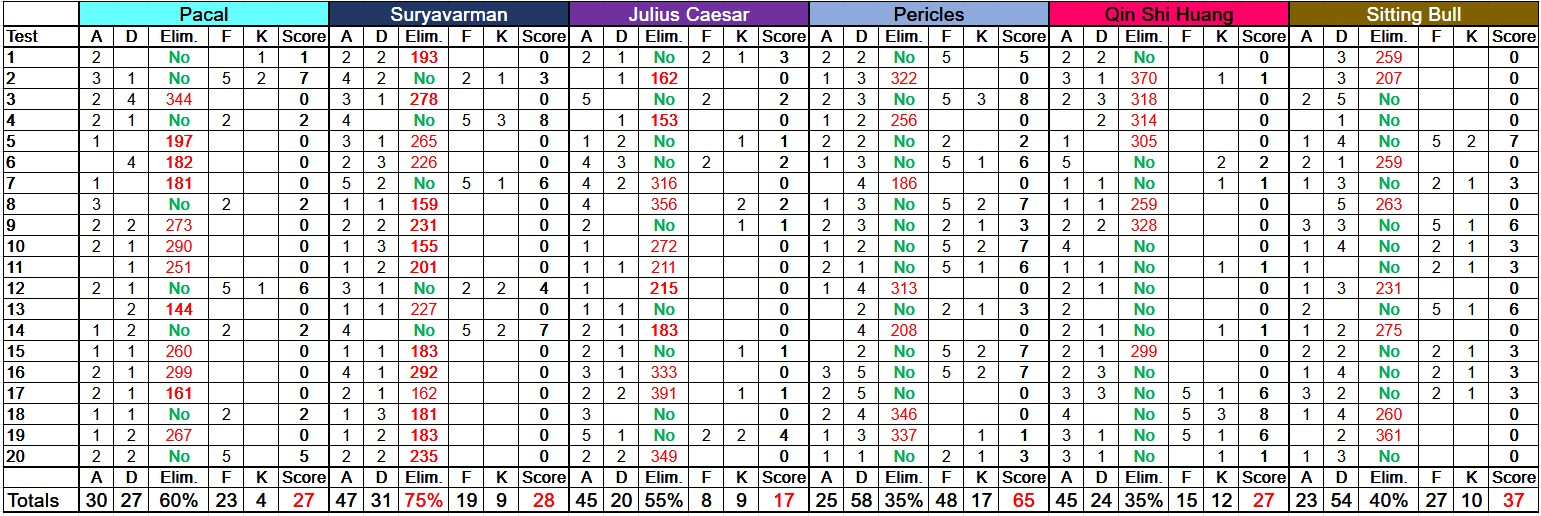
(Note : "A" column tracks the number of war declarations initiated by the AI, "D" the number of times the AI is declared upon, "F" the points for finish ranking, and "K" the number of kills.)
Vincarius: When we ran Game Three earlier this year, the community was shocked by the result. Pacal, the heavy favorite and backed by almost 2/3rds of the community (myself included), failed to meet the expectations and was even first to die. Instead, we saw a dominant Qin run over the map with a distant Suryavarman in 2nd place. But how common would this result actually be?
Pretty rare, as this map turned out to be a very open and competitive game. Somewhat surprisingly Pericles was the only leader who was a clear step above the rest with 8 wins and the most kills by a wide margin. The other five leaders were much closer in terms of results and four of them were able to win 3 games each. Even Julius Caesar, who got the lowest score, got close to winning in Game 6 and could have gotten more 2nd places if someone else was attacked by the dominant power instead. As mentioned, the live game turned out to be a rare outcome. Individual parts of the game were somewhat replicable but together formed an unlikely result.
Two main things stood out in the live game. The first one was Pericles having a really weak start. In most games, he expanded much faster and got the majority of the land between him and Suryavarman. The fact that he attacked Suryavarman early on also meant that he wasn't able to fill in more of the map sooner. This hurt him quite a bit in the long run as he wasn't able to make any significant gains against Suryavarman either. Pericles would usually be the strongest leader on the map, and it would take a 2v1, or sometimes even a 3v1, to take him out.
The second thing is that Pacal's religion was a lot more dominant than what we saw in the livestream. Because he was the only religious leader in the game, he was guaranteed to found at least one of the early religions and sometimes even managed to get all three of the earlier ones. By building Stonehenge, he would also get his shrine up-and-running early and he made sure to build plenty of missionaries. This meant that in most games Pacal's religion would be the only followed religion except for maybe one leader following a self-founded religion. Diplomatically Pacal was in a good position, except for the leader to his north.
On top of that Qin even adopted one of Pacal's minority religions in the livestream game. A rare event that could happen in other games but never had any real consequences as the leader would soon convert to Pacal's main religion anyway. In all the games that I have run (25 in total, but I only used 20 for the results), I only ever saw Qin attack Pacal when he got his own self-founded religion early, making them enemies for the rest of the game. This meant that an early war between the two leaders was very rare and only occurred in about 2 games. Out of those two Qin was only able to snowball to a win in one of them (Game 17). Qin needed this early success as he was simply not good enough to stay relevant the later the game went on. In the games where he was passive, he would fall behind in tech and stay a middle-of-the-pack leader till the end. In the games where he did attack, he encountered another problem: everyone besides Pacal was a lot better at defending themselves. His wars often stalemated for a long time, and when he did dogpile a dying Suryavarman, he was not able to get any real gains.
Instead of Qin, the real powerhouses of this game were actually Pericles and to a lesser extent Suryavarman. The two leaders fought early and often, and the winner of this duel would pretty much always finish in the top two. Most of the time, this would be Pericles. This wasn't because Suryavarman was weak. While Sury looked like he had a sketchy metals situation, that turned out to be pretty irrelevant. Instead, he would get backstabbed all the time. While most of the community expected the low peaceweight leaders to work together and dogpile Pericles and Sitting Bull, instead Julius Caesar turned out to be a high peaceweight leader in disguise, being more inclined to attack his direct neighbors Qin and Sury.
In fact, Caesar was a great wildcard. If he attacked the Protective Qin this would often result in a very long, bloody and fruitless war that put both of them behind the rest of the field. But when he attacked Suryavarman, the Khmer would quickly melt, as Suryavarman at this time would be too distracted by his powerful Greek neighbor and could simply not defend both sides, especially when they both had very strong early game unique units. This was yet another major departure from the live, where Caesar wasted his Praetorian window by marching across the map to attack Sitting Bull. Had Caesar dogpiled Qin or Sury instead, we might have gotten a more typical game for this setup. As Suryavarman collapsed, Pericles would usually get most of the spoils, as he was not only stronger than Julius Caesar but also a far better techer, giving him superior units even considering Caesar's Praetorians. This sequence of events happened a lot throughout the games, and after Suryavarman was eliminated, it was rare for anyone to be able to stand up against Pericles' might.
With all the western leaders out of the way, that leaves us with Pacal and Sitting Bull. As mentioned previously, Pacal was the heavy favorite coming into this game. He had an amazing capital and lots of commerce. So why was he only able to advance 7 out of 20 games? Well, it mainly had to do with his archnemesis to the north, Sitting Bull. The two would battle it out repeatedly in nearly every game. Although there were a handful of games in which a decisive war happened early (often because of a dogpile), the first wars would usually be inconclusive except for conquering the occasional forward settle. It was around the industrial era when things really started to shift. At this point, Pacal would have grown to a second place, using his culture, wonder building and superior teching to reap lots of points. Yet instead of researching the crucial Military Tradition and Rifling techs, Pacal would often do his best Willem impression and beeline straight to Communism/Physics. Meanwhile, Sitting Bull, while clearly behind Pacal and Pericles, still had a respectable research rate and a tough army. With his emphasis on military techs, he was incredibly likely to tech straight to cuirassiers/grenadiers or even riflemen. From here on there were two main options that could happen:
1. Pacal researches Military Tradition/Rifling in time in which case he would beat Sitting Bull as the superior technology means he has much better troops from now on.
2. Pacal channels his inner Willem and researches all the way down to Physics, Communism, Biology yet ignores any of the Renaissance/Industrial military techs. Sitting Bull attacks him with cuirassiers and overruns his medieval defenders.
In the 20 games used for the scoring of these alternate histories, the latter appeared to be slightly more common. However, in the extra 5 games that I ran later, Pacal suddenly woke up and showed a lot more military prowess and willingness to research Rifling, netting a Top 2 finish three games in a row and suggesting some potential that may have not been realized in the official Alternate Histories. The story of the map was that Pericles and Suryavarman would have a strong early start, and get into a fight early, Pericles usually winning due to having Caesar as a dependable ally in this stage, although Sury was capable of winning if things broke his way. The winner usually secured a top two spot. Over in the east, Pacal and Sitting Bull would have their own showdown for a top two finish, with Sitting Bull's numbers and military emphasis going up against Pacal's tech and cultural emphasis. Meanwhile, Qin would be pretty irrelevant, either fighting meaningless stalemated wars (usually with Caesar, dragging both leaders down) or just sitting there irrelevantly with neither the traits nor the land to compete with the others.
The most typical ending was a Pericles Domination victory with either Sitting Bull or Pacal second. However, even though Pericles was the best techer on average, he was not great at it, and these were some extremely slow games (mainly due to the amount of warring). This gave opportunities for Pacal to use Financial/Alive to outscale him. There were also two odd games where Sitting Bull, having conquered Pacal and his cultural cities with 4+ religions wins the culture race, swiped a Cultural victory from Pericles' nose (when the Greeks had themselves foolishly turned up the slider when they would have easily won through teching).
Onto the leader summaries:
Pericles of Greece
Wars Declared: 25
Wars Declared Upon: 58
Survival Percentage: 65%
Finishes: 8 Firsts, 4 Seconds (48 points)
Kills: 17
Overall Score: 65 points
Despite his tricky diplomatic position, Pericles was clearly the strongest leader on this map. His dominance can be explained by a variety of factors. Pericles had one of the larger spaces on the map and he made excellent use of this. At the start of the game, he would always send his first two cities to the east, blocking Sitting Bull from going west. Next, he would expand south and was usually the first leader to get to the middle. Because Suryavarman was more focused on settling his coast first, Pericles would then get most of the land west between both leaders as well. When most of the continent was filled up, he still had room for a couple of decent tundra cities. This meant that, unless something went wrong (think barbs, too much wonder building), Greece was the biggest empire on the map, only rivaled by the Khmer in some games. On top of having the largest empire, his land was also of great quality. The gold and corn resources near his capital pulled him towards Mining and Agriculture early, giving him both a great early research rate and a fast-growing capital that could churn out settlers. His second and third cities also had plenty of food resources, a river network and enough hills for production. Meaning, he had a lovely core that got online very quickly. Lastly, the creative trait is a great help for the ai as the early culture makes them a lot more consistent.
His diplomatic position was also a lot better than one would expect. While the map did have 2 high peaceweight leaders against 4 low peaceweight leaders, it was the high peaceweights that worked together a lot better. Pericles and Sitting Bull shared a large border, but because they were usually Pleased, they rarely fought. Pacal would leave him alone as well since all of his attacks were against the Native Americans instead. This meant that Pericles' eastern border was secure and he only had the southwest to worry about. While Julius Caesar and Qin Shi Huang did attack him sometimes, this was not as common as one would expect, and it rarely developed into a big enough dogpile that could take him out. Instead, it was a lot more common for Julius Caesar to attack Suryavarman, giving Pericles an excellent opportunity to take most of the Khmer land.
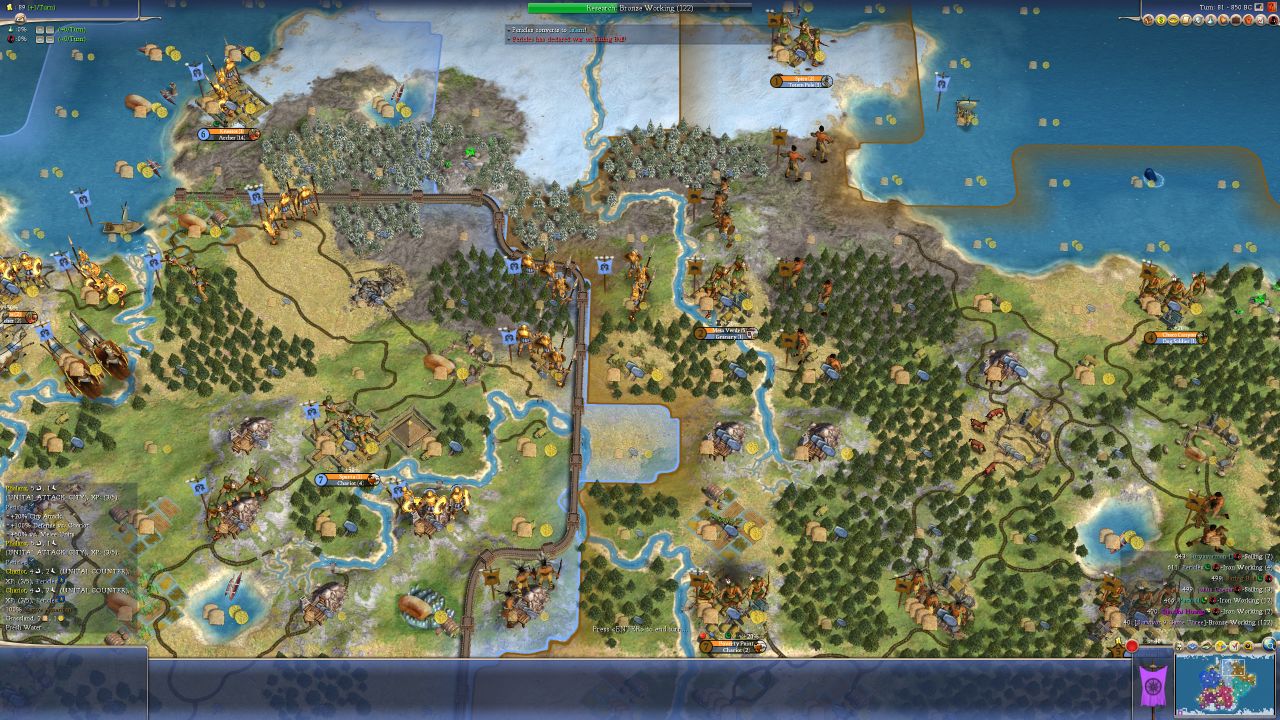
All of this meant Pericles had a consistently fast start, was usually the biggest empire on the map, and had a surprisingly stable diplomatic position. This formed a great foundation and out of all the leaders on this map he was the second best builder on the map too, only behind the Financial Pacal. With top stats in all categories, it is no surprise that he scored so many points. Despite his dominance, Pericles still struggled in a couple of games. Usually this was when the low peace weights worked together and dogpiled him. But there were also a few games in which he lost a city to barbarians or when he was too distracted with building wonders and gave all of the western land to Suryavarman. These games were rare and even in these games he was still relatively strong, and it should be noted that despite his central position he was never the first to die.
Another weird weakness that Pericles had was his tendency to attempt a cultural victory. Since Pacal would claim most of the religions, Pericles' culture was not good enough, but his double culture trait meant that he would sometimes be tempted. This almost cost him the game in Game 6, getting a late Turn 374 victory just a couple of turns before a Julius Caesar spaceship would have finished. It did cost him in Game 9, when both him and Sitting Bull turned on the culture slider but Pacal's religion gave Sitting Bull the edge (also see SB's section).

Sitting Bull of the Native Americans
Wars Declared: 23
Wars Declared Upon: 54
Survival Percentage: 60%
Finishes: 3 Firsts, 6 Seconds (27 points)
Kills: 10
Overall Score: 37 points
What an upset by the Native American leader. Getting 2nd place is much better than what people expected from one of the lowest rated leaders. So, what made him perform well here?
Well for starters, his territory was not bad. It had a good mix of food and production, a long coastline, and a nice river network. But more importantly he had the perfect neighbors. To his west was Pericles, a high peaceweight leader that would trade with him and secure his border, and to his south Pacal, a low peaceweight leader with a low unit training emphasis and who was more aggressive than was good for him. Sitting Bull is a leader that builds a lot of units but doesn't use them because he doesn't want to start any wars. However, this time he didn't have to as Pacal would start those wars for him. Although often stronger, Sitting Bull was usually not able to simply overrun Pacal from the get-go, unless the latter had a particularly weak game. But it did enable him to take advantage of the occasional dogpile on Pacal and made him a lot more active.
Sitting Bull was also shockingly one of the best researchers. While not quite on par with the frontrunners Pacal and Pericles, he was serviceable enough that he could catch Pacal with his pants down when the latter ignored military techs again. This happened quite often. Games 9, 10, 11 and 15 all saw Sitting Bull defeating Pacal with cuirassiers or grenadiers when the Mayans still had knights. Sitting Bull's success was linked with the failure of Pacal.
What also helped him a lot was having a dominant high peaceweight ally to his west. Pericles would often overrun the rest of the map while Sitting Bull could just sit in the corner and ride his coattails. Most of the time, he only had to worry about Pacal as the other low peaceweight leaders were distracted with other wars. And if he could take him out, he had an easy path towards a second place finish. On the other hand, despite a weak performance from Pericles and getting attacked by both Julius Caesar and Suryavarman, Sitting Bull nearly got second place in the live game anyway. He definitely wasn't a pushover, and in hindsight it makes sense why he was the king of second place in these alternate histories.
Sitting Bull's best performance was in Game 5, where he was able to overrun a weak Pacal early and played active and aggressive from there on, conquering Suryavarman and most of the Roman territory for a well-deserved domination victory. There were also a few lucky games that boosted his results, most notably Game 9, in which Pericles was much stronger but threw the game when both turned on the culture slider. Sitting Bull won a Turn 412 cultural victory because he inherited Pacal's 5 religions and strong cultural capital, and Game 7 when a much stronger Suryavarman attacked him but won a diplomatic victory before he could conquer Sitting Bull's lands, allowing him to hold on for second place.

Suryavarman of the Khmer
Wars Declared: 47
Wars Declared Upon: 31
Survival Percentage: 25%
Finishes: 3 Firsts, 2 Seconds (19 points)
Kills: 9
Overall Score: 28 points
Next up, Suryavarman finished in 3rd place. This was a disappointing result for one of the more highly rated AI leaders in this game. With a low survival percentage of just 25% and a staggering first to die rate of 55%, Suryavarman didn't last long in most of the games. Interestingly, when he did though, he always finished in the top two, making him a very hit or miss leader.
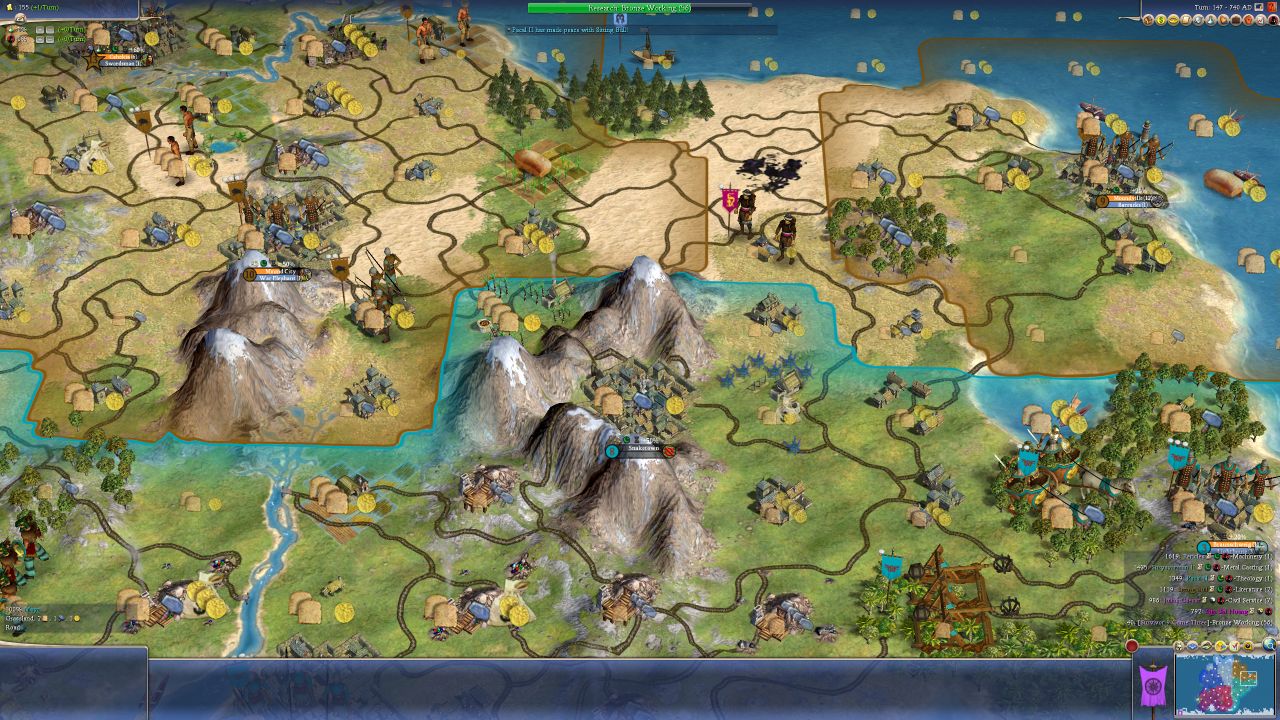
Suryavarman was often the second strongest leader in the early game. He had a decent expansion phase, becoming one of the larger empires and was often similar in size to Pericles. His expansion was far from perfect though as he focused on settling the coastal areas to his west first. Suryavarman's empire could have been a lot larger if he had settled inland instead. This made his early expansion very mixed. In some games he got most of the land between him and Pericles. In others, he only got a small portion of the northwestern coast. His economy was also very inconsistent. Some games he was one of the frontrunners in research. In others he would still be researching classical technologies while other leaders were already almost done with medieval techs. While I don't have a perfect explanation for this inconsistency, I have a feeling the next point was the cause of this.
Suryavarman's biggest weakness was that he fought more than was good for him. This can be seen by looking at his war count. Even though he was first to die 55% of the time, he still managed to declare 47 wars throughout 20 games, the most out of all leaders. Suryavarman really did not sit still, declaring wars just turns after making peace and generally fighting most of the game. Unsurprisingly, this hurt him a lot, particularly when these wars did not give him any significant gains. Not only was he unable to build up his land properly, but he also made a lot of enemies this way.
There were also issues Suryavarman could simply do nothing about. That being his 'friends' in the south attacking him game after game. Most of the time this would be Julius Caesar but Qin didn't mind joining a dogpile against him either. While Caesar and Suryvarman both have a low peace weight and should be inclined to like each other, the large border they ended up sharing meant they were actually fighting a lot early on, before they had a chance to climb up to a friendly relationship. With a strong Pericles to his north and a backstabbing Caesar to the south, Suryavarman fought 2v1 or even 3v1 wars in the majority of his games, a situation any leader would struggle with.
Nonetheless, this is still a very disappointing result, and his previously discussed weaknesses do bring into question Suryavarman's rating as a leader. I have a feeling he could perform better without Aggressive AI as he seems to turn into one of the crazy leaders with it turned on. While his game often ended in disaster, when it did work out, he could quickly snowball into a dominant victory. His best game was arguably Game 4, in which he attacked Caesar early before he was able to build up his Praetorians and killed him before running over the rest of the map in decisive wars.

Pacal of the Mayans
Wars Declared: 30
Wars Declared Upon: 27
Survival Percentage: 40%
Finishes: 3 Firsts, 4 Seconds (23 points)
Kills: 4
Overall Score: 27 points
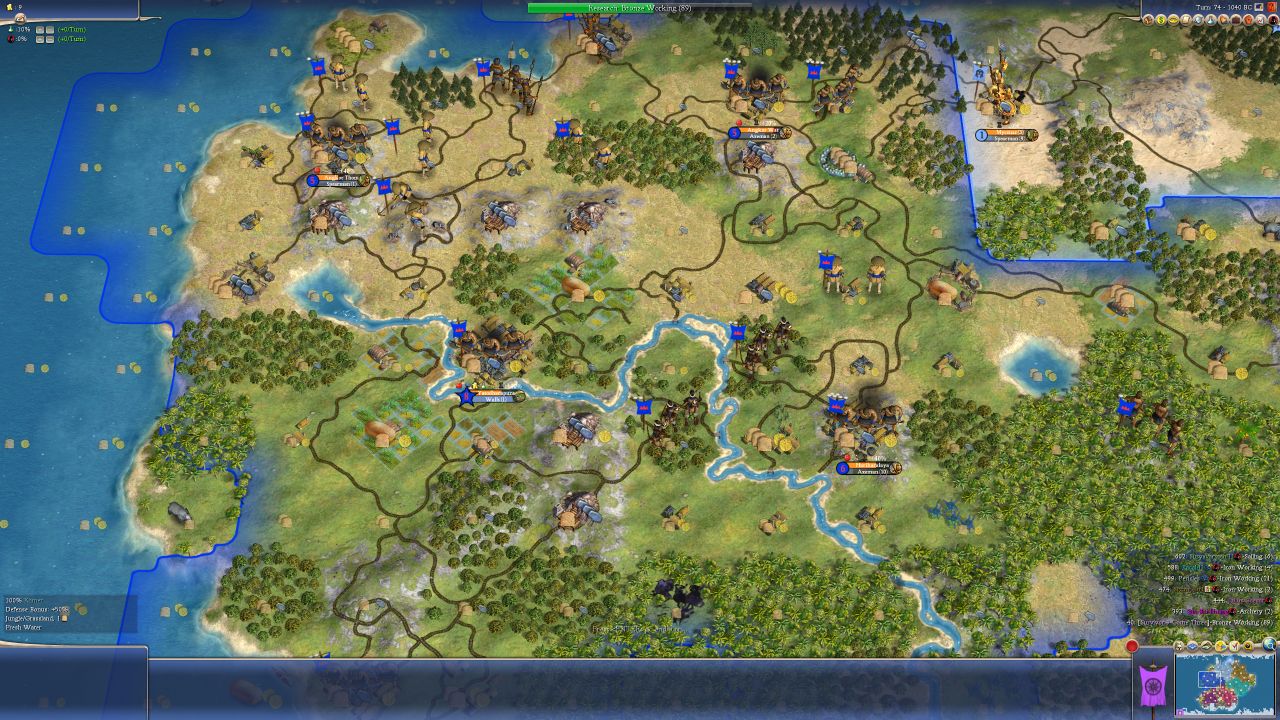
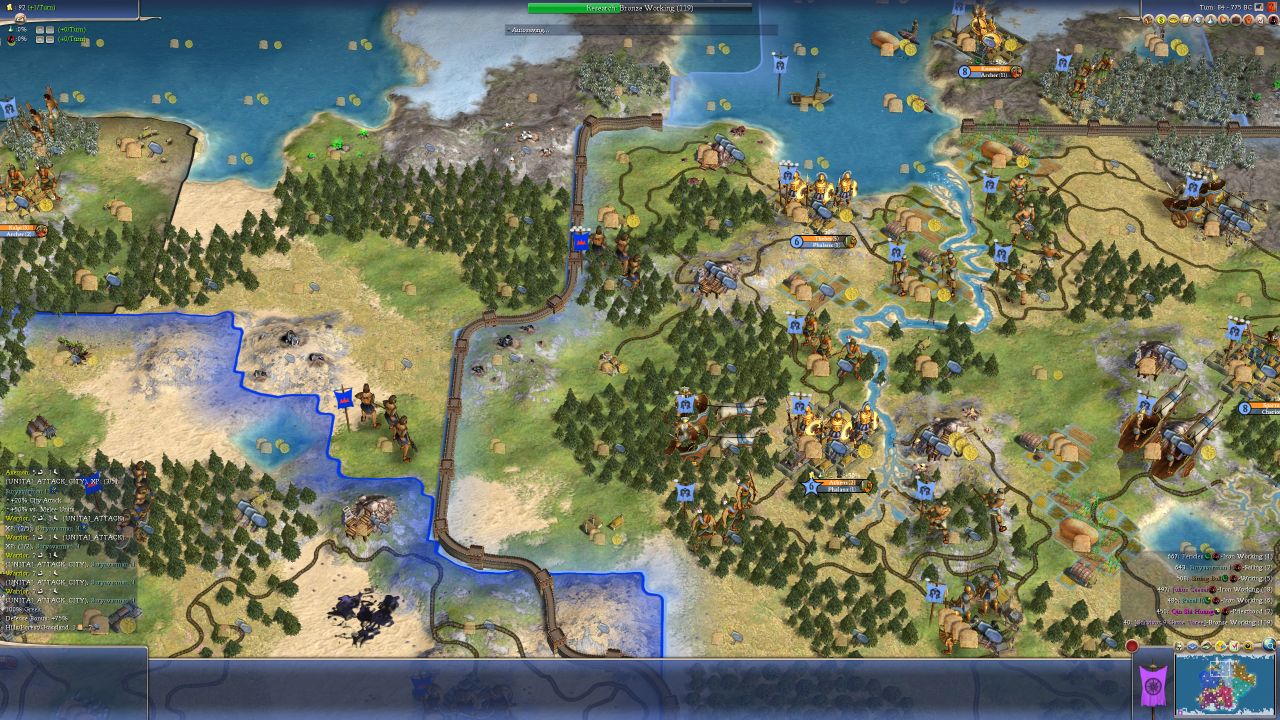
Despite the high expectations, Pacal was unable to deliver on this map. With an amazing looking capital and surrounding land with 3 grassland gems, this seems surprising. Why could he not make this start work? For starters, while his capital was great long term, it wasn't as strong right out of the gate as people expected. Pacal's starting techs weren't the best fit for this start. With mining, he would always work the gold tile first. This meant he had great early game research but was not able to grow his city beyond size 1 until he had researched agriculture. On top of that, he would usually build his first settler in the capital, meaning growing his capital would take even longer. When he did get past this point, his capital would quickly catch up and was a strong city. However, this combined with his second city being just an ok jungle city as well, meant that Pacal was slow at expanding.
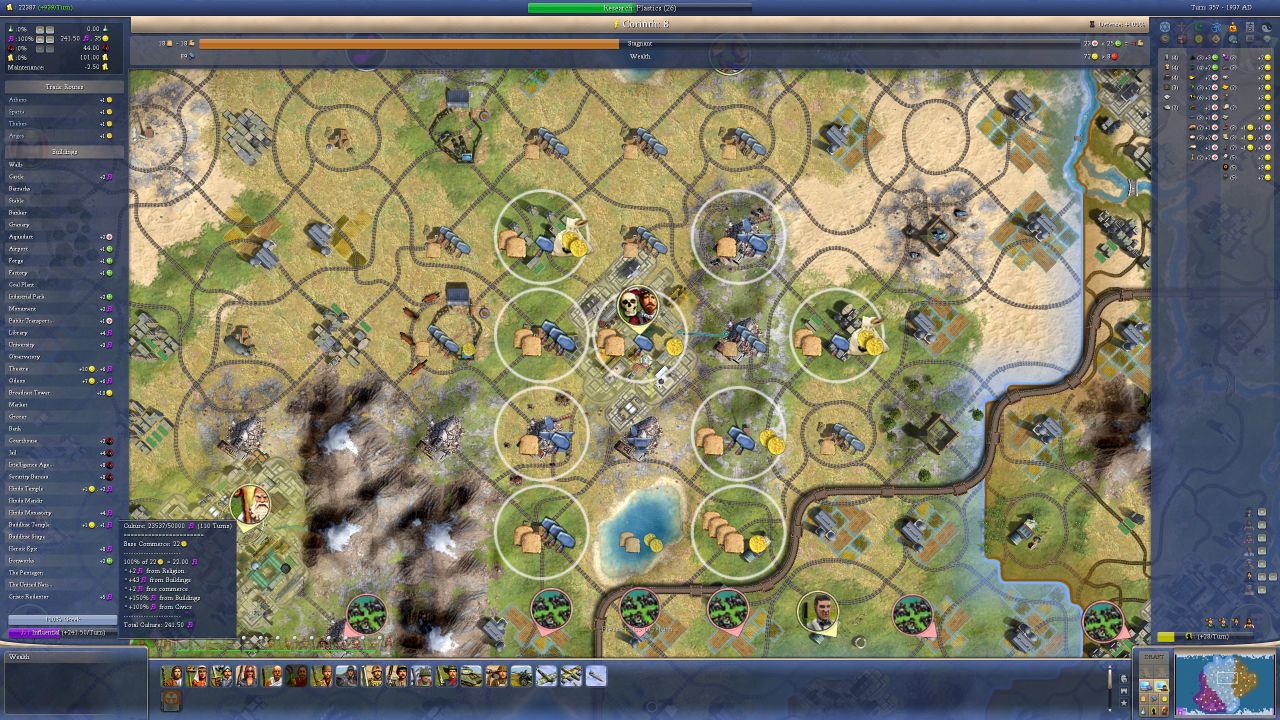
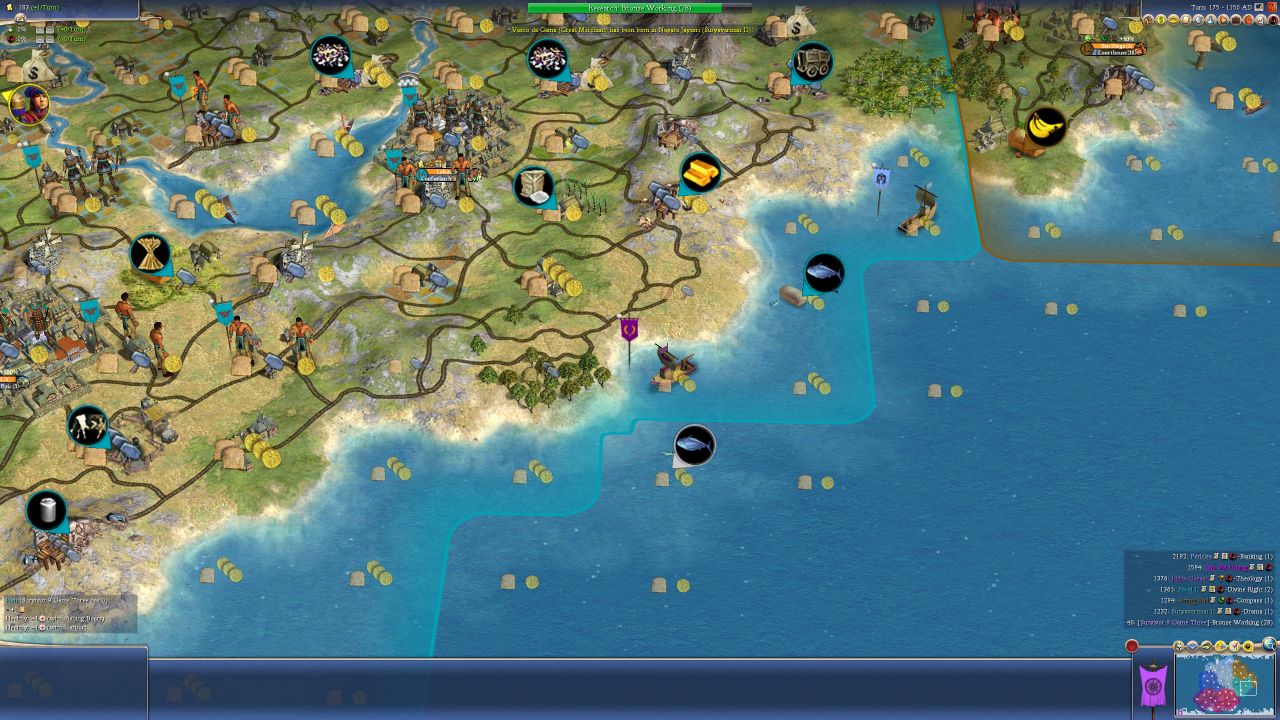
What made matters worse was that his direct neighbors turned out to quickly settle towards him as well. Qin often settled his north and east first, and Sitting Bull was inclined to settle south as his second or third city. Combined with his slow start, this meant Pacal was often cramped for land. His usual city count would be somewhere between 5-7 cities. But I have seen games in which he only got up to 4 cities. The Mayans regularly had the smallest empire on the map, and while his land was high in commerce, it wasn't the best in terms of production and, because his land was in the jungle belt, it did take a while for him to get his cities online.
It should be said that Pacal could have used his land a lot better. Particularly looking at the following picture, by spacing his cities out better he could have easily gotten 2 more cities.
All of this meant Pacal struggled with production. He didn't have as much as the other leaders and was often weaker militarily. Prolonged wars turned out to be difficult for him and in case of a 2v1 he often collapsed quickly. Pacal was first to die in 5 out of 20 games, three of those games stemming from a 2v1. Twice this was because he had a small empire and got into a long and disastrous war against Sitting Bull. His other 7 eliminations all happened a lot later and usually had to do with one thing: not researching Rifling in time and getting attacked by Sitting Bull during this window. As mentioned in the general section, whether Pacal would research Rifling in time felt like a coinflip. In some games he ignored Rifling and instead beelined into modern era techs. In others, he researched it as soon as it got available. This was a crucial moment in the game as it was often the last time Sitting Bull could threaten him. If Pacal ignored the military techs, he would generally get overrun and die against Sitting Bull. But if he did research Rifling in time before sustaining serious damage, he would turn into a menace and start running over other leaders.
Despite the lack of land and production, Pacal was still by far the best cultural and economic leader on this map, showing just how strong he can be. As mentioned before, he managed to get a religion in all of his games and even had games in which he founded all 7 of them, and he was also the best at spreading his religion. Usually, the entire map except perhaps one leader with a self-founded religion would follow his religion. His Financial trait also helped him a lot and enabled him to be ahead in tech even when another leader was twice his size. Pacal's best games were when he could make use of his culture to squeeze Sitting Bull (even taking cities off of him peacefully occasionally), and then use his superior research to build all the wonders and ran away technologically. Examples of this would be Game 2, 12 and 20, in which he had a strong economic start, built all the wonders, got Rifling well before the other leaders, killed Sitting Bull, and won the game from there.
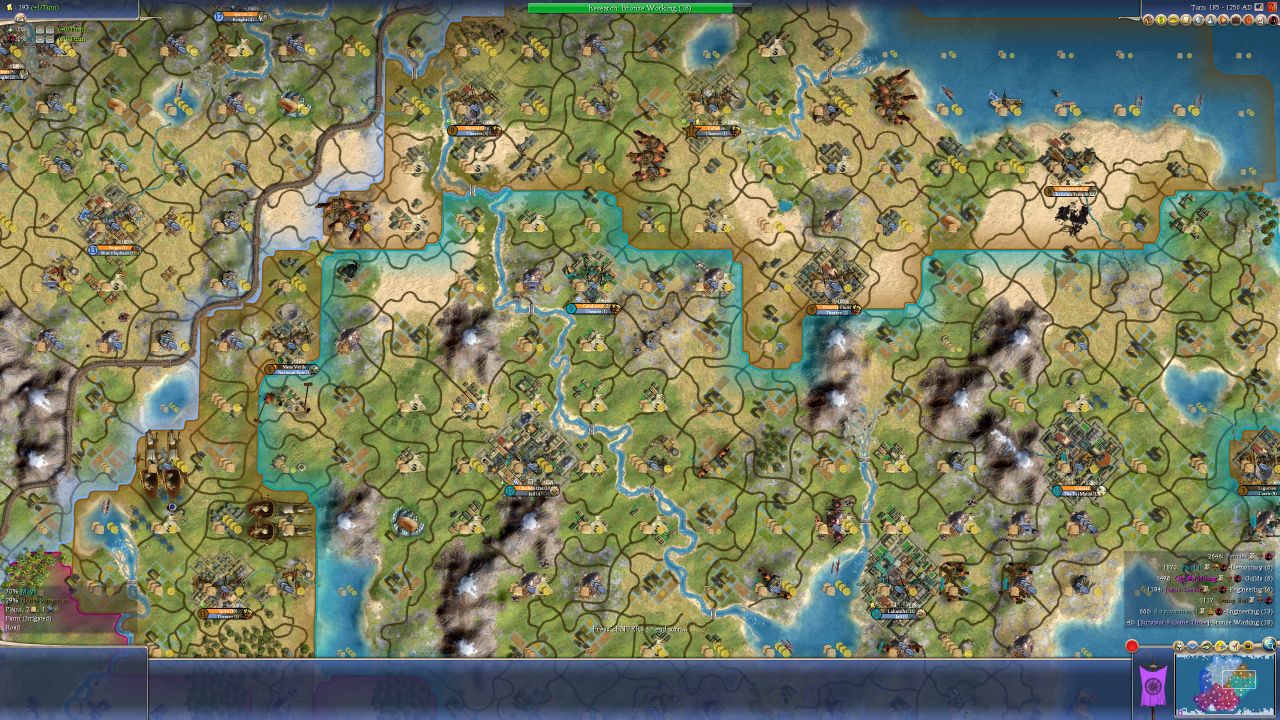
But there were also other games in which he came very close to winning and got a bit unlucky. Examples included Game 1 when he was in a strong position and would have won with his spaceship had he not attacked Pericles, and Game 8 when he was a couple of turns too late in attacking Pericles before he could win a domination victory (he had modern armor against infantry). Finally, there was Game 14 where he was well on his way to another Financial/Alive spaceship victory but Suryavarman won via diplomatic victory instead.
Additionally, when I ran the extra 5 games, Pacal showed a different side to him, running over Sitting Bull early in one game and researching Rifling early and getting a Top 2 finish in three out of the five extra games. Combined with the fact that Pacal was a bit unlucky in the 20 alternate history games and the fact that his scoring is also lower because he has a very low kill count of just 4 kills, I would actually argue that Pacal would have been the second strongest leader in a large sample size, albeit very clearly behind the number 1 leader Pericles.

Qin Shi Huang of China
Wars Declared: 45
Wars Declared Upon: 24
Survival Percentage: 65%
Finishes: 3 Firsts, 0 Seconds (15 points)
Kills: 12
Overall Score: 27 points
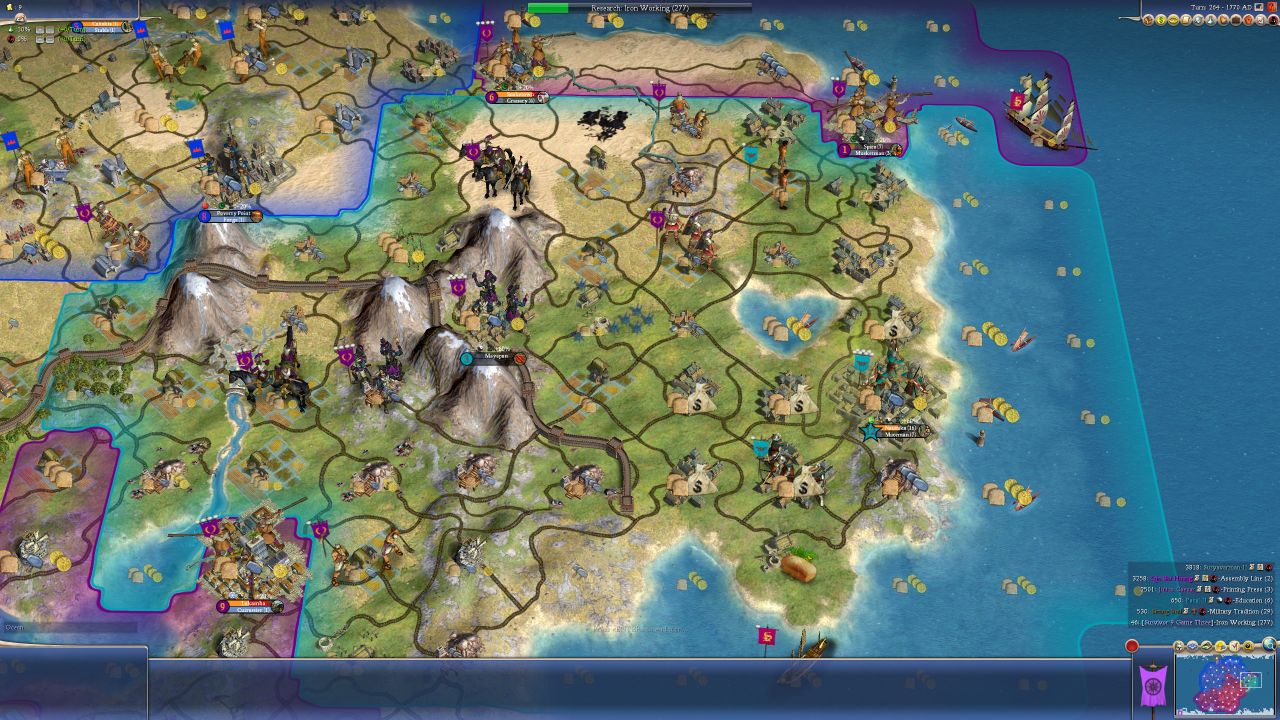
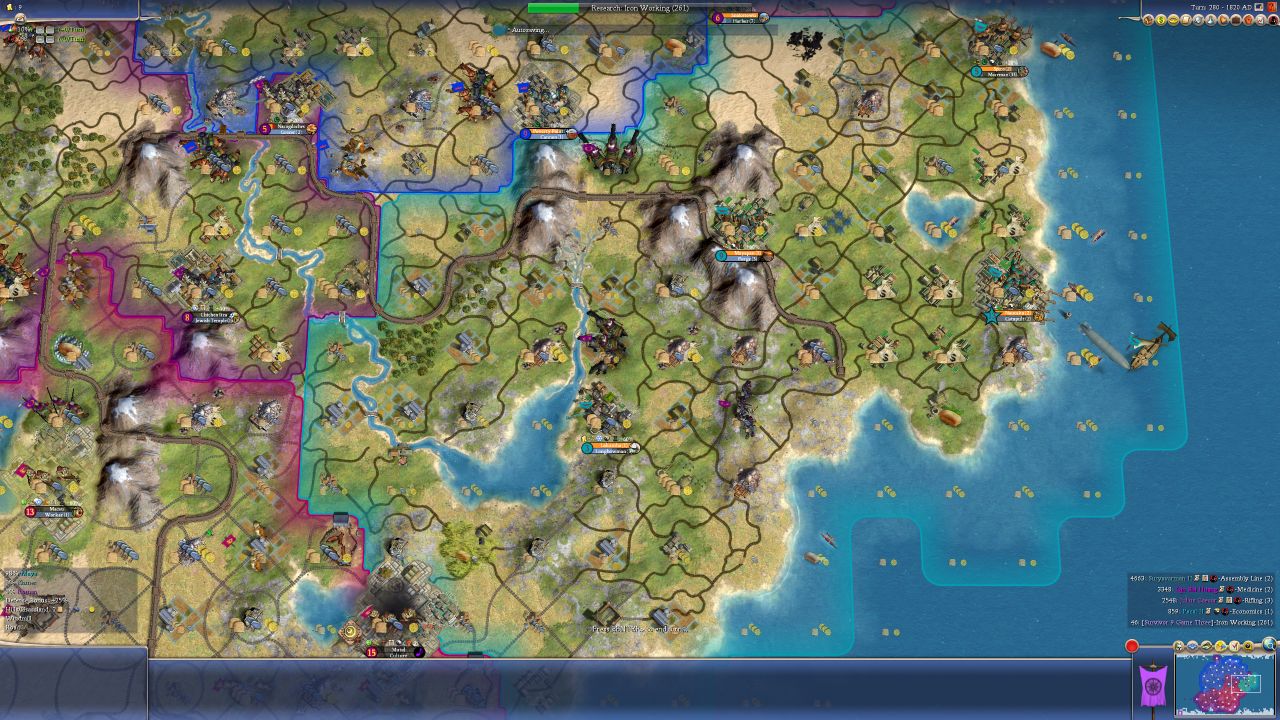
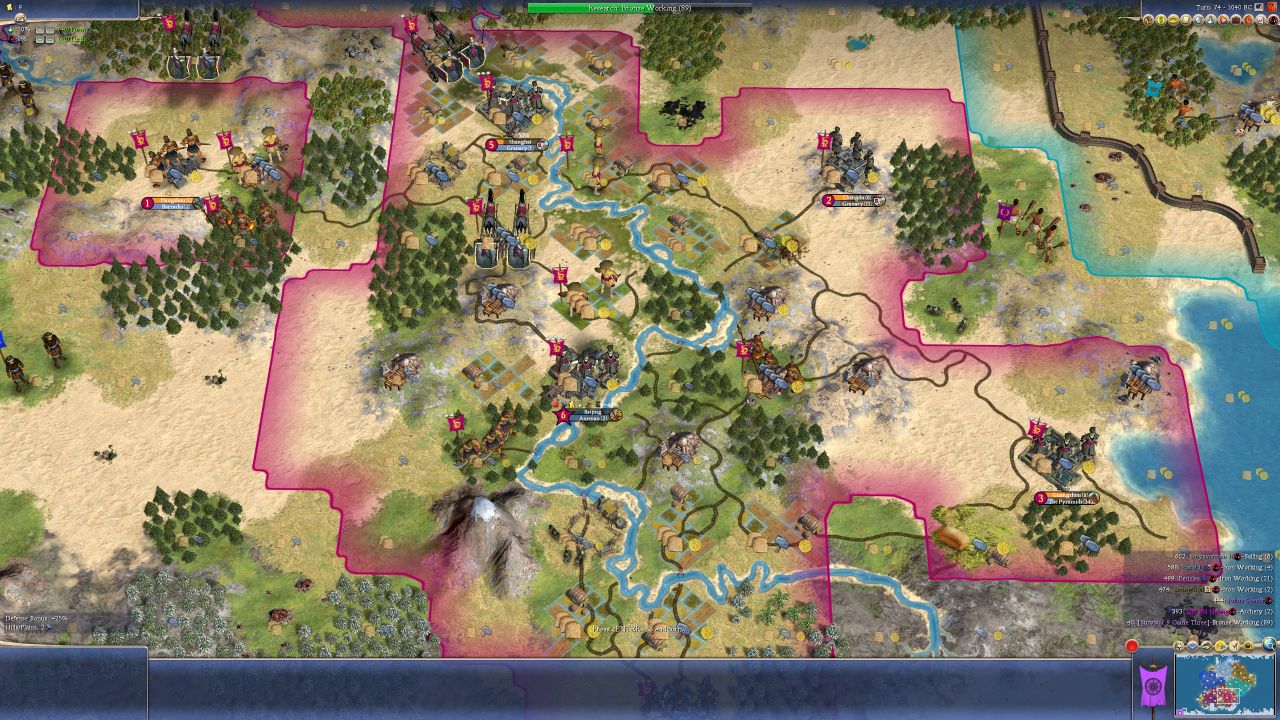
Qin Shi Huang, our winner from the livestream game, had quite a disappointing run in the alternate histories. His teching was poor due to a lack of resources and growth potential, and he did not help his case with his early tech choices, frequently prioritizing Bronze and Iron Working over the Wheel and cultural techs. He even struggled with losing cities to the barbarians! While he was usually able to claw back to the middle of the pack from an awful start, he generally accomplished nothing in his wars. His weak research and passive play meant that he would fall behind in the mid game. At least he had the sense to understand when he was irrelevant and was a good survivalist, his most common result by far being Wildcard relegation (which happened in half of these games!)
Before Game 17 I was about to write him off completely as he got nothing done except for a few kills. Then, he suddenly woke up and won three times in a row, Games 17 and 19 in particular seeing him take most of Pacal's cities like in the live game. The livestream was still by far his best performance. For example, in Game 17, after his conquest of Pacal, he was still weaker than Pericles and required the help of Sitting Bull to beat the Greeks in a 2v1. Game 18 was much more of a fluke, as through sheer luck, he somehow managed to capture most of the Khmer cities. Critically this was also a game in which Caesar and Qin actually worked together instead of fighting to the death for 100+ turns. Qin's way to victory required some substantial luck and, seeing how streaky his results were, there was a chance he might have been the weakest leader on this map. Having this high a survival rate yet zero second place finishes should be pretty embarrassing.
Note from TheOneAndOnlyAtesh: this reminds me a LOT of Vicky in the Game Two Alternate Histories where she looked like a total scrub for the first 16 games then won twice in the final four replays, adding some evidence towards the plausibility of the Actual Game.

Julius Caesar of Rome
Wars Declared: 45
Wars Declared Upon: 20
Survival Percentage: 45%
Finishes: 0 Firsts, 4 Seconds (8 points)
Kills: 9
Overall Score: 17 points
Despite his low scoring, Caesar turned out to be a big influence on how the game played out. If he managed to work together with the low peaceweights leaders, the group would usually end up dogpiling Pericles and winning the game from there. Most of the time though, he would attack the Khmer instead causing the Khmer's downfall while being too weak to profit from it well enough.
The problem for Caesar was that after Suryavarman was eliminated, he would become the next enemy for the high peaceweight leaders and died from there on. Caesar did get close to winning once but that was more because of Pericles going for a very slow cultural victory. He was probably unlucky to miss out on some second place finishes as well. To be fair, Caesar's land was pretty bad in this set, so it is hard to make any true judgment calls. He for sure would have been a monster in Pacal's or Sitting Bull's spot.
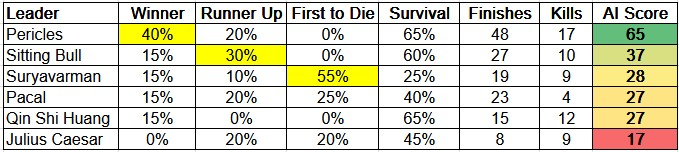
In conclusion, it seems the livestream game was a pretty rare result, but it wasn't totally unheard of as most of these leaders appeared to have a chance on this map. Throughout the alternate histories, Qin was never as strong as in the livestream game but did still win 3 times, albeit in a streaky manner. The actual most likely winner was Pericles, who was the strongest leader in the majority of the games. This is the one position I'm confident to call, as the score difference with second place is significant.
For runner-up, Suryavarman, who we saw finish second in the live game, was again a rare result and particularly in combination with a Chinese victory. Suryavarman and Qin were likely to fight at some point in the game, like we saw in the livestream game where Sury barely held onto second place when Qin had reached the Domination limit. Somewhat surprisingly, the best pick for runner-up turned out to be Sitting Bull, who could easily ride the coattails of Pericles after he took out Pacal, while also twice surviving in the corner while one of the low peaceweight leaders won. For the first to die option, Suryavarman was by far the best choice with 11 out of 20 games. As mentioned before, Suryavarman wasn't even weak, but a strong Pericles combined with backstabbing by the low peaceweight leaders meant he was in a very bad position. Finally, in terms of the victory condition, it was well-mixed as we saw all the different victory types come by at least twice, although due to how long and bloody these games were Domination was by far the most likely option with 10 out of 20 games finishing this way.
With how close the scoring turned out to be, I can only say for sure that Pericles was the strongest leader on this map. All the other positions are debatable. Therefore, it would be interesting if someone ran a hundred more games to see who of the other leaders were the stronger ones. I hope you enjoyed analyzing this crazy set with me!