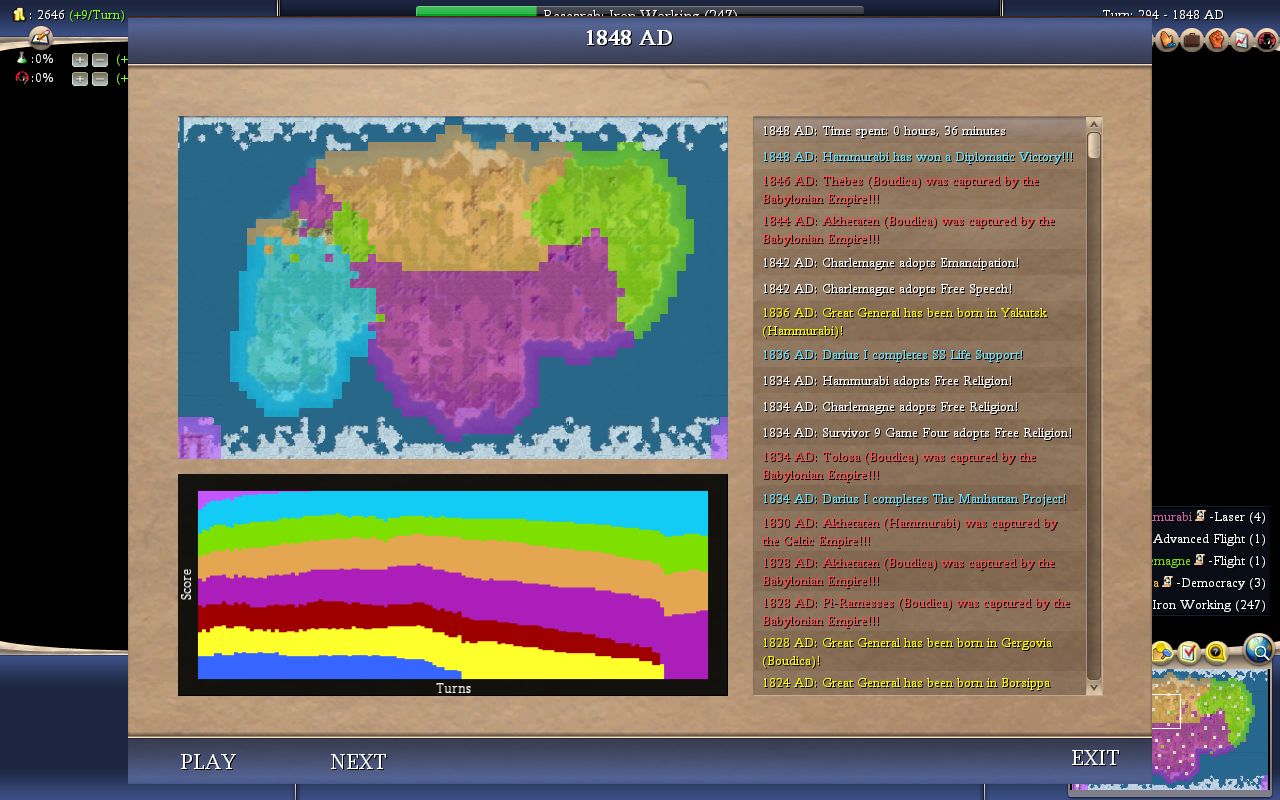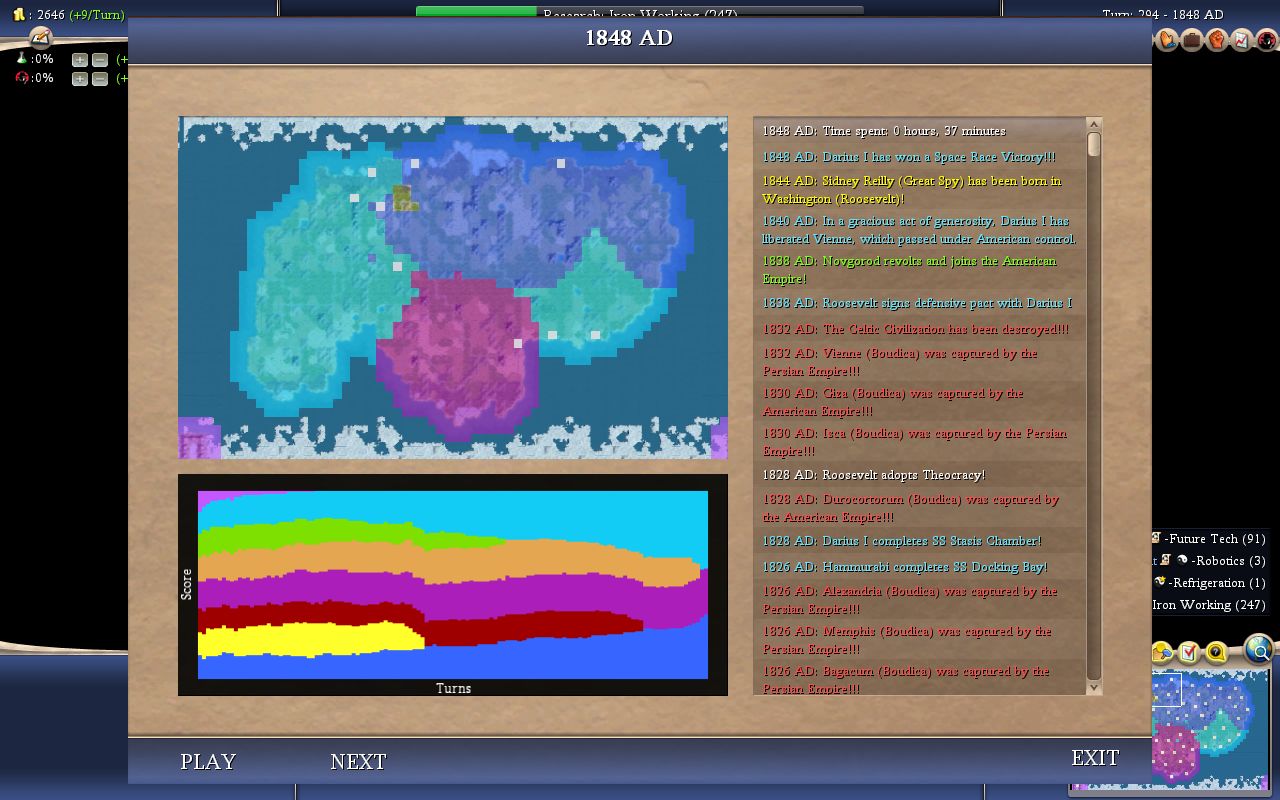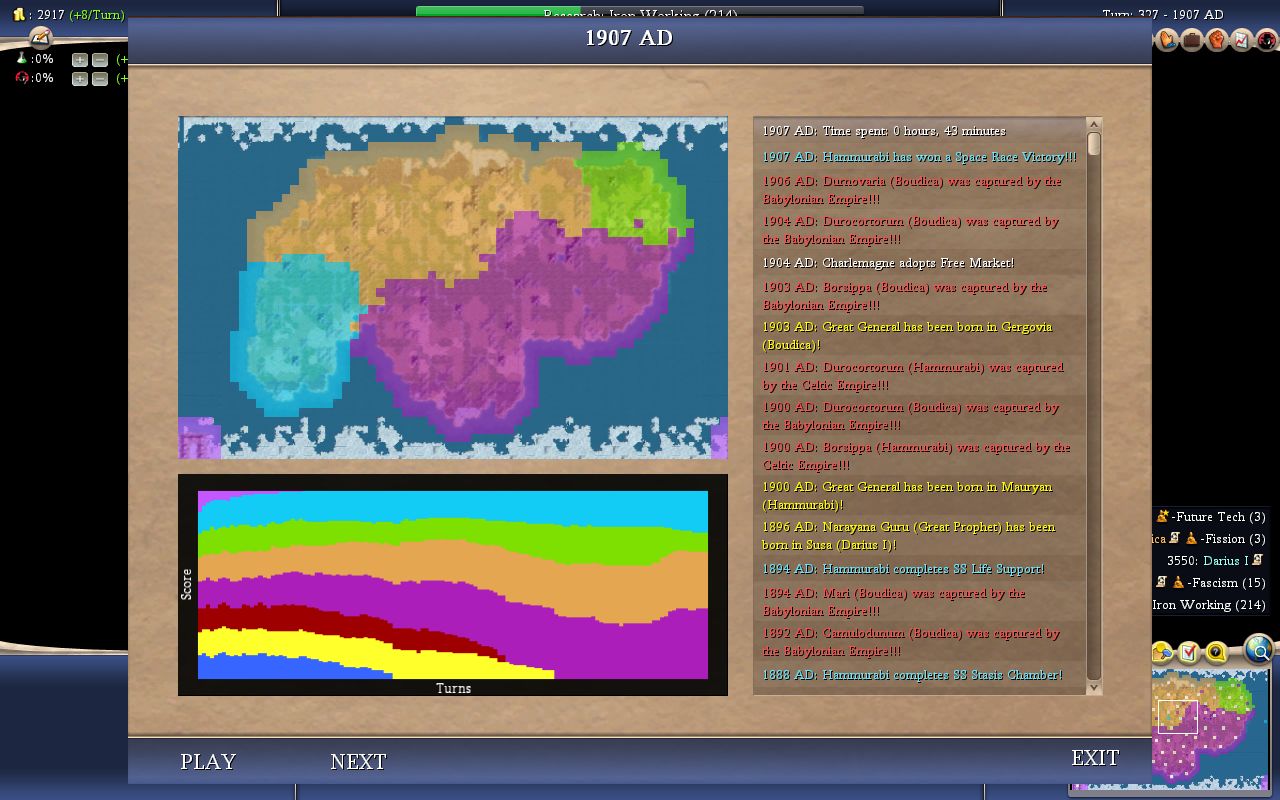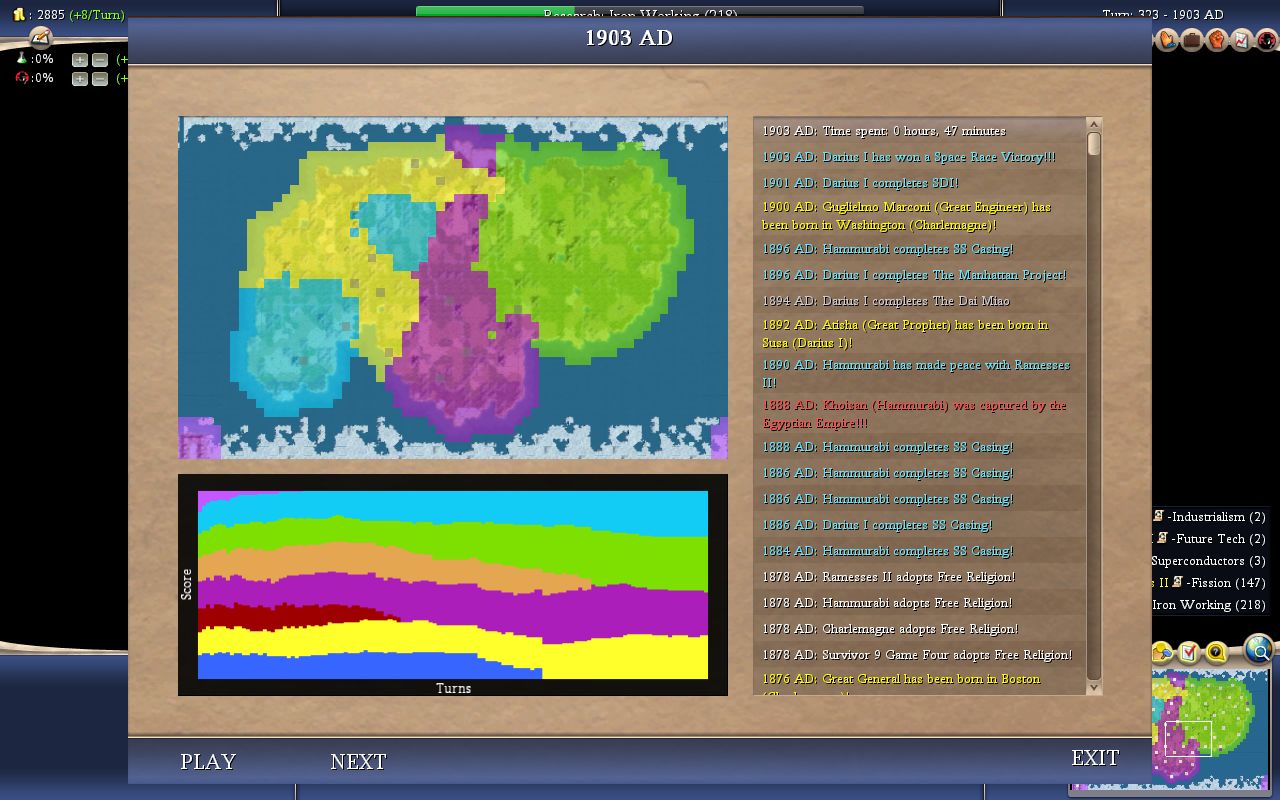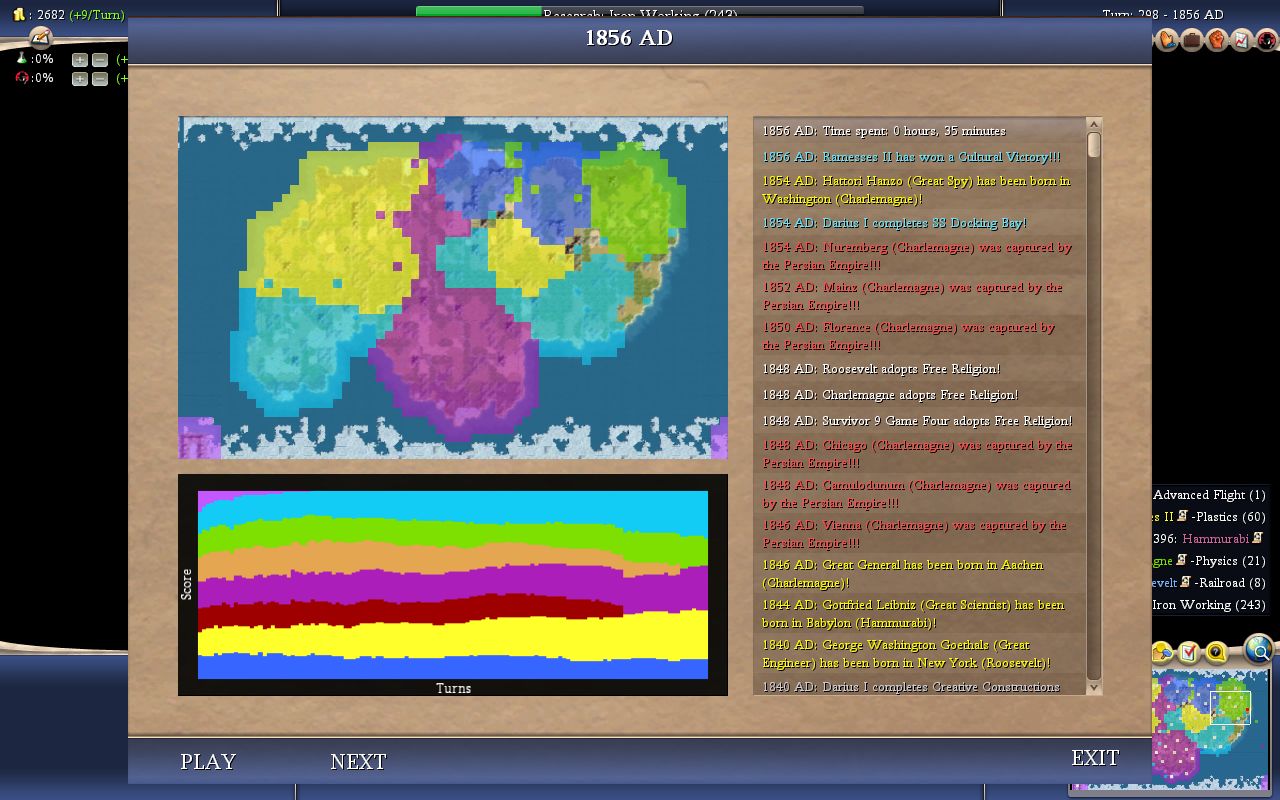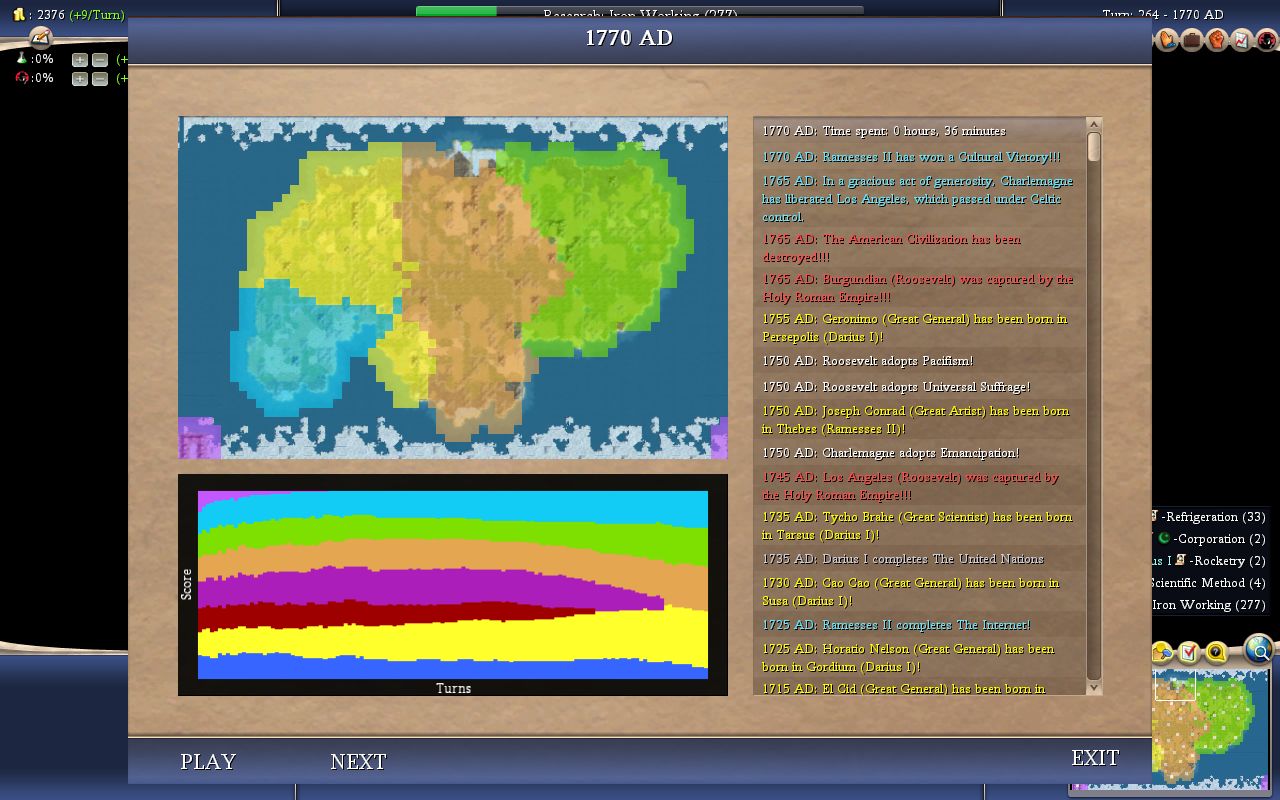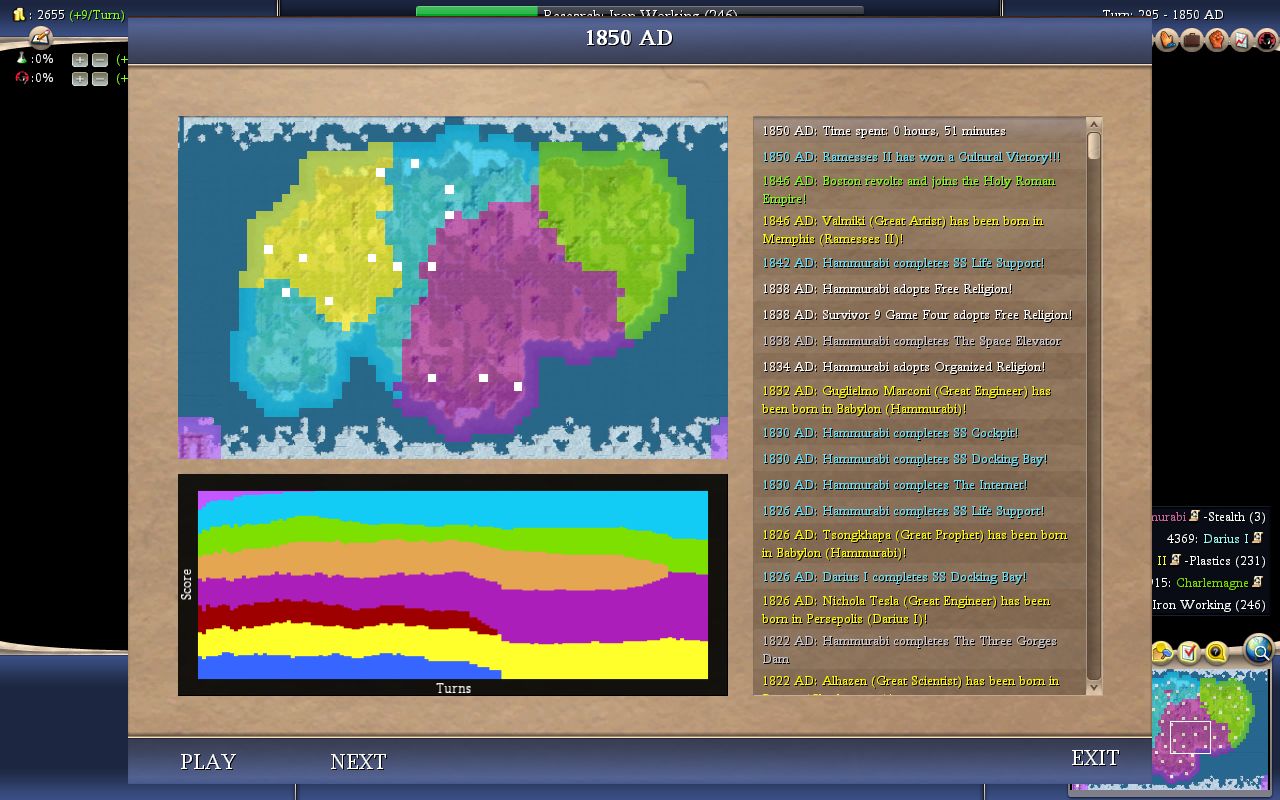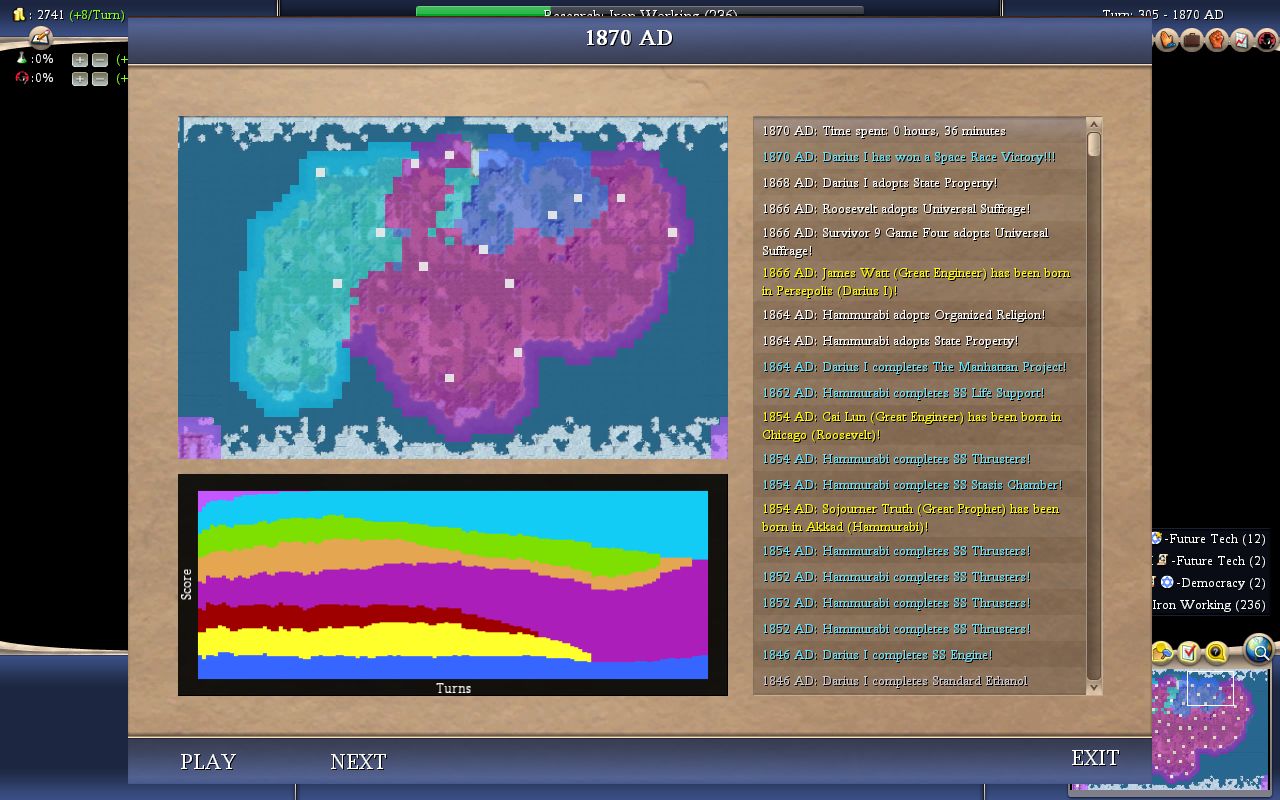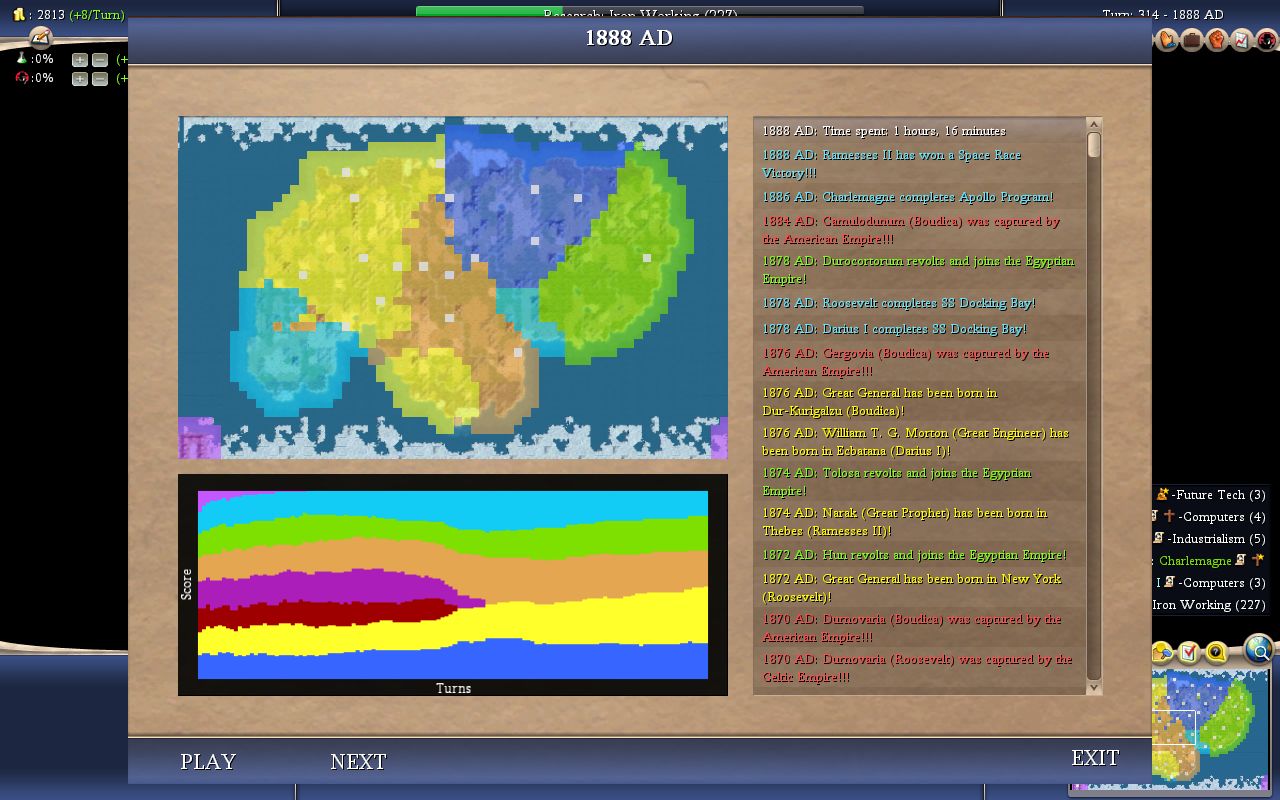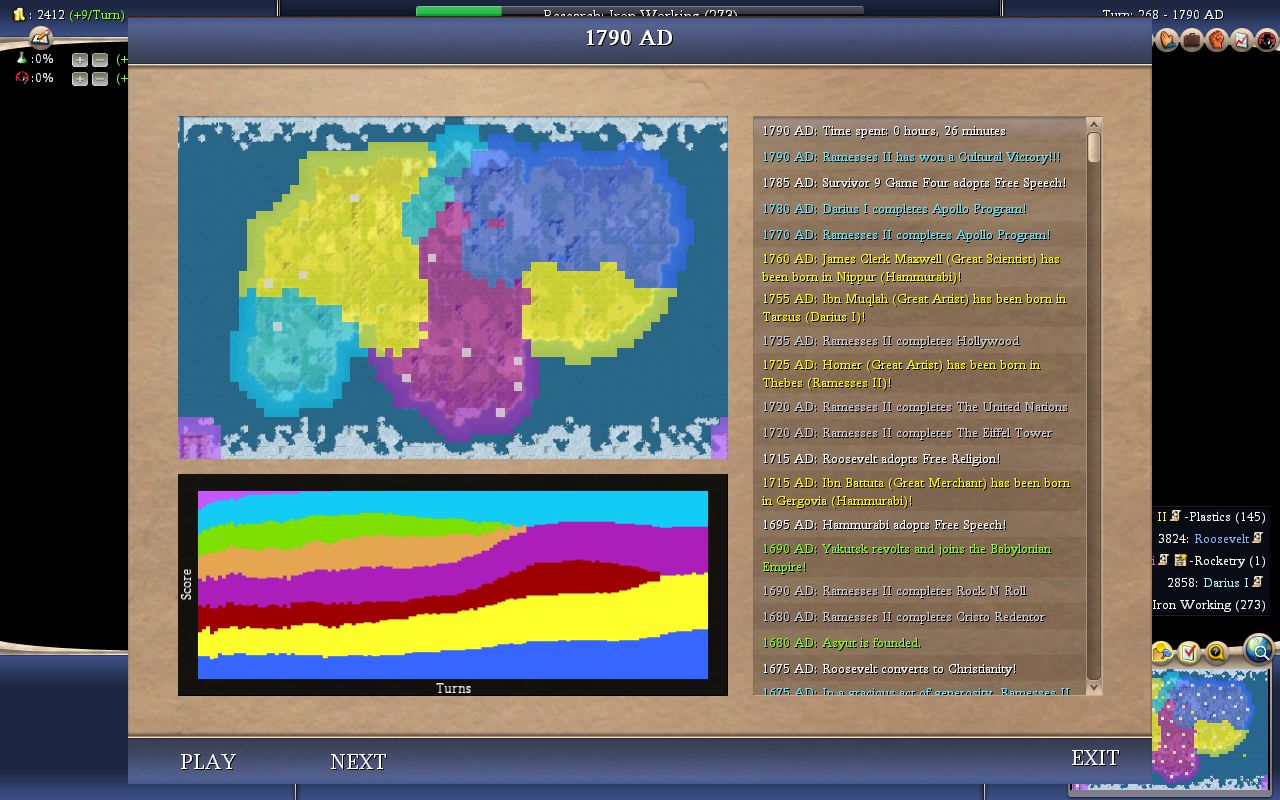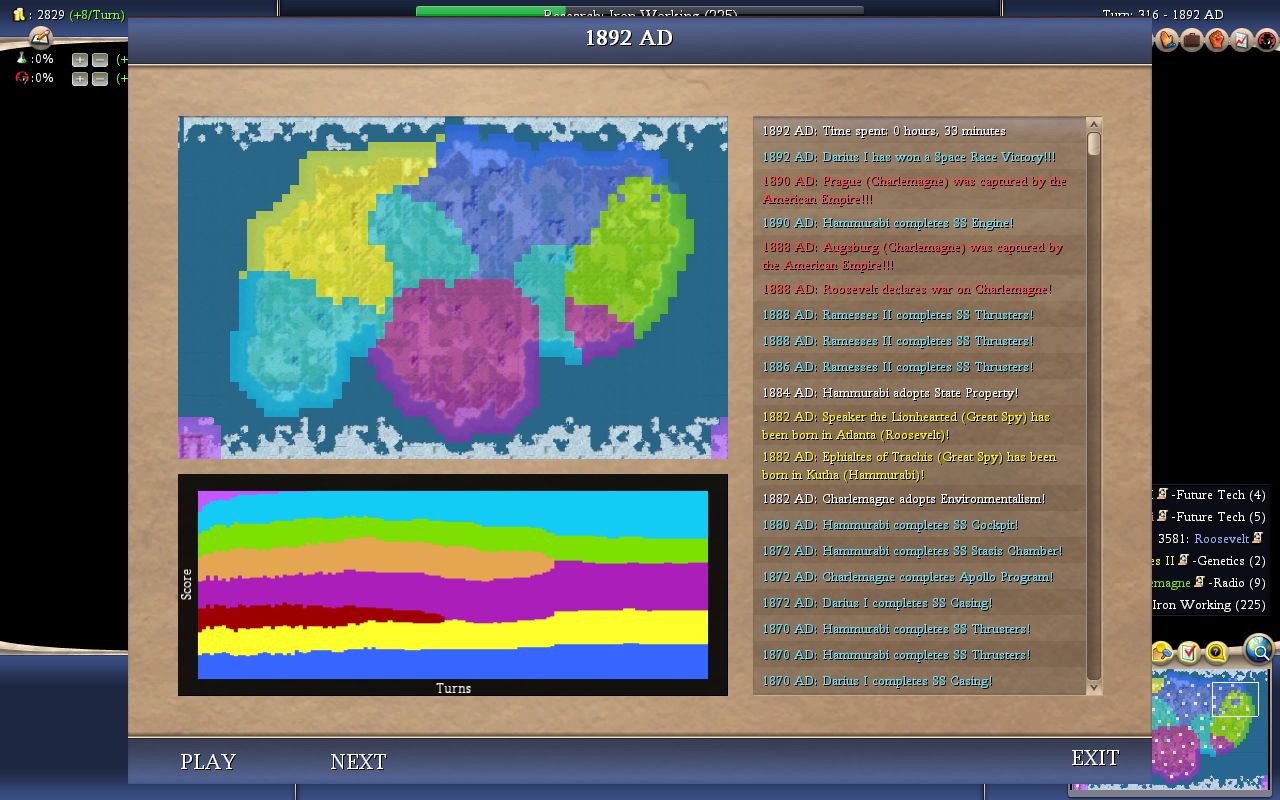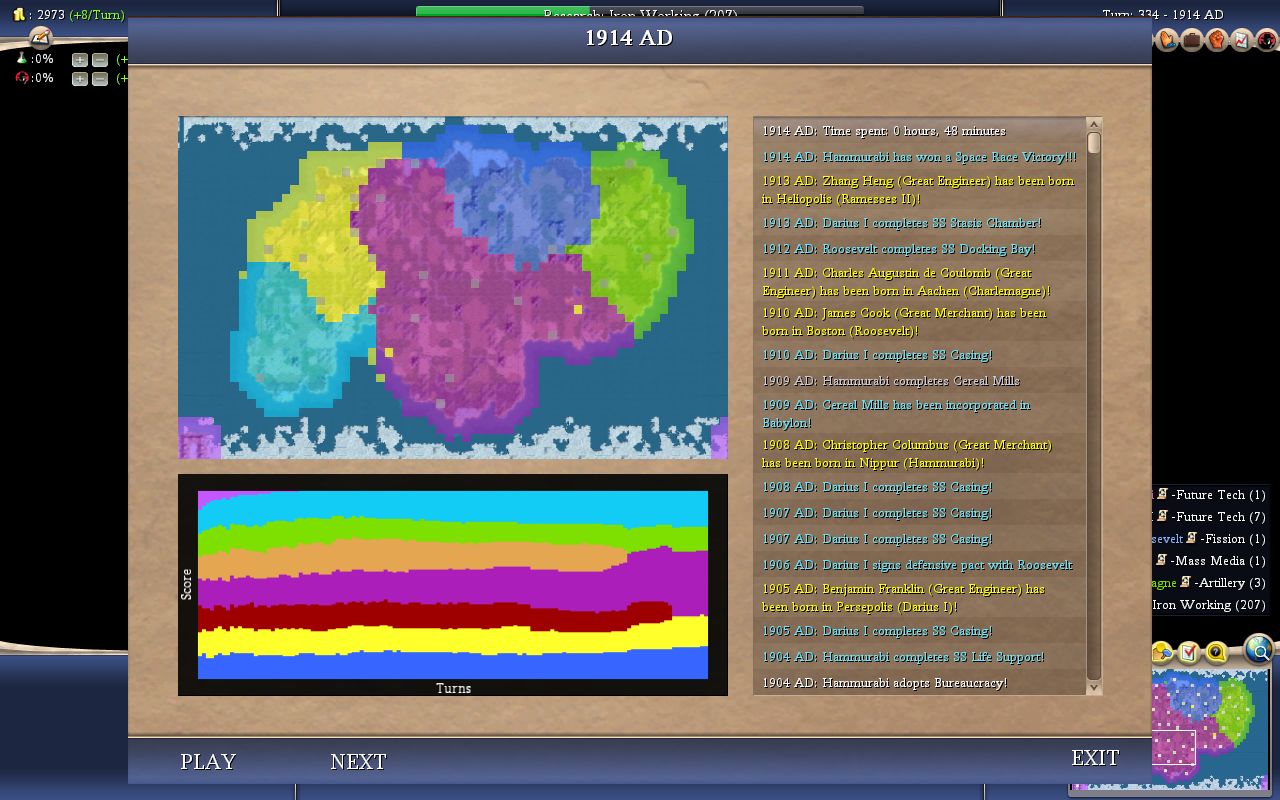
One of the recurring features of past seasons of AI Survivor have been our "alternate histories", running additional iterations on the same maps to see if the same events would play out again. Game Four had a nailbiting finish as Ramesses and Darius competed to out-peacenik one another with their respective Cultural and Spaceship victories. Was that something which would unfold in each game? This was a topic that called for more investigation with alternate history scenarios. Following the conclusion of previous seasons of AI Survivor, I had gone back and investigated some of the completed games and found that they tended to play out in the same patterns over and over again. While there was definitely some variation from game to game, and occasionally an unlikely outcome took place, for the most part the games were fairly predictable based on the personality of the AI leaders and the terrain of each particular map. Would we see the same patterns play out again and again on this particular map?

The original inspiration to run these alternate histories came from Wyatan. He decided to rerun the Season Four games 20 times each and publish the results. The objective in his words was twofold:
- See how random the prediction game actually is. There's a natural tendency when your predictions come true to go "See! Told you!", and on the contrary to dismiss the result as a mere fluke when things don't go the way you expected them to (pleading guilty there, Your Honour). Hopefully, with 20 iterations, we'll get a sense of how flukey the actual result was, and of how actually predictable each game was.
- Get a more accurate idea of each leader's performance. Over 6 seasons, we'll have a 75 game sample. That might seem a lot, but it's actually a very small sample, with each leader appearing 5-10 times only. With this much larger sample, we'll be able able to better gauge each leader's performance, in the specific context of each game. So if an AI is given a dud start, or really tough neighbours, it won't perform well. Which will only be an indication about the balance of that map, and not really about that AI's general performance. But conversely, by running the game 20 times, we'll get dumb luck out of the equation.
Wyatan did a fantastic job of putting together data for the Season Four games and since then we've continued to use the same general format. First we'll post the resulting data and then discuss some of the findings in more detail. Keep in mind that everything we discuss in these alternate histories is map-specific: it pertains to these leaders with these starting positions in this game. As Wyatan mentioned, an AI leader could be a powerful figure on this particular map while still being a weak leader in more general terms. This particular set of alternate histories were run by TheOneAndOnlyAtesh - many thanks for spending so much time on this task!  Now on to the results:
Game One | Game Two | Game Three | Game Four | Game Five
Game Six | Game Seven | Game Eight | Game Nine | Game Ten
Game Eleven | Game Twelve | Game Thirteen | Game Fourteen | Game Fifteen
Game Sixteen | Game Seventeen | Game Eighteen | Game Nineteen | Game Twenty
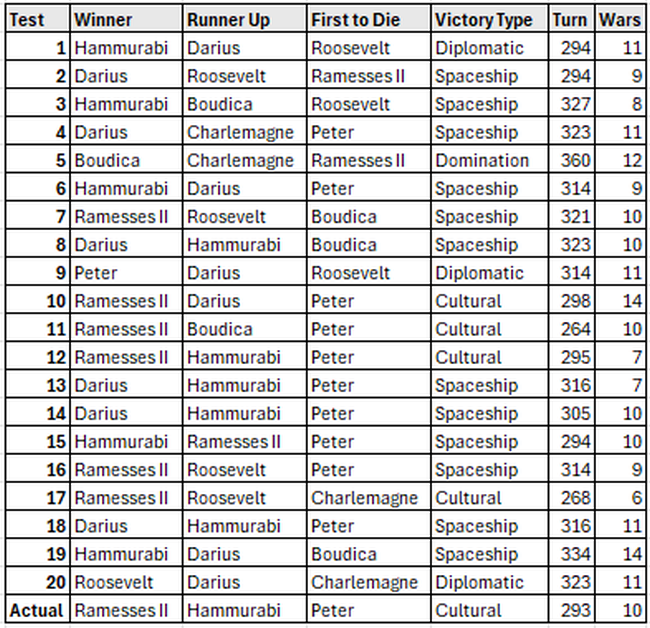
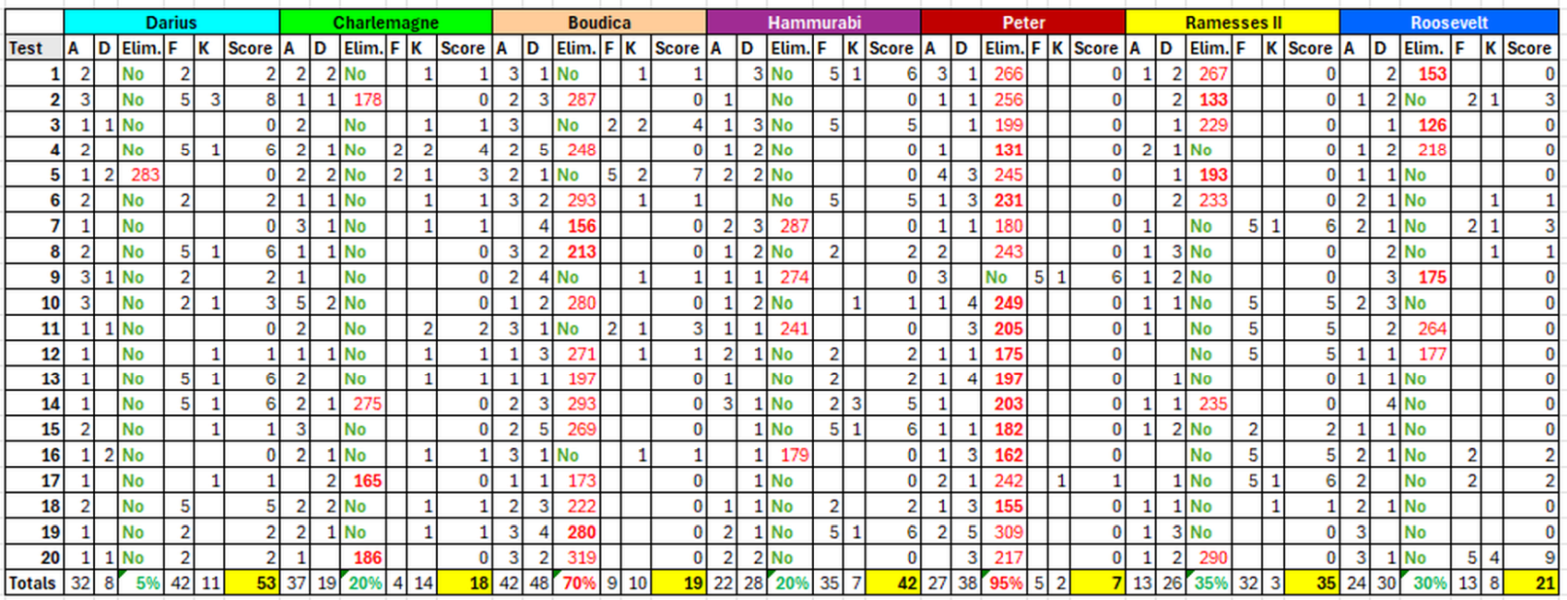
(Note : "A" column tracks the number of war declarations initiated by the AI, "D" the number of times the AI is declared upon, "F" the points for finish ranking, and "K" the number of kills.)
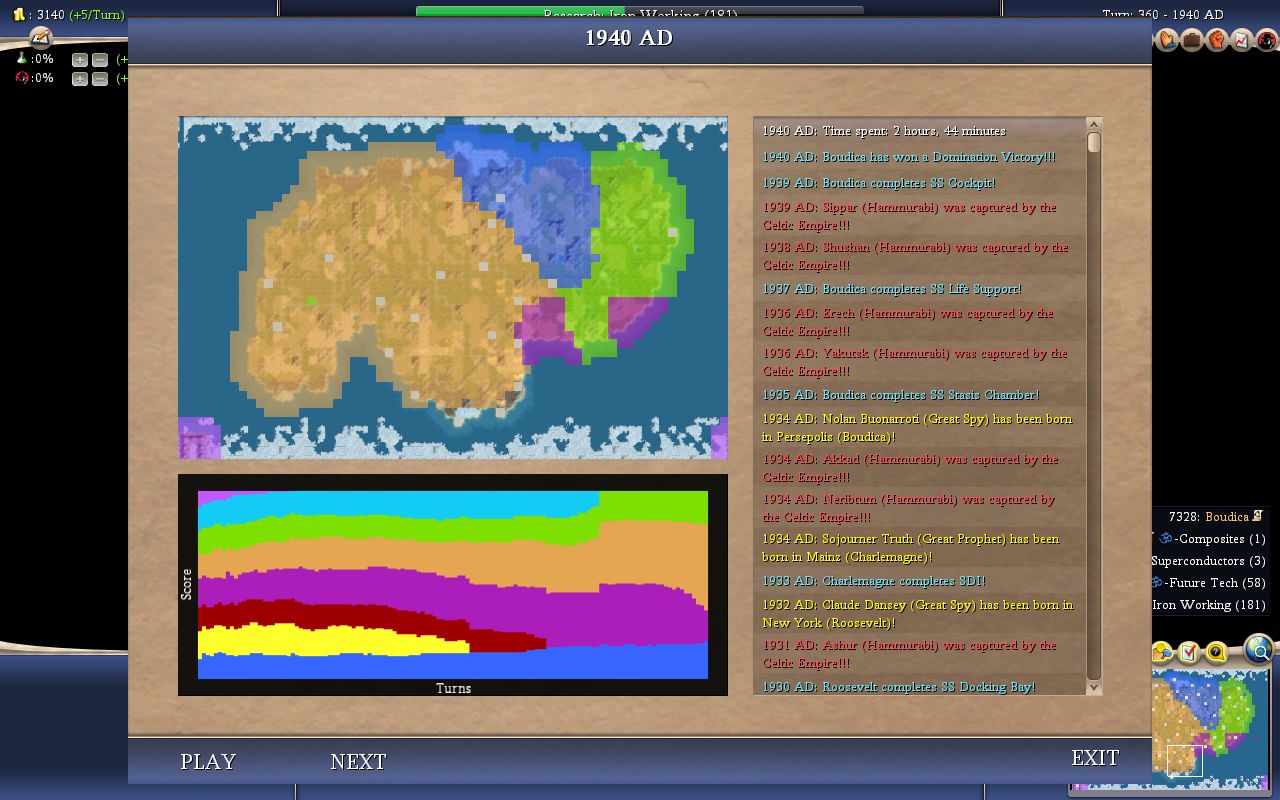
TheOneAndOnlyAtesh: After the previous two Alternate Histories revealed that their respective games were outliers, this set represented some sort of return to normalcy. The three strongest leaders in the real contest were Darius, Hammurabi, and Ramesses, and they were the strongest leaders in the set naturally. In fact, the Actual Game was the perfect snapshot of how the Big Three succeeded, Darius through Financial/Alive, Hammurabi through religious diplomacy and a ludicrously overpowered starting position, and Ramesses through culture and wonders; all three had best case scenario outcomes for their respective gameplans in the livestream and it was essentially a three-way coin flip who would win. Sadly for Darius, he was consigned to the Wildcard despite having his spaceship in transit.
It should not be hard to discern why these three were so dominant: this was a massive map even by seven player standards, and the Western hemisphere in particular had a large amount of territory that afforded its four leaders (the Big Three plus Boudica) room for around a dozen strong cities. Boudica was the only other leader on this map to consistently give the Big Three a run for their money, and if she had favorable diplomacy (or even if she were just a better economic leader) she would have also been competitive. The Eastern leaders, conversely, had quite a bit less land, usually being cramped after just seven or so cities, and what land they did have was lacking in quality, particularly regarding commerce. The Eastern leaders were thus often out of victory contention by Turn 100 and had to hope to get enough success on the warpath to sneak into 2nd place - or the occasional Diplomatic victory.
A general rule of thumb regarding map size is the bigger the map, the higher the cost of war is, and vice versa. After all, the larger the empire, the harder and faster it scales, meaning that if two nations spent all their resources fighting each other, even if they were strong, it would turn into a Thyucidedes trap where the real winner of such conflicts would be the 12 city non-participant going all in on development and research. Boudica was especially a kingmaker in a way, capable of wrecking at least one of the Big Three's winning chances while leaving the untouched leader(s) free to run away with the game. Nevertheless, this was a set where the less fighting a leader did, the better. The war counters for the Big Three were 40, 50, 39. For the others, they were 54, 90 (hmm, I wonder who), 56, 65. The East was just much more violent than the West, meaning it developed at a far slower rate.
Religion was also extremely important in this map and for any leader's success it was essential to play the religious game very carefully. With just two leaders (FDR, Peter) who could plot at Pleased, religion was especially important for cementing (or breaking apart) alliances. Nearly every leader founded one of the first three religions over the course of these games, and even later religions had a decent chance of being relevant, like we saw in the livestream when Ramesses founded a later religion and used it to bring himself back into relevance. Indeed, Ramesses and Hammurabi were especially big players, using religion to make critical allies (sometimes even bridging peaceweight gaps) in their best games.
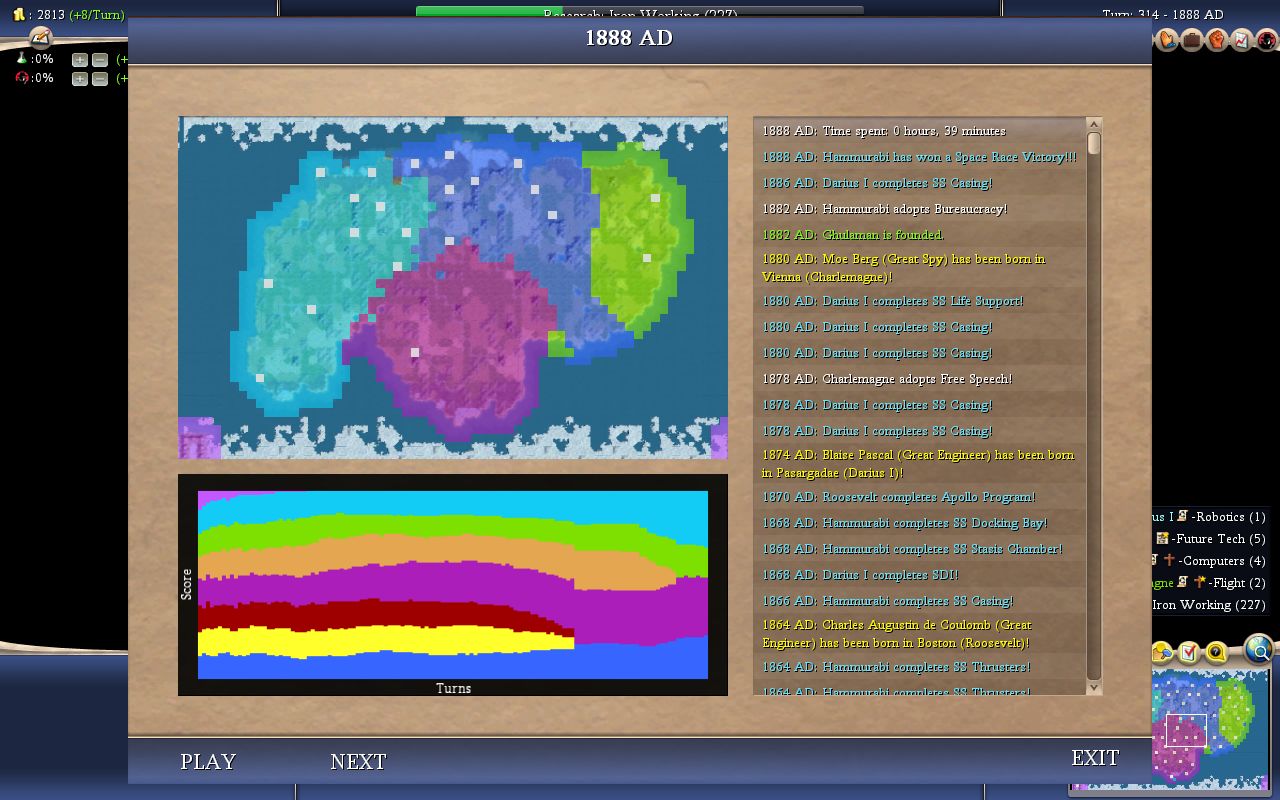
A typical game had three phases. First was the expansion phase, where every leader would focus on settling their vast territory and on spreading their religion for the first 80-100 turns. From there, the diplomatic lines would be drawn and the game would proceed to the war stage, defined by a series of peaceweight or religious wars. Eventually, the dust would settle (usually with the demises of Boudica and Peter, the two low peaceweight warmongers) and the remaining leaders, secularized into Pleased or better relations through Free Religion, would settle into the thumb twiddling phase as the obvious runaway zoomed off into the stars or whatever cultural utopia they had created. One particularly amusing example of this was Game 13, where after Peter and Boudica were dispatched on Turn 197, not a single extra shot was fired for the rest of the game as Darius' Spaceship landed on Turn 316. Overall, these were (thankfully) quick games, especially considering they mostly ended in Spaceship, with the map size, the field, and the relative lack of warring creating a feedback loop that further sped up these games.
Onto the individual leaders!

Darius of Persia
Wars Declared: 32
Wars Declared Upon: 8
Survival Percentage: 95%
Finishes: 6 Firsts, 6 Seconds (42 points)
Kills: 12
Overall Score: 53 points
Darius was the sole Financial leader in this set given an EXTREMELY generous diplomatic position, even by his standards, so good that he faced a staggeringly low 0.4 invasions per game. It was the perfect "Darius" setup, one where he had a good enough corner peninsula all to himself, alongside the perfect neighbor situation, being blessed with two neighbors loyal enough to leave him alone but also more than strong enough to serve as meat shields, particularly against Boudica. In light of this you may be thinking that he was his usual disappointing self mustering only six wins despite being handed a golden setup.
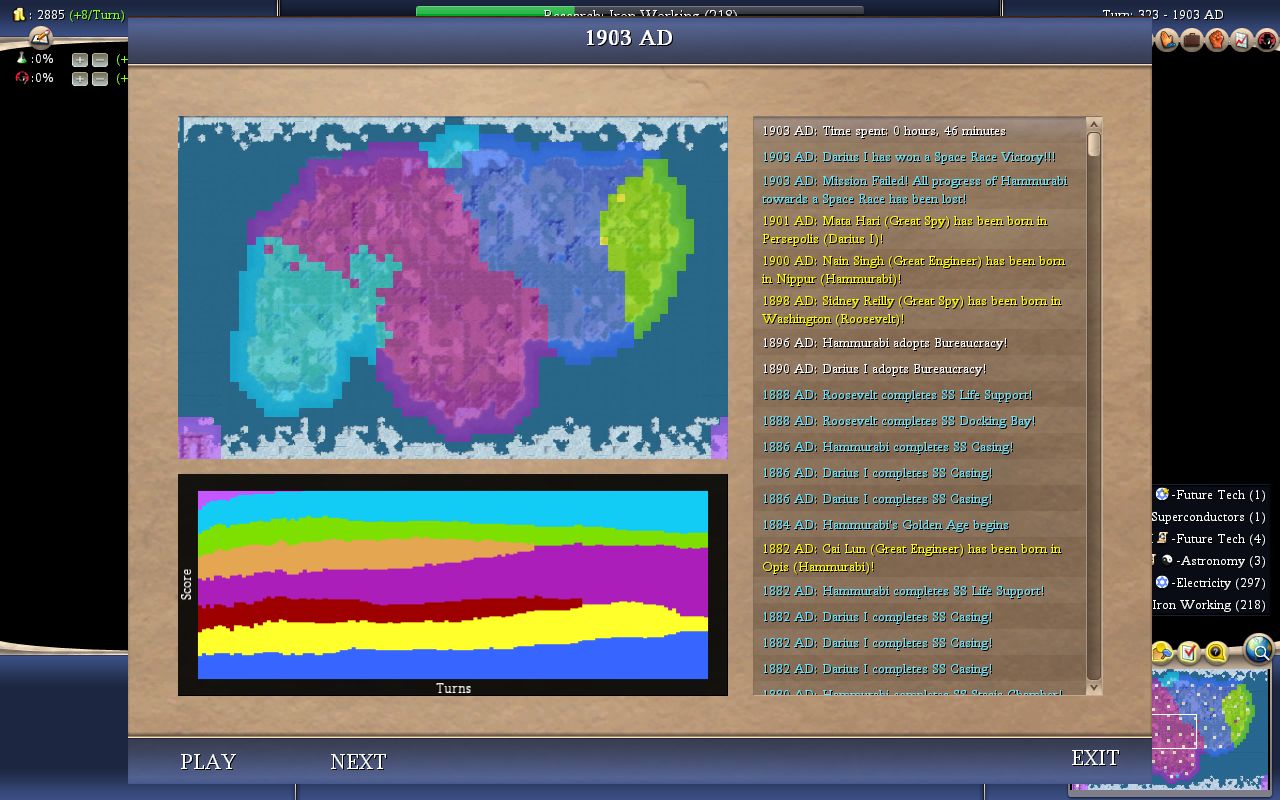
Except, I actually would not be too hard on him. First of all, these results undersell Darius' true strength, as he had not one, not two, but THREE likely wins (Games 1, 9, 20) where he instead came in second due to a different leader winning a Diplomatic victory from a second place position. While all three of those losses were his fault (see awards or game summaries), Darius was clearly the Lebron James of this set's Big Three, the leader most likely to win. That shows the power of Financial/Alive, as although Darius' land was good, I would argue it was the weakest of the four Western spots. Part of the reason for this was just how strong the other three spots were, especially Hammurabi and Boudica's, but additionally Persia was too heavily forested, and Darius would often enter the midgame middle of the pack in score, having to tech or conquer his way up the ladder.. Furthermore, he ran a risk of being boxed in by the culture and expansion of his neighbors, which led to some of his worst performances. Nevertheless, his land scaled quite well once chopped down and Darius was capable of some quite quick victories, he was a good fighter when he put his mind to it (in one case solo conquering Ramesses within 135 turns), and at worst he was virtually guaranteed a second chance in the Wildcard; his only death in this set came in Boudica's outlier victory. It is a little sad that despite being on pace for a pre-Turn 300 Spaceship in the Actual Game he still ended up relegated to the Wildcard. That is one of the risks of the "sit idly in your corner and tech to space" strategy, however.
Darius Award: In Game 1, Darius blew an easy win by VOTING HAMMURABI THE GAME WINNER.
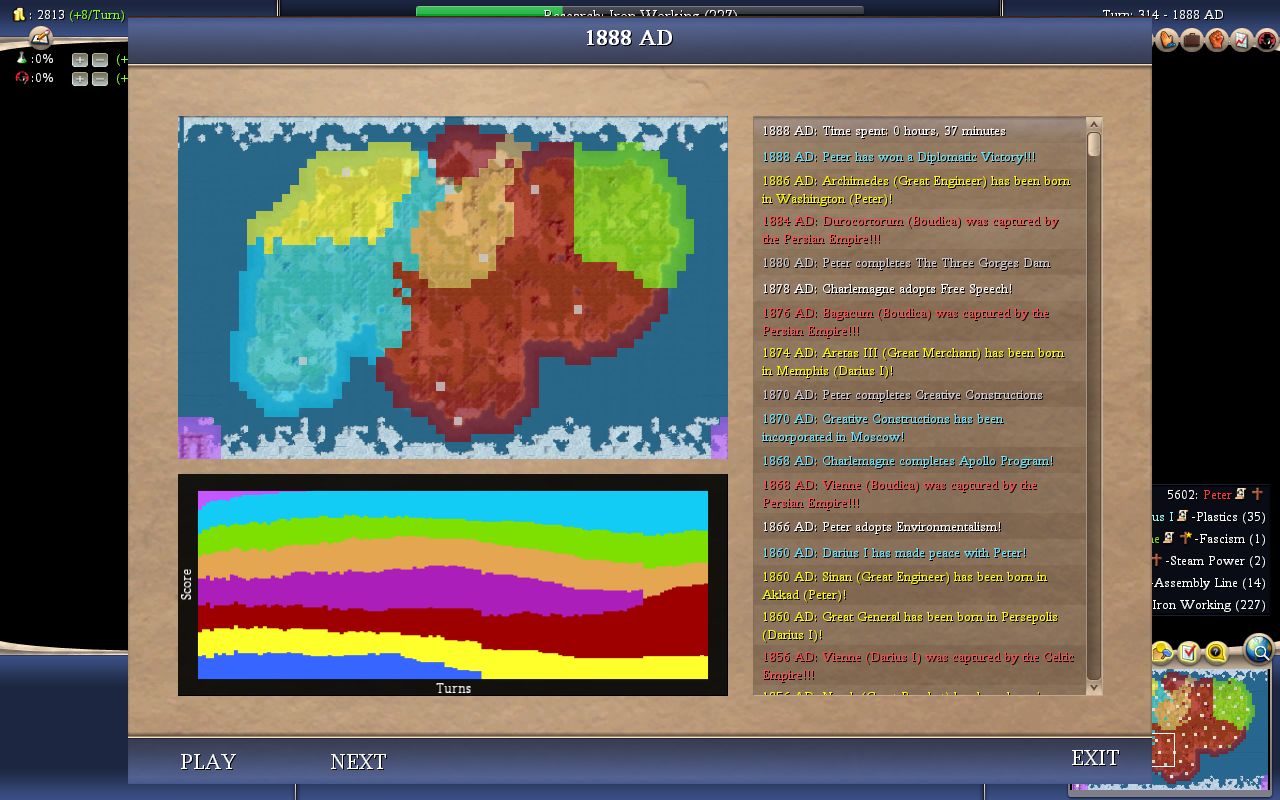
Darius Award: In Game 9, Darius probably would have won by space or domination as his only real competition was PETER, except he inexplicably TURNED UP THE CULTURE SLIDER, allowing Peter to catch up in military tech and take enough of Persia to steal a Diplomatic victory.
Darius Award: In Game 20, amidst an unusually strong FDR performance, Darius was lucky to have Boudica suicide into him to prevent FDR from being a Domination or Diplomatic victory threat. Except, Darius inexplicably makes peace before he can kill Boudica. FDR then swooped in, killed Boudica himself, and then liberated her Babylonian holdings to Hammurabi, getting the Babylonians to Friendly and allowing FDR to win a Diplomatic victory while Darius' spaceship was still traveling to Alpha Centauri.

Hammurabi of Babylon
Wars Declared: 22
Wars Declared Upon: 28
Survival Percentage: 80%
Finishes: 5 Firsts, 5 Seconds (35 points)
Kills: 7
Overall Score: 42 points
Hammurabi rolled a 20 on his starting position, but as one may expect he did not quite maximize his opportunities. His territory had it all: abundant resources, excellent synergy with his starting techs (which meant he was never punished for his Isabella-esque early Monotheism beelines), the ideal mix of foodhammers and commerce, and unlimited room that allowed Hammurabi to settle around a dozen cities peacefully every game; there were a couple of games where he had as many as fifteen without going to war!
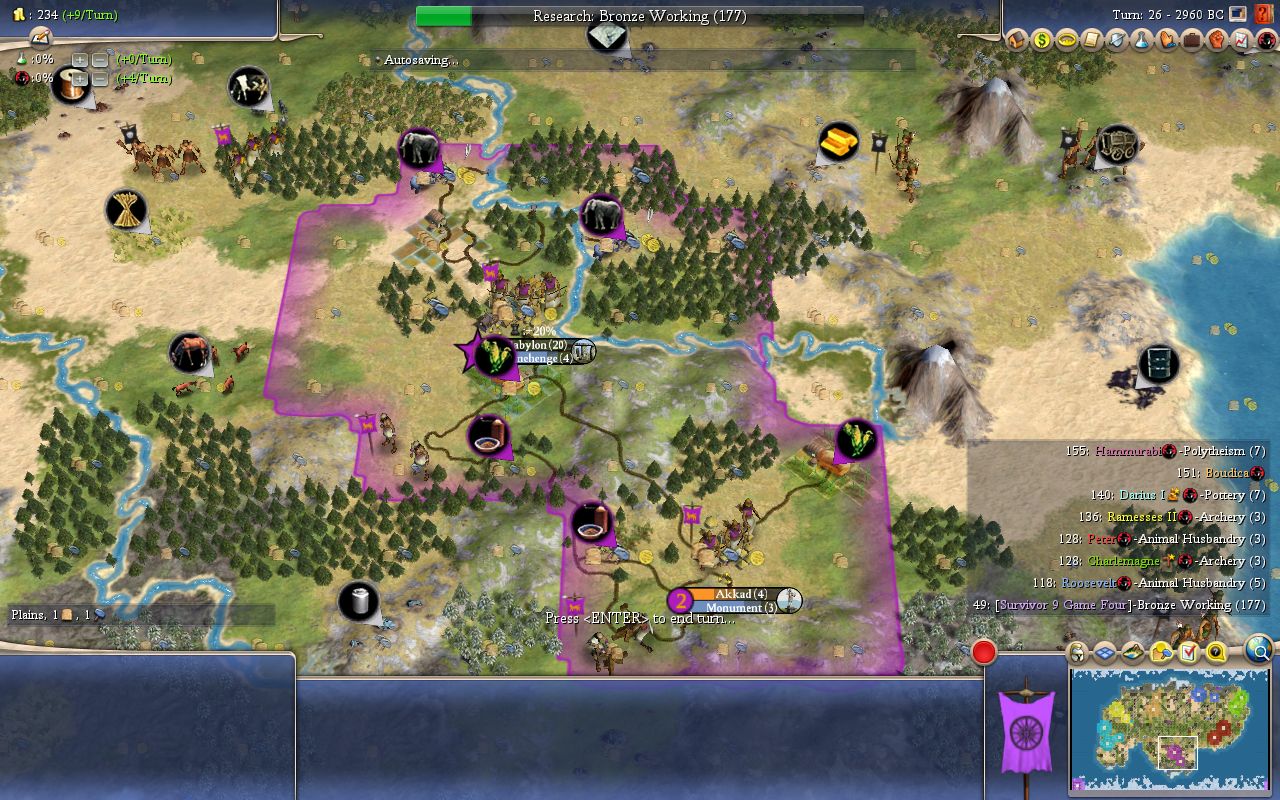
Furthermore, Hammurabi had two great avenues for conquest, the dogpile magnet Boudica and the extremely weak dogpile magnet Peter. Thus, the fact he fought more defensive than offensive is inexcusable. That, in my opinion, is the biggest sign that a leader was handed a golden starting position rather than actually succeeding on their own merits. Hammurabi's successes were generally correlated to how his fighting went. If he killed someone early enough or managed to be the only leader to skirt wars, he would probably win. One such example was Game 15 where Hammurabi took advantage of a truly terrible Peter performance to win a Turn 294 Spaceship victory, a ridiculous Spaceship finish date for a non-Financial leader. There was also Game 3 where he used a brilliant backstab on DARIUS to take a few core cities and cement his runaway status. If he had to grind down a leader, allowing a different leader to outscale him like in the Actual Game, then he typically came in second. He did sometimes completely faceplant militarily, especially against Boudica, most notably in Game 16 where he was on track to be First To Die until Peter suddenly got on the wrong side of a 3v1. Another aspect to note was that Hammurabi was the strongest religious leader in this map, which says something considering that Ramesses, Boudica, and Charlie were in this game. Religion was a huge part of his gameplan here: the two games where he failed to found a religion (Games 9, 20) were among his worst performances and helped create the conditions for those two games being outliers.
I would say these results are the absolute floor of what one could have done given this starting position. To be fair, Hammurabi did have multiple VERY close second place finishes, a couple times using his size and The Internet to nearly catch Darius, and he was also the rightful winner of Game 12, instead coming in second due to Ramesses bullshitting a Cultural victory from an otherwise totally irrelevant position. Nonetheless, he left quite a bit to be desired and I think Ramesses or Darius would have won at least 12 games from this set.
Exploding Portuguese Kittens Award: Losing in a spaceship tie to Darius in Game 8 with an exploded spaceship, although with just one casing he only had a 10% chance to win.
As It Turns Out The Future Is Not Always Better Tomorrow Award: In Game 5, having reached Future Tech and with an easy Spaceship win in his grasp, Hammurabi instead lost to BOUDICA who used spies to blow up his spaceship parts and then ran him over with 300+ backwards units, leading to the sole Domination (and Celtic) win of this set.
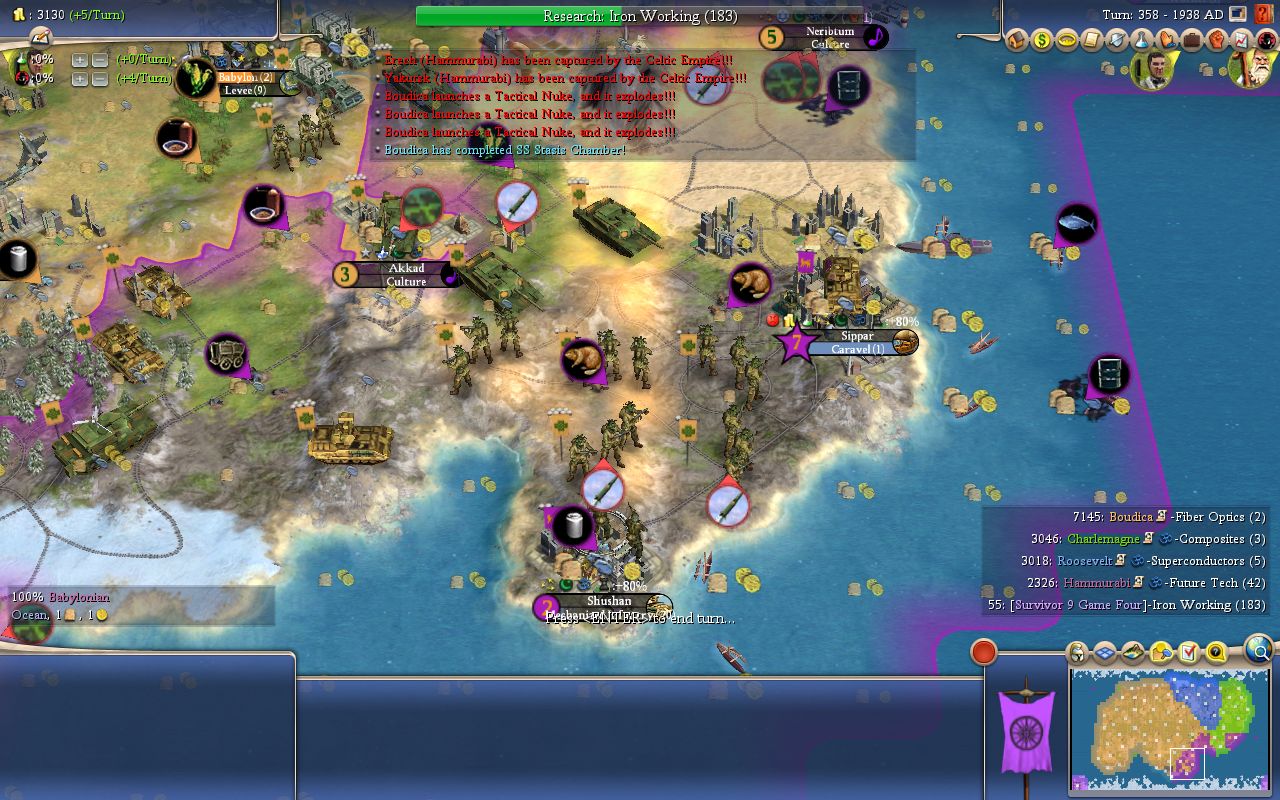
Nice Guys Finish Second Award: Hammurabi had about 50 turns to call for a Diplomatic Victory vote that he would have won in Game 14 but instead kept constantly reaffirming Free Speech and Universal Suffrage as Darius won by Spaceship.

Ramesses of Egypt
Wars Declared: 13
Wars Declared Upon: 26
Survival Percentage: 65%
Finishes: 6 Firsts, 1 Second (32 points)
Kills: 3
Overall Score: 35 points
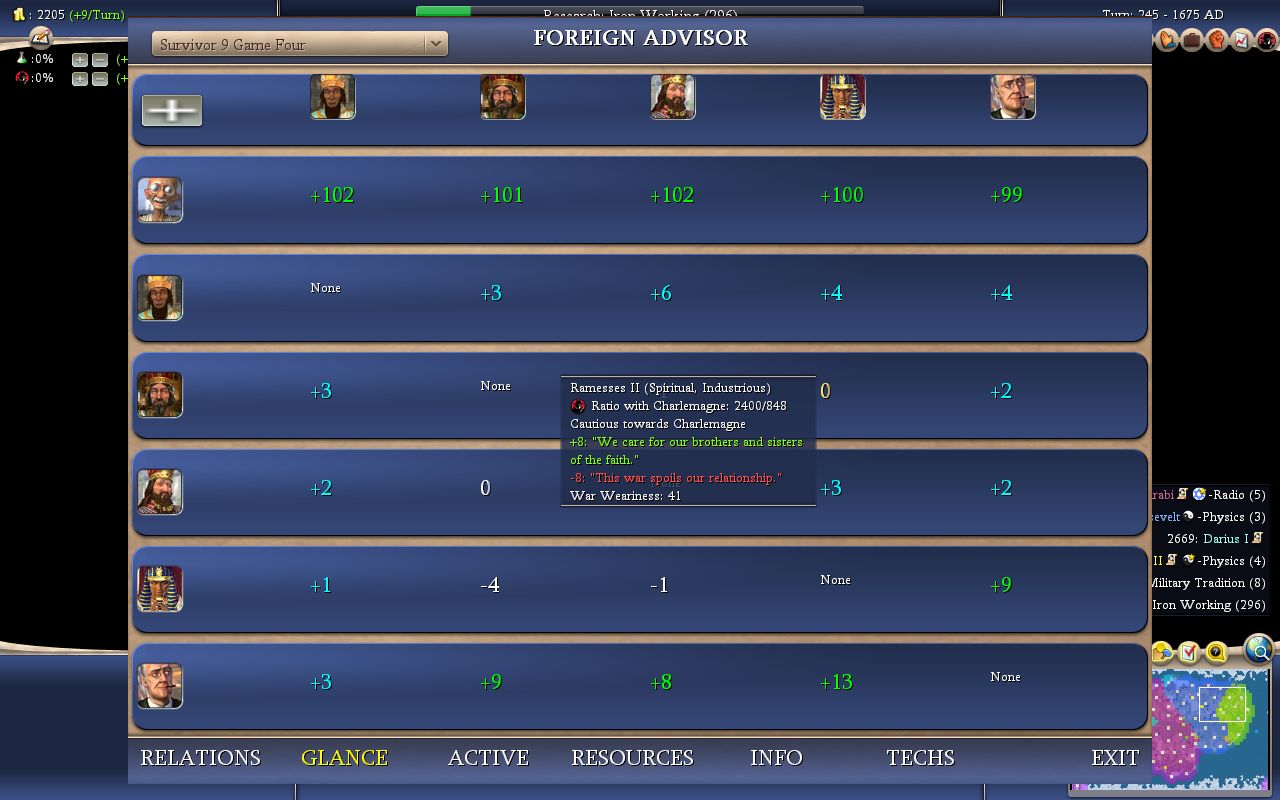
Ramesses was the boom-or-bust member of the Big Three, churning out some utterly ridiculous performances including two Turn 260ish Cultural wins where he barely touched the slider, but otherwise coming up empty, almost never being competitive in his non-winning games. He netted the lowest survival rate of all the high peaceweight leaders, had a paltry three kills, and was also the only member of the Big Three to be First To Die. This was a true all-or-nothing set, as even in his one second place finish he was less than ten turns from victory and only lost due to an especially ridiculous Hammurabi teching performance. I was a little skeptical of Ramesses before this game, and even more skeptical after the livestream despite his victory, as he was, in my humble opinion, quite lucky to win that game, nearly collapsing militarily multiple times and relying way too much on his Industrious trait to clutch out critical wonders and religions. The early part of this set only reinforced this belief, and until he found the win column in Game 7 I was wondering if we had yet another Season 9 anomaly. In a way we did, because Ramesses barely eking out a victory from last place in score was unusual. In the replays Ramesses only won one time from a non-top two position, Game 12. When Ramesses won, he typically won big.
The main issue with Ramesses, as is often the case for those with the cultural playstyle, is that his strategy was too highly dependent on religion and wonders amidst a field where wonders and religions were hotly contested. Furthermore, Ramesses was left quite vulnerable militarily, which was a dangerous game to play considering that Boudica was breathing down his neck. He especially struggled in the first third of this set, often neglecting expansion and then getting caught with his pants down by Boudica (and even Darius), leading to two games where he was First To Die. Ramesses often needed to not only found a religion, but also have it spread well, because, as one can see from his stats, warring was something to be avoided at all costs; five of his six wins saw him fight just one war. This set was the tale of two pharaohs: I saw the guy who had a Mansa Musa-esque run to this season's title, but I also watched the guy who stumbled through six seasons of mostly futile performances before he started to make himself known to the AI Survivor community.
Tepid War Award:

Roosevelt of America
Wars Declared: 24
Wars Declared Upon: 30
Survival Percentage: 70%
Finishes: 1 First, 4 Seconds (13 points)
Kills: 8
Overall Score: 21 points
FDR was the meatshield of the game, serving as the perfect buffer for the Big Three to hide behind and tech or culture away. Regarding his actual chances, however, he was given a pretty tough hand, with global diplomacy the only factor working out in his favor. The Americans were destined to have at least two hostile neighbors due to peaceweight and religion, and while they held up admirably against the endless hordes of Russo-Celtic-Frankish crusaders, hence a 70% survival rate, by the thumb twiddling phase they were usually too exhausted from fighting to keep up with the Western leaders. There were also three games where he was attacked or dogpiled early, once without metals, en route to an early exit. The other issue with FDR was his land. While he had a decent amount of space, it was far lower in quality than in the West, with lots of tundra and not all that many resources. The one thing keeping him relevant was that he built the Great Lighthouse in nearly every replay, but even that economic boost only lasted for the first half of the game and there were quite a few games where he was keeping up with the Dariuses and Hammurabis in tech, only to get left in the dust technologically around the Renaissance due to his inferior land. FDR's ticket to the playoffs was to try and carve out enough territory to get enough score points to advance, and to his credit he managed this in a quarter of all replays. He was an especially good partner for Ramesses, with three of his four Runner Up finishes coming behind the Egyptians, often because a successful Egyptian performance typically saw the two partition Boudica's territory, giving FDR enough land to be a major player.
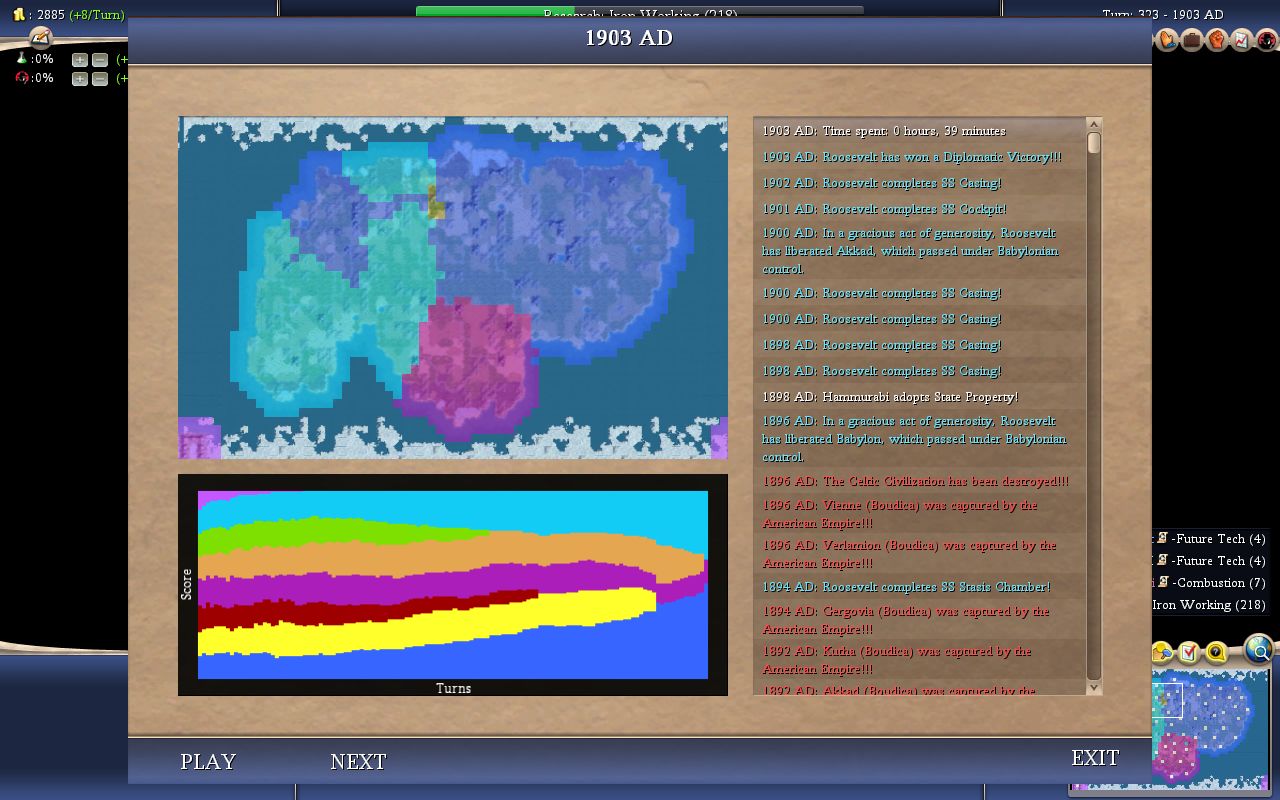
I must give special mention to his spectacular Game 20 win, where he scored a whopping NINE points with an insane four kill game. That game was effectively a Domination win, where he managed a solo conquest of Charlie, followed by running over Peter, Ramesses (stopping what would have been an Egyptian cultural victory) and Boudica. Boudica had nearly conquered Hammurabi, but FDR brilliantly liberated most of Babylon over the course of his Celtic conquest, getting Hammurabi to Friendly relations and thus clutching out a Diplomatic win right when Darius' spaceship was about to arrive at Alpha Centauri. Before that game, FDR was on track to be the second worst scoring leader in this set, only beating out the hapless Peter, but with how much the Big Three monopolized everything one outlier result was enough to jump from bottom to middle of the pack. I must give props to this guy though for making the best of a rough situation.
A Whimper And A Big Stick Award:
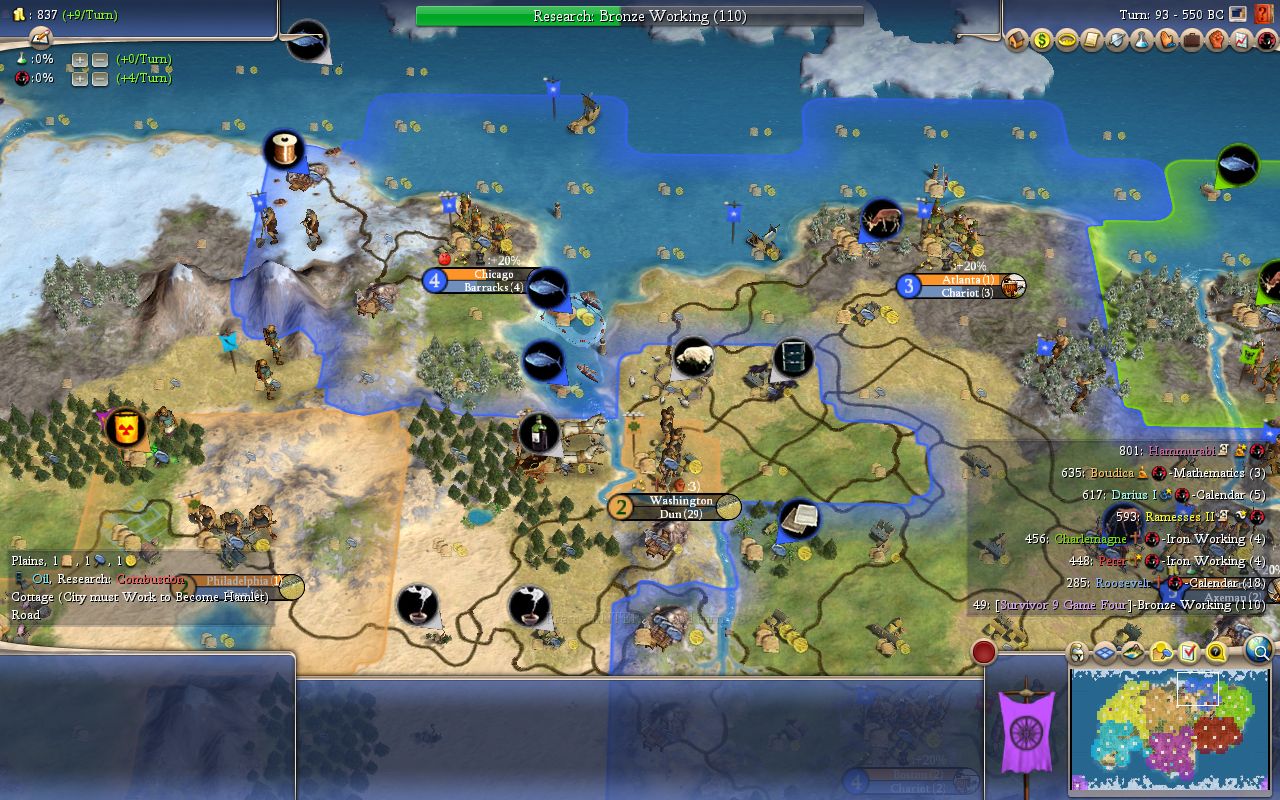
Wang Kon Award: Only getting second place in Game 16 by signing a Defensive Pact with Darius, dragging him into a war against a Boudica with her army in another flank and getting just enough to claim second place when the Celts had it locked up.

Boudica of the Celts
Wars Declared: 42
Wars Declared Upon: 48
Survival Percentage: 30%
Finishes: 1 First, 2 Seconds (9 points)
Kills: 10
Overall Score: 19 points
It said a lot about how bad the Eastern starting positions were that until Game 20, this gal was the highest scoring of the non-Big Three leaders despite being a centrally located peaceweight outlier. When running these games it was not hard to see why she had some dark horse support, as her starting territory was excellent, fit her starting techs as well as it could have, with double Ivory and a few nearby Animal Husbandry resources:
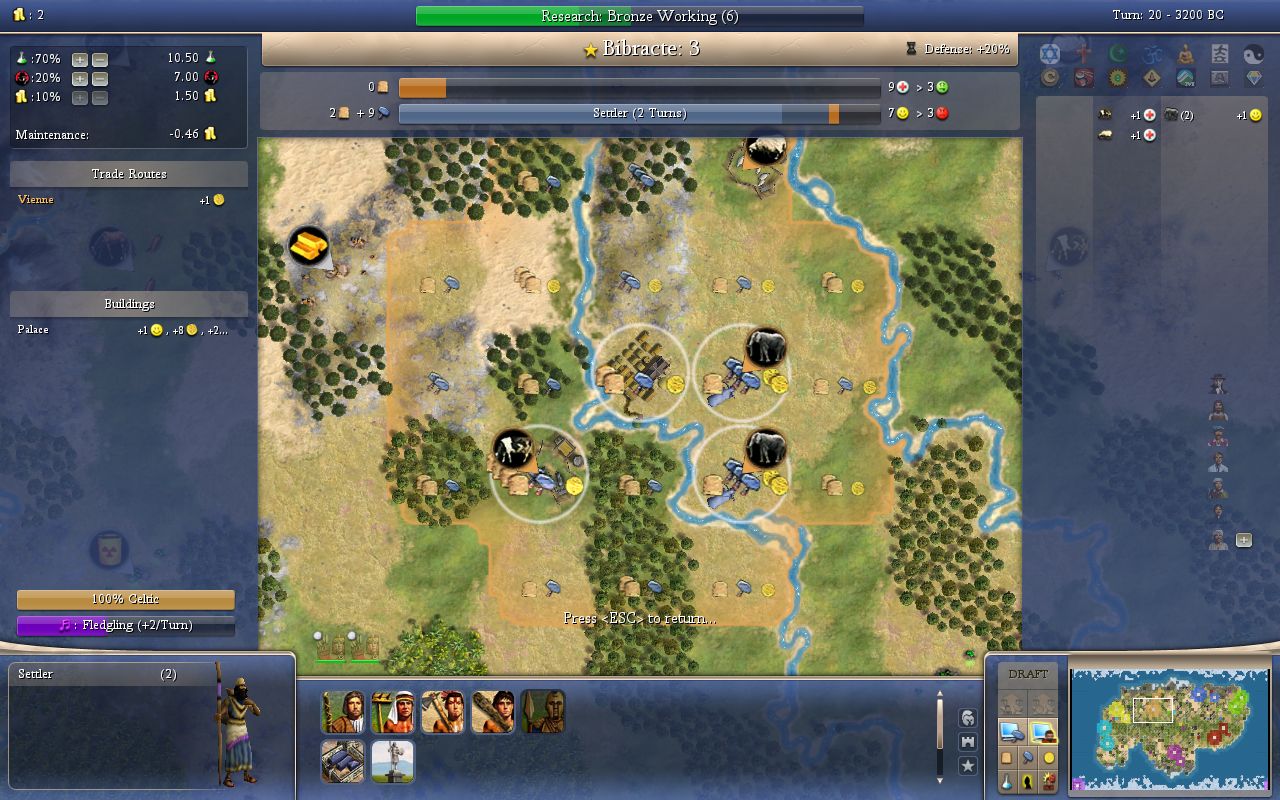
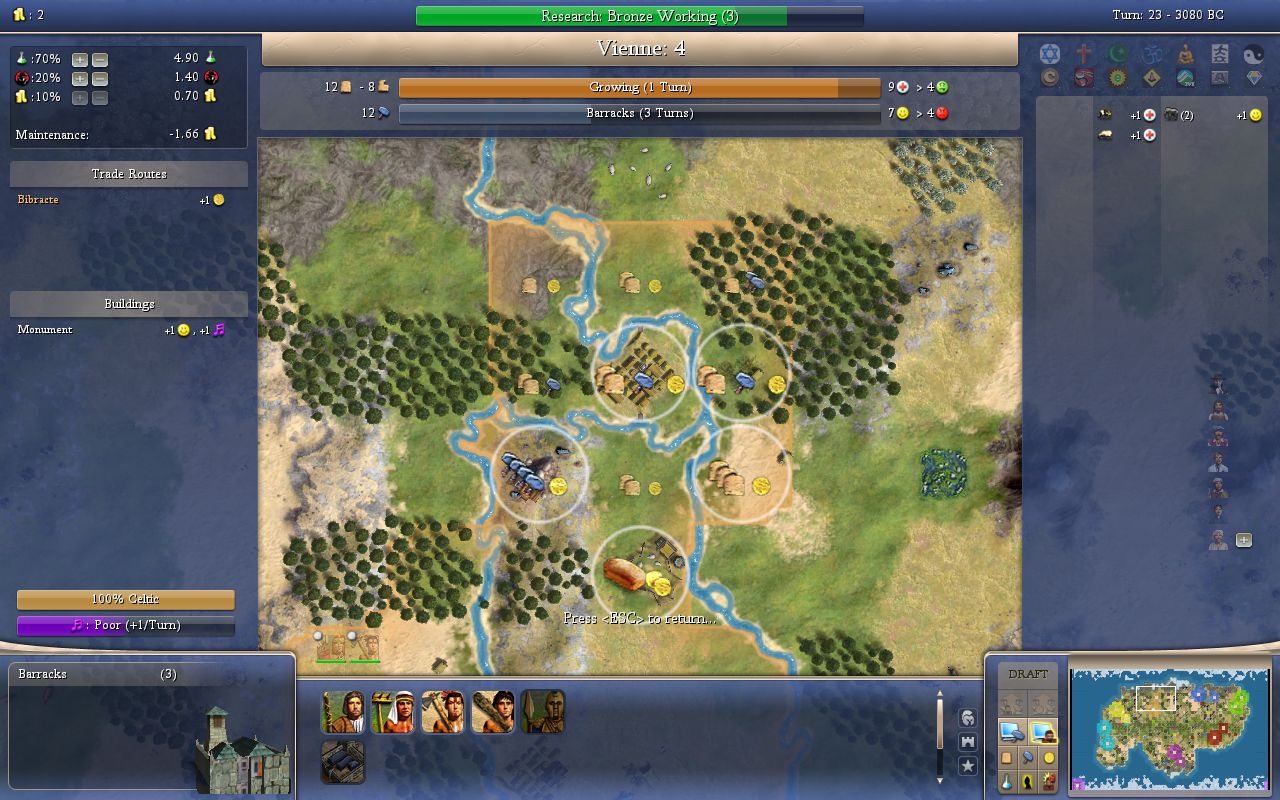
Moreover, she had a lot of expansion room alongside two neighbors who were rather squishy in the early game, and many times she utilized an Elepult-Gallic timing to turn into one of the scariest leaders on the map. Of course, her diplomatic situation and inability to keep up economically typically came back to bite her at some point, but she was still a real gamewrecker in these matches, ruining the games of each member of the Big Three multiple times.
Interestingly, Boudica's chances hinged almost solely on one decision: would she found a religion? The correct move was NOT to go for a religion. With Ramesses, Charlie, and Hammurabi in this game, there was too much competition and Boudica just was not committed enough to the religious gameplan to get away with it. Furthermore, with her starting techs, it was far more important that she went for Animal Husbandry or economic techs. This pattern was so strong, by the second half of the set the moment I saw Boudica go religion first I could already confidently write her off. She could ill afford delaying Animal Husbandry, or Pottery, or Construction, by ten turns. Instead, without a religion she could instead adopt another leader's religion, and this gave her a powerful ally alongside some breathing space for conquests. Occasionally, she could grow strong enough to come in second, or even win this set's only Domination victory. Notably in that game both Ramesses and Darius had very ugly performances, failing to expand and thus leaving themselves easy pickings for Boudica. Normally, she would either get attacked from the other side by a stronger power, or by the time she had run one leader over the remaining ones would be too far ahead. I would say though that Boudica played her cards as effectively as she could have, and had, say, Peter's starting position been switched with one of the Big Three she would have been a top performer here.
Having More Balls Than Willem Award: Doing everything she could to avoid GUNPOWDER in Game 16 yet still nearly running over and crippling a Darius who had rifles.
Atlanta Hostage Crisis Award:


Charlemagne of Holy Rome
Wars Declared: 37
Wars Declared Upon: 19
Survival Percentage: 80%
Finishes: 0 Firsts, 2 Seconds (4 points)
Kills: 14
Overall Score: 18 points
Charlie was by far the least interesting leader here, trying to play a religious crusader game without the proper setup to do so. His games virtually all followed the same pattern: for 200 turns he would relentlessly fight against those darn infidels, and then once the dust settled and the remaining leaders had modernized their civics he would just sit there Doordashing whoppers to his fellow high peaceweights for the rest of the game. The vast majority of his score points came from his 14 kills, mostly stemming from being in the best position to strike the finishing blow on Peter. Regarding his starting position, security was all he had going for him as his land was low in quality and quantity; the Burger King had the lowest expansion potential of all seven leaders here, with even the weak Peter frequently boxing him in. Moreover, when he did found a religion (which did not happen as much as I thought it would) his Holy City was usually wasted:
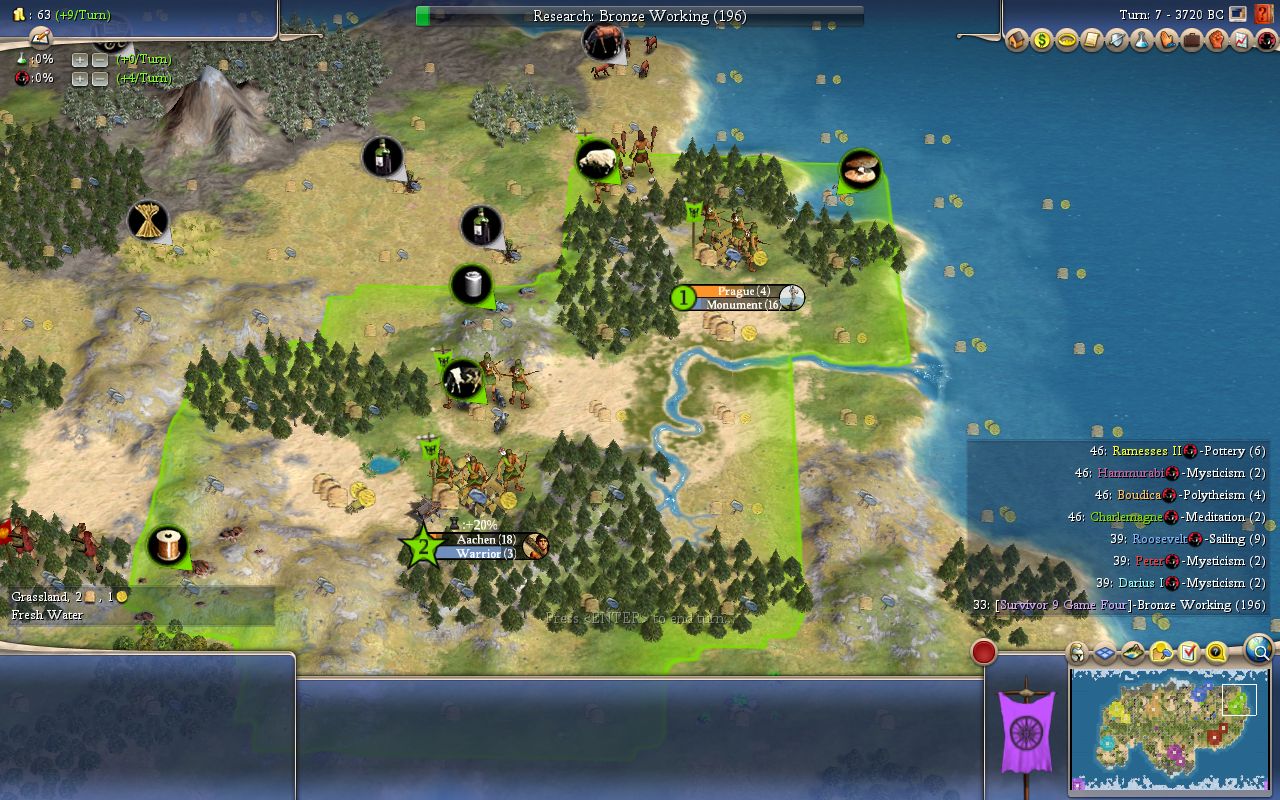
Charlie only had one good game, Game 4, where FDR gifted him a city to make him stronger than normal. Charlie leveraged that early tempo into an ultra fast conquest of Peter, and while he could not keep up with Financial Darius he nearly won a Diplomatic victory. His other second place finish was in Game 5, where Boudica backdoored him in, and it should say a lot that one of his playoff finishes came in an outlier game. Otherwise he had Wildcard written all over him, as he had great survival prospects due to his faraway corner position and having the correct peaceweight for this map. Charlie was little more than an NPC in this game.
Peaceful Diplomatic Bastion of Sanity Award: Defying the Stop the War resolution that would have saved him from certain doom against Babylonian Modern Armor in Game 3.
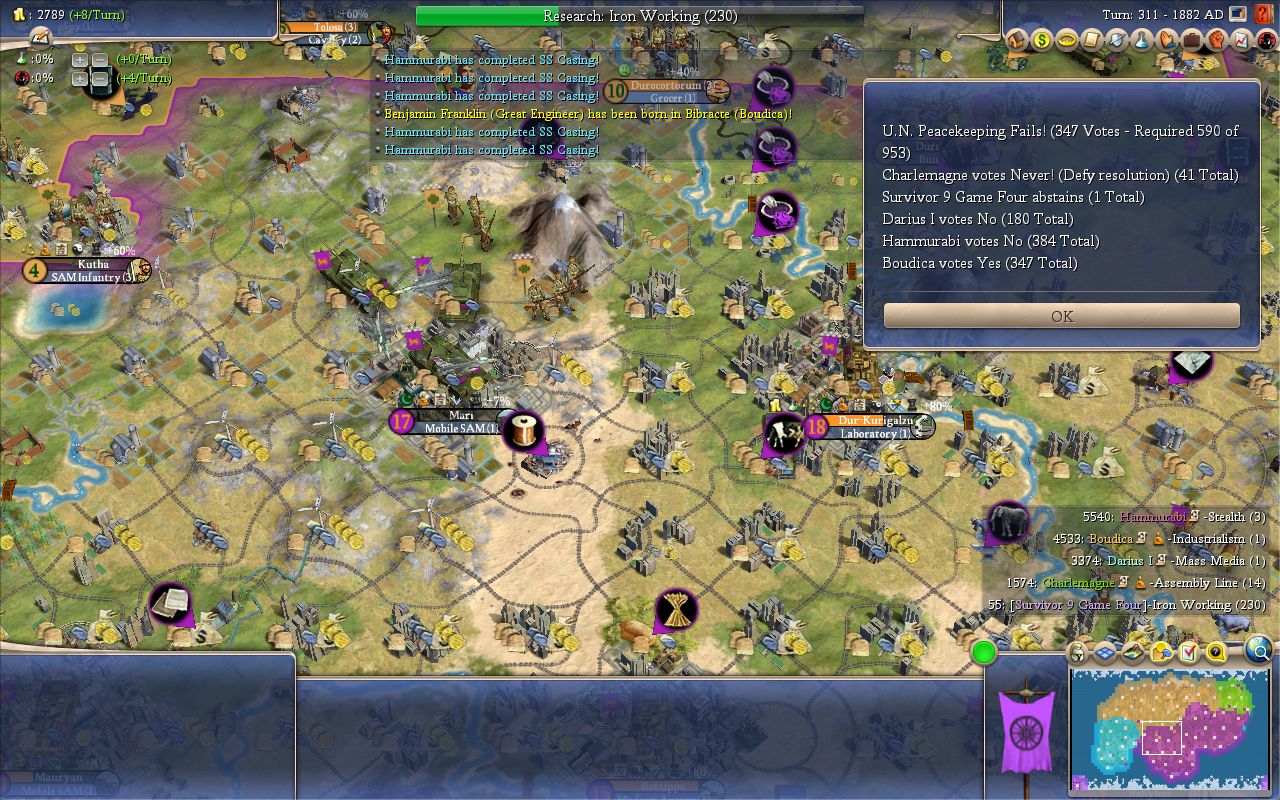
Charlie somehow survived this game.

Peter of Russia
Wars Declared: 27
Wars Declared Upon: 38
Survival Percentage: 5%
Finishes: 1 First, 0 Seconds (5 points)
Kills: 2
Overall Score: 7 points
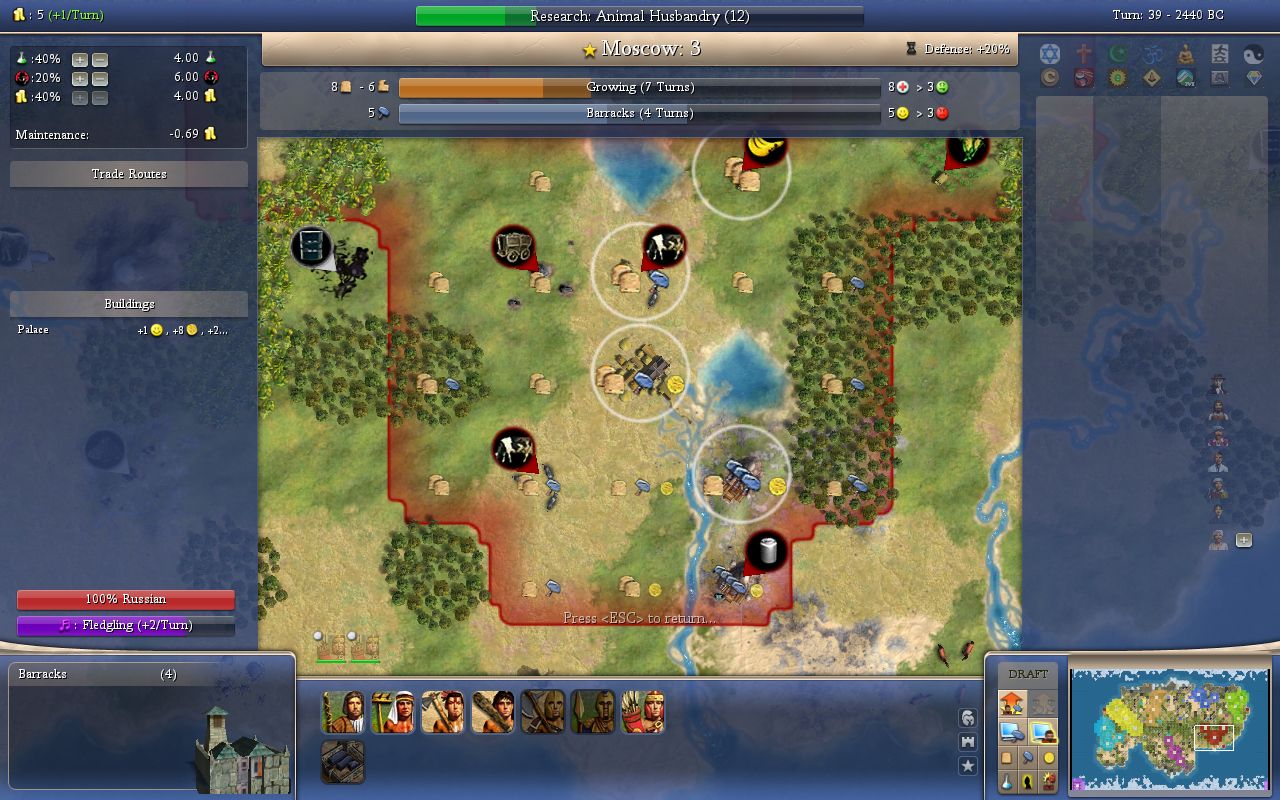
I am still completely flummoxed how Peter won a single game. I truly believe that if I discarded this set and decided to run another twenty games the Russians would be dying every single result. Yes, he had a double plains cow, but with barely any rivers and all of his commerce potential locked behind jungle realistically he had about zero chance. As we saw with Boudica, leaders can sometimes handle bad diplomacy if they have good land. Charlie demonstrated how a leader can manage with bad land but good diplomacy. Rarely can a leader handle bad diplomacy AND land. There was little he could do, as no matter his tech path or expansion rate he would always be the runt after the first 100 turns and it was just a matter of if, not when, he would get run over.
So what happened in that ridiculous Game 9? My recommendation is to just read the game summary, but if you want the short version essentially Hammurabi and FDR, two of Peter's neighbors, had horrible early games, allowing Peter to get much stronger than usual and turn into a military runaway. Even then, he only won due to a Darius throw. That game was Victoria Playoff 2 levels of wackiness, and had that taken place I probably would have retired somewhere to the Great Plains of Kansas and become a cattle farmer.
Bismarck Award:
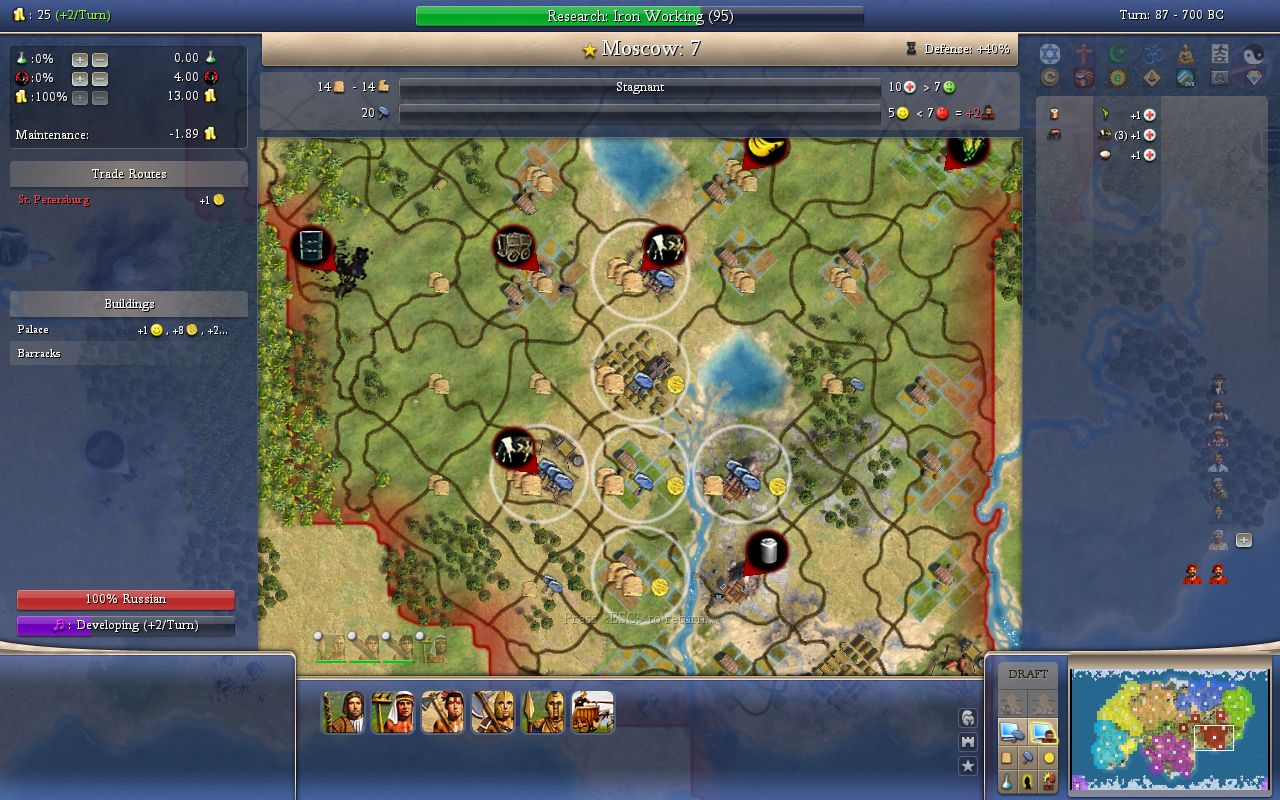
Mad Moscow Disease Award:
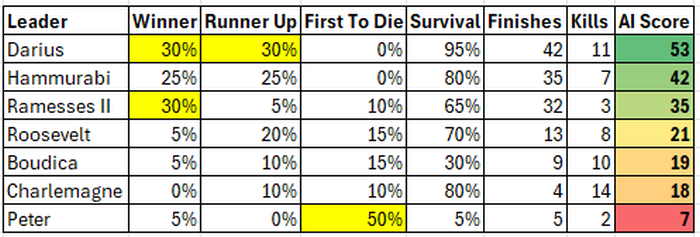
If I had to highlight one unusual aspect of the livestream, it was how all three members of the Big Three were either in contention or had a playoff spot locked up at the same time. In the replays, there was a bit of a Rock Paper Scissors dynamic amongst the Big Three, as Darius would outtech Hammurabi through the Financial trait, Hammurabi tended to steal crucial religions and wonders to squash Ramesses' gameplan, while Ramesses often squeezed Darius with his culture.
We were lucky to get an exciting down-to-the-wire livestream game, as many of these replays were snoozefests (especially after 200 turns). I have noticed a trend of excellent official games being followed up by relatively moribund repeat playthroughs, but hey, as long as the best content is saved for the real thing I certainly do not mind. Thankfully, this scenario had just enough wacky games - Games 6, 9, and 20 for example - to keep things relatively engaging and add some story beyond "builder lala land". There is a reason this game programmed more warmonger personalities, as Civilization IV was not intended to just be sim city (sim empire?) gameplay over and over again.
Click the link above to read full summaries of each individual game!