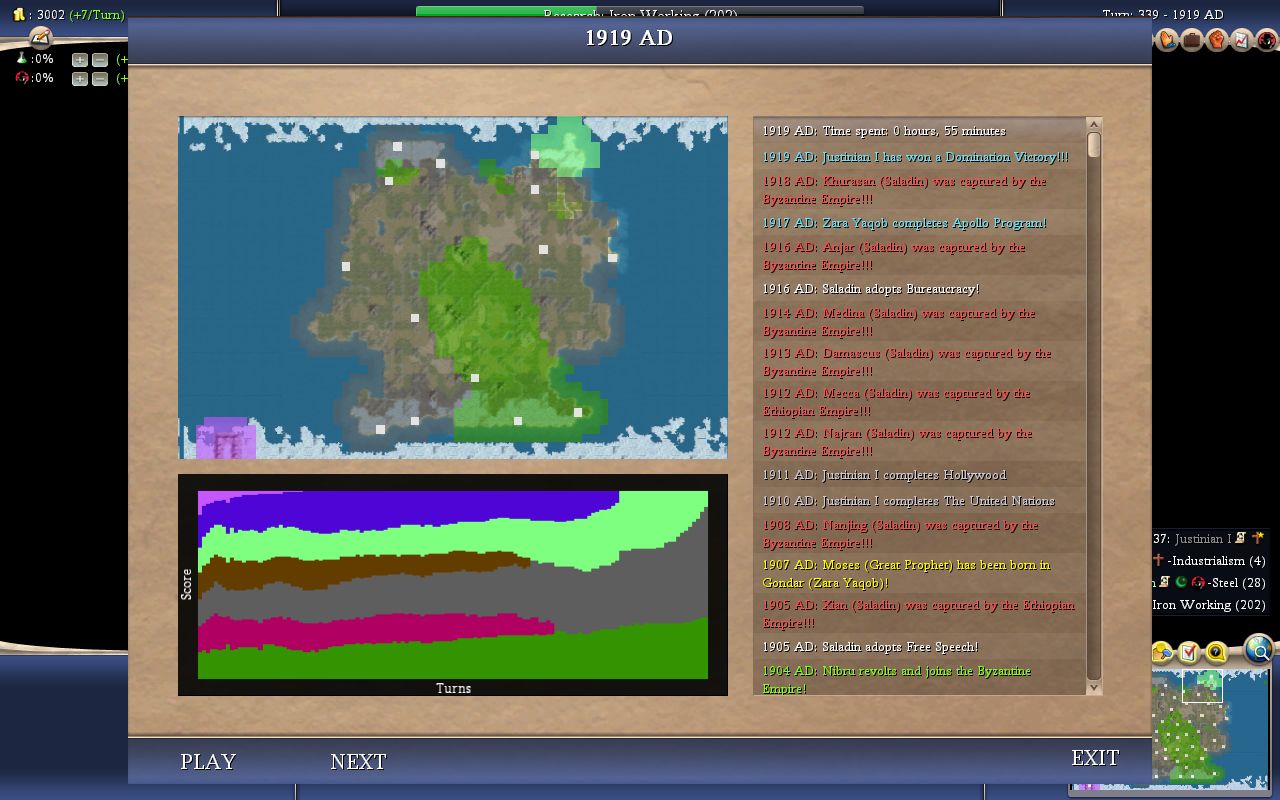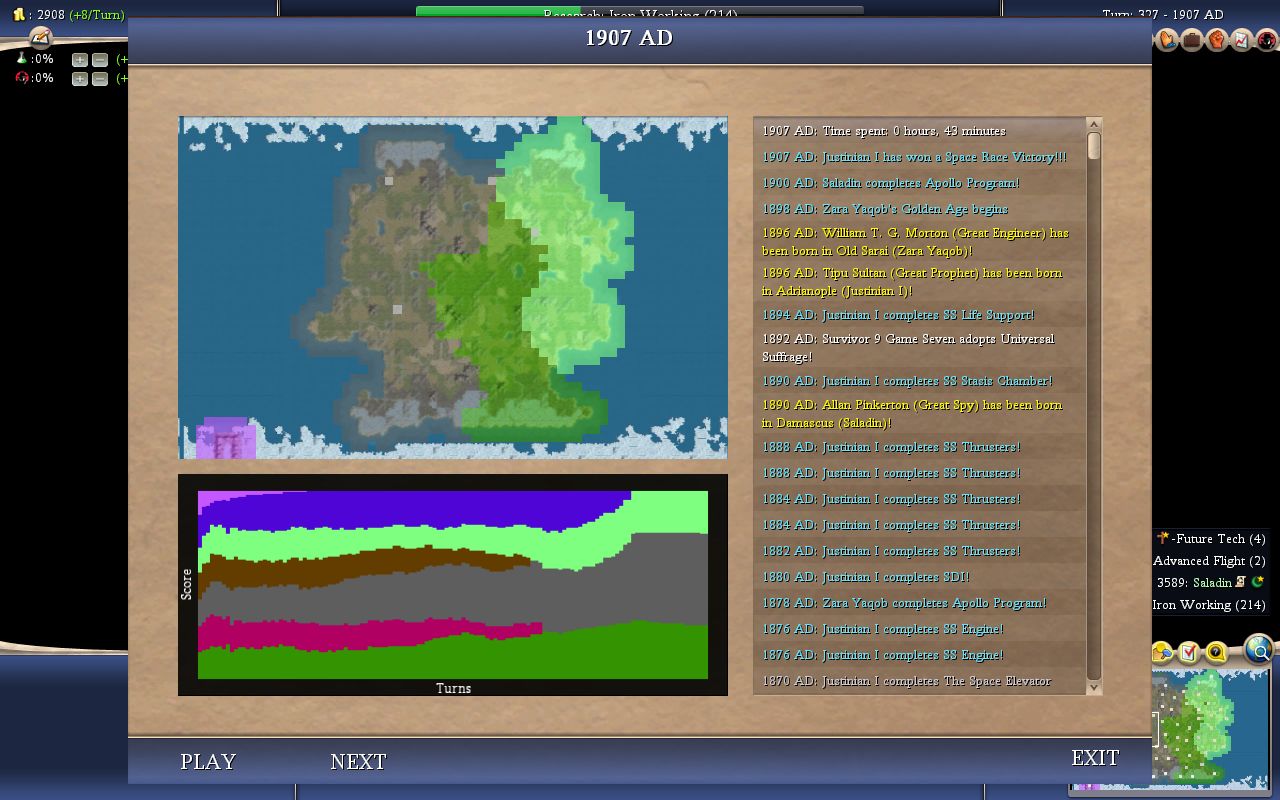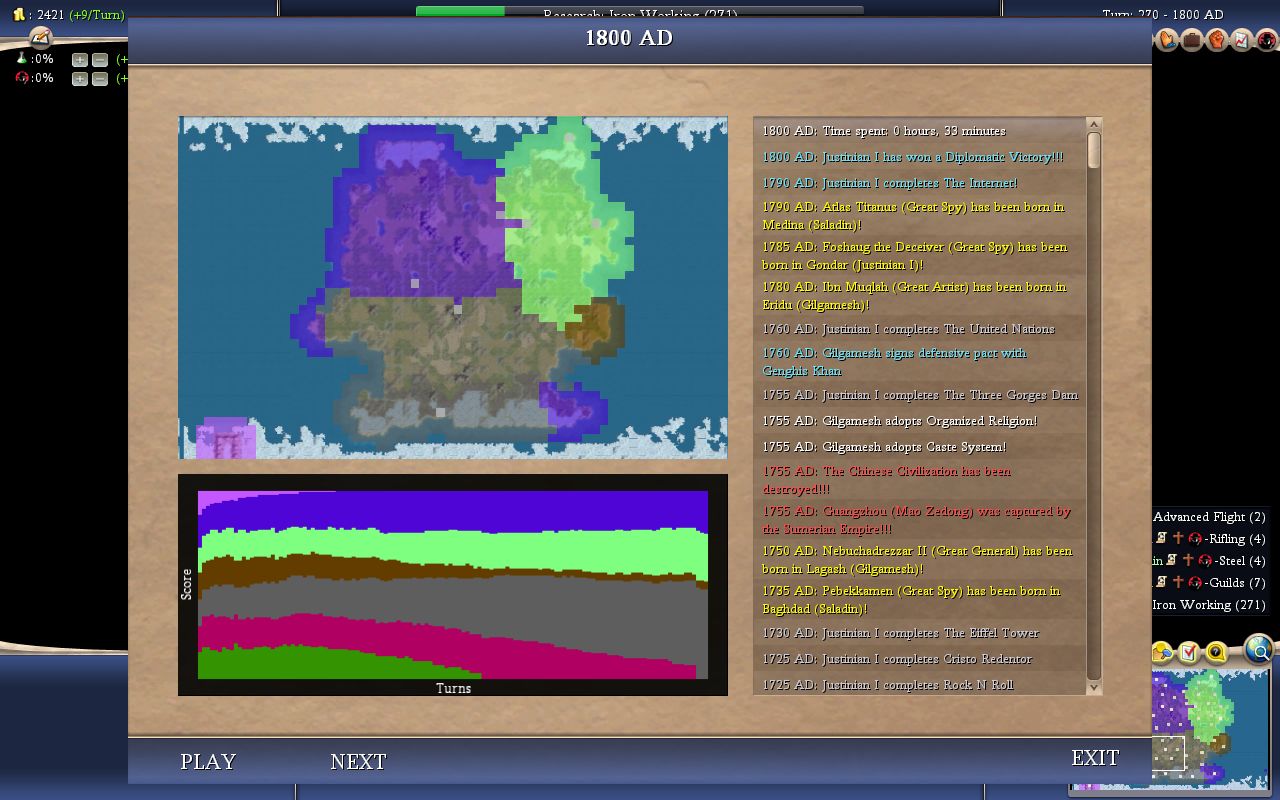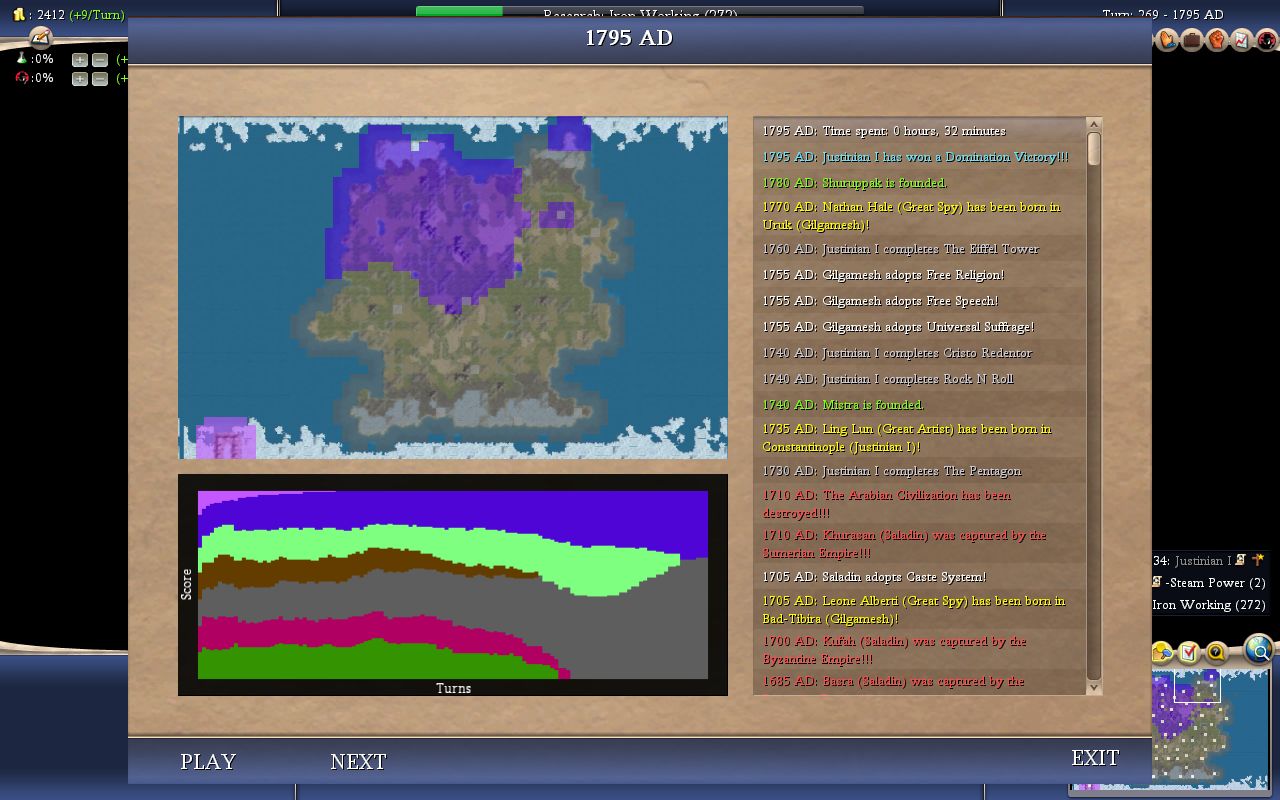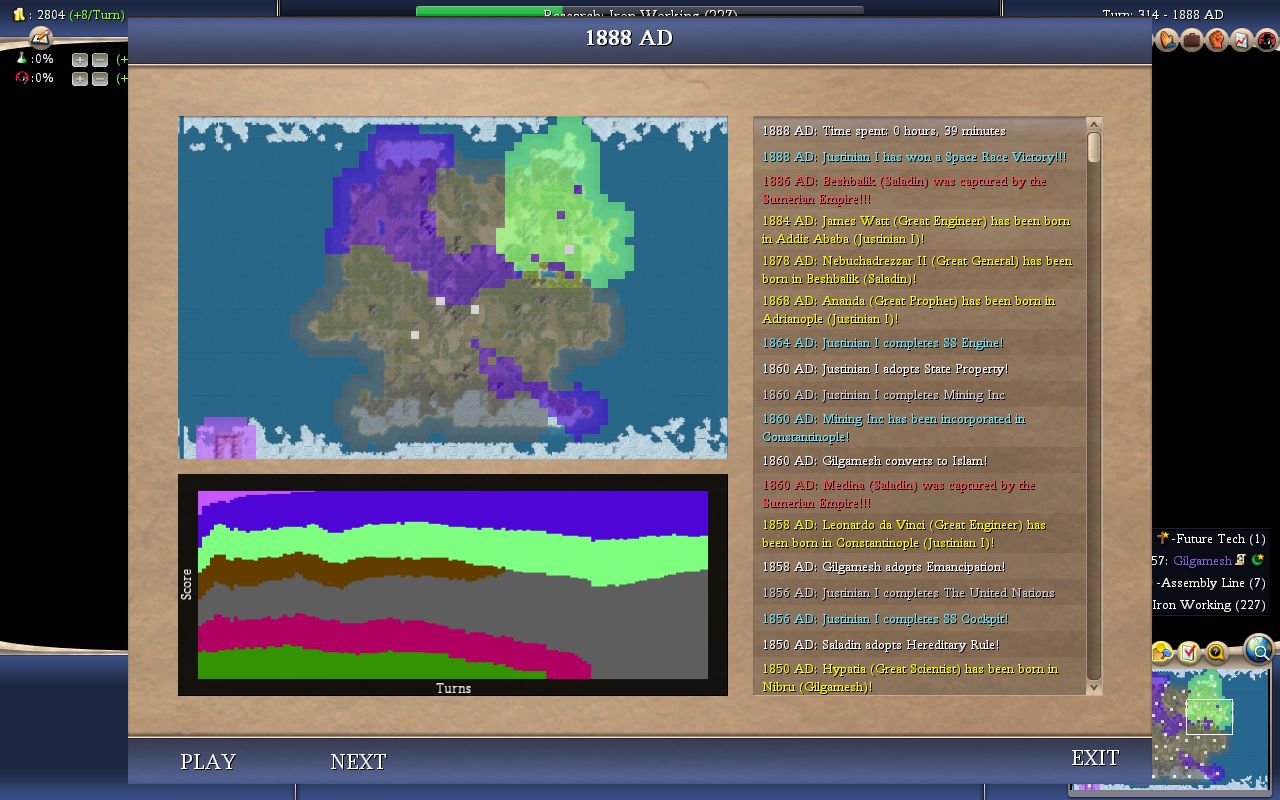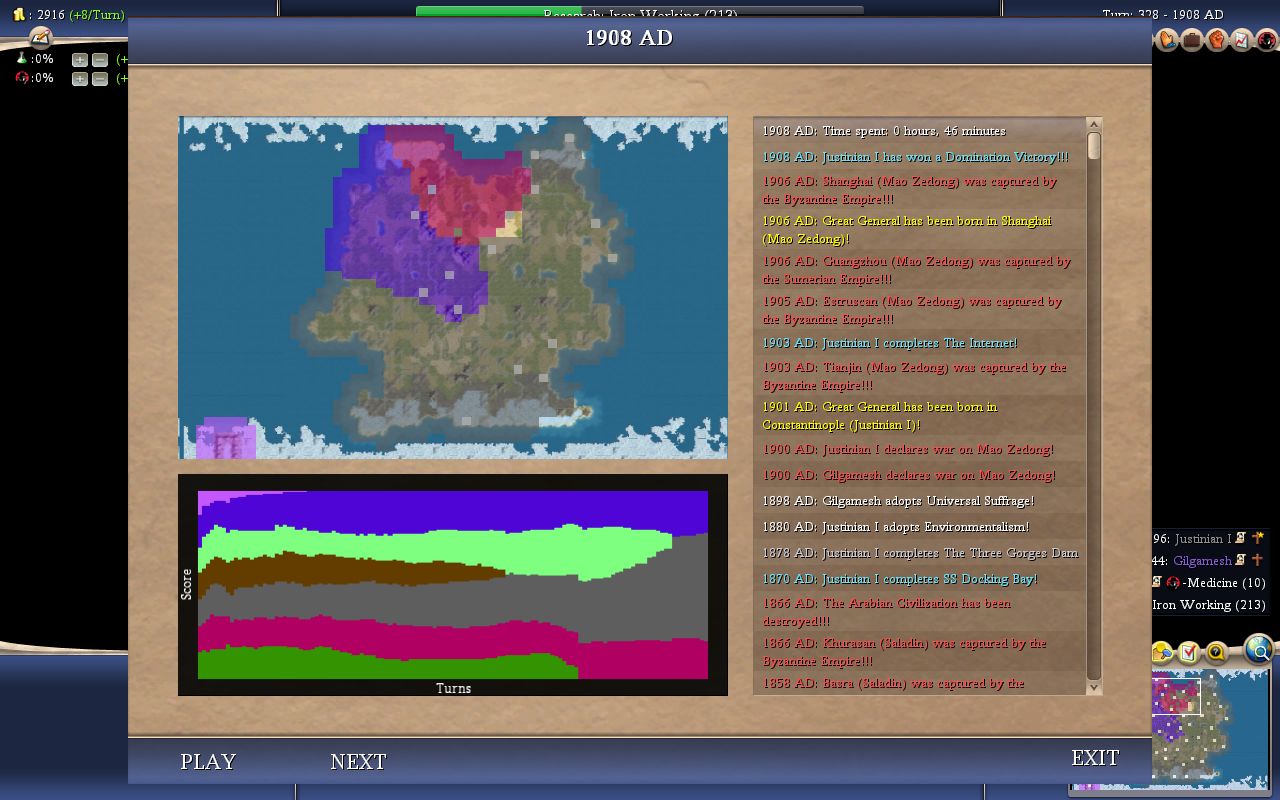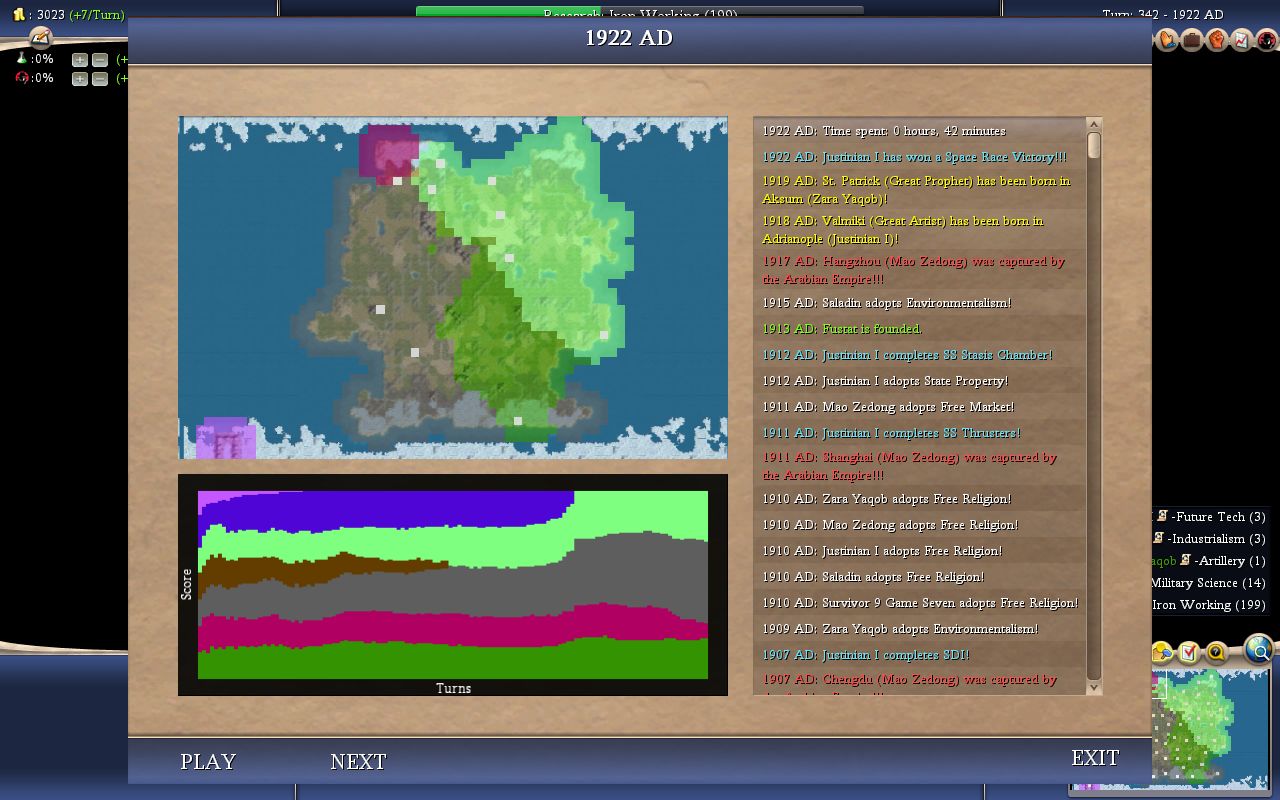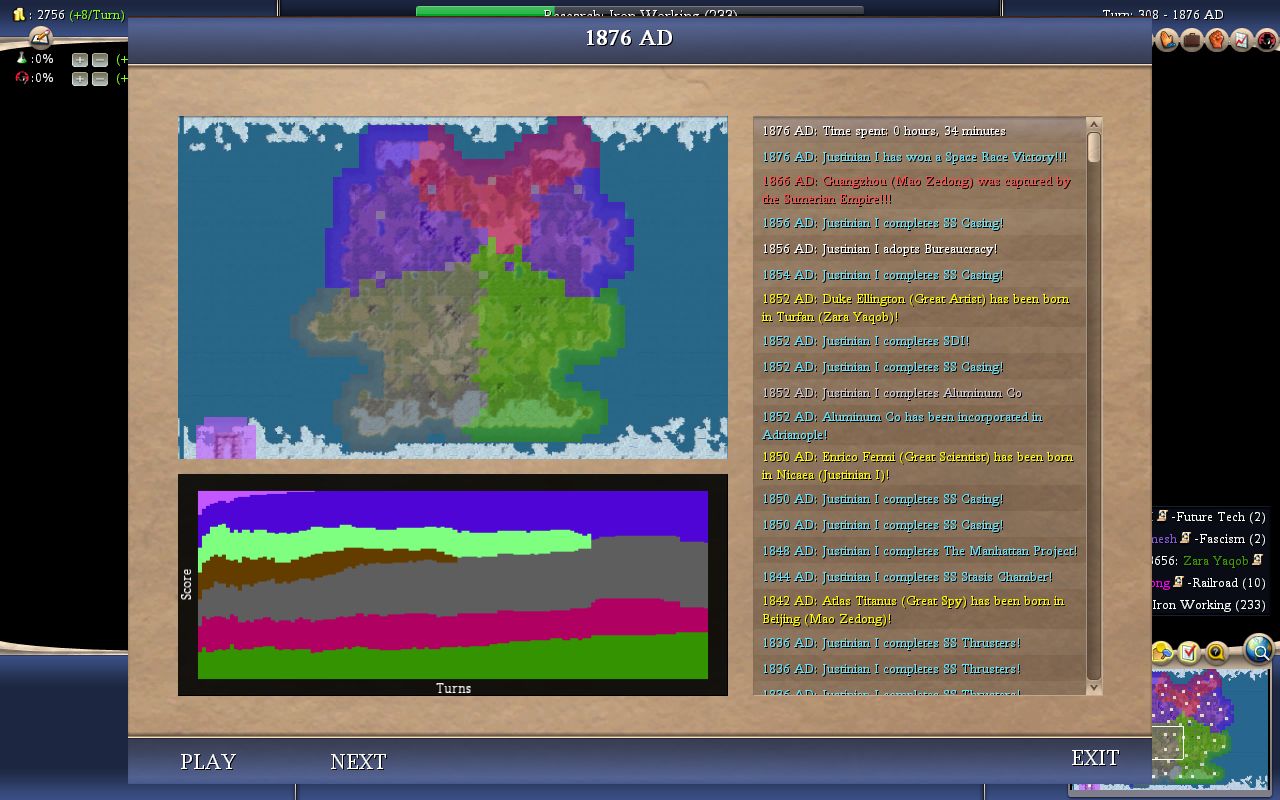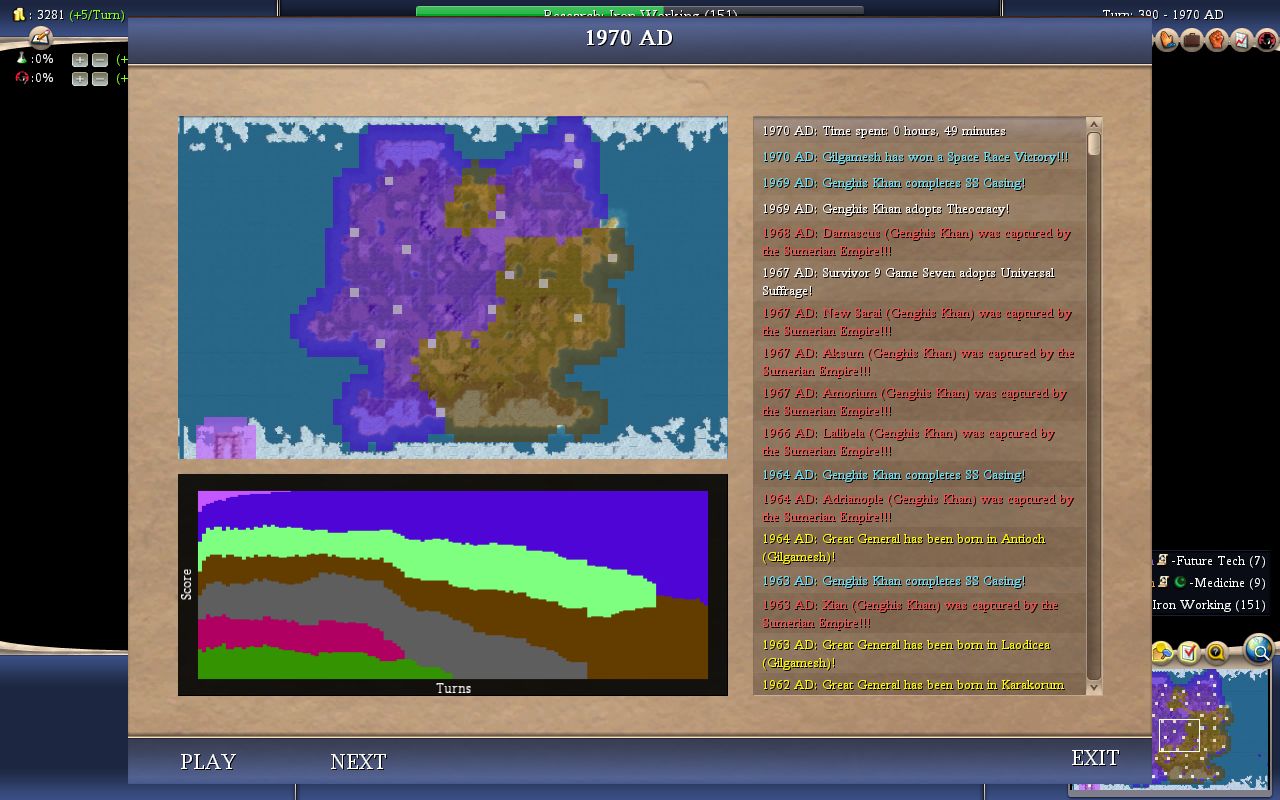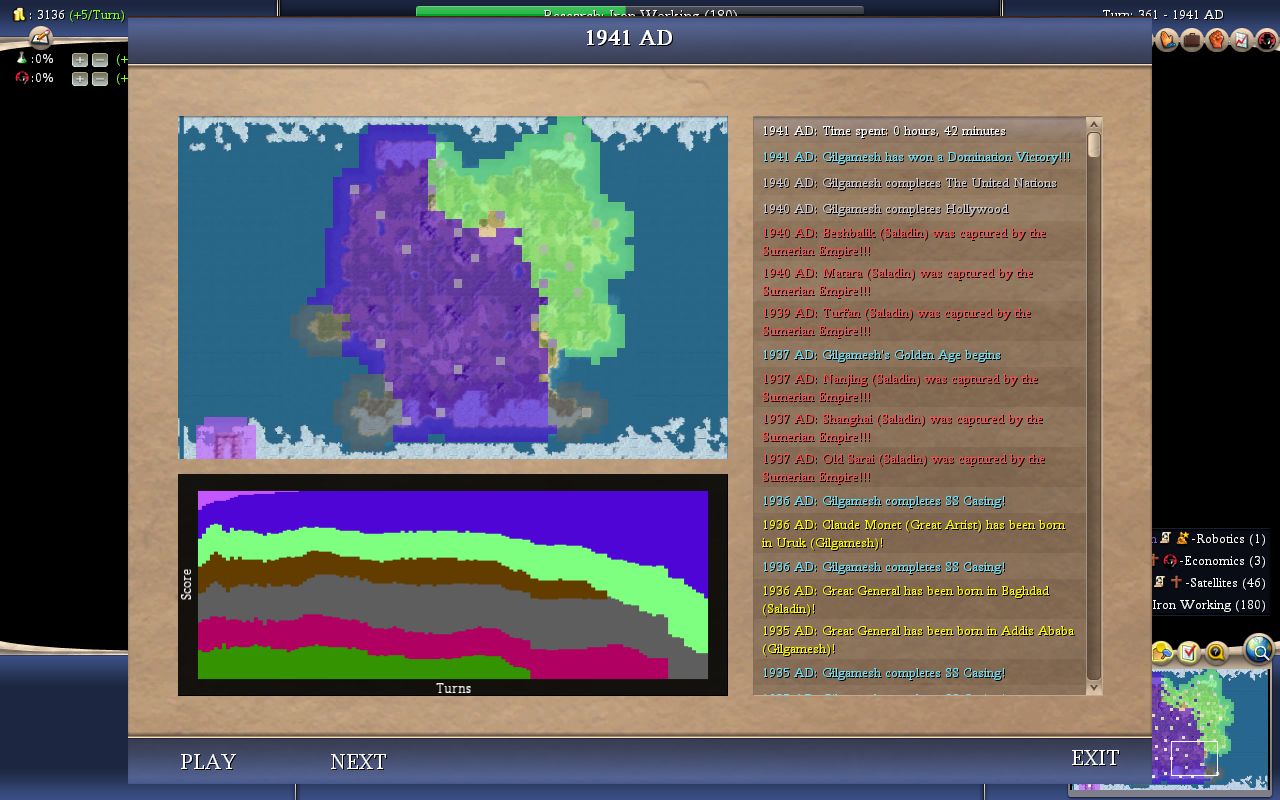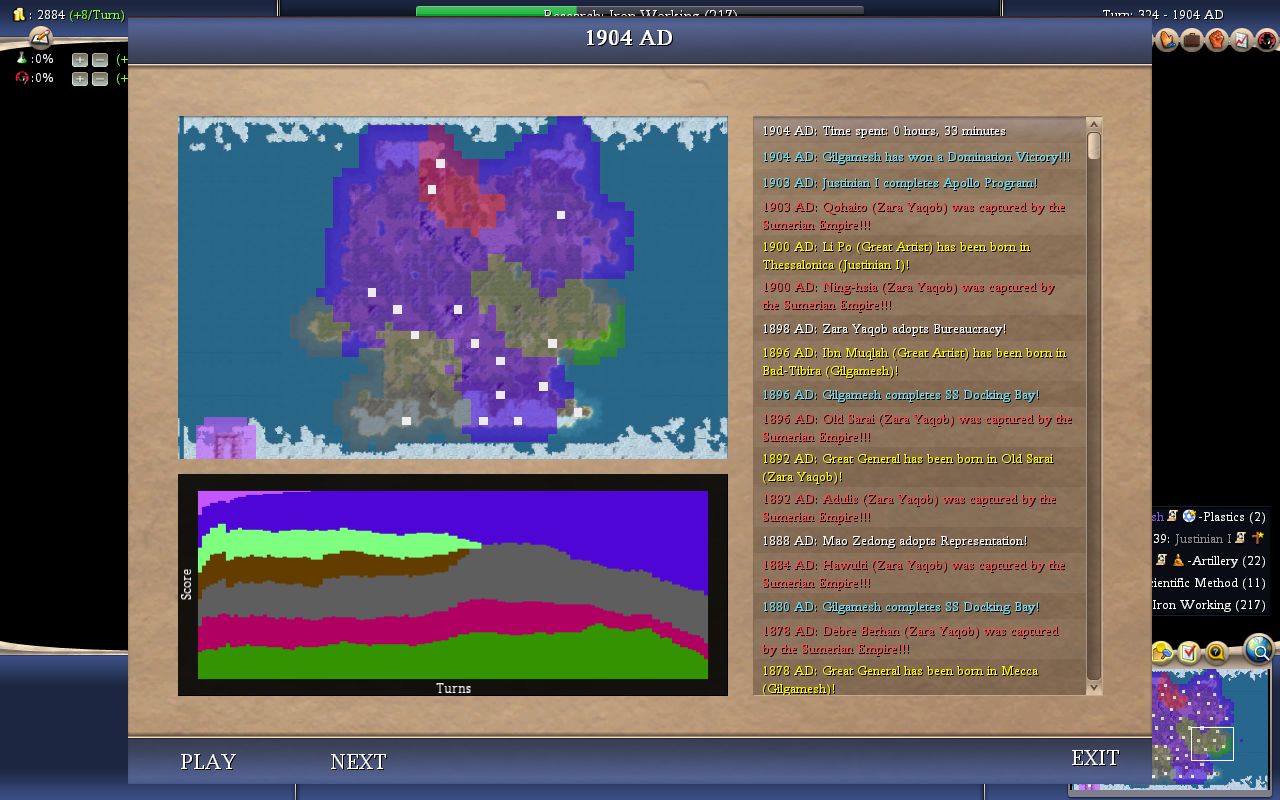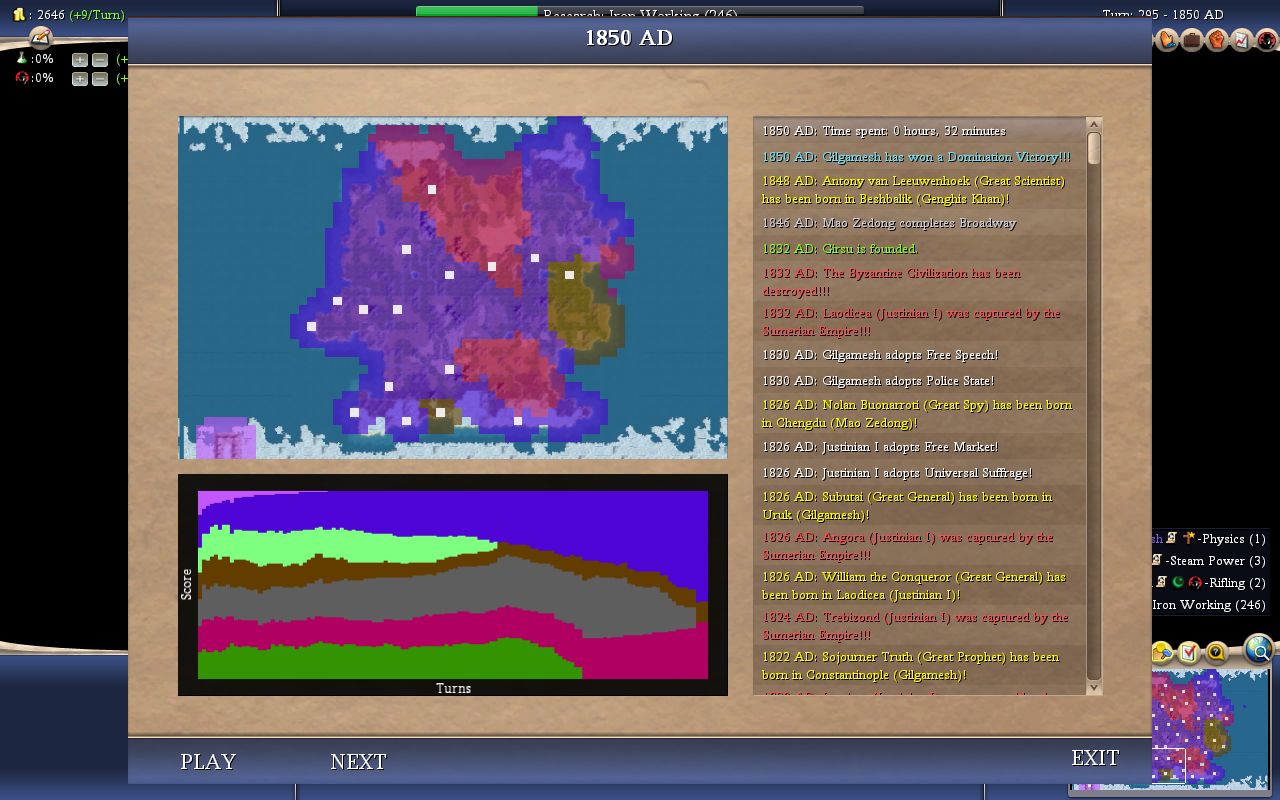
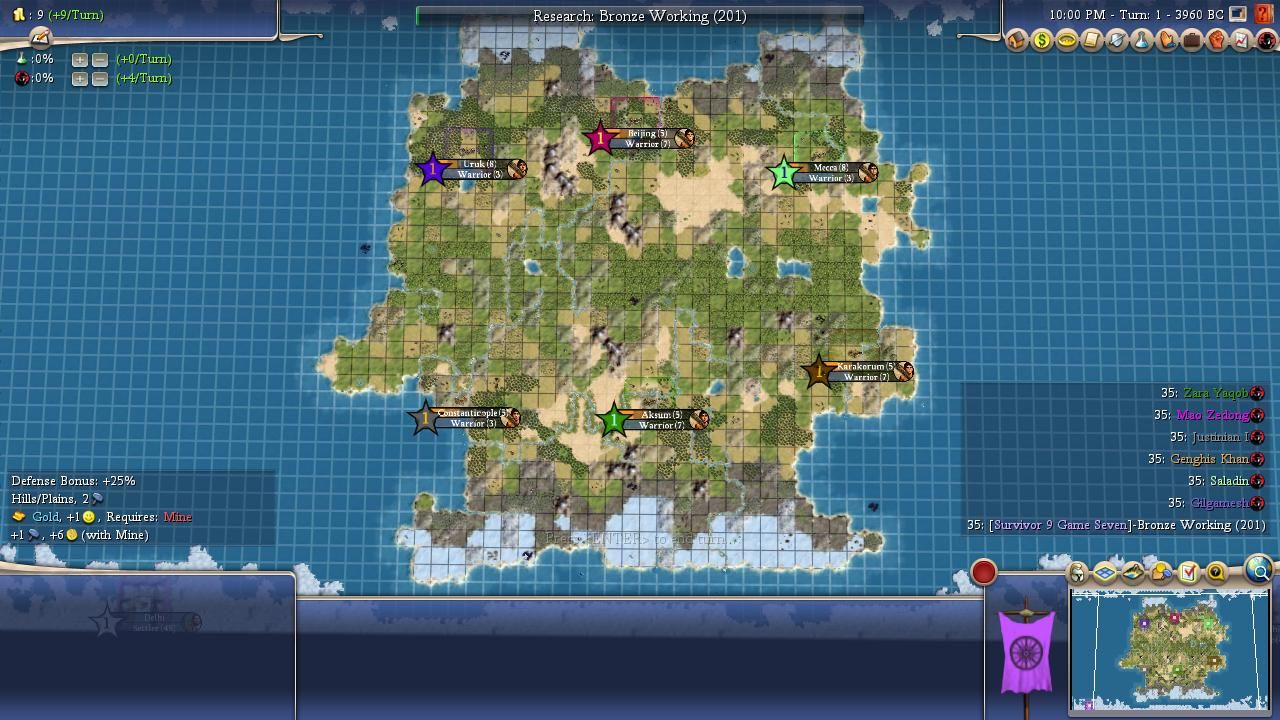
One of the recurring features of past seasons of AI Survivor have been our "alternate histories", running additional iterations on the same maps to see if the same events would play out again. Game Seven was a fascinating duel between Gilgamesh and the paired team of Zara Yaqob and Justinian, with Gilgamesh barely scraping out a Domination victory by virtue of a brilliant peace treaty that allowed him to interrupt Zara's Spaceship attempt. Was that something which would unfold in each game? This was a topic that called for more investigation with alternate history scenarios. Following the conclusion of previous seasons of AI Survivor, I had gone back and investigated some of the completed games and found that they tended to play out in the same patterns over and over again. While there was definitely some variation from game to game, and occasionally an unlikely outcome took place, for the most part the games were fairly predictable based on the personality of the AI leaders and the terrain of each particular map. Would we see the same patterns play out again and again on this particular map?
The original inspiration to run these alternate histories came from Wyatan. He decided to rerun the Season Four games 20 times each and publish the results. The objective in his words was twofold:
- See how random the prediction game actually is. There's a natural tendency when your predictions come true to go "See! Told you!", and on the contrary to dismiss the result as a mere fluke when things don't go the way you expected them to (pleading guilty there, Your Honour). Hopefully, with 20 iterations, we'll get a sense of how flukey the actual result was, and of how actually predictable each game was.
- Get a more accurate idea of each leader's performance. Over 6 seasons, we'll have a 75 game sample. That might seem a lot, but it's actually a very small sample, with each leader appearing 5-10 times only. With this much larger sample, we'll be able able to better gauge each leader's performance, in the specific context of each game. So if an AI is given a dud start, or really tough neighbours, it won't perform well. Which will only be an indication about the balance of that map, and not really about that AI's general performance. But conversely, by running the game 20 times, we'll get dumb luck out of the equation.
Wyatan did a fantastic job of putting together data for the Season Four games and since then we've continued to use the same general format. First we'll post the resulting data and then discuss some of the findings in more detail. Keep in mind that everything we discuss in these alternate histories is map-specific: it pertains to these leaders with these starting positions in this game. As Wyatan mentioned, an AI leader could be a powerful figure on this particular map while still being a weak leader in more general terms. This particular set of alternate histories were run by TheOneAndOnlyAtesh - many thanks for spending so much time on this task!  Now on to the results:
Game One | Game Two | Game Three | Game Four | Game Five
Game Six | Game Seven | Game Eight | Game Nine | Game Ten
Game Eleven | Game Twelve | Game Thirteen | Game Fourteen | Game Fifteen
Game Sixteen | Game Seventeen | Game Eighteen | Game Nineteen | Game Twenty
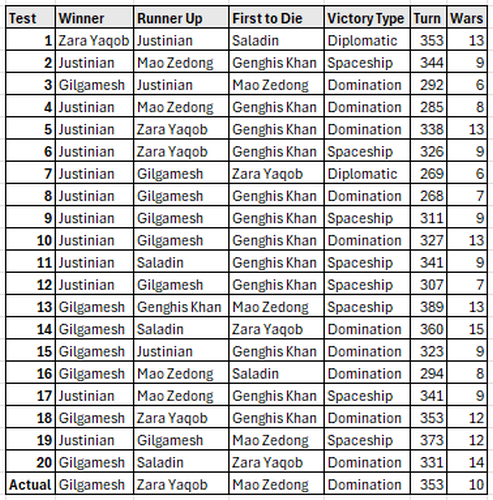
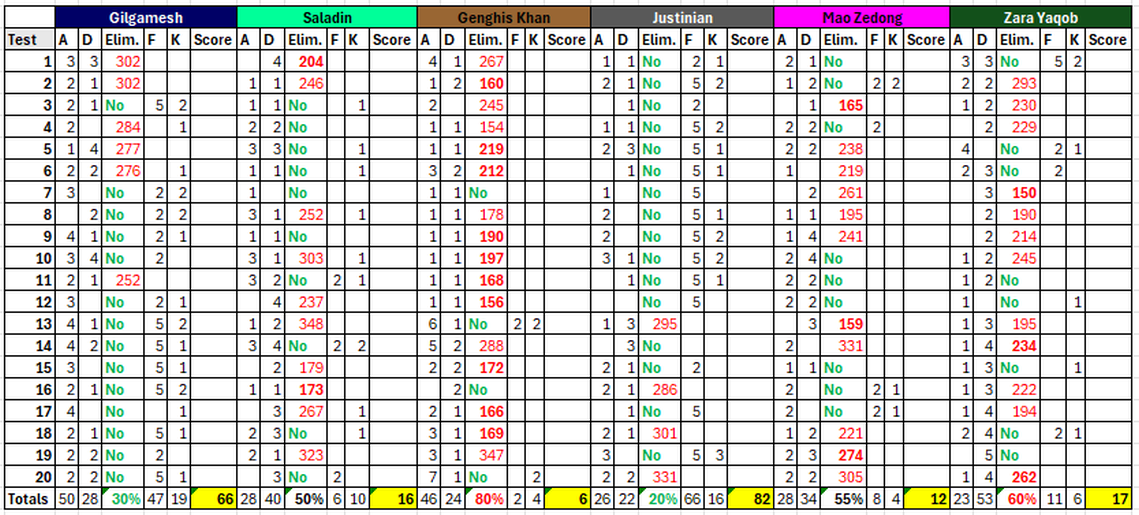
(Note : "A" column tracks the number of war declarations initiated by the AI, "D" the number of times the AI is declared upon, "F" the points for finish ranking, and "K" the number of kills.)
TheOneAndOnlyAtesh: Despite the incredibly lopsided results in favor of just two leaders, Justinian and Gilgamesh, this set turned out to be even more interesting and harder to read than I was expecting. Let's just say, I was absolutely flabbergasted at the 9 game winning streak that Justiniain had here. Based off of the eye test and the livestream, there was no way Justinian could have been THAT dominant. It was not like he had somehow rolled an extremely favorable peaceweight setup, as I had run every single game from a new Worldbuilder save in order to reroll each leader's peaceweights when starting the next game.* This was especially critical in this map, as these leaders listed peaceweights were relatively bunched up and there were two rather important leaders here in Justinian and Saladin who could not plot at Pleased.
* In any game, a leader can roll up to two above their listed peaceweight. For example, Justinian (listed PW4) could have a PW5 or PW6 for a specific game. When rerunning games, however, in order to randomize peaceweight rolls you have to start each new game from the WORLDBUILDER save. If you run every game from a regular save, all twenty games will be played with the peaceweights from Game 1, which can skew results - it makes a significant difference where all the Pleased and Friendly thresholds are.
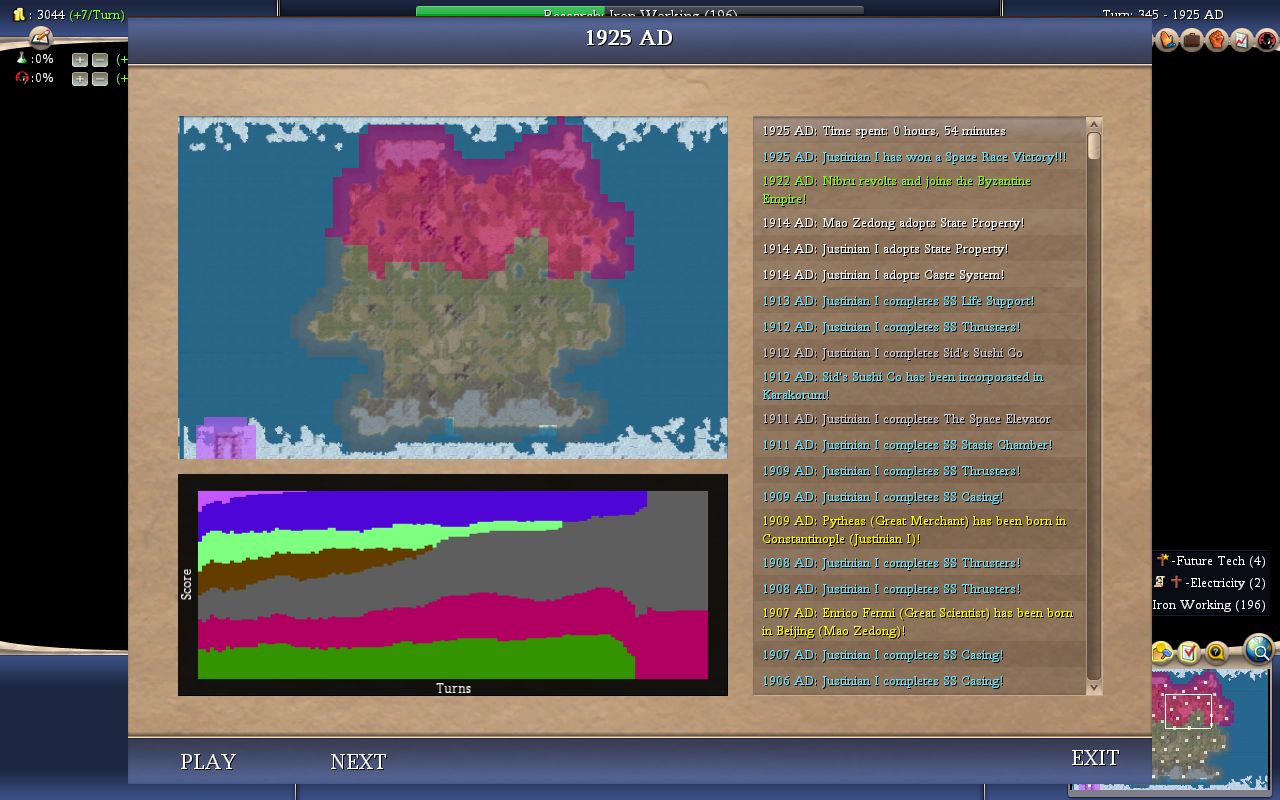
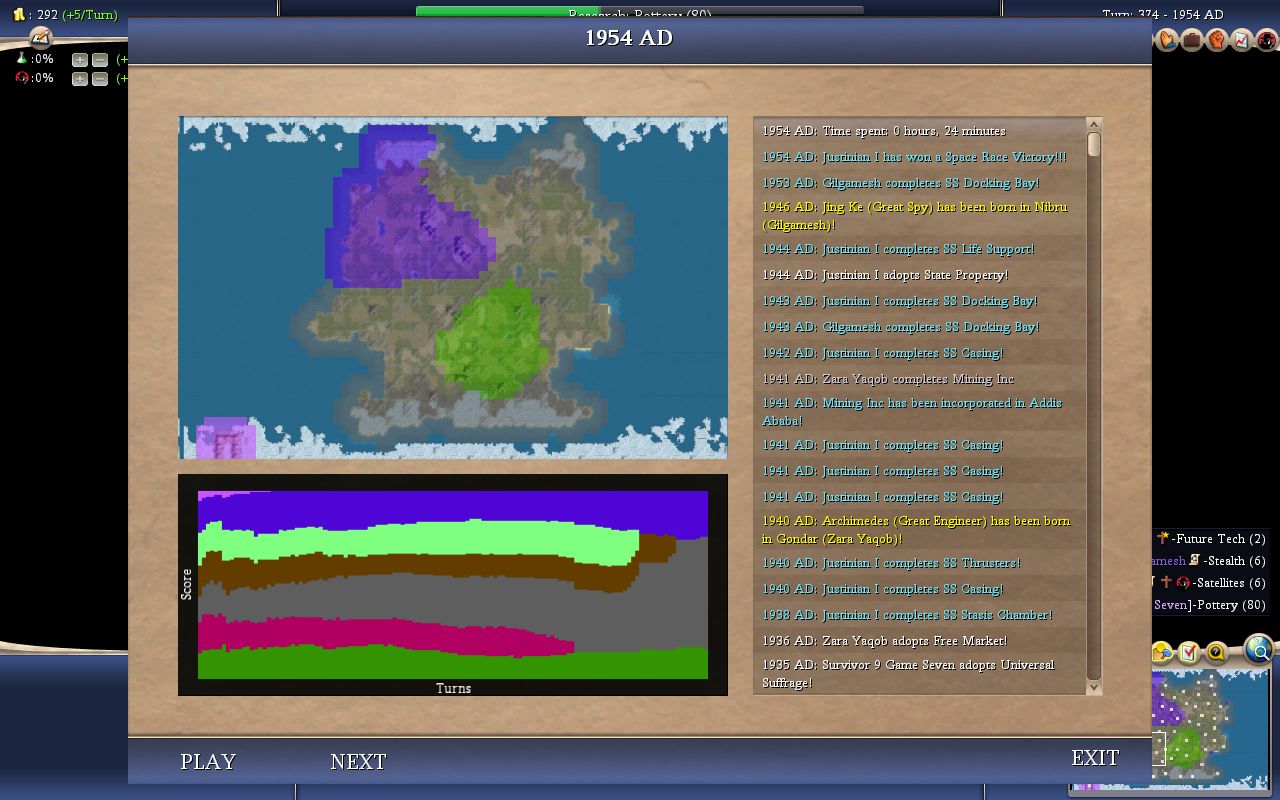
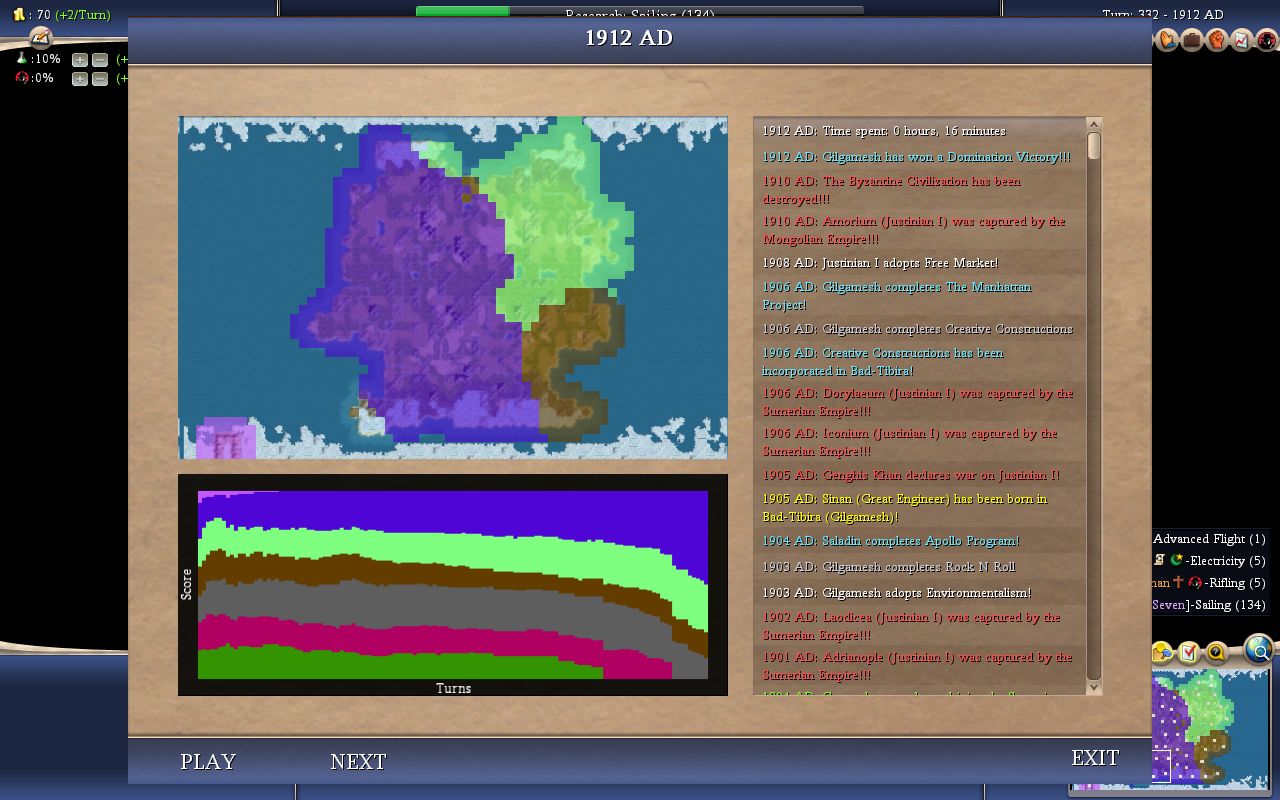
However, following a particularly comical Game 12 win where Justinian dusted out the Darius playbook and won a Turn 307 Spaceship victory without firing a single shot, GILGAMESH, the actual game winner, embarked on a four game winning streak in which he looked like the map's real power player. The Sumerians largely dominated the final third of this set, Justinian only winning twice and managing one second place finish over that stretch. Because of this, while Justinian was the highest point scorer here and did have an impressive twelve wins and a 75% advancement rate, I cannot yet ascertain who the stronger of the two is, and (as will be discussed in the individual leader sections) my guess would be that their true power levels were close to equal.
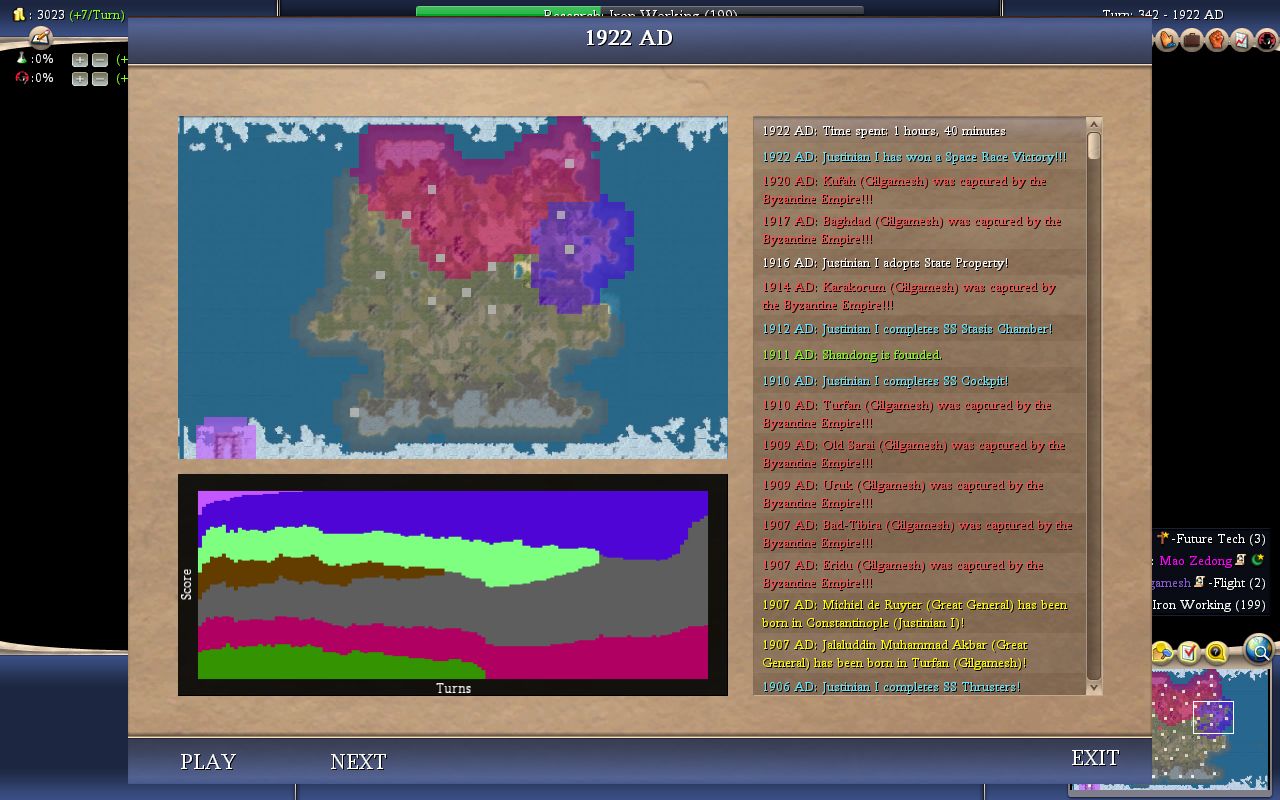
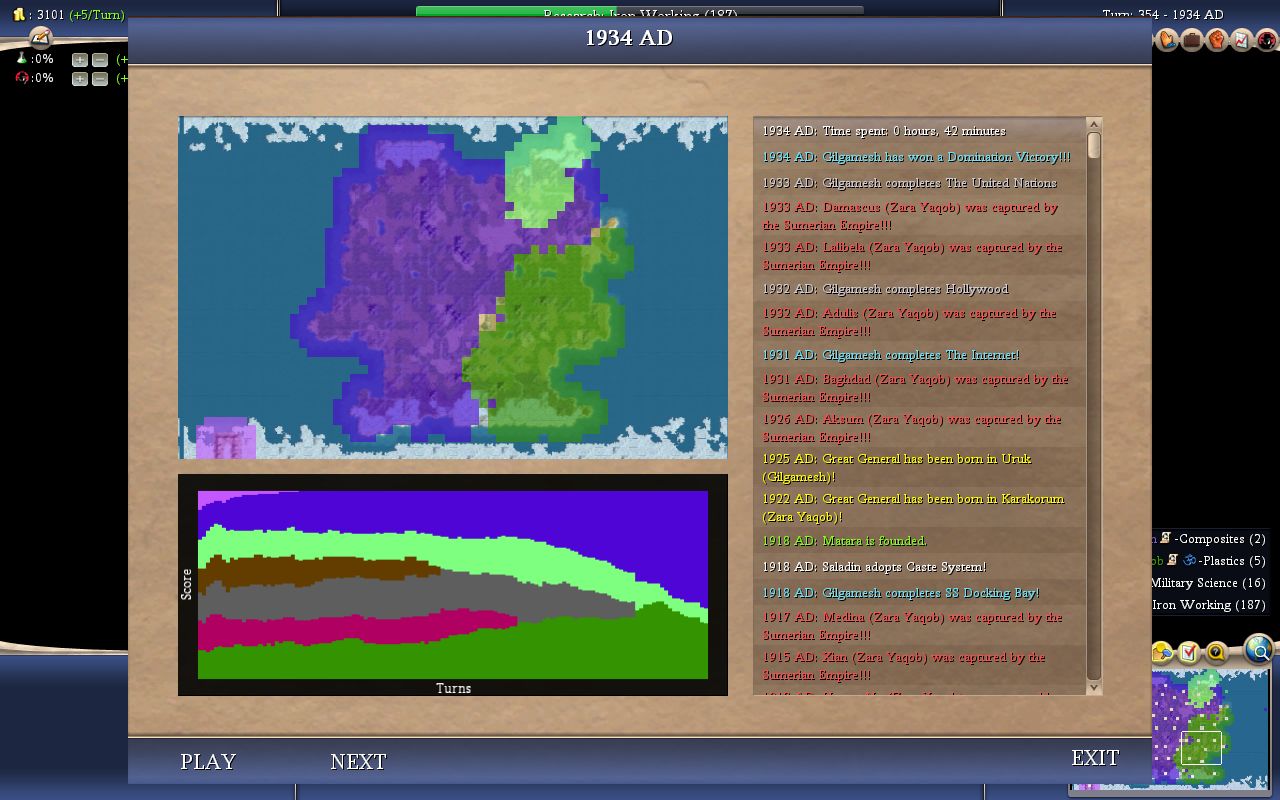
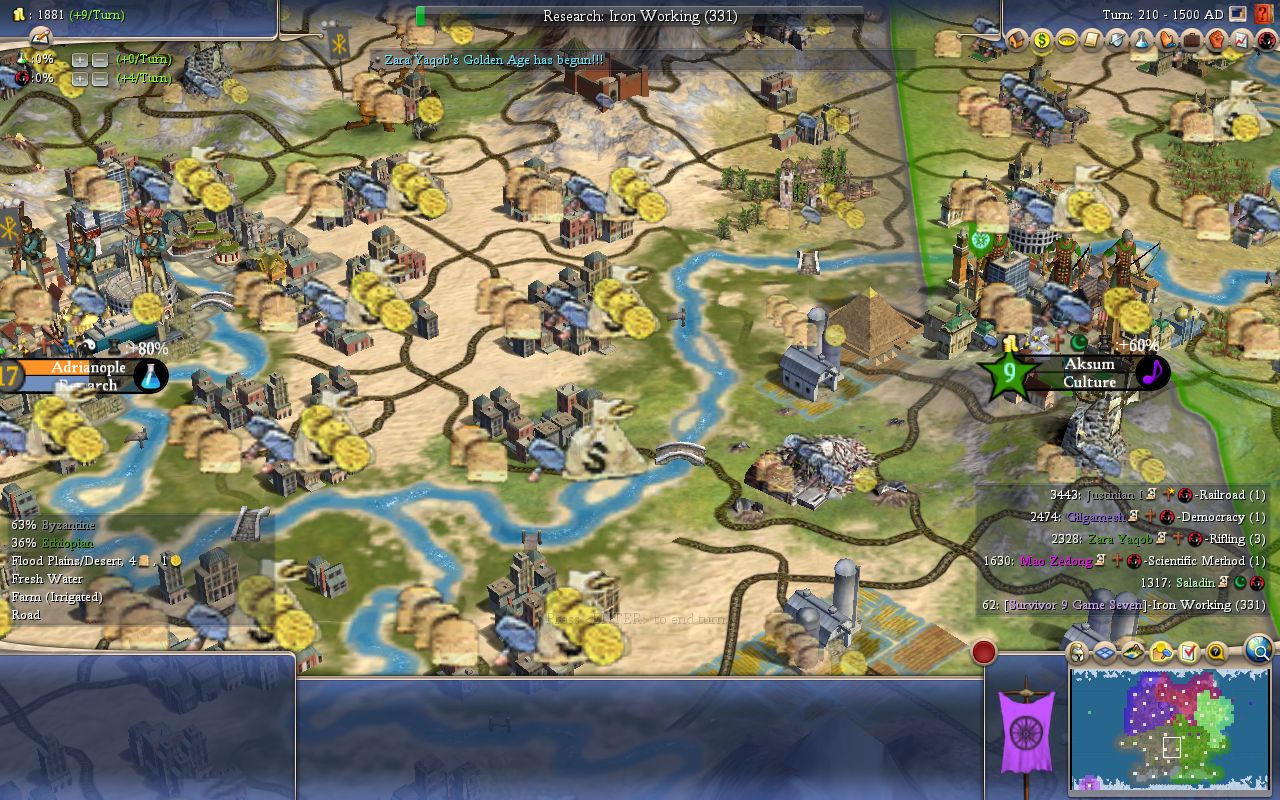
So why were these two so dominant to the tune of winning 19/20 games? Simply put, there were two factions in this map: the theocrats (Justin, Sal, Zara) and the dogfighters (Gigs, Mao, Genghis), and Justinian and Gilgamesh were by FAR the strongest leaders amongst their respective peer groupings. The theocrat's games revolved around religion, culture, and economy, and Justinian naturally was the best at juggling all three while still being a factor militarily. In fact, his total irreligious nature in the livestream turned out to be EXTREMELY abnormal, as he founded one of the early religions in literally every replay, and typically collected many of the post-Monotheism religions as well. While he did open some games with an Animal Husbandry beeline like he did in the real game, he quickly circled back to religion upon doing so. In the livestream, with Justinian completely ignoring religion, Zara took that mantle instead, causing the Byzantines to get squeezed into becoming a second rate power for the entire game. In the replays, with Justinian actually playing in an Orthodox manner, he was the cultural monster, even when going up against Stele culture:
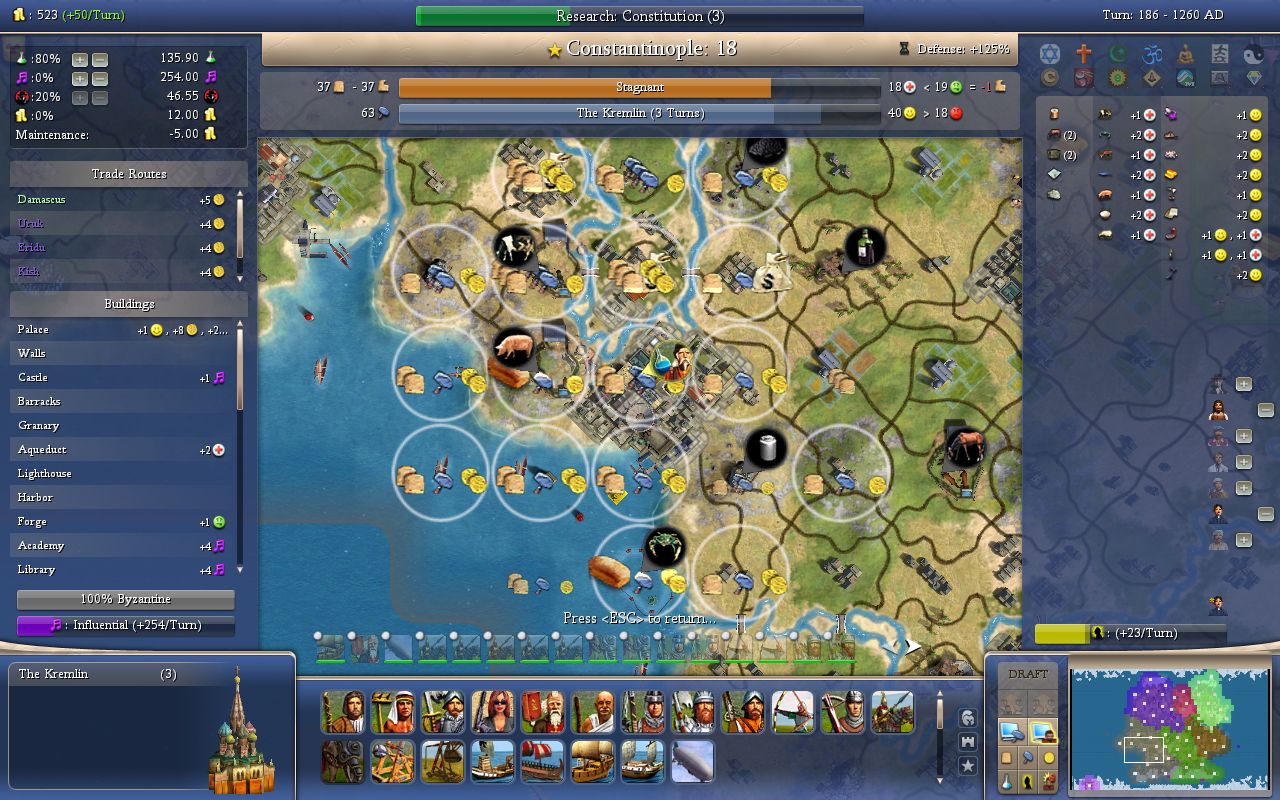
Moreover, Justin almost always built the Great Lighthouse and Colossus (like in the livestream), and when combined with shrine income, he was an economic powerhouse who pummelled his way through the tech tree over and over again:
Regarding the other theocrats, Zara's land was just not great to start with (for reasons that will be expounded on in his section), and he constantly fought early wars with Genghis that prevented his empire from taking off. Furthermore, much of the theocrat playbook was unavailable to him, as Zara having a religion usually meant that Justin would also have one, spread it to the Sumerians, and thus put him at odds with at least one of the two power players. While Zara was the only leader outside of the Dynamic Duo to win a game (or even threaten to win another), results wise he was not that much better than Saladin and Mao, generally grading out as mid like those two. Note that Zara was not at all likely to be First To Die, as his diplomatic position was better than initially thought due to religion/civics, and his two natural enemies were not strong enough early to be any sort of existential threat. Most of Zara's deaths came relatively late and at the hands of the big two or the third dogpile. Meanwhile, Saladin's setup was just sad, as the Arabian lands were NOT good and he always founded Medina in the same backline coastal spot, causing him to have a tough time spreading Islam. He was pretty much playing for 2nd place from T0. With that said, Saladin was better at playing for 2nd than the results indicated and this set actually found some tragicomical ways to screw Saladin out of a playoff spot.
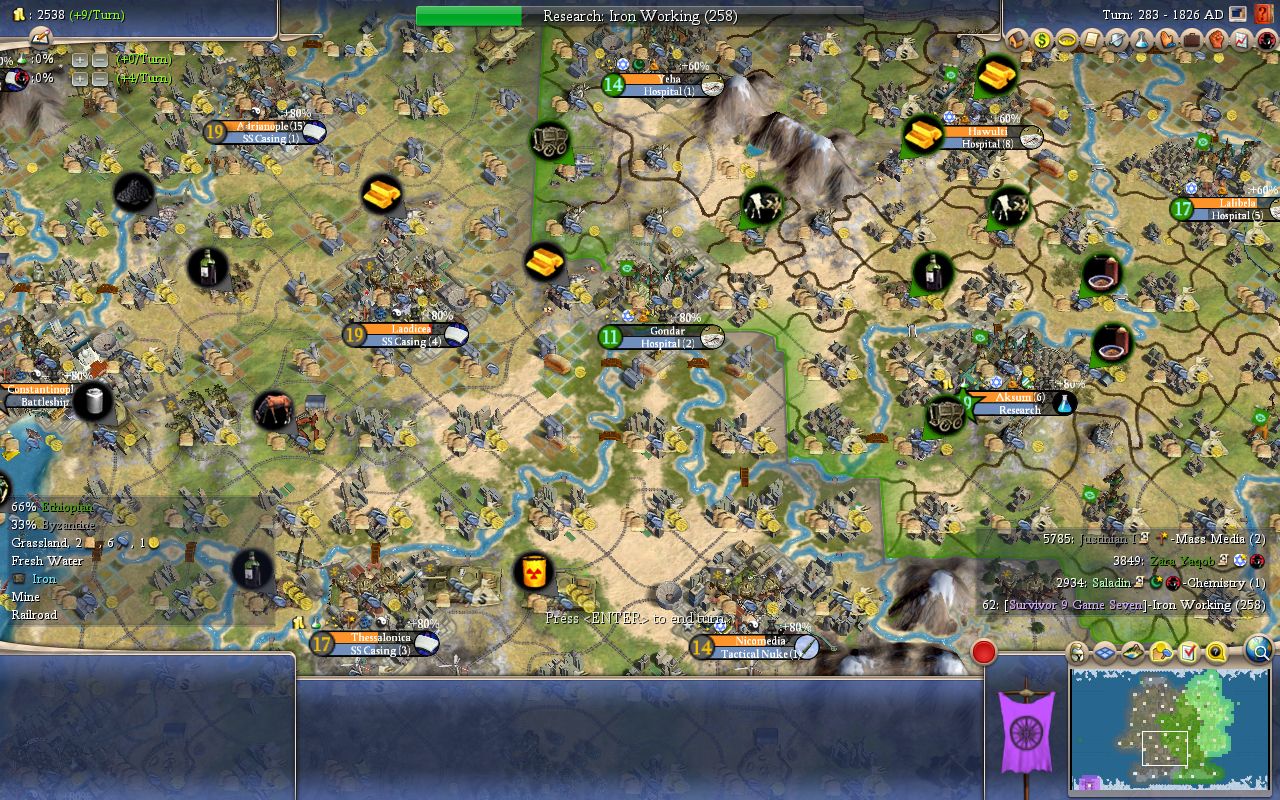
Something to note is that if the theocrats had made it to the midgame, they tended to work together even when following different faiths, as the Theocracy civic indeed did turn out to be a key factor in diplomacy. The three theocrats had close peaceweights, could not plot at Pleased in the case of Justin and Sal, and granted an intrinsic +4 from warmonger respect and base relations in the case of Zara. One game where this was especially apparent was Game 6, in which the three formed an unstoppable Theocratic lovefest while being the respective leaders of, amusingly, the three Abrahamic religions:
Conversely, the three dogfighters were more than happy to betray their religious brethren and generally tried to win through, well, fighting, and Gilgamesh was naturally the biggest and baddest dog. Part of this was due to his land, which many, myself concluded, had clearly underestimated; whatever his land may have lacked was compensated for by sheer quantity, and Gilgamesh was ruthlessly efficient at wiping out barb cities, often taking them out within 5-10 turns of them spawning. This meant they were pretty much guaranteed 10-12 cities, and Ziggurats meant they rarely had trouble with empire maintenance. The other reason was, as a foil to Justinian, Gilgamesh was also able to compete culturally with the theocrats. Oftentimes, he would expand peacefully, play along with the religious nonsense for as long as it was convenient for him, and then find the right time and target to begin his quest for global domination. If Gilgamesh was ever able to absorb one of his neighbors or nab the Great Lighthouse (which had the added effect of bringing his biggest rival down to earth), god save the rest of the field. Imagine how dominant his actual win would have been if he did not get same turned to that wonder!
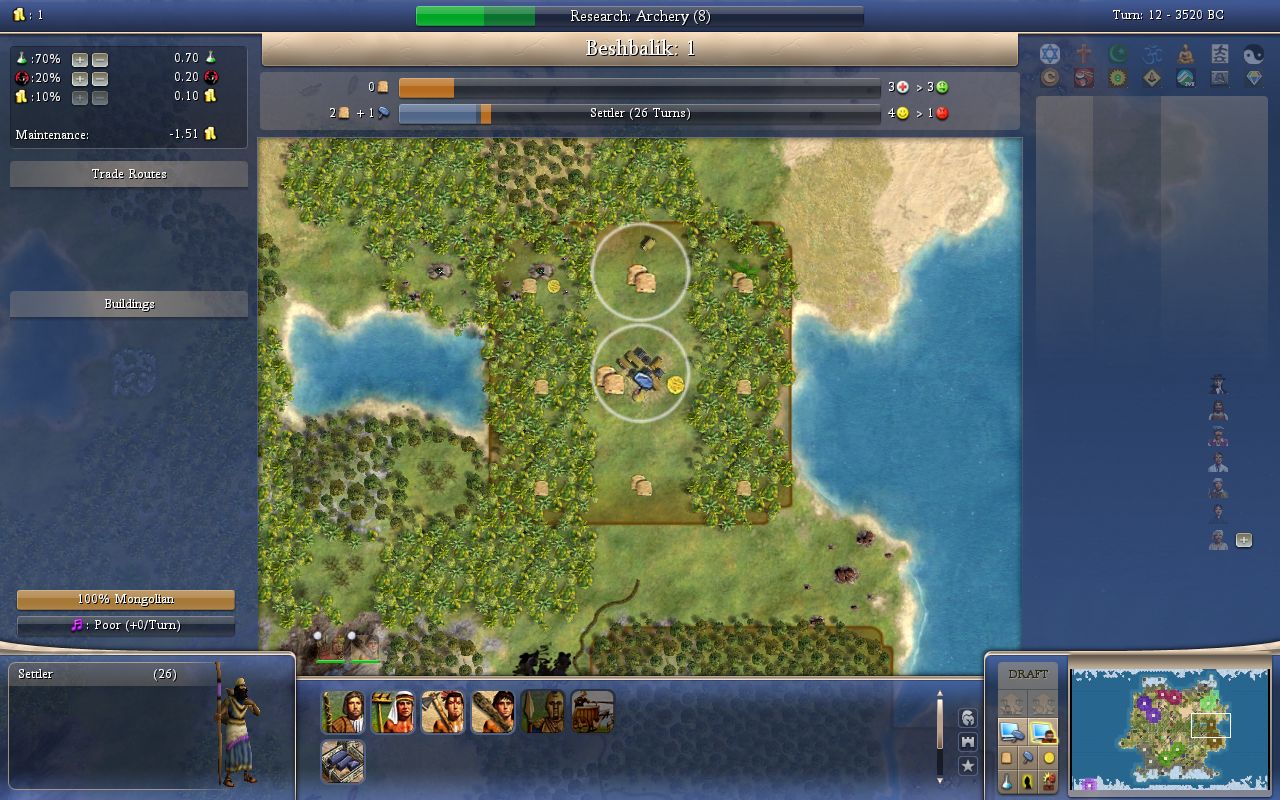
Regarding the other warmongers, Mao had the Zara problem, often getting squeezed by his more dominant western neighbor while generally being worse at executing the same gameplan. Mao was a lot more credible than one may have expected, however, and many of Justinain's best games came when Mao was able to be a major thorn in Gilgamesh's side. Genghis, meanwhile, had Saladin's bad land, being handed a terrible starting position prone to bouts of Hannibalism:
In most games, the first 150 or so turns would see Justinian and Gilgamesh work diligently in their respective theocrat and dogfighter gameplans. Usually, the two shared the same religion, which, alongside shared civics and/or mutual military struggle bonuses meant they were typically allies in the early and mid stages of the game. Usually though, around the Rifling Era, the game would diverge into four endings. I list them below from most to least common:
1) The Orthodox Ending (Justin 1st, Gilgamesh 2nd, six games). This was the default, or as they say, "canon" ending. Here, Justin and Gilgamesh would both remain friends, but when both leaders were strong, Justin's tech lead would make him the stronger partner in this arrangement. From there it was just a matter of watching Justin either launch his spaceship or murder all the infidels.
2) The Don't Try It Gilgamesh I Have The High Ground Ending (Justin 1st, random 2nd, six games). Sometimes in an otherwise Orthodox situation, Gilgamesh would attempt to backstab Justin... only for his Cuirs or Cavalry to be going up against Tanks and Modern Armor, and the results were not pretty. If the two had their showdown, the later it came, the better it generally went for Justin (and vice versa). You were my Gilgabro, Gilgakin! I loved you!
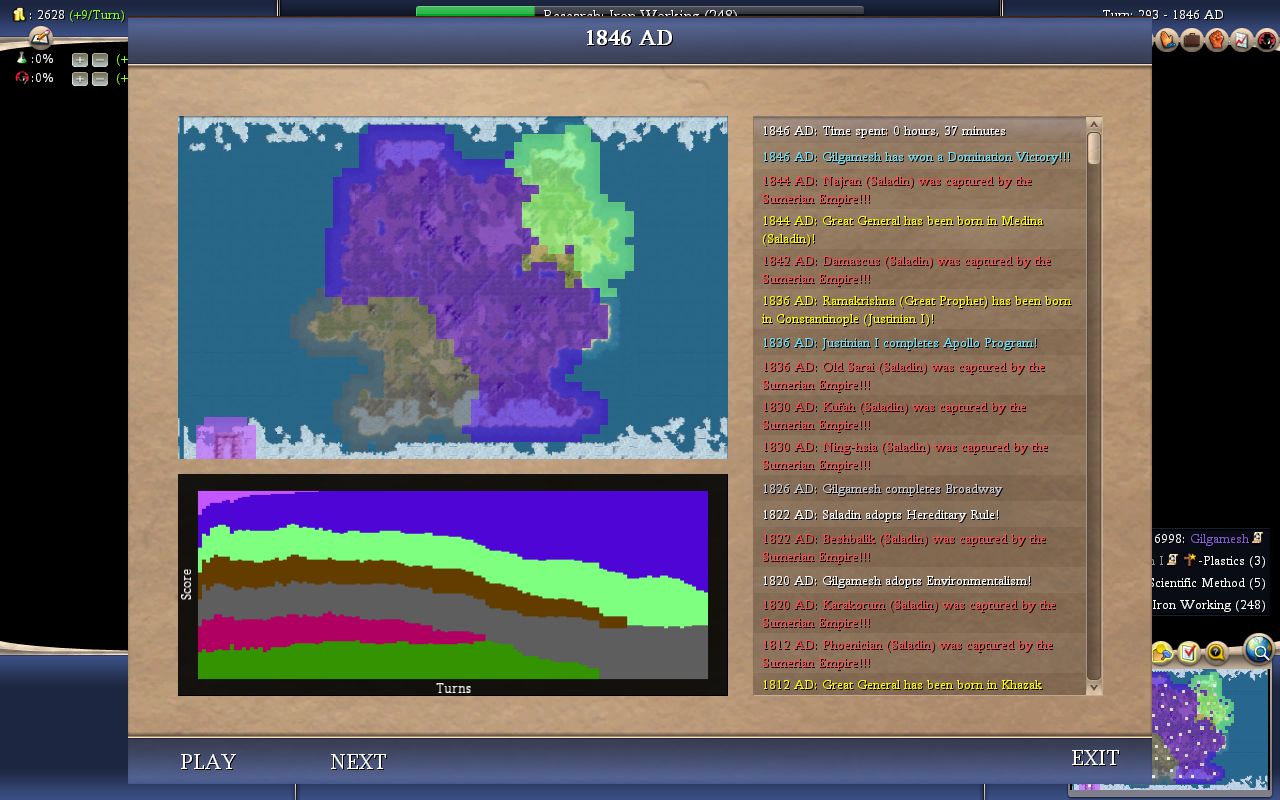
3) The Enkidu's Revenge Ending (Gilgamesh 1st, random 2nd, five games plus the livestream). Eventually, relations would degrade due to some combination of border tensions, "you declared war on my friend", and civic/religious switches, and the two would end up in a victory showdown, which was almost always triggered by Gilgamesh. However, if this happened early enough, Justinian would often be ill-prepared, focusing too much on wonders and infrastructure and having a much weaker (even if more advanced) army, and Gilgamesh would absolutely pummel him with a million units like what happened in the livestream. One of these games - Game 15 - still saw Justin skirt by in second place because Gilgamesh let him off the hook with enough of his core intact and then turned elsewhere for the remainder of the game.
4) The Christian Bromance Ending (Gilgamesh 1st, Justin 2nd, two games). Justin was either weaker than usual or Gilgamesh had an especially good game, but in these games Justinain managed to convert and keep Gilgamesh in Christianity, ensuring he never got on the wrong side of a runaway Sumeria. This was definitely the least common ending, mainly because a victorious Gilgamesh usually required a dead or crippled Justinian. Oftentimes, something would go wrong for Justin early on, whether it was failing to build GLH or just not expanding well.
While there were many factors that could impact the ending, probably the most important one was Zara. Zara's land was not good to start with, but oh boy was it good to take. If the dogfighters took most of Ethiopia, it was usually bad news for the Byzantines, but if Justin managed to get a foothold into Ethiopia - whether it was through culture flipping other leader's conquests, getting his hands dirty himself, or even just outsettling Zara - then his win was almost assured. The other important factor relating to Zara was his second city location. Zara could either settle towards Justinian like he did in the livestream, or place Gondar towards the East, which effectively surrendered the entire contested flood plains region to the Byzantines and helped contribute to their strongest performances.
Regarding victory conditions, these games tended towards Domination, as outside of Justinian the tech pace was extremely slow, although most of Justinian's wins were by Spaceship as he was often Pleased locked out of Domination in the endgame. There were two Diplomatic wins (one coming in Zara's sole victory) that were early coronations of the rightful winner, and while these games never ended Culturally Justin was less than ten turns away from a sliderless cultural victory a couple of times.
Onto the individual leader summaries!

Justinian of the Byzantines
Wars Declared: 26
Wars Declared Upon: 22
Survival Percentage: 80%
Finishes: 12 Firsts, 3 Seconds (66 points)
Kills: 16
Overall Score: 82 points
I must emphasize how terrible Justin's performance was in the Actual Game. Not only did he blow up his game by ignoring religion, but his expansion was really, really bad. Remember Iconium, the city Justin settled extremely late that allowed him to survive to the Wildcard with just one city left? Well, here are a few screenshots to demonstrate exactly how much more iconic this guy was in the replays:
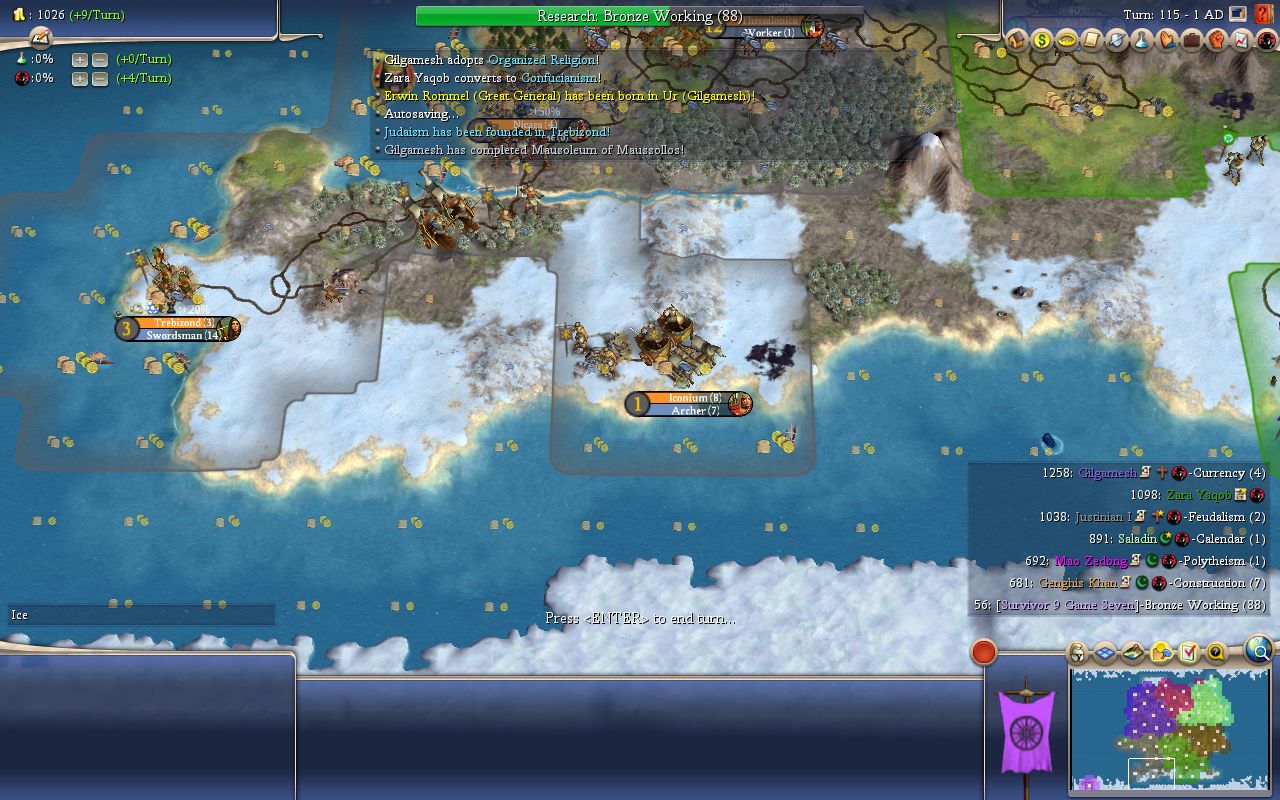
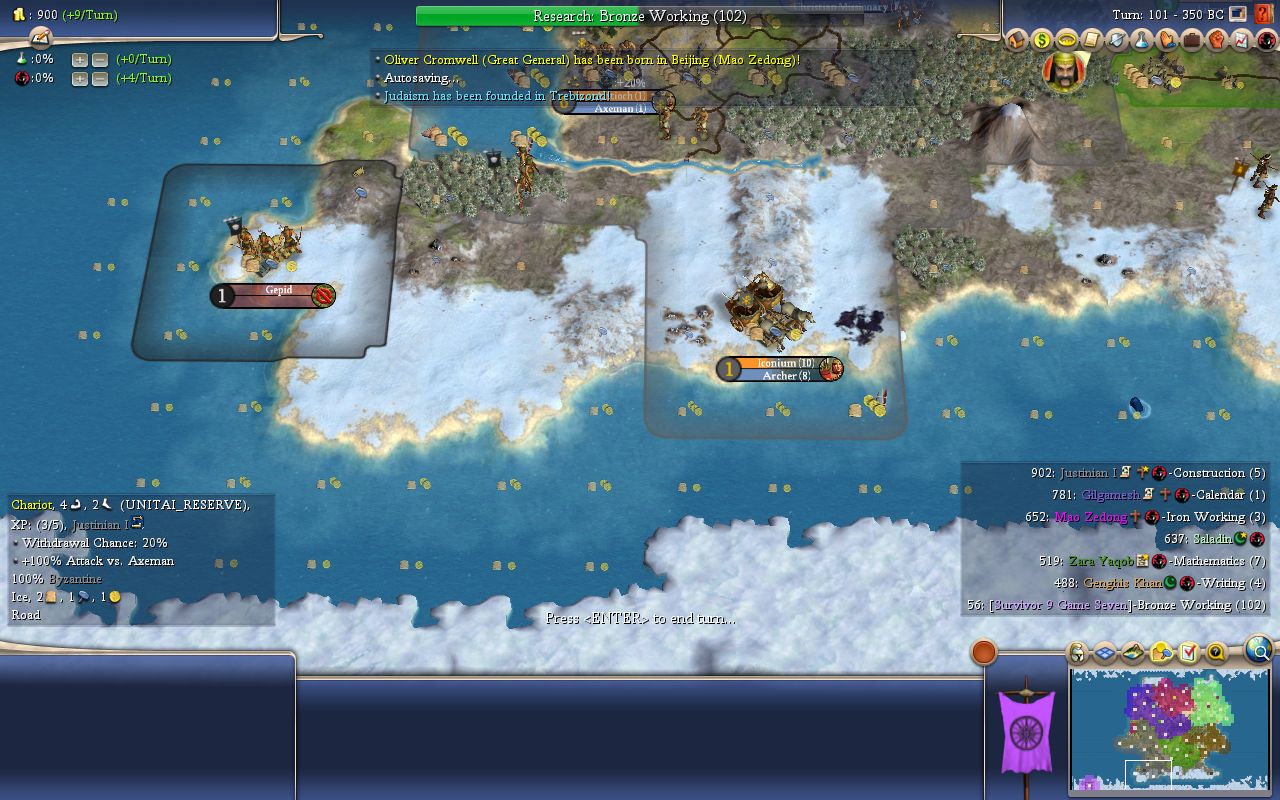
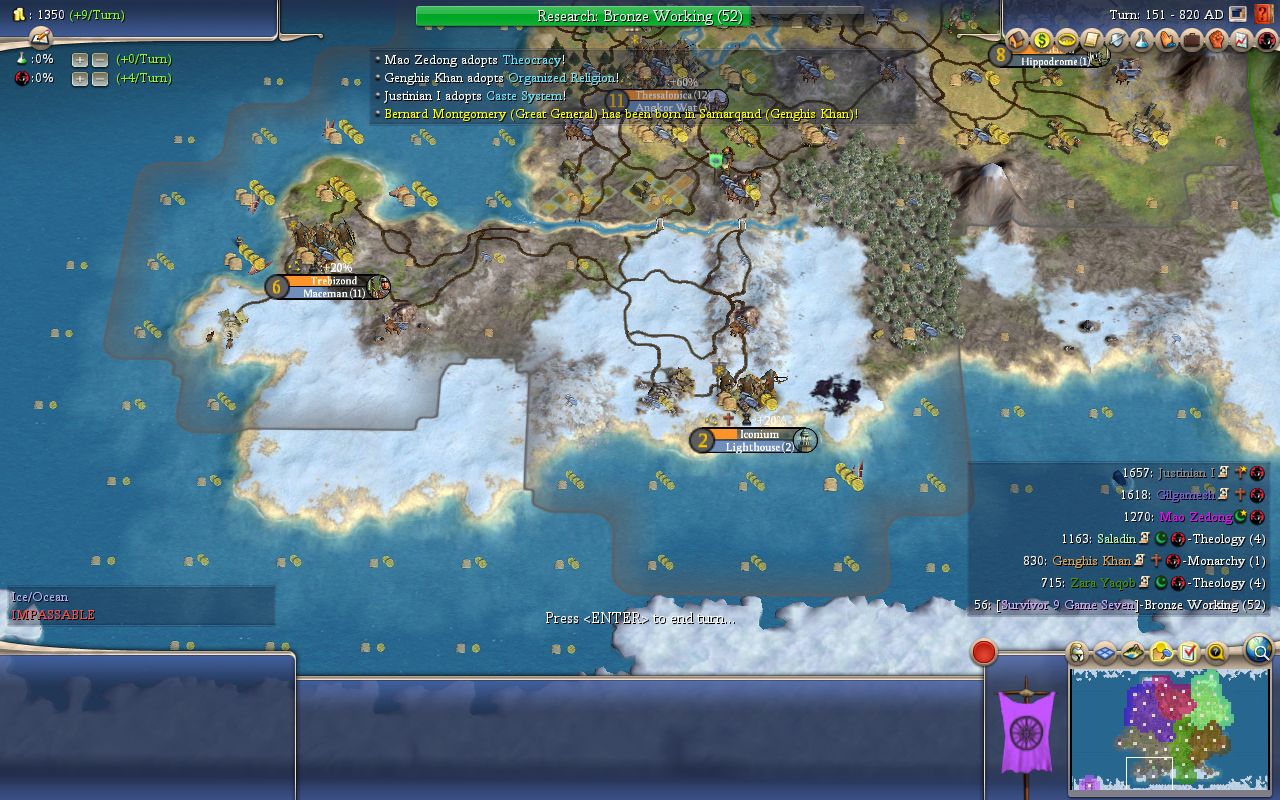
There was a point in this set where I thought this guy would win 17 or so games. His economic dominance was utterly insane in many of these games:
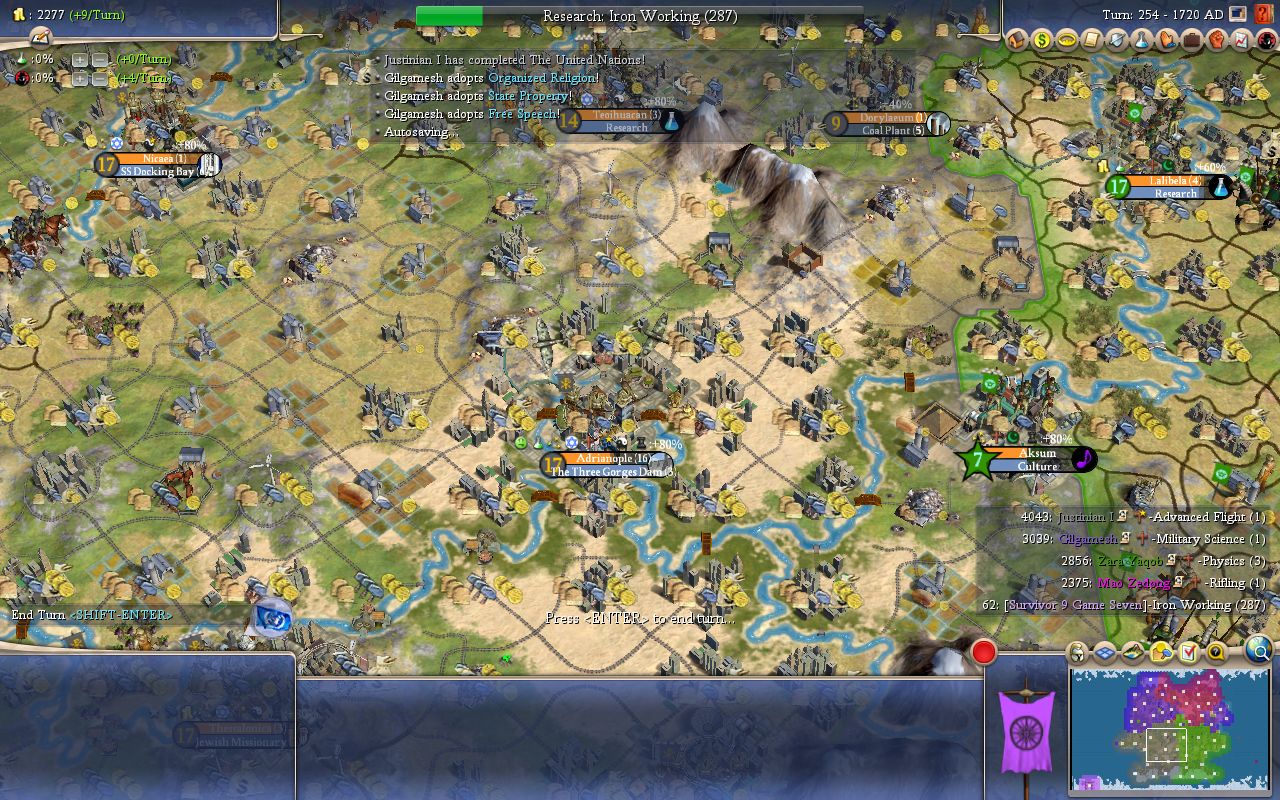
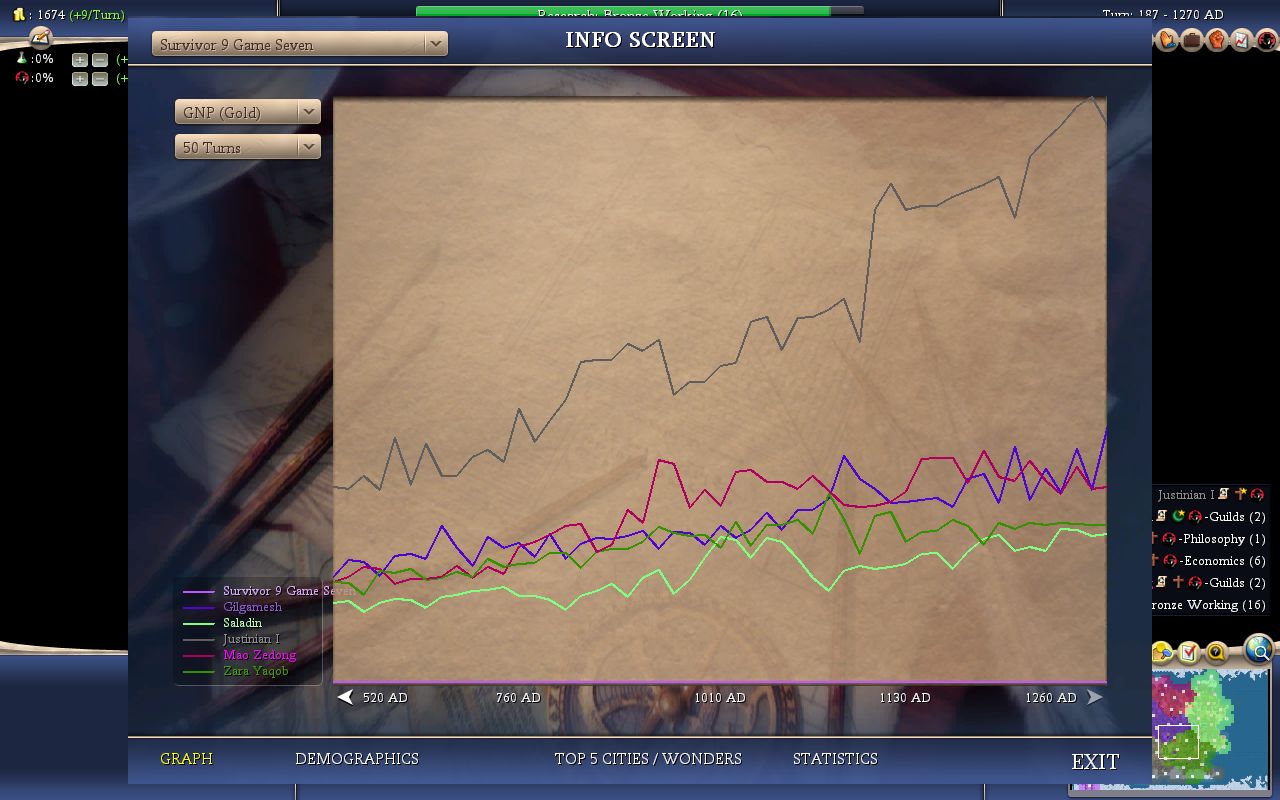
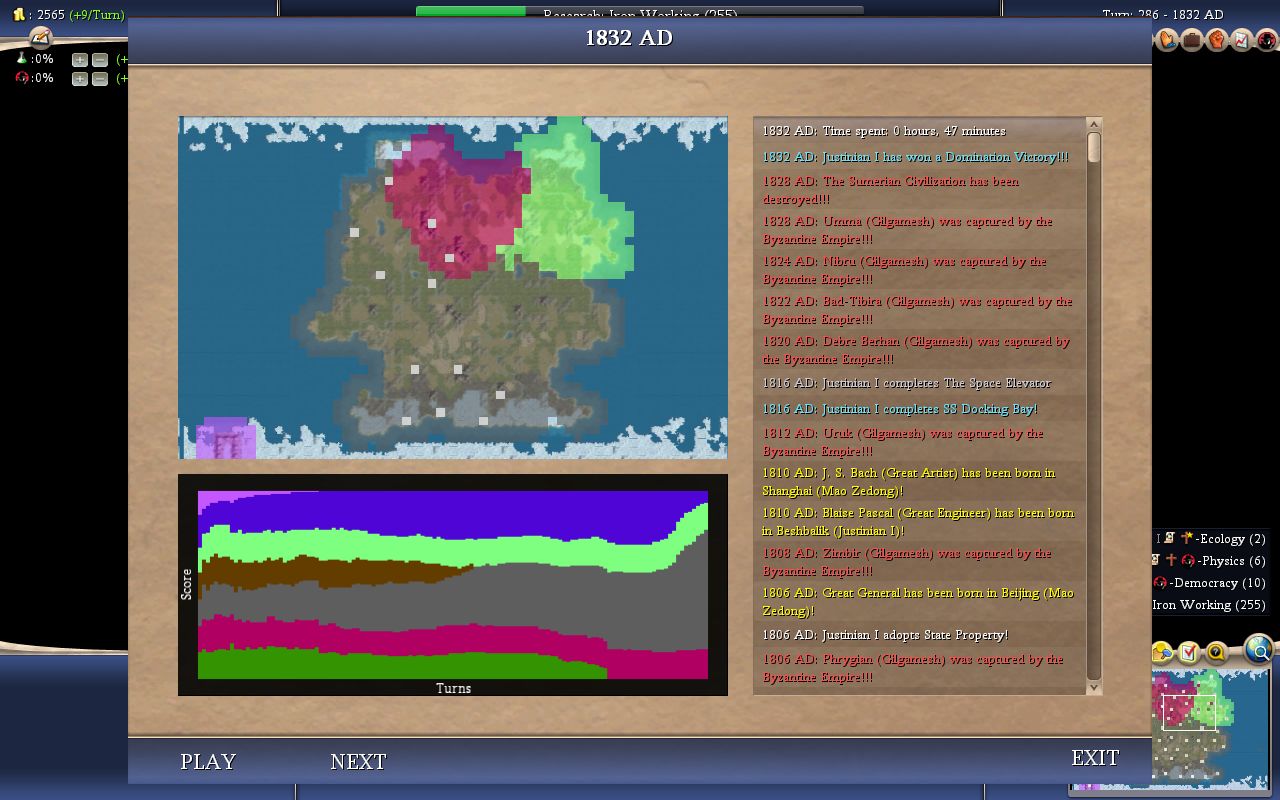
The combination of a global shrine and a coastal economy was oftentimes just too much for his competition to handle. To add, Justin had rather flexible options for victory. Sometimes, he leveraged a successful Copper, Construction or Cataphract war to establish himself in a runaway position (Games 2, 5, 7, 9). While Justin marching across the map to murder Genghis in the livestream looked like a mistake (and probably was in the context of the game), in the replays Genghis was actually one of Justin's best targets, and killing the Mongolians (whose land was not only great post Iron Working but also added more coastal cities to bolster the water econ) was typically a winning move and a major theme of the first half of his streak. Furthermore, it helped that in these games Justin actually had a religion and thus his faraway holdings would not get squeezed by Ethiopian culture. Killing Zara, which was less common, was also an equally viable path to victory - one particularly impressive Game 10 saw Justin seemingly gimped by a T65 Zara attack, except Justin was able to recover through his usual shrine+economy (and some help from Genghis), kill Zara, and still runaway.
Most tellingly, however, were the several "pacifist Justinian" games where the guy looked more like Pacal than like Justinian. If you look at the second table, you will find five games where Justin won without a SINGLE OFFENSIVE WAR. Part of this was due to Justin being unable to attack at Pleased, and either spreading his religion all over or establishing a Theocracy bond with potential heathens, but there were instances where Justin was willing and able to attack someone but just, for whatever strange reason, did nothing and continued to be in builder mode. This was both a good and bad thing. If Justin was able to decisively win the expansion phase (in some cases settling the entire Antarctic) or culture flip other leader's conquests, then going full-on Mansa mode was all fine and dandy for him. With that said, Justin also had a fine line to walk between war and peace. Some of his bad games saw his weirdly peaceful nature backfire, especially when he let an opponent off the hook when he was about to gain the upper hand in a conflict. If he sat in builder mode for too long and allowed Gilgamesh and other leaders to grow too strong, he was in grave danger, and quite a few of his failures (particularly in the final stretch of games) saw him caught with his pants down by a much larger Gilgamesh. He was also prone to the opposite extreme, and that was also not good. Get into war mode too early, or launch a misguided crusade (attacking Mao or Saladin early rarely went well for this guy), and he would just drag himself down and lose his technological foothold. Justin could also falter by either failing to build the Great Lighthouse, or just getting unlucky with religious spreads. While Justin had many paths to victory, there were also many things that had to go right for him, which prevented him from completely stomping over this set. He was typically weak when not winning, and his three second places by and large stemmed from him successfully converting the dominant leader to his religion.
What literally never happened though was Justin going full-blown atheist, which is what truly destroyed him in the livestream. Justin never, and I mean NEVER, looked as weak in the replays as he did in the actual game. It was like he forgot he was a religious and Imperialistic leader in the livestream! Overall, this was a very impressive display by the Byzantine leader against some stiff competition, and while fantasy wise I am a bit miffed it did not quite work out for me, at least it is more interesting for the rest of the community.
You Shall Not Pass Award: Immediately seizing Gondar from the Sumerians when they foolishly believed their Rifles could take on Byzantine Tanks in Game 4.
Justin the Great Award: Taking a leaf from Alex's book in Game 7, copperdeccing Zara, and IMMEDIATELY PILLAGING HIS IRON to prevent Zara from building metal units:
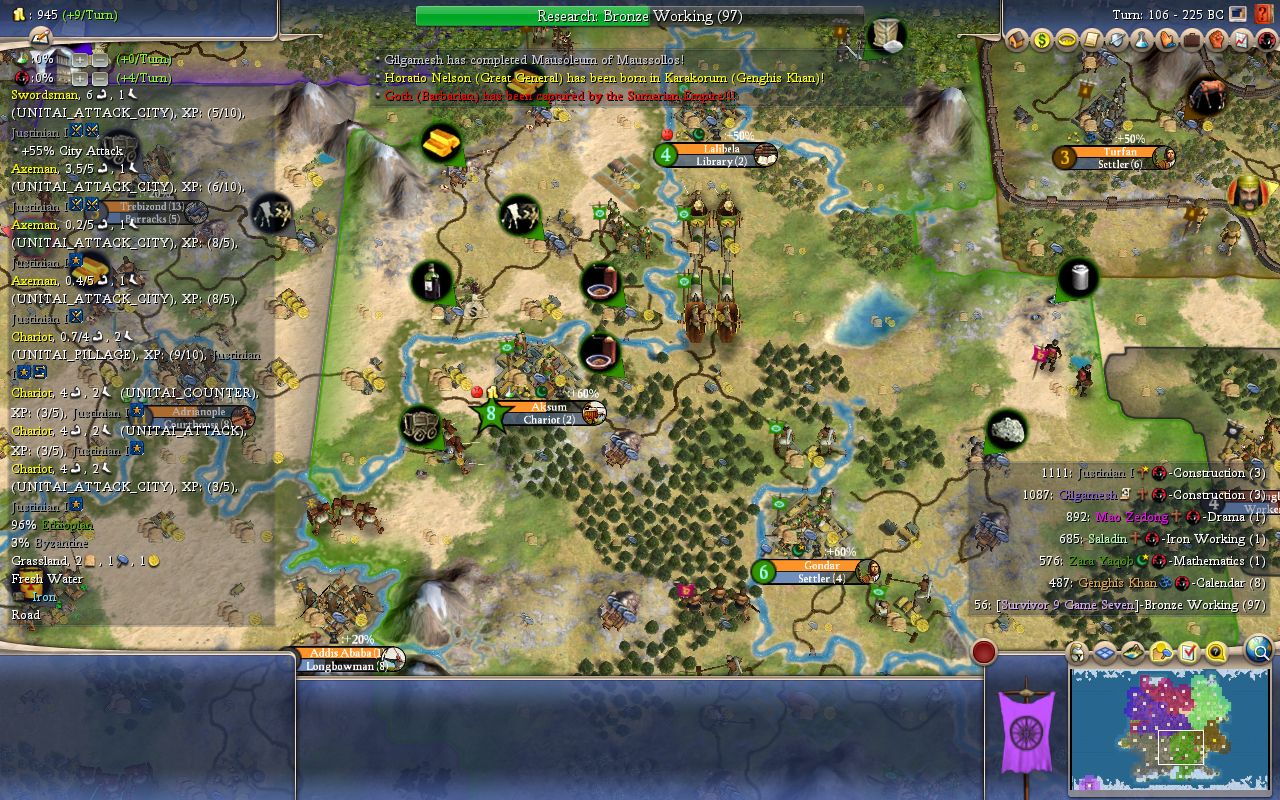
That's Not What I Meant By The First Commandment Award: Justin getting completely screwed in Game 13, as instead of Christianity, his secondary Monotheism religion ended up spreading to Zara and Gilgamesh. In particular, he got to Annoyed with Gilgamesh, causing them to close borders and rule out any chance of rectifying things religiously. This was the beginning of Gilgamesh's smashing finish to this set.

Gilgamesh of Sumeria
Wars Declared: 50
Wars Declared Upon: 28
Survival Percentage: 70%
Finishes: 7 Firsts, 6 Seconds (47 points)
Kills: 19
Overall Score: 66 points
It did not look like it for a while, but by the end of this set Gilgamesh had absolutely backed up his real result and then some. Naturally, he won by playing a completely different set of games than Justin, and one need only look at the war counters to see how. His path to victory was simple: sheer brute force. Expand a bunch, build up for a bit, and then murder everything in sight. This meant that while his gameplan was a tad less flexible than Justin's, he was also more resilient to setbacks than the Byzantines. If even one thing went wrong for Justin, it greatly messed up his game, but if something did not go Gilgamesh's way, he could just brush it off and come back later. Gilgamesh was the best expander in the map - yes, I would say better than Imperialistic Justinian - and his games were a masterclass in barbarian management. Not to mention, if Justinian was faltering in some way, Gilgamesh was there to fill the void, winning every single game he built the Great Lighthouse and also winning the one game where he ended up founding the rival religion to Justin's Christianity (Game 14). I would say his clearest path to victory, however, was in killing Mao (like in the livestream) or Zara early, and then using that extra territory to build a large production edge and take out the rest of the world.
Gilgamesh's biggest weakness, that most of the community had correctly identified before the game, was economy. This should be no surprise; Gilgamesh had played a virtually perfect economic game in the livestream, yet by the turn of his victory, T353, he was not particularly close to completing his spaceship and actually would have lost the space race to Zara if he had allowed it to happen. So when he was not always playing up to his full potential, of course he was that much slower. Now, this did not matter as much as it could have as most of his rivals were equally if not more inept economically (Zara was especially disappointing in that regard), but there were multiple instances where he got on the wrong side of a FAR more advanced Justinian, and it was ugly. There were multiple games where Gilgamesh had second place wrapped up only to suicide into a loyal Justinian in the lategame, in one case foolishly trying to sic CUIRS onto TANKS (Game 6). Otherwise, Gilgamesh could just get stalled early on with early warring, usually against the unreliable ally Mao but in one case losing a Construction Era showdown against Justin in Game 5. Nonetheless, this was a very impressive set from Gilgamesh and LinkMarioSamus showed major foresight in betting 50 gold on this guy.
Enkidu's Curse Award: Making peace with a Rifleless Mao in Game 1 to instead attack and die to a Justinian with Infantry.
Gilgabromance Award: In Game 8, Saladin would have easily taken out Gilgamesh in the 2nd place showdown... but Gilgamesh was able to draw in Justin through a Defensive Pact and swipe a rather undeserved second place finish from there.
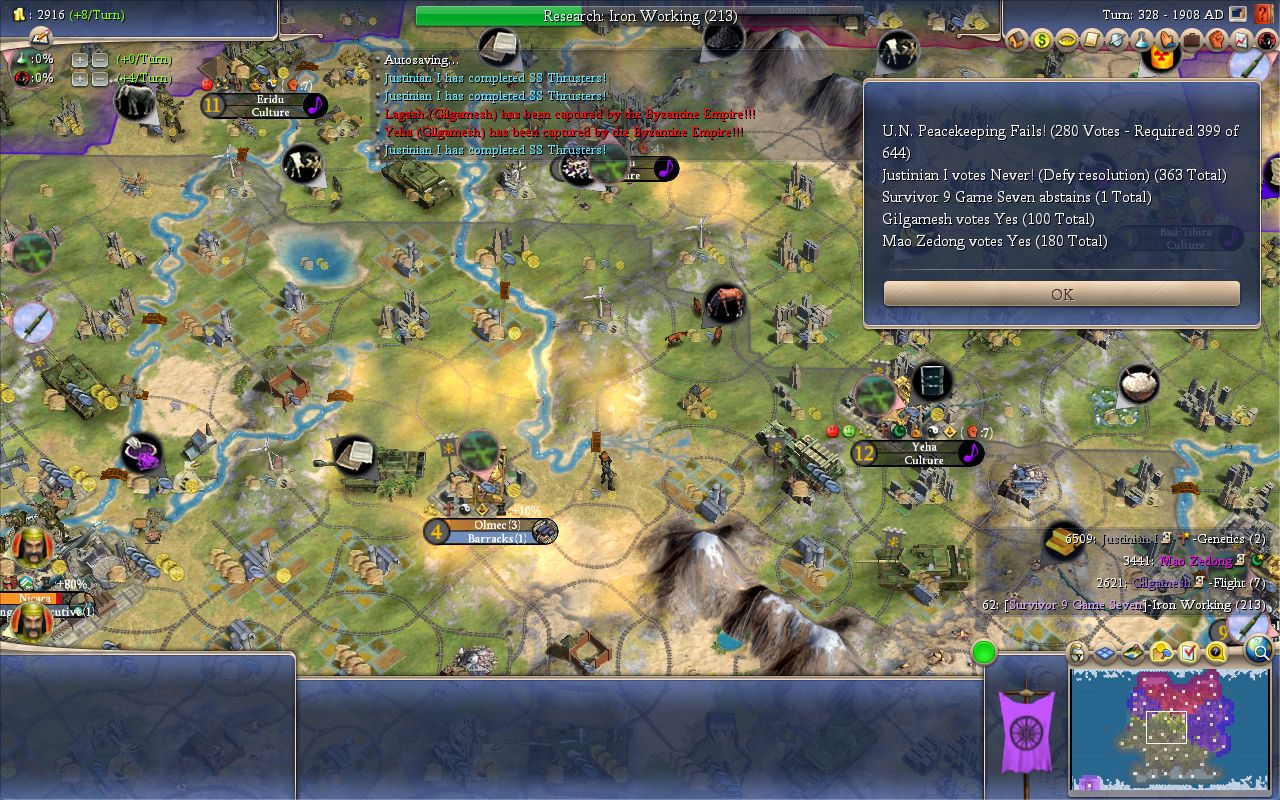
Apocalypse Award:

Zara Yaqob of Ethiopia
Wars Declared: 23
Wars Declared Upon: 53
Survival Percentage: 40%
Finishes: 1 First, 3 Seconds (11 points)
Kills: 6
Overall Score: 17 points
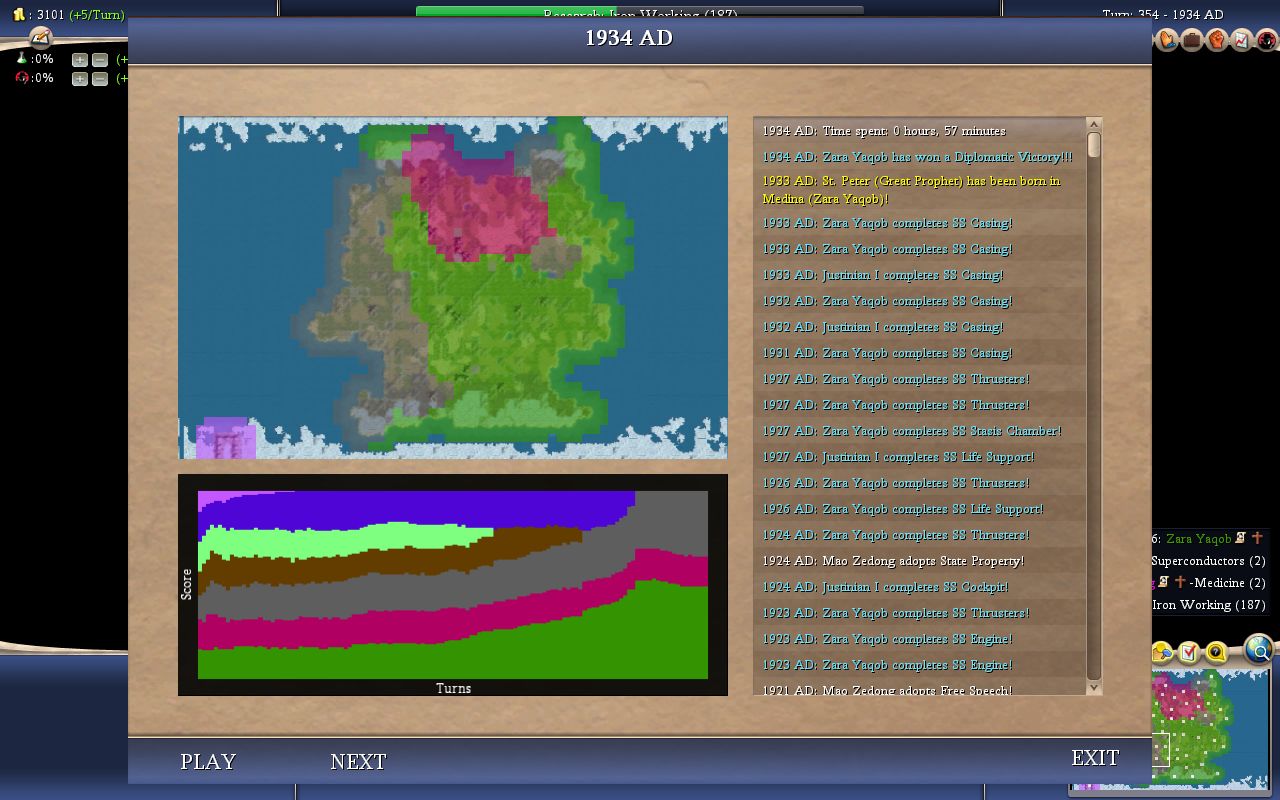
Perhaps the biggest community misread overall for this game was that Zara was either a "win big or die horribly" leader. Instead, he was merely middle-of-the-road, as outside of his Game 1 win he had the same smattering of second place finishes and kills that Mao and Saladin had alongside a similar survival rate. Not to mention, he was only First To Die three times, two of them coming very late (T234, T262). Now, Zara was the only leader outside the top two to ever win a game, and he was the only one who was ever in contention to win in the other 19 replays (and I would later see him win one more game on this map - see Appendix B). Any strategic resource concerns were way overblown, as Zara usually teched Iron Working extremely quickly, and there were only two games (4, 7) where he was ever crippled by a copperdec. Additionally, Zara's diplomatic position was not as bad as people may have thought:
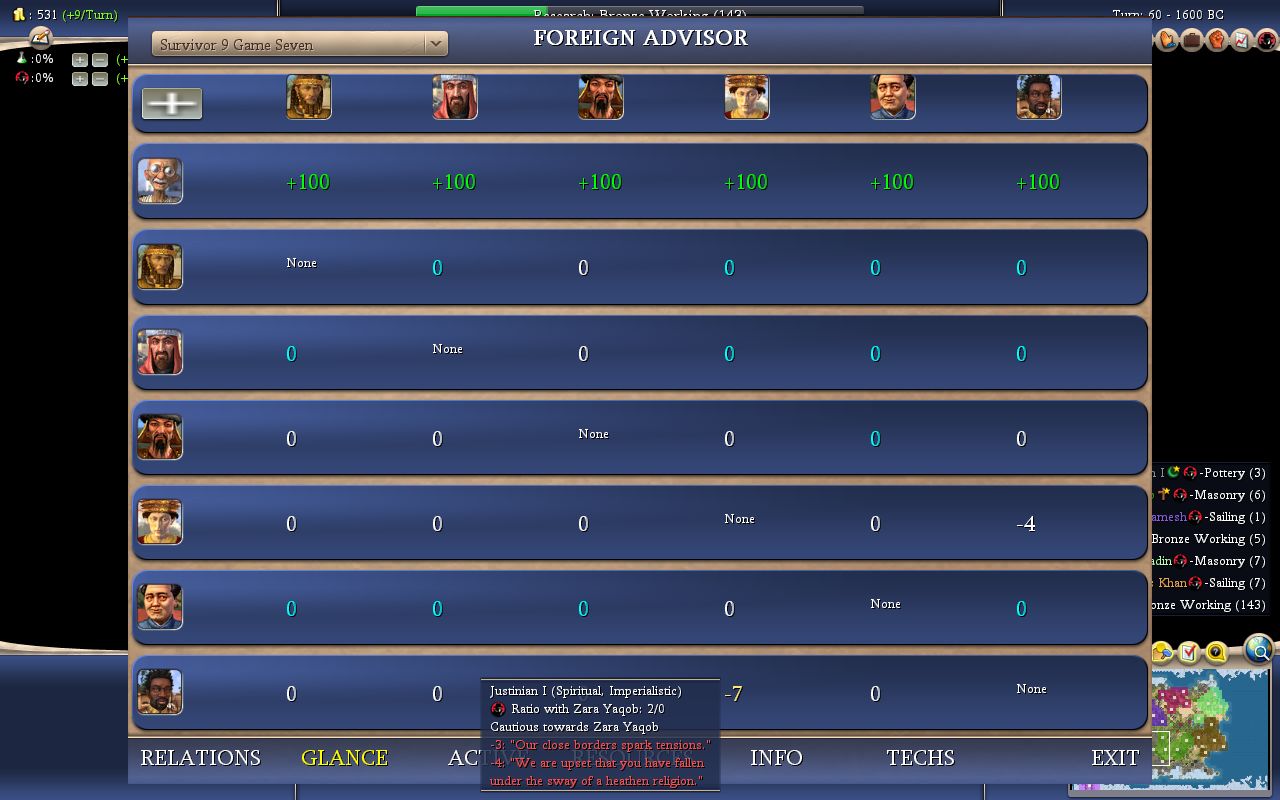
In light of all this, Zara's performance in this set overall was EXTREMELY disappointing. Even with his central position with some exposed flanks, he had the best access to the screwed Genghis Khan, he failed multiple times to capitalize on a weak Mao or Saladin, and he in theory should have also been able to fill the void in games where Justinian faltered. Yes, he was attacked before T80 in nearly every replay by the Mongolians, but once again, with how weak they were, that should have been free real estate for the Ethiopians. However, in game after game, Zara allowed such conflicts to cripple him, and usually it was other leaders killing the Mongolians instead. Moreover, even in games where he had more breathing room or managed to conquer extra territory, for whatever reason he rarely reached the same economical or military levels as his western rivals, always doing one thing worse than at least one of them and coming up short as a result. In order to win, Zara needed BOTH Justin and Gilgamesh to falter in some way - you will also see this in Appendix B. In Game 1, Justinian greatly slowed his game down with an abnormal cross-map crusade against Saladin, while Zara and Mao formed an unlikely military alliance to whittle down the Sumerians in a series of 2v1s. Later, Mao would help his State Property Comrade Zara cash in through a Diplo win. (This was not a stolen victory - Zara was the runaway in that game.)
I might be being too harsh on him, as he was still attacked 53 times which is a decent chunk, but just from watching the games and his overall position I got the feeling that he should have been better. So why was he so mediocre? Well first, Zara just is mediocre, especially since AI Survivor settings cause him to lose a lot of his inherent advantages - I am sure he would be a beast here under regular settings. More importantly, however, was that his land was not as good as we thought. Honestly, the main takeaway from this is that we should be rather wary of low production, high commerce starts, especially if the leader is not someone like Huayna or Ramesses who has a mechanism to quickly cash in on such starts. The problem is, which I noticed again and again with Zara, these types of setups cause leaders to zoom through the early techs, which may sound like a good thing, except you know they have to build every wonder and infrastructure under the sun, and they often lack the hammers to build them quickly enough, ultimately netting a bunch of failgold that they absolutely do NOT need with their already high commerce land while neglecting expansion and military. Zara frequently found himself with 3-4 cities and tying many of them up on 20-30 turn wonder builds while other leaders, even Genghis with his Hannibalism issues, had 6-8.
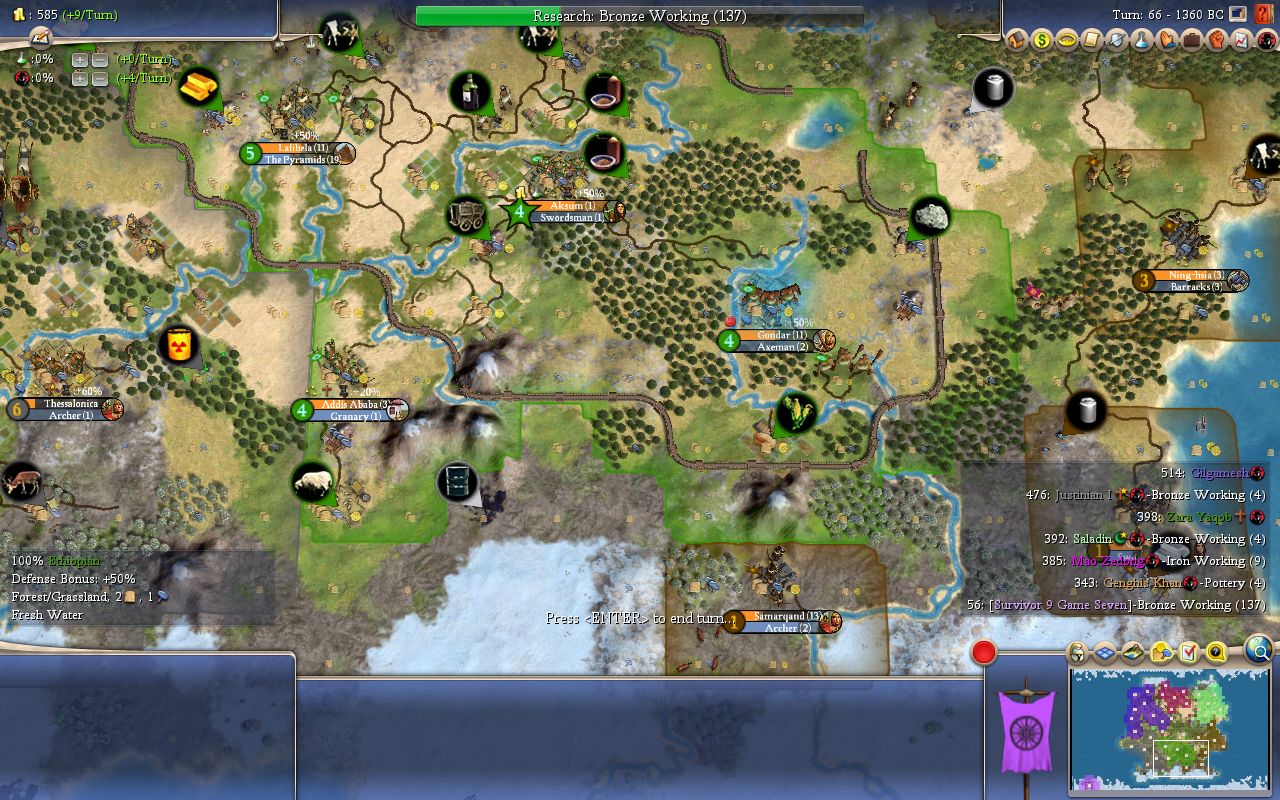
All the juicy flood plains and gold tiles in the world will not prevent one from quickly falling behind opponents who are twice as large. Then, he always had production issues when fighting conflicts 1v1, and you know someone would come piling on at some point. Frequently his role was to develop nice riverside vacation homes for his future overlords. The best starts have a good mix of commerce and production (and food of course, although food is essentially an indirect source of both), and Zara's was sorely lacking in the latter. This is what I meant when I had stated in the overview that his land was bad to start with, but great to seize.
One Does Not Simply Walk Into Constantinople Against Cataphracts Award: Backstabbing Justin in Game 2, nearly winning, but then Justin techs Guilds in the nick of time and Cataphracts turn the tide. Eventually Zara would hand over a core city for peace and later die to Justin.
Willem's Qorn on a YaQob Award: Zara should have won Game 18, but he went Combustion before Rifling, causing him to stall out against a Saladin he should have easily killed, and then Gilgamesh later showed Zara who a true winner is.
Maybe Gondar Should Not Have Called For Aid Award:
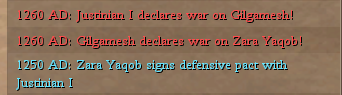
From Game 20, where Justin should have had a rock solid alliance with Gilgamesh secured and at least gotten second place. Justin later died horribly.

Saladin of Arabia
Wars Declared: 28
Wars Declared Upon: 40
Survival Percentage: 50%
Finishes: 0 Firsts, 3 Seconds (6 points)
Kills: 10
Overall Score: 16 points
Saladin was stronger and performed better than his results indicated, especially considering his land and I am glad he had enough kill points for his positioning to at least somewhat reflect that fact. His land was quite bad, with way too much flat desert and jungle nearby, but despite that he had a number of games where he was at least in contention for second place. As a matter of fact, Saladin was this set's tragic figure, especially in the first half as these games found some ridiculous ways to screw Saladin out of a playoff spot:
1) See the Great Leap Forward Award for Game 4.
2) In Game 5, Mao auto-razed two Arabian cities very early on. Somehow, Saladin managed to recover and become once again the top second place contender, only for Justinian to decide to run him over late.
3) See the Wang Khan Award for Game 7.
4) See the Gilgabromance Award for Game 8.
5) In Game 9, Saladin was ahead of Gilgamesh in tech but Gilgamesh just had 200 more units and won the second place showdown.
6) A Gilgabromance situation happened AGAIN in Game 10.
Luckily, Saladin's luck evened out a bit in the latter half and he got his three second place finishes in the final ten games, and I do believe he has some of the highest Runner Up odds in this map. At the end of the day, however, Saladin's land was simply not good enough to contend for the win, and he was by and large betting on a sheltered position, an absorption of Mongolia and/or China, and relatively favorable diplomacy that allowed him to form friendships across the religious aisle to make it into the playoffs.
Saladin Khan Award: Ruining his Game 2 with a T0 Archery beeline.
72 Virgins In The Wildcard Award: Blowing what would have been a second place finish in Game 3 by attacking a runaway Gilgamesh late, being lucky to survive with one city remaining.
Mao Zedong of China
Wars Declared: 28
Wars Declared Upon: 34
Survival Percentage: 45%
Finishes: 0 Firsts, 4 Seconds (8 points)
Kills: 4
Overall Score: 12 points
Like Saladin, Mao was also somewhat of a pleasant surprise, demonstrating the tenacity that he generally has been known for in AI Survivor. While the concerns about his squeezed and central position turned out to be valid, he still put out a decent performance considering his situation, especially in the purview of the strongest military leader on the map. I was certainly taken aback when he got second place in Game 2! That was easily his best performance of the set, one where he had a monstrous expansion phase and conquered his way to becoming the largest leader in the North. While he was WELL behind Justinian, he still did about everything he could to succeed. His other three Runner Up finishes were backdoor, two of them seeing Justin wipe out a stronger Gilgamesh late while the other one in Game 17 saw him work together with the Sumerians. Him working with Gilgamesh was a rare occurrence; a stronger Mao typically meant a weaker Sumeria, especially when he got early culture (in one case founding a religion), and it was no coincidence that three of his Runner Up results came behind Justin.
However, there were also games like the livestream where Mao did not expand particularly well (I think there were a couple of instances where he got screwed by the barbs), and those usually saw him get easily run over by Gilgamesh en route to a Sumerian stomp. An early Mao elimination, like what happened in the livestream, generally correlated to a Gilgamesh win, with the exception of Game 19 where Mao was actually strong and had greatly crippled Sumeria, only to somehow be the designated Cataphract target of a very angry Justinian. There were also a couple of games where Mao temporarily lost Shanghai to the barbarians, allowing his neighbors to be stronger than usual. His average game, however, usually saw him skirmish with Saladin, Gilgamesh, or Zara to little avail while not being all that important to the larger dynamics of the game. He definitely overperformed for his position, but realistically his ceiling capped out at Wildcard here.
Pink Heart Award:
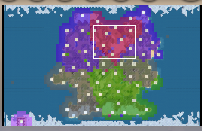
Cultural Revolution Award:
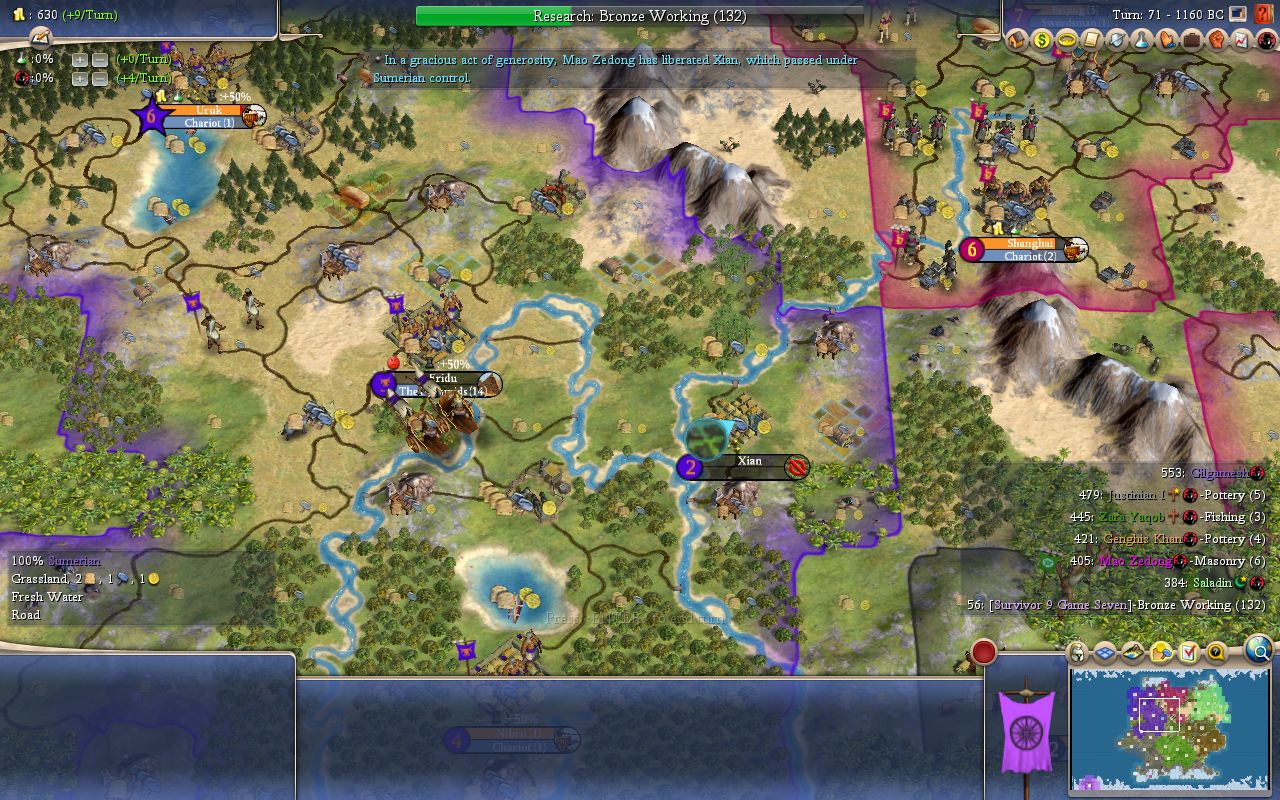
Great Leap Forward Award: In Game 4, Saladin was in the driver's seat for second place, but when Justinian ran over Gilgamesh late, IT CAUSED THE CHINESE BORDERS TO EXPAND ENOUGH TO VAULT THE CHINESE OVER THE ARABS IN SCORE.
Genghis Khan Temujin of the Mongols
Wars Declared: 46
Wars Declared Upon: 24
Survival Percentage: 20%
Finishes: 0 Firsts, 1 Second (2 points)
Kills: 4
Overall Score: 6 points
Genghis certainly backed up his livestream result where he was essentially First To Die (as a reminder he died on the same interturn as Mao), but this result was more an indictment of his land rather than his abilities. I do think a different type of leader could have had some sort of shot with his start, as it did scale quite well once the jungle was hacked down. Genghis was not that kind of leader; a hardcore warmonger like him needs a fast start, and this one, as many including Sullla had identified, was painfully slow for him. By the time he connected metals, Zara had long since researched Iron Working, and Genghis generally slammed his head against Zara or Saladin over and over again until he was eventually put out of his misery. A secondary issue for Genghis was his proximity to Saladin, which meant he almost always was Islamic, and he lacked the peaceweight or Theocracy shield to get away with that.
I will say, he did have one impressive second place finish in Game 13. Instead of proving Einstein's definition of insanity, he instead turned his forces towards a weak Mao, working with Gilgamesh to conquer the Chinese. This let the Mongolians be MUCH stronger than usual and thus an extremely effective junior partner for Gilgamesh. Such instances were rare however, and Genghis was pretty lucky to have mustered the results he had here.
It's The Ekhanomy, Stupid Award:
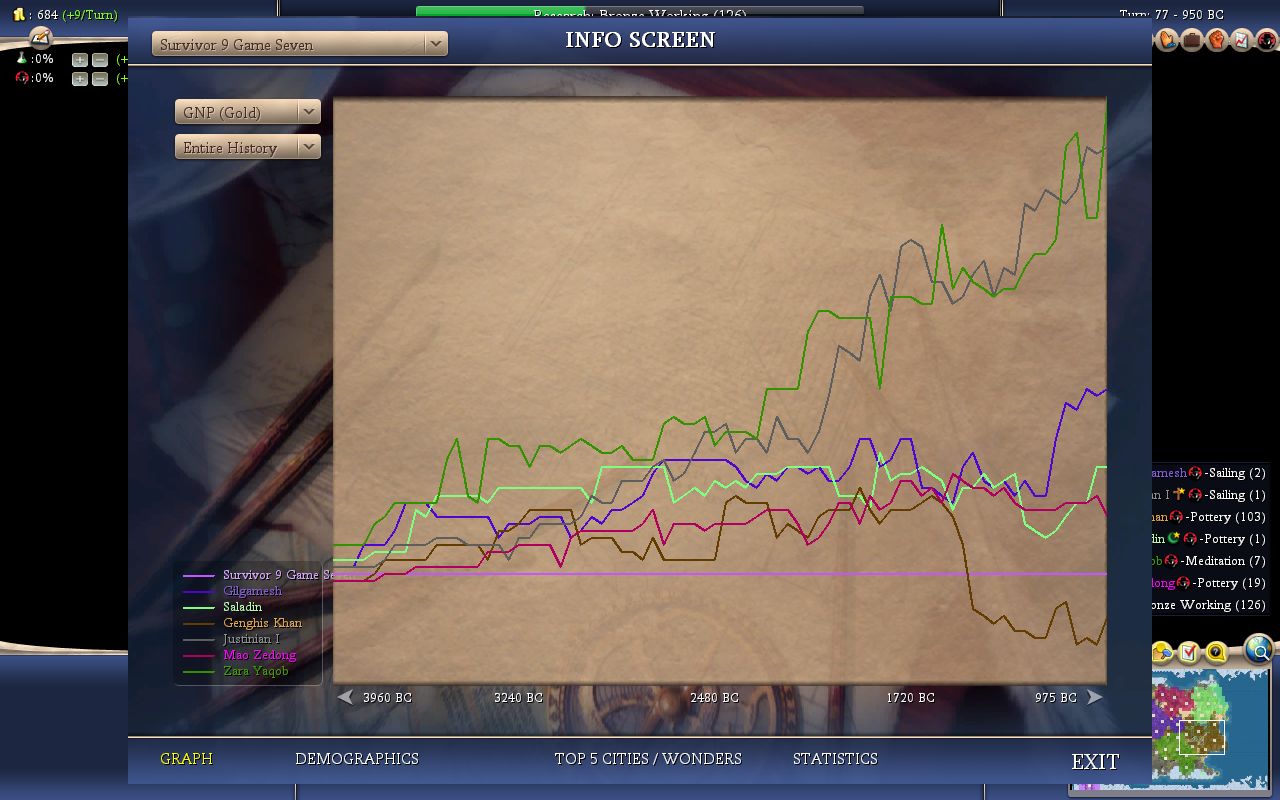
Yolo Khan Award: Absolutely ransacking Arabia in Game 6 even while Zara was ripping through the Mongolian mainland.
Wang Khan Award: In Game 7, Genghis was about to die, before he somehow finagled a peace treaty with Saladin when he had JUST ONE CITY REMAINING. Then, he converted to Saladin's religion (which somehow happened to be Christianity), getting Saladin to Pleased and unable to finish him off later. Saladin would miss out on second place by just 20 score points.
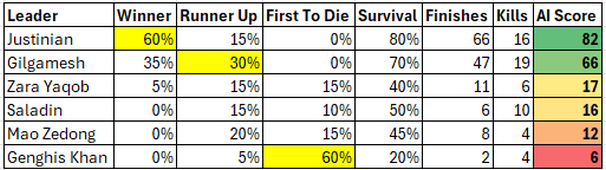
At the end of the day we got a pretty typical livestream result outside of Justinian playing like Chairman Mao. While Zara was not especially likely to finish in the Runner Up spot, whoever got Runner Up behind Gilgamesh was pretty random anyways, and Gilgamesh had a couple of wins that played out in an eerily similar fashion to the official result, ESPECIALLY Game 18. Unfortunately, Justinian once again proved to be rather unlucky in modern Survivor, having had Alternate Histories results that were much better than his live one in nearly every season. This included Season 8, as while it ostensibly looked like a return to form, he was shafted from the Championship Game in his Playoff Alternate Histories! Nonetheless, this is how leaders like Churchill and Alex are in Pool 1 while Justin fails to even be seeded.
I would like to reiterate that I'm not so sure Justin is THAT much stronger than Gilgamesh here, as his streakiness was frankly pretty absurd, and I would definitely like to see someone run 1000 games (one of the CFC superfans up for the task, perhaps?) to truly see who is the strongest leader. I would not be surprised if it is essentially a tie, or if even Gilgamesh is proven to be stronger.
Zara, Saladin, and Mao meanwhile generally reinforced their reputations. Zara has always been a leader who typically fails to reach what is an admittedly high ceiling, while Saladin and Mao showed themselves to be high floor leaders who are often capable of making lemonade out of lemons. Genghis, meanwhile, was generally rendered a non-factor due to an ill-fitting start.
I hope you enjoyed analyzing this wacky set with me!
Appendix B: Game 21
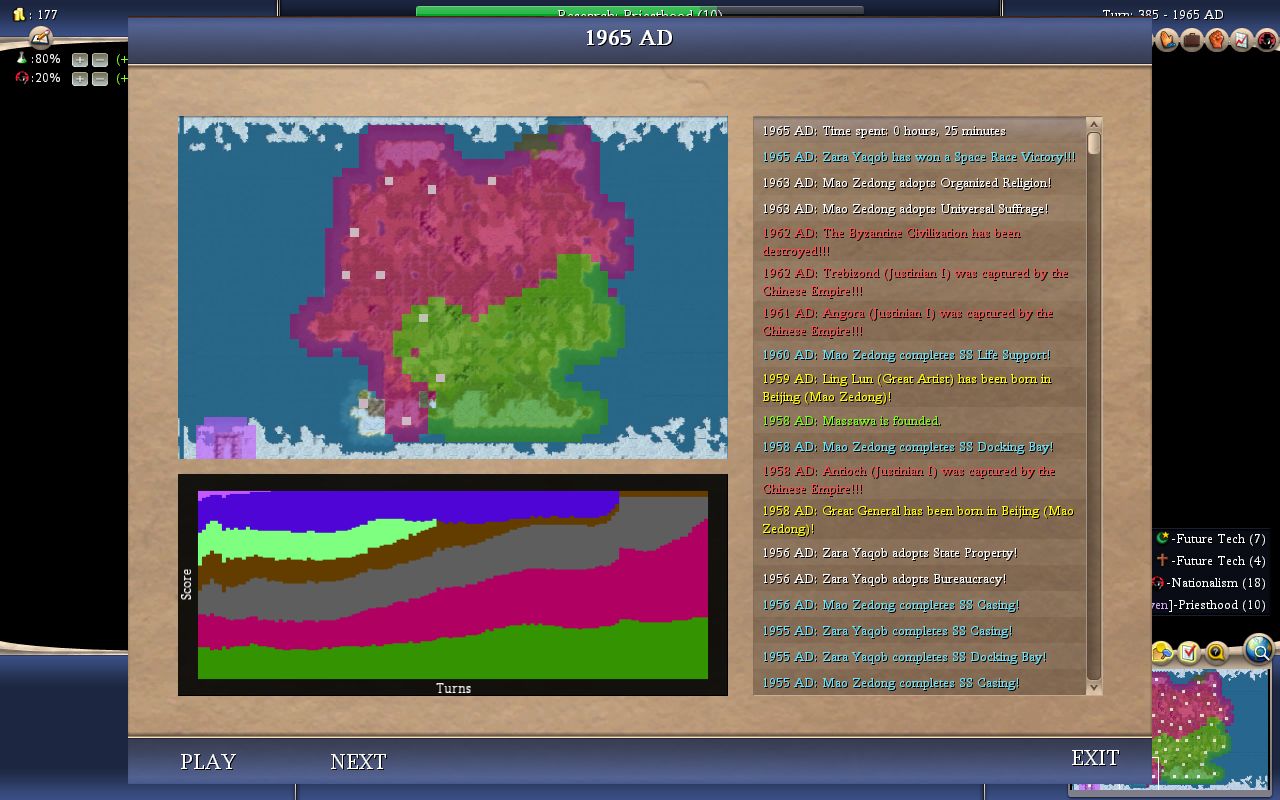
I was quite curious how many more games it would take for a leader not named Gilgamesh and Justinian to win, and funnily enough this test ended at just one game! I really really wish this was in the official set, as it would have been quite interesting (and I did consider substituting this game in lieu of one of the first twenty). Contrary to what the minimap was showing, Zara was the actual winner, but in truth Mao was the dominant runaway and this game was proof to me that Mao had some sort of tangible victory shot here, even if it was the most outlier of outliers. What happened in this game was, Justinian and Gilgamesh fought each other extremely early, causing both leaders to be taken down several pegs. They would continue fighting each other over and over again to no avail. This allowed Mao and Zara to fill the void, with Mao killing Saladin (who was First To Die) and Zara "killing" Genghis (who rather amusingly ended up surviving as Mao would not give Open Borders to Zara to reach a random former Arab city GK had sniped - the two were not at all friends despite finishing in the top two). Mao became the technological runaway and later killed Gilgamesh, and it looked like he would win. However, Zara was somehow able to get the Internet while Justin was still alive and kicking at the end of the tech tree. This catapulted Zara to an undeserved tech lead, and while Mao murdered Justin he was not quite able to get over the Domination hump before Zara's Spaceship arrived at Alpha Centauri. Well, this set started with a Zara victory, and it feels befitting that it ends (even if unofficially) with one too.