After finishing up with dozens of solo class challenges for Final Fantasy, Final Fantasy 5, and then Octopath Traveler, I wanted to find another game so that I could continue doing these silly ventures. I spent some time looking around at different possibilities before identifying the 2024 remake of Dragon Quest 3 as a good choice, this game officially known as the HD-2D version and done in the same style as Octopath Traveler. This is the fourth time that Dragon Quest 3 has been remade, after previous efforts on the Super Famicom (1996), Gameboy Color (2001), and Wii (2009), though several of those versions didn't make it out of Japan where the game has always been super popular. Dragon Quest 3 has widely been seen as the best of the four NES Dragon Quest games and it's even a game that I played a lot when I was a kid, back when it was "Dragon Warrior 3" in the United States due to copyright issues. Expect to hear me mentioning some of the changes between the original NES game and this remade version from three and a half decades later.
Dragon Quest 3 has an outstanding setup for oddball variant games, so well suited that I considered playing the NES game alongside the original Final Fantasy in the early 2000s before deciding that I didn't have enough time. The plot in this game centers around a Hero character who can recruit up to three additional companions to join them in their journey. These additional companions can be drawn from any of the other classes (originally seven other classes, now nine after two more were added in the remakes) and there are essentially no restrictions on how the player builds their party. You can take a balanced group of classes, or create an all-spellcasting party, or pick three of the Goof-Off joke class for a really punishing time. It's also a fantastic game for running solo challenges and of course I had to start out that way, opting to begin with the Hero class since it's clearly the strongest in the game. I could use this initial playthrough to figure out what I was doing and then dial up the difficulty meter with some of the game's weaker classes later on. There are actually three different difficulty settings in this DQ3 remake and I chose the middle / default option of "Dragon Quest". There's a harder option named Draconian Quest where experience gains are lower, all monsters deal 20% more damage, and bosses have extra health - none of which I wanted for this playthrough.

At the start of each new game, the player must pick a name for the Hero character since they are never allowed to leave the party. I wanted to name my character Erdrick since that's canonically the name of the Hero in DQ3, at least in the English versions since the Japanese name is "Loto" which was wisely changed. However, it turns out that DQ3 does not allow the player to use Erdrick or Loto as the name of their Hero character! There's a story-based reason for this later; I avoided the restriction by using a letter "E" with two dots above it when spelling Erdrick. The player is also prompted to choose a male or female character, with the female option being the superior one for gameplay purposes. Female characters have access to the strongest personality type and can also equip some better equipment later in the game. If this sounds progressive, that's emphatically not the case: DQ3 is a game in which wearing bikini armor literally makes you stronger as we'll see later on. Anyway, I picked the female option for this first playthrough.
This is followed by a series of questions that are used to determine the Hero's starting personality. This quiz is surprisingly elaborate with more than two dozen different potential questions laid out along an interlocking web of a decision tree. The questions will eventually funnel the player into one of eight different scenarios (!) and then the actions that the player takes in those scenarios will dictate their final personality type. For example, the scenario that I experienced on this playthrough was named "The Queen's Treachery" and prompts the player whether or not to reveal a plot on the part of a scheming queen, or follow the unjust orders of a king, or somewhere in between the two. There were four different outcomes here and I chose the "follow the king's orders" path to get the desired Vamp personality. This is the personality with the best stats in the game, more on this in a moment. I'm really impressed at how much detail went into what could have been a formulaic introduction. Most players will never even see more than one or two of these eight scenarios and all of them present some sort of moral dilemma.
Once that was over, Erdrick awoke on the morning of her 16th birthday and was prompted to go visit the local king of Aliahan. With control over my character for the first time, I opened up the menu to look at her starting stats:
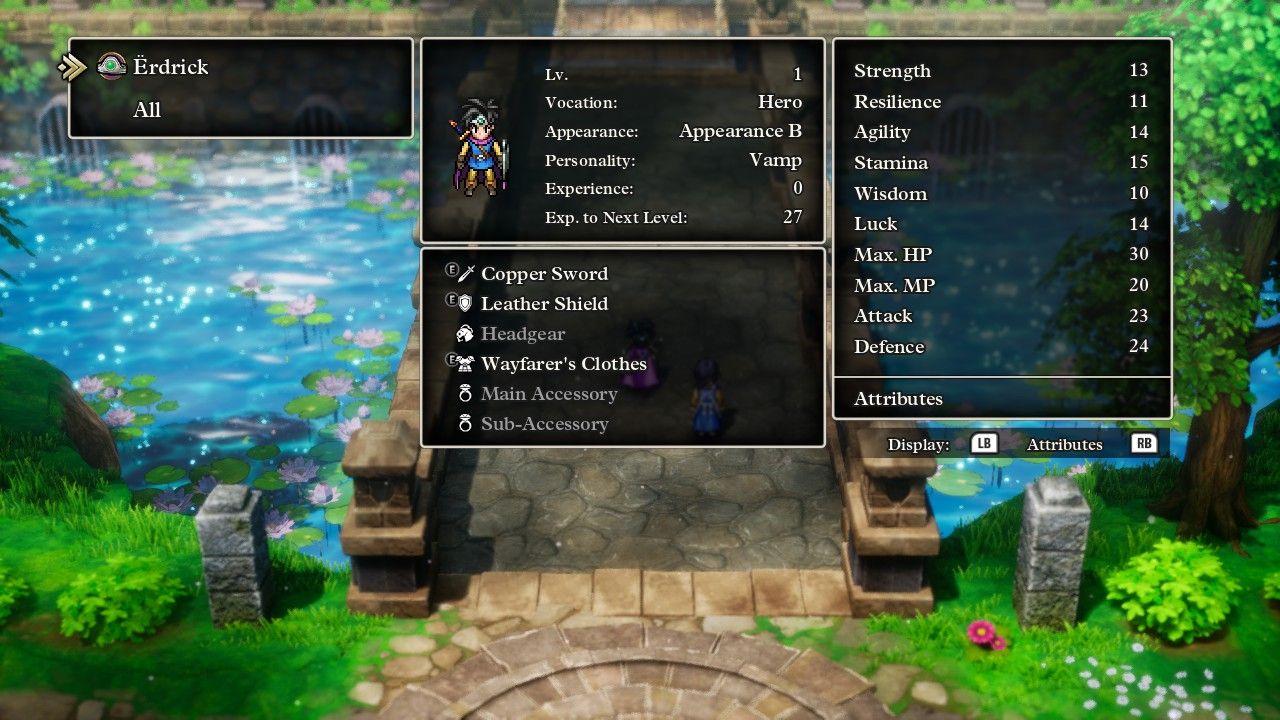
These stats are the core of how DQ3's gameplay operates so I'll take a moment to walk through how they function. For the curious, the various gameplay formulas are all completely different in this HD-2D remake of the game as compared to the NES original, which caused me a lot of confusion when I was searching for how everything worked online. Anyway, Strength and Resilience are pretty straightforward. Add the Strength value of the character to the Attack value on their equipped weapon to get their overall Attack; the Copper Sword has 10 Attack which added together with Erdrick's 13 Strength to get the displayed 23 Attack. Resilience works the same way only added to the defensive value of the character's armor to get the total Defense value displayed here. (Technically the "Defence" value since this game uses British spellings for everything; you'll have to put up with my Americanisms, I'm afraid.) Agility affects the evasion rate and the turn order in battle, though no one seems to know exactly how the evasion formula works. The turn order formula is Turn order = (Agility + 20) * RAND(0.5 - 1.0) which means that the player and all monsters can effectively roll anywhere from half of their Agility vaue up to their full Agility value. Stated another way, if the player has double the Agility of the monsters, they will always go first in combat - something that would quickly take place as Erdrick gained some levels.
The other three stats are a bit more complicated. Stamina and Wisdom affect HP and MP growth respectively, with a character's maximum HP at any time falling between 195-205% of the character's Stamina score. That is, max HP is basically double the character's Stamina score with some minor wiggle room in either direction; sure enough, Erdrick started with 15 Resilience and 30 health. Wisdom works the same way for MP growth, though Wisdom also affects how much damage spells do using a more complex formula that I'll detail later. As for Luck, this is the most complex stat in the game since it affects resistance to status ailments, bonus chance of inflicting statuses, critical hit rate, and physical damage. I'll try to discuss each of them in more detail later, but suffice to say for now that this is a very important stat and not to be overlooked.
Stat growth in DQ3 is fixed: each class will always get the same stats in each category on each level up. There's a very small amount of variation and two characters of the same class that both level to 99 will have some minute differences here and there, but characters that roll a higher Strength increase at Level 5 will then roll a lower Strength increase at Level 6 such that the whole process always stays on the same overall track. That was honestly a good sign for me as I really didn't enjoy having to do stuff like rerolling each level in the original Final Fantasy for those 1 in 4 odds of each stat increasing. Remember how I said the Hero was the most overpowered class in this game? Here's a quick demonstration of how the various classes stack up from a pure numbers perspective:

So, ummm, yeah - this isn't even remotely close.  You are supposed to be the Hero in this game and it isn't shy about making that point clear. The Hero has - by far - the highest Strength growth, the highest Resilience, the highest Agility, and then the second-highest Stamina, Wisdom, and Luck. Most of the other classes do one thing well, like the Warrior class having high Strength balanced out by terrible Agility and Luck, or the Mage having high Wisdom along with dismal Strength and Resilience. But the Hero is simply good at everything, better than everyone else by virtue of being the prophecied savior of the land. This is clearly the Hero's story and the other recruitable classes are mostly along for the ride.
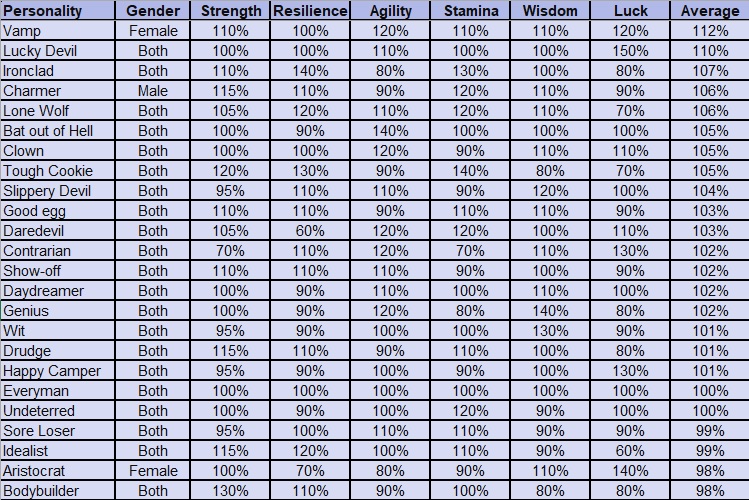
These base stat growths, which are again fixed for each class, are then modified by the personality of each character. There are 46 total personalities, out of which I've listed the first two dozen in this picture. Each personality will increase - or decrease! - the growth of each stat which will add up to some sizable differences over the course of the game. For example, I could have manipulated the Bodybuilder personality for Erdrick which would have given her 30% additional Strength growth, at the cost of reduced Agility, Wisdom, and Luck. Instead I had chosen to give her the Vamp personality since it has the biggest total stat increase in the game. Every single category is positive for this personality and scores of 110% in Strength, 110% in Stamina, and 120% in Luck would all be extremely nice. Note that the Vamp personality is only available to female characters; the male version is Charmer which has slightly better Strength growth at the cost of much worse Luck - not worth it. I *REALLY* do not like the fact that "Vamp" is statistically the best personality in DQ3, as this is specifically described as being an airheaded flirty girl who's obsessed with chasing after crushes. It doesn't make any sense that this is supposed to be the best personality and it reflects poorly on the developers who are holding this up as an ideal of female behavior. There's a lot of stuff associated with how DQ3 portrays women which was intended to be whimsical and funny back in 1990, and which has aged... badly.
Anyway, Erdrick visited the castle and talked to the king who laid out the plot for this game. She was tasked with traveling the world to defeat the Archfiend Baramos, the evil brute laying siege to the rest of the world with his monsters. This journey also takes place following in the footsteps of the Hero's father, Ortega, who made a similar journey a decade earlier before falling into a volcano while battling against a demon. I was amused when the king made this pronouncement that Erdrick would surely fail without recruiting some additional party members - hah! I'm gonna make you eat those words, buddy. Then Erdrick poked around the castle and found this:

It was the first mini medal, one of two big collect-a-thon side quests that takes place over the course of Dragon Quest 3. There are 110 of these medals scattered all around the world and the player receives various different rewards for collecting them and bringing them back to the mini medal monarch, who conveniently lives at the bottom of a well in the initial town (it's a Japanese game, don't ask why these things happen). I have the list of where all of the medals are located and Erdrick would do her best to hunt them all down since the prizes for collecting them have some nice goodies. Note that this initial mini medal was located in a barrel: it's an important point that the world of DQ3 is absolutely PACKED with stuff located in pots and barrels and bookshelves all over the place. Talking to people rarely provides much of anything but there's junk crammed into seemingly every nook and cranny of every location. And while the vast majority of what the player finds is junk, something like 5-10% of the hidden stuff is super valuable like these mini medals. I've been working on compiling spreadsheet resources to winnow out the wheat from the chaff among this vast sea of garbage, something that I'll post on the website when it's done.
I managed to find a Leather Hat and a Dragon Scale accessory while exploring looting the starting town of Aliahan, which together added another 8 points to Erdrick's defense rating. And, now that I've gotten you to read 2000 words before we even went outside, it was time for the first combat of the game:

The Dragon Quest series has always used a first-person perspective for its battles, in contrast to Final Fantasy which traditionally placed the party on the right side of the screen. Normally you would see your full party standing here ready to engage in combat, though for Erdrick she was of course alone and looking pretty slick while engaging in this staredown with four Stark Ravens. The NES original version of this game simply had a black background and no visible representation of your characters; here in the HD-2D remake, everything looks absolutely gorgeous and the backgrounds change constantly depending on wherever the combats take place. The appearance of your characters even change depending on what weapon and (sometimes) what armor they happen to be using. Anyway, there wasn't much choice for Erdrick at the moment as a Level 1 character. I selected the Attack command and she stabbed one of those birds to death:

The Stark Ravens have 12 HP making for an easy one-shot kill. Now obviously I had to know: where do these numbers come from? How does the damage formula work in this game? I had to do a good bit of searching before finding the answer on a Japanese website linked from a Gamefaqs discussion board. Unfortunately the formula isn't intuitive in the least:
baseDamage = attack * (1700 - attack) / 2000 * (1700 - defense) / 2000 * 0.7 * randrate
normalDamage = (attack - defense) * (1700 - math.max(attack, defense)) / 2000 * 0.6
damage = math.floor(baseDamage + normalDamage)
This was too complicated for me to do an easy breakdown of the formula and ultimately I set up an Excel spreadsheet where I could plug in various Attack and Defense values to see what numbers came out. Erdrick had an Attack of 26 at the moment when measured against a Defense of 23 on the Stark Raven. When I ran this through the formula, it said that she would deal 16-18 damage which perfectly matched what she was seeing in practice. Or at least, that's the amount of damage she was doing with "high Luck", which is what the "randrate" part of the formula means. Basically, the game has a predetermined table of Luck values that it compares each character against based on their Level. If a character has a Luck stat that exceeds that number by at least 10%, they deal 10% extra damage on their physical attacks; if their Luck is below that value by 10% or more, their physical damage DECREASES by 10%, and no modification takes place for Luck values near the predetermined value. Thus Erdrick was inflicting 16-18 damage with her high Luck, which would have been 15-16 damage with normal Luck, and only 13-15 damage with low Luck. This is why Luck is such an important stat, even leaving aside how it also affects critical hit rate and status resistances!
As best I can tell, the damage formula in DQ3 is designed to cause the numbers to increase slowly over time as the game progresses. For example, you might think that if Attack = Defense, then the damage output would be the same no matter what those values might be. However, that is very much not the case: if Attack and Defense are both 10, the average damage is about 5-6 points. If they're both 50, then average damage is about 25 while if they're both 500 then average damage is about 132. It also holds down the numbers and keeps them from hitting extreme values: 500 Attack / 250 Defense deals about 250 damage while 500 Attack / 100 Defense only deals 330 damage and even 500 Attack / 10 Defense only deals 370 damage. The system kind of caps the amount of damage that can be inflicted and restricts it to a more narrow band of possible outcomes. I'm not exactly sure how this will play out for solo characters or other variants, it's something that I'm going to have to test out via experimentation over time.

Erdrick leveled from the very first battle that she fought, with solo characters thankfully getting 4x the normal experience value since they don't have to share it with anyone else. The gameplay helpfully provides this screen indicating how all of the stats increased along with any new spells or abilities that may have unlocked. Leveling also heals your character to full HP/MP, which is standard in modern RPGs but which was very much not the case in the NES original. I fought outside for a little while longer while waiting until the sun set in the distance, and yes, this game has a day/night cycle which sometimes causes some differences in the towns if the party comes back at night. (That feature was included in the NES game and it was a pretty novel concept at the time.) Returning to Aliahan at night allowed Erdrick to enter an additional building which was hiding the second mini medal, which I then turned in for the first reward: a Thorn Whip. This was an improved weapon with 9 additional points of Attack that she'd be using on her next excursion into the wilderness. But first, I had to save-scum some seeds:
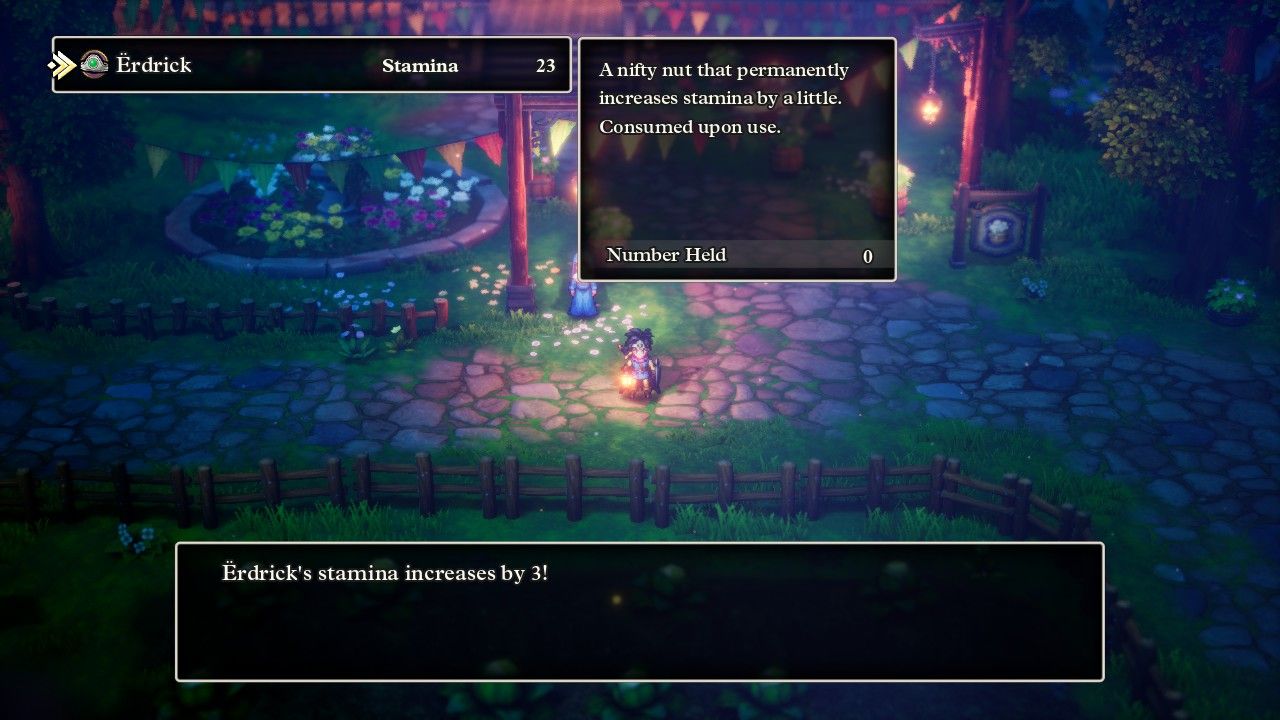
Dragon Quest 3 is packed full of seeds that permanently boost the stats of characters, in the same fashion as Octopath Traveler's nuts. These were present in the NES game and, unlike in Octopath Traveler where the stat gains were fixed, the seeds in DQ3 have a range of potential outcomes. Most the seeds can roll a value anywhere from 1 to 3, like this pictured Seed of Stamina, and it's a completely random dice roll as far as which number comes up. For a solo game, there's really no choice other than save-scumming the maximum value on each and every seed as the benefit is simply too great to pass up. For example, I had earlier made several attempts until rolling the max value of 5 additional HP from a Seed of Life that Erdrick had turned up in the castle, which increased her max HP from 30 to 35. That was kind of a big difference! Fortunately (unfortunately?) there are HUNDREDS of these seeds to be found over the course of the game, plus monsters can drop more seeds at low odds when winning battles. That's good news in the sense that solo characters can potentially farm stat-boosting seeds to make it past tough bosses that might otherwise be impossible. It's also bad news in that I knew I'd be spending hours sitting next to the nun who can save your game, rerolling those blasted 1 in 3 odds over and over again every time that Erdrick turned up another seed. It really did make a difference in terms of her stats and the time investment was worthwhile - but not exactly the most entertaining use of my real-world time. (For the curious, I'm playing the game at double or triple normal speed using an out of game program, much as I did with Octopath Traveler. It helps speed through this kind of tedium.)
Once the seeds had been sown with their max stat benefits, Erdrick could head outside and put her new Thorn Whip to good use:

She had ventured into the first dungeon of the game, which is a surprisingly complicated location known as Dreamer's Tower that can be accessed from two different underground cave areas. There were some new enemy types to be found here, though they also died in a single hit from Erdrick's weapon. She was using a whip which had the special property of being able to hit an entire group of enemies at once. All attacks and abilities in DQ3 are classified in one of three ways: single target, single group, or all enemies. The groups are identified on the battle screen when picking a target, and note that all monsters of the same type do *NOT* necessarily get grouped together! You could have three Antnibblers in a group, as was the case here, or three individual Antnibblers each making up their own separate group. For opponents that share a single group, whips will hit all of them in a single attack, with the damage decreasing by roughly 20% for each additional target struck. The damage is always highest on the first target and then goes down from left to right, with no way to change this property. Sometimes there are groups with as many as seven or eight monsters, causing the damage on the final target to limp in at some pitiful value.
But even with the reduced damage for larger groups, this property on the Thorn Whip was fantastic for a solo character like Erdrick. She was still one-shotting everything (Antnibblers only have 14 HP and nothing in this first dungeon went above 20 HP) and was limited only by how many opponents she could hit at a time. She was also taking very little damage in return, with the monsters quickly falling so far behind in the damage formula that they couldn't inflict more than 1 damage at a time. Many of them were also outright missing, though again I don't know how the evasion formula works in this game. Erdrick had learned the basic Heal spell already which restores about 30-40 health per casting, though she was leveling fast enough that she could rely on the free HP/MP restoration without having to cast spells. She even found the third mini medal and turned it in for a Leather Dress (only equippable by females) which boosted her Defense by another 7 points.

Erdrick reached Level 8 while she was ascending Dreamer's Tower and unlocked her first ability, Flame Slash. Abilities were a new addition in some of the earlier remakes of DQ3 as they didn't exist at all in the NES original. The old game only had spells as an option, with three of the eight classes having no spells whatsoever and therefore never gaining anything from leveling except higher stats. (If you played as a Soldier in the original game, you could literally never do anything other than Attack or use items for the entirety of the gameplay - this was normal back in 1990.) The HD-2D remake has a whole bunch of abilities and ensures that every class gets something from leveling, though the Hero class is again special here as no other class has both spells and abilities, only one or the other. The Hero class gets both, of course, starting with this Flame Slash. Note that the in-game description is almost completely useless, with DQ3 sticking to the Octopath Traveler philosophy of "never tell the player anything" when it comes to spell or ability descriptions. Who wants to know things like numbers or formulas when we could have vague platitudes instead? 
What Flame Slash actually does is hit a single target at 130% of the normal Attack value, with fire element as the damage type. There are six different damage types in DQ3: Strike damage (physical), fire element, cold element, wind element, explosion element, and lightning element. It's a bit confusing to me that fire and explosion are listed as different elemental types of damage but I don't make the rules here. The Hero class learns several different fire element spells, including the whole "Sizz" family that hits a group of opponents, but it's usually better to use this Flame Strike ability instead since it boosts the already monstrous Attack value of the Hero by another 30%. I tested out the ability against an Antnibbler since that monster type has a weakness to fire damage, which led to the poor thing getting absolutely splattered with overkill damage. Obviously there wasn't any real need for Flame Slash in these random encounters, though I would keep it in Erdrick's back pocket for potential boss fights later on.

The plot token item in Dreamer's Tower is the Thief Key, something that lets the player unlock previously barred doors in classic Metroidvania fashion. There are three such keys throughout the game and this is the first one that the party comes across. Once she had this new key in hand, Erdrick was able to unlock an improved piece of headgear named the Hardwood Headwear which added 8 more points to her Defense rating. She also picked up this pictured Boomerang near the top of the tower, a new weapon that had 8 fewer points of Attack as compared with the Thorn Whip, but which now hit *ALL* of the monsters on screen in each round of combat. Boomerangs did not exist in the NES version of the game and they can be tremendously useful weapons for this reason, even though their base Attack value tends to be lower than other contemporary gear. With the Boomerang in hand, Erdrick started clearing nearly every battle in a single round. Random encounter starts, Erdrick tosses her boomerang, everything dies. Rinse and repeat. I knew it would get harder eventually but this was pretty awesome for the moment.
In order to progress the story, Erdrick used the Thief Key to unlock a door in the northern town of Reeve. A person hiding inside gave her a grenade (yes, really) which would clear the path through the next dungeon in line and allow her to escape the starting tutorial island. While Erdrick was clearing the eastern half of that starting island, let me cover two additional things that appear outdoors on the world map:

These were the "Sparkly" areas and the Secret areas, hidden locations which can be found all over the world. Both of these things are new to this incarnation of DQ3 and they serve as an incentive to explore the world map. Since this was originally an old NES game, there are vast stretches of the map where basically nothing happened in the 1990 version of the game. I think that players were expected to spend a lot of time stumbling around, trying to figure out where to go back in the pre-Internet era. I certainly remember doing that with my friends when we were all 10 years old! Three decades later, that doesn't really work anymore and the gameplay has been updated with loot drops that can be found in every environment possible. The Sparkly areas are visible as soon as the player leaves Aliahan for the first time, small glowing patches on the ground that contain 1-3 items when discovered. Most of them have total junk but a few have extremely valuable items, including a whole bunch of additional seeds. It's worth the time and effort to find them all which also serves the dual purpose of exploring the beautifully rendered environments in this game.
Secret areas are basically the same concept but slightly harder to find. They're portions of the map that stand out in some way: an unusually tall tree, a pile of rocks standing by themselves, a pillar of ice out in the ocean, etc. Walking into a secret area exits the overworld and opens up a smaller "indoor" area of sorts that always contains a treasure of some kind. The secret areas are rarer than the sparklies and tend to have better or more valuable stuff inside, though that's not a given and both of these places will delude the players with mounds of useless garbage. There are also *TONS* of these places across the whole game: 334 sparkly locations and 101 secret areas over the course of the whole thing (!!!) I put together a full list from some third party resources online which I'll convert into an easy checklist to post here on the website. By the way, I think this is a fantastic concept and it helps to keep players engaged in DQ3 even when there's nothing going on in the main plotline. You can spend hours just walking or sailing around on the map and hunting for secret stuff which is a lot of fun.
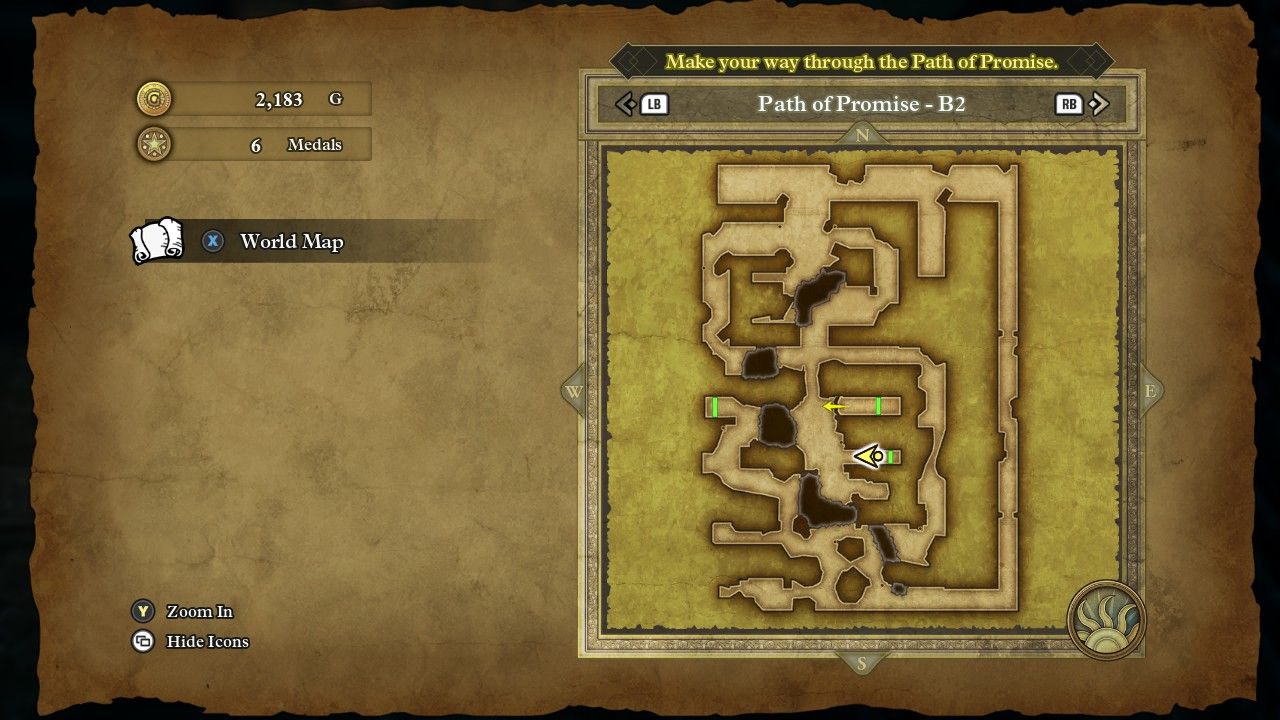
I also need to mention that the HD-2D remake of DQ3 features internal maps that always keep track of the party's location. This is a godsend as the environments in this game are much bigger than their NES counterparts and it would be very difficult to know where to go with them. There's also an indicator that always tells the players where to go next, though it can be turned off in the options menu if desired. This was the map from the Path of Promise, the second dungeon in the game, which the party must pass through to reach the rest of the world map. The monsters in here were a modest step up from what Erdrick had been facing thus far, still dying in a single hit from the Boomerang (unless she was hitting a whole bunch of targets) but a couple of them were able to damage Erdrick to some extent. The Killerpillar bugs could deal 6-7 damage with their attacks which was a big step up from the 1 damage that most everything had been doing thus far. I found that the damage formula was working perfectly for Erdrick's own attacks yet seemed a bit off for the damage dealt by the monsters. Perhaps they use a slightly different formula? Either that or the monster stats that I had were incorrect. By my accounting, the Killerpillars should have been hitting for 1 damage as well.
Erdrick wasn't in any danger yet, as she had well over 100 HP and could cast the Heal spell at any time for recovery purposes. She cleared out the dungeon, picking up two more seeds in the process, and went through the teleportal to the other side. There's a mandatory story encounter upon exiting:

The party runs into this Slime, only to discover that it's a friendly Slime being watched over by this guy Monty. He asks the player to recruit more of these friendly monsters, thus introducing them to the other big collect-a-thon side quest in DQ3. This is a new feature in the HD-2D remake as there are 122 of these monsters located around the world for the player to discover and recruit. Those monsters will then battle for the player in the monster arena which can be found in several different towns along the journey. The monster arena actually did exist in the NES version of the game, though in that incarnation it was more like playing a slot machine where the player would bet on which monster would win in combat and gain money if their guess was correct. Here in the HD-2D version, the player builds their team of friendly monsters and then pits them against other NPCs in Pokemon battles at the arena. My favorite part about this gameplay mechanic is how the monsters "level up" by finding additional versions of the same monster type. For example, the initial Slime "Splatrick" starts at Level 10, but increases to Level 23 if the player finds the second Slime "Slimon" later, and so on. There are five Slimes in total and most monster types have at least two or three of the same version that can be upgraded.
Finding and recruiting the monsters can be a bit finnicky. Some monsters will always be present no matter what, however a decent subset of them require the party to show up at a certain time of day: either day, or sunset, or night. Appear at the wrong time of day and no monster will be present, with no indication that the player missed anything (practically forcing the use of outside guides). Some monsters also flee from the party at first appearance, either due to their scent or their sight or their noise. These first two conditions can be bypassed: using a Musk item covers the party's odor and a Fading Jenny item turns the party invisible so that they can sneak up undetected. Unfortunately the noise condition can't be fixed with items and requires having a Thief or a Monster Wrangler in the party to recruit the shy monster. Therefore let me introduce:

Wrangler the Monster Wrangler! This is the new class added in the HD-2D remake of DQ3 and it has the innate property of always being able to recruit monsters no matter what conditions they might have. I added this guy to the party solely for monster recruiting purposes, with the plan of ditching him back at Patty's Party Planning Place for any situation involving combat. I did the same thing in Octopath Traveler, using the non-solo characters for their Path Actions, and I figured that having an extra character for monster recruiting served the same purpose. I used Wrangler here to recruit this Spiked Hare who hangs out by the fountains in Romaria and only appears at night. This is kind of a rude awakening for new players as the bunny monster can only be recruited using a Thief with Padfoot ability or a Monster Wrangler, with the gameplay not making this clear at all. My initial non-variant party had no clue what was going on and why I couldn't recruit this thing since I lacked either of those two classes.
Once I had a few more monsters recruited for Erdrick's team, she could take part in the arena battles:

This screenshot was taken slightly later on but I wanted to display it here since I was covering the topic of monster recruiting. After finding and catching these things out in the wild, the player can pick a team of three monsters to engage in combat. Remember, finding multiple copies of the same type of monster will level them up with higher stats, allowing even early game critters like Slimes and Antgobblers to remain relevant for a while. The player selects which arena rank they want to take part in, with the first arena in Romaria having two ranks out of an eventual eleven (nine in the main game and then two more secret arena ranks in the postgame content). The player does not control the monsters directly in combat, only selecting from four different tactics and then watching what happens like an autobattler. Who would have thought that Dragon Quest would have a miniature version of Teamfight Tactics, heh. The first two arena ranks are pretty easy and Erdrick's monster team won them both, yielding the very nice prize of 3 Seeds of Strength and 3 Seeds of Stamina plus a Cloak of Evasion which was better than the current armor she was wearing. Then I kind of wish that I hadn't won the arena since I had to spend the next five minutes rerolling the max stat gains on all six of those seeds, sigh.
Anyway, hopefully it should be clear that this game is packed full of optional side stuff going on in the background. Between mini medals, monster recruiting, searching for sparkly and secret areas, and finding all of those hidden seeds, the amount of stuff to keep track of can feel overwhelming at times. There's a reason why I did a whole non-variant playthrough ahead of time and spent hours compiling my spreadsheet resources before taking on this first solo challenge. Now that I've covered most of the basic gameplay mechanics, I'll put a break here and continue with the plotline proper on the next page. Arriving at Romaria is where the tutorial portion ends and the gameplay begins to open up in earnest - what did the big wide world have in store for Erdrick next?