
I didn't go on any work trips during 2025 due to the birth of our second son at the tail end of the previous year, but by the beginning of 2026 Charlie was old enough that we felt I could spend a few days away from home. I usually travel to a conference hosted by the American Medical Association each year in January, which always takes place at some warm destination since the AMA headquarters in Chicago isn't the most desirable location at that time of year. This time the conference was being held in Los Angeles, the second-largest city in the United States and a place that I'd only visited on two previous occasions. I think anyone reading this will be familiar with the city of LA to at least some degree, famous for being the worldwide center of the film industry as well as the entertainment capital of the USA. Los Angeles is also a major financial center and one of the largest shipping ports in the world (though that wasn't something that tourists would go visit). Almost 20 million people live in the greater metropolitan area of LA and this city is infamous for sprawling out endlessly in every direction. It's a remarkably low density area for such a large city, with very few skyscrapers, and it takes forever to get anywhere due to LA's terrible traffic jams. I could only see a small subsection of the attractions in LA during this brief work trip and therefore I was going to have to plan my itinerary carefully.
As readers of the other travel reports on this website will know, I typically only get to do any sightseeing on the day of my arrival, as the remaining days of my work trip are taken up with, well, working. The doctors that make up the AMA are used to long hours and the meetings usually start at 8:00 AM and run until 5:00 or 6:00 PM with only a brief break for lunch. Therefore I made sure that I had an early flight scheduled for this trip, leaving from Baltimore at 8:00 AM and arriving early in LA at a little after 10:00 AM (taking advantage of the gain of three hours from crossing time zones). I headed over to the rental car center and picked up the small blue car that I'd be driving for the rest of the day. The traffic wasn't too bad in late morning and I was able to make it to my first destination before noon:

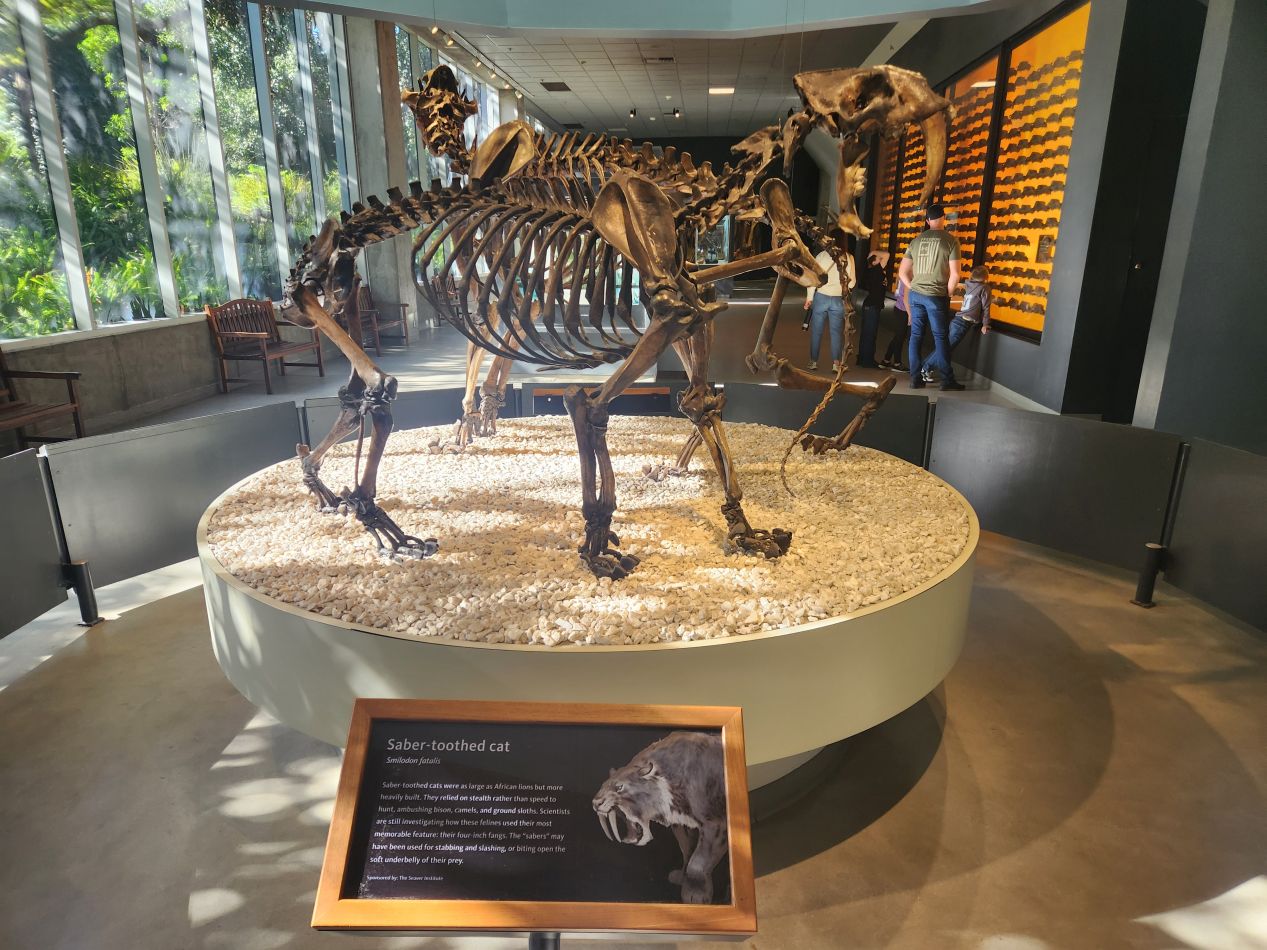


I started out my whirlwind day of sightseeing at the La Brea Tar Pits. I had always wanted to see the famous tar pits and their location in central LA was well situated along the route that I would have been driving anyway. We don't tend to think of Los Angeles as being connected to the oil industry, however there actually is a substantial oil field underneath the city which was drilled extensively in the early 20th century. The tar pits are a natural consequence of that oil field: oil bubbles up to the surface and collects in ponds, where it becomes thick enough to trap animals. The tar pits were apparently especially bad for predators as they would come to eat the trapped animals, only to become trapped themselves and perish. I started out my visit to the tar pits by exploring the small museum located here, named after George Page who donated the land on which it now sits. There were lots of reconstructed skeletons of the animals who had been discovered preserved in the tar pits, giant bears and extinct camels and saber-toothed cats. Skeletons of horses have also been recovered from the tar pits, notable because horses evolved in North America and then went extinct here, only to be reintroduced later by Europeans. There was even an entire wall displaying 400 skulls of dire wolves, an extinct breed of wolf which had been recovered in huge numbers here at the tar pits.

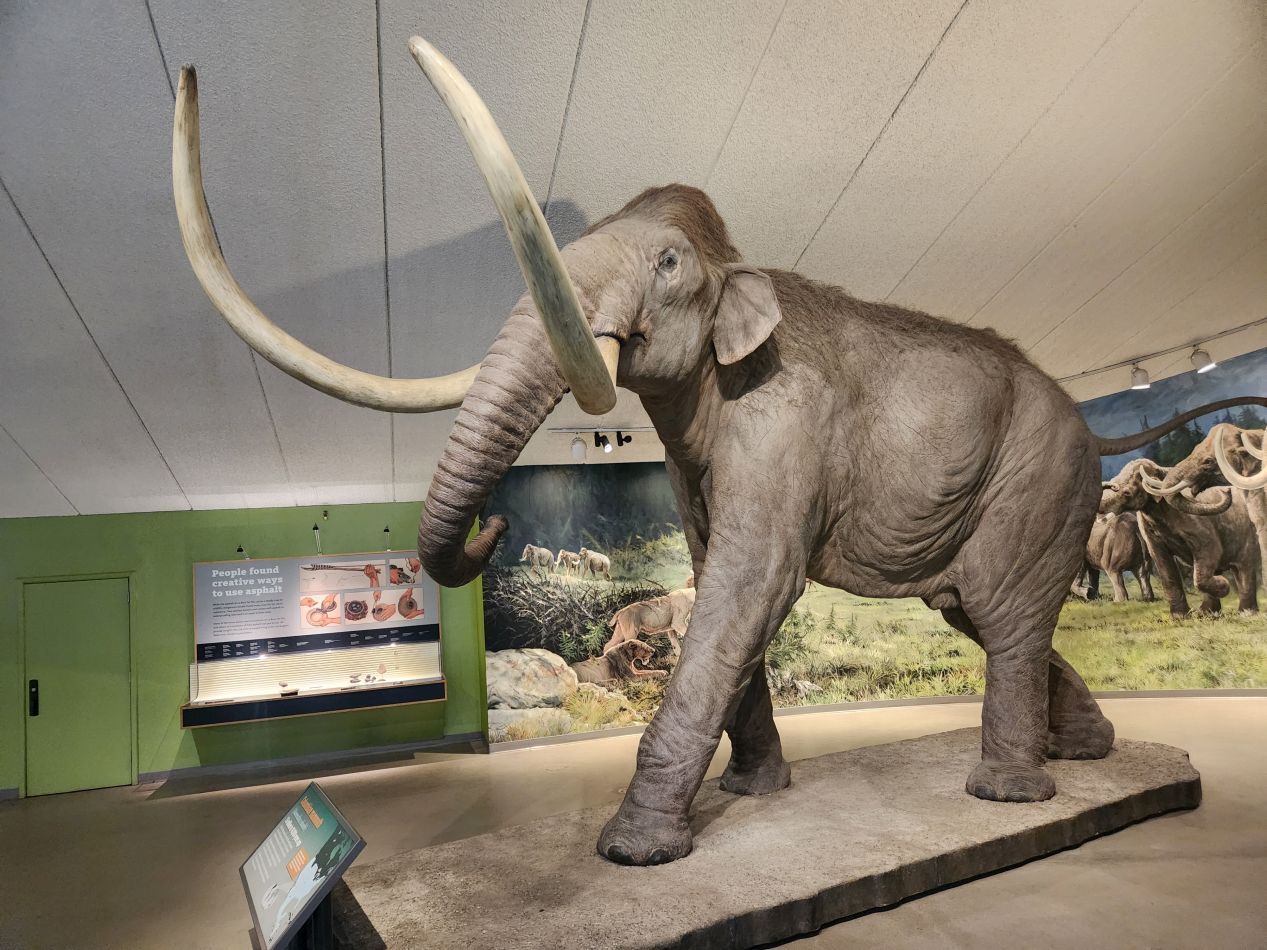


The most impressive animals on display at this museum were the mammoths and mastodons, prehistoric elephants that had been common in this area as little as 15,000 to 10,000 years ago. Largest of these was the Columbia mammoth, a less-shaggy version of the famous wooly mammoths associated with prehistoric humans. There were also giant ground sloths living in prehistoric LA and even dwarf mammoths that had been recovered from the offshore Channel Islands of California, miniature elephants about the size of a donkey. Looking at these skeletons and reconstructed displays, I couldn't help but feel saddened that all of these animals had gone extinct after humans arrived in the Americas sometime around 20,000 to 15,000 years ago. The ecosystem of North America should have these animals present, mammoths and camels and giant cats and huge sloths, to look something like the African savanna. Instead these animals are all just... missing, and the vast majority of people don't even know that they should be here. Imagine if you could go to Yellowstone National Park and see these animals today, it would be incredible.

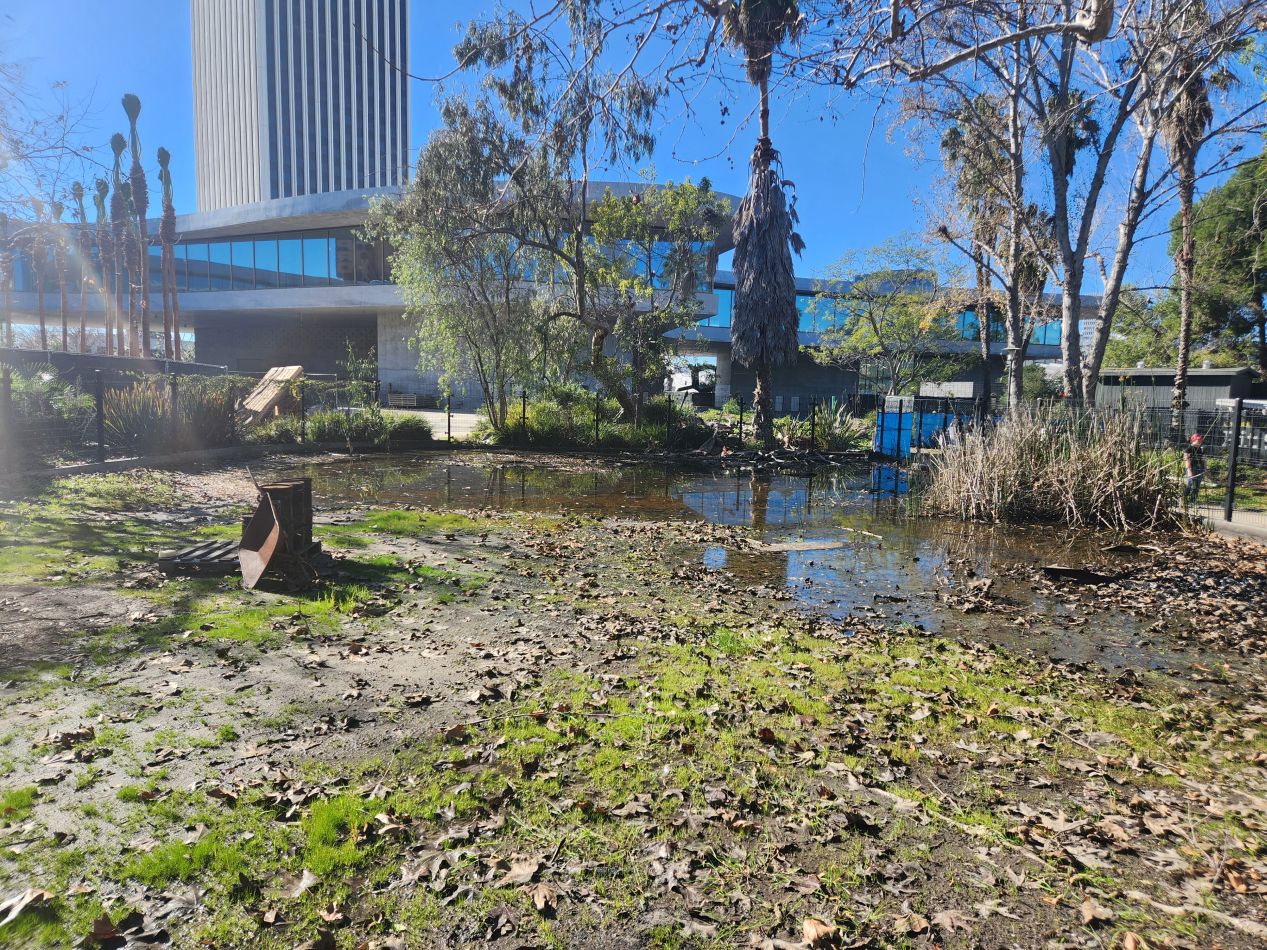


The museum was quite small, though very good for what it had on display, so it didn't take long before I exited and walked over to the tar pits themselves. There were about a hundred of these originally but most have been sealed up for safety reasons as the city of Los Angeles completely enveloped this area. The largest of the remaining spots was the Lake Pit, which is what most people popularly imagine the tar pits to look like, where an artist added these traumatizing mammoths getting trapped in the tar back in the 1960s. Did that person really have to create a baby mammoth screaming in distress? Generations of schoolchildren have probably been freaked out by seeing that. There were four or five other tar pits that could be viewed while strolling through the park that surrounded the museum, all of them much smaller in size. Each of these was fenced off and looked similar to the pictured Pit 13: small, wet pits with a glossy sheen of oily tar on the surface. There was also a research station here where archaeologists were cleaning the hardened tar off more fossil specimens; despite the tens of thousands of animals already found, this work continues onwards with no end in sight.
Oh, and the tar pits trapping animals isn't something confined to the distant past. Animals are still getting trapped in the tar to this day, as birds and squirrels routinely still get stuck in the tar and perish. Those fences around the tar pits were placed for a reason as the pits could be dangerous to anyone who might wander inside.


The La Brea Tar Pits share the same park space with this building, the Los Angeles County Museum of Art (usually shortened to LACMA). This is the largest art museum in the western United States with more than 150,000 works in a collection that specializes in modern and contemporary art. I would have enjoyed seeing this excellent art museum but I had to pick and choose which spots I was going to visit in my limited available time, and art installations usually draw the short straw for me as there are other attractions that I prefer to visit. That included the next spot that I was stopping to see which was located right across the street:

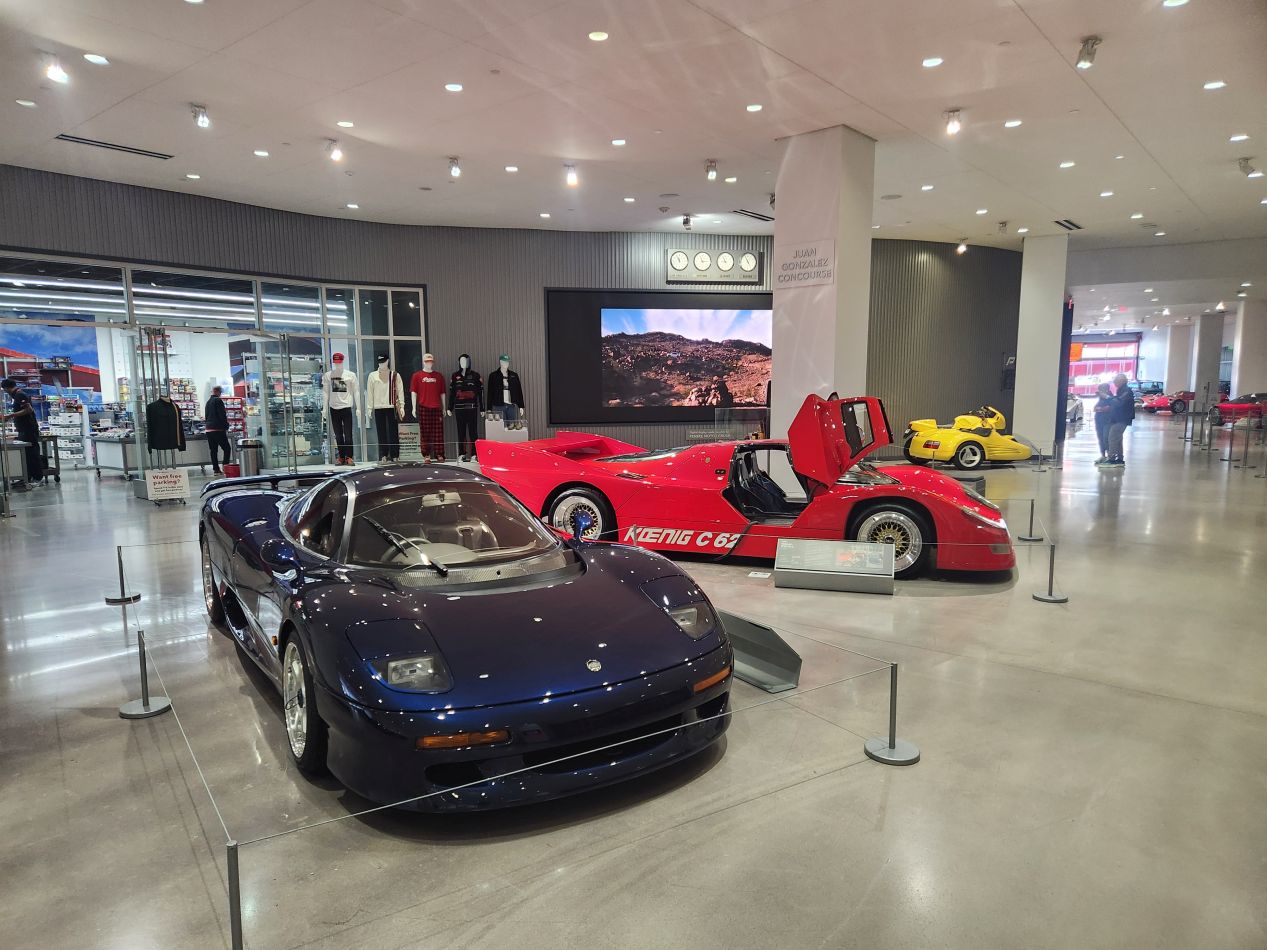


That being the Petersen Automotive Museum, one of the largest automobile collections in the world. Hopefully I wasn't being too much of a philistine by passing up an outstanding art museum to go look at a bunch of cars! In all honesty though, I thought that the car collection on display at the Petersen would be more interesting to see and I ended up being glad that I chose to visit this place. The Petersen opened in 1994 and keeps more than 100 vehicles on display in its permanent collection; it also hosts rotating exhibits like most other museums, though the ones here usually have extremely expensive or rare cars. (The Petersen is also somewhat infamous for being the location where rapper Biggie Smalls was murdered in 1997 during a drive-by shooting that took place just outside.) The museum's collection started out on the third floor which had some antique vehicles along with utterly bizarre stuff like this 1969 Fascination prototype design. It seems someone really did make one of those bubble cars from the Jetsons and other futuristic media.

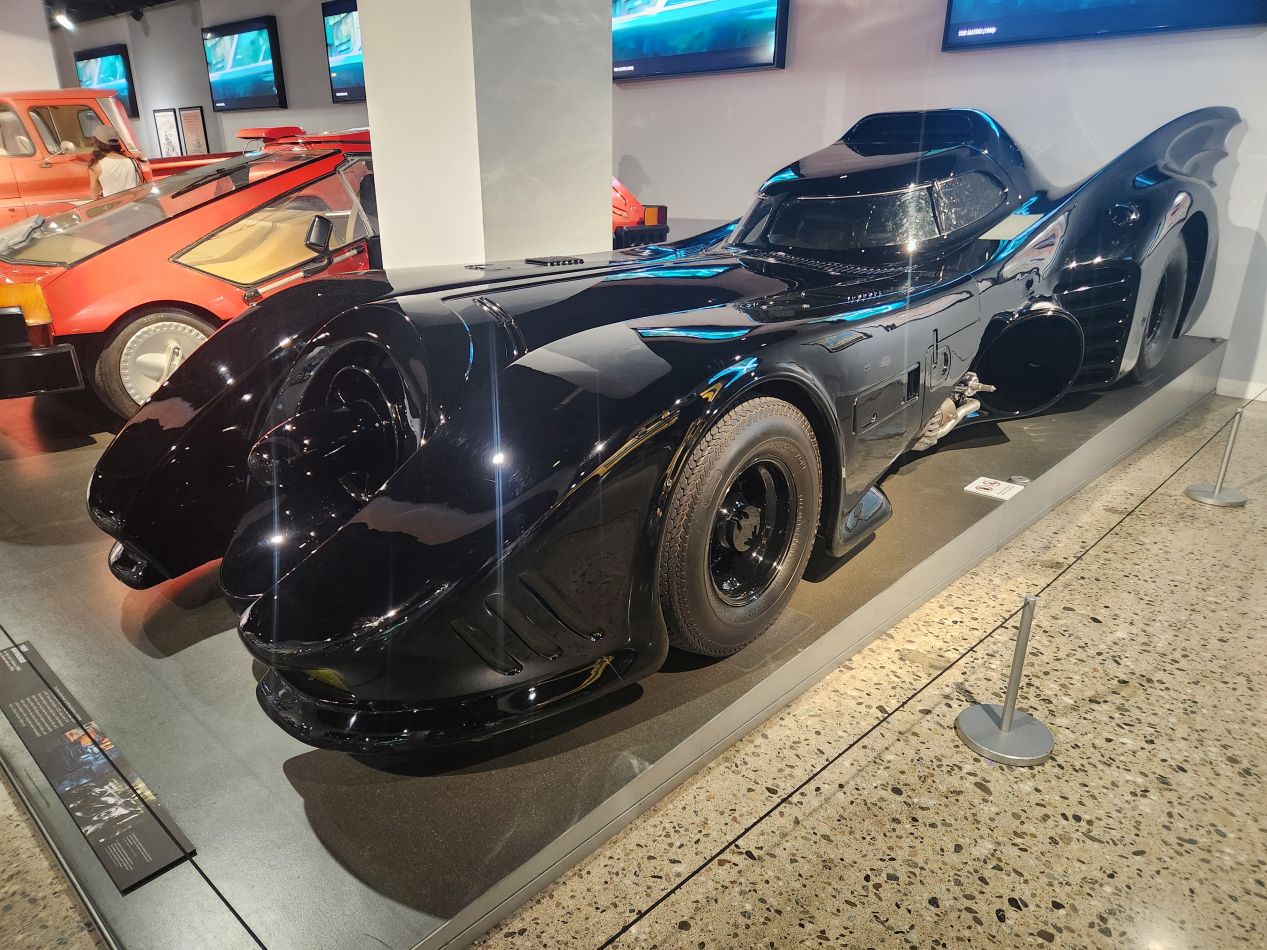


The biggest highlight of the Petersen was its collection of movie cars though, at least for someone like me who isn't a huge car person. There were several dozen vehicles on display which had been used in different film productions, many of them quite famous. There was the Chevy Camaro used for Bumblebee in the Michael Bay Transformers films plus the Batmobile used in the Tim Burton Batman movies. Somewhat more obscure but amusing to me was the yellow pickup truck used in the 1990s film Twister, complete with that stupid weather device in the back that the characters kept trying to drive into the path of a tornado. Then off by itself in a position of prominence was a life-sized creation of Lightning McQueen from the movie Cars which is apparently the single most popular vehicle in the museum. Our older son William was 3 years old at the time and absolutely loved the movie which he insisted on watching over and over again. I took a picture of myself with Lightning and sent it back to my wife, which resulted in our son telling everyone that his Dad had traveled to California to see Lightning McQueen. 

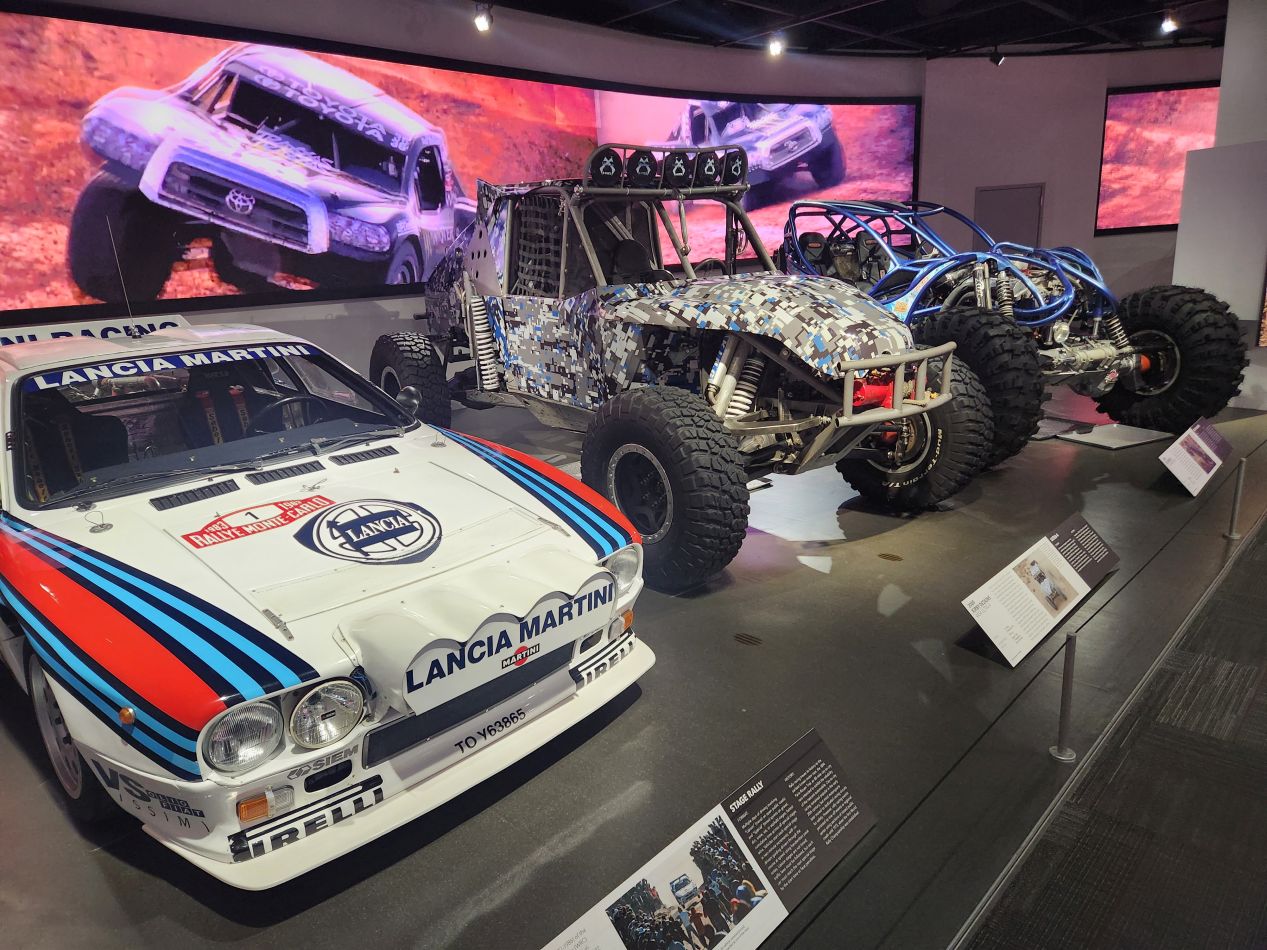


All of those cars had been simply been on the top floor of the museum. As I moved down to the second floor, I found more bizarre vehicle designs that looked like they had come out of someone's fever dreams. The green car was apparently a 1955 Chevy Biscayne which had a really striking profile between those circular headlights and the verticle grill in the front. It looked a bit like a movie monster's face to me. There were portions of the museum dedicated to early motorcycle designs and then offroad buggy racing vehicles. One of those things was shaped like a giant shark and named the Landshark for no understandable reason. Stranger still was the "Lo Res Car" from 2016 that indeed looked like a polygon that hadn't finished rendering, though apparently it could indeed be driven on streets, if not very quickly with a max speed of 30 miles / 50 kilometers per hour. Then there were the "hypercars" from the last picture, absurdly expensive models with ridiculous horsepower and top speeds. If you wanted to see what a car exceeding a million dollars might look like, this was the exhibit for you.

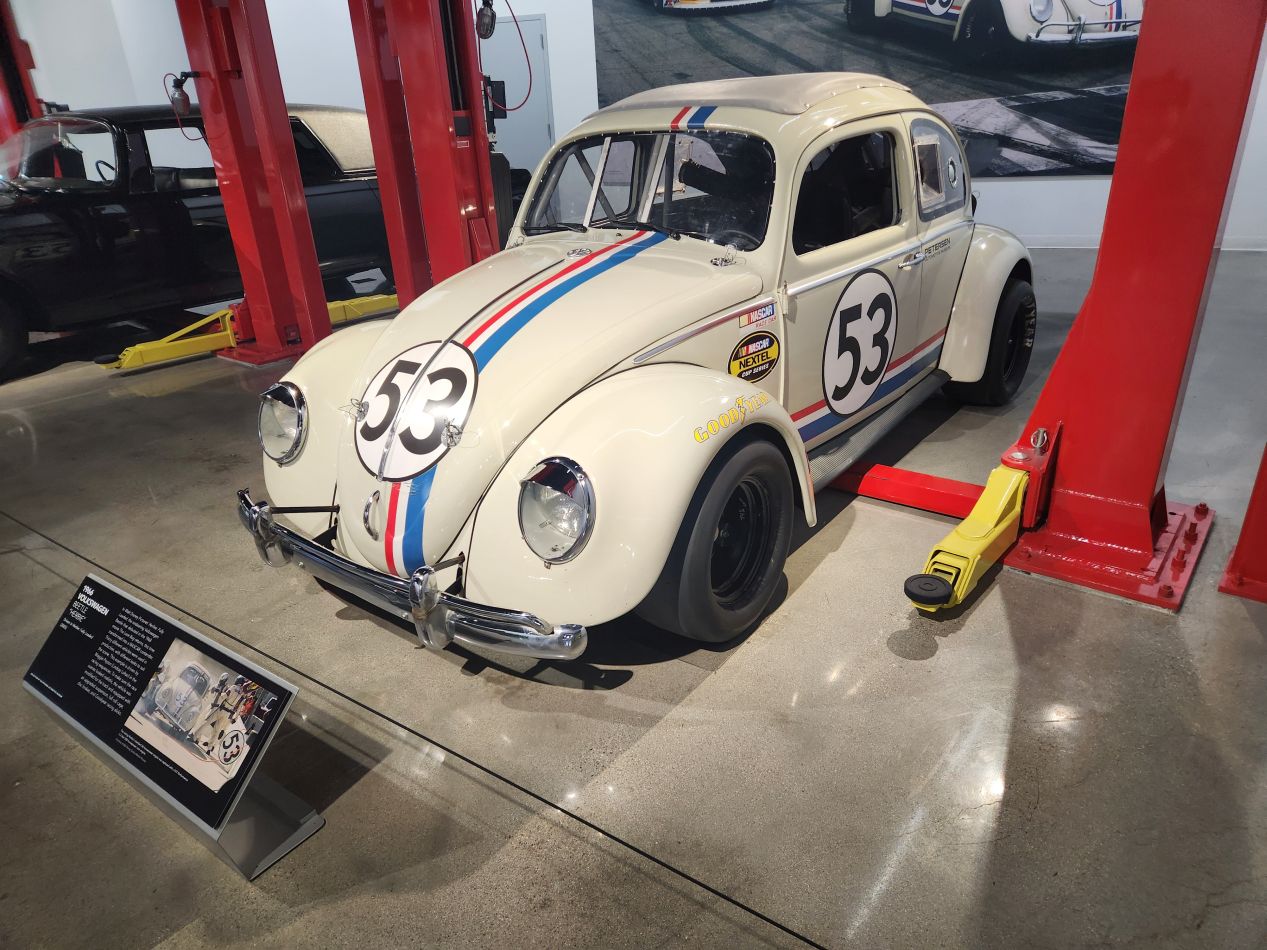


This floor had its own collection of movie cars to explore. Highlights included the Mystery Machine van used in the live action Scooby Doo movie which somehow looked smaller than I expected it to be. There was the Volkswagen Beetle used in the Herbie movie (unfortunately the remake from 2005 and not the original film) along with the "Mirthmobile" car driven in the movie Wayne's World. The museum had placed a little casette on the dashboard containing Queen's Greatest Hits since this was the car used in the famous "Bohemian Rhapsody" lipsynching and headbanging scene. This floor also had a temporary exhibit showcasing various Aston Martin cars, the famous luxury brand of British vehicles. There were about half a dozen cars on display but I included a picture above of another movie car, this one an Aston Martin from 1964 that had been used in the No Time To Die James Bond film. The steering wheels on all of the Aston Martins were, of course, on the right side of the vehicles.

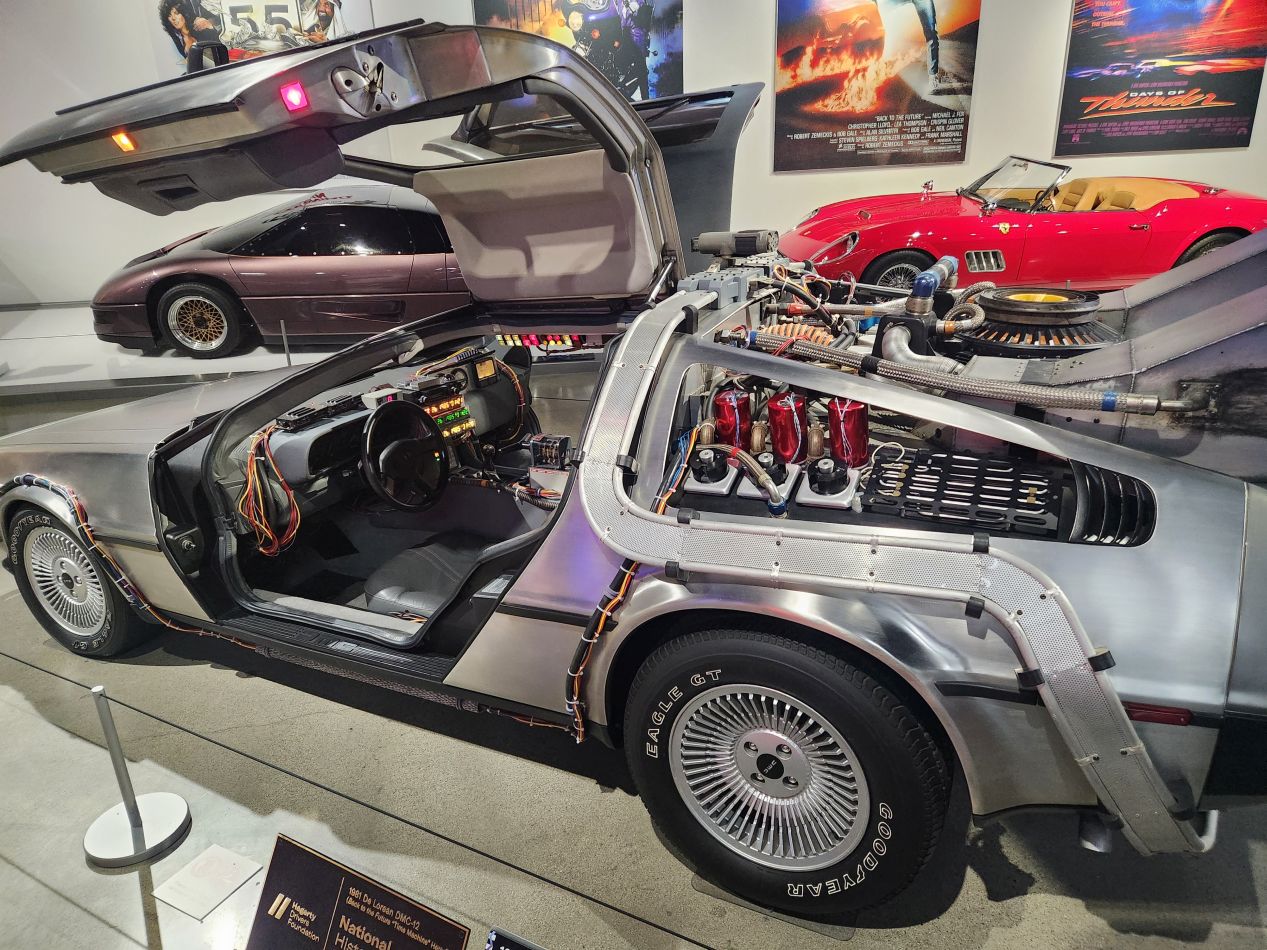


There were even more cars down on the ground floor of the museum and I could have spent even longer here if I wasn't trying to hurry along. The theme here was cars from the 1980s and 1990s, a period during which car designs became inexplicably blocky before rounding out into more sensible curves again. There were a number of sedans and trucks and luxury vehicles to be found here, but the gems of the collection were once again a series of famous movie cars. The most famous of these had to be the actual De Lorean used in Back to the Future, a car that was so iconic that it was listed on the National Historic Vehicle Register. Everyone wishes that they could drive this car and it was awesome to get to see it in person. Right behind the De Lorean was the red Ferrari from Ferris Bueller's Day Off, the one owned by Cameron's dad that plays such an important role in the plot. (No, the car wasn't actually destroyed while filming, an incomplete model was used for stunt scenes.) There were also half a dozen arcade video games focused around driving, games like Off Road and Daytona USA that had been set to free play mode, and then this Pac Man car built as a stunt in 1982. Wild stuff.

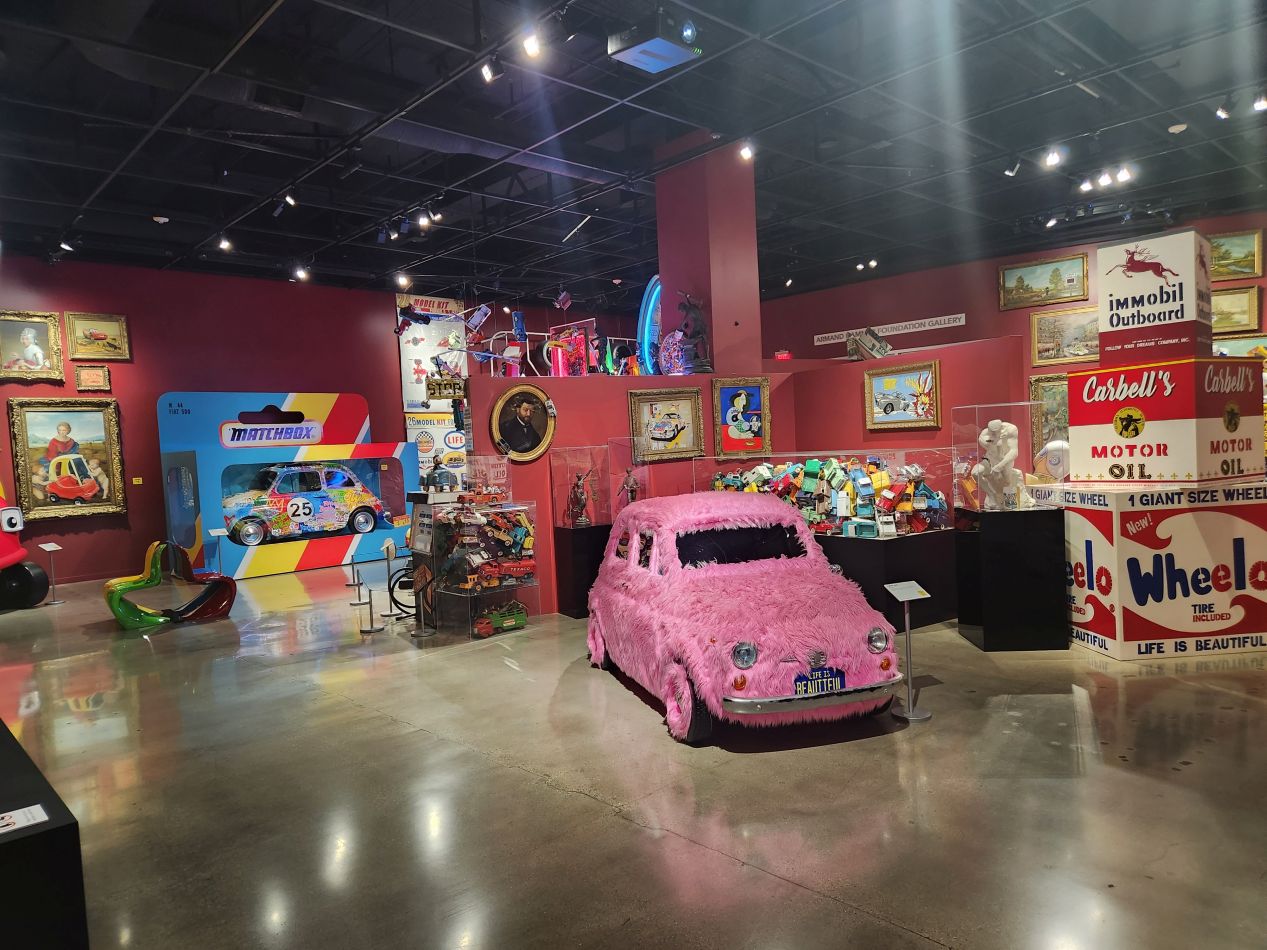


The final exhibit at the Petersen museum was a temporary showcase named "Cars Are Beautiful" by artist Mr Brainwash. I have no idea what this stuff was supposed to mean but the art was all appropriately car-themed in nature. It was fun to see even if I had no idea what was going on. Overall, I spent a little over an hour inside this museum and I was really happy that I had taken the time to visit. The Petersen is well worth seeing even for people who aren't particularly interested in cars. There are even more vehicles that can be seen downstairs in their "vault" collection, however that required paying an extra fee and I didn't really have the time for that anyway. I had to get moving to my next planned stop.

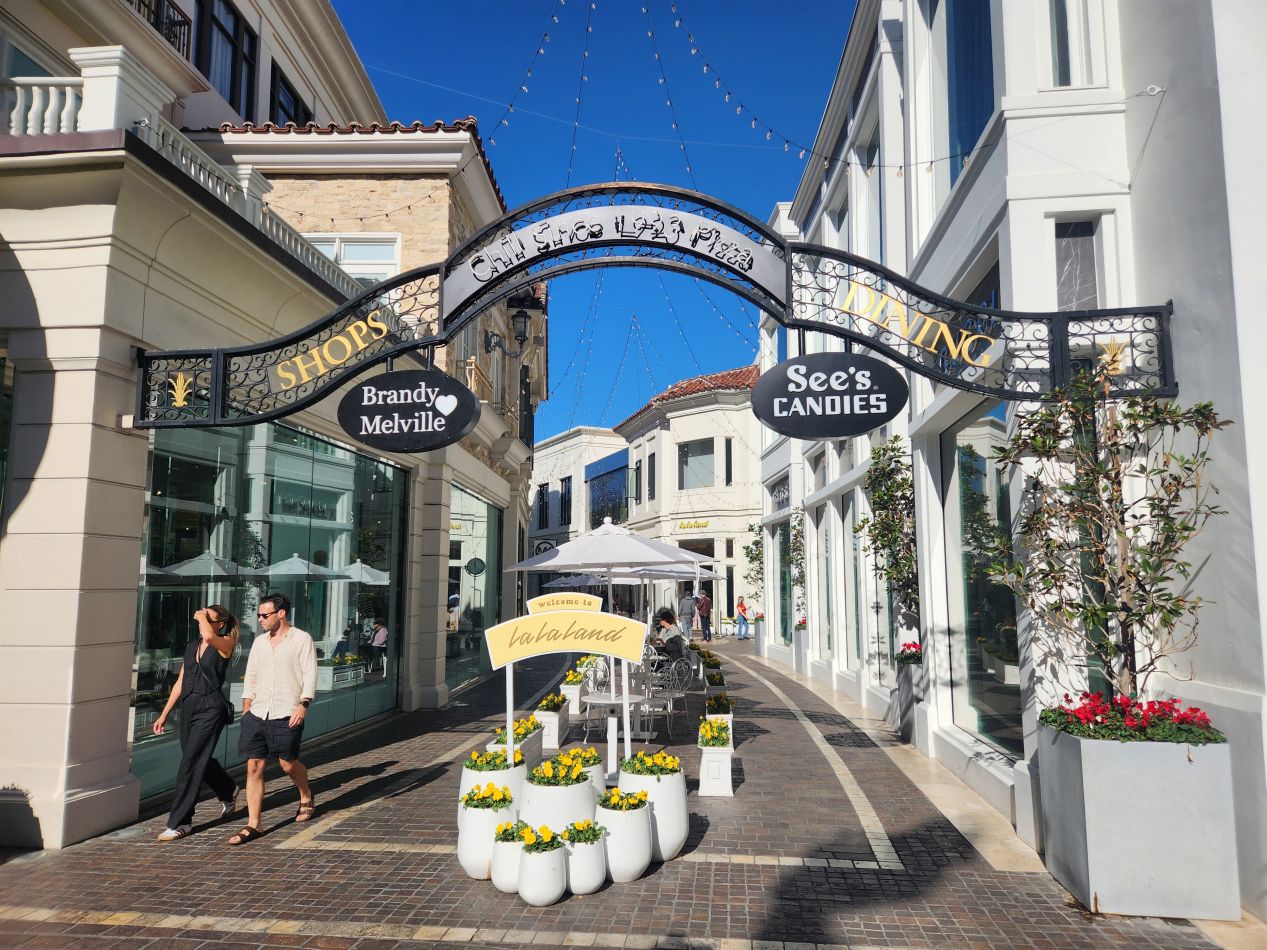


I was trying to move my car as little as possible, not least because I had to pay for parking everywhere that I stopped, and therefore I walked to my next destination which was about a mile away to the north. (Well, I actually ran there as much as I could to save time, though I had to stop to walk when I started to get tired.) This was the Grove, an outdoor shopping area known for its upscale brands and expensive restaurants. The Grove retains one of the few double-decker trolleys that used to be common in Los Angeles, though the trolley is basically for show as it doesn't run anywhere outside of the shopping area. I entered from the eastern side of the Grove where there was a large valet parking section, then consulted the directory which had ten luggage/handbag stores and *NINETEEN* different jewelry stores listed - I want to note that the Groves is not that big! It was certainly pretty though on this lovely sunny day, especially the area around the central fountain. I would have loved to have taken my wife to the Blue Ribbon Sushi Bar that I saw here, or simply gotten any lunch at all since I was getting a bit hungry. The clock was ticking though so instead I ran the mile back to where I had parked my rental car at the La Brea Tar Pits and began the drive to my next stop.

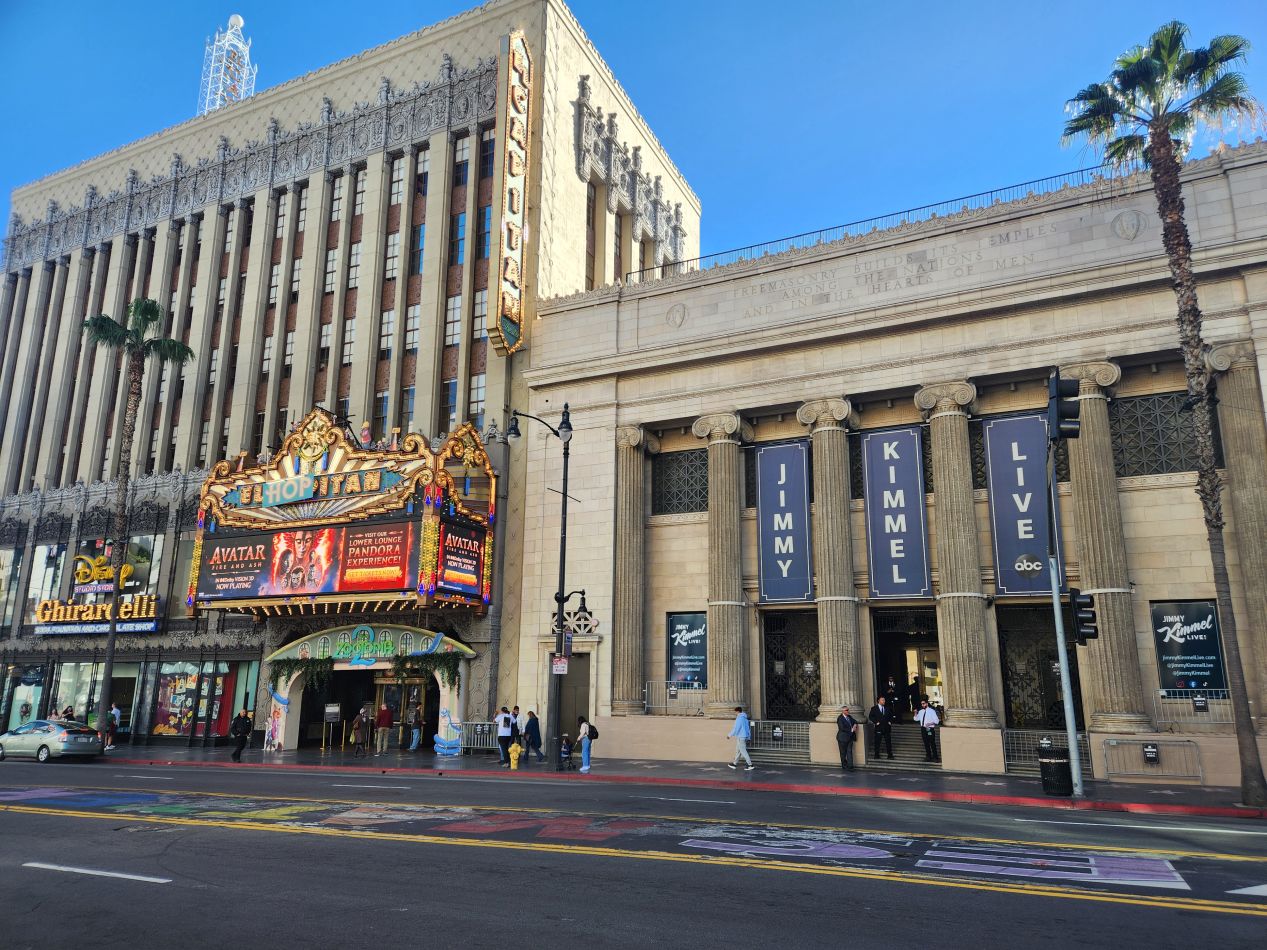


That turned out to be the most touristy of the places I visited, the Walk of Fame on Hollywood Boulevard. This is where all of those stars can be found sporting the names of film and television icons, basically anyone famous from the American entertainment industry probably has a star here. There were about 2800 of them at the time of writing and the stars stretch for more than a mile along Hollywood Boulevard at 6 foot intervals. You could spend a long time walking around and spotting different names, though be warned that this is an extremely touristy area so it tends to be crowded and there are often pickpockets working the visitors as they stare downwards. I was able to take a picture looking down Hollywood Boulevard when the traffic permitted which captured the quintessential LA look with its flashy signs and palm trees dotting the sidewalks. Jimmy Kimmel's nighttime talk show broadcasts from here and this is also the home of the Oscars:

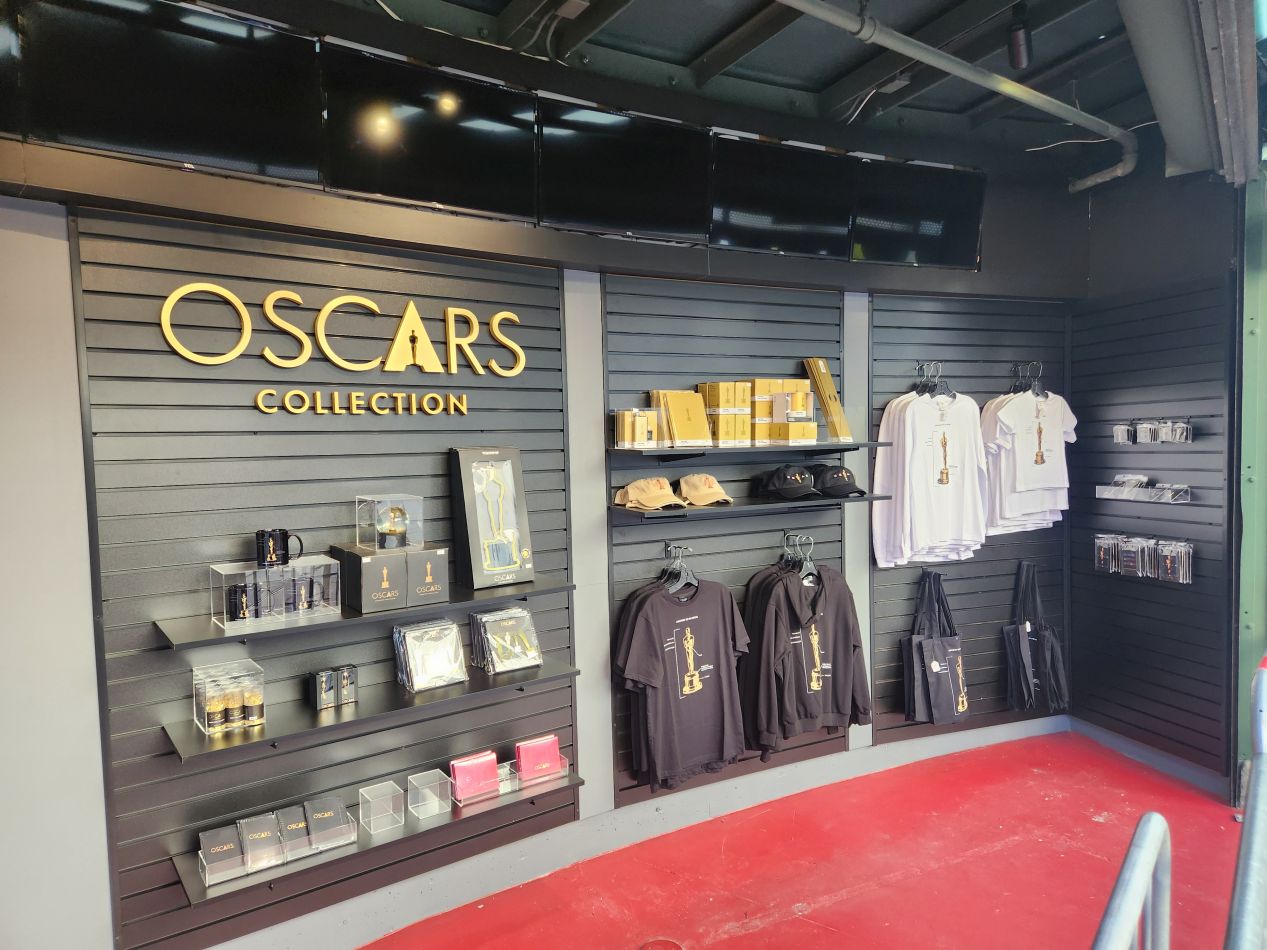


The Academy Awards were traditionally hosted here at the historic Grauman's Chinese Theatre which opened back in 1927. Many, many movies have premiered at this famous spot over the last century including Star Wars in 1977. I wasn't able to go inside the theatre but I was able to see the famous handprints and footprints left in cement on the plaza out in front. Most people have probably heard about this tradition where actors leave their mark on wet cement; how exactly this began is disputed but seems to have been an initial accident shortly after the theatre opened which then stuck around as a fun gag. The individuals captured here run pretty much the entire span of Hollywood's history, as I saw handprints from Humphrey Bogart, Jimmy Durante (who left his nose print!), and Abbott and Costello all dating back to the 1940s. One of the other tourists near me gasped at how small Judy Garland's feet had been as it seems she was a truly tiny woman. All of the more recent film stars were here as well, as I saw Arnold Schwarzenegger and George Clooney and the kids from the Harry Potter films in various spots. The largest footprints were from Kobe Bryant who had the ridiculously huge shoes that you would expect from an NBA player.


The Oscars are currently held next door to Grauman's (which is now too small for the event), at the Dolby Theatre. That's the spot captured in the first picture above, far in the back with the names of the Best Picture winners listed on the columns on either side. I didn't know that this was where the Oscars are hosted until I did the research for this writeup or else I would have taken more pictures of the Dolby Theatre beyond this shot of the entrance. This area is also a big shopping mall (I had parked my car in its underground garage) which wasn't quite as upscale as the Grove had been. I poked around for a few minutes but didn't find anything else too interesting before hurrying off to my next destination.

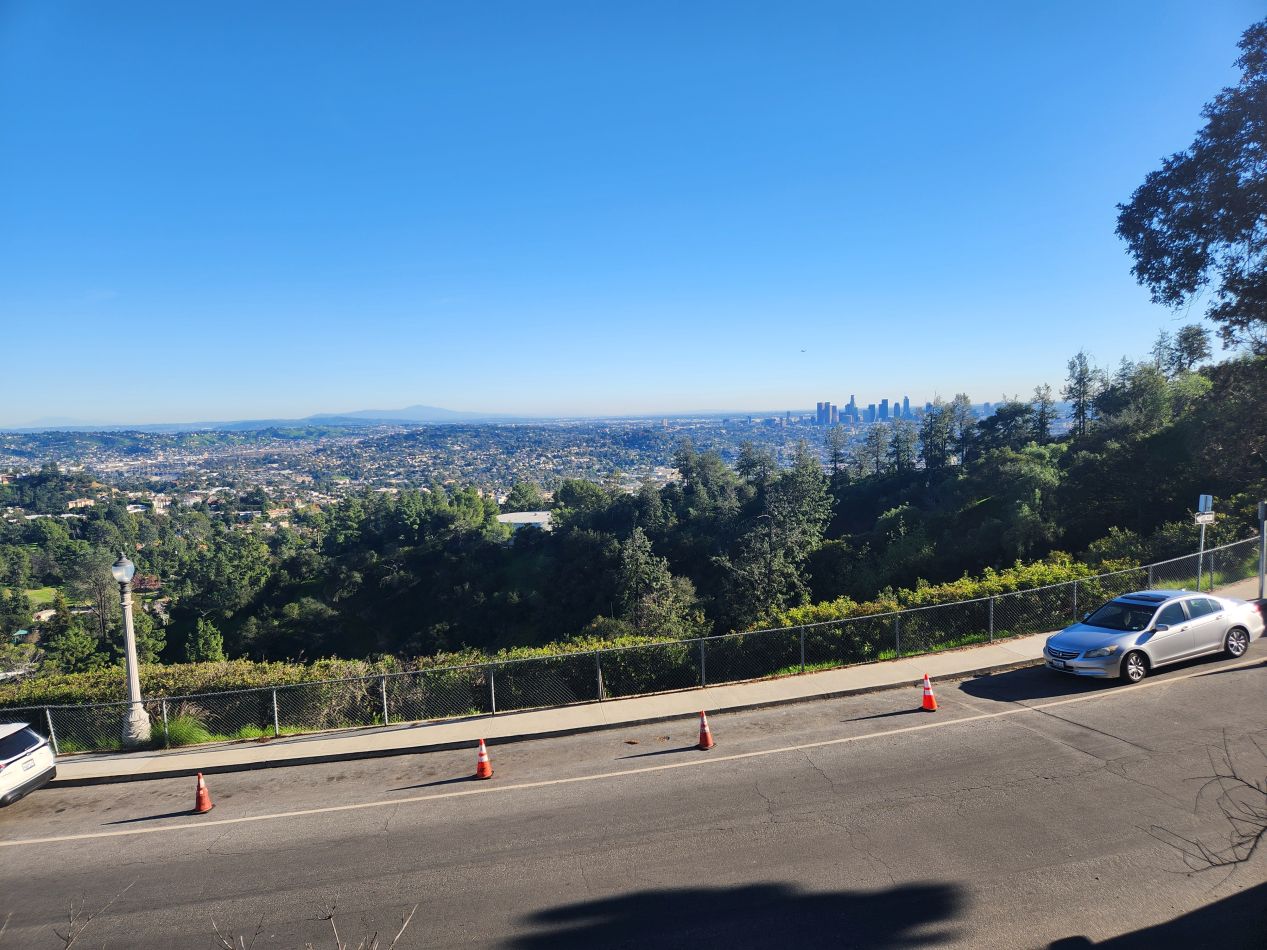


This time I drove northeast into the hills overlooking downtown Los Angeles. This was the home of Griffith Observatory, sitting atop the high ground within the larger Griffith Park which holds a whole bunch of hiking trails along with the Los Angeles Zoo. This observatory has the namesake of 19th century industrialist Griffith J. Griffith who donated this large expanse of land to the city back in 1896 and requested that a public observatory be constructed here. It wasn't completed until 1935 but Griffith Observatory has been here ever since. The narrow roads leading up to the observatory were crowded despite this being a Tuesday afternoon in mid-January; I parked about half a mile away and then took these pictures while walking up to the summit. The higher elevation provided some fantastic views looking off towards downtown Los Angeles in the distance as well as the famous Hollywood sign in the opposite direction to the west. Given more time to spend in LA, I would have loved to hike through this park over to the sign for a closer look.

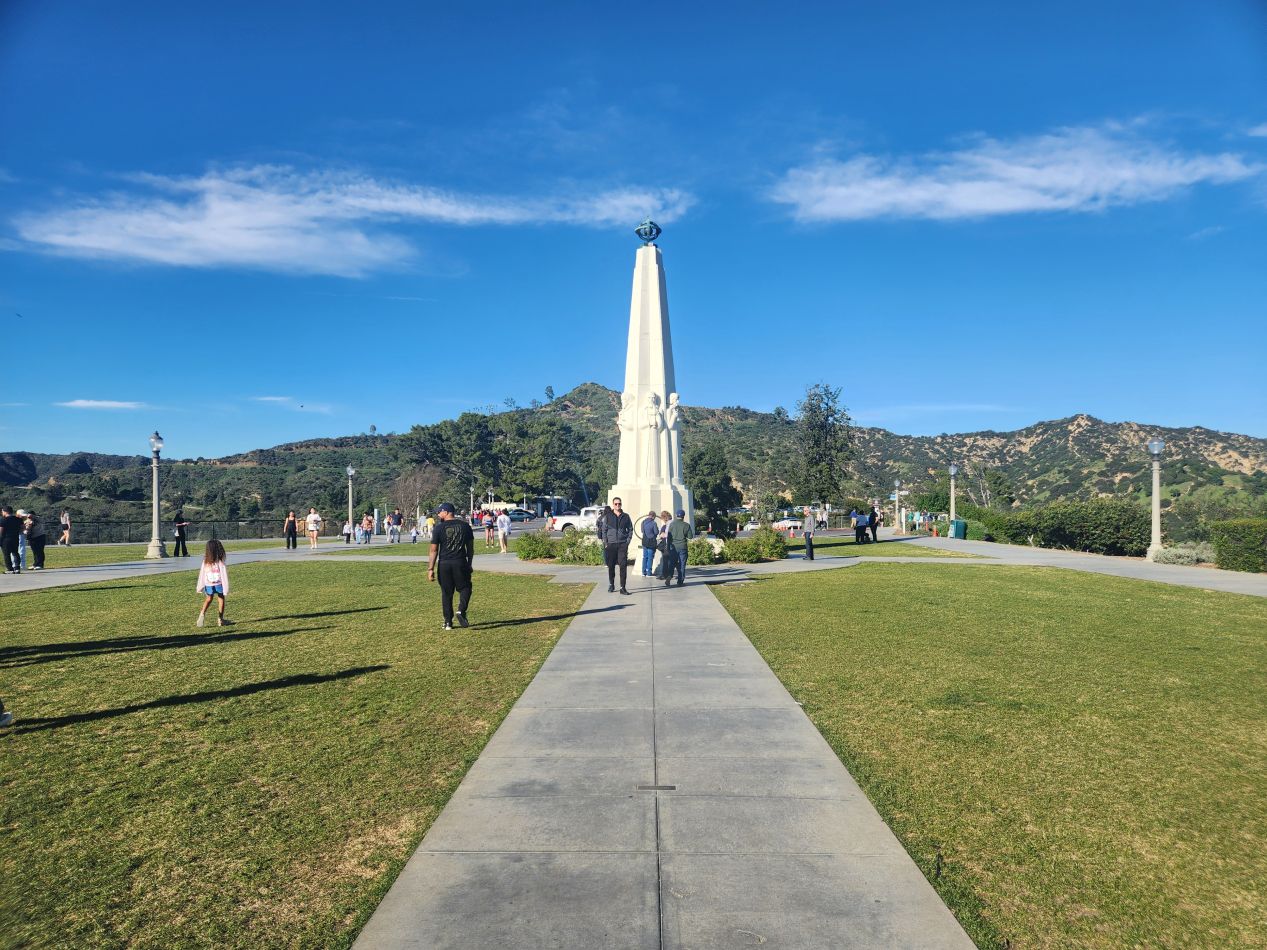


Soon enough I made it to the main entrance of the observatory. There was a monument out in front of the building dedicated to six famous astronomers: Hipparchus, Nicolaus Copernicus, Galileo Galilei, Johannes Kepler, Isaac Newton, and William Herschel. The monument itself was built in 1934 at the same time as the observatory as part of the New Deal's employment of local artists. Griffith Observatory was constructed in a Beaux-Arts styling with Greek elements; I really liked the design on the doors which made me think of Art Deco stylings. The core of this building dates back to the 1930s though there was a substantial rennovation from 2002-2006 that modernized much of the interior. The observatory has always been free to the public since its opening which was a nice surprise since almost everything else that I visited on this day had an admission charge.

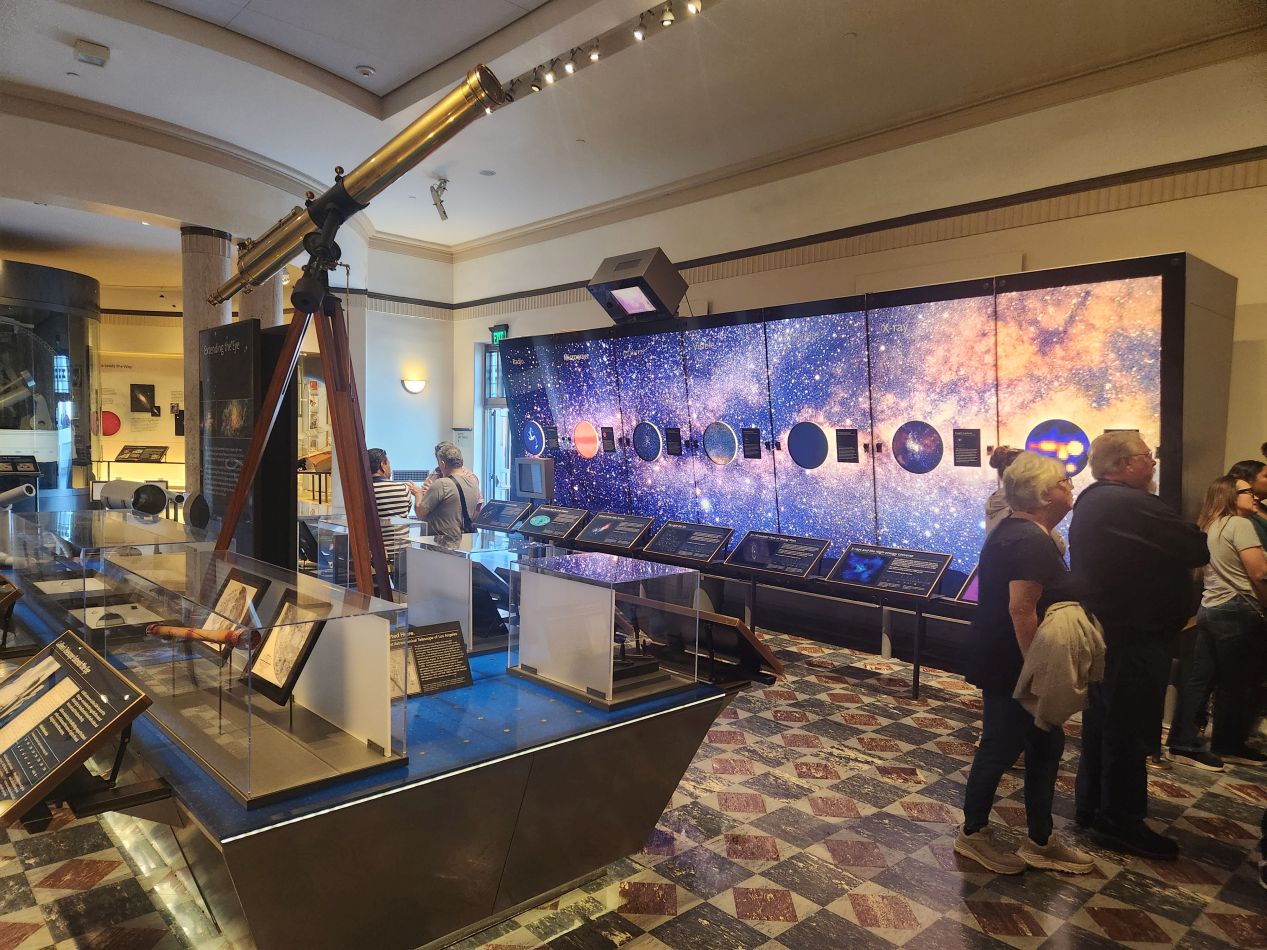


The immediate entrance of the observatory contained a Foucault pendulum which has been here since the original opening. The pendulum slowly moves in a circular pattern over the course of 24 hours to match the rotation of the Earth; I remember seeing one of these at the National Museum of American History in downtown Washington DC when I was growing up. The interior of the observatory proved to be pretty small, packed full of various displays associated with astronomy or other space themes. Visitors could learn all about the solar system, different types of stars, how the altitude of the sun in the sky varied by latitude and time of year, and so on. There was a Tesla Coil here which was doing a demonstration for some children and I was able to get a picture of the electrical current before the machine was turned off. Much of the observatory's footprint was taken up by a planetarium in the back, which unfortunately was closed for construction on the day that I visited.

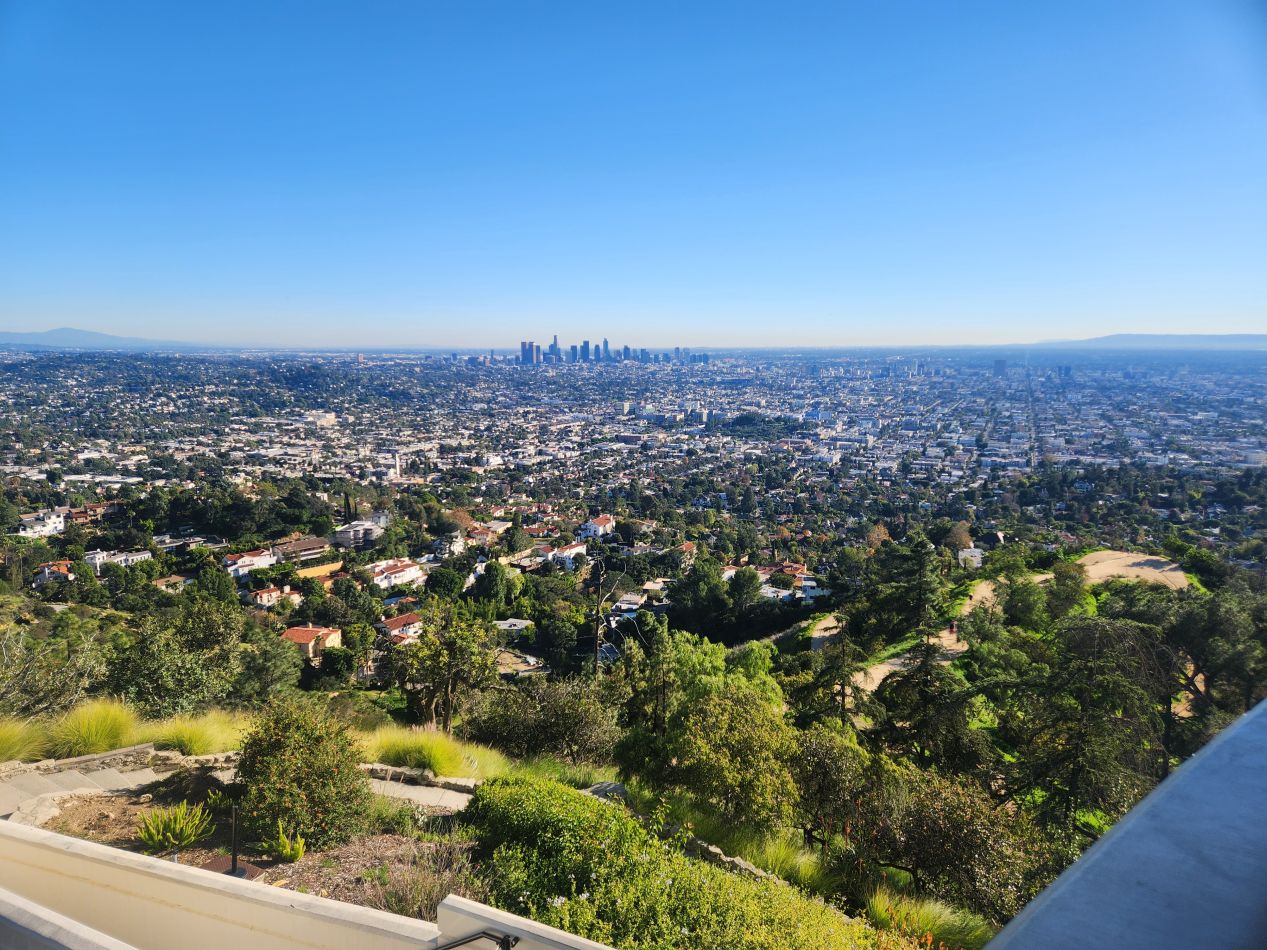


Surprisingly, visitors were able to climb up a set of stairs and walk around on the roof of the observatory. The big dome of the planetarium was easier to see from up here along with a series of arched columns running along the sides of the buildings. More importantly, this was the best place to get views looking south at downtown Los Angeles as the city sprawled out to the horizon in seemingly every direction. It's really hard to emphasize just how far LA stretches with its low-density pattern of construction; the city boundaries extend 45 miles / 70 kilometers from north to south and 30 miles / 50 kilometers from east to west. Even from up here I couldn't see any end to all of the buildings.

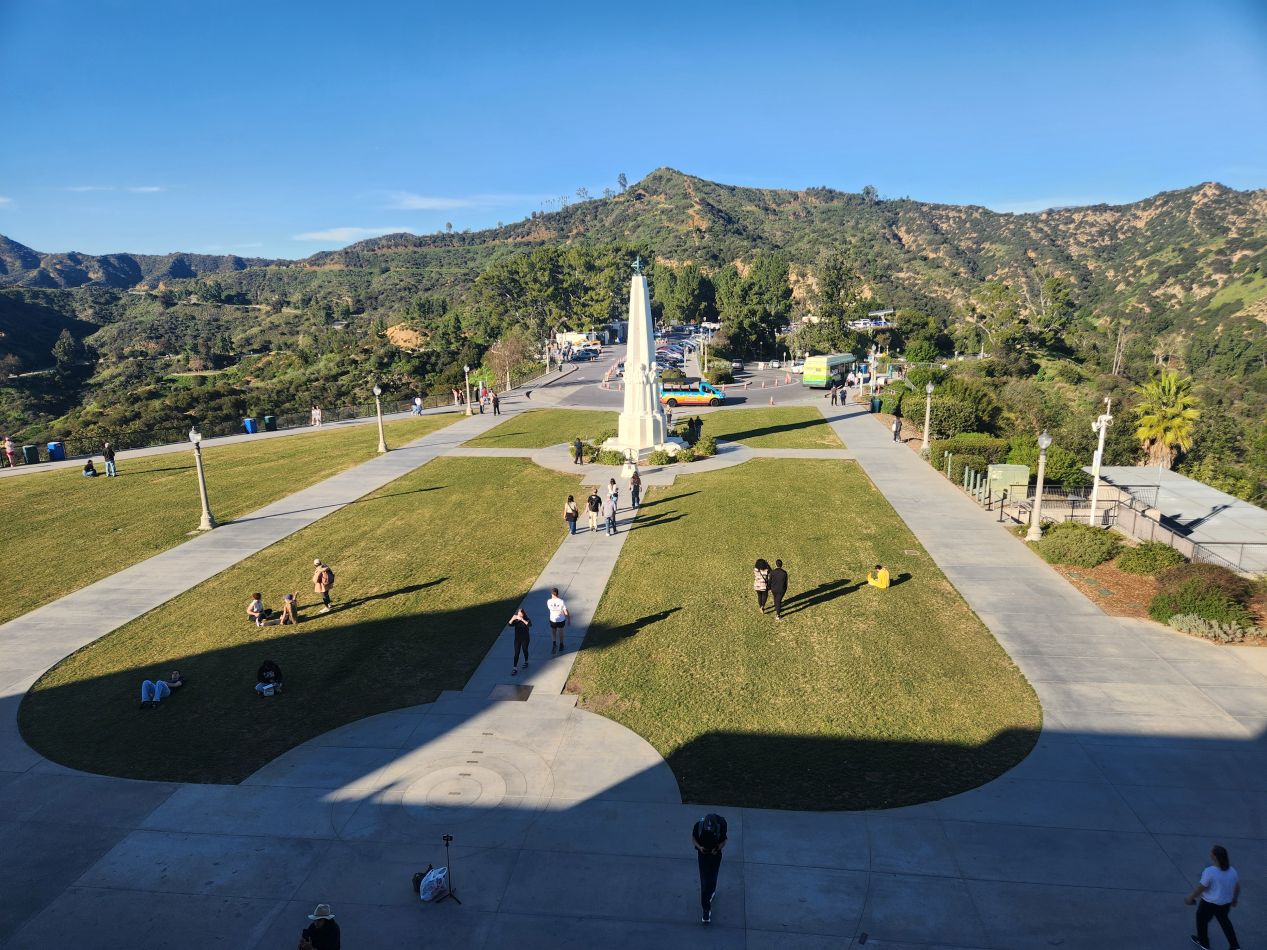


The rooftop also held the observatory's big telescope which is open to the public. Anyone is allowed to look through the telescope though that does require coming back at night. This is a really amazing service and it helps keep Griffith Observatory relevant even though its telescopes are naturally long since outdated for professional astronomy work. The other main reason why Griffith Observatory became famous was due to the many movies and television shows that have been filmed here. The most famous of these was Rebel Without A Cause from 1955, which has been commemorated with a small bust of James Dean located next to the observatory over by the Hollywood sign. Dozens of other movies and television shows have used the observatory as a filming location since then, with the most famous recent example probably being La La Land. Griffith Observatory often stands in for LA in the same way that the Eiffel Tower stands in for Paris and this is a truly beloved part of the city's cultural landscape.

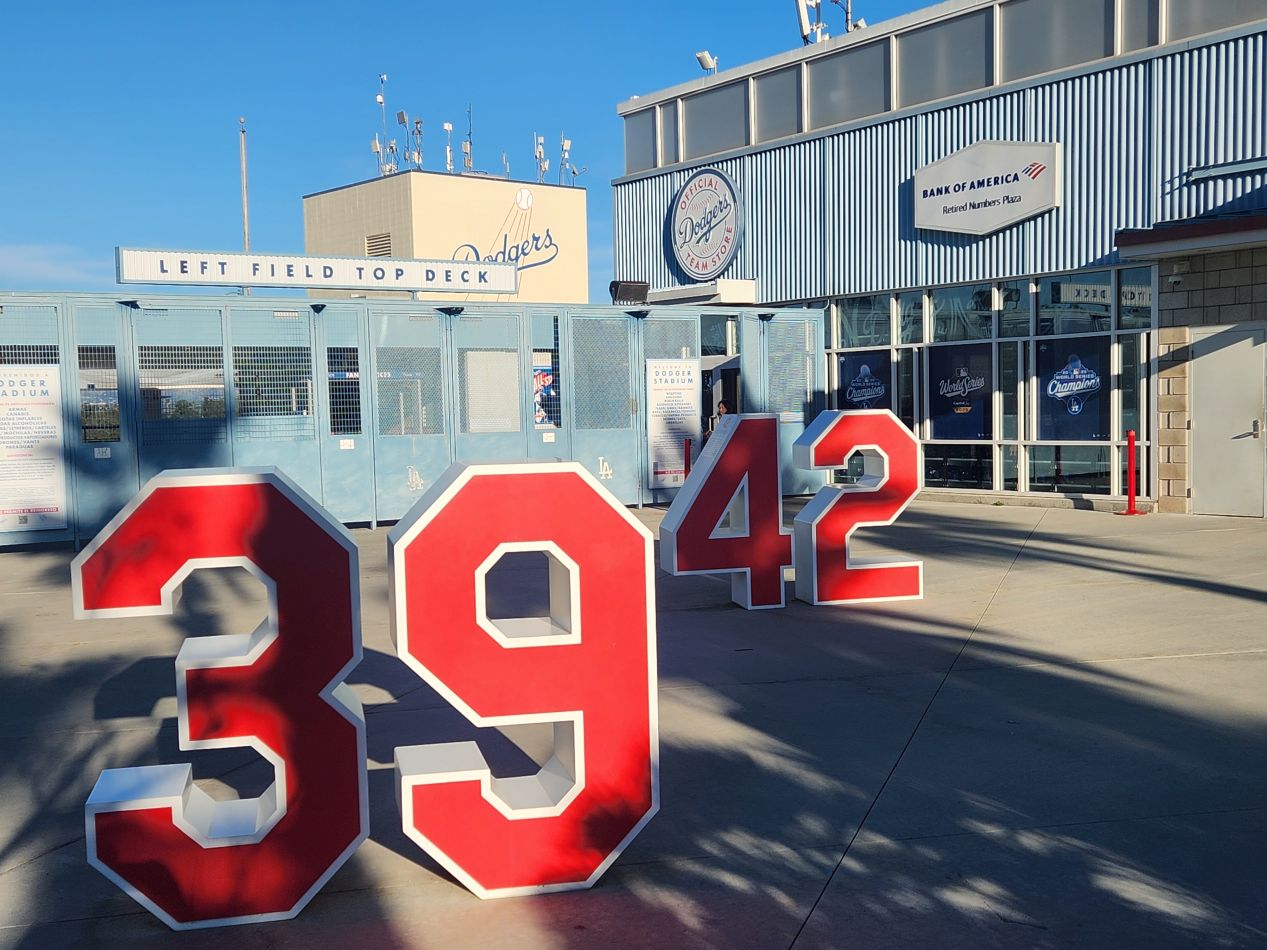


I was beginning to race against the setting sun by this point as I drove down out of Griffith Park and stopped at nearby Dodgers Stadium. This was naturally the home of the Los Angeles Dodgers baseball team, one of the oldest and most successful franchises in Major League Baseball. This stadium is popularly known as Chavez Ravine due to the local geography where the stadium is situated since it's built into a natural low point in the otherwise hilly terrain. I was visiting offseason in January and I was struck by the absolutely massive parking lot that surrounded the stadium on my approach. Dodger Stadium was built in 1962 with car culture in mind and it is poorly serviced by public transportation. The expectation is that everyone will drive here in their own personal cars and then park in the gigantic lots surrounding the stadium. Believe it or not, this is the third-oldest stadium in MLB (after Fenway Park in Boston and Wrigley Field in Chicago) and has the largest seating capacity of any current stadium at roughly 56,000 people.
I parked at the Dodgers team store which was the only thing open this afternoon. The plaza outdoors listed all of the retired numbers for former Dodgers players, including the #42 for Jackie Robinson which has been retired by every MLB team, but Jackie actually did play for the Dodgers for his whole career. The Dodgers have retired 12 numbers in all, ranging from earlier players like Pee Wee Reese and Duke Snyder to more recent individuals like fan favorite Fernando Valenzuela and longtime manager Tommy Lasorda. Inside the team store was all the Dodgers merchandise that anyone might want to purchase, prominently featuring star players like Shohei Ohtani and Mookie Betts along with the team's recent World Series victories. The Dodgers had won the last two championships at the time of my visit, in 2024 and 2025, with the latter coming in one of the greatest baseball games of all time during an extra innings Game Seven win over the Toronto Blue Jays. I was watching that game live and it was absolutely incredible, with the Dodgers throwing out one of the Blue Jays players at the plate by mere inches to avoid defeat.

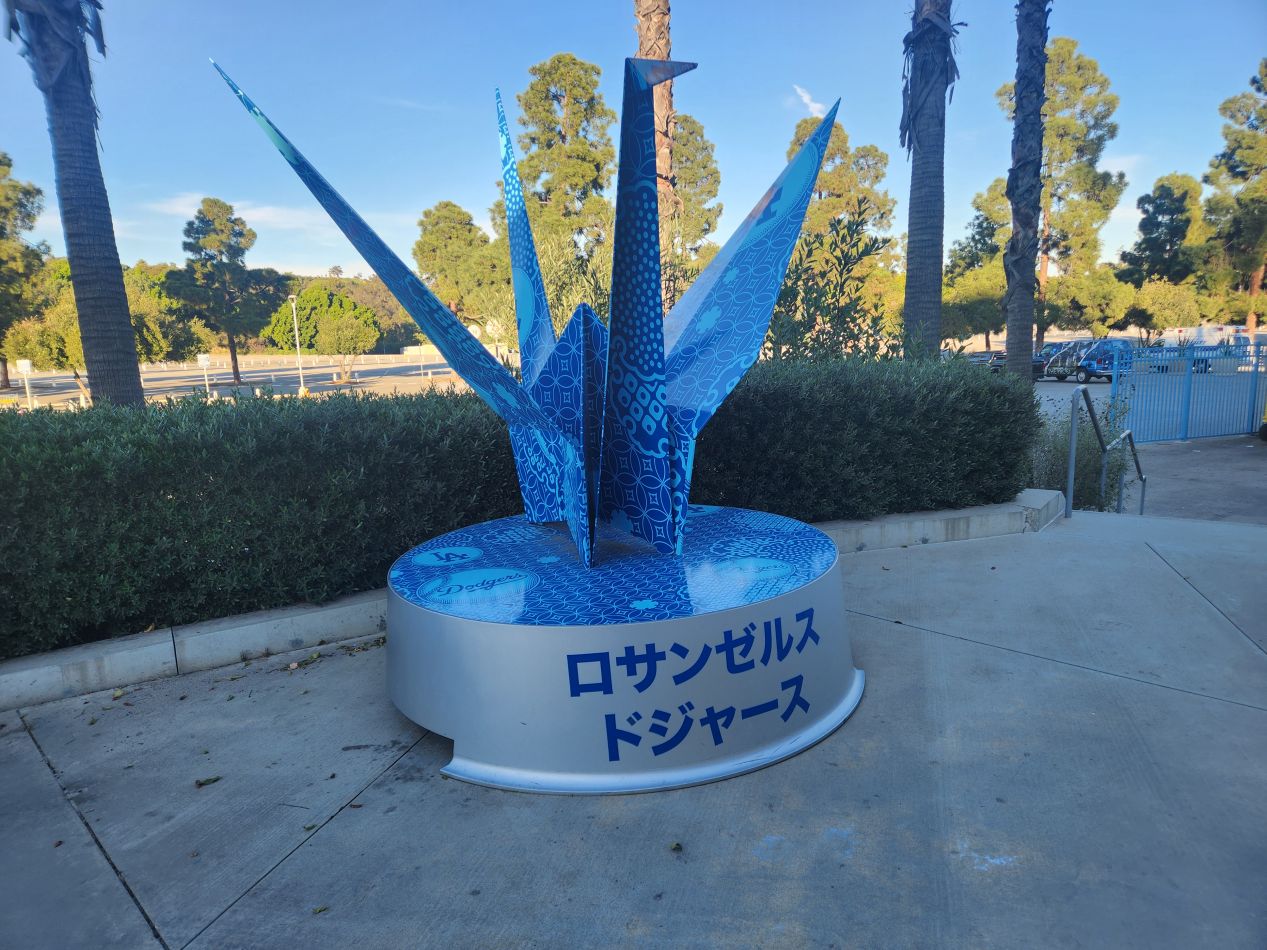


The actual stadium itself was locked up since there wasn't anything taking place inside today. I tried to see if I could go inside to take a few pictures but the staff said that wasn't possible. Therefore I drove around to the other side of the stadium and took these pictures behind center field where there was a better viewpoint. Everything was colored some shade of blue and it was all higly picturesque when combined with the local palm trees. The Dodgers have a strong Japanese influence as several of their best players come from Japan (Ohtani along with 2025 World Series MVP Yoshinobu Yamamoto). That explained the presence of this crane sculpture with Japanese writing at the bottom, which I know enough katakana to be able to translate as spelling out "Los Angeles Dodgers". The big hand was also amusing to see and provides a bit of a sense for the gargantuan empty parking lots that ringed Dodger Stadium on all sides. Maybe if I come back again in the summer I'll be able to catch an actual game here.

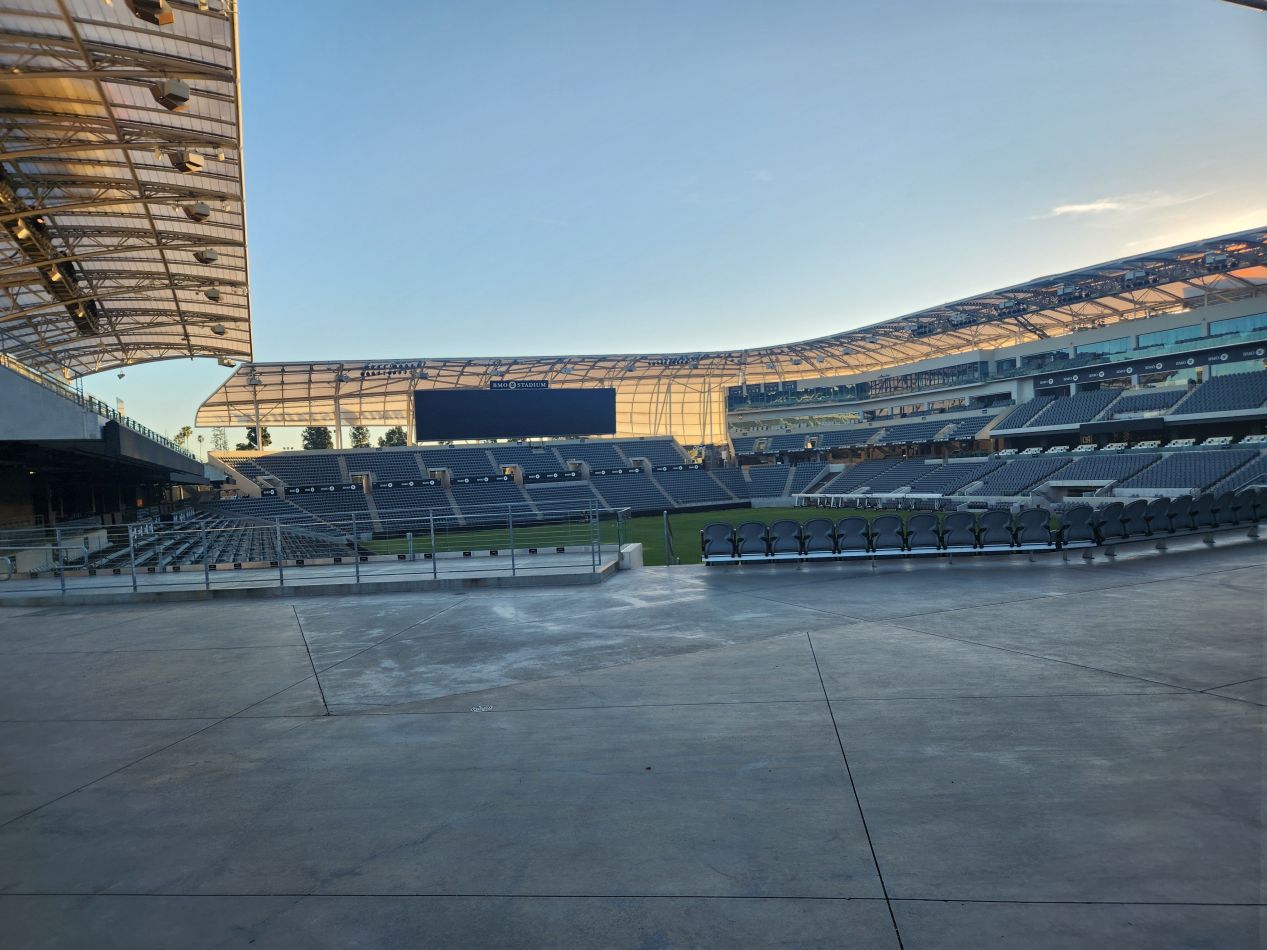


The daylight was really starting to fade as I made my way to the final destination of the day. I drove past the downtown portion of LA with its highrise buildings since there hadn't been anything there that interested me, instead making my way to Exposition Park a little bit further south. There's a museum cluster located here along with several stadiums, the first of which I came across was BMO Stadium. This venue was a recent construction that finished in 2018, a 22,000 seat stadium designed exclusively to host soccer games for the Los Angeles FC team. Soccer-exclusive stadiums have been a rarity in the United States until the last decade and this looked like a really nice place to watch a game. Los Angeles FC has traditionally been overshadowed by its crosstown rival the LA Galaxy, one of the founding members of MLS, with this stadium being an attempt to change that narrative.
The other stadium that sat right nextdoor was the far more famous Los Angeles Memorial Coliseum. This stadium was initially constructed in 1923 and named after American veterans of World War I; it has been hosting big sporting events in LA for the last century, including two Olympics and multiple Super Bowls. The LA Coliseum is probably best known for being the home of USC football which has been a dominant college football powerhouse for decades. The stadium was most recently rennovated in 2019 to help modernize the aging structure, a redesign that lowered its seating capacity from 93,000 to a more comfortable 77,000. I very much wanted to go inside to walk around a bit but the gates were locked and a security guard only grudingly allowed me to poke my camera through to take these pictures. The Olympics will be coming back here again in 2028 so the LA Coliseum remains very much relevant today. Fun fact: my Dad happened to be in LA for work in 1973 and attended Super Bowl VII here, watching the Dolphins beat the Redskins to cap off their undefeated 14-0 season; he said that it wasn't hard to get tickets at the time.

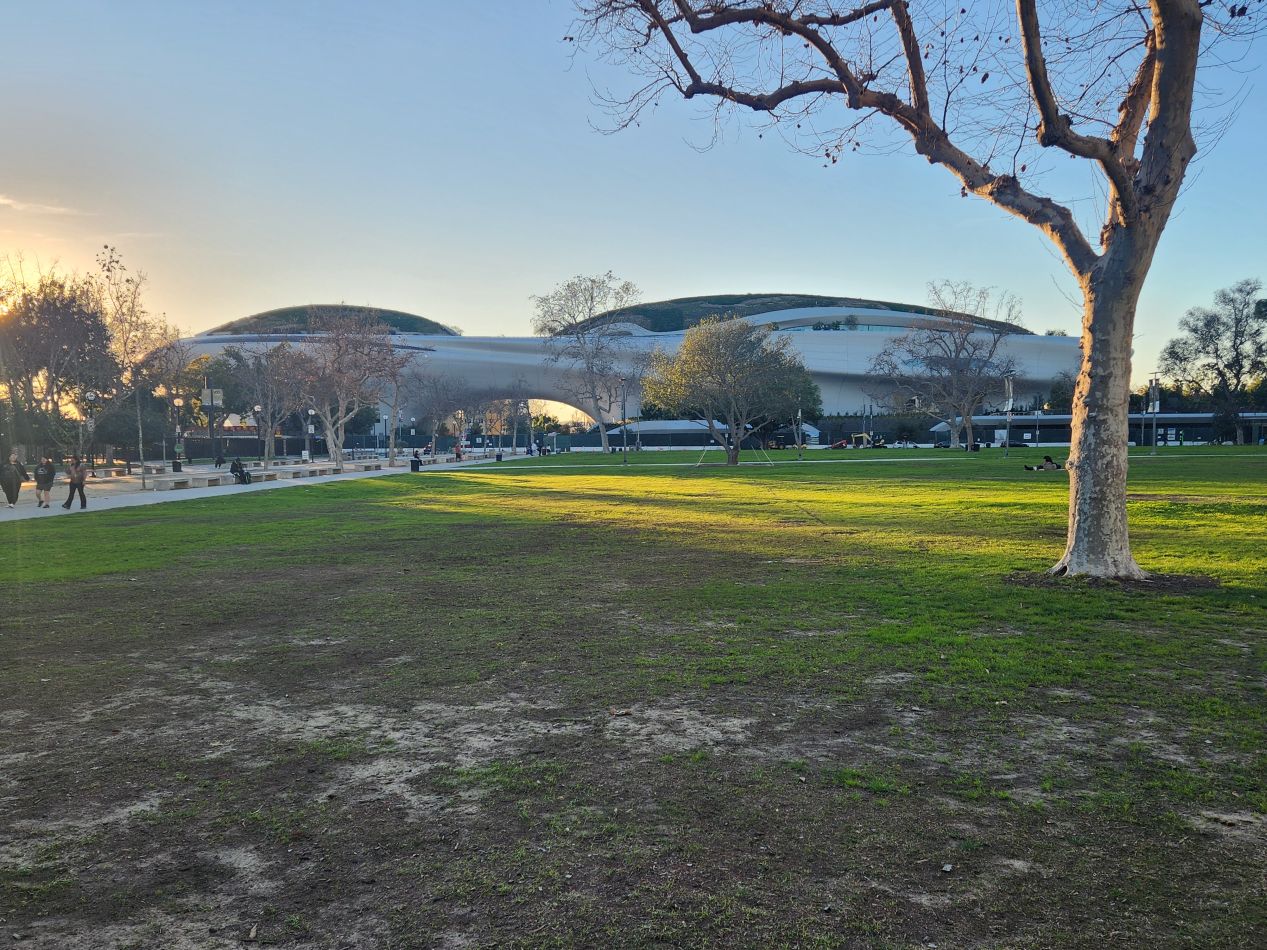


Exposition Park held nearly half a dozen additional museums tucked in between the city blocks surrounding it. I walked past the California Science Center, or ScienCenter as the building displayed its name, a huge structure that looked like it would be a blast for kids. Our two sons love going to the Maryland Science Center in Baltimore and this building looked to be bigger and better. Off in the distance was a futuristic-looking building that turned out to be the Lucas Museum of Narrative Art, founded by George Lucas of Star Wars fame and dedicated to showcasing forms of visual storytelling. This museum has a scheduled opening date in late 2026 so I couldn't have gone inside even if I wanted to. The older building nearby was the Natural History Museum of Los Angeles County; I took a picture of the historic brick entrance but the full museum was much, much larger. All of these museums were surrounded by gardens and I snapped a few pictures of the Rose Garden that sat between the Science Museum and the Natural History one. These would have been fun places to go given more time and if they hadn't already been shut down for the day.

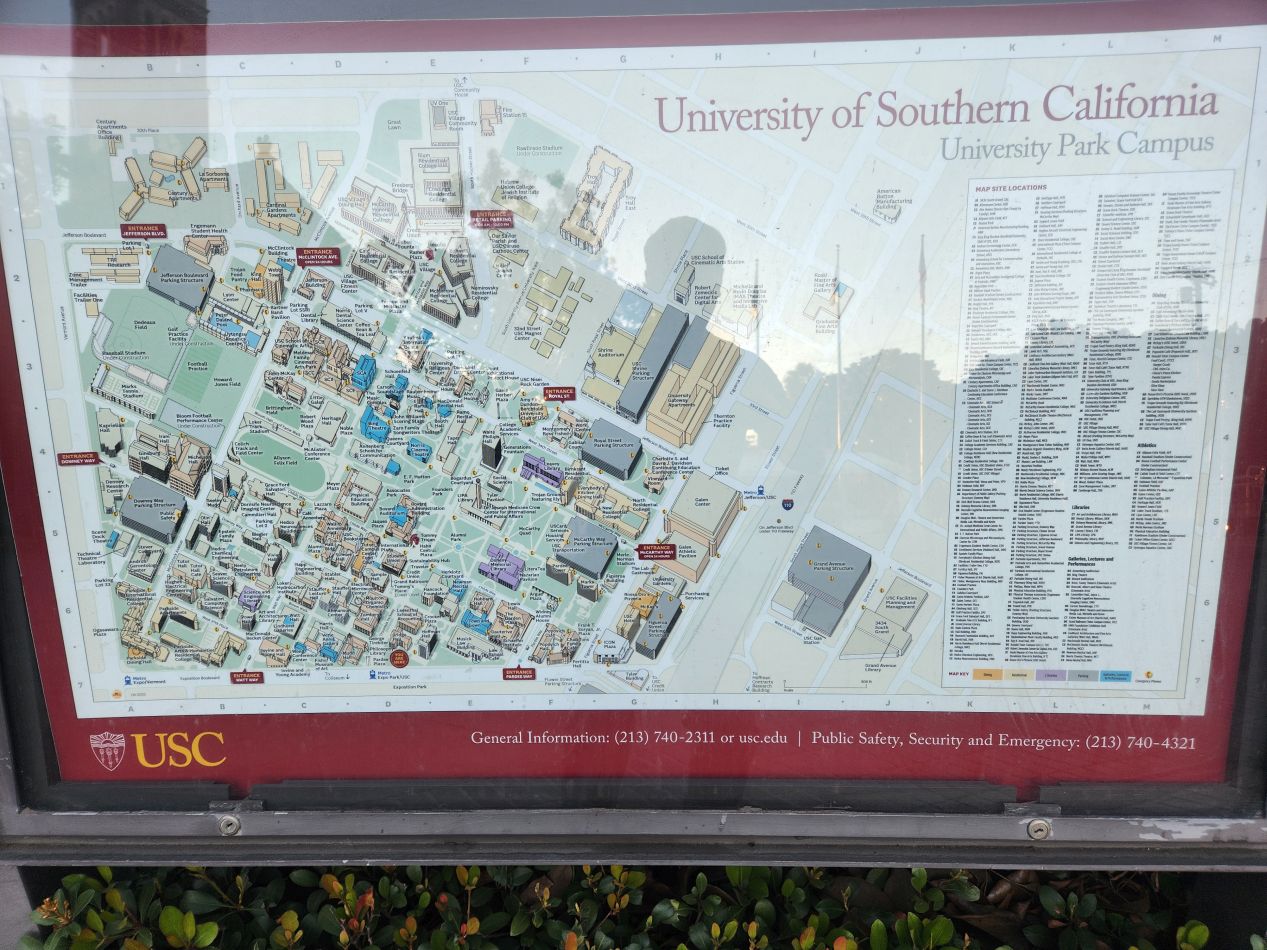


But I hadn't driven to this part of LA to see shuttered stadiums and closed museums. Exposition Park was also literally across the street from the campus of USC, the University of Southern California. USC is located right in the middle of downtown Los Angeles, crammed into a couple of city blocks where it tightly packs together its educational and administrative buildings. Due to its urban location, entrance to USC requires passing through a security checkpoint and anyone who wants to go inside is supposed to show their university ID. I had no such document, of course, but I pretended to fumble in my pocket for a card and the bored security guard waved me through without bothering to check - thanks for being so lazy! Good to know how well the students were being protected, heh. I was entering at Pardee Plaza and walking north towards the heart of the campus past the chemistry and accounting buildings. I was amused to see the cyclist wearing a Trojan helmet (the university's mascot) to indicate a bike lane.

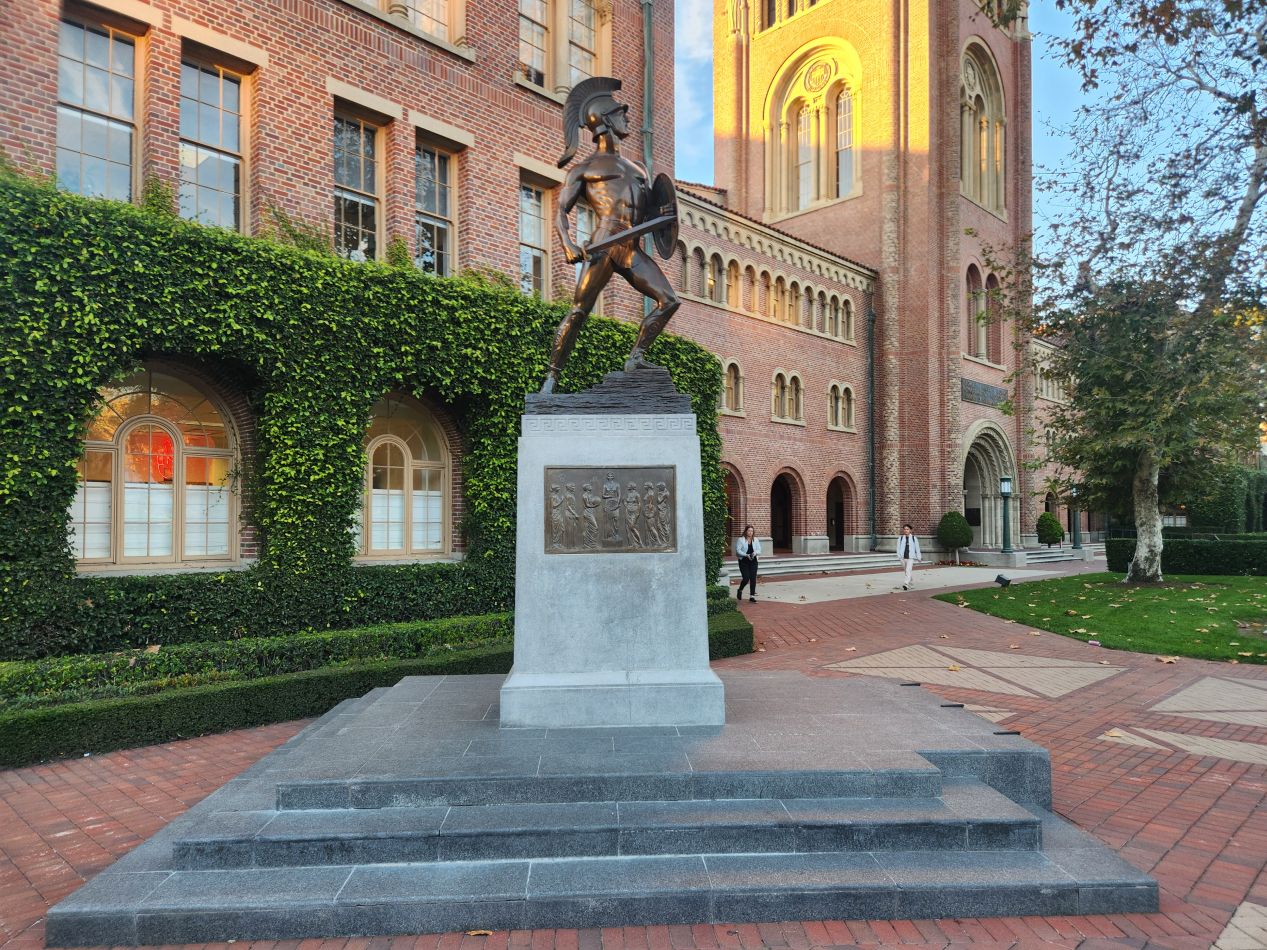


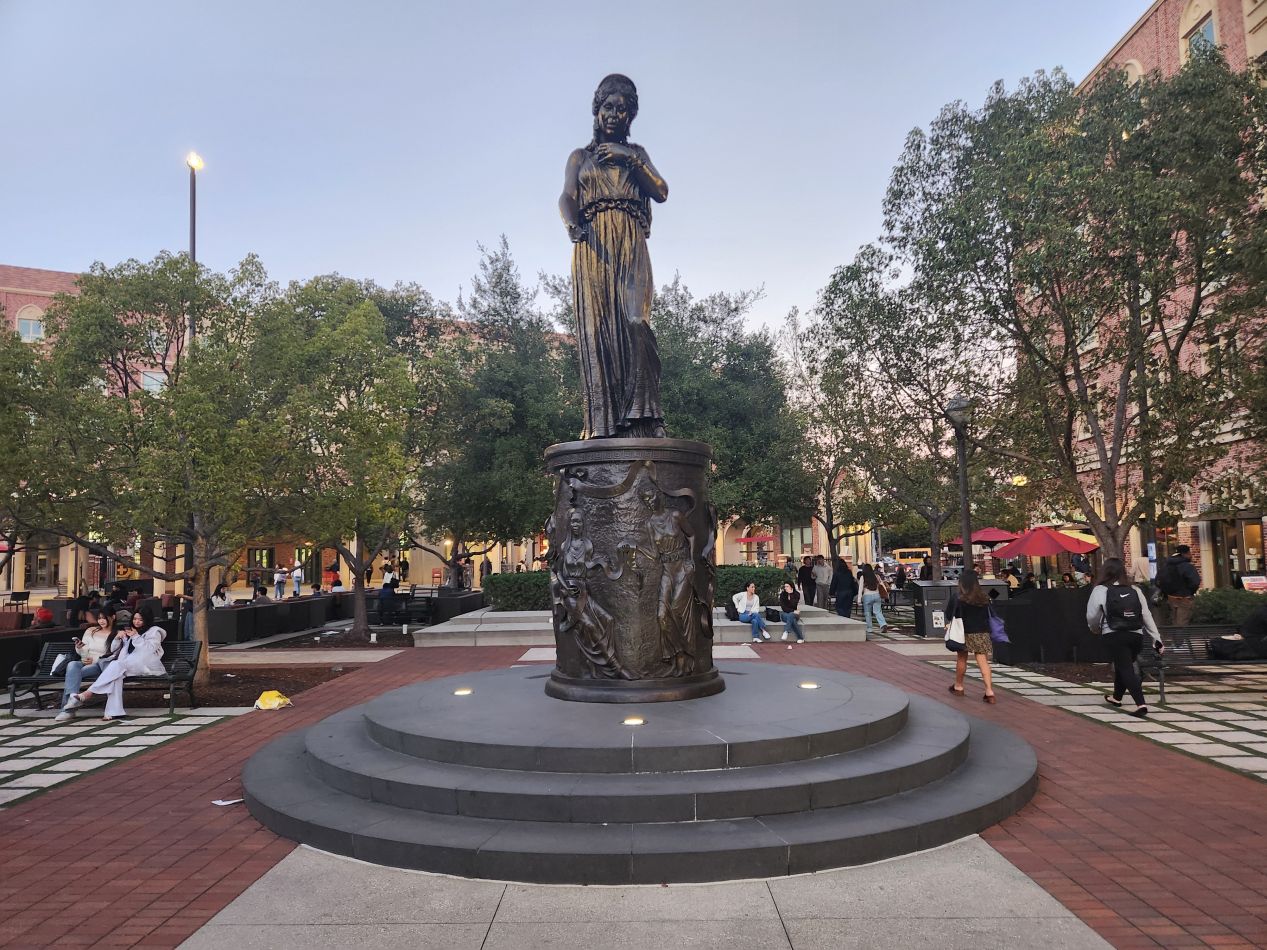
A short walk brought me to Alumni Park, the spiritual center of the USC campus. There was a beautiful plaza here with a fountain merrily splashing water, and I had arrived at the perfect time to capture the sunset reflecting off the red brick buildings that dominated the campus. USC primarily uses a Romanesque style of architecture which is a great fit to dovetail with the university's cardinal red and gold color scheme. This plaza held a statue of Tommy Trojan, one of the university's mascots, with the other one being a white horse named Traveler. (There's a statue of Traveler here as well and somehow I missed capturing the darned horse in every picture I took from this spot!) The surrounding buildings here included the administration headquarters and several libraries, and the whole place was packed with students walking around probably going to get dinner. I'm no longer young enough to get mistaken for a student but apparently no one was bothered by me wandering around and snapping pictures.

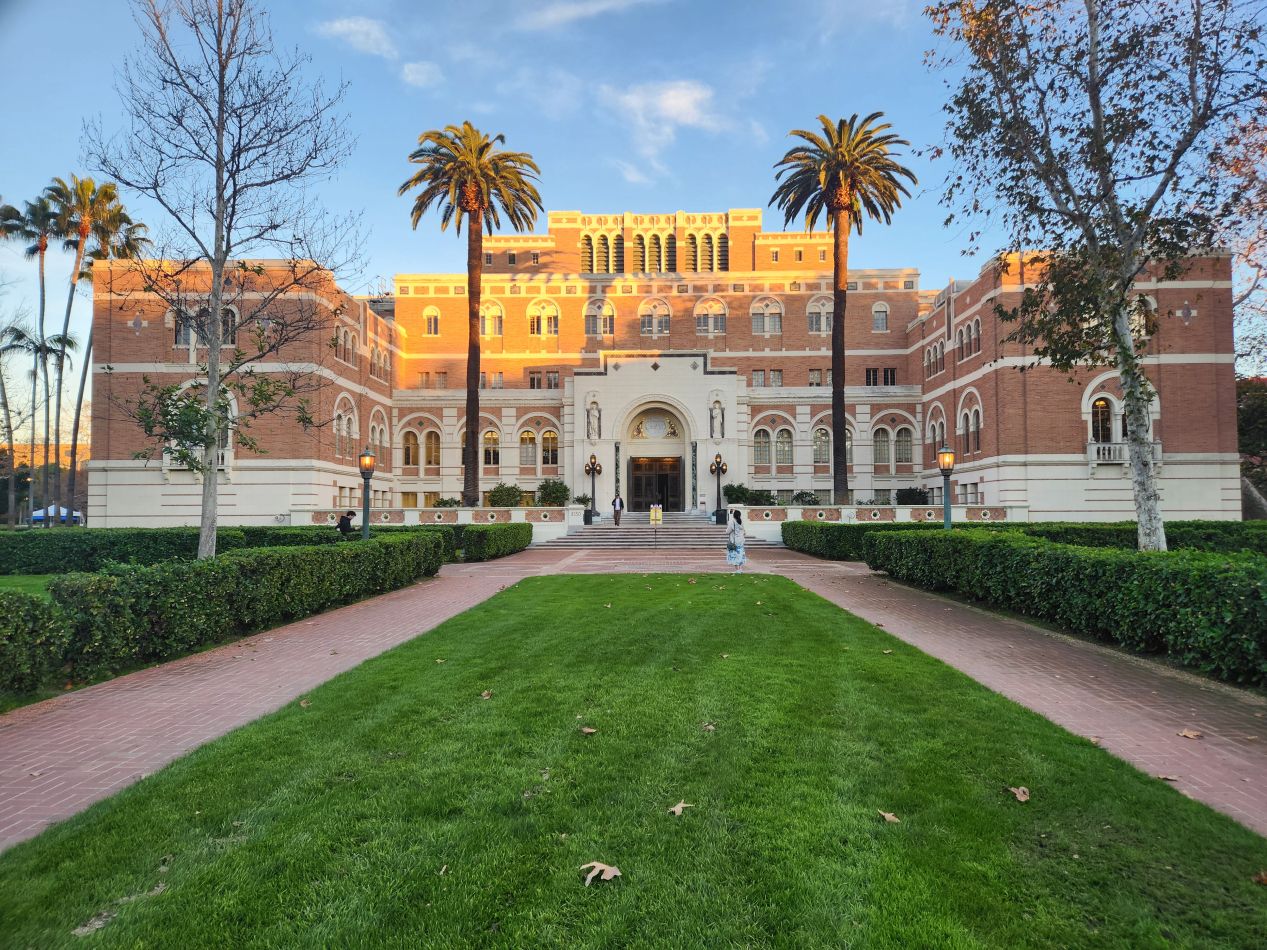


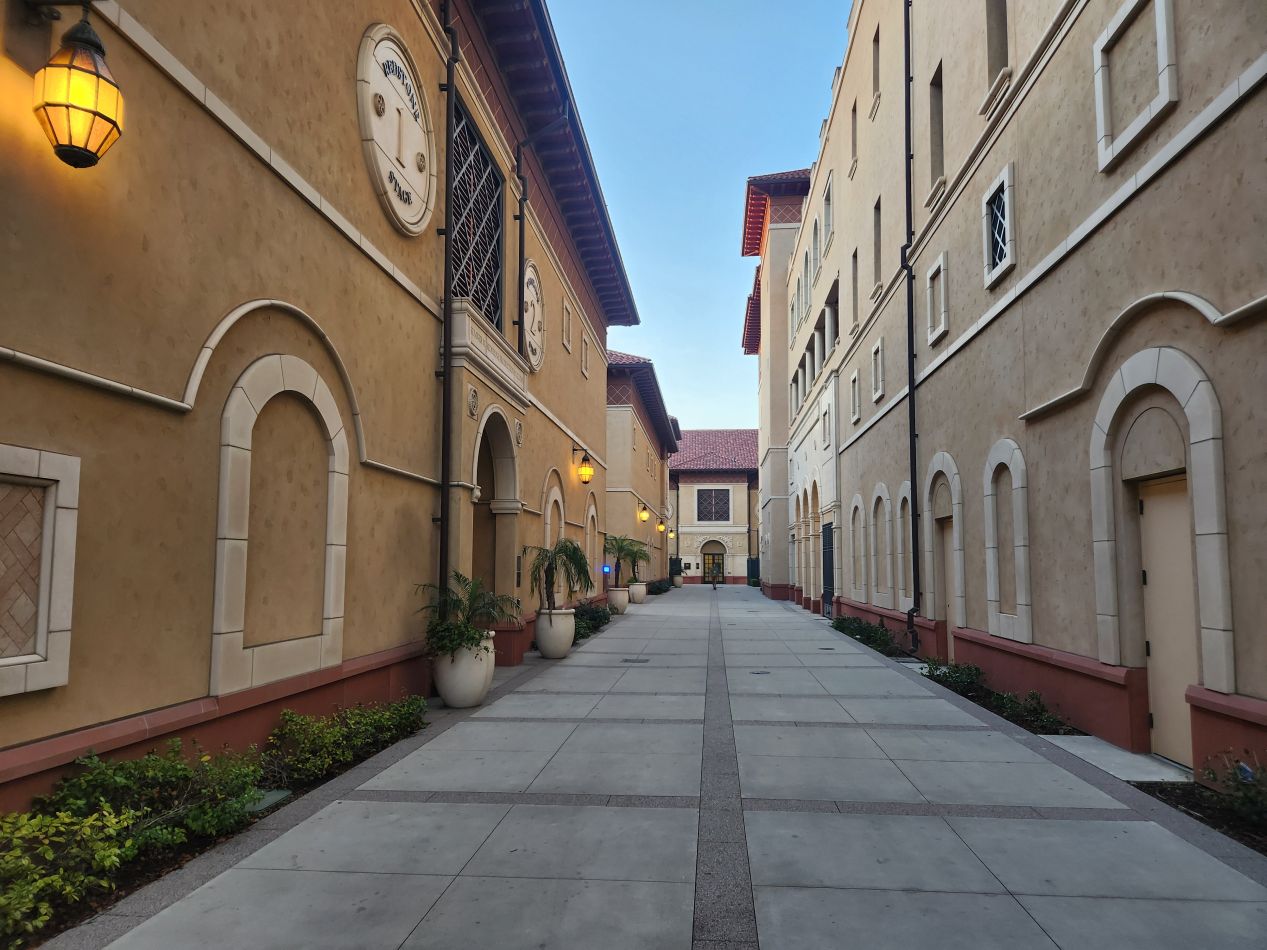
There were some additional pictures that I took while passing through the USC campus, as I walked in a counterclockwise circle trying to see the highlights. There was no denying that this was a gorgeous university that looked like an inviting place to attend college. USC had about 27,000 students at the time of writing (with more than half of them being graduate students) and it's considered to be an excellent academic institution, typically ranking somewhere around 20-25th place in the national lists. USC is also a private university and it's an extremely expensive place to enroll, with annual tuition hitting $70,000 plus another $20,000 for any students who wanted to live on campus as of 2025. Non-American readers have to be amazed at the cost of attending college in the United States and something really has to be done about this as student debt is killing an entire generation of young adults. USC doesn't have any trouble filling those spots though as the university received 80,000 applications and accepted 8000 of them in the most recent year of data so the financial racket looks to continue. This university has the reputation of catering to the wealthy and privileged, with its detractors referring to it as the "University of Spoiled Children", and there's at least some truth to that.



The western side of the campus held the athletics fields for the campus along with Heritage Hall where a whole bunch of sports trophies were on display. Athletics are a big deal at USC and the university has been one of the most successful programs at overall college sports, holding 113 different NCAA team championships. That's the third-most of any university, though unfortunately for USC their bitter rival UCLA has the second-most championships at 123 (fellow California school Stanford has the most). USC has also won the most individual athlete championships of any university, bolstered by the fact that the climate in southern California is perfect for track and field, swimming, and tennis. I found that the door to Heritage Hall was unlocked and therefore I was able to go inside and see the eight Heisman Trophies on display, the award given annually to the best player in college football. The most recent of these had been awarded to Caleb Williams in 2023 and some of the prior USC winners included, ummm, murderer OJ Simpson and bribe-taking Reggie Bush. Let's just say that USC has had a colorful cast of characters at times in piling up all of those athletic awards. USC is known as a football school and has won an incredibly impressive 11 national championships, with the most recent one coming in the 2003 season.

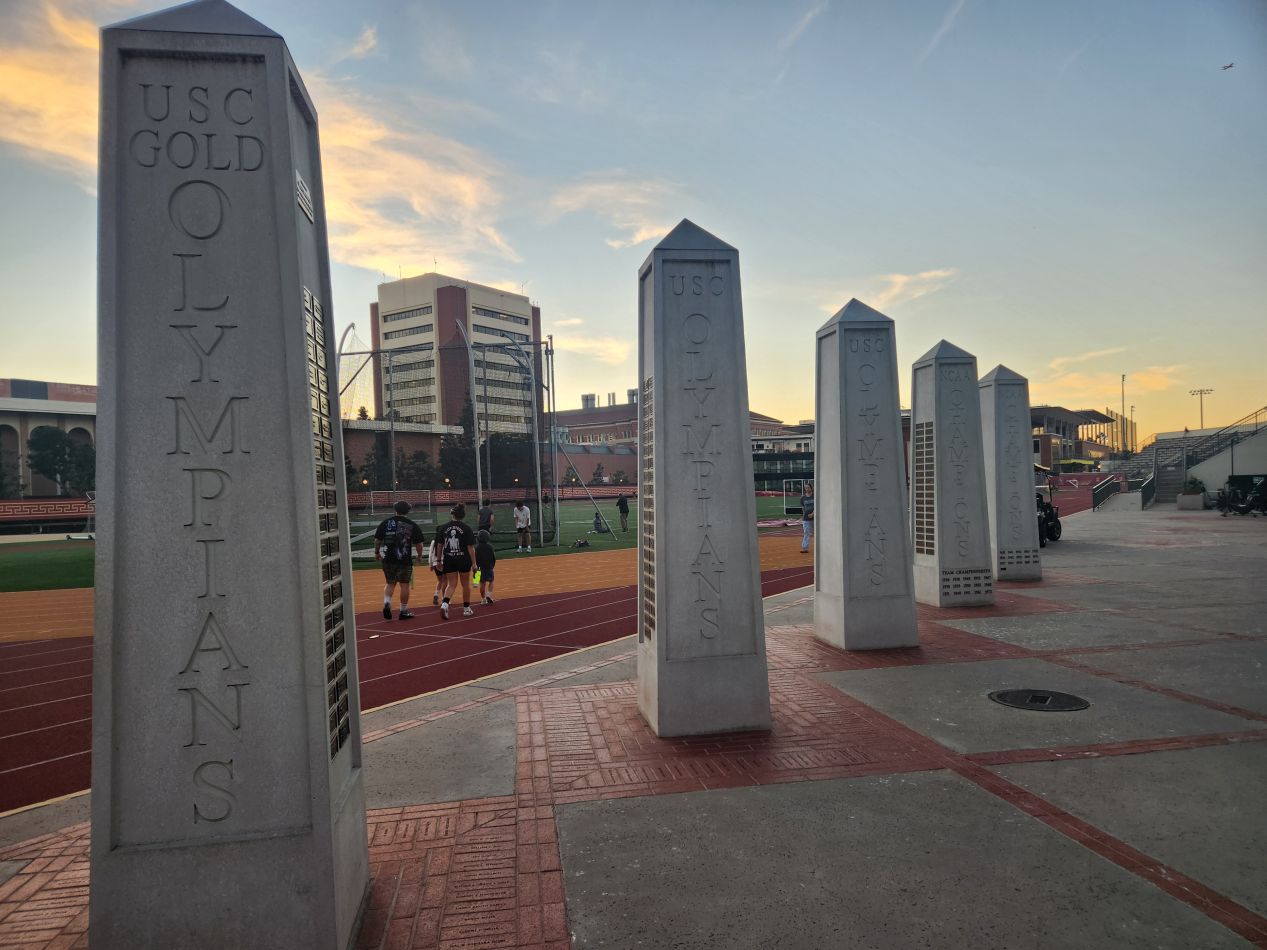


Just behind Heritage Hall were the althletic fields themselves, starting with something named Brittingham Field that looked like it was in use for intramurals soccer at the time of my visit. A bit further back was Allyson Felix Field which was the host to track and field. This was a rather nice facility devoted entirely to track, reflecting the high status of this sport at USC. I was able to walk right onto the track and thought about jogging a lap for fun before deciding that I was too tired; I had woken up at 5:00 AM this morning (2:00 AM Pacific time!) after all. Even further back were the baseball and tennis stadiums which I ended up skipping since the baseball venue was under construction at the moment.



The last part of the USC grounds that I wanted to see was technically off the campus itself. This was an annex of sorts named USC Village which was located to the north across Jefferson Boulevard, no longer within the gated checkpoints of the main campus. The land that became USC Village was purchased by the university in 1999 and then developed into a combined retail / residential area until having its official grand opening in 2017. USC Village has over 130,000 square feet of retail space on the ground floor, with student housing on the four floors above; basically it's like having downtown apartments mixed together with traditional dorms - what a cool idea. There were more than a dozen restaurants present when I visited (along with a Target and a Trader Joe's), with more food trucks lining the streets outside to cater to the student population. I wanted to eat at a restaurant named "Chinese Street Food" which sounded fantastic, only to find it closed and end up getting some Korean bibimbap instead which was still excellent. This was the first thing that I'd had to eat since the plane ride that morning and it was very pleasant to enjoy a short meal while watching darkness descend over the bustling student courtyard outside.


Now I had to make my way back to the rental car which was still parked near the LA Memorial Coliseum. It was unlikely that I'd be able to make my way past security a second time (they surely would be checking for ID cards now that night had fallen) which meant that I had to walk around the outskirts of the USC campus while walking the half a dozen or so blocks back. This path took me past the Galen Center pictured above, home to USC's basketball teams. I checked to see if they were playing a game tonight but nothing was taking place. The Galen Center is most noteworthy to me for hosting the League of Legends world championship in 2012, right when the game was blowing up in popularity and I was playing it on a daily basis. Then I had to drive back to the airport to drop off my rental car, and when I stopped for gas on the way, by complete dumb luck I ended up right next to Randy's Donuts. This is a local landmark in LA due to its big donut on the roof and it was parodied on The Simpsons with the Lard Lad Donuts man in a bunch of episodes. I didn't expect to see something like that while filling up the rental car with gas!

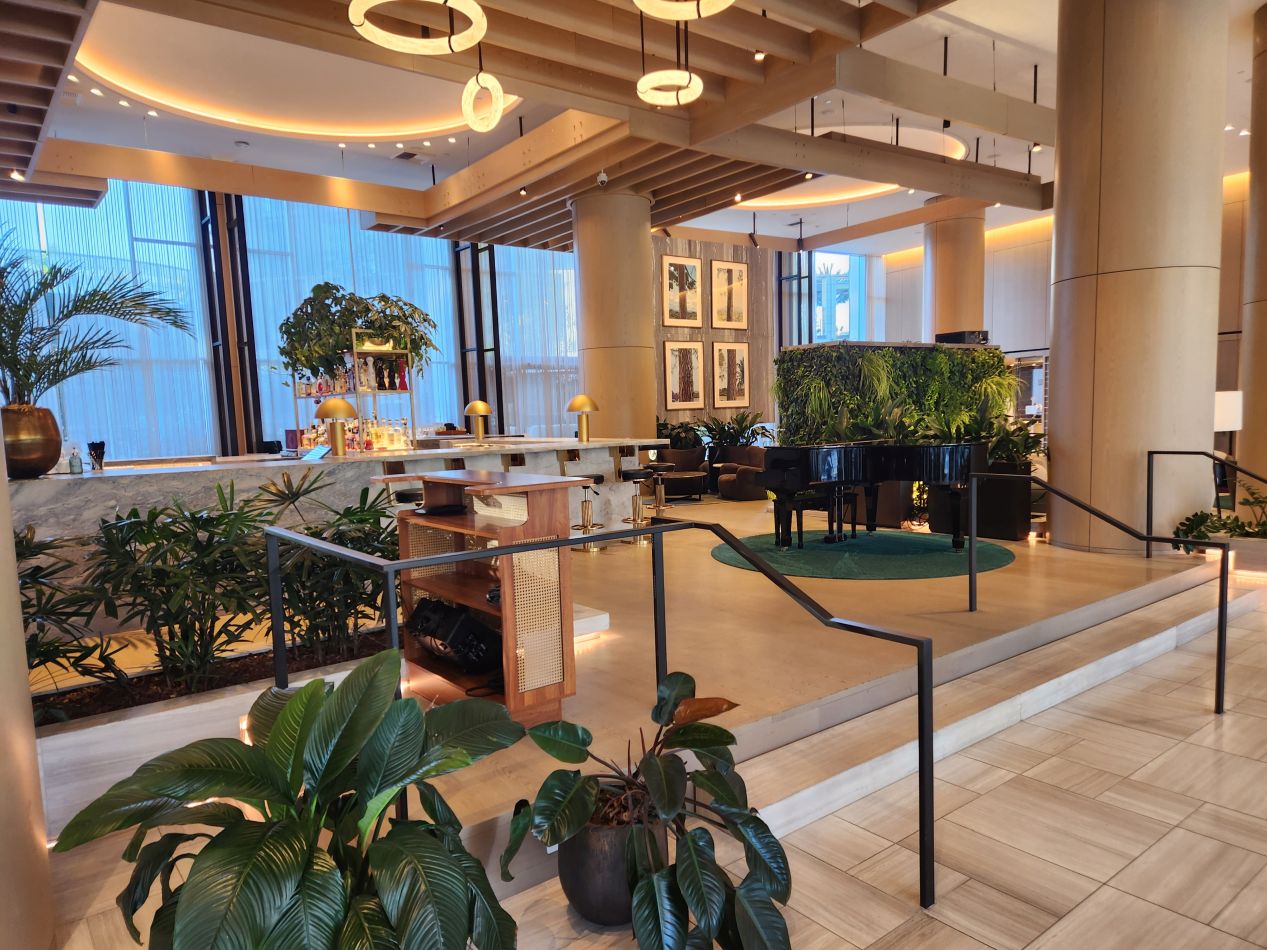


I successfully brought the rental car back to the airport in one piece (despite nearly getting hit by a car at one point on the drive back), followed by taking a taxi to my destination for the next few days. This was the Fairmont Century Plaza Los Angeles located on Avenue of the Stars near the Westwood neighborhood. The Fairmont was hosting the American Medical Association conference that I was attending, and the doctors always pick somewhere fancy for the meetings that would be taking place. This 19 floor building was an older hotel that opened in 1966 and was the first hotel to boast of color television in every room. Lots of celebrities have stayed at this hotel over the years and it apparently hosted the 1967 Emmy Awards along with the 1970 and 1971 Grammys. The hotel had been recently rennovated in 2021 to modernize the facility and it was definitely somewhere that I wouldn't have been staying if I had been footing the bill. The in-house restaurant was a French one which was wildly overpriced and I don't recommend eating there given how many excellent food options there were in the surrounding area. Long story short, it was a very nice hotel while also living up to LA's expensive reputation.


As usual for my work trips, most of my time was spent in this big ballroom listening to the AMA discussions as they decided how to value various different physician services. The way this works is that the AMA representatives debate each medical procedure and come to a consensus, then make recommendations to the Center for Medicare Services government agency (where I work), which we then propose and ultimately finalize as national payment policy for Medicare. It's exactly as exciting as that description sounds though I never mind attending these meetings since I enjoy the travel opportunities. Most days the meetings begin at 8:00 AM and run until 5:00 or 6:00 PM which doesn't allow much time for sightseeing. However, on this trip I had an opportunity to go to an evening event on Wednesday night after the meetings for the day had finished. I saw that the LA Clippers were playing the Washington Wizards in an NBA basketball game, and it was easy to get tickets because both teams were having poor seasons. I bought a ticket for $19 and then caught a ride share down to the Inglewood neighborhood where the Clippers play. LA's infamously bad traffic meant that this trip took almost a full hour and the taxi ride cost $55, triple the cost of the actual game - sheesh! I would have taken public transportation but LA's buses and subways are even worse than its traffic.

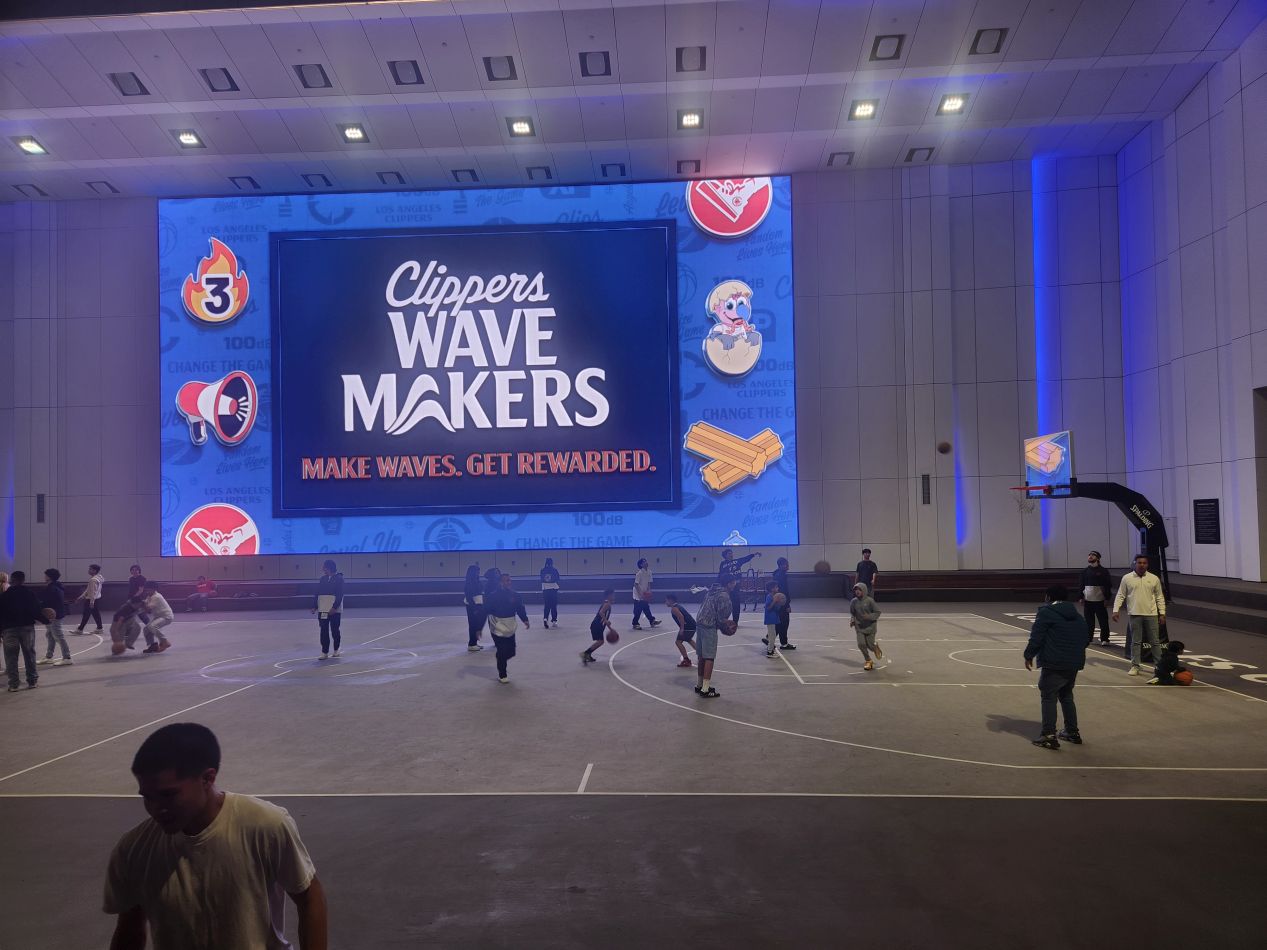


The Clippers play their games at the Intuit Dome which had only opened in 2024 and at the time of my visit was the newest stadium in the NBA. The arena definitely looked new and had a futuristic feel to it, starting with its outdoor courtyard where there was a big basketball court with kids shooting hoops. The stadium itself was open to the air along the whole outer rim, taking advantage of the mostly dry weather conditions in LA. It cost about $2 billion to build the Intuit Dome which finally gave the Clippers their own home stadium after spending decades as unhappy tenants of the Lakers. This new arena was clearly an attempt by Clippers billionair owner Steve Ballmer to upstage their much more famous and successful rivals over in downtown LA.

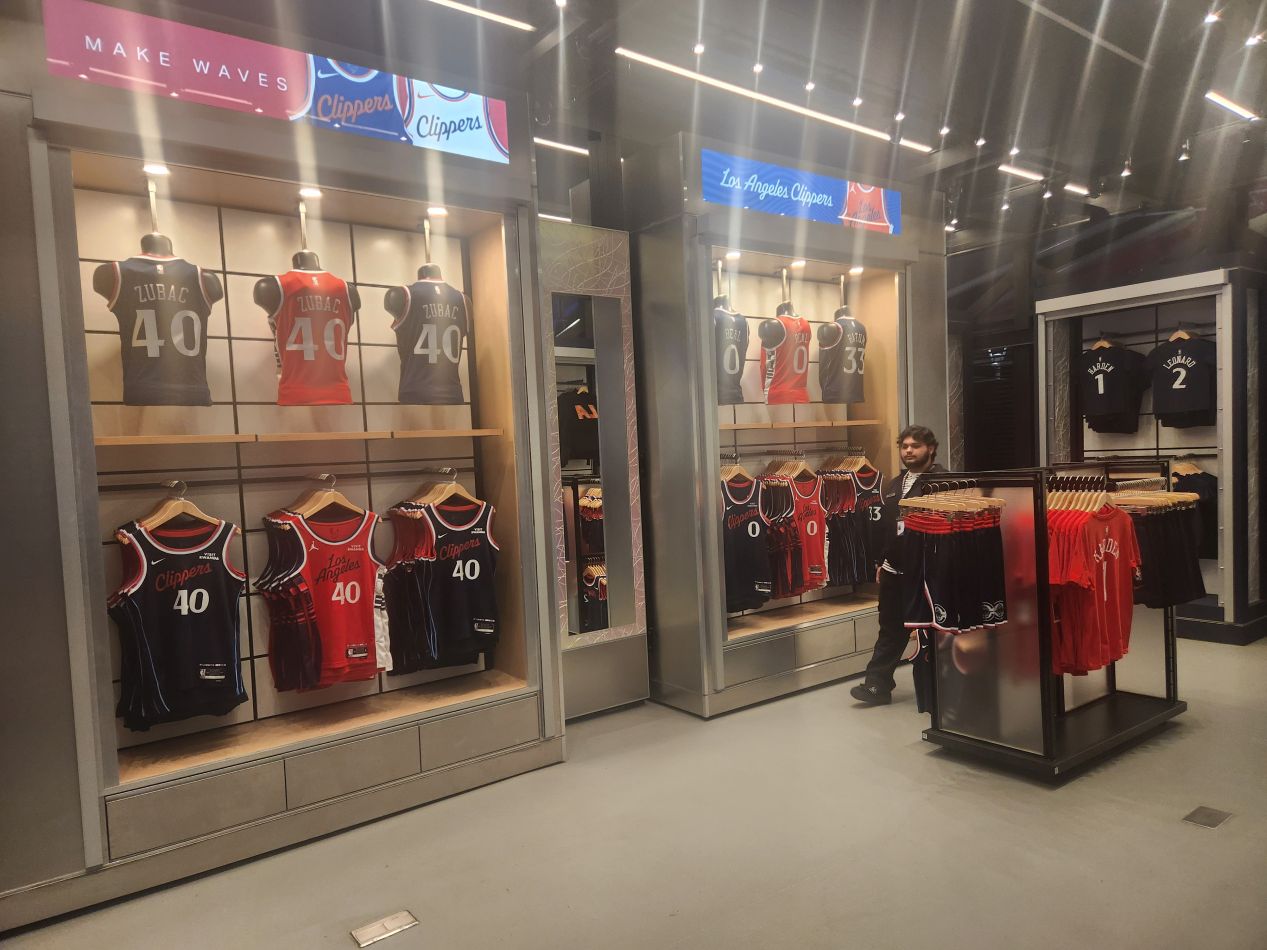


I walked past a bunch of signs advertising the 2026 NBA All Star Game which was set to take place here a month after my visit, then took the towering escalator up to the top floor of the stadium. The views were great from up there though it did feel vaguely like I was visiting a theme park of some kind. There were more basketball hoops up here where fans could shoot baskets for fun along with a smaller version of the Clippers team store hawking jerseys and other merchandise. I had arrived about 45 minutes before tipoff which meant that the place wasn't too crowded yet as I strolled through the spaceship-like hallway along the upper concourse. Here's one thing I really don't like about the Intuit Dome: everything is handled through an application that visitors must download onto their phones in order to enter. The Intuit Dome app tracks your tickets and handles all food/drink/merchandise purchases through scanning on entry, with visitors not allowed to spend money in any other fashion. It also wants to scan an image of your face and use facial recognition technology for tracking purposes, though that's at least possible to opt out of for the moment. It feels really, really distopian to have your phone tracking your every movement and purchase just to go to a sporting event - I deleted that application off my phone the instant that I was back at my hotel. I sincerely hope this isn't the direction that other stadiums are going to be taking, not least because the software kept breaking down and required assistance from the staff. Just great, all of the loss of personal freedoms without even the convenience that the app was supposed to provide!

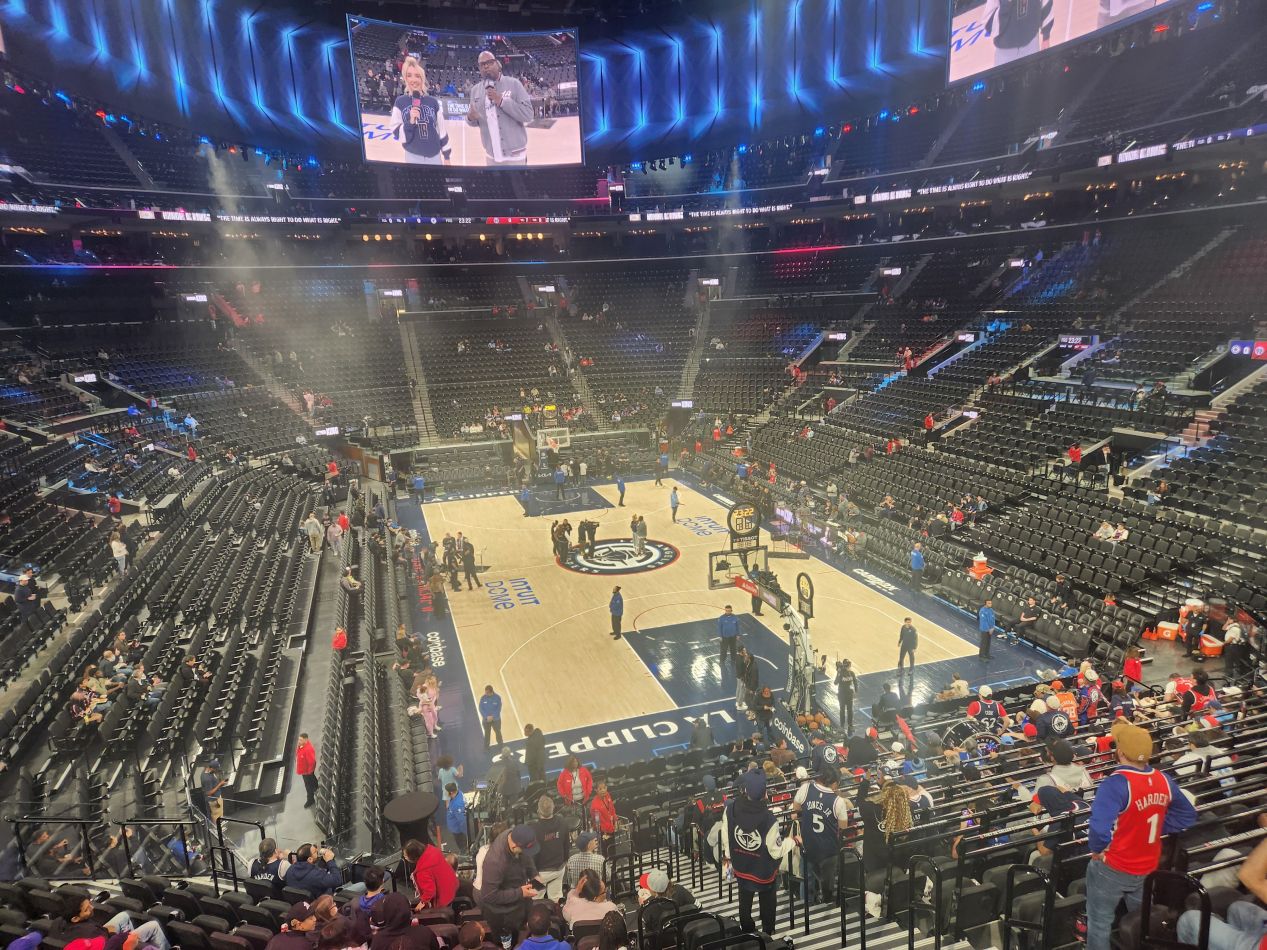


I purchased some overpriced chicken fingers using the creepy app since this was going to be my only opportunity for dinner and then found my way to my seat. I had picked out the best seat possible at the cheapest price point, a spot just to the right of center court in the upper deck. Lots of other people clearly came to the same conclusion as my portion of the upper level ended up being packed with fans while the more expensive tickets one section over were almost completely deserted. There were two unusual features of the Intuit Dome, the first being a massive video board that stretched around the court in a big circle at our level in the upper deck. I tried to get some pictures from different angles of that thing which displayed all sorts of different highlights, statistics, and advertisements as the game took place. The other standout feature was "the wall" located to the right of where I was sitting, essentially an attempt to bring a college basketball atmosphere to an NBA game. These seats are set aside for serious Clippers fans with the expectation that they will be standing and cheering throughout the contest. The fans there had a base drum that they kept playing throughout the game and it definitely brought a bit more energy to the place in comparison to the often staid NBA atmospheres.

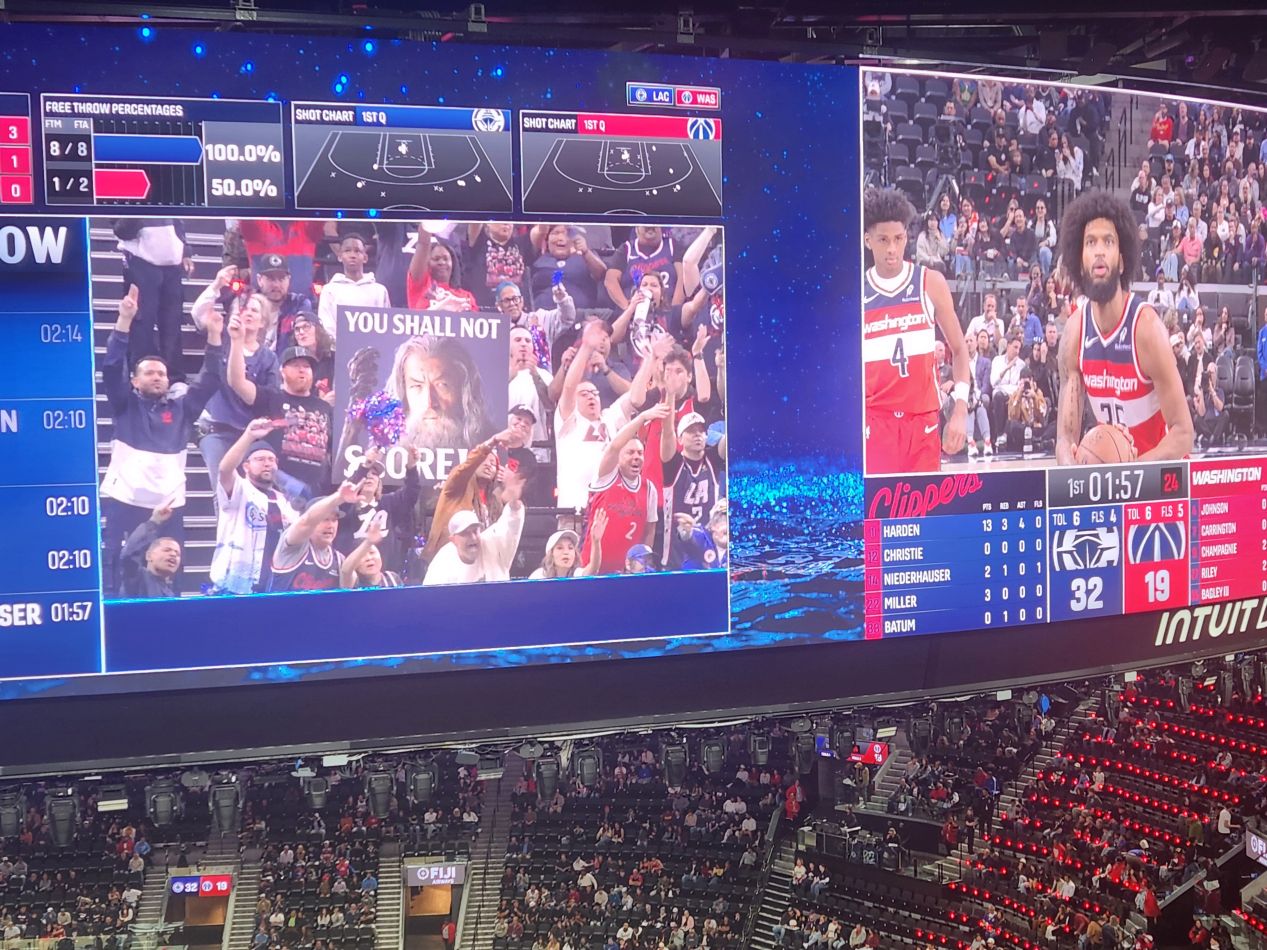


As far as the game itself went, the Clippers had gotten out to a terrible start this season but had been playing much better of late. They were clearly a far better team than the Washington Wizards (technically my home town team though I've never been a fan) who were having yet another lousy season. The Wizards had recently traded for Trae Young and it would have been fun to see him play but of course he was resting with an "injury" to help the team tank for a better draft pick. I wondered which Clippers player would be the final one introduced, the traditional honor given to the best player, and Kawhi Leonard got the nod over James Harden, probably because he had been on the Clippers longer. The game rapidly turned into a demolition as the Clippers ran all over the Wizards, jumping out to leads of 37-22 after the first quarter and 70-51 at halftime. The big video screen kept track of lots of stats as the game progressed, with the one that jumped out to me being a perfect 27 for 27 from the free throw line for the Clippers - sound fundamentals! During breaks in the game, the video board held contests and games (always tied to advertisers of course) that fans could interact with using a controller built into their seats. Again, it all felt a bit futuristic while also completely ignoring any notion that visitors might not want corporations to track every detail of their lives.
I left at halftime since I didn't want to be out too late given the need to be up again early the next morning. The Wizards apparently went on a run in the 3rd quarter but still never mounted a serious threat as the Clippers won 119-105; here's the Basketball Reference for the curious. I had to order another ride share for the trip back to my hotel, which this time went far better thanks to the lack of rush hour traffic. Unlike my first driver who said nothing, this time I had a chatty driver named Alberto who enjoyed talking about his love of music. He apparently had taught himself to play a rare 12 string guitar and kept showing me pictures of it when we were stopped at traffic lights. He was a great guy and really made the ride back pass by quickly, only lasting half an hour now that the roads were clear. I might have stayed at the game longer had I known that I would have such a fast and easy trip back!


The Clippers game had taken place on a Wednesday night. The following Thursday morning I had a series of administrative subcommittee meetings, things that I could have attended but didn't really need to be present to listen in. Therefore I had earlier decided that I would use this morning to do a bit of additional sightseeing, taking advantage of the fact that this hotel was located near the UCLA campus. I plotted out a route on Google Maps and planned to jog the 2.5 miles / 4 kilometers northwest over to the university. I woke up early and left the hotel at about 7:00 AM as the sun was rising, heading uphill through the sleepy Westwood neighborhood. I knew that this was a wealthy residential area and the houses that I passed along my route did nothing to disabuse that preconception. The houses were large and beautiful, many of them clearly had professional landscaping for their lawns, I saw numerous convertibles in garages, and I caught sight of some kids in private school uniforms leaving their homes. Clearly this was a great place to live if you could afford it.

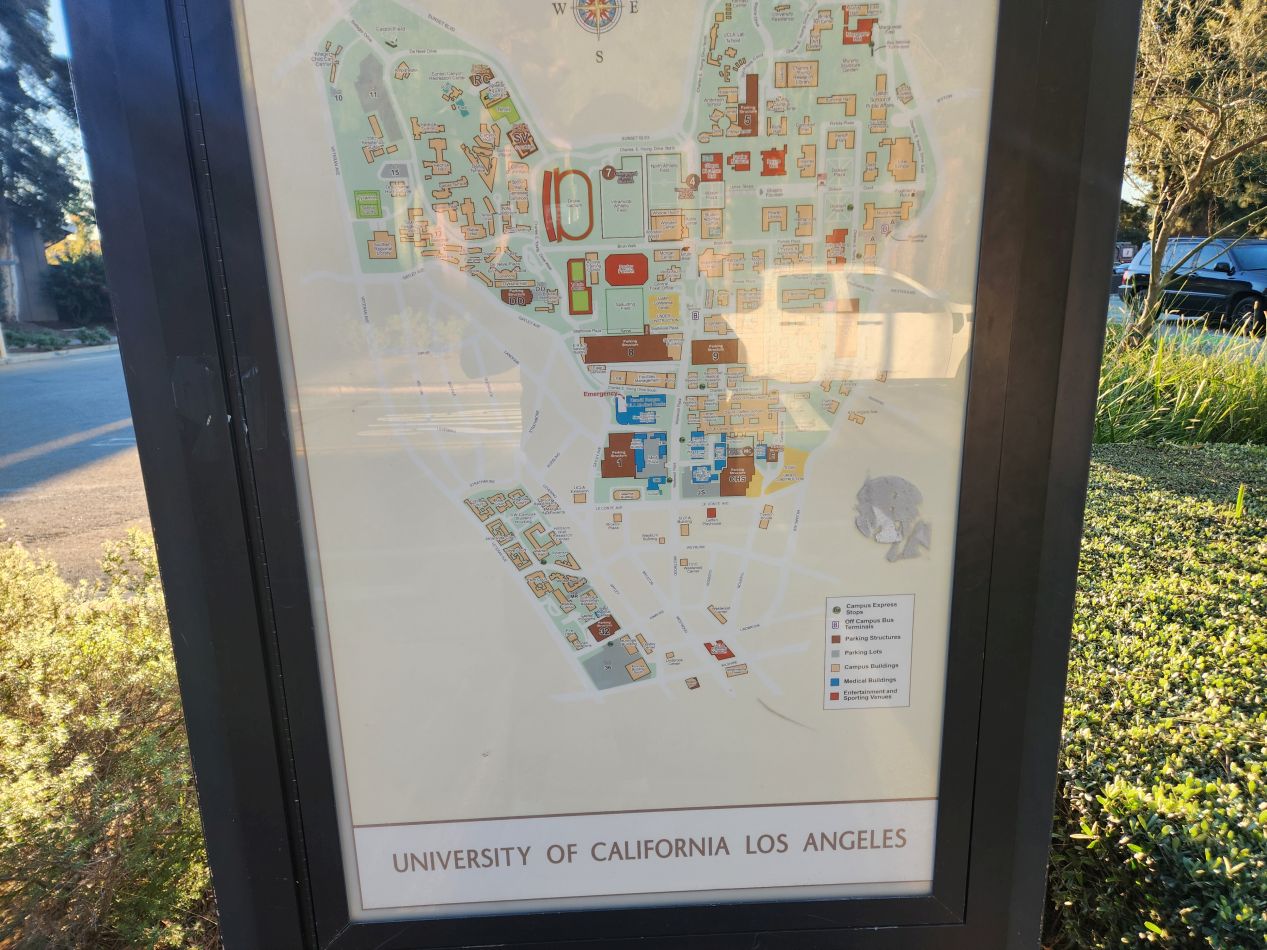


I was pretty winded by the time that I reached the campus of UCLA, not helped by the fact that the going had been mostly uphill. I'd like to tell you that I ran the whole way but the truth is that I had to walk a bunch of the time despite my best efforts. I had reached the home of the University of California Los Angeles (UCLA), the flagship university of the California public system along with Cal Berkeley up in the Bay area. This is the bitter rival of USC and it was impossible not to compare the two universities given that I had toured the Southern Cal campus just two days earlier. I was entering along the eastern edge of campus at Westholme Drive near the music building; there were no gated admissions here since UCLA didn't have the same downtown environment as USC. It was a little bit before 8:00 AM on the clock and the campus was just beginning to wake up as I started to see more and more students walking around as time passed. I made my way up to the Franklin Murphy Sculpture Garden where a few of these pictures were taken, then circled back towards the green space in the middle of campus.

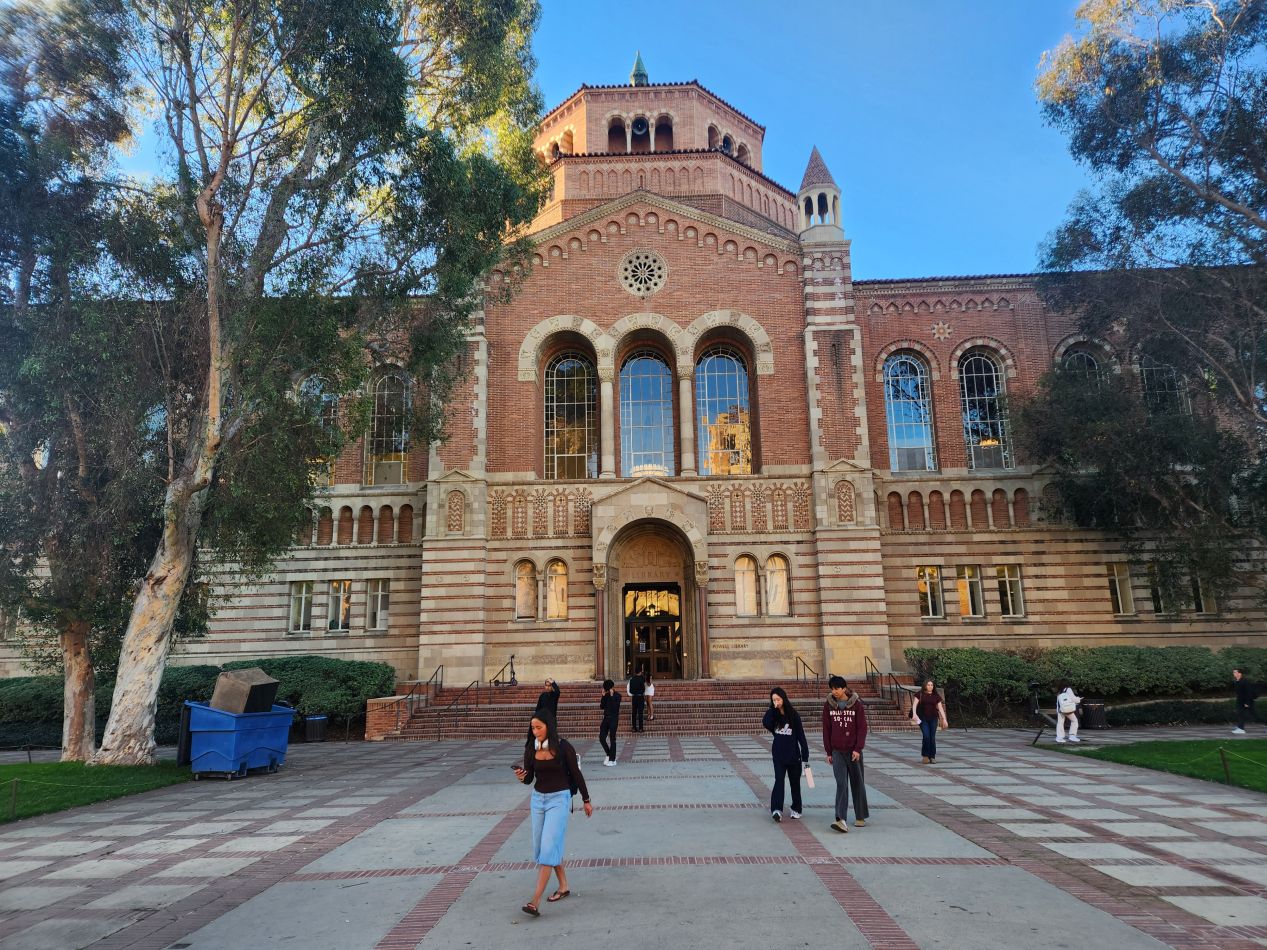


These pictures were taken while strolling through Dickson Court, the oldest part of the UCLA campus which has served as a gathering place for generations of students. This is where the first few academic buildings were built in the 1920s and 1930s when UCLA was still being treated as a satellite campus of Cal Berkeley and fighting for recognition as an independent institution. Like USC, UCLA also used the same Romanesque architectual style for its campus buildings which made the campuses look similar in many ways. Both of them also loved fountains which were dotted across both campuses. The two main buildings here were Royce Hall, home to UCLA's performing arts, and Powell Library which I would have entered if I hadn't been covered in sweat and wearing running shorts. At the west end of the campus quad was Shapiro Fountain which figures into a number of UCLA student traditions that involve students jumping into the water. The climate here makes that more fun than when students jump into the water at the ODK fountain at my own University of Maryland.

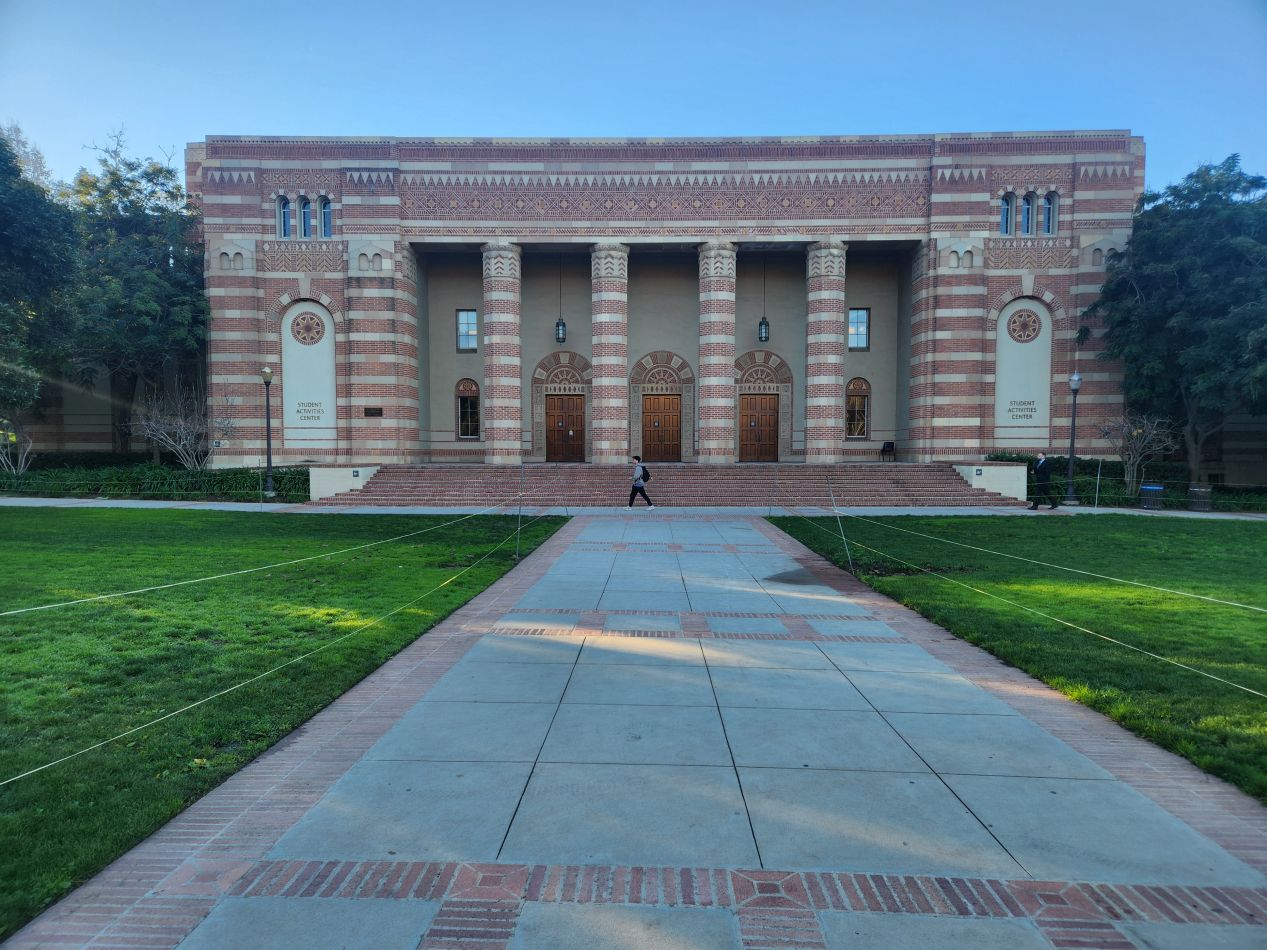


Dickson Court apparently sits on top of a hill as this lengthy staircase led down to Wilson Plaza a little bit further to the west. There were more academic and administrative buildings down here, as well as a small museum named the Fowler Museum which unfortunately didn't open until noon and was therefore not possible to visit on this trip. A little bit further past the student activities center and the recreation building was a statue of a Bruin, the bear mascot of UCLA. This statue is a good luck symbol for UCLA students who were probably fortunate to be admitted to the university. Like USC, this is an equally elite institution that also typically ranks around 20th place in the national rankings (which is top five status for a public university). UCLA actually receives more applications than any other university in the United States, most recently receiving 146,000 applications and accepting 13,000 of them. This is a larger school than USC with about 46,000 students (33,000 of them undergrads) and tons of distinguished alumni. California has four exceptional universities between these two plus Cal Berkeley and Stanford in the Bay area, all of which are rivals both academically and athletically.

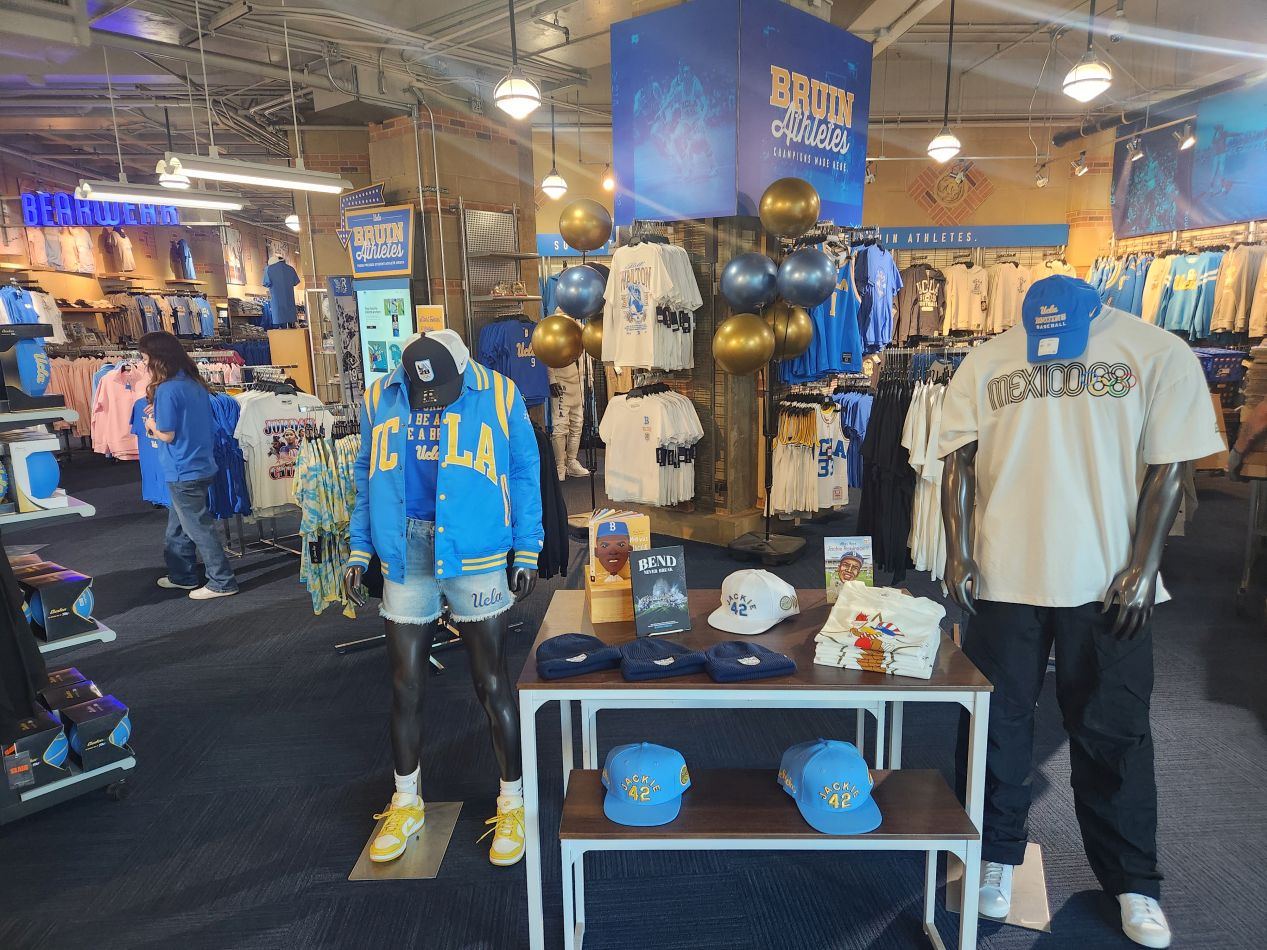


The Bruin statue was also located across the street from the Ackerman student union. The building was already open for the day and I was able to wander around the UCLA Store inside which had the predictable mass merchandise covered with the UCLA logo. I did enjoy the banner proclaiming "Bearwear" with different types of Bruins shirts and pants, that was clever. The little bears with UCLA shirts were adorable and I wanted to get one for our son Charlie but had no practical way to carry it with me given that I still had a run of roughly three miles back to my hotel yet to be done. I suppose that I should feel some kind of antagonism towards schools like USC and UCLA now that they're in the same Big Ten conference as the University of Maryland... but I just don't care. Maryland had rivalries with Virginia and North Carolina and Duke, schools that they spent decades competing against in the same geographic region. Now I'm supposed to care about these California schools on the other side of the country? Forget it. It sucks that television money and these gigantic conferences have ruined so much of what made college sports fun.

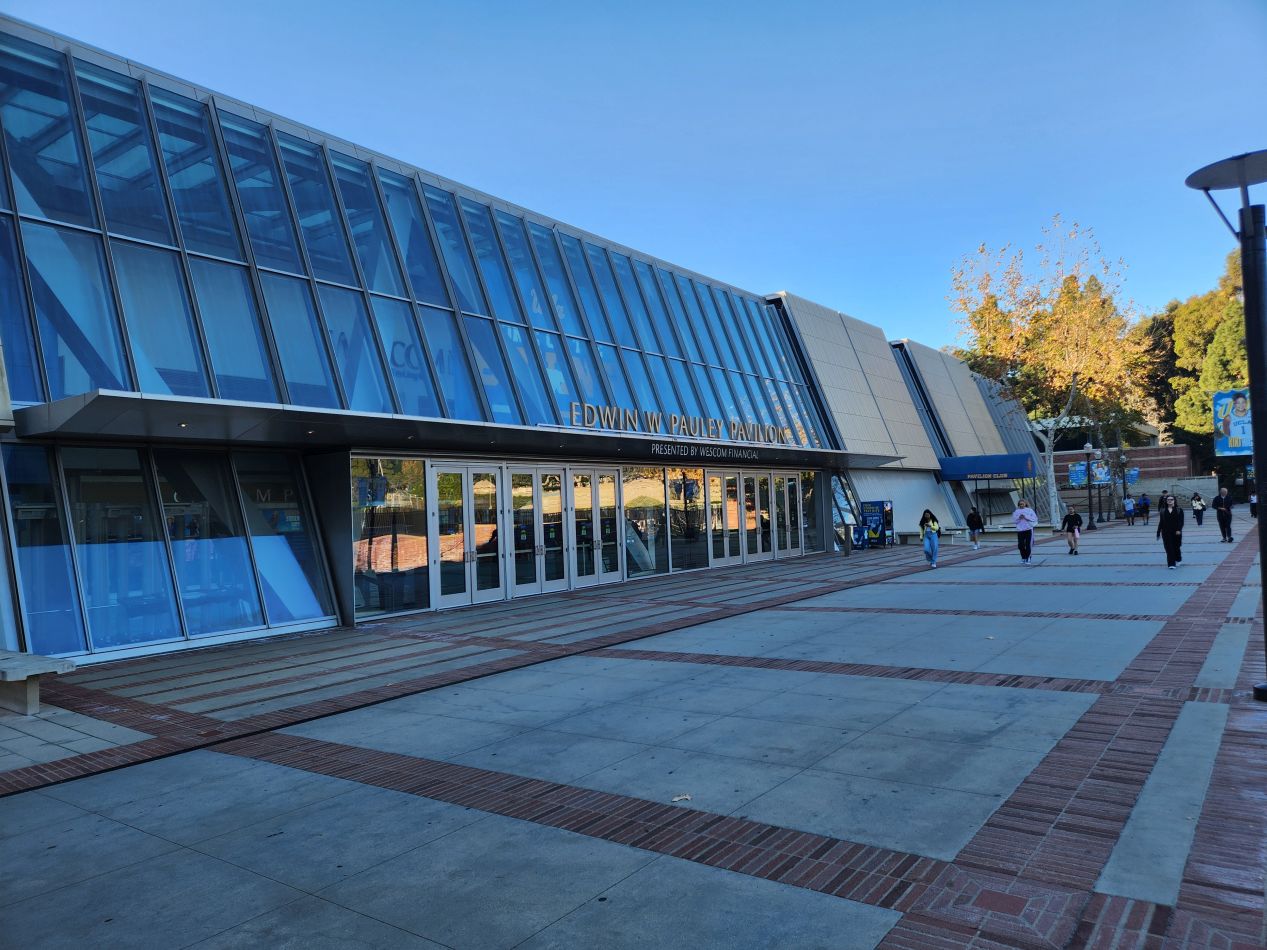


Speaking of college sports, close by the student union was Pauley Pavilion, home to the UCLA basketball teams. This facility sits on the short list of the most legendary college basketball arenas, having played host to the UCLA men's and women's teams since it opened in 1965. I mentioned before how USC was known as a football school; well, UCLA has the reputation of being a basketball school and has a solid claim on the title of best college basketball program of all time. UCLA has won 11 national championships in men's basketball, the most ever, as well as an insane 10 national titles in 12 seasons from 1964 to 1975, including seven straight titles from 1967 to 1973. From 1971 to 1974, UCLA men's basketball won an unprecedented 88 consecutive games which no other school has even remotely approached in length. All of this took place under head coach John Wooden who is immortalized in a statue outside Pauley Pavilion. The team has been nowhere near as dominant since then and has only won a single national title in the last 50 years, in 1995, but UCLA has still been a consistently good program. I wanted to see a game here very badly but there were no men's or women's basketball games taking place during the time of my visit, too bad.

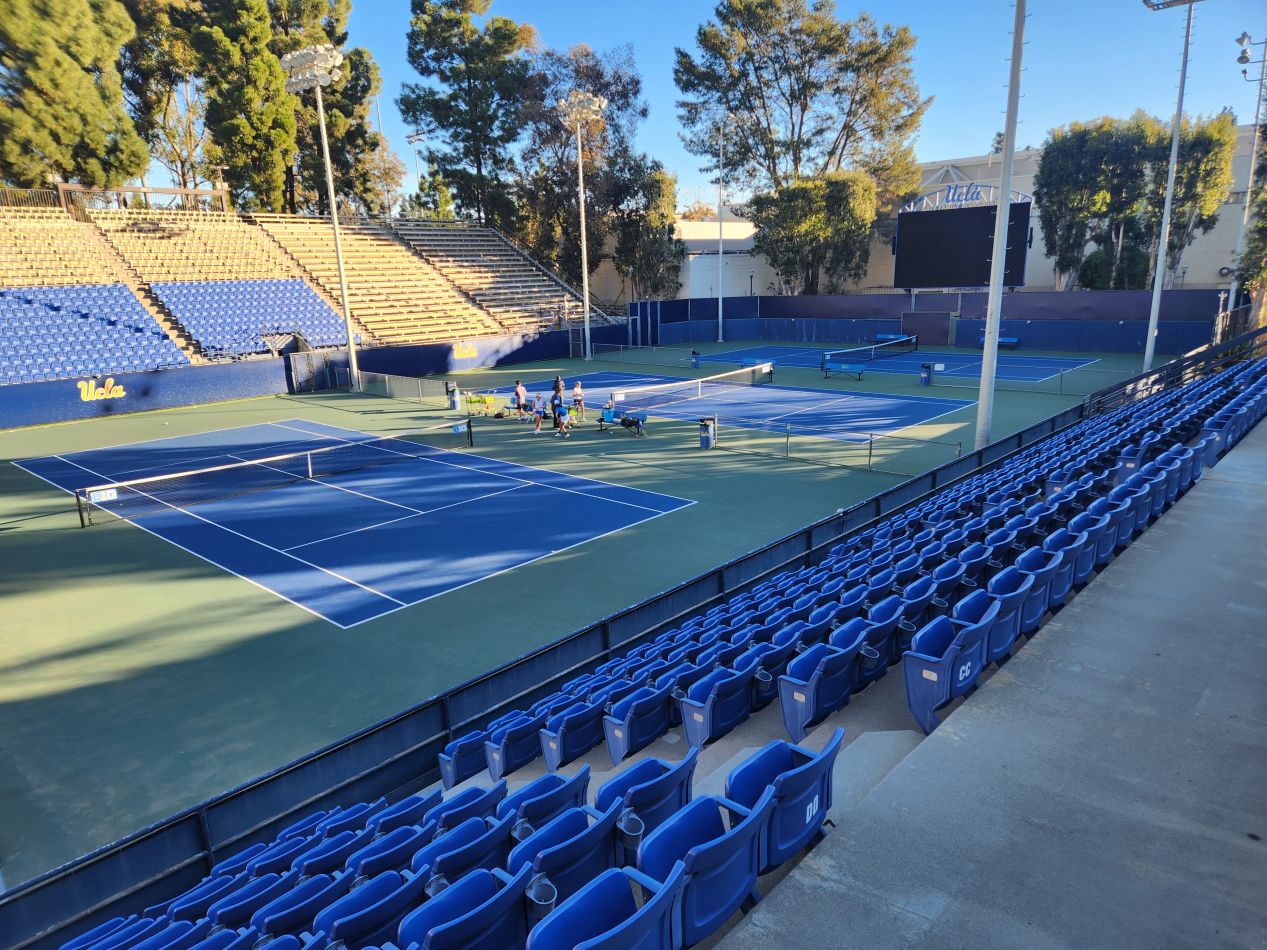


This western part of the UCLA campus held the other athletics facilities as well. The nicest of these was the Los Angeles Tennis Center which was built as part of the 1984 Olympic Games and which UCLA's tennis teams have been able to use ever since. I've played a lot of tennis in my life and never on a court anywhere near as nice as these ones. Next door was Elvin Drake Stadium which was built in 1969 to serve as a multisport facility. I assumed that this had been the prior home of the UCLA football team, however they've never actually played their games here (instead also playing at the LA Coliseum in earlier decades) as instead Drake Stadium was used for track and field along with soccer. For the curious, UCLA's football team currently plays at the Rose Bowl in Pasadena, which they've been using since the early 1980s. That's nowhere close to the UCLA campus which is a bit of a shame, as I've always preferred the on-campus venues. I did not see these teams during my visit, but apparently UCLA is also really, really good at water polo and softball where the university has been dominant for decades. Most big universities have at least one obscure sport like this where they crush the competition; for the University of Maryland, it's women's lacrosse.
That took me to the western edge of the UCLA campus where there wasn't much else to see. Continuing onwards would have taken me to the Hill, a big cluster of residence halls where I was already seeing students stream past me on their way to class, and it would have felt really weird to be taking pictures there. Instead I headed south to exit the UCLA grounds where I walked past the massive high rise buildings of the UCLA medical center which is supposed to be one of the best hospitals in the area. Then I ate a quick breakfast near the campus and ran 3 miles back to my hotel, where I showered and dressed in time to make the 10:00 AM start time for that day's meeting proper. I had to squeeze in this trip to UCLA if I was going to see it and I was glad that I managed to find the time. Between the two southern California universities, I preferred the quiet neighborhood of UCLA to the bustling downtown of USC, though both universities are outstanding in their own right and fantastic places to attend college.

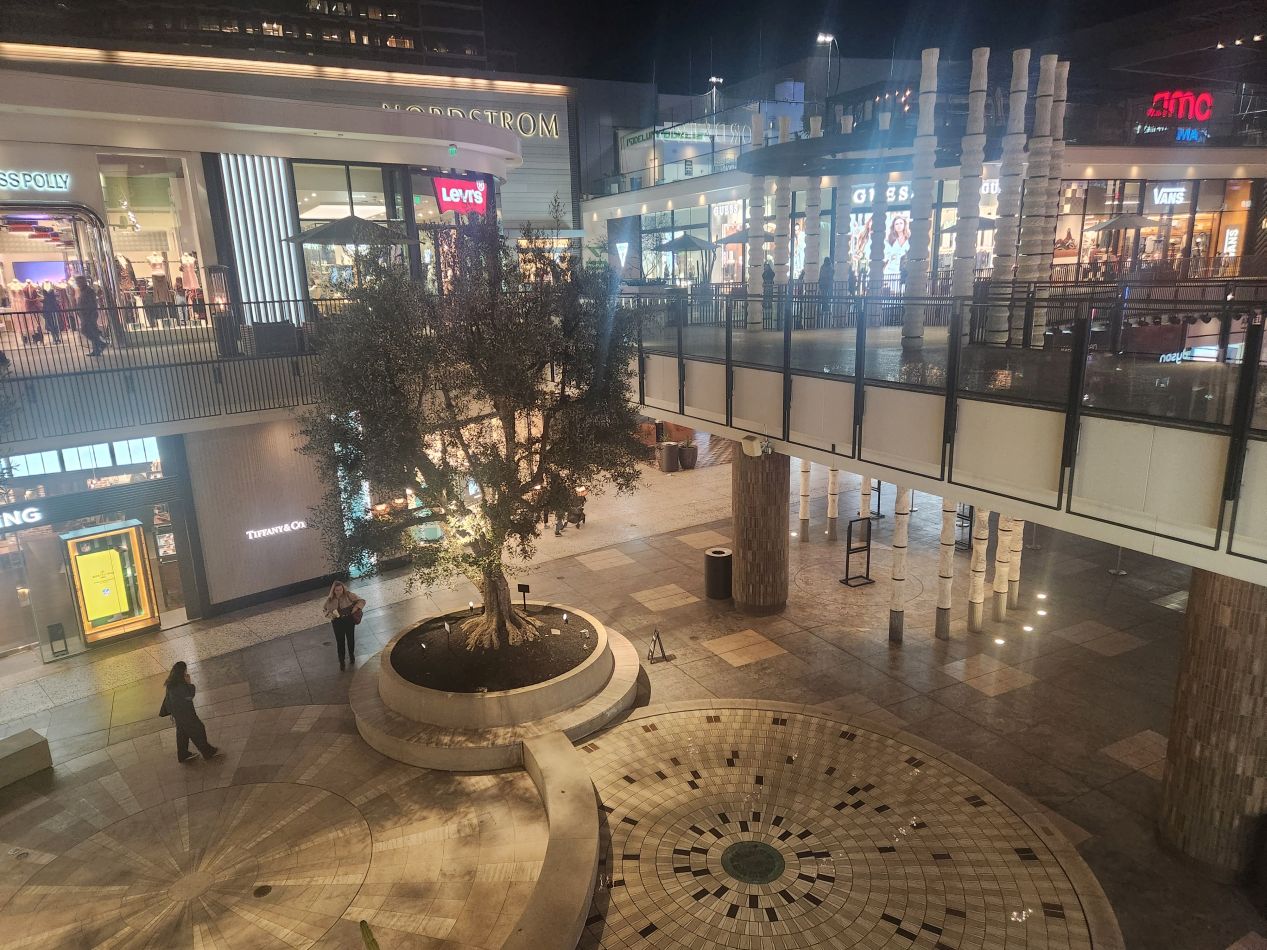


There was only one other attraction worth visiting in the immediate area of my hotel, a shopping center right next door to the Fairmont Century Plaza named Westfield Century City. This was an outdoor shopping mall which had originally been developed in the 1960s but underwent a complete renovation in the last decade before reopening in 2017. I could only visit the shopping area at night, after my work meetings had concluded for the day, and I went here to get dinner on both of my last two nights of the trip. Westfield Century City had two floors which were both left completely open to the outdoors, something that only worked due to the mild and dry local climate. The mall was somewhat upscale (though not as much as the Grove) and was quite crowded both nights that I was there, bustling with mostly young people enjoying the food and the shopping. There were lots of appealing restaurants to pick between but I ultimately selected these two:

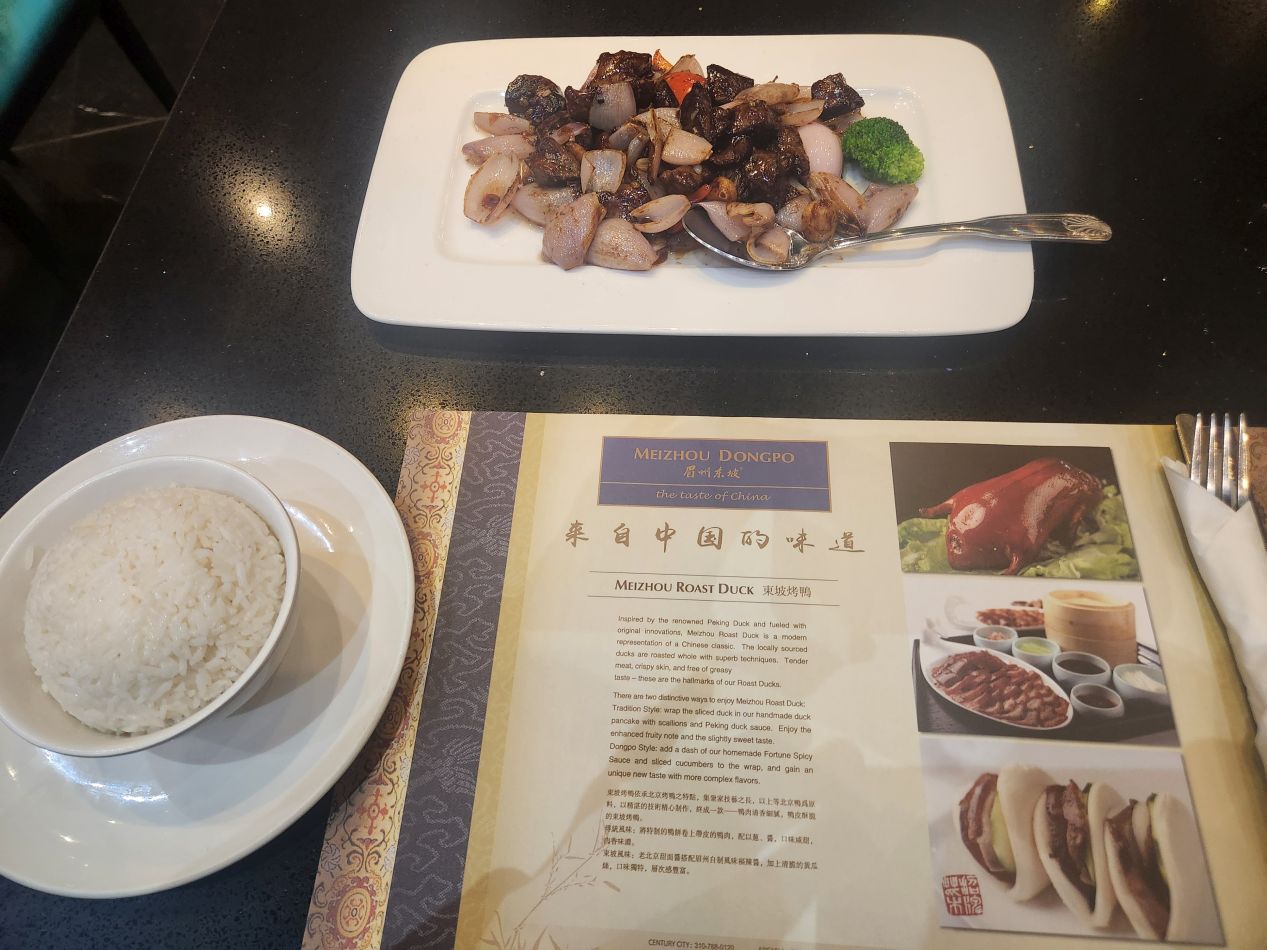


The first of these was Meizhou Dongpo, chosen from among more than a dozen restaurants serving different types of Asian food. Their specialty was roast duck, which is one of my wife's favorite dishes and I wish she had been here to try it out. Instead I ordered a beef and rice dish which was very good, if a little bit overpriced as expected here in LA. The final night I went to get dinner at Eataly, a combination Italian grocery store and restaurant chain that currently serves as one of the anchor stores for the mall. I enjoyed window shopping my way through the grocery store portion of Eataly before making my way to the restaurant and getting this triple meat Neapolitan pizza. It was every bit as good as it looked and the perfect way to close out a day where I had spent 10 hours sitting in meetings.
I had several more hours of meetings the next day, from which I went directly to the airport and flew back to the Washington DC region. This flight even had satellite TVs on board which allowed me to watch Josh Allen's Bills lose an agonizing overtime playoff game to the Denver Broncos while flying over the southwestern United States, what a unique experience. Anyway, the trip overall was a great success and I was very pleased with what I was able to visit during the short periods of time that I wasn't busy with work meetings. Los Angeles is a massive city and I only experienced a small fraction of what the city has to offer so there will be plenty more to see if I come back again for another work trip. Until then, thanks as always for following along with my travels.


