I continued speedrunning my way through the various classes in Dragon Quest 3, this time taking a look at a solo Priest run. This was the first class that I had undertaken to focus primarily on spellcasting instead of physical attacking, making for a very different style of gameplay. The Priest class (originally known as the Pilgrim in the NES "Dragon Warrior 3" translation) is essentially the White Mage of the Dragon Quest cosmere, focusing on healing and support spells but with relatively little offensive firepower at its disposal. The greatest advantage of the Priest class is the simple fact that it has access to the Fullheal spell, an ability that completely restores HP back to full. In a game where there are no items whatsoever that heal for more than 80-90 HP, this is a very big advantage indeed! The Priest class has the goal of winning boss fights by outlasting their opponents, calmly restoring health again and again while whittling away with modest damage. The Priest does get access to exactly one elemental type of damage, the wind element, and I knew that I'd be spamming the very limited selection of wind spells over and over again.
One small note: the Priest class is intended to wear an outfit with a big cross on the front to fit its thematic nature. This is the "Priest" class, after all, so of course it would contain some kind of religious iconography; you can see what this looks like in the original Toriyama artwork for the Priest. However, it turns out that some Christians have very strong feelings about anything displaying a cross icon, and the various international versions of Dragon Quest 3 have all tried to sidestep controversy by removing any depictions of a crucifix. (This included the original NES port which is why the class was renamed to "Pilgrim".) Thus the HD-2D version uses a bunch of tridents instead, with the same symbol included on every church within the game, making it looks as though everyone worships Poseidon in this universe. I don't particularly care either way about this issue but if you were wondering what the deal is with all the tridents, that's the reason. I do think that the female Priest design looks absurdly cute and that this is one of Toriyama's best character designs for DQ3.

Starting a new savefile meant that I had to undertake the task of rolling a new Priest character at Patty's Party Planning Place. As I've explained in prior solo reports, this involves a *LOT* of rerolling to get the desired starting stats. Every class has its own base stats, which for a female Priest are 7 / 10 / 7 / 9 / 12 / 5 when going in order down the list of the six main stats. Wisdom is the highest of these at 12 to indicate that this is a spellcasting class and I was pleased that Resilience (the defensive stat) was the second-highest at 10. Then every time that the player chooses to refresh the stats, the gameplay will add 2-10 additional stat points in random categories, based on a normal distribution in which most rolled characters will receive 4-7 bonus stats. This particular Priest gained six total bonus stats, with three of them going into the Resilience stat which was the category that I most wanted.
Then the player gets to assign five additional stat-boosting seeds to any of the six main stats, which themselves will each roll a value from 1-3. Thus there's the potential for a massive disparity in starting stats, as an unlucky character could get as little as 2 bonus stats and another 5 points by rolling a 1 value on the additional seeds, or as many as 10 bonus stats plus 15 points from 3 values on the five seeds. The combination of inherent bonus stats plus the stat values from the player-chosen seeds then determine the personality of the new character:

This was the first character where I actually understood how this system worked; I had previously been working off a guide at Gamefaqs which was simply incorrect about the mechanics. What actually happens is that the game looks for the stat category with the highest values above the BASE stats for the class. Let's say that I wanted to get the Lucky Devil personality for example: the base Luck stat for a Priest is 5, so therefore I would need to target 12 additional points in Luck (17 or more in total) from the initial randomly distributed bonus stats plus the extra stats from the player-chosen five seeds. If a character could hit that target, they would have 80% odds to get a Lucky Devil personality and 20% odds to be assigned the Happy Camper personality. Note that it's difficult to hit the personalities listed at the top of this chart, which are mostly the better / stronger personalities in DQ3. To reach 12 extra points in Luck, the player would have to roll very highly on the stats from using Seeds of Luck (you would need 3, 3, 2, 2, 2 or better) or else get fortunate on having the bonus stats go into the correct category.


I was targeting the Ironclad personality for my Priest character, the same one that I had used for my solo Monster Wranger. This required getting 11 additional stats in the Stamina category, the one that determines HP growth, for a total starting value of 20 or higher. And even then, the odds were still only 1 in 3 to receive the Ironclad personality! I rolled many, many characters before finding one that had the correct personality and a distribution of stats that I liked. I was also thrown off by misleading information at Gamefaqs which incorrectly stated that assigning Seeds of Resilience would lead towards an Ironclad personality. That was not correct: Resilience is the only one of the six main stats that does not lead to any personality at all! This is because Resilience didn't exist prior to the HD-2D version (Agility was previously used as the defensive stat) and therefore the personality system remains tied to the other five stats. Eventually I managed to get a setup that I liked which also came with the Ironclad personality and could move on.
Why the Ironclad personality? Aside from having one of the highest overall stat bonuses in the game, Ironclad also gave me the stat that I most wanted: Resilience (i.e. defense). Strength was not needed on this class as it wouldn't be doing much melee attacking, and similarly Luck didn't matter that much as the Priest wouldn't need the extra physical damage boost from having high Luck. I've found Agility to be irrelevant as every class will out-speed the monsters via rampant seed use by the end of the game, and this class would have more than enough Wisdom to hit the target value it needed at the base 100% growth. Therefore the one stat that would legitimately help was having higher Defense and so I wanted the Ironclad personalty for 40% more of this value. The Priest class has poor stat growth in general, lower in the aggregate than everyone other than the Goof-Off. Wisdom is the only stat that isn't subpar and even that stat gets outclassed by the Mage and Sage. I guess Priests are known for their faith and not their innate physical or mental abilities.

This was the Priest that I ended up with after all of that preparation. I was using a female Priest for the superior equipment selection as usual, picking visual Option 3 out of the four different choices since it matched the original artwork the closest. The Priest class canonically has blue hair and that seemed like a good fit with the blue and orange coloring on their robes. (I tested out using red or blonde hair and it didn't look good at all on this sprite design.) This character just barely made it to the 20 Stamina needed to qualify for Ironclad personality and I probably could have rolled the stats further for an optimal outcome; this was likely good enough though. The Priest gets its damage from spells and therefore pumping a stat like Strength is nowhere near as necessary for this class as it is for some others. Starting the game with only 18 max HP was a bit concerning, though she would only need to level one time before the extra Stamina would translate into more max health.
I went with an obscure historial reference for my character's name: Saint Hildegard of Bingen. She was a German Benedictine abbess who lived in the Rhineland in the 12th century, which isn't quite the same thing as a Priest but about as close as I could get. Hildegard is listed on her Wikipedia page as a writer, composer, philosopher, mystic, visionary, and as a medical writer and practitioner. She was well known in her day and traveled around the Rhineland on various preaching tours, while also corresponding with many of the biggest political and religious figures of her era, such as Holy Roman Emperor Frederick I Barbarossa, the famous monk Bernard of Clairvaux, and multiple popes. There's been a major revival of historical interest in Hildegard in the 21st century as scholars have traced the importance of women in religious life and how they challenged traditional assumptions about the medieval period. Anyway, this is a really interesting historical figure and it gave me a unique and memorable name for a female Priest character.

Hildegard began her journey by thoroughly exploring Aliahan's castle and town, as there were several modest equipment upgrades and a couple of stat-boosting seeds hidden in various pots and barrels. Upon exiting the town, she paused to kill off her useless Hero companion and then began slaying the weak monsters outside. I was surprised to find that this class could equip the Copper Sword and included the image of what Hildegard looked like wielding it, left-handedly it would seem like the Monster Wrangler class. With a total Attack value of only 18, she actually felt short of enough damage to one-shot a Stark Raven, as sad as that might be. The monsters were only able to hit Hildegard for 1 or 2 damage at a time though and she had enough health to kill this mob without getting into serious damage. The experience from this first encounter was sufficient to reach Level 2, at which point her Stamina bonuses kicked in and doubled Hildegard's max HP up to 47 points. That was more than enough to be safe and I could go back to relaxing and exploring the surrounding area for the first few sparkle and secret locations.
Hildegard had never really been in danger though because she started the game with the Heal spell. This is the basic healing spell in DQ3, restoring 30-40 HP at a cost of 3 MP. She could easily use the Heal spell to keep herself topped off on full health, though even that was typically unnecessary since she was leveling quickly as a solo character and the HD remake restores all HP/MP on leveling. After clearing out the initial sparkle loot drops near Aliahan, Hildegard reached Level 5 and unlocked her first offensive spell:

Woosh is the Tier 1 wind element spell in DQ3, one of only three spells that deal this type of elemental damage. It targets a group of enemies (not everything on screen) and deals 11-26 base damage against monsters with no wind resistance. Every enemy in DQ3 has a resistance rating in six different elemental categories (fire, cold, wind, explosion, lightning, and "strike" = physical) though the elemental categories tend to be less significant in this game as compared with other RPGs. For example, monsters that were "weak" to wind element only took 25% additional damage from Woosh instead of 50% extra damage or double damage as in other games, and there were relatively few opponents who had greater than 25% resistance to wind element. I should also mention that multitargeted spells like Woosh deal additional damage when hitting fewer enemies, 15% more damage when hitting exactly two foes and 30% more damage if cast against a single opponent. This was certainly helpful due to the fairly low base damage of this spell.
Spell damage can also be boosted by the Wisdom stat in the HD remake of DQ3. The way that this mechanic works is that the spellcaster's Wisdom stat is compared against a table of expected values based on their Level:
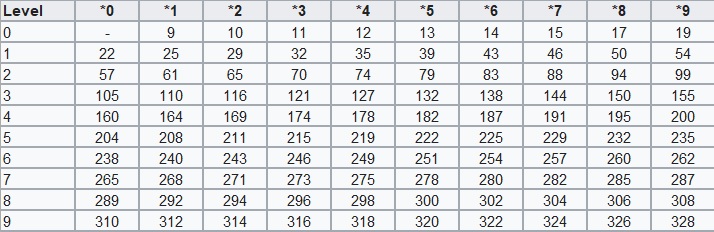
The class and spell in question don't matter for this calculation, only the Wisdom stat and the level of the spellcaster. (Note that this is the exact same table as the expected Luck values, which are used for physical damage and critical strike chance.) The spellcaster compares their Wisdom against the number on this chart, and for every point of Wisdom above the value listed here, the damage of the spell is increased by 1% (up to a maximum cap of +60%). To use Hildegard's current situation as an example, she learned Woosh at Level 5 at which time she had a Wisdom score of 25. This was 12 points above the expected Wisdom target of 13 for a damage bonus of 12% above the base value, or 12-29 damage in total. With enough Wisdom, the base damage could be increased by a full 60% up to the 18-42 range which was a huge leap over the initial values. Now I need to stress something else about this mechanic: it's *VERY* difficult to reach a Wisdom score fully 60 points higher than the expected target! The numbers in that table start out slowly but then race upwards at breakneck speed, going up 5-6 points at a time for a long while before finally calming down after hitting Level 50. Under normal circumstances, characters will struggle simply to reach these expected Wisdom targets at all, much less be another 60 points higher than what's listed here. Hildegard would have a tremendous amount of help from Seeds of Wisdom but it was still going to be a very long time before she came anywhere close to that full 60% bonus on her wind element spells.
I found that Woosh was a helpful tool to have in Hildegard's arsenal while it fell short of becoming her main form of offense. The damage was simply too low to be an all-purpose killer and Hildegard was already dealing more damage with her melee attacks than this basic wind spell. Add in the fact that Woosh cost 4 MP per casting, and the fact that it could only hit one "group" of monsters at a time, and it didn't make sense to use the spell against everything that Hildegard encountered. Instead, I used Woosh when Hildegard could hit at least 3 and preferably 4 or more enemies at a time, using physical attacks instead against smaller collections of monsters. It was also handy to use this spell when Hildegard was hit with the Dazzle spell to cause half of her physical attacks to miss. Overall though, the low damage and highly variable nature of Woosh (11-26 damage was a WIDE range of numbers!) meant that Hildegard played like a fighter-mage hybrid class, physically attacking more than I had expected while mixing in her Priest talents for healing and the occasional offensive blasts.

These mechanics meant that Seeds of Wisdom were in extremely high demand for Hildegard, both directly increasing the damage dealt by her spells as well as translating into additional max magic points. Every point of Wisdom turns into 2 additional max MP in this game, just as every point of Stamina becomes 2 additional max HP, making these very hot commodities for Hildegard. She cleared out Dreamer's Tower followed by the Path of Promise which was where she discovered the seed pictured above. Neither of these early dungeons contain bosses and they were generally routine for Hildegard, though some of the enemies in the Path of Promise were reaching the point where they had enough health to shrug off the damage from Woosh. For example, it was better to attack the Prestidigitators and kill one per round with Hildegard's melee blows than it was to cast Woosh into their 25% wind resistance and require at least three rounds to start dropping them as a group. She leveled early in the dungeon and nearly ran out of MP before reaching the teleportal at the end, though I could have simply ran from combat if things had truly been dire.
I included the picture of Hildegard's spell list above to highlight some of the additional feats that she was learning. Unfortunately many of the Priest spells aren't very useful for a solo character as they are intended to be used in a party setting. Squelch cured poison status which was nice, I guess, though Antidote Herbs would have done the same thing. Zin was completely useless here as it has the chance to bring a character back to life: 50% odds to revive another party member when cast. It might feel bizarre to have resurrection attached to a coin flip mechanic but DQ3 really likes its dice rolls. Acceleratle (not "Accelerate" for this game!) doubles the party's Agility stat for the next few rounds, which can be useful under normal circumstances to move the party in front of a speedy boss but served little purpose here as Hildegard's abuse of Agility Seeds would soon speed her past everything. Then there were the status spells: Dazzle drops enemy accuracy and causes them to miss half of their attacks, Fizzle blocks enemy spells (not abilities), and Snooze puts them to sleep. Status effects tend to be pretty weak in DQ3 as bosses either resist the statuses or shake them off quickly. Then the Poof spell is essentially an instant death spell that blows away enemies entirely... but grants no gold or XP for defeating them, making it largely pointless. None of these spells were more than curiosities for Hildegard as she didn't have much use for them.
Sap, on the other hand, would legitimately be useful against some bosses. I'll discuss it in more detail later.

The next spell that Hildegard learned at Level 12 was crucial to her gameplay for the moment, an upgrade to the Heal spell named Midheal. This was another single target healing spell that restored 75-95 HP when cast, which more than doubled the 30-40 health restored from the earlier Heal spell. I spent a little time testing the healing mechanics and verified that the Wisdom stat does *NOT* boost the health restored from the healing spells; this was a bit disappointing but made sense from a balancing standpoint. That Midheal spell was put to good use right away as Hildegard made the trek from Romaria to Asham where there were much more dangerous monsters lurking. Hildegard had particular trouble with the Jackanapes and Vampire Cats, with the former having 75% wind resistance while the latter could cast Fizzle to block all of Hildegard's spellcasting. Both of these enemies could also call in reinforcements or break out the monster critical hit ("Desperation Strike") whenever they felt like it, slamming Hildegard for 60 damage at a time. She was wiped out on several occasions but could always reload from the autosave that takes place after every battle in the HD remake, making it trivial to keep trying again. The gameplay is honestly too generous in this regard but it did make reaching this next town a cinch.

Asham was a noteworthy destination because it contained this special shop. This is the only vendor in the whole game that haggles with the player, asking for an absurd initial sum for his goods and then lowering it if the player keeps choosing the "No" command. The price keeps going down by half every time that the player rejects the offer and this can take place up to four times in all. As an example, these Aerofoil Earrings started at a price of 30,400 gold and then dropped in succession to 15,200 gold, 7600 gold, and finally 3800 gold which was the final take-it-or-leave-it price. Note that this was still double the normal price for Aerofoil Earrings so this merchant is indeed ripping off the player, though that highway robbery is balanced by the fact that this guy has some stuff normally not available until later in the gameplay. This whole bartering mechanic was indeed present in the NES original version of the game and I remember being very confused by what was going on when playing this game as a kid! 
Hildegard was very interested in two items for sale here, the pictured Aerofoil Earrings along with the Magical Skirt. The skirt was standard equipment that several of my other solo characters have used, equippable only by women and providing 25% resistance against all enemy spell damage. The Magical Skirt actually had good base Defense for this point in the gameplay and I snapped it up for Hildegard even at the increased price. The Aerofoil Earrings were more of a specialized case specifically for Hildegard since they granted an additional 8 Wisdom when equipped. Other solo characters have wanted this accessory for its 25% resistance to wind element damage, and Hildegard didn't mind that either, but she really wanted them for the Wisdom boost to her damage output. A pair of them would cost a pricey 7600 gold though and that was out of reach for the moment. I would spend the next hour or two of the gameplay hunting down all of the secret and sparkle locations around Romaria, Khoryv, and Norvik to save up enough money to purchase a pair of these things. Clearing the first two tiers of the monster arena in Romaria were a big help here as the cash prize was worth a combined 2400 gold - not bad.

Eventually Hildegard had the whole region to the north of Romaria stripped of its various hidden treasures and she could return back to Asham before pushing on to the oasis kingdom of Ibis. She hit Level 18 during this excursion and unlocked her second offensive spell, the Tier 2 wind element spell Swoosh. This spell summoned a much more impressive tornado that dealt 31-56 base damage for an average of 44 damage - and note again that very wide range of potential outcomes! This was more than double the basic Woosh spell's 19 average damage and represented a much-needed upgrade to Hildegard's offensive output. She could further boost the damage of Swoosh by upgrading her Wisdom score, hitting smaller groups of enemies, or targeting foes with a weakness to wind element. Multiple different versions of those damage multipliers were in effect during the screenshot above, with Swoosh getting the 15% bonus damage for hitting only two targets and the 25% bonus damage from hitting the Vampire Cats who were weak to wind element. I really hated those stupid cats and it was a pleasure to be able to one-shot them reliably with this upgraded spell. On the other hand, remember that Swoosh could still only hit a single "group" of enemies at a time which meant that it left the two Mummy Boys next to the cats untouched. This was still a limited form of direct damage where Hildegard had to work around its weaknesses.
Upon reaching Ibis, she was able to purchase a major equipment upgrade in the form of the Scholar's Cap. This helmet had a minor defensive boost along with the real prize: 20 additional points of Wisdom! That alone was worth 20% additional damage from Woosh and Swoosh and boosted Hildegard close to the 60% damage cap from having 60 Wisdom above the expected target. The real question was whether she could remain at that elevated level, something that was becoming harder and harder as the expected Wisdom goal kept going up by 5 or 6 points per level. Hildegard was gaining about 3 Wisdom per level on average which meant that she was always falling behind absent outside intervention. I was augmenting her Wisdom with this new equipment along with the various seeds that could be found across the world map, even finding a lucky Seed of Wisdom from a 1 in 64 odds drop from a Bullmustiff monster near Norvik. Nevertheless, the whole thing felt like a Red Queen's Race where she had to keep running harder and harder just to stay in place.

Arriving in Ibis meant access to the next monster arena and it was unusually important for Hildegard to complete this optional sidequest. She had been dutifully collecting all of the various recruitable monsters along the way and had about a dozen of them in tow by this point in the gameplay. I selected a team that I've used before for this arena: Gobblebert the Antgobbler, Harry the Spiked Hare, and Healie the Healslime for some curative power. This group didn't have much trouble clearing both the tier 3 and tier 4 arena challenges despite the idiocy of their AI programming. They did a terrible job of focus firing enemy combatants and on one occasion the Healslime refused to heal a party member who was sitting on 3 HP despite my having selected the "Focus on Healing" instruction! It all worked out fine but I really do wish that I could control what the monsters did in combat. (For the curious, DQ3 defaults to having the AI control every party member other than the Hero, where they are equally stupid, though this is easy to change in the options menu.)
The reward for defeating these two arenas was 6400 gold, half a dozen of the stat-boosting seeds, and a new weapon named the Somatic Staff. This is a unique item that can only be equipped by spellcasting classes and it essentially converts MP into physical attack power. Every attack with the Somatic Staff costs 3 MP but the tradeoff is a whopping 96 Attack rating - this is actually the weapon with the highest Attack value that the Priest can equip in the whole game! (At least until reaching the unbalanced postgame content.) So believe it or not, Hildegard now had her endgame weapon unlocked as early as Ibis. When testing out the Somatic Staff in practice, I found that the jump in physical damage was massive, from 60-70 damage on average up to roughly 110 damage per swing. However, for a solo character it wasn't practical to use in every random combat since Hildegard would run herself out of magic points in a real hurry. I mostly used the Holy Lance sold in Ibis with 34 Attack and saved the Somatic Staff for boss fights and the like.

Speaking of which, Hildegard was now ready to take on the first boss of the game at the top of Skyfell Tower. This was an easy dungeon since the party is supposed to tackle it before heading south to Asham and Ibis, with Hildegard stabbing most of the monsters with her lance and firing off Swoosh tornadoes whenever particularly large groups assembled. Robbin' Ood can be a dangerous opponent due to his Brutal Strike, the monster version of a critical hit. Sometimes he'll use it a bunch and pose a dire threat while at other times he'll ignore the move and flounder around doing nothing. Hildegard wasn't much worried about this battle due to her healing spells and therefore decided to experiment with the Sap spell that I teased earlier in the report. Sap is supposed to be a debuff that reduces the Defense of the enemy. However, this is actually not the case: it doesn't interact with the Defense stat of the enemy in any way, instead directly buffing the physical attack of the party member who happen to hit whatever was tagged with Sap. I've had some trouble pinning down exactly how this spell works but my understanding is that Sap will increase physical damage against the target by 25% while the Kasap spell (which targets a group instead of one opponent) increases physical damage by 12.5%. You can stack Sap three times or Kasap six times in all for a total buff of 75% damage before hitting the maximum allowed, though this is hard to do in practice since Sap and Kasap will both expire after a few turns of duration. The spell is also not guaranteed to succeed when cast and every monster in the game does have a Sap resistance score; in practice, it seems to work about 2/3rds of the time against most enemies.
In any case, I had Hildegard cast Sap several times against Robbin' Ood to see what would happen. I managed to get three casts of Sap to succeed against one failure which should have brought Hildegard to the maximum 75% damage bonus. The numbers that followed backed up my theorycrafting: Hildegard was wielding the Somatic Staff and hitting for about 115 damage against the non-Sapped minions, then dealt roughly 200 damage when hitting Robbin' Ood himself. I had intended to combine this with Oomph Powder for an even bigger damage boost only to forget to place the Oomph Powder into Hildegard's personal inventory - whoops. Her own melee blows seemed to work just fine though as Robbin' Ood collapsed after three strikes. He had only gotten off a single Brutal Strike and I didn't even feel the need to use one of Hildegard's healing spells. It seemed that the Priest was surprisingly decent as a melee fighter!

The next dungeon in sequence was the Pyramid, by far the largest and toughest hostile zone that Hildegard had yet encountered. I started out by descending down into the lower basement levels in an attempt to pilfer the Golden Claw. This was a madcap idea since spells do not function on the bottom two levels of the Pyramid, leaving Hildegard as an underpowered physical bruiser with no healing magic whatsoever. Taking the Golden Claw also triggered a trap which dials up the random encounter rate to absurd levels, with the party getting assaulted every few steps until making it out of the dungeon. Nevertheless I was crazy enough to make the attempt with Hildegard, purchasing 200 Strong Medicine items ahead of time and equipping the Somatic Staff which still functioned normally. (The game is heavily biased against spellcasters here since abilities work perfectly fine in the Pyramid basement; this is an artifact of the original NES game's design carrying over into the modern remakes.)
Hildegard took the claws and proceeded to fight her way out of the tomb step by step. She had to kill dozens of Mummies and Mummy Boys, always focusing on the Mummies first because they could call in more Walking Corpse reinforcements. Most dangerous were the Shade ghosts since they could sometimes take the form of more advanced monsters from much later portions of the gameplay, though at other times they would pull the stats from really weak opponents as well. The Somatic Staff worked beautifully here and one-shot everything except the Walking Corpses and some of the Shades. I ran from one battle that looked dicey, used Strong Medicine items liberally between combats, and timed a level up to restore MP partially through the underground. Hildegard still had to use a Prayer Ring twice to restore MP which fortunately didn't break in the process. To my own surprise, she made it out successfully on the first try with the Golden Claw in hand - take that, undead pharoahs!

While Hildegard had used the Somatic Staff on the basement floors of the Pyramid where magic didn't work, she went back to the Holy Lance for the rest of the dungeon to save MP for healing and Swoosh usage. That's when I discovered that the Holy Lance was getting the "red" numbers for its damage output against Mummies and Shades to indicate that it was dealing extra damage. It turns out that the Holy Lance deals extra damage to the Undead and Zombie types of monsters (which are not the same thing), with the Walking Corpses falling into the former category and the Mummies falling into the latter. There are only a handful of weapons that have this property of dealing additional damage to a certain class of enemies and I've had little luck at finding how this damage bonus works. These weapons with monster effectiveness appear to deal 30-50% more damage than normal, based on both my empirical observations here in the Pyramid as well as a rough translation of a Japanese website discussing the damage mechanics in DQ3. The Holy Lance therefore did almost as much damage as the Somatic Staff against these undead opponents and there were enough of them in the Pyramid that I felt little need to swap back to the other weapon.

The next boss fight guarded the Magic Key as Hildegard was confronted with the Ripper of the Rift along with two Kylla minions. Once again I wasn't worried about these bosses because Hildegard had plenty of healing at her disposal along with bringing the Magic Skirt and double Aerofoil Earrings to cut down on the wind element damage by the Ripper. The main danger in the fight actually came from the two Kyllas due to their Lullab-Eye ability which is guaranteed to put the target to sleep with no chance for failure. Those floating eyeballs could therefore take the controller out of my hand and disable Hildegard at any point in the fight which meant that they had to die first. This time I had remembered to bring Oomph Powder in Hildegard's inventory and buffed up on the first turn of the battle as usual. She managed to pound the first Kylla for 240 damage with the Somatic Staff before getting put to sleep by the other one. Hildegard was stuck in dreamland for the next few turns, long enough that her Oomph buff wore off, which forced me to reapply it after she finally woke up. Then she went back to Hulk smashing by downing first one Kylla and then the other while absorbing chip damage from the Ripper all the while.
Other classes would have been starting to run low on health by this point and caused me to worry. Not so much Hildegard:

She could simply use the Moreheal spell which she had picked up back at Level 22. This was the Tier 3 healing spell and it restored 164-184 HP per casting, again not boosted by the Wisdom stat unfortunately. Hildegard's possession of this curative power meant that there was no chance she would ever die to the Ripper once the Kyllas were gone, not with the demon hitting her for 5-10 damage at a time with its Woosh and Swoosh spells. The Ripper was heavily resistant (75%) to wind element damage itself which meant that Hildegard needed to smack it on the head some more rather than rely on her magical offense. I had her hang out for a little while just defending until the Ripper ran itself out of magic points, leaving the creature in a truly pathetic state. It could no longer use any of its spells or abilities while Hildegard had calmly healed back to full HP and then proceeded to bash its brains out with the Somatic Staff. I honestly felt kind of sorry for the thing - Hildegard dragging things out for so long was a bit like torturing the foul creature.
Defeating this boss unlocked the Magic Key and access to the next portion of the gameplay, along with the top two floors of the Pyramid itself. The 12 trapped treasure chests at the top of the structure were difficult for Hildegard to fight her way through, forcing a lot of healing magic to claim all of the rewards. She was only wiped out and had to restore from autosave one time though, which was better than average for my solo characters here. Hildegard now had 23 mini medals in her possession which allowed her to teleport back to Aliahan and claim the Scholar's Specs accessory from the mini medal mansion. This accessory grants 15 Wisdom to the wearer (along with Wit personality though I put it in the second accessory slot to disable that effect) which was a boost over the 8 Wisdom on the Aerofoil Earring that Hildegard had been wearing. She was now getting 23 Wisdom from her accessories and another 20 Wisdom from her helmet which was enough to hit the maximum 60 Wisdom over the hidden target. Hildegard was Level 26 with 144 Wisdom against an expected Wisdom of 83 - just barely enough! Hopefully she'd be able to keep finding more Seeds of Wisdom to keep herself at this lofty plateau and keep receiving maximum damage from her wind element spells.

The next part of the gameplay sent Hildegard west to Portoga, where she was able to purchase a slightly better shield, and then back to the east through the dwarf's cave. While Hildegard was exploring the empty portion of the map that corresponds to Central Asia in the real world, she spent some time experimenting with the instant death spells Whack and Thwack. Both of these spells have a chance to kill the target immediately, with the single target Whack having a base 67% chance to succeed while the group-targeted Thwack has a base 50% chance to land. Those are the base odds, mind you, as some monsters have additional innate resistance to these spells and they simply don't work at all against certain targets. I found that neither spell would work against the common Rottenweiler canines in this region (classified as a Zombie) and of course they don't work against any of the game's bosses.
To no surprise, I didn't find Whack or Thwack reliable enough to use them very often. The single target Whack was far too slow at eliminating the monster packs that always appear; better to use physical attacks if Hildegard needed to defeat a single enemy. As for the multitargeted Thwack, it was far too unreliable to count on 50/50 coinflip odds in combat. Sometimes the spell would get lucky and flatten a whole opposing group, however it could also do absolutely nothing at all and put Hildegard into serious danger. I preferred to rely on actual damaging abilities instead of rolling for a successful hit with one of these spells. It's honestly wild that the Priest class, this game's version of the White Mage, gets access to these seemingly evil spells. I guess they also get the resurrection spells so perhaps the original design conceived of Priests as having power over life and death. They also do *NOT* get the spells that buff the party's physical defense, Buff and Kabuff which are bizarrely Mage spells and not Priest ones, which really makes you wonder what was going on at Enix in the 1980s.

Sharp eyes may have noticed in the previous screenshot that Hildegard had learned a much better spell by this point. This was the Tier 3 wind offensive spell Kaswoosh, another terrible name attached to a not-so-terrible spell. Kaswoosh was the best offensive spell that Hildegard would ever have at her disposal, with a base damage of 90-120 that could be amplified up to 144-192 damage with a fully buffed Wisdom score at 60 points above the hidden target value. Hildegard was juuuust barely meeting that +60 Wisdom target which meant that she was enjoying the full damage potential for this spell. Its damage could be further increased by hitting a single target as opposed to a full group, or alternately using Kaswoosh's wind element against monsters who were weak to that particular damage type. These Beakon enemies in the Tower of Trascendence had a wind element weakness and were flattened instantly by the massive tornado summoned by Kaswoosh. Hildegard had a much higher level than intended for this portion of the gameplay, therefore unlocking this spell earlier than was intended, and Kaswoosh was absolutely flattening everything in its path at the moment. As long as Hildegard could watch her MP consumption, this part of the game was... a breeze. 

Now here was the downside: hitting a group of monsters for 150-200 damage was awesome for this point in time, no doubt about it. However, spells in DQ3 are limited in how much scaling they can achieve, with a maximum bonus of 60% extra damage from having 60 Wisdom above that hidden target as I've been mentioning frequently. And that's it: there's no way to increase their damage any further, with nothing gained from having 700 or 800 or whatever Wisdom. Hildegard had already reached that 60% Wisdom bonus which meant that the damage from Kaswoosh would never increase further beyond what I could see here. If anything, the damage was likely to go down in the near term since it would be tough to maintain that +60 Wisdom above target. While this pictured damage was great for the region around Alltrades Abbey, I had serious questions about how it would scale into the lategame moving forward. There was one boss in particular at the end of the game that had the potential to be a real nightmare for Hildegard.

Anyway, there was little to do at the moment beyond soldiering onwards. Hildegard cleared the whole Tower of Transcendence and then pushed further east to Mur where she was able to find this double Seed of Wisdom at a forested sparkle location. Together with another Seed of Wisdom in the Kidnappers Cave, Hildegard was clinging to that +60 Wisdom bonus for all she was worth. She was passing through Level 30-40 at the moment which is the single worst part of the hidden target system, with expected Wisdom going up by 55 points in 10 levels (!) for an average of 5.5 Wisdom needed per level just to remain in place. It was basically impossible to gain Wisdom fast enough to maintain that target, as there were some levels where Hildegard gained 4 Wisdom and still went backwards -2 points relative to the target since it had increased by 6 points. This pressure would greatly ease at later levels so Hildegard needed to hang in there for the moment as she was passing through the worst of the storm.
She was able to purchase the Magical Robes in Mur which were a straight upgrade over the Magical Skirt, a magely version of the nearly-identical Magical Armor that several of my other solo characters have used. Hildegard was sadly not able to equip the Ice Shield sold in Mur which could be a real problem later, though I had some magical remedies to that issue at her command. Once the Mur area had been completely explored, Hildegard returned to the Kidnappers Cave for the Robbin' Ood refight:

His monster critical hit was the one danger in this battle though Hildegard had so much healing that she could essentially nullify any damage taken. Instead of worrying about that, I used this boss fight as a testing ground for the Kaswoosh spell since it would need to be Hildegard's main offensive weapon against other more dangerous foes later. Kaswoosh was consistently landing for damage in the 180-210 range as pictured here, and while that might sound great, I was immediately concerned by what I was seeing. Based on the spellcasting math, I was expecting Kaswoosh to hit for more damage than this: take the base damage (90-120) and then apply the 60% Wisdom bonus, plus the 30% bonus for hitting a single target with a group spell, then the 25% bonus for Robbin' Ood being weak against wind element (note the "red" damage numbers in the screenshot). That multiplied out to 234-312 damage which was clearly far above what Hildegard was experiencing here, and while it didn't matter for pathetic Robbin' Ood who collapsed in six castings of the spell without doing much of anything, I was concerned about what this would mean for future bosses. Clearly I had to do more poking around in the mechanics formulas to get a better understanding of what was happening here with Kaswoosh.
Defeating this boss granted Hildegard a supply of black pepper and shortly thereafter her own ship. The next part of the gameplay would send her out into the wide expanse of the seas where I had to hope that Hildegard's limited offensive output wouldn't be too much of a detriment. She could heal herself forever but could she actually kill things? This continued to be a very different solo character from the ones that I had played before!