
Sullla AGA8: notyoueither's Comparison Game
v.62
Medium/Normal/Noble (Spain: Isabella)
This report was a bit different than the others; we had a batch of new players who had just joined the testing group, and I wrote up an introduction of sorts to help them learn about Civ4's gameplay. I would later expand this concept into my Civ4 Walkthrough which I published at the time of release later that year.
Since the v.63 patch was delayed for an extra day, I had time to slip in some turns on nye's comparison game. This is intended to serve as an example of one potential way to play out a particular start in Civ4; I will try to explain what I am doing as I go along and illustrate it with some pictures in order to help explain how to play Civ4 for newcomers to the testing process. As I am far from an expert myself, please do not think that this is the "right" way to play Civ4!  I would also like to request that newcomers refrain from reading this thread until they have had some time to experiment with the game and form their own first impressions. Those initial feelings are one of the most important things that can be contributed to this testing, and reading this too soon will spoil them. Once you have some familiarity with Civ4, however, this may well be useful.
The starting position was close to a river and also the coast, prompting an interesting dilemma to start. It's a big advantage to have a coastal start in Civ4, as that allows for the ability to place cities overseas with galleys and also allows you to build harbors later on, which increase the commerce from trade routes by 50% (that's a lot). Settling on rivers is also a good thing, since it adds +2 health to a city. I started by moving the free warrior one tile to the east; that revealed that there was a clams resource out on the water. This made up my mind for me, and I moved the settler one tile east as well. Madrid was founded in 3960BC. I moved onto the coast because 1) there was a clam resource there 2) the Spanish start with Fishing, allowing me to hook it up immediately 3) the Spanish are Expansive and get +2 heath in each city anyway, making the river less important 4) I would still keep the silks and ivory (the other resources in range) within Madrid's 21-tile radius by moving there. Here's what the city looked like on founding:
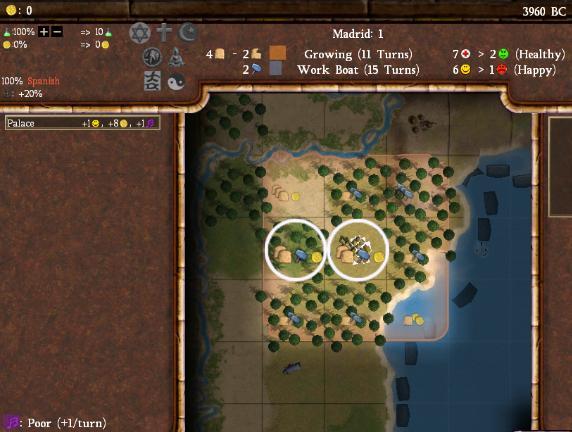
I have an interesting choice over what tile to work in Madrid. I can go with a high-shield tile, but then the city would barely be growing at all. I could also work the floodplains tile for high food, but then would only be getting 1 shield per turn. Usually, I would go with the floodplains tile to get as much food as possible, but in this case I've chosen to go with the silk resource, which is 2 food/1 shield/1 commerce. That's because my first build is a Work Boat; when it completes, it can build a fishing net on the clams and make that tile 4 food/2 commerce. Unlike building workers (which cause your cities NOT to grow while they are being constructed), cities can still grow while building Work Boats. By building a Work Boat, I was thus able to both grow Madrid and make progress towards hooking up one of my resources; it is usually impossible to do both at once. This is also why I am going with the silk tile over the floodplains; I will actually grow FASTER by completing the Work Boat sooner than by working the floodplains tile and producing the Work Boat later. Got that? 
This is the correct general idea, though the work boat would produce even faster by working the 3 production forested hill tile; that wasn't a move I considered at the time.
Research went into Polytheism to start. notyoueither chose not to pursue an early religion in his game, so I decided to do the opposite and try to grab a LOT of religions. As Spain, I started with the tech Mysticism, giving me a huge advantage in the race for an early religion. The first one to discover Polytheism will found Hinduism (I'll get into the specifics of what benefits religions provide in a minute). Here on Noble, I fully expected to be able to get whatever religion I wanted, and since Polytheism would lead me on the path to Monotheism as well, I went with it over Meditation and Buddhism. 10 turns for the tech at max rate, sounds pretty good.
Next couple turns were pretty quiet. My starting warrior was out exploring, and in 3760BC he popped another warrior from a hut. Nice - double exploratory power! I got the message that Buddhism was founded in a distant land in 3680BC; that was ok as I meant I was basically guaranteed to get Hinduism. Madrid's borders expanded (from having 10 culture) in 3560BC, popping a hut right by the starting position and getting me a free scout. Not too bad! That relieved me of the need to build any units for exploring and was certainly a nice break. I also finished researching Polytheism in 3560BC and indeed founded Hinduism; since Madrid was still my only city, it became the Holy City.
Religions do a couple of different things in Civ4. First of all, they provide happiness; every city that has your state religion present gets one extra happy face. Secondly, religion opens up the Religious Civics in the government screen, allowing you do get extra happiness (Organized Religion) or extra production (Theocracy) or other advantages. Third, you can build special religious buildings for each religion in a city, like temples for extra happiness and monasteries to spread your religion further. Fourth, you gain a line of sight to any city that has your state religion (in other words, you can "see" what's going on in cities that have your state religion). Finally, you can build a special wonder called a shrine if you control a religion's Holy City that provides you with 1 commerce for each city that has that religion present in it. That might not sound a lot, but if you control the Hindu Shrine, and there are 25 cities with Hinduism on the map, you're getting 25 extra commerce in that city each turn every turn! That makes a big difference. Religion never hurts you, only provides extra advantages (Firaxis did this deliberately, and that was definitely a good idea). Having multiple religions doesn't so much help you (although it can, if you spread your minority religions around and build their shrines as well) as it does HURT the AI civs, who are NOT getting the extra happiness from religion and NOT getting shrine income. In this game, I intend to found as many religions as possible to deny them to the AI civs.
Note that at this point Theocracy civic had the +25% production which would later move to Organized Religion, while Organized Religion itself provided extra happiness (I believe it was an extra 2 happiness in each city with your state religion).
Madrid finally produced its Work Boat in 3360BC. I wanted a Worker next, but Madrid was so close to size 3 that I decided to wait and let it grow another size first. Therefore, I will put a few turns of work into a barracks first and let Madrid grow to size 3 before starting the worker:
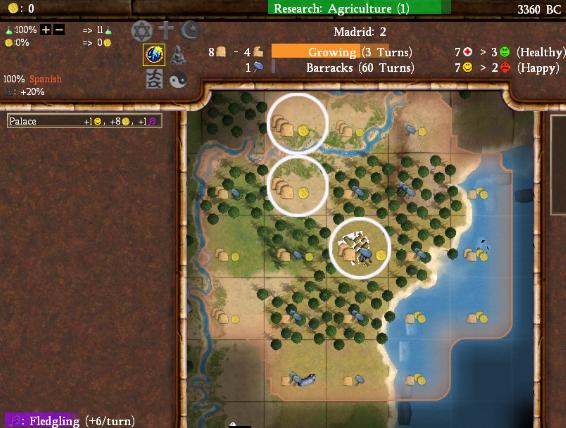
Notice that I'm only getting 1 shield/turn here. That's ok! I'm not actually trying to build the barracks, I'm trying to grow Madrid up to size 3 so I can swap to a worker. Notice also the culture in the bottom left corner of the screen. Since Madrid is the Hindu holy city, I'm getting 1 culture from the palace, 1 culture from having Hinduism (my state religion) in the city, and 4 culture from Madrid being the Hindu holy city. This is a big deal in the early game, and another reason why early religions can really help you out. After finishing Polytheism, you can see my religion now went into Agriculture. I need my workers to be able to build farms to use those floodplains properly, so I slipped Agriculture in before heading after Monotheism. On a harder difficulty I couldn't do this, but it shouldn't be an issue here on Noble.
Three turns pass. The Work Boat hooks up the clams, and Madrid reaches size three. I start in on a worker, and here's what the city looks like now:
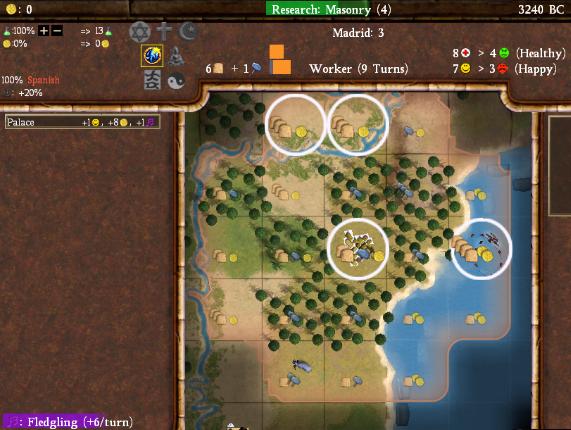
Notice what a huge difference the Work Boat has made in the tile with the clams! Two extra food makes a big change. It also adds an extra point of health, which you can see by comparing to the previous screenshot. Now, when building workers and settlers, your cities do not grow; that's because the excess food goes TOWARDS building the unit, just like shields normally do. Thus, for those units excess food = shields, for all intents and purposes. To find the best tiles for worker/settler building, just add together the food and shields on a tile. I could have picked a number of different tiles here that would provide a total of 3 combined food/shields, but I went with the floodplains to illustrate how food counts as shields for workers, and also because I pick up an extra commerce as well to help my research. I'm pursuing Masonry, because that's a necessary prerequisite for Monotheism (in this build, anyway...)
So the worker will take 9 turns to complete; that's pretty typical for this stage in the game. With more resources at the start you can do better, but I didn't want to wait any longer for a worker here in my game. While I was waiting around for the worker, I discovered Masonry and went on to Monotheism, as planned. My scouting units had by this time encountered all the other civs on the island - Caesar, Huanya Capac, Alexander, and Asoka. They didn't seem to be doing all that well, but then again I doubt they were managing their cities as intelligently.
Madrid finished the worker in 2880BC. Since it was only 3 turns from growing to size 4, I decided to let it grow again before going onto a settler. At this point, the only thing my worker could do was build Farms; he couldn't build roads or mines or hook up my ivory. I didn't have the techs for any of those things!  One of the tradeoffs of going after the early religions is that the worker techs end up getting delayed until later. Still, the worker could do important work just by putting farms on the floodplains, so I told him to do that. As expected, I got Monotheism first in 2720BC and founded Judaism in Madrid. Woohoo, double holy city! I'll be getting some serious shrine income from that down the road, let me assure you. Research next went into some cheap worker techs to let me hook up my resources; Hunting (for the ivory) -> Animal Husbandry (for the cows) -> The Wheel (roads!) All in all, my early research path seemed to work pretty well.
Madrid produced its settler in 2240BC and immediately went to work on another one, for lack of anything else to build. The only city improvement it could have made was a barracks, and I just didn't need that. Barcelona was founded in 2160BC, and here's what the game looked like at that date:
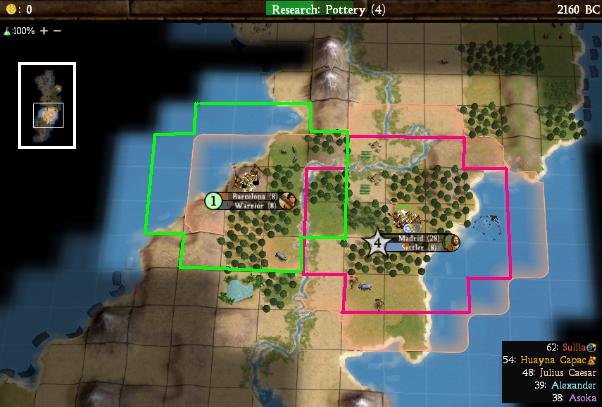
I've explored far beyond what you can see (check the minimap), but this is the only important area at the moment. Madrid is working on another settler and Barcelona is building its warrior escort (with the improved barbs in Civ4, you don't want to be sending out unescorted settlers!) The most important question is probably why did I put Barcelona where I did. Well, for starters, despite how it might appear, the city only overlaps 2 tiles with Madrid, as I've illustrated above. It's also by far the best place to put a city on the western coast; I considered a number of different spots and they all ended up with much worse land. Barcelona also will have two strong tiles right off the bat - a grassland cows (4 food!) and a plains ivory (3 shields!) Together with some of the grassland forests, that's all it will be need to be a good ancient-era city. Down the road, it will be able to mine the desert hills and use them for shields and build a lighthouse and work all those sea tiles for commerce. It also does one other hugely important thing: combined with Madrid, the cultural borders of Barcelona completely cut off the peninsula. No AI unit can pass through my territory without Open Borders, so I can prevent the AIs to the north from ever meeting Caesar to the south before boats if I want to! So despite how it might appear, this is a strong city site and will be a great second city to supplement what Madrid is doing.
Judaism spread on its own to Barcelona (yes, that can happen) in 2080BC, prompting a slight change in my strategy. Since both my cities were Jewish, I converted my state religion from Hinduism to Judaism, and would be spreading Judaism as my state religion for the rest of the game. You have to be flexible and adapt as the game goes along. After researching Pottery, I next went after Mining (to, umm, build mines) and then Bronze Working (reveals copper and allows forest chops).
Madrid finished its second settler in 1880BC and, now that I had Pottery, began building a granary. Barcelona finished its warrior escort for the settler the same time and began a second worker, which it could build at a good rate thanks to its cows and ivory. Despite what Wtiberon has posted, I constantly found myself with more jobs for my workers to do than I had available in this game.  Seville was founded in 1720BC:
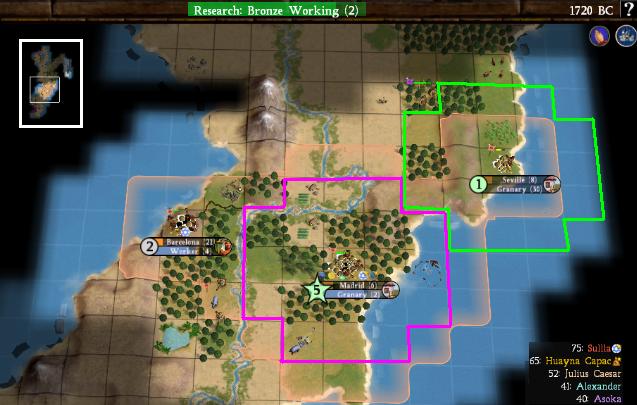
Seville has an outstanding location for a city. It perfectly manages to avoid overlapping with Madrid (I wish I could say I planned that, but it was mostly coincidence the way the land shaped). Its two resources are corn and fish (which you can't see in that picture), both of which give huge pluses to food - 5 food from the corn and 6 food from the fish (with a lighthouse). To complement that, it has 4 hills tiles, which will give the city lots of shields when they are mined. And - the city also has lots of water tiles and 2 grasslands that can be turned into cottages, which means it will be a high-commerce city as well. I can get high shields and commerce from this city, which is pretty unusual. Now it does miss the horses, but in order to get them I would have had to found on the corn (and waste all that food - nuh uh!) or move off the coast (also not good) or found 2 tiles north, which would see a lot of tiles around Madrid go to waste. I planned to have another, later city get the horses, or just have Seville's culture expand twice (100+ culture) and get them that way. The only reason I founded Barcelon before Seville is that it will take more worker activity to get Seville up and running. Barcelona was ready to go very quickly, while Seville is more of a long-term project, so I delayed founding it by a little bit. There is no doubt it will be a powerhouse city.
After founding Seville and discovering Bronze Working, I started researching Monarchy in 1640BC. Monarchy is an expensive tech for the early game, but it enable the Hereditary Rule civic which grants +50% shields and +50% commerce in the capital city. This is very powerful early on, so I had chosen to go after it even though it was a pricey tech. To do this, of course, I had to pass on other techs like Sailing (lighthouses, more food from the sea) and Writing (libraries), which shows that everything in Civ4 is a trade-off, the mark of a good strategy game! After finishing its granary, Madrid built a Work Boat for Seville's fish resource (1480BC) and then started it on another settler. Barcelona built a second worker (1560BC), then a granary for itself (1320BC) and then began a Jewish missionary to spread the faith to Seville and get it some culture. Granaries, I should mention, fill up the food box halfway so that cities take less time to grow and also grant an extra point of health with certain resources. Ordinarily you need Monasteries to spread your religion, but I was running the Organized Religion civic which allows you to build missionaries without them. Just having Judaism in my cities would grant extra happines AND give them 1 culture/turn, so I was trying to spread it with those missionaries early on.
At this point, Hereditary Rule civic had the familiar Bureaucracy function: 50% more production and commerce in the capital city, while Bureaucracy unlocked cash-rushing. The problem was that this was too powerful when the player only had a handful of cities, making a Hereditary Rule beeline the best choice in almost every situation. Soren therefore moved the civic's benefit back to Bureaucracy, by which time there would be more cities on the map and pumping up the capital would be less impactful, with cash-rushing moving all the way back to Universal Suffrage.
Madrid finished its settler in 1160BC and went onto yet another settler. Why not? Plenty of land and I still didn't have the techs to build libraries or forges or lighthouses. Monarchy was discovered in 1120BC, Hereditary Rule swapped to (beefing up Madrid considerably), and Writing pursued to finally get some libraries up and running. Cordoba was founded in 1080BC, and here's what it looked like:
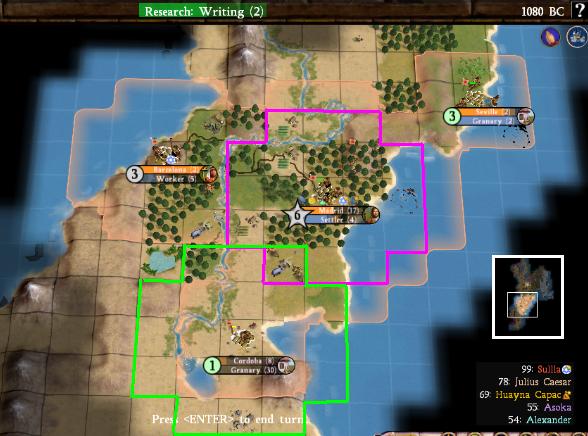
On first glace, Cordoba does not appear to be a city worth founding. It appears to be hopelessly mired in desert (and desert tiles are much worse in Civ4 compared to Civ3; they give 0 food and 0 shields and can't be improved!) However, on closer inspection, most of Cordoba's tiles are actually floodplains and not desert tiles, which grant 3 food and can be irrigated to 4 food. There are actually only 4 desert tiles in its radius, plus a desert hill (which can be mined) and a desert stone - aha! Stone is a strategic resource that allows certain wonders to be completed at half cost. For example, Stonehenge is an early wonder that costs 120 shields - but with Stone, it's only 60 shields. Stone (and its counterpart marble) are thus very important for any attempt at early wonder building, and here on Noble I planned to do a lot of that. Cordoba thus gets me a needed resource, only overlaps 1 tile with Madrid, and ends up with about 15 decent tiles - more than enough for a city. It's also founded ON copper; I tried not to put the city there, but any other location would have been worse. So it actually gets me two important resources; copper or iron is needed to build some early units like spearmen and axemen, as well cutting in half the cost of the wonder The Colossus, which I also planned to build.
Madrid produced another settler in 1000BC (wow, fast!) and went to work on a library, since I had discovered Writing on the same turn and was now going after Sailing. It thus wasn't long before I had my fifth city up, in the form of Toledo.
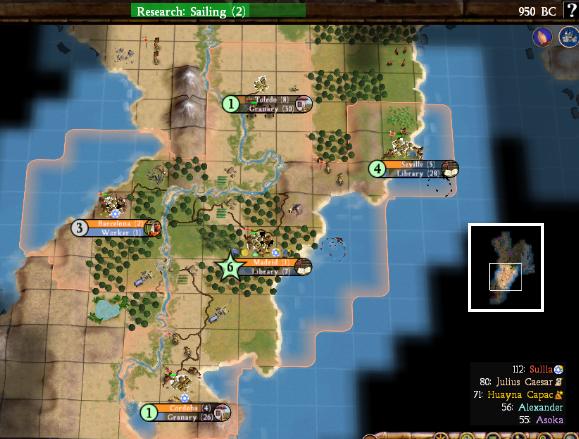
Toledo gets me the incense, and otherwise it's all floodplains and desert. I have plans for this city down the road, but I'll say more about that in a minute. By 950BC, my civ is already in a strong position already, and I'm about to blow past the AIs and dominate the game.
Everything was looking good around 1000BC. Madrid had become a shield powerhouse after swapping to Hereditary Rule, Barcelona and Seville were progressing nicely, and my new cities were just beginning to develop. After cleaning up Sailing, I breezed through Priesthood and Meditation, so that I could start researching Code of Laws (the tech that enables courthouses - and Confucianism). My evil plan to deprive the AI civs of religions was continuing apace. After finishing its library in 800BC, Madrid went over to building the Oracle (9 turns), an early wonder that grants the builder one free tech. Yes, one of the most useless wonders in Civ3 is now highly desirable. Since Madrid was now going to be locked onto wonder building for the forseeable future, Barcelona now took over settler building duty and continued to spit them out at regular intervals to continue expanding my territory.
The Oracle finished on schedule in 625BC and I took the tech Theology with it, another expensive tech that enables the religion Christianity. When I finished researching Code of Laws on the next turn, I got this fun message that won't be seen too often:
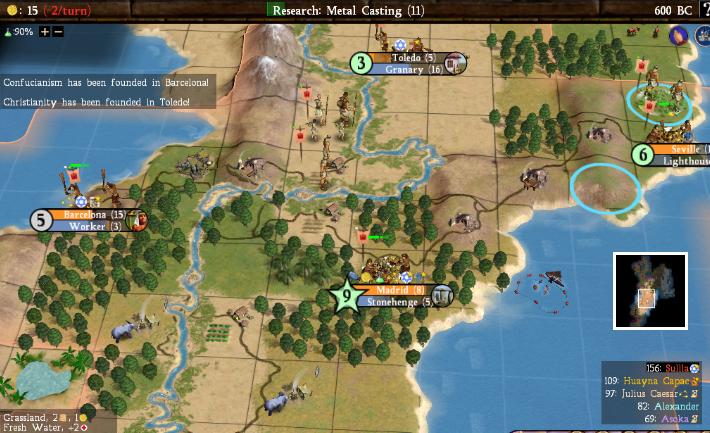
Two more religions for me to play with. Barcelona and Toledo became the holy cities, and with luck one day I would be able to build shrines in both of them. Madrid, meanwhile, had gone over to building Stonehenge, which I could get in a mere 6 turns thanks to my stone resource. I finished that wonder in 525BC, and Madrid began building Angkor Wat, which could be finished in only 7 turns thanks to the stone half-discount. This is almost too easy! By this point, I had blown so far past the AI civs that I was no longer taking super-close notes. The next city to be founded was Santiago in 500BC, and I'll post the map from that date.
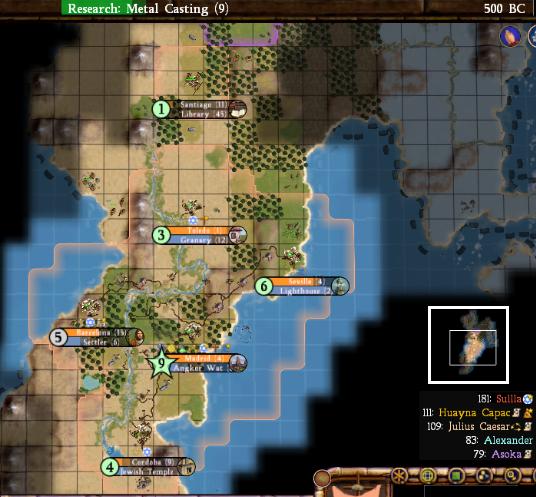
Santiago is a bit of a stretch, but it carefully avoids overlapping any tiles with Toledo. It had one tile of overlap with an Indian city, but I was confident that I could win the culture battle and gain control of that tile. It will control a cow and 2 ivory, and should be quite decent down the road with some worker improvement. This would be as far as I planned to expand to the north, because everything north of Santiago was useless desert that I didn't want. Asoka could have that to himself. Elsewhere, the other cities are at work on their infrastrcture; Madrid still on wonders, Barcelona still on settlers, etc. In terms of score, it's not close anymore, and the gap is widening.
Angkor War finished in 350BC. After that, I slipped in a Jewish Temple for more happiness and then went to work on a forge for even more shields. I got my first Great Person, a Prophet, in Madrid in 100BC, which deserves some more explanation.
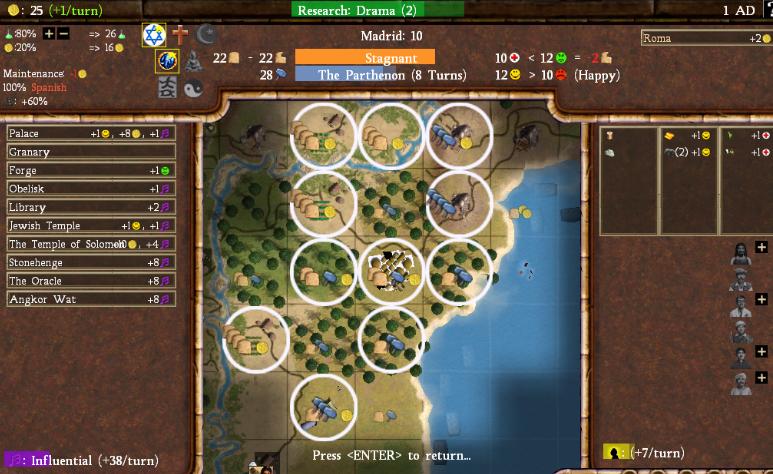
This is taken from a couple turns later, but it will help explain things. On the right side of the screen in the bottom corner, look where it says +7/turn. That refers to the number of Great Person points being accumulated in this city. There are two ways to build up points towards a Great Person. The usual way is to run specialists; each specialist adds 3 points towards a Great Person each turn. The Specialists are the faces on the right side of the screen with the plus signs; if I wanted to create a scientist, for example, I would have to take away one of the tile being worked by Madrid on the main screen and then click the + button next to the scientist. Right now I'm happy with the way Madrid is set up, but there are many different situations where you would want to run specialists rather than working tile (such as building up points for Great Persons, or if you don't want the city to grow past its happy limit, or you want to run a Merchant for cash, etc.) The other way to get Great Person points is to get them from wonders, which is how Madrid is getting its points here. The Oracle, Stonehenge, and Angkor Wat all contribute points towards a Great Prophet, so when I reached 100 Great Person points in Madrid in 100BC, a Great Prophet was born.
Each Great Person has a different function. Great Engineers can rush wonders or any city building, Great Merchants can conduct a trade mission to a foreign city for a huge amount of gold, Great Scientists can build a city improvement called an Academy that adds +50% science, Great Artists can add 1000 culture in any city with a Great Work, and Great Prophets can build religious shrines. They can also all be used to discover techs (or research towards a tech), and you can use them to trigger golden ages as well (2 Great Persons of different types needed for the first, 3 for the second, etc.) If you don't want to do any of those things, the Great People can also be "merged" into a city, where they provide other benefits like extra shields or commerce each turn. I used my first Great Prophet for the Jewish Shrine; you can see it here as The Temple of Soloman (they all have different names). That gets me 10 commerce/turn every single turn, and that will go up as I continue to spread the religion. That's a nice deal! All these wonders are also getting Madrid a pretty crazy amount of culture per turn, especially for this early in the game.
Look more closely now at Toledo:
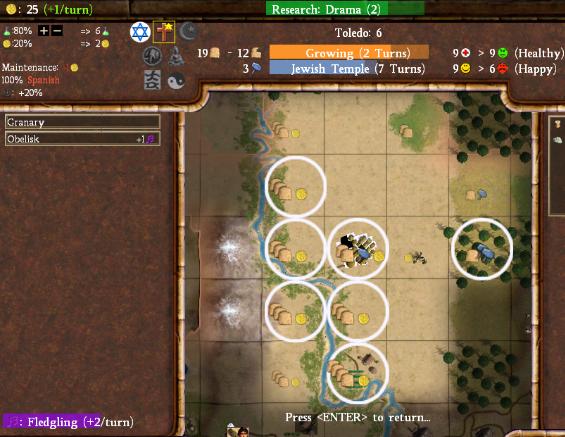
The city has no less than 7 floodplains in its territory. Seven! That's a lot! Once they are all irrigated, they alone will be producing 28 food/turn, enough to feed a city of size 14. This will allow Toledo to run a huge number of specialists down the road and become a Great Person factory. Once I reach Biology (which increases the food output of tiles with farms), it will only become that much more ridiculous. By the end of the game, I should easily be able to run 10 specialists at a time here. Cities with lots and lots of floodplains can thus become extremely useful to your civilization by contributing lots of Great People. (This works particularly well combined with the Caste System civic.) This city doesn't appear to have great land, but it will be far from useless for me down the road.
With that said, I reached 1AD which is where I decided to stop this venture. I only wanted to play out the game's opening, to demonstrate one possible way that it could be done. I'm sure Aeson would have seen the ivory, beelined to Construction and elephants, then had half the world conquered by 1AD. This is one way to play the game, not necessarily the best. Map:
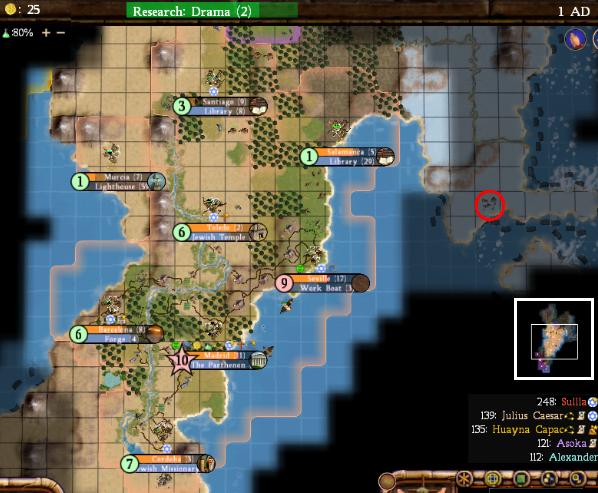
With the founding of Murcia and Salamanca, I have about all the territory I need. Everything beyond these borders is pretty useless, either desert or tundra. The only place I want another city is in the east; there's a marble resource circled there, and if I put a city one tile southwest of it, I can use both the marble and a clam resouce in the water for a semi-decent city. With stone and marble on hand, I expect to be able to build every wonder in the game (the AI civs have gotten none thus far). I've also converted all of Rome's cities to Judaism (you can sort of see this on the minimap), have opened up a huge tech lead on the AI civs, and am about to get Drama (and a free Great Artist for discovering it first) in two turns. The one irritating thing about this picture is that Madrid and Seville are starving because a barb galley has sailed by and wrecked my fishing nets. Gah! I have a galley ready to kill it next turn and Seville is building Work Boats to replace them, but it's still a little black mark on my record. Sigh.
I also learned that I can beat up on the Noble AI given a decent start, for what that's worth. Here's a save game from 1AD (v.62) if you want to take a look at what I did or try your hand at playing this situation. Enjoy!
I actually do still have this savegame file on my computer, not that something from version 0.62 would ever function on a current computer, heh.


