
Sullla AGAW3: Their Finest Hour
England - Churchill (Charismatic/Protective)
Standard Shuffle (Continents), Prince, Normal Speed
v5
This was one of the more frustrating test games that I played, forced to spend huge amounts of time and effort trying to stop Alexman from implementing a disastrously bad change to Civ4's combat mechanics.
I set up this group test so that we'd have everyone who participated playing the same save, hopefully so we could compare the different paths taken in a single game to evaluate their effectiveness. Having seen that Dominae played out an Always War game, and Willburn simply killed everyone as rapidly as possible, it looks like that was largely fulfilled.  I still hope we'll get some other reports too.
I had no preconceptions going into this game; I decided I would simply take whatever came without trying to follow any particular strategy. One thing I did decide to do was start out by researching Polytheism for Hinduism, which I expected to get given that this was only Prince difficulty. Once of the most important things that happened in this game was that I popped a scout from a hut on turn 2 of the game. With a scout and an exploring warrior on hand, I was able to get a large share of the huts, which would have important consequences.
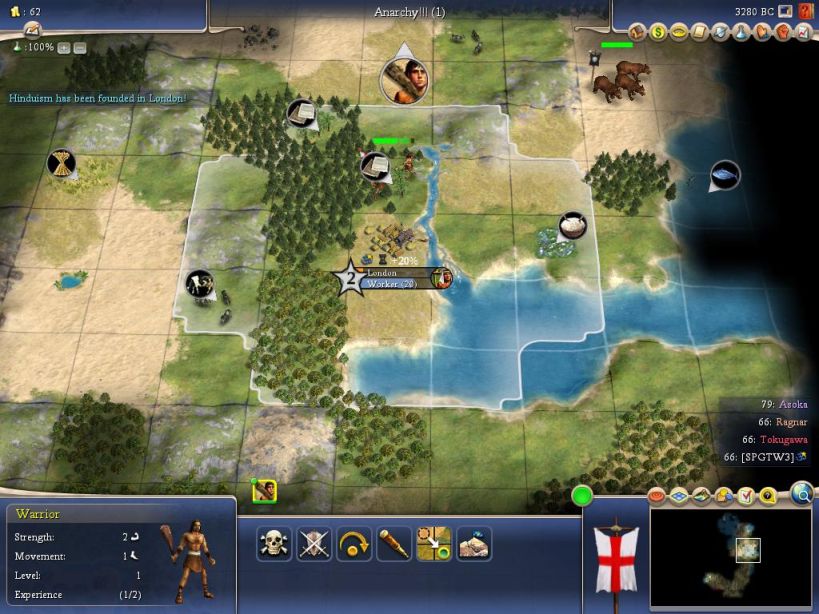
Here's the capital, and yes I did get Hinduism. With the two silks and lack of a lot of shield tiles, I decided that I would cottage over pretty much everything and turn this into a big commerce center. My second city had a lot of hills and would be a unit/wonder builder. That's a division of labor that has always worked well for me in my games.
Anyway, I popped Bronze Working from a hut in 3640BC, which was a big break of luck. But a couple turns later I had an even greater stroke of luck, popping Iron Working from a hut! 
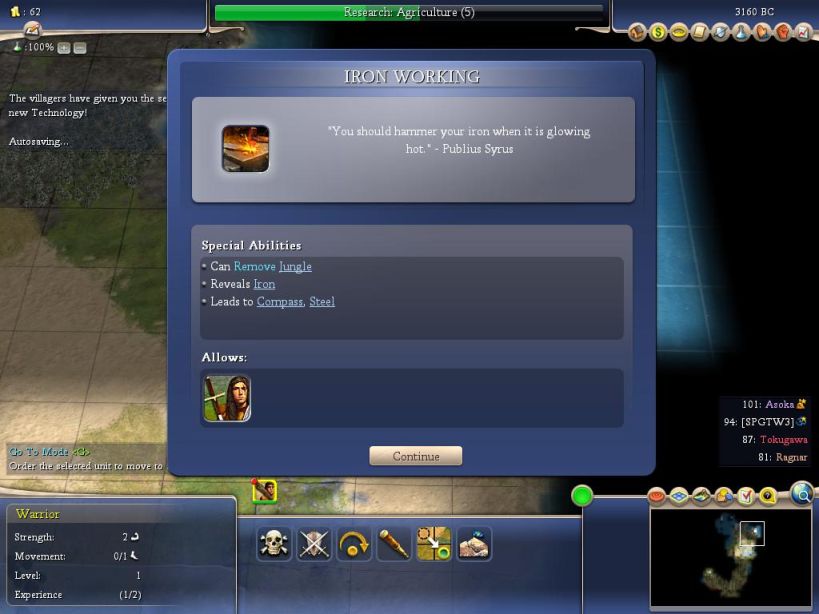
Well obviously I have to get something out of this! My planned second site for a city already had iron in it, very nice. I built a settler, and that second city built itself a barracks, then started pumping swords. Gonna use this iron to take someone out in BC years, since the AI simply doesn't hook up metals soon enough on Prince. Meanwhile, my capital started working on the Temple of Artemis, since I wanted to test that out. Unfortunately, an AI civ built it in 725BC! (Wow!) That was shocking. I was a little over halfway there, so there goes some 200+ shields down the drain. Not the greatest moment for me ever, but it was strange to see Temple of Artemis built before Stonehenge and Oracle!

The printout for Artemis reads at the same time as I declare war on Asoka. He's most definitely doomed, since he has no metals connected and I have a group of swords descending on his territory. By the way, Bombay has Stonehenge in it (you can just see it on the map if you look closely). Well that worked out nicely. 
Ragnar completes the Great Wall in 650BC. I feel like I'm playing against Willburn!
What's there to say about the campaign against India? I took Asoka's cities easily, and since I hadn't opened up the techs for vassalage yet, I destroyed his civ in 375BC:
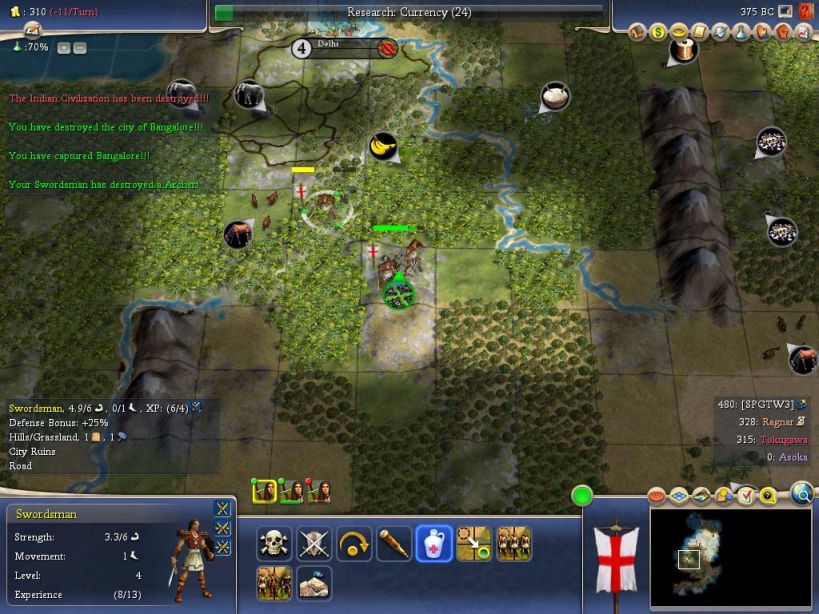
Obviously I could have done the same with Ragnar and Tokugawa, but that wasn't my goal here. (Besides, I couldn't settle their land economically yet either, so I didn't really see the point.) So I now went into builder mode for a while to try and evaluate things on that end of the game. I decided to invest heavily in the monk side of the tech tree to evaluate the effectiveness of Sankore/Spiral Minaret from an unbiased perspective. I had founded Hinduism, Asoka had founded Buddhism (which I took over), and I would eventually get Confucianism (via Oracle) and Islam as well. Since there were no other religions founded on my continent, I was able to spread Buddhism around to pretty much every city on the continent and reach large shrine benefits from it. But that's getting ahead of the story a bit.
Artemis popped a Great Merchant for the civ who built it in 425BC. Umm, it was built in 725BC! That's only 12 turns (and this is NOT Quick game speed!) Artemis is too strong. I know we've been saying this for a while now, but those two Great People super-specialists are just way too strong in the early going. It works for Great Library because it's a lot further down the tree, but for Artemis - bad mojo here.
The Temple of Artemis was still going through revisions to its wonder effects at this time. It formerly granted two additional trade routes along with +100% trade route income in the city that built the wonder; the extra trade routes were then scrapped in favor of a free Priest and Merchant specialist. These double specialists were way too strong for Philosophical civs in the early game, and the Merchant was soon removed to leave Temple of Artemis in the rather underpowered state that it has today.
Since I've got a soapbox here for a moment, I want to mention something else relating to Great Generals, and Great People as a whole. Currently, the first Great General produced is ALWAYS named Sargon, just as the first Great Prophet is ALWAYS Moses and the first Great Merchant is ALWAYS Harkuf. I could give you the first couple names in every one of the Great People categories by heart - and similarly, I don't know the ones at the bottom of the list at all. This is very silly; it's a lot like what we used to have with barb cities, in that the first barb city to appear on the map would ALWAYS be Cherokee, the second one would ALWAYS be Anasazi, etc. We can do better than that.
What we need is to RANDOMIZE the names for the Great People. When a Prophet is born, the game needs to randomly select a name from the Great Prophet list, instead of simply printing out the first one every single time. The repetition gets boring fast. We've got these long lists of names - let's use them! Ditto for the Great Generals too (seeing "Sargon" get born over and over again was the inspiration for this). Finally, the printout message needs to clearly identify the type of Great Person as well. Instead of saying:
Moses has been born in a faraway land!
It should read:
Moses (Great Prophet) has been born in a faraway land!
No more trying to guess which type of Great Person Isambard Kingdom Brunel is! That's silly; this info should be readily available instantly. So if we randomize the order of the names and clearly identify which type of Great Person/General has been born, I think we'll be in better shape here.
This is one change that I did manage to get into the gameplay, just as I had pushed earlier for barbarian city names to be randomized instead of appearing in the same order every game. Originally you would get the same Prophets in the same order in every game, plus there was no text identifying which type of Great Person had just been born. I'd like to think that this is one of the small ways that I was able to make Civ4's gameplay better.
Picking up where I left off, by 1000AD I had expanded out to cover most of the land on my continent, with a few more city sites left in the extreme north that I was getting ready to settle:
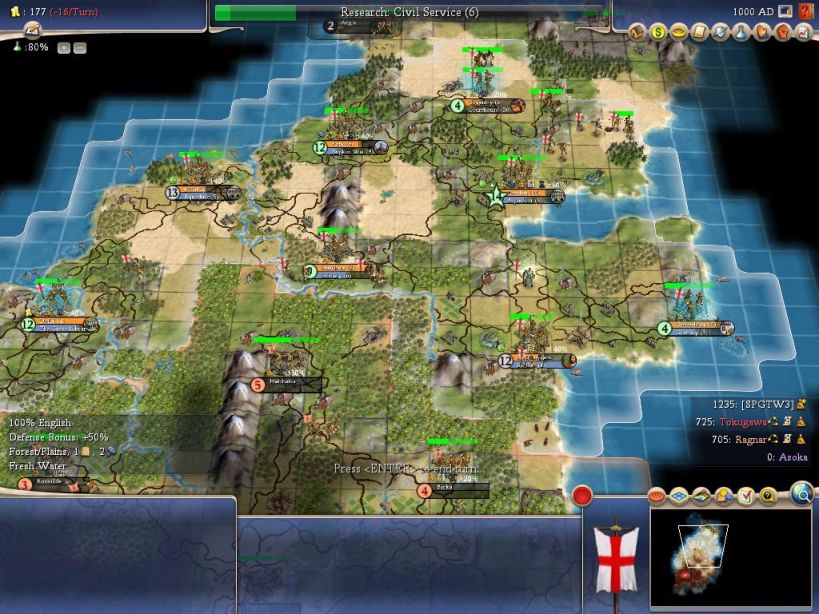
You can see that I had converted both Ragnar and Tokugawa to Buddhism, which has now become my state religion. My own Hinduism failed to spread to any cities on its own, while my captured Buddhism was spreading around like crazy, so I made the switch. Amazingly, I have even managed to get Open Borders with Tokugawa at the moment, but he would soon cancel them before I could get more than one missionary down to his cities. Oh well. Both of these AI personalities seem difficult to get along with; obviously I knew about Tokugawa, but this was the first time I'd spent a significant amount of time with an AI Ragnar. That's fine though - the game needs more aggressive AI personalities.
I was beaten to the Great Library by a single turn in 1040AD! Argh! (Actually lost it by 3 shields, heh.) That's such a late date for that wonder though, I deserved to lose it. I did get Hanging Gardens, Angkor Wat, and a lot of others. Actually, I haven't built this many wonders in a long time - no doubt due to this being Prince difficulty. The wonder movies were all skipping on my computer for some reason, don't know why that was. I've never gotten that before on this computer.
OK, so I was running a real monk economy, and I went out of my way not only to spread my state religion (Buddhism) around as much as possible, but also to build lots of Buddhist temples and monasteries. I was even building them in cities that had no use for them whatsoever! (This did give me some impressive overall culture, of course.) By the time that I was on the verge of building Sankore, I had 5 Buddhist temples and 5 Buddhist monasteries; basically, all my core cities had them, and my colonies were working on more of them. So what was the grand payout from Sankore?
Before Sankore: 222 science
After Sankore: 242 science
An increase of 20 beakers, or a 9% increase in science overall. And that's AFTER I've not only spread my religion around, but made a huge shield investment in building those silly temples and monasteries. In other words, this confirms what we all knew already: this wonder stinks. 
But WHY does it stink? Let me do some math-crunching, if I may:

Here's my city of Nottingham, which happens to be the Confucian holy city. It has both a Buddhist temple and a Buddhist monastery. Sankore is indeed giving this city 2 beakers of science, but that only takes it from 16.8 beakers to 18.8 beakers (before getting magnified by buildings - this city has a library and TWO monasteries, so it gets a lot of boosts here in the pre-Education era). Now that's an increase of 12% in the base science, so it's not that Sankore does NOTHING... but you'd expect to see more after going through the trouble of building those darned religious buildings.
Now compare this to Spiral Minaret, which I also built in this game:
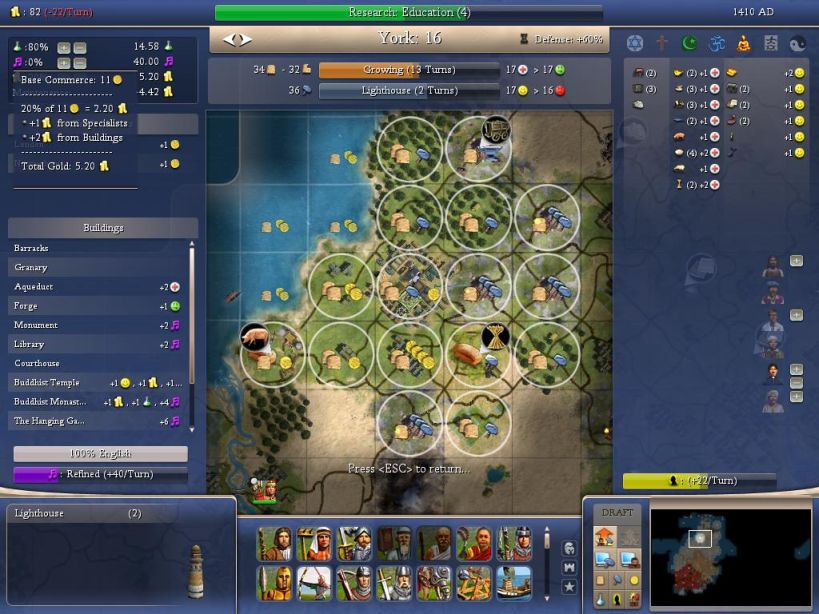
The overall effect of Spiral Minaret increased my gold from 144 to 163, an increase of 13%. That doesn't appear to be any different from Sankore, but let's look at the cities more closely. Here's York, another city with Buddhist temple and monastery (I had to use a different city for Spiral Minaret's gold to avoid the Confucian shrine throwing things off). As far as gold is concerned, this city is getting 2.2 gold from base commerce, which is then increased by 2 more gold from Spiral Minaret to 4.2 gold. That's an increase of ONE HUNDRED PERCENT!
See, this is why Spiral Minaret is so much more valuable than Sankore, and why one beaker does NOT equal one gold in practice. Certainly they do in theory, but not in practice. With both Sankore and the Spiral Minaret we're pulling beakers/gold out of thin air. They are not related to a city's commerce at all, so the value of the wonder is seen in how they increase that base commerce value. In a normal game, players are researching at a high percentage of science: 60%, 70%, 80%, etc. They are therefore likely to be producing little gold, as you can see here with York. As a result, the gold that Spiral Minaret pulls out of the ether has a MAJOR effect on the cities, often doubling the gold output (as seen here) or close to it. Now compare that to Sankore. BECAUSE so much commerce is going to science already, the extra beakers from Sankore get swallowed up and are barely noticeable. They have a trivial effect, at best, and require a shield investment in religious buildings to get it. Now in a theoretical world there would be no difference between the two, but (as everyone who has been playing the game has been saying!), the very fact that you spend most of the game at a high research rate causes Sankore to stink!
In short: Sankore stinks. It should go back to being a flat +10% science in all cities which is what we had in version 1 and which I gave a strong thumbs-up to at the time! Sheesh. We out-thought ourselves on this one. 
By this point the University of Sankore wonder had moved from its initial 10% global bonus to science over to its modern version of granting additional beakers on all state religious buildings. It was very clear to everyone in the testing group that this was a weak wonder, and I wrote the paragraphs above trying to explain why that was the case, even as Alexman stubbornly continued to insist that it must be just as useful as Spiral Minaret since they did the same thing only attuned respectively to beakers and gold. What he was missing is that beakers and gold do not exist in a 1-to-1 equivalency in Civ4; T-Hawk later wrote the definitive article about this on his website which I'll link here. My treatment of the subject was far less eloquent but it was obvious to everyone playing the game that Sankore was a weak wonder not really worth building. This was eventually resolved by increasing the bonus from Sankore and Spiral Minaret to 2 beakers/gold per state religious building, which made Sankore at least functional while still being pretty situational. I still prefer the flat 10% science bonus even if it would have been a bit boring.
Continuing with the game, I built caravels after hitting Optics and met the other continent of AIs. Everyone was extremely reluctant to trade resources on my own continent, but I think that was just due to the personalities of Tokugawa and Ragnar. I was able to get some resource trades going with Mansa Musa and Kublai Khan post-Astronomy, so I don't think there was actually a problem with that, on further reflection.
Once I hit the bottom of the tech tree and got to Stock Exchanges, I started building them everywhere. My comments went something like this:
stock exchanges...
Stock Exchanges!
Stock exchanges
Within 15 turns, my science percentage went from breaking even at 70% science to a profit at 90% science! That may be in part to having several holy cities with shrine income boosts, but the fact remains that I gained a lot of money in a shockingly fast period of time. That +75% gold from ONE building... jeez. That's a LOT of cash there. Unlike what Dominae stated in his report, I think we should scale this back somewhat. I'm thinking +60% gold instead. Any one building getting a boost as high as +75% to gold just seems like overkill to me. I'd love to get some more feedback on this from other players besides myself and Dominae on this too. Our difference of opinion may have to deal with the contrasting styles of the games we played.
If you're playing a peaceful game though, WOW! That's a lot of money.
The stock exchanges were nerfed down to 65% additional gold where they are still a very strong unique building without being quite so absurd.
Ragnar and Toku BOTH declared war on me in 1695/1700AD (bad timing for sure!) My final part will go into the details of that.
Since this morning a new version has come out, with a number of changes to the combat system, but at the moment I'm unsure just to what extent things have been altered. Therefore, I'm going to present this report with v5 in mind, and we can sort out the details of what has actually changed since then later. Anyway, on with the details of the game.
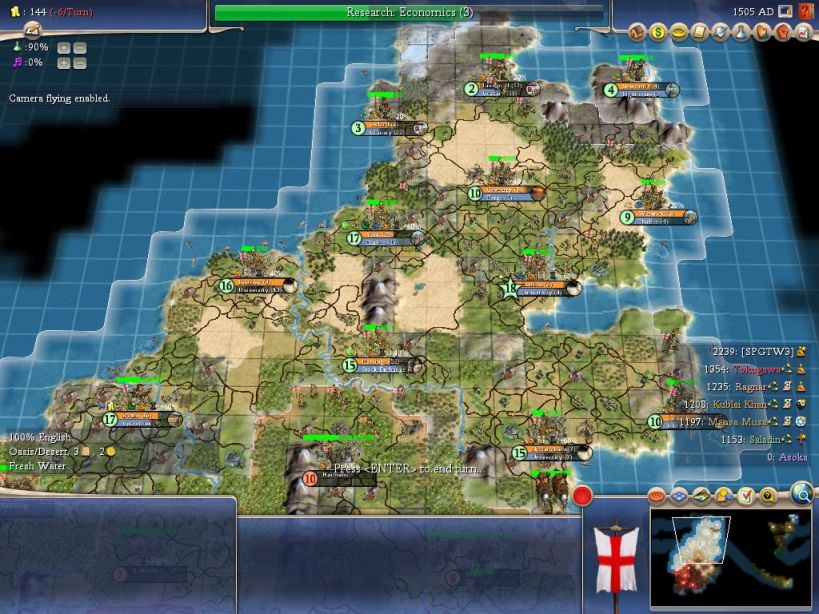
Here's a map from 1500AD, a much earlier period, but it should give some idea of what my civ looked like when war was declared. I had a long border in the south with Ragnar, and a shorter one with Tokugawa (who had settled most of the southern tundra). You can see the one Viking city jutting into my territory and forming a little salient - it was a constant irritation, but I was planning on playing the game peacefully, at least with my religious allies.
Anyway, I swapped to Free Religion sometime after this picture, and that ticked off the civs on my continent (apparently) as I lost the shared religion bonuses. Tokugawa declared war on me in 1695AD, and Ragnar followed that up with his own war declaration in 1700AD - I wonder if Toku bought him in? No way to tell, but it's a possibility. I was lower than them in power, but I had started building up a small group of Redcoats "just in case" once I got Rifling tech. Good thing I had! There was at least one Redcoat in every frontline city, but the backline ones still had archers. That ensured that I wouldn't get snowed under in the early turns of the war. Since I had Steel as well as Rifling, every city started building either Redcoats or cannon for defense. If the situation had gone critical I would have swapped to Nationhood and started drafting, but as this was Prince and it never got too serious, I was able to avoid it.
The warfare DID give me a great chance to try this combat system dealie that I've been so critical about, and give it some thorough examining at least as far as the AI is concerned. See, I'm sure that we can teach HUMANS how to use a different combat system (although moving away from the policy of "best unit defends" seems unwise to me), but can we do the same for the AI? I'm not nearly so certain about that. Soren's AI is built to fight under the rules of 1.61 Civ4, and it actually does a darned good job of that. I've gotten my nose bloodied over and over again in Emperor games against this AI, as it knows well how to use collateral damage both on attack and on defense. But with the whole Siege vs. Siege thing? Well... now that I've had a chance to look at it more closely, the preliminary evidence is that the AI doesn't do very well with the system. Not very well at all. 
Quick context for the reader: Alexman was trying to revamp Civ4's combat system by changing the mechanics so that siege units would always be the first units to defend if attacked by another siege unit. In other words, if you hit a stack with a catapult, any catapults within that stack would be the first units to defend, and no collateral damage would be applied until all of the siege units in the defending stack were wiped out. This was confusing (abandoning the very simple principle of "strongest unit always defends") and led to a whole host of problems detailed in the following paragraphs.
The AI brought a nice mix of units at me in this war, as it usually does. Mostly cavs and trebuchets/cats, but also some grenadiers mixed in. I was fielding redcoats and cannon, so I had a clear upper hand technologically - but it was still an interesting fight. Under 1.61 Civ4, I would expect to have to use my own siege units for collateral damage, suiciding them against the AI in order to damage their stacks. Since their superior units would defend, this would be the only way to get at their cats/trebuchets. But with the siege vs. siege system, I can pick off their incoming siege units with ease:
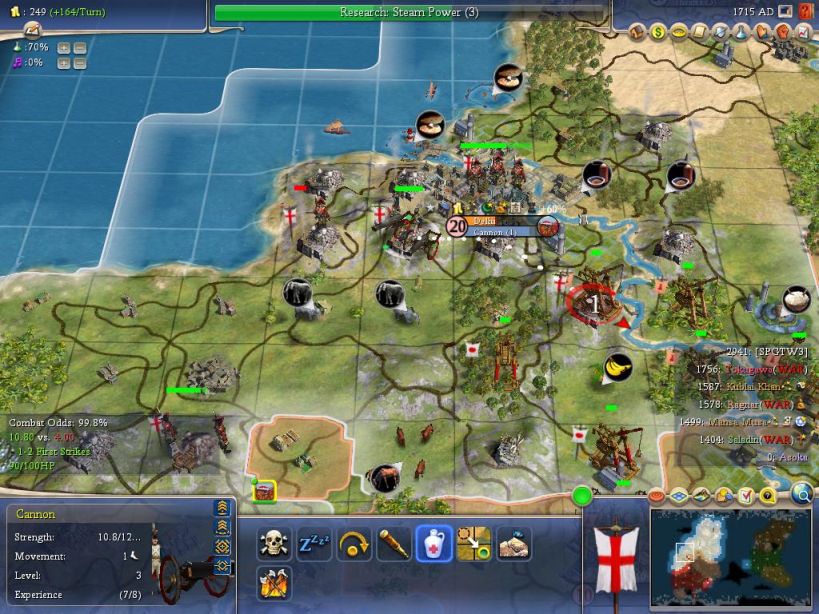
Here's my cannon unit highlighted. Note that all of the siege units in the AI stacks are highlighted, because siege vs. siege means that these units MUST defend against my cannon, even though they are sure to die. My cannon easily sniped off all of Ragnar and Tokugawa's incoming siege units, taking no losses in the process. Now granted I did have cannon against cats/trebuchets, but I could have gotten a similar effect from going Combat II on a cat. The AI doesn't know to promote its siege units to defend against this. So after the initial turns of the war, the AI has immediately lost all of its siege units. Not good.
I now have two options. I can either suicide my own siege units against the AI stacks (bringing us back to the 1.61 system), or... I can simply hole up in my cities and make the AI come to me and attack. With no way of reducing city defenses, or of causing collateral damage, the AI has essentially zero chance of taking a city. It's that easy.
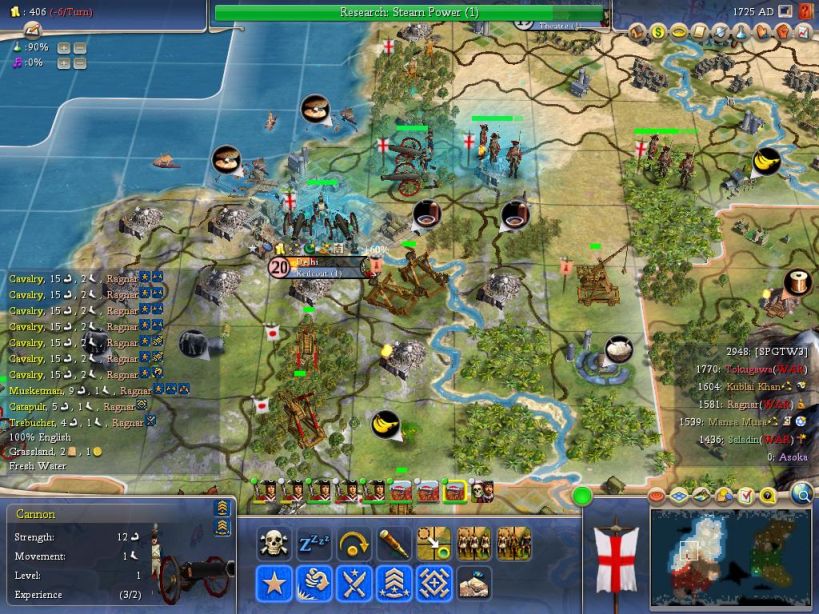
Here's a very credible stack from Ragnar. I would expect to have to lose several cannon at the very least to attack this stack in 1.61, softening them up for my redcoats to take out. After all, that would be the only way to get at the cat and trebuchet, and if I don't take out those siege units, my city's defenses are going to come down and they'll have decent odds attacking my city. Now compare that to what we have in Warlords v5. I simply snipe off the two siege units with my cannon (or Combat II catapult, or whatever). Now the stack cannot touch my city, so they have no choice but to attack at impossible odds... and go down in a blaze of futile glory.
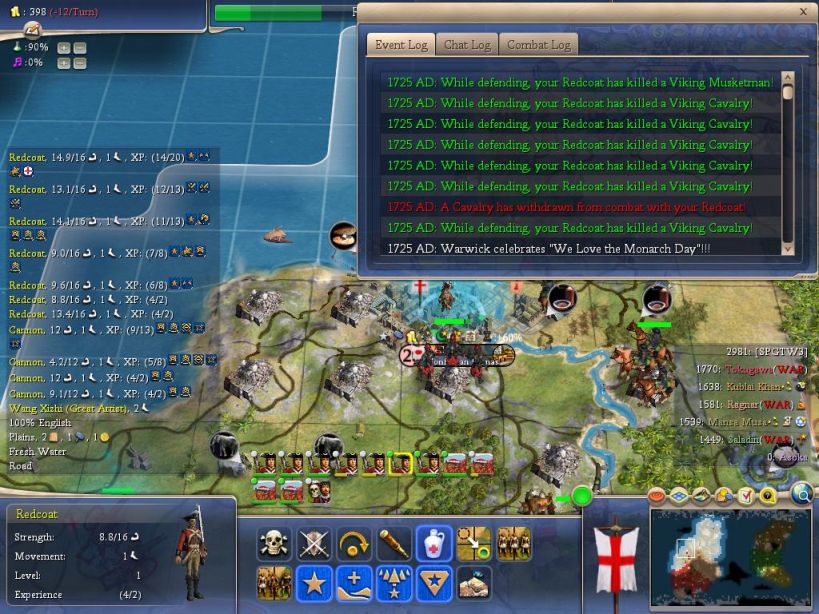
Yep, didn't even scratch my guys. Not good.  Again, in MP a human might well decide to pillage around the city and ravage my economy if I refuse to come out of the city and fight. But is an AI going to do this? I think not. Siege vs. siege made it pathetically easy to defend my cities, even when I was seriously outnumbered (and I was definitely outnumbered when the war started, although the enemy numbers rapidly diminished once I started killing them).
So siege vs. siege may be bad for defense, but what about on the attack? It's no better there either. After I killed the incoming AI armies, I swapped over to the offensive. Ragnar had a good half-dozen siege units holed up in one of his border cities, clearly intending to be used for defensive collateral damage. In 1.61, I would have seen a stack seriously injured, and had to wait a couple of turns with a Medic unit to heal the damage. But in Warlords v.5 I simply stick a couple cannon (or Combat II cats, etc.) in each attacking stack, and the collateral damage is completely nullified to my units. It never happens - the AI siege units target my siege units and die in the process! Thus, as long as I have more siege units than the AI in this particular vicinity, I am guaranteed to win.
That's really the long and short of it - whoever has more siege units is practically guaranteed to win under this system, because you can either stop collateral damage from being done to your attackers, or kill off attacking siege so that it's impossible to drop city defenses. More siege, you win. And the human can manipulate this far, FAR better than the AI can, so much so that I'm almost ready to pronounce the system broken in favor of the human. Wasn't the whole point of this system to make it so combat WASN'T simply an issue of whoever has the most siege wins? If that was the goal, it has failed MISERABLY, and added both additional complexity and a combat model that the AI doesn't really understand how to use.
In short, it's bad. Real bad. I can dance circles around the AI with this siege system, and that's not good. I recommend scrapping this system in the strongest language possible and trying to find a different solution to the "siege is too strong" problem. If that even IS a problem (it's really not much of one for Single Player).
There was a perception that siege units were too strong when Civ4 came out, probably because most of the playerbase was used to Civ3 where there was no collateral damage. This perception was wrong, and the Multiplayer pros on the ladder were well aware that the strongest units in the game were actually elephants/catapults and fast-moving Mounted units, but Alexman saw this as a problem and was trying to correct it. His solution was much worse than any existing issues in the combat system, however, and Alexman's attempts to reduce the importance of siege units backfired by making them even more dominant than ever before. Throw in the fact that the AI wasn't programmed to use this combat system and had no idea how to leverage it properly, and yeah, it was pretty ugly. Constant lobbying from myself and the entire Multiplayer continent in the test group did manage to get this siege vs siege concept killed off before it ever saw the light of day; I consider this to be my greatest achievement in Warlords testing, stopping a potential disaster from ever being released.
That was the main issue from this game, but there are some other little things as well. I upgraded a number of archers to redcoats, and of course they kept the free first strikes from Drill II. Neat! I would be worried about it being unbalancing, but you can add City Raider promotions to gunpowder units from upgrading maces, and that has a much bigger effect, so this certainly appears to be fine. More of a fun addition than a problem.
Ragnar became a vassal state of Tokugawa in 1780AD:
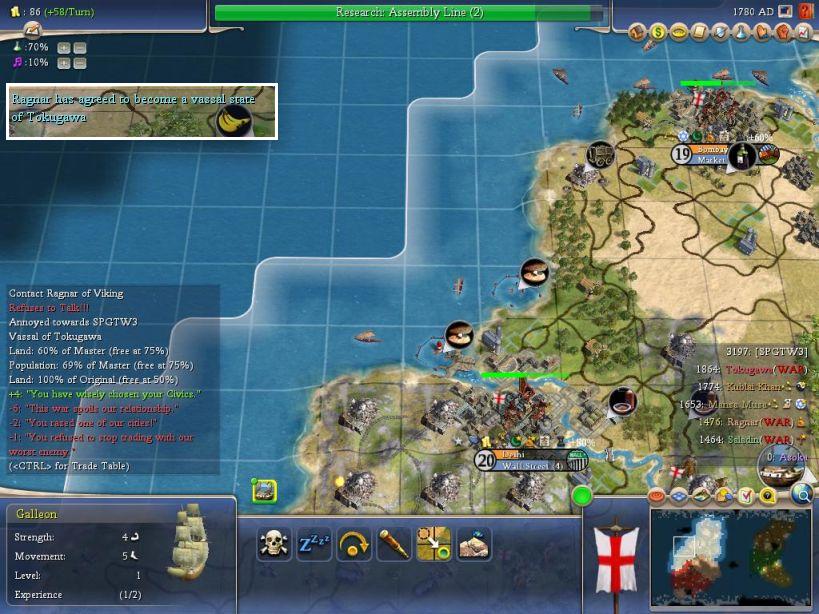
Huh? Why did this happen? Ragnar was still in good shape at the time, so I have no clue why he would become Tokugawa's vassal. The little popup box is a step in the right direction, but vassal states are still a head-scratcher for me. I have tried to be openminded on them, but I still can't help but feel that they DON'T fit into the diplo model Soren came up with. Vassal states feel like they were tacked on at the end - which they were. And I don't mean this disrespectfully, as they have already come a long way since v1, but we still have a long way to go in this area. They are not at all ready to go out in a finished game yet, and we have about six weeks left. Better keep working on this one...
Vassal states sucked as a concept back then and still suck as a concept today. I would rip them out of Civ4 entirely if I could.
Finally, let me show you my best unit. I had an archer unit that was upgraded to Drill IV, then I used a Great General on him and turned him into a redcoat. I used the 20 free experience to take Combat I/II/III and Pinch, then got enough experience to take March promotion as well when I reached 38XP (helps to be Charismatic!) Here's Superdude after he became an Infantry:
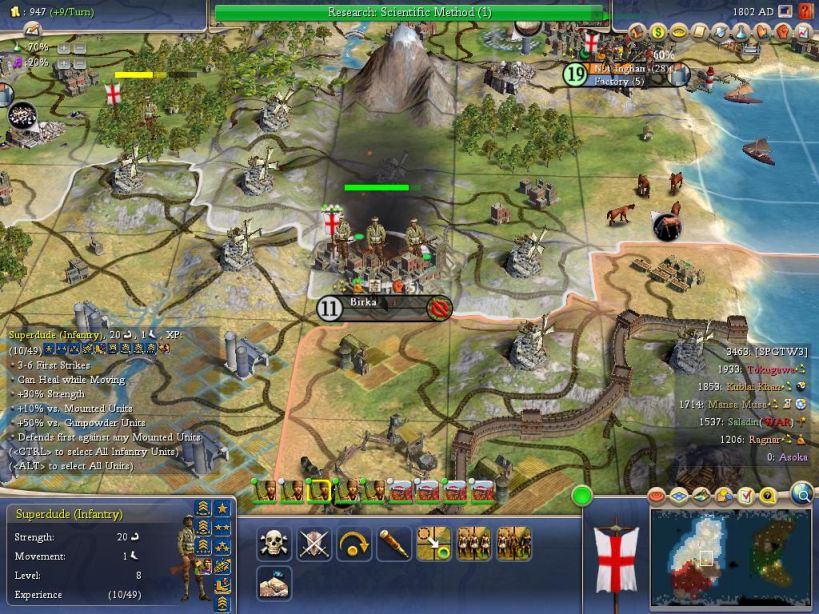
You don't want to mess with this guy! Not only Combat III/Pinch, but also gets 3-6 first strikes and can heal without stopping. Fun stuff here. This may surprise some of you, but I think that Great Generals are actually in really good shape. Their generation is relatively balanced, they don't mess with the other Great People, and the benefits offer several interesting choices without unbalancing the game in favor of warmongers. I wasn't sure that we'd get here, but we did. Nice work on the part of everyone involved. I even like the idea to add special Great General-only promotions, as long as we don't go too crazy on it. A Combat VI as strong as Combat I through V combined would be stretching it, I daresay.
The Great General-only Combat VI promotion was originally going to grant another 50% combat strength to the unit in question. I pushed for this to be reduced and it was toned down to its current 25% extra combat strength which felt a lot more reasonable.
Other stuff in good shape... Protective and Charismatic are both strong traits and fun to play, adding genuinely new stuff without damaging the old. That's tough to pull off, but I think they both work. I'm less certainl of Imperialistic, as it seems weaker, but it may well be a boon for MP. Needs more testing, I think. The new civs seem to be pretty good as well, aside from some issues with the hwatcha that are still not getting enough attention (danger! the unit is too strong!) Some of the unique buildings also need some tweaking, but those are relatively minor concerns.
Areas that still need work... Vassal states are the top concern. They still don't fit into the flow of things, and need a lot more fine tuning on WHY an AI civ signs one (either with the player or another AI) and WHAT exactly they are going to do. Many exploits still possible here. Finally and frankly, the combat system is still a mess too. We never should have changed this in the first place, and now the attempts to rectify a flawed system have only driven us deeper and deeper into confusion. For me, this is the single biggest problem with Warlords, because I can simply turn off vassal states if I don't like them. I can't turn off a combat system that has foolishly (IMO) moved away from an excellent and fully-functional 1.61 Civ4 model. I can't even get a real handle on the trebuchet until we do something about this; the verdict on that unit is therefore still out there for me.
That turned out to be longer than expected... Anyway, it was an entertaining game. I stopped here since v6 is now out. Thanks to anyone who played the save file!


