Pachacuti of Nepal
Small map, Fractal Continents, 5 AI Opponents
Immortal difficulty
Patches 1.4 / 1.4.1
Watch this game on YouTube (Playlist Link)
It's not much of a stretch to say that Civ7 had a rocky debut. The game released in a buggy, broken state with an interface that barely functioned and an AI that had no clue how to play its own game. While patches slowly cleaned up some of those problems, they only brought more attention to the deeper issues plaguing the gameplay: a on-rails, deeply inflexible setup where players were forced down the same routes over and over again. Civ7's ill-considered "ages" mechanic relentlessly tore down the buildings that players had constructed and then forced them to do the same thing all over again in the next era, only to smash their progress again a second time. The game rapidly became tedious to play since the player was forced to chase after the same legacy scoring goals in every game while the AI opponents were hopelessly useless at pursuing the same missions. Thus the player could easily achieve any victory condition desired even on the top difficulty level and each of the four victory types played out very similarly. Most importantly, Civ7 simply wasn't a fun game, which was why the player count rapidly collapsed after release. Civ6 was routinely pulling 5x to 6x as many players on Steam and Twitch while even the ancient Civ5, which hadn't been updated in well over a decade, was averaging 2.5x as many players as the shiny new Civ7. Given the huge expenses associated with developing Civ7 and the need for a steady stream of downloadable content purchases, this was a five alarm fire for developer Firaxis and publisher 2K Games.
Thus we ended up with major, major gameplay changes coming to Civ7 in the first half of 2026. Patch 1.4 was billed as the "Test of Time" update which made two very big alterations to the gameplay. The first of these was the removal of the era limitations for each civilization: now any civ could be played in any era, including sticking with a single civ for the whole game instead of being forced to transition at the end of each age. That was a gigantic improvement and very obviously should have been in the gameplay from the start! Players would now have much more agency to customize their games and a whole bunch of the Modern era civs (who barely saw any action previously since the Modern era was always so short) suddenly became much more interesting to use. The other big change was removing the legacy scoring goals entirely from the gameplay, replacing them with a new system called "triumphs". I'll cover the triumphs in more detail later in this report, however this would have been a massive improvement even if the legacy scoring goals had been replaced with nothing. Those things were awful and having them out of the way was an outstanding change simply through pure subtraction.
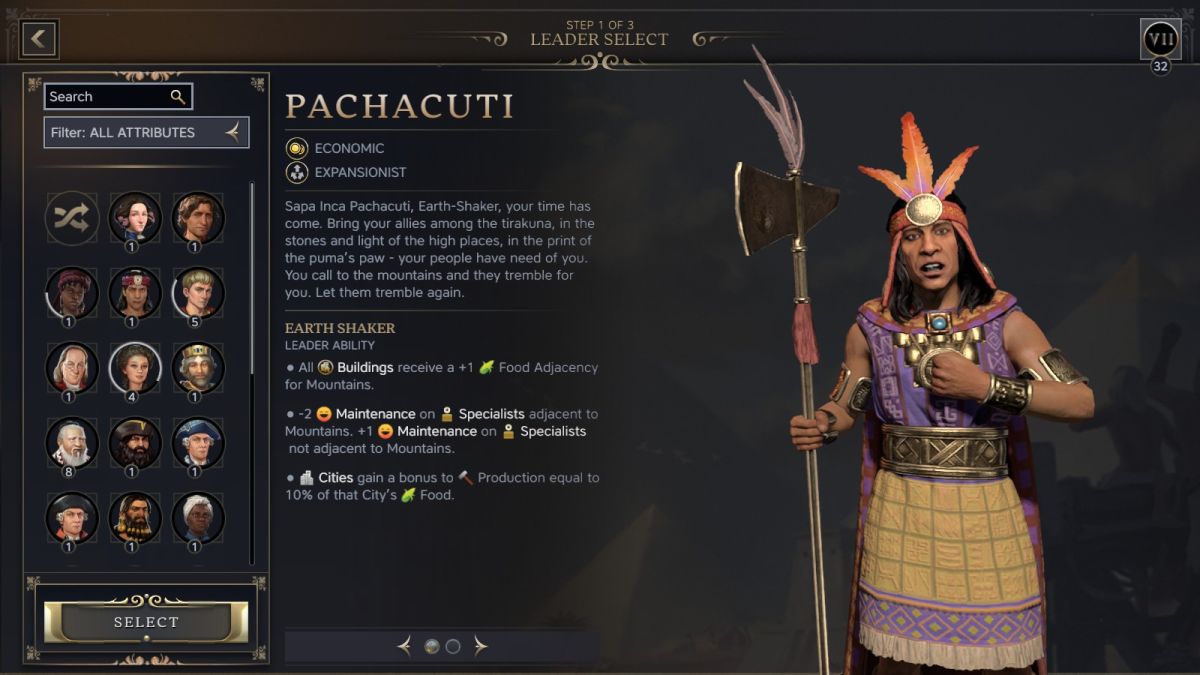
I wanted to try at least one Civ7 game to test out this new update and began running it on Livestream about a month after Patch 1.4 was released. I spent some time thinking about what might be interesting to experience and settled on a theme involving mountain tiles. The leader that fit this theme was Pachacuti, a historical Incan leader though I wouldn't be playing as the Incans in this game. Pachacuti grants a food adjacency bonus for all buildings when placed next to mountains, +1 food for each mountain tile that they border. It's not a huge deal but extra food can be nice in the early stages of the game, plus Pachacuti will always spawn next to mountains due to his leader starting bias. His specialists essentially don't pay a happiness cost when placed next to mountain tiles at the tradeoff of needing an additional happiness point when they don't go next to mountains; Patch 1.4 supposedly made some significant changes to how specialists work and I needed to spend more time exploring how they function under this new system. Finally, Pachacuti grants a production bonus in cities equal to 10% of their food intake, which is better than it sounds because that refers to total food and not the food surplus. It's common to have cities receiving 200-300 or more food per turn by the lategame and translating some of that into extra production is quite nice.
Still, Pachacuti was taken more for thematic and flavor purposes than because I truly needed his leader abilities. More relevant was my civ choice of Nepal:
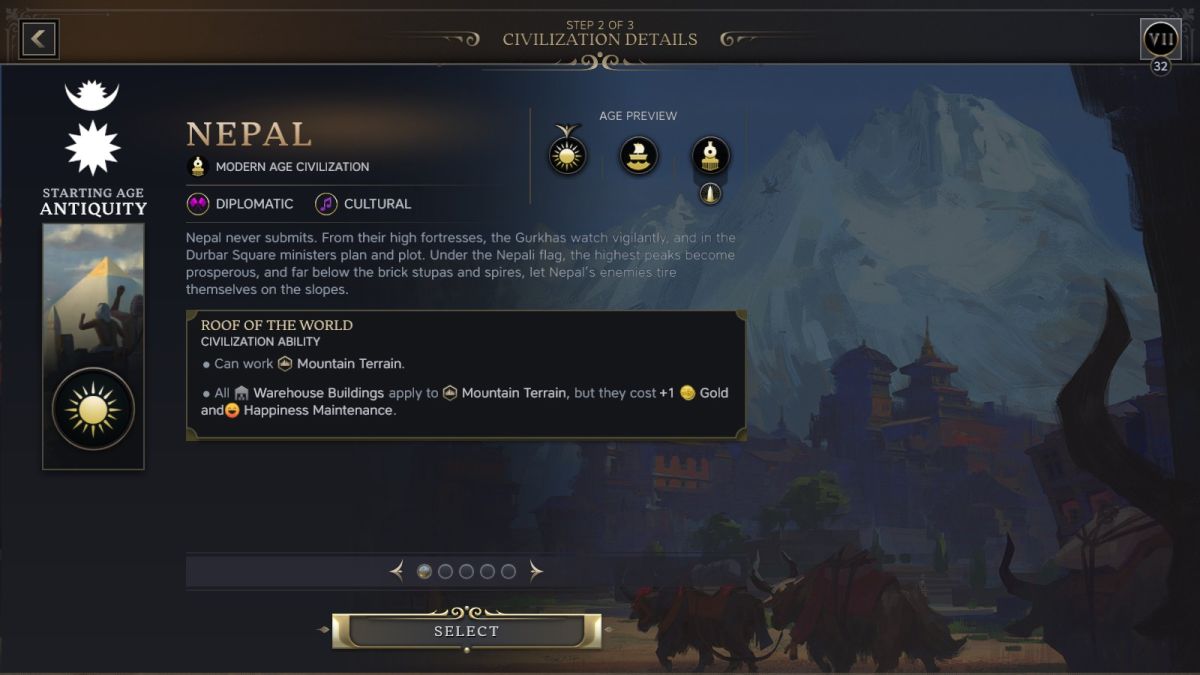
This is one of the Modern era civs that was added in an earlier round of patches; I think that they were included in my copy of Civ7 because my wife had purchased the more expensive version on release. Nepal has a really fun and unique civ ability that allows them to work mountain tiles in settlements, tiles which are otherwise usually inaccessible as in Civ4. The civ pays a slight gold and happiness penalty for working those mountain tiles, however they receive the benefit of *ALL* warehouse buildings within that settlement. The whole "warehouse building" concept was a definition added at some point in patching as this term wasn't defined at all upon release. It refers to the ageless buildings that grant some kind of yield bonus to the base terrain of the settlement, things like granaries adding a bonus point of food on farms or brickyards adding +1 production on mines and quarries. Mountain tiles gain the benefit of every warehouse building in that settlement, plus there are additional Nepal-specific traditions that can boost their yields even further, potentially adding up to some crazy yields. There are eight warehouse buildings and together they could be granting as much as 4 food and 4 production on every mountain tile, parts of the map that otherwise wouldn't be used at all!
So this is a really fun mechanic that helps to distinguish Nepal from the other civs in the game. Unfortunately it was completely wasted prior to the release of this patch, as Nepal was stuck in the Modern era where every city would already be heavily developed and there was little reason to prioritize expanding onto mountain tiles. Most of my past Civ7 games finished by Turn 30 of the Modern era which made the choice of which civ I happened to be playing virtually irrelevant. The Test of Time update would allow me to use Nepal from the very start and actually build my civ around this unique mountain terrain mechanic, something that was different enough to make a new game worth playing. It really makes you wonder what the developers were thinking when they restricted every civ to exactly one era and forced players to swap at the start of every age, whether they wanted to or not.
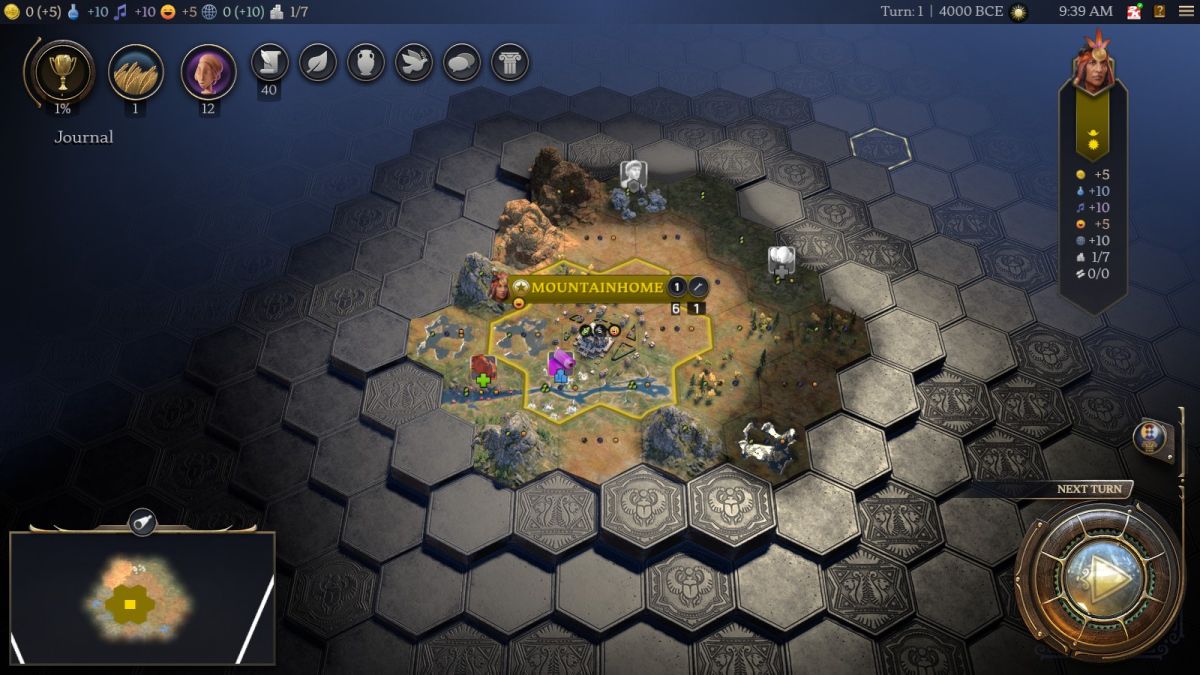
I took the first start rolled by the map generation which the Twitch chat suggested naming Mountainhome. There was one strong resource here in the form of the cotton off to the east and then several decent resources in the silks and crabs; I was also pleased to note a navigable river to the west since the capital would need a source of water to construct its fishing quay and harbor warehouse buildings. There were also mountains here, of course, with a range running off to the north and then extending to the south, and with Mountainhome located not far from the southern tundras. This would have mattered a lot in previous Civilization games but didn't really affect things in Civ7, where tundra and desert landscapes produce exactly the same amount of food as grasslands. The fact that all terrain functions exactly the same in Civ7 is a huge problem that this latest patch did nothing to address; it's not a good thing that the player can put cities basically anywhere and they all act more or less the same.
Mountainhome began by training a series of four scouts per usual for a Civ7 opener. The scouts will defog the map and usually bring back enough gold from tribal huts to purchase a granary or similar early building rather than investing production to build it manually. Sure enough, over the first dozen turns the Nepalese scouts explored enough huts to discover about 180 gold and open up a granary purchase to leap straight from size 4 to size 5 and then begin training settlers. One of the huts also allowed me to sacrifice a single turn of science in exchange for 100 happiness towards the first celebration, an incredible deal given that my civ was only gaining 7 happiness/turn and this sped up the arrival of that celebration by nearly 20 turns. Less welcome was the nearby presence of several hostile independent powers (IPs), including one of them merely eight tiles away to the southeast. I planned to save my initial influence and then toss it at befriending some of those IPs just so that I didn't have to waste resources fighting them.
Further exploration revealed that I was sharing a relatively small continent with exactly one other AI leader, Ashoka of the Mauryans. This was already a notable change from the earlier patch versions of Civ7, under which the player always found themselves on a starting continent with exactly the same number of AI opponents (which would have been 3 AI leaders here on a Small map). It was a baby step forward for Civ7's gameplay to have starting locations with few or no AI opponents present, but still a step forward nonetheless. I had also turned on the gameplay setting which caused leaders to try and match their historical civs if possible, thereby causing Ashoka to appear with an Indian civ like the Mauryans. That also made the gameplay feel a lot smoother than in the old release version, where you would get bizarrely jarring leader/civ combinations all the time. While these might seem like small changes, it actually does make the game more fun when Ashoka is leading the Mauryans with their elephant unique unit as opposed to piloting something like the Roman Empire.
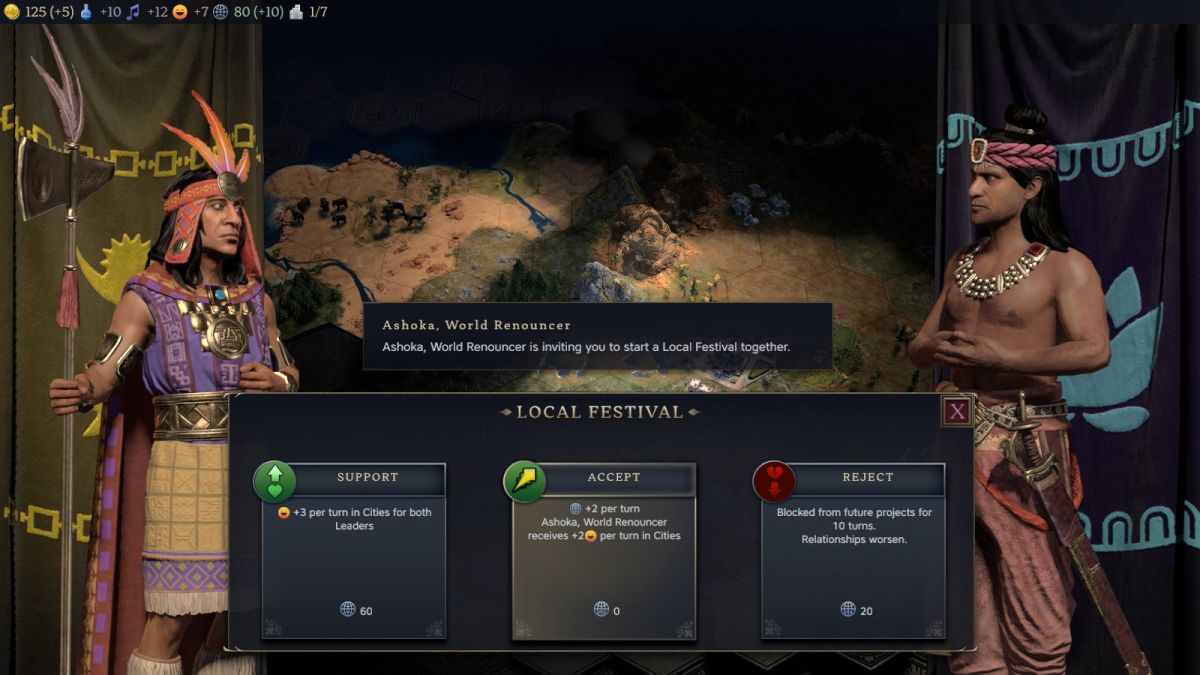
Ashoka is a relatively peaceful leader in Civ7, at least when using the "World Renouncer" personality seen here as opposed to the alternate "World Conqueror" personality which exists only so the developer can sell more DLC. Ashoka likes civs that have high happiness levels and dislikes those with low happiness which is one of the easier AI leader agendas to fulfill. He offered this Local Festival endeavor immediately upon first greeting which was an absolute steal for me and a terrible deal for him. I chose the "Accept" option which cost no influence and gave my civ an additional 2 influence per turn; Ashoka received 2 additional happiness in his capital (and only city) at the cost of spending 60 influence to offer the endeavor. I happily flipped that influence around into befriending the nearby IPs while the extra happiness did basically nothing for his civ. Now to be fair, the Local Festival endeavor can be quite good later on when the player has a bunch of cities to benefit from 3 happiness in each one, however here in the early game it was a total sucker's bet for poor Ashoka.
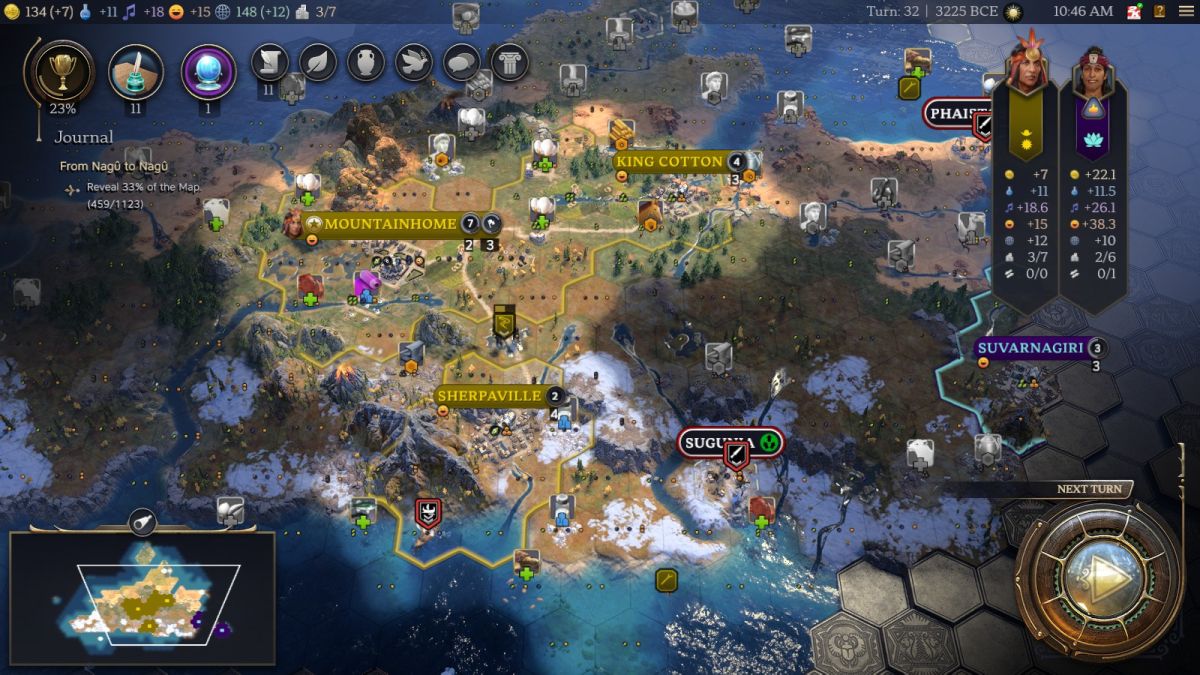
I pushed expansion as quickly as possible, with Mountainhome training those four initial scouts into a pair of following settlers. The first settlement went east at the King Cotton location, the best immediate spot with a pair of cotton resources (each worth 2 food / 2 production when slotted on the resource screen) along with a gold and silver resource. Those latter resources now provide empire-wide benefits to every settlement and are always excellent to control, though sadly silver no longer discounts all rush-buy purchases by 20% apiece. The next settler went southeast to claim the Sherpaville spot which would have been mediocre in a normal game but looked quite strong when playing as Nepal thanks to all of those mountain tiles. I planned to grab some of those tiles to the northwest with Sherpaville and then transfer them over to Mountainhome later, as the Test of Time patch now finally allows settlements to swap tiles with one another, only to discover later that improved tiles cannot be switched between settlements, only unimproved ones. Better but still annoying. My first influence dump had gone into befriending Sugunia, one of the new Expansionist IP types, and I was still trying to make due with as few military units as possible while expanding across the map. I knew that I would likely have to rush-buy defenders somewhere but I had no problem spending gold in that fashion as I kept trying to accelerate the growth curve to greater speeds.
When it was time to choose a pantheon belief on the following turn, I went with Stone Circles. This granted +1 production on clay pits, mines, and quarries in cities that had an Altar building present, and importantly the Altar also functioned as a warehouse building. This meant that the same +1 production was also granted to any mountain tiles within the city's borders as I continued trying to buff their yields. Since production is extremely powerful in Civ7, this made the Altar a much more useful building than normal and one that also synergized with the mountain theme that I was running. Unfortunately as soon as the Ancient era finished every Altar would go obsolete and this bonus would be lost in the Exploration age. It's one of those truly baffling aspects of Civ7's design - why? Why does the gameplay work like this?! Let's have this really fun and interesting game mechanic involving pantheons, then toss it into the trash for no reason at the start of the next era.  I'm going to state this a whole bunch of times about different Civ7 mechanics, but this game would be so much better and so much more fun to play if the entire age concept simply did not exist.
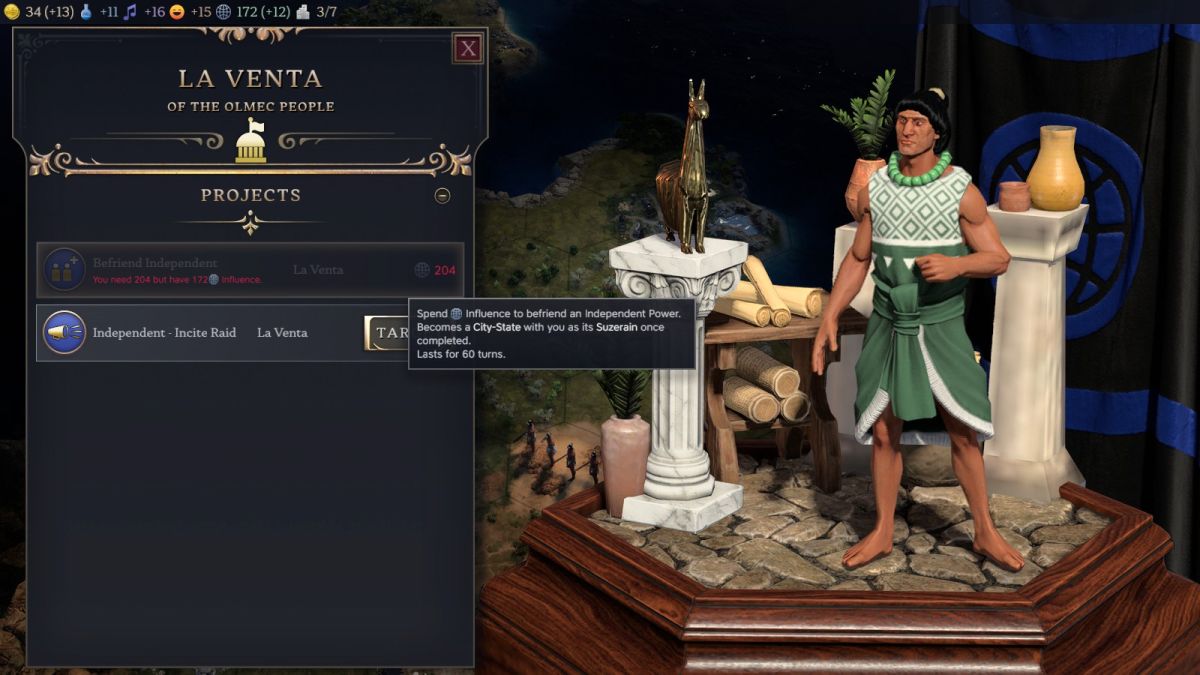
Part of the reason why Civ7's gameplay felt so simplistic in earlier patches was the ease of snapping up every indendent power on the map. They were trivially easy to befriend using the influence system, the AI civs never seemed to make much of an effort to ally with them (instead they rabidly killed all of the IPs), and the city states initially gave percentage-based bonus which scaled ludicrously well. You could ally with eight IPs, with each of them giving benefits like +5% gold / science / culture per city state alliance, and the player's yields would just balloon far past anything the AI could achieve even on Deity. Those percentage-based bonuses were removed several patches ago and this most recent Patch 1.4 added a further nerf to the IPs: now it costs more and more influence for each befriending process. The first one still costs the original 170 influence but now the second one costs 204 influence (a 20% increase) and then the third one cost 236 influence, and so on. This still makes it possible to ally with a bunch of independent powers, however it slows down the process considerably and makes it less of a One Right Choice. The AI also seems to compete more aggressively for friendship with the IPs which is another badly-needed improvement.
Eventually my first friendship matured with the independent power of Sugunia and I was able to pick a bonus from suzeraining this city state. The Expansionist IP options felt pretty weak on the whole, a far cry from the old IP benefits, with stuff like "+1 food in each settlement for each Expansionist city state you suzerain". That wasn't +1 food per city state, it was +1 food per EXPANSIONIST city state, of which there was exactly one on the whole map. Food also tends to be fairly weak as a yield in Civ7 after the early stages of the gameplay and most of the Expansionist IP bonuses are tied to extra food in some fashion. I ended up just taking the good old +1 settlement limit option, which I didn't really need since I was running a gameplay mod that already doubled the normal settlement limit, but it was still better than anything else. Taking control of Sugunia also led to a big -30 relations malus with Ashoka since he had also been trying to control the independent power. That felt excessively punitive from a diplomatic standpoint, dropping us from +37 relations to a mere +7 relations - he got that angry simply because I invested my influence points into one of the nearby IPs? I was doing everything possible to act friendly with Ashoka, between not settling near him and sending him a trade route and (by coincidence) running the same government type. While I hoped to play peacefully with my only neighbor, if he was dumb enough to start trouble then I wouldn't feel bad about running him over.
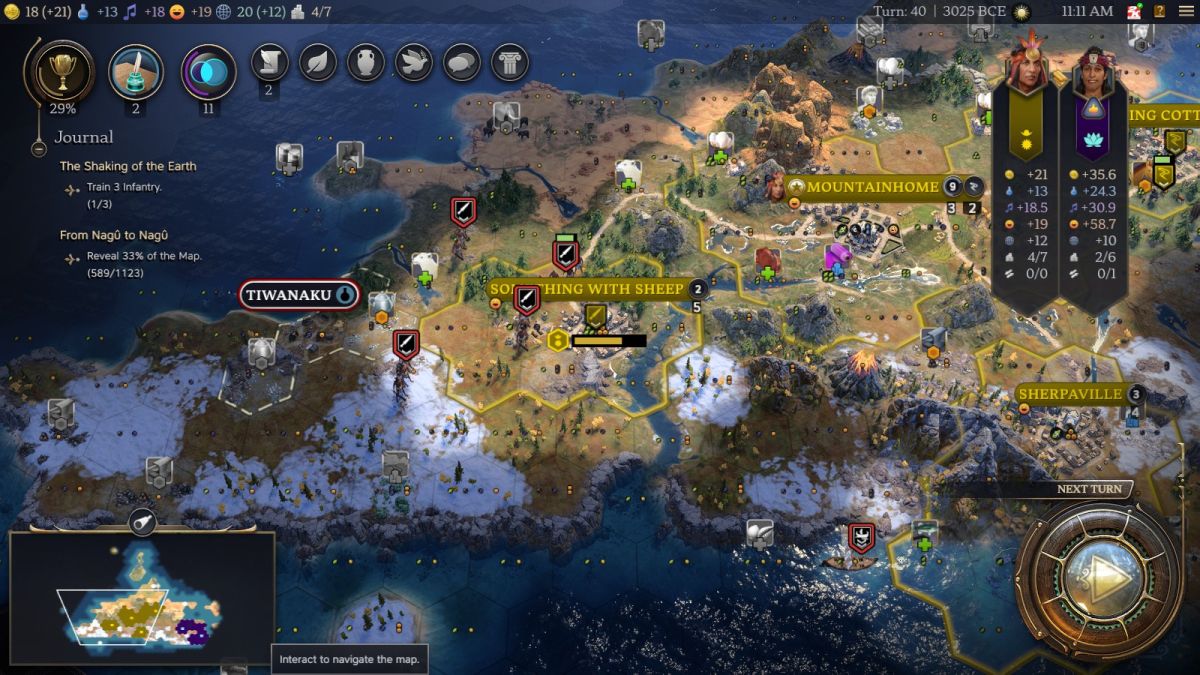
My fourth settlement went west along the navigable river that flowed past the capital, becoming the town of Something with Sheep when it was established on Turn 38. I didn't send a military escort because there was nothing in the west other than a friendly Scientific IP named Tiwanaku, the only one of the four IPs on this starting continent that hadn't rolled hostile out of the gate. What I had failed to anticipate was that settling the Something with Sheep location would suddenly drive Tiwanaku into hostile status. This happened with absolutely no warning either: the IP had the neutral white colors at the end of Turn 38, then suddenly four hostile red warriors were charging into my territory at the start of Turn 39. That's a gameplay mechanic that really needs to be explained better to the player, or better yet, not have this silly concept within the gameplay at all. As an independent power, Tiwanaku would never expand its borders in any way - why would they care if I set up shop four tiles away on land that they weren't using?
The following turns were therefore consumed with the struggle to defend Something with Sheep from this enemy army that had appeared out of thin air. I rush-bought first one warrior, then a second inside the new settlement to stall for time while Mountainhome trained a pair of slingers. Units are very cheap to purchase or build in Civ7, honestly far too cheap for a game with One Unit Per Tile rules as they quickly clog up the map on the higher difficulties even with army commanders to help with mobility. Why this game doesn't have the corps / armies from Civ6 makes absolutely no sense since they would be perfect here. Anyway, Something with Sheep would have been captured if the AI had simply rushed me with all of its warriors, but of course they wasted a bunch of time milling around in circles doing nothing. That bought enough time for the slinger reinforcements to arrive and start shooting them to death, soon supplemented by my first army commander that unlocked as a freebie from researching Discipline civic. It wasn't even the warriors from Tiwanaku that proved to be the biggest annoyance, instead a series of hostile barbarian galleys showed up and had to be confronted with my own galleys out of the capital. Slingers were attacking with 5 ranged strength against 25 defense on the galleys which was stupidly lopsided; I don't understand why the developers made naval units so overpowered in this game.
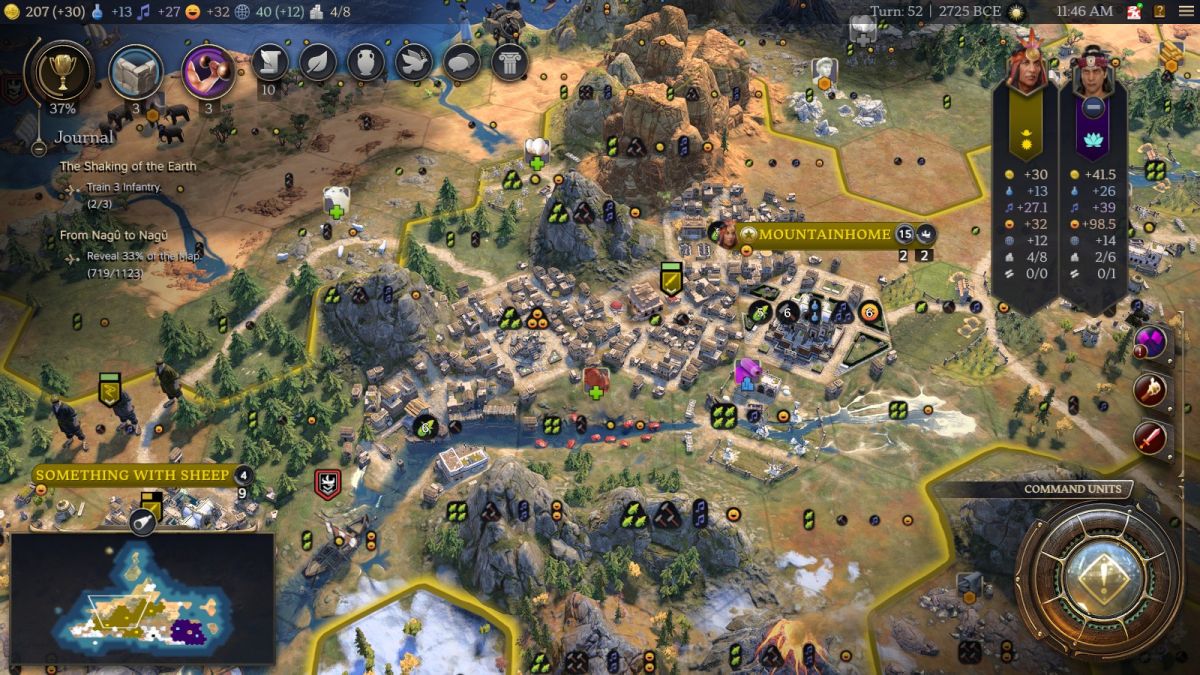
One of those barbarian galleys was visible in the screenshot above where I zoomed in to display the tile yields at Mountainhome. The capital had already constructed five different warehouse buildings to this point: granary, brickyard, saw pit, fishing quay, and harbor for a total of 2 food / 3 production added to each mountain tile. I was also running a Nepalese traditions that added +1 culture on each mountain tile outside the capital and +2 culture on mountains at the capital, all of which combined together to create the beautiful tile yields pictured above. I was grabbing another mountain tile on each additional population growth since they were so far superior to the normal terrain options. Mountainhome was shaping up as a powerful city with a lot of early game production; I was hoping to crank out a few more settlers and then start building vertically upwards once all of the good land had been claimed.
So building up the capital with all of the various Pachacuti and Nepal bonuses to mountain tiles was genuinely a lot of fun and played differently from my previous games of Civ7. There were two big problems here though, starting with the fact that every non-warehouse building would go obsolete at the end of this Ancient era. I liked the Altar that I had chosen for my pantheon belief but my enjoyment of the various Ancient buildings was tempered by the knowledge that all of them were going to become useless in another 70 turns. The second major problem was a visibility issue: even after 18 months of playing this game, it's impossible to identify any of these buildings on the map! Can you tell which one of these tiles holds the granary by looking at it, or where the Altar might be? You can barely even see which tile holds the fishing quay / harbor pairing even though they had to be placed on the only navigable river! Keep in mind that this is a zoomed-in screenshot and when playing normally it's even more impossible to tell anything apart. This is a giant problem because nothing is color-coded (as in Civ6) and by the later stages of the gameplay everything on the map looks like an impenetrable blob of featureless building spam. This horrible visual aesthetic still hasn't been tackled in patches and it's a major problem that might never be addressed.
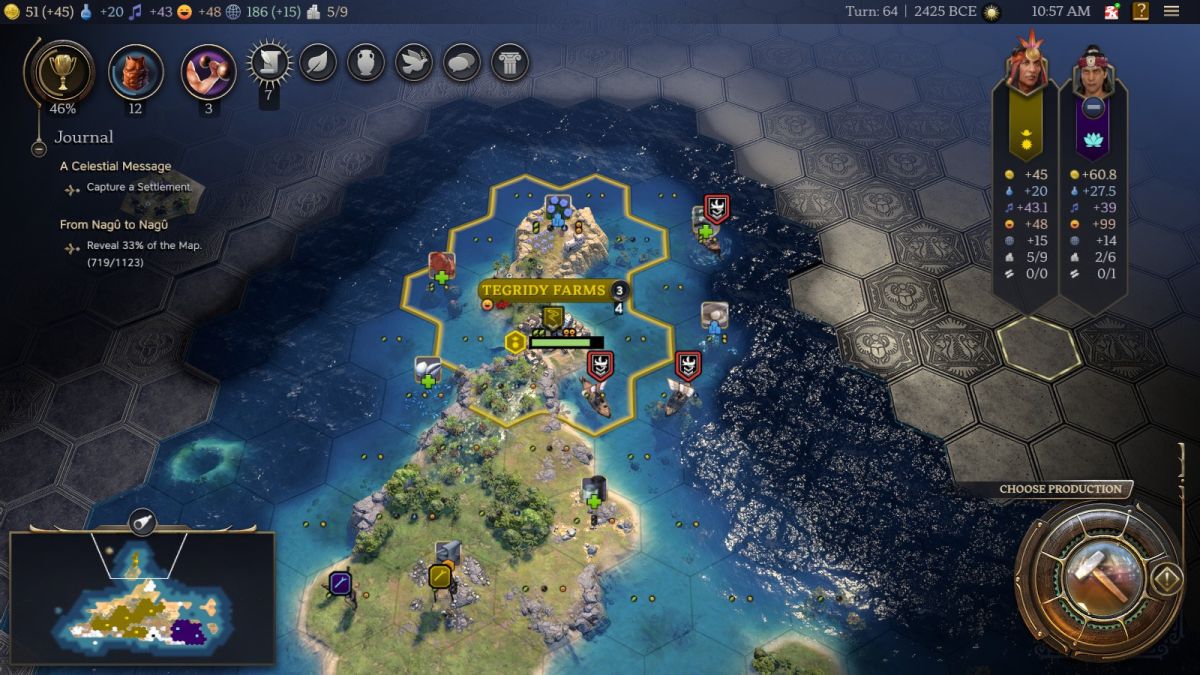
By Turn 55, I had managed to get the situation in the west under control. All of those warriors were dead and the galleys had been driven off by the newly christened Nepalese navy. I was able to walk one of my own warriors over to the center tile of Tiwanaku and disperse it, later placing my own settlement in the region to claim its multiple silver and iron resources. I would have preferred to ally with that city state but I guess we had to do things the hard way. Meanwhile, there was a small offshore island to the north where I had spotted that a single settlement could grab six different resources. This spot therefore became Tegridy Farms (which is apparently a South Park reference), where I hoped to be able to send overseas explorations down the road once the game finally allowed my ships to cross ocean tiles in the next era. There were even more barbarian galleys roaming around up here which forced me to cash-rush another slinger for defense, though that wasn't too much of a drain on resources given that slingers only cost 120 gold to purchase and I was making almost 50 gold/turn by now. A pair of slingers would force back these enemy ships over the next dozen turns.
Tegridy Farms brought my civ up to five settlements with two more settlers on the way. I had also paid 300 gold a short time earlier to upgrade King Cotton into a city and unlock an additional build queue; more on cities and towns later since their relationship has changed drastically from the earlier Civ7 patches. All of this was coming along nicely which left me with one question: what was Ashoka doing?! He had built a second settlement fairly early on and then simply did... nothing. There were plenty of Mauryan warriors wandering around and eventually I spotted one of their settlers, however there was already little more than scraps remaining on this small continent that we shared. I genuinely do not understand how they can fail at the most basic aspects of expanding across the map.
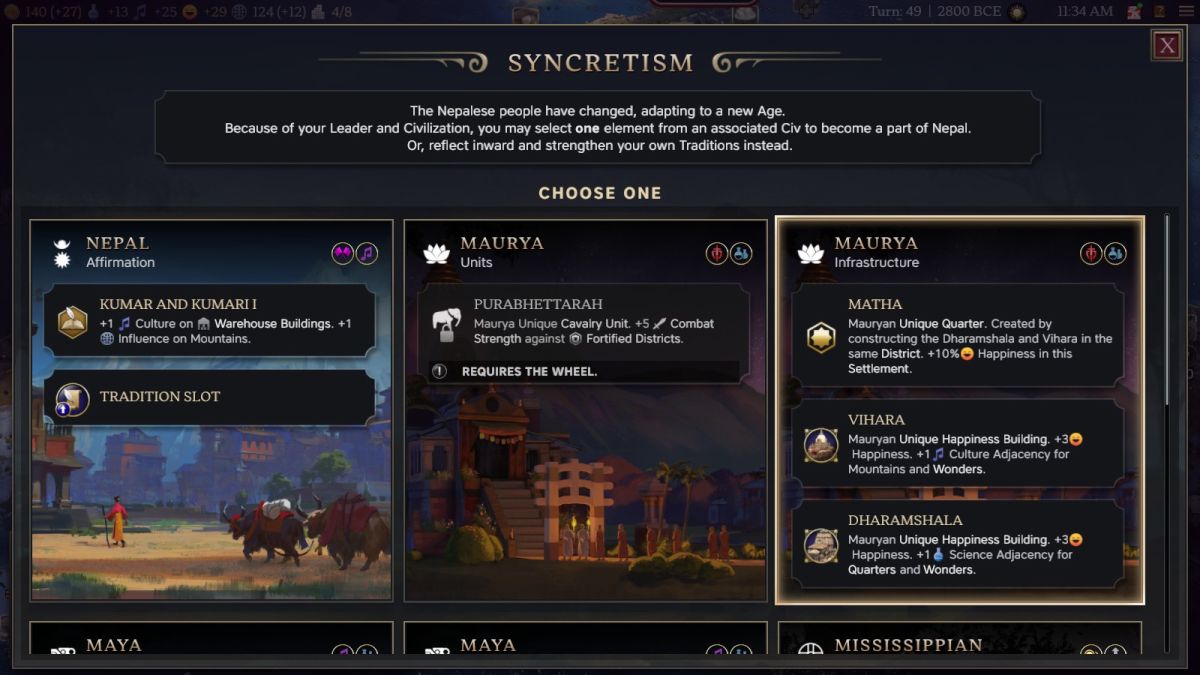
Here's one of the biggest new features in the Test of Time patch: a gameplay concept known as syncretism. One of the big changes was the ability to play any civilization in any era, which naturally contradicted the original design goal of only being able to use civs in their "apex" era where each of them would have their various unique units, buildings, and so on. While the developers could have simply given players the chance to use civs outside their intended era and treat them as a blank slate with no bonuses whatsoever, instead the developers gave these non-apex civs the chance to choose minor benefits that normally belong to other civs. Since I was playing as Nepal outside of the Modern era, their civ-specific civics tree contained a pair of tradition policies and then had this syncretism option. Researching syncretism allowed me to take the Kumar and Kumari policy which would grant culture on warehouse buildings and influence on each mountain tile, or alternately pick one bonus from a series of other Ancient era civs. I could take a single unique unit like the Purabhetarrah elephant or a single unique quarter like the Matha, with different options from different Ancient era civs. Although these were weaker benefits than playing a civ in their intended apex era, I could still get something useful for Nepal by essentially taking one unique item from someone else.
This is a genuinely cool concept and I really like how it opens up the possibility of mixing and matching unique bonuses that otherwise aren't intended to be used together. There are probably some really broken combos out there by taking the innate benefits from one civ and combining it together with a unique unit or unique quarter from an entirely different civ. I decided that I would pick the Mauryan Matha unique quarter since that's one of my favorite options from the Ancient era. That quarter is a one-stop solution for happiness issues and scales really nicely over the long haul thanks to providing a permanent +10% happiness in the settlement. I also considered taking the Nepalese policy (which came with its own tradition slot to make it completely free to run) but ultimately decided that I didn't need influence quite that badly. The Mayan unique quarter (Uwaybil K'uh) was also available as a choice but sadly that thing has been nerfed heavily since release, plus I didn't have enough jungle tiles here to make it a good match for the local terrain.
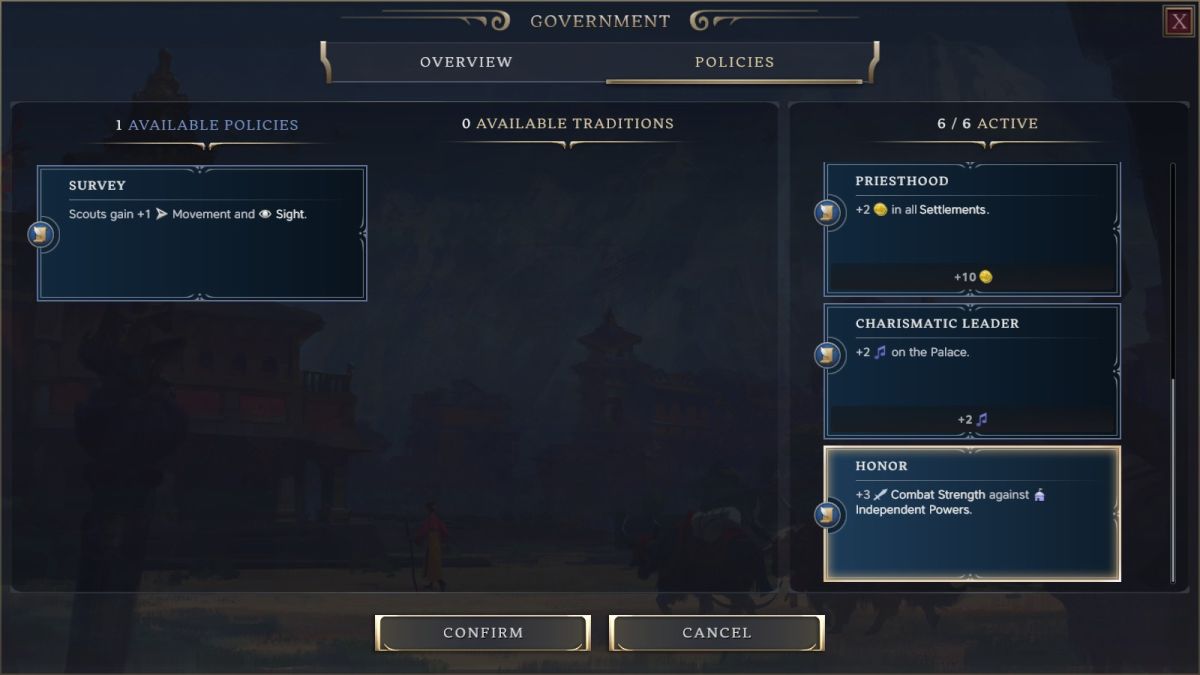
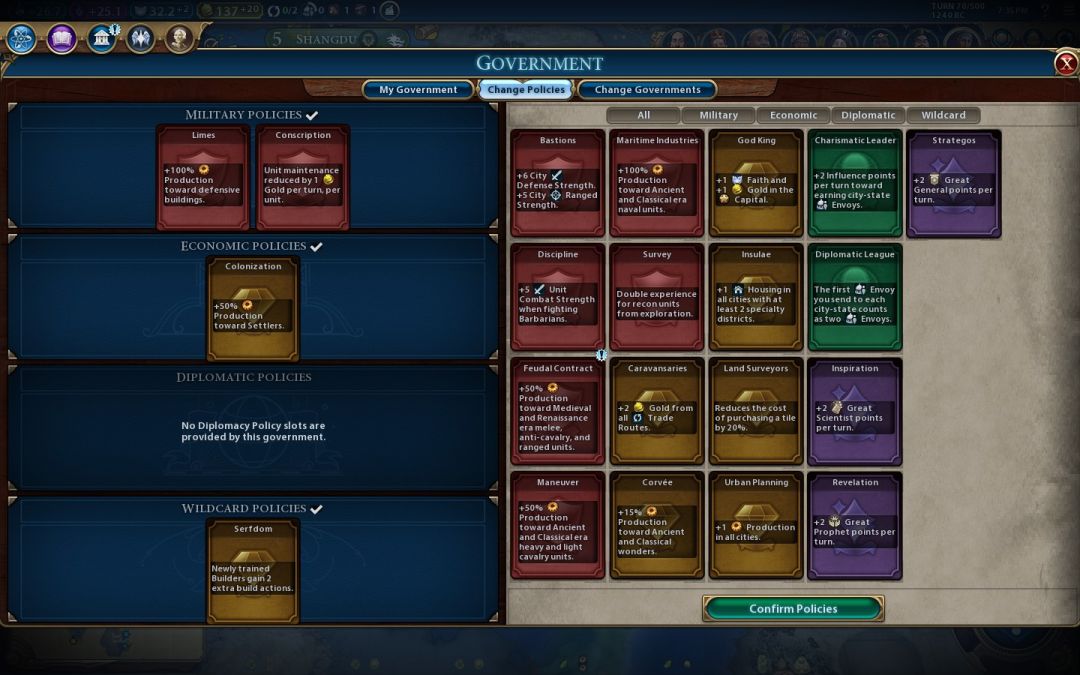
As nice of a feature as syncretism looks to be, unfortunately Civ7 still feels unfinished in many other areas. Take this screenshot of the government screen for example, where the player slots in the various policies in the same fashion that they did in Civ6. While the Civ6 version of this screen was easy to read and could display every policy card available at the same time, the Civ7 version is an absolute dumpster fire from a user interface perspective. For no clear reason, only three of the active policies are displayed at any one time, forcing the player to scroll up and down to see what the heck they're actually using. Keep in mind that this was still the Ancient era and I was already making use of six policies, a situation that only gets worse in the later portions of the gameplay. Then the player is also limited to only seeing three available policies and three available traditions at any one time, when there can easily be a dozen or more options to choose between. This doesn't even get into the unnecessarily-confusing nature of what constitutes a "tradition" versus a normal "policy" anyway, which the gameplay never bothers to explain to the player. There's also the further annoying problem of every non-tradition policy obsoleting and disappearing on each era transition; too bad if you liked running something from the Ancient era, it's gone now and you can't use it anymore. Finally, this is the REDESIGNED version of this screen, not even the initial version from release! Why is there so much wasted space everywhere - how could anyone think that this looks good?!  I'm flabbergasted that a game with a $100 million budget can't seem to create the most basic functioning interface for something like this.
Anyway, the Ancient era continued to rumble onwards with my civ doing the usual expansion and growth thing. I tried to build the Hanging Gardens at the capital and missed it by a single turn, a bit of bad luck given how that's one of the best wonders of the first era. I also found myself in a competition with Ashoka to suzerain the last independent power on the continent, the Scientific IP of Phaistos. He started the friendship process four turns before me but I thought that I could win the race by spending additional influence after the initial purchase to speed up the little friendship meter. To my surprise, Ashoka responded by also investing more influence into the IP which put him back ahead again! I don't think that I'd ever seen the AI pull that maneuver before so kudos to the developers for that improvement. It looked like I'd have to make due with a pair of allied IPs and Ashoka controlling the other one (with the fourth IP having been burned down in the far west).
Everything had been pretty leisurely until this struck out of the blue:
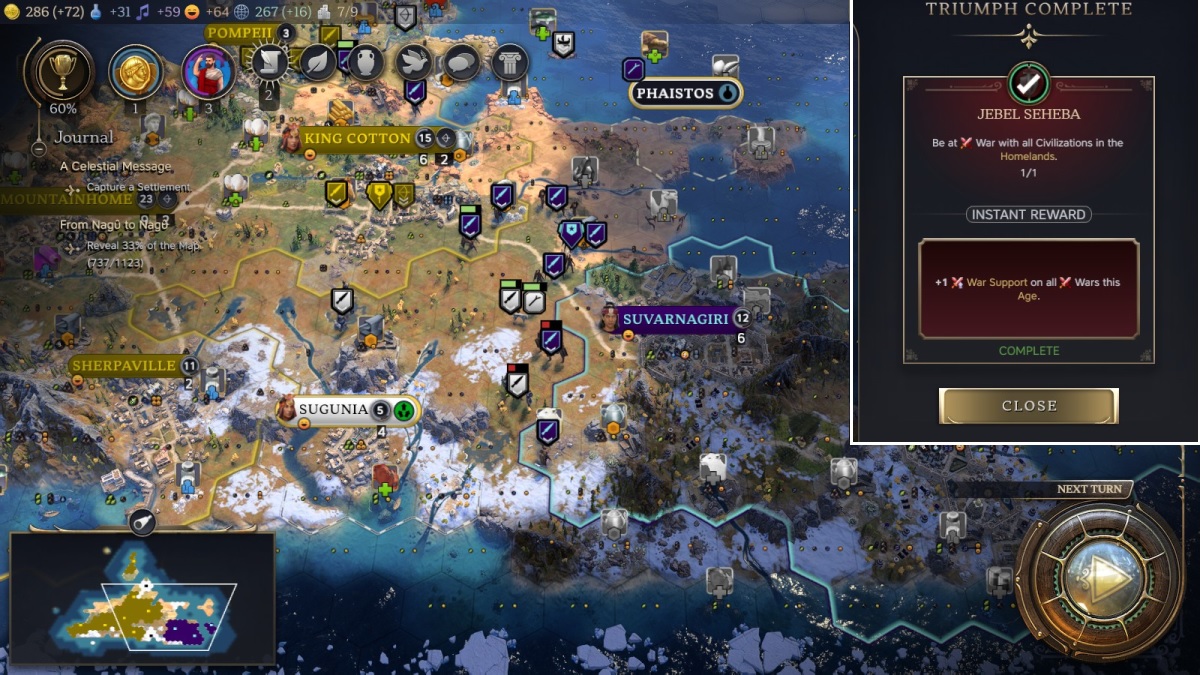
Wait, I achieved a triumph for "being at war with all civilization in the homelands", huh? Oh apparently Ashoka declared war out of the blue, which was pretty baffling given that our diplomatic relations had climbed back into the friendly region again. He had denounced me earlier but I countered the denunciation by paying 120 influence which essentially meant that it never happened; I'm honestly not sure why this guy wanted to attack given that I had never done anything more aggressive than compete for the nearby IPs. His surprise war was considered dastardly enough that I received a big war support bonus at the start of the conflict, a total of +4 war support which is a huge deal in Civ7. Those 4 points of combat strength were nearly enough to cancel out the Immortal difficulty bonus (+5 combat strength on all AI units) which is another one of the largest advantages the AI gets on the higher settings. Ashoka didn't seem to have much more than a swarm of warriors, the weakest unit in the game, though he did have a lot of them running around. I was hoping that my city state allies of Sugunia and La Venta (offscreen to the north) would absorb some of the initial brunt of Ashoka's attack while I trained a bunch of archers to shoot down his forces.
While I didn't have that much in the way of military forces at the moment, I did have some economic resources to leverage in this unexpected conflict. I could start out by upgrading my warriors into spears, which are not anti-cavalry units in Civ7 but instead the standard tier 2 infantry units that simply have 5 additional combat strength. It was worthwhile to pay the modest gold amount to have slightly stronger melee units at my disposal. I also had plenty of influence saved up which had been intended to wrest control of Phaistos away from Ashoka but now instead could be put to military use. I made three total payments of 100 influence apiece to take permanent control of an archer and two galleys from my city state allies, with the naval units in particular doubling my forces on the high seas. These additional units helped plug the gap momentarily while my two cities cranked out half a dozen archers over the next few turns.
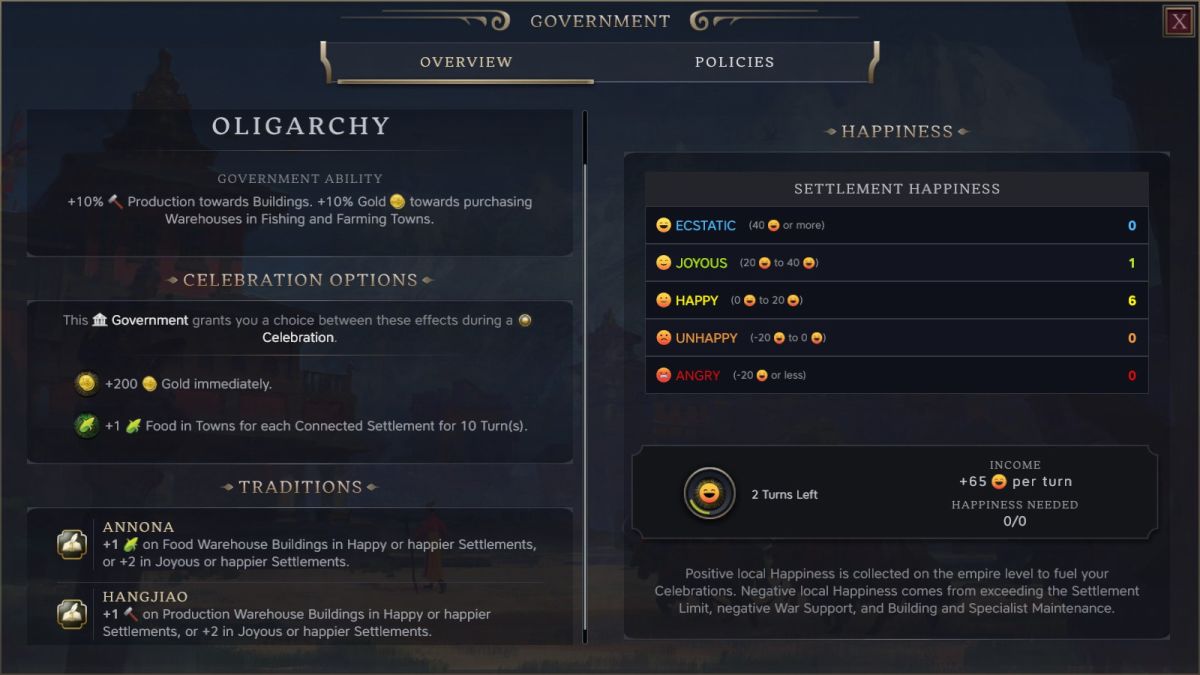
As the war effort continued to build, I found my Nepalese civ entering into another celebration in the background. I've never particularly liked this mechanic in Civ7, in which a happiness meter fills up in the background and then the player receives some kind of bonus based on their government type when it finishes, along with receiving one additional policy card slot. This is a gameplay mechanic that was still changing as I was playing this game, with Patch 1.4.1 reworking how governments and celebrations function - the patch dropped literally halfway through the Ancient era of this game! The updated governments now have a base function always in effect (the production bonus on buildings and cheaper warehouse purchases in towns) along with a pair of attached celebration options. The instant 200 gold from Oligarchy would have been really helpful earlier to help accelerate the growth curve, though at this point I thought it was better to take the extra food in each town.
There were also some new policies (technically traditions which meant that they would survive the age transitions) associated with the Oligarchy government that granted bonuses based on the happiness level of each settlement. These five levels of happiness ranging from Ecstatic to Angry were also freshly added mid-game and represented another new feature that hadn't been in Civ7 previously. It was good to see a more formal set of rules associated with city happiness, which previously had been a big black box where city yields decreased from unhappiness but absolutely nothing was explained to the player. The Hangjiao tradition was worth running since almost anything associated with production is powerful in Civ7 and I think that I had enough policy slots that I was able to make use of Annona as well. Taken as a whole, these systems are definitely an improvement over the half-finished mess that existed previously in Civ7's gameplay. With that said though, there's still zero ability to change governments after making a selection in the first few turns of each age which feels pointlessly rigid and unforgiving.
I spent the first few turns of the war systematically killing the Mauryan units scattered around Nepalese territory. While most of them were off on the eastern plains, where they occasionally launched a random attack but mostly wandered around aimlessly, there were a handful of other hostile forces camping out in the north and in the west. The first three archers out of Mountainhome had to march to the west, not east, in order to clean up this little raiding party which for some reason was attacking Something with Sheep. The city state of Phaistos also formally allied itself with Ashoka during these turns, though I'd known that was going to happen ahead of time and pounced immediately on its quadrireme with all four of my galleys. Phaistos was shortly left with no defending units and I captured it followed by razing it to the ground as the terrain was fairly weak in that portion of the map. They made a bad choice about which side to take in this conflict.
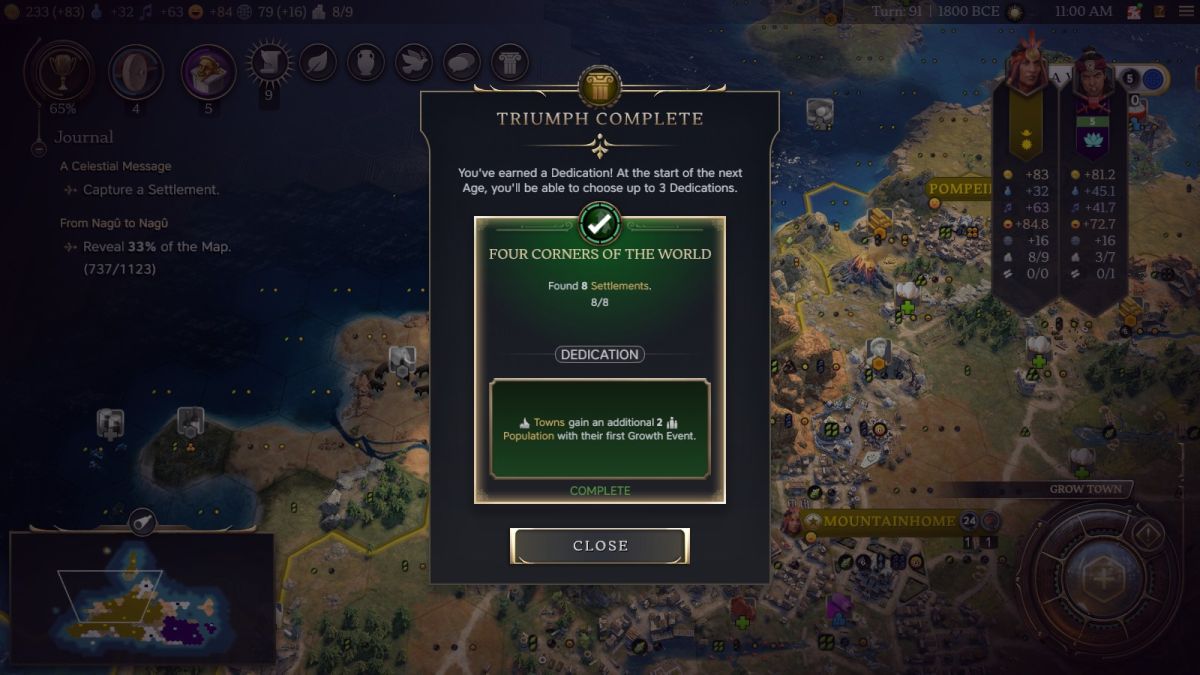
Clearing out Ashoka's units in the west also allowed me to plant my final intended city on this continent's northwest coastline, resulting in this triumph popping up. Triumphs are the replacement for the legacy scoring goals and they are a much, much better gameplay mechanic largely because they stay out of the way. Triumphs come in two forms: instant triumphs that yield an immediate benefit and then long term triumphs that do nothing for the moment but allow the player to make a dedication at the start of the next age, with the latter type typically being more powerful. Founding eight settlements gave my civ the chance to take this dedication worth +2 population sizes in all towns in the next era, which might be good enough to be worth choosing depending on which other dedications I ended up earning. There's a separate screen that lists all of the various triumphs and they can be tracked on the side of the screen if the player wants to keep an eye on them. Many of the triumphs grant rewards for doing things that the player would be doing anyway, like this one that I certainly hadn't been going out of my way to achieve. Best of all, the triumphs can be completely ignored if desired since they're an optional part of the gameplay. There's no more of that "you must deliver 30 treasure fleet resources or all of your cities revert back to towns" nonsense anymore, thank goodness. The triumphs themselves aren't anything amazing, just a nice little bonus aspect to the gameplay, however this is a massive case of addition by subtraction wherein the real benefit is simply not having the old legacy scoring any longer.
It took about half a dozen turns to clear my territory of Mauryan units and then I shifted over to the offensive full time. Although the AI is terrible at fighting offensive wars in Civ7, they are a vast improvement over the Civ6 AI because they can actually defend themselves in warfare. Don't get me wrong, they don't *DO* anything and their tactical movements are abysmal, but the Civ7 AI is very good at spamming out defensive units and then forcing the player to wade through a Carpet of Doom to capture anything. This gets very tedious very quickly (I've said a hundred times that unit costs are way too cheap in Civ7) and I don't really enjoy the military side of Civ7's gameplay that much. Trying to capture all of the various fortified districts in each AI settlement inevitably takes forever since each enemy city is popping out a new unit every turn while the player has to keep maneuvering their reinforcements up to the front lines. Army commanders are a godsend here and the combat would be almost completely impossible without them, but could we maybe just let units stack together to speed everything up a bit? Like Civ5 and Civ6, the One Unit Per Tile combat in Civ7 emphasizes tactics over strategy in a way that I continue to feel doesn't match the tone of the series.
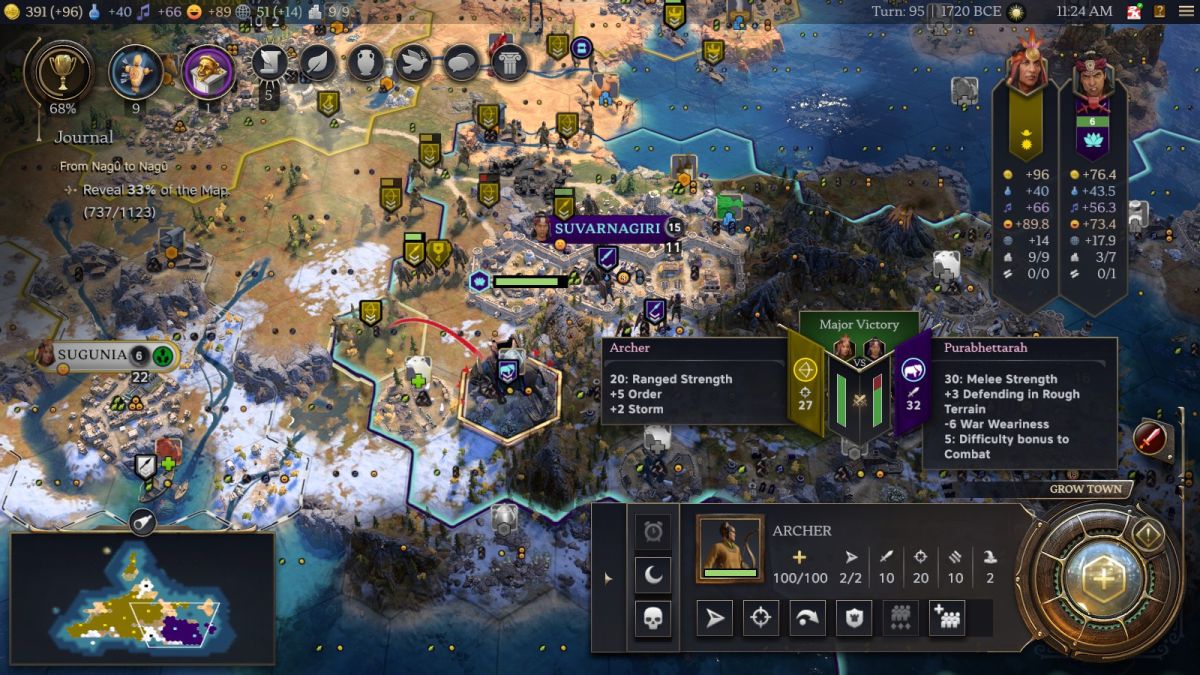
At least in this war I had some major advantages working in my favor in the combat math. I mentioned above how Ashoka's unprovoked sneak attack had saddled him with a big war support penalty, which I was then able to supplement with additional influence spending to get my war support as high as +6. This entirely offset the Immortal difficulty penalty of +5 combat strength which all of Ashoka's units were receiving, then I also racked up experience on my single army commander at an amazing rate. That commander was buffing five or six archer shots every turn and earning 20-30 XP at a time, enough that I was able to complete the entire Assault line of promotions in less than ten turns to unlock the first commendation. I chose Order as always for its +5 combat strength and that along with the Storm promotion had my archers firing at +7 strength. Adding in the war support effect, that was a total swing of 13 points of combat strength which is absolutely enormous under the Civ6/Civ7 combat model. To use an example, this archer would normally be firing at 20 strength into 38 defense on Ashoka's elephant for a range of 11-17 damage dealt. Instead, it was 27 strength into 32 defense for 19-29 possible damage, more than 50% better than the base numbers would have suggested. And this applied to every single combat everywhere on the battlefield, extremely handy for digging the defenders out of the mountainous terrain near Suvarnagiri. It took nearly ten turns to siege down the place, with the help of some ballistas once I unlocked them on the tech tree, with the city finally falling on Turn 101.
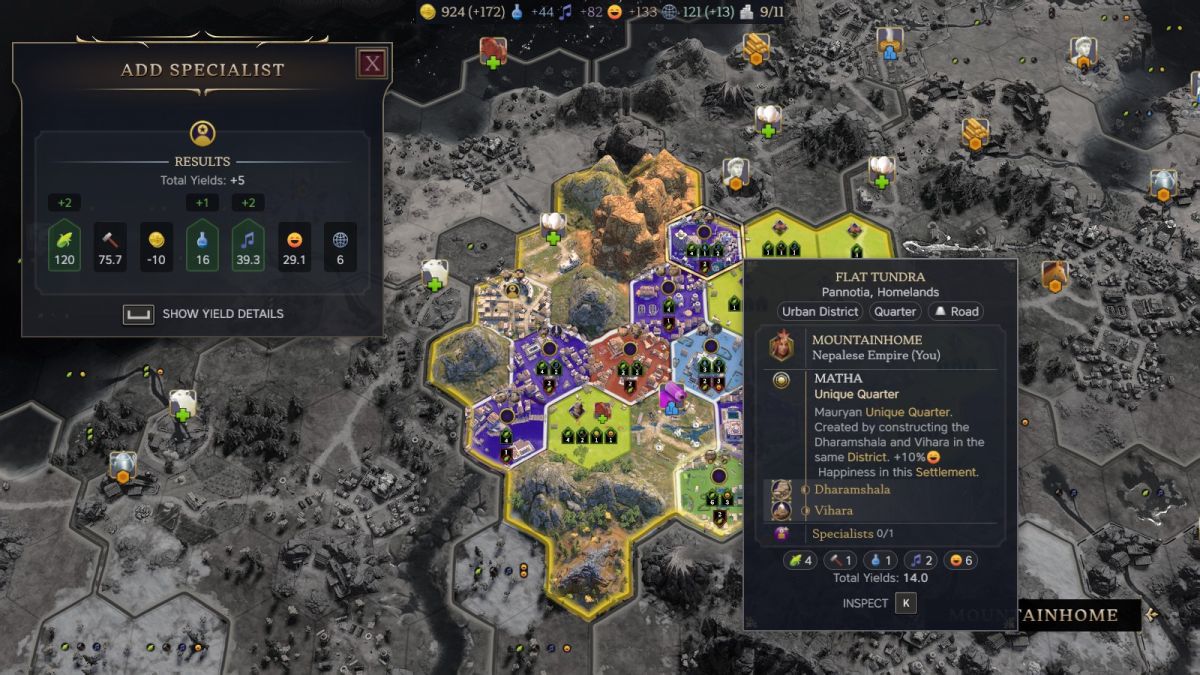
The recent patches for Civ7 also changed how specialists function in cities. Previously they had a base 2 science / 2 culture no matter where they were placed and then would gain additional yields on top of that base amount due to building adjacencies and the like. This meant that the placement of specialists didn't matter very much, especially in the lategame, since their yields all tended to look extremely similar once the map was blanketed in buildings. The developers at Firaxis having been trying to fix this and their latest attempted correction was to tie specialist yields more closely to the underlying adjacencies. No longer do specialists have universal base science / culture yields, instead they magnify the bonuses granted by the buildings upon which they are situated. It's kind of hard to see the tiny yields in this screenshot but the various bonuses were quite different depending on where I chose to place this population point as a specialist. I was also benefiting here from Pachacuti's leader ability that removes -2 unhappiness for specialists placed next to mountain tiles, along with the Nepalese civ bonus of getting extra food from buildings placed next to mountains (which apparently carries over to specialists as well). These changes look like net positives to me, though I do want to spend some more time experimenting with the specialists in the later ages. Unfortunate the whole system remains highly inflexible since a specialist can never change location or convert to a different type of specialist once assigned; they are stuck forever once making the initial choice.
Militarily, my forces continued grinding eastward after capturing Suvarnagiri (which we renamed to Mount Ragebait). A ridge of mountains blocked access to Ashoka's capital from the north and forced my units to march through a narrow two-tile chokepoint in the south, though fortunately my units were able to pass through it easily since the AI didn't understand the concept of making a stand at the chokepoint. They are simple dreadful at doing anything other than standing behind fixed fortified defenses, and of course there were three more fortified tiles at the capital that had to be knocked down with ballistas. Ashoka kept popping out more elephants and spearmen for defense, enough that he killed a decent number of my own units, but which were offset in turn by the reinforcements that I'd known would be needed and had trickling up to the front lines. Archers did the killing against military units while a pair of ballistas did the heavy lifting against the fortifications. It was a slow process but Ashoka's capital fell on Turn 111:
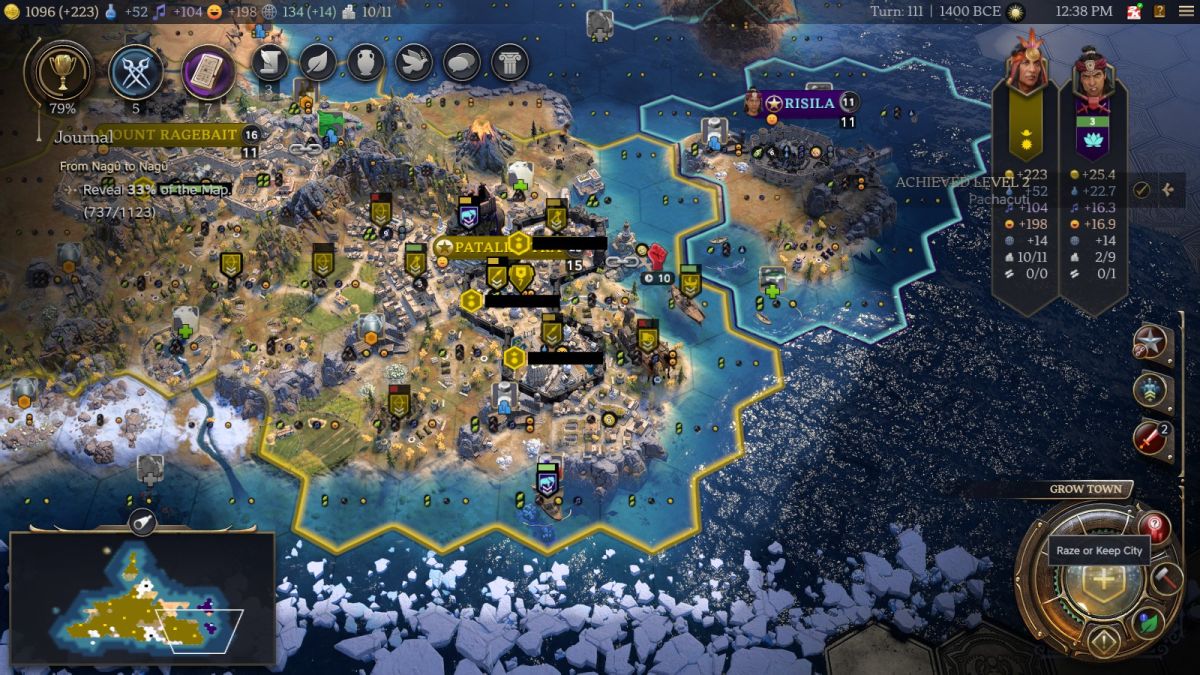
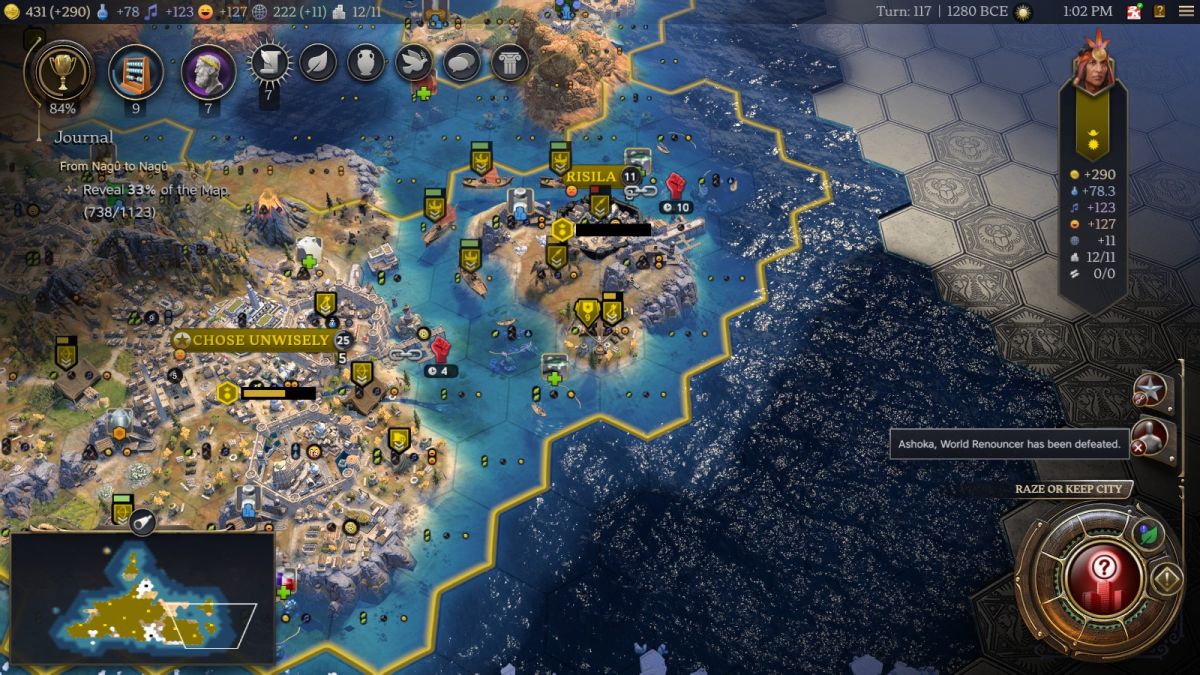
This effectively ended the war though I still had some cleanup to do on the offshore islands which were being bombarded by my four galleys. Taking the enemy capital actually triggered three different triumphs, including "Have 150 population" and "Be the first to conquer a capital" which didn't surprise me because the AI civs can't capture each other's cities, much less their capitals. My army commander earned so much experience in the process of fighting this war that I was able to take TWO commendations, choosing the one that pushes out its range to two tiles and enables a dozen friendly units to gain the benefit at once. We renamed Ashoka's capital to "Chose Unwisely" and turned it into my third city, knowing that this would be a very strong location thanks to having so many mountain tiles in the immediate vicinity. As for Ashoka, I used my naval units and a ferried ballista to capture the remaining two settlements off on the eastern islands. I had enough happiness to keep both of them thanks to modifying the settlement cap, with the Mauryan leader making his exit from the world stage on Turn 117.
I was left with 12 settlements in total, three cities and nine towns. This is a place where the Civ7 metagame has shifted completely from the initial release version where towns were awful and the best option was converting everything into cities. Now the gameplay heavily punishes having more than a handful of cities by making each additional copy of each building more expensive, one of my absolute least favorite changes to the gameplay. Instead, the developers clearly want the player to have a handful of cities supplemented by lots and lots of towns:
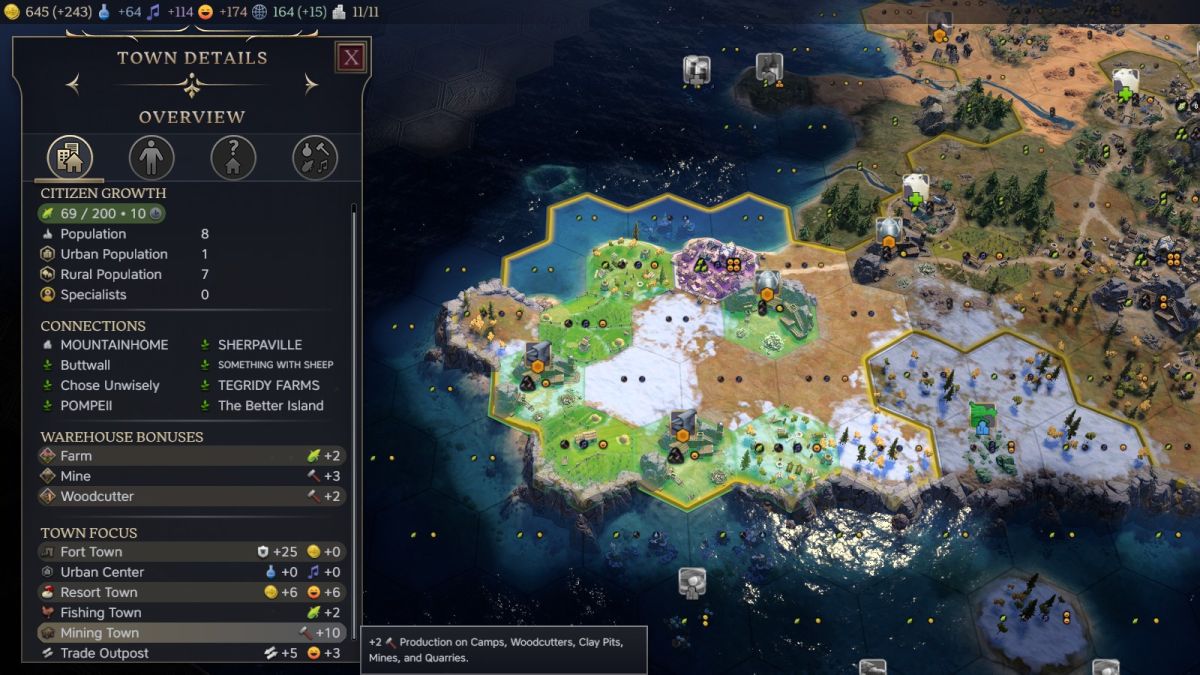
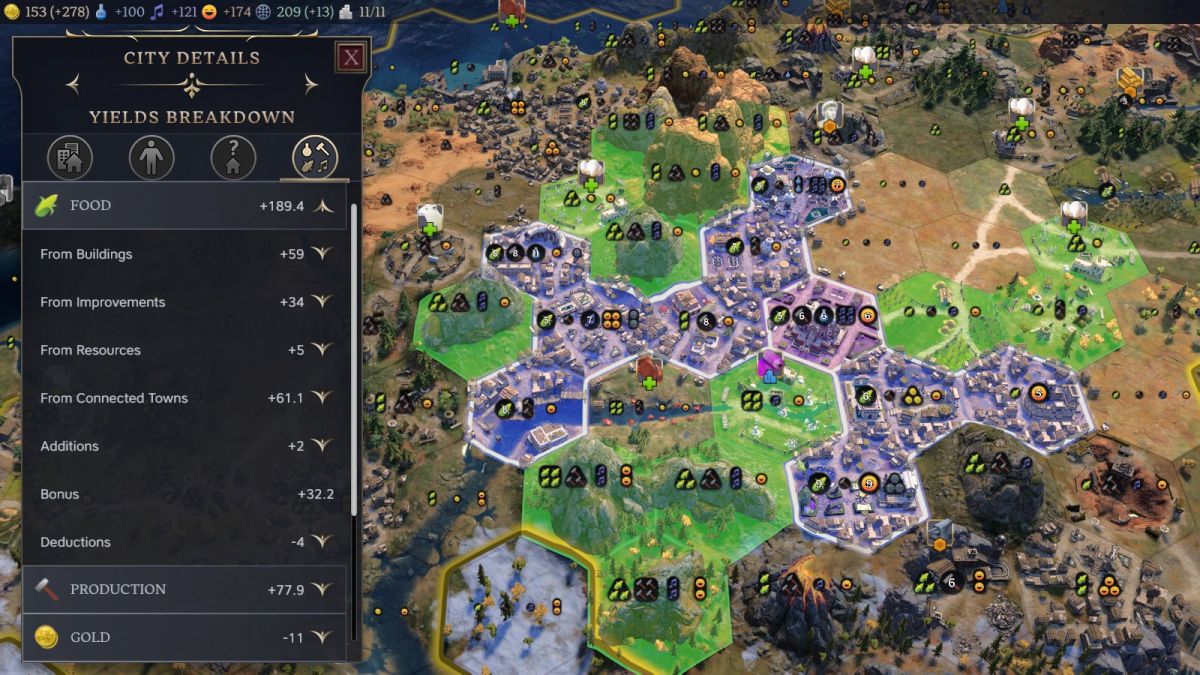
This was one such town, the replacement for the hostile IP in the west named Sullla's Better Tiwanaku. Towns like this one are designed to claim any resources in the area and grab any tiles with strong yields, with the double iron and silver resources being the main draw for this particular settlement. The food mechanics have changed significantly such that it's actually worthwhile to let these towns grow for a while and claim all of the good tiles in their region; note that I needed 200 food to grow the 8th pop point here which would have cost 417 food on the release version of Civ7. Once all of the good tiles have been claimed, then it's time to convert the town over to one of the different specialization options. This stops the town from growing any further in exchange for getting a bonus to some type of yield listed under the "town focus" options at the bottom. Towns with a focus also send their food over to other nearby settlements which can be a major boon to their own growth. Mountainhome was all the way up to 189 food/turn (which converted into 18.9 bonus production via Pachacuti's leader ability) thanks to 61 food/turn coming in from connected towns. I picked the Mining Town option for Sullla's Better Tiwanaku as it seemed like the most useful choice, effectively granting an additional 10 gold/turn since towns turn all production into money. Most of my other towns chose this option as well for lack of anything better, though there were several that I simply kept growing for the entire age as they still had good tiles to acquire.
What I don't like about this system is that a town's focus still cannot be changed once picked. There's exactly one chance to make a decision and then the town is locked for the rest of the era, too bad if you change your mind later. I also need to point out that this whole screen was being altered by the City Hall interface mod to highlight the town connections, warehouse bonuses, and what benefits the town would enjoy from the various focuses. The default gameplay does not tell the player what the town will actually get from selecting the different focuses, something that sounds incredible - how can you even make a choice with the numbers completely hidden in the dark?! I really hate how I'm constantly forced to download these interface mods to have any idea what's going on in terms of the gameplay.
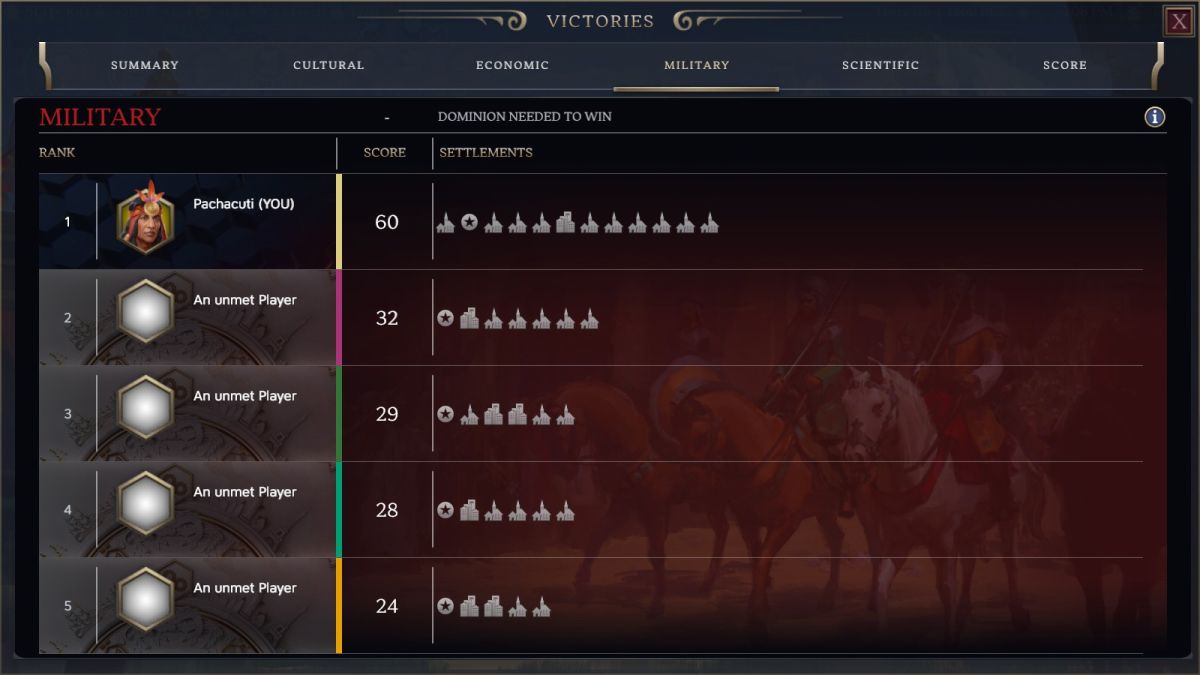
I also spent some time poking around in the new victory screens since the old ones based on the legacy scoring goals have been completely reworked. All four of the various victory types are now based on accumulating points in their respective categories and then hitting a moving target that gets easier to reach as time passes on the calendar. It's still completely impossible to win any of the victories in the Ancient era however some of them can be reached in the Exploration age if the player gets far enough ahead. Each of the victory conditions now makes a lot more sense than before, such as scoring Economic points for constructing gold generating buildings and connecting resources or accruing Science points for researching various goals on the tech tree. The pictured Military victory granted players 4 points per settlement controlled, with an additional point for captured settlements and four extra points for a captured enemy capital. (Note that no AI civ had more than seven settlements even though I had doubled the settlement cap in this mod - they all still suck at expanding.) This is effectively now a Domination victory condition as any civ that gets big enough, via conquest or simple expansion, can eventually win the Military goal.
Best of all, the events of the first two eras actually matter now in terms of winning the various victory conditions. It was ridiculous how absolutely no progress could be made towards any of the victories until hitting the Modern era and then the player would race across the finish line in 30 turns because the scoring conditions were so poorly chosen. This is definitely a much better system, however the tradeoff is that the new victories often don't feel like milestones since the player can win based on arbitrary calendar-based milestones. You hit a certain date and suddenly shift from needing 3x anyone else's military scoring to 2x their score and then get declared the winner out of the blue - ummm, OK? It's another case of an improving gameplay mechanic that doesn't feel finished yet.
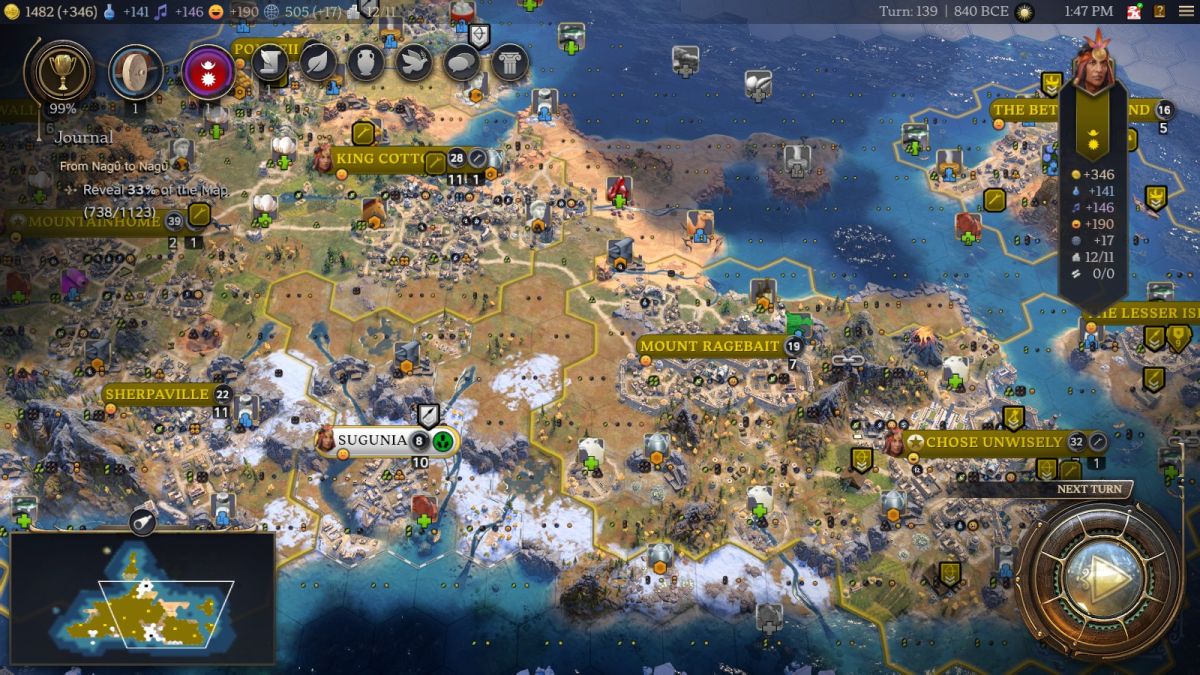
Very little of interest happened after Ashoka was eliminated for the rest of the Ancient era. I constructed some more buildings in my three cities, cash-rushed warehouse buildings in the various towns since they wouldn't obsolete during the era transition, and largely sat around waiting for the age to conclude. I couldn't research my way into overseas travel due to the idiocy of the ages mechanic, I had to wait around doing nothing until the game chose to move to the next era. Once the 10 turn countdown began, I trained or cash-rushed five settlers and about a dozen scouts so that they would be ready to start sailing across the waters at the outset of the Exploration age. This was really, really stupid from a gameplay perspective but the alternative to the "Continuity" option that I had picked for this game would have been the "Regroup" setting which would have deleted every ship, every civilian unit, and most of my military units. That was the only choice when Civ7 came out and I think that was even worse. It's almost like having these age-based roadblocks aren't a good thing for the gameplay, imagine that.
Anyway, that was the whole first era played to completion. It was time to move into the next era and finally get off this rock!