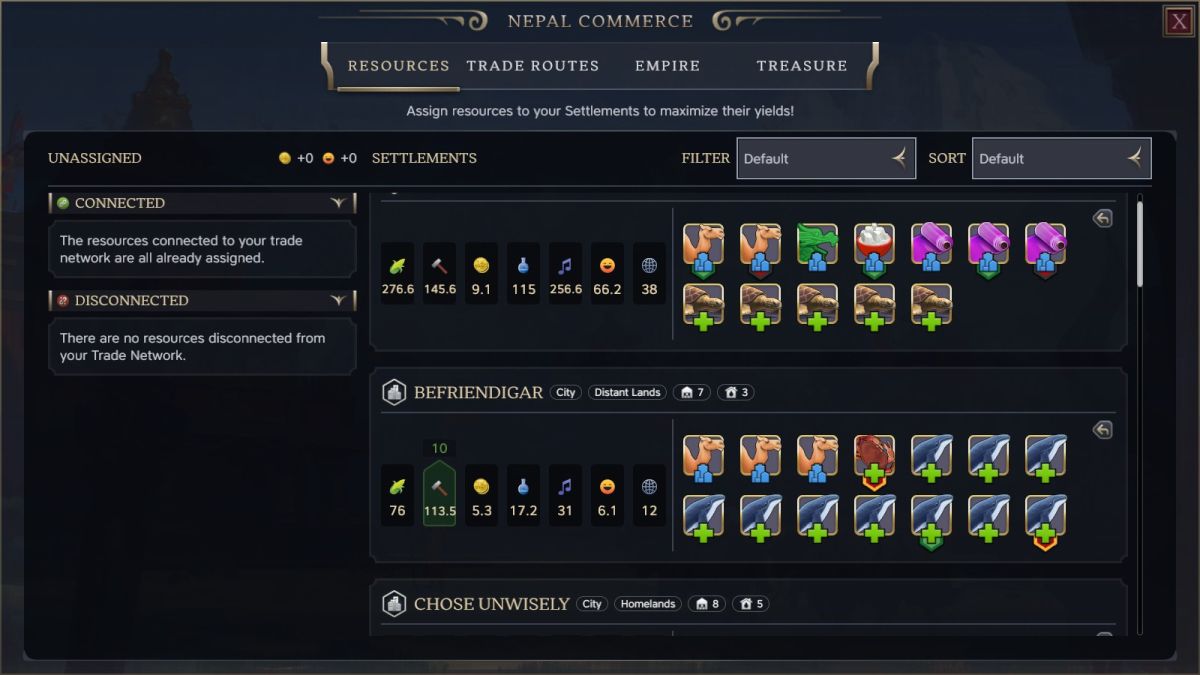
This was the first time that I had played through an era transition following the release of the Test of Time update to Civ7. The age reset was, well, slightly better but still not a lot of fun to experience. I ran the transition off Livestream to avoid boring the viewers and it took another 45 minutes to go through all of the various age transition tasks: picking new techs and civics to research, choosing new policies to run, reassigning all of the resources to each settlement (since the resources change and move around on each era transition), tossing influence to start befriending the new city states after the previous ones all magically disappeared, moving all of the various military units, assigning new builds in each city, and tediously going through every town to determine what focus it should run for the new age. Did the traditional Civilization gameplay really need these jarring discontinuities right in the middle of the player's experience? There's been some improvement through the course of patches since continuity mode no longer deletes and teleports all of your units but yeeesh this whole process is still horribly unfun in practice.
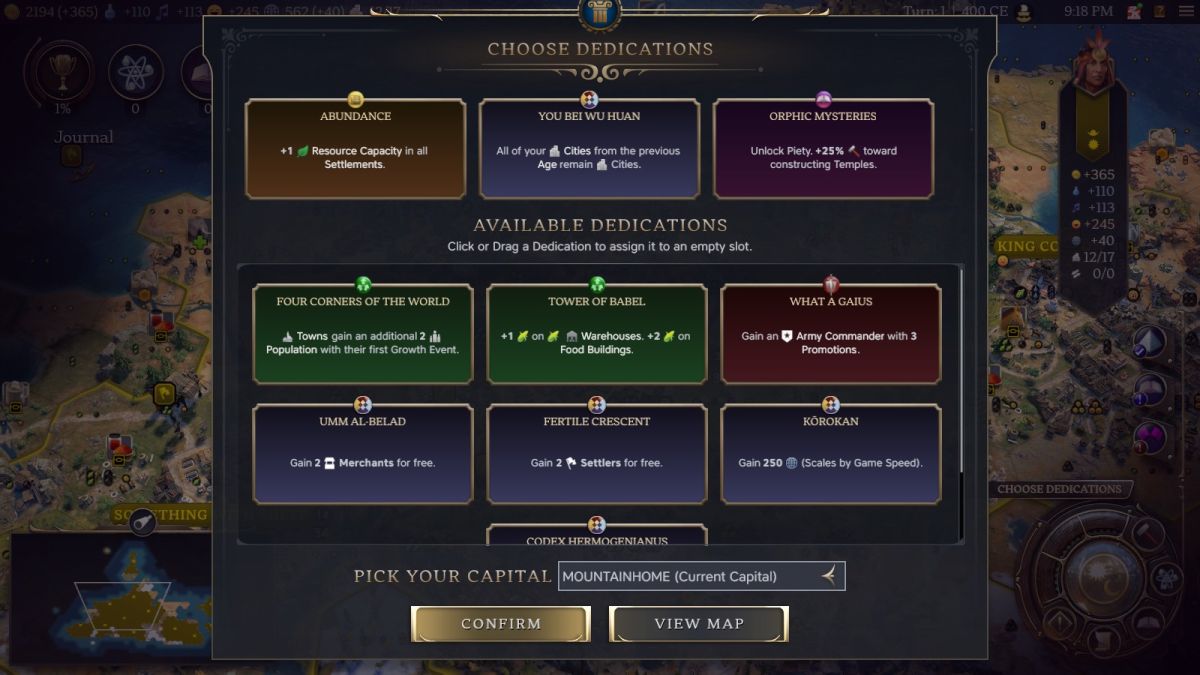
The biggest change post-Test of Time was the removal of the awful legacy scoring goals and their replacement with this dedication mechanic. There are a handful of dedications that are always available, such as getting to select two free settlers at the start of the Exploration age, and then the player can carry over any of the big dedications that they earned in the previous era. This is a vast improvement that alleviates some of the forced gameplay from the original patch versions and there's room for much more player flexibility here. I opted to take Abundance for extra resource capacity (a very big deal in towns that default to only one allowable resource) and the dedication that let me keep my cities as cities. That one is always available so no more having to mess around with slotted resources or treasure fleets just to keep your cities from collapsing back into towns, yay! Then for lack of better options I took the dedication that awarded the Piety civic for free and discounted temple production which I figured would help me found a religion a little bit faster.
Another thing that I liked was the fact that significantly more policies from the Ancient era survived the age transition than in older patches, stuff like Priesthood (+2 gold in all settlements) and Rites and Rituals (+2 happiness in all settlements) which were legitimately useful to have. Under the older system, everything that was not a civic-specific "tradition" would obsolete at the start of the next era and the player would be left with basically nothing to run for policies. For this game, I picked the Himal tradition that granted culture on mountain tiles along with the Hangjiao policy from my old Oligarchy government which added production on all warehouse buildings. What I didn't like was the fact that I dropped back down to a mere two policy slots for the start of the age after having about ten slots at the end of the previous one. Was that really necessary? It certainly wasn't much fun. I actually did manage to keep my science and culture roughly at the same output (about 150/turn of each) for the start of the age instead of collapsing downwards as usually happens, hooray for that I guess.
Elsewhere, I rush-purchased several more cogs with the funds leftover from the previous age and prepared my swarms of settlers and scouts to begin moving into the overseas fog as soon as the Cartography tech allowed civilian units to enter ocean tiles. This is where the ridiculousness of the age system becomes especially apparent, as I had spent the last two dozen turns of the prior era just waiting and waiting for the gameplay to allow my civ to travel off the starting continent. In every other Civilization game, you can prioritize overseas travel by researching that part of the tech tree; you, the player, get to decide how important this is and pilot your tech direction accordingly. Civ7 simply takes this off the table and decides that everyone will unlock overseas travel at exactly the same time, neatly removing all of the player agency in the process. This is supposed to help the AI function, except that of course the AI can't plan ahead around the era transitions properly and so the human player still runs rings around them at the outset of the Exploration age. The gameplay ends up getting railroaded in a really unfun way for no point whatsoever.
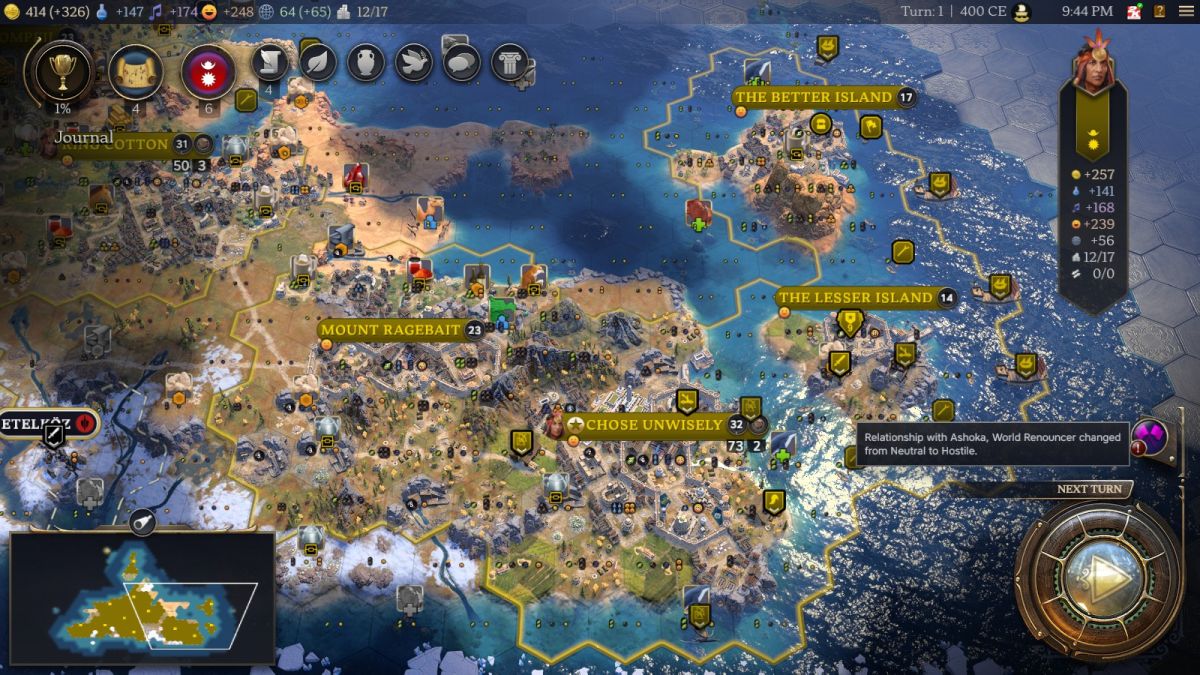
And yes, the gameplay insisted on printing out a message about my relationship status with the deceased Ashoka - no bugs to be found here! 

There were three new government options for the Exploration age and I had to pick one; there was no option to stick with one of the Ancient era governments if desired in yet another forced mechanic. Plutocracy looked to be by far the best choice of the new trio, largely because of that 20% production bonus towards overbuilding city improvements. I'll highlight shortly why overbuilding older structures has gone from a difficult choice into a total no-brainer under these recent patches and Plutocracy therefore helps a ton on the production end. Primitive Accumulation was also pretty decent since science is difficult to generate under the current gameplay and the instant 600 gold infusion for each celebration was another nice boost. The other two options were Feudal Monarchy (only good for fighting) and Theocracy (heavily tied to religion) which both felt much weaker to me outside of their specific niches. I was still trying to play a peaceful game here and religion is one mechanic that remains a placeholder shell with little attention given to it thus far in Civ7 patches. When I built my first temple, I named my own religion Crabby McCrabber with the crab icon and took some very standard beliefs, a relic for converting city states and minor science gain from converting enemy settlements. I could theoretically get some decent beakers from mass converting enemy cities but the AI is so rabid about spamming missionaries that it isn't worth the effort.
Anyway, Cartography tech rolled in and my ships and civilian units began pushing outwards in every direction. The gameplay felt that it was very important to tell me that those units were taking the rough seas damage on each interturn, over and over and over again. There was one turn where 17 (!) different units were hit with the rough seas damage and the gameplay scrolled to each one of them in turn to play the damage animation, sigh. I met my first foreign leader, Edward Teach of the Pirate nation, who was located off to the northwest at a fairly close distance. Despite the pirate moniker, Teach was pretty friendly and we signed a series of endeavors that boosted relations. I had six different settlers pushing into the fog in mostly blind fashion along with an equal number of cogs and scouts, all of which soon began to identify unclaimed overseas islands ripe for the plucking.
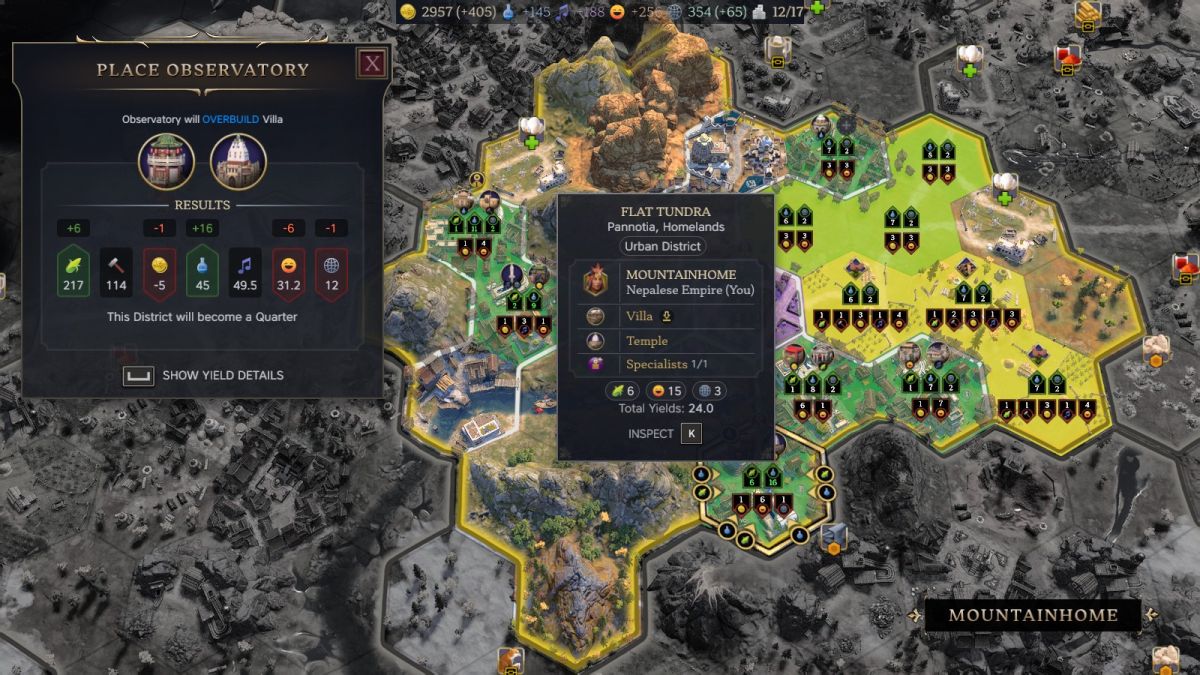
Here's a little bit more about overbuilding in practice. Readers may recall that all of the non-warehouse buildings from the previous era go obsolete at the start of the next era transition, with their yields getting slashed down to a minimal amount in the process. (It's the single most anti-fun mechanic in Civ7 and I have no idea why the developers thought players would like having all of their progress torn apart.) But even with those yields greatly reduced, it used to be a tough call about whether to overbuild the prior infrastructure with new buildings from the current era. An obsoleted library would still produce 2 beakers/turn while the Exploration age observatory, the tier 1 science building in this era, used to be worth 4 beakers/turn before adding adjacency bonuses. Even if the old library had a better spot in adjacency terms, I often left the obsoleted buildings intact because they were still contributing in a significant way. Four beakers/turn against two beakers/turn just wasn't a big enough increase to justify tearing down the old stuff.
That is definitely no longer the case. All of the Exploration age buildings have had their yields drastically increased over the old system, such as this new observatory being worth 16 beakers/turn (!) Later on, I was routinely building banks that were worth 18-20 gold/turn without even having particularly amazing placements. These vastly increased yields put the obsoleted buildings to utter shame and makes it obvious that they are no longer worth keeping, since 16 beakers/turn paving over 2 beakers/turn isn't remotely close. Furthermore, one of the recent Civ7 patches added a mechanic whereby each building constructed in each city makes all of the future buildings more expensive, and that INCLUDES the obsoleted buildings! So you really want to bulldoze those things since they contribute virtually nothing and make it harder to build the new stuff that has much better yields. There doesn't seem to be much strategy to the city-building these days as the player is simply overbuilding atop the same 4-5 tiles with the identical building types in each era. All of this feels idiotic and self-defeating to me but that's the gameplay that the developers have constructed thus far in the patching process.
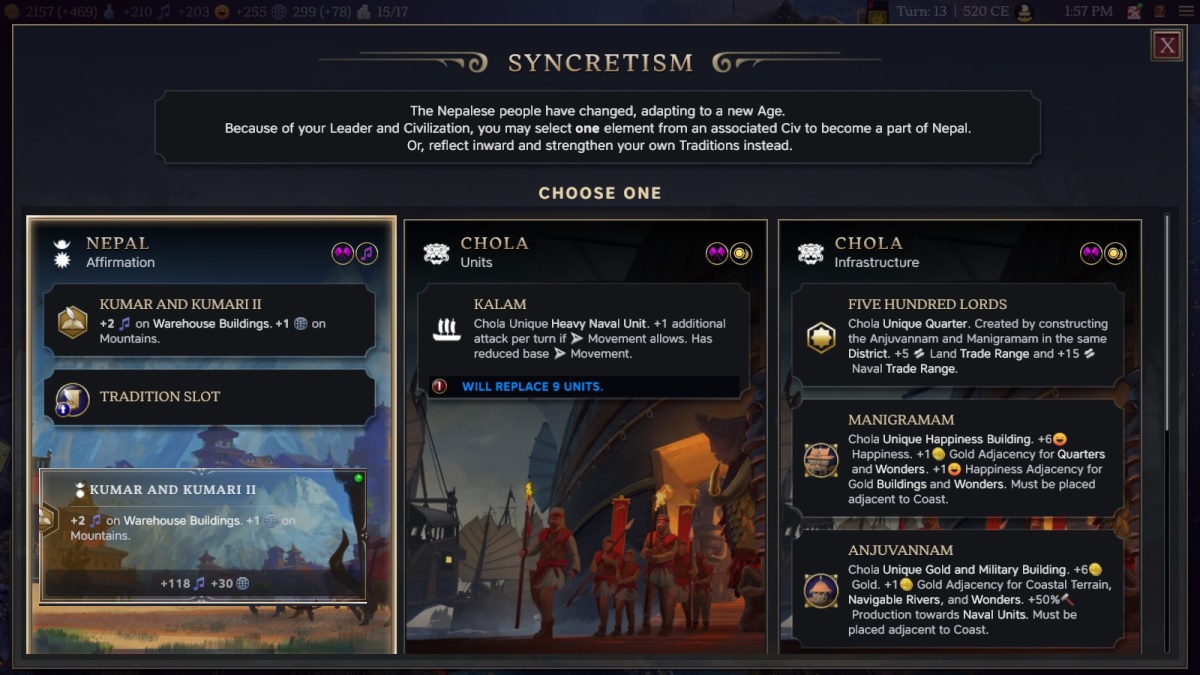
I was sticking with Nepal for this game which meant that I was able to select one additional syncretism option after researching it on the civics tree. I considered taking the Chola unique quarter which grants happiness and gold, however I didn't like how it has to be placed on water tiles and the fact of the matter was that I didn't really need happiness that badly. Instead, I opted for the Nepalese Kumar and Kumari tradition which proved to be a fantastic choice. This tradition came with its own slot to run it effectively for free and granted +2 culture on every warehouse building along with +1 influence on each mountain tile. The policy yield preview mod didn't function on the syncretism screen but kicked into effect once I had made my selection: Kumar and Kumari was immediately worth 118 culture and 30 influence per turn! That was an increase of roughly 50% in both categories and I would eventually get the culture bonus over 200/turn from this single policy. As nice as that unique district would have been, I think that this Nepalese tradition was significantly better.
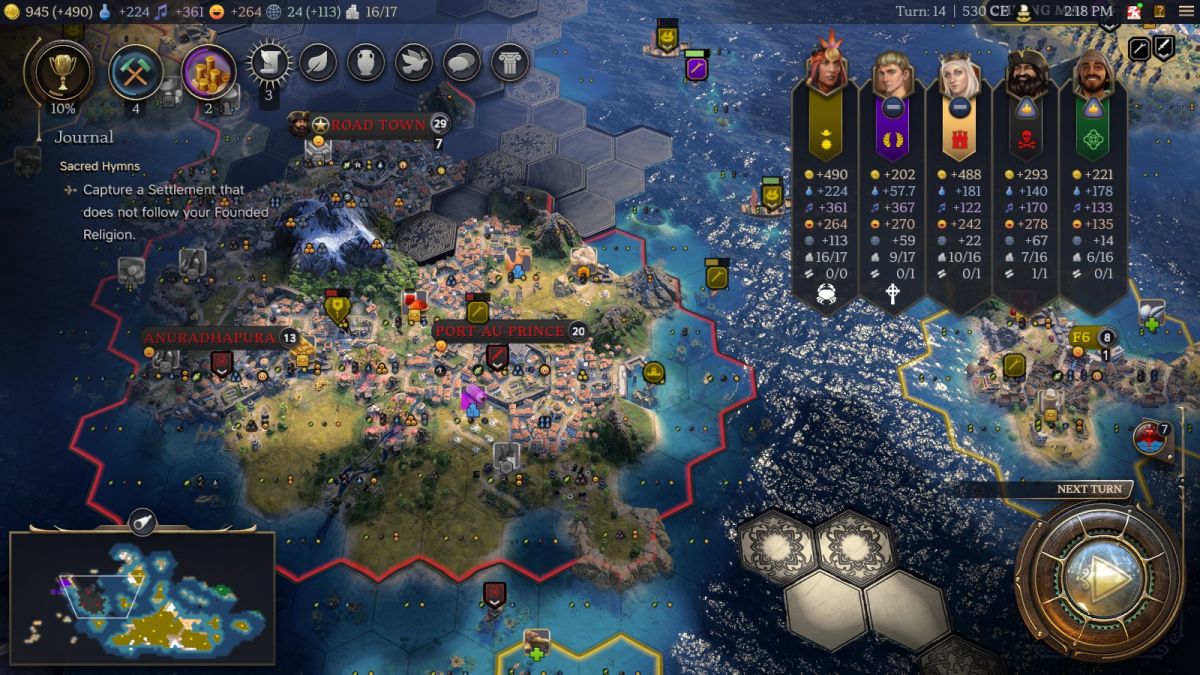
My Nepalese civ met the four remaining AI leaders in just over a dozen turns of exploration. Teach and the Pirate civ were the closest to the northwest and it turned out that Augustus' Rome was a bit further in the same direction. Isabella of Spain and Ibn Battuta of the the Abbasids were located in the opposite direction to the northeast, further away beyond a small line of barrier islands. It was notable to me that some of the AI leaders were doing well in individual categories, like Isabella matching my civ in gold income and Augustus equaling my efforts when it came to culture. However, no one was competitive in more than a single category and some of these leaders had drastic shortcomings, like Augustus with only 57 science/turn or Ibn Battuta with a mere 14 influence/turn. Several of the AI leaders took nearly 30 turns to establish their own religion, which requires only researching Piety civic and building a single temple! It also bears mentioning that the AI cheats *OUTRAGEOUSLY* when it comes to these yields which might as well be pulled out of thin air. There was one point later where Ibn Battuta was stated as having about 400 beakers/turn and I went through his cities and counted his actual science yield which was maybe 150 beakers at best. Sadly, even with these gigantic cheats the AI leaders don't put up much of a fight outside of spamming units on the defensive.
The other huge flaw in the AI leaders was their lack of expansion. This has been a problem since the outset of Civ7 and it still hasn't been fixed in patches: these guys just do not expand. There was ample space available on this map and I had furthermore doubled the settlement cap with a mod so every AI leader was nowhere close to hitting the happiness limitation. And yet they were all struggling to get past 10 total settlements even as I continued to race ahead, planting four new settlements by Turn 15 with more settlers on the way. The AI leaders are especially bad at expanding overseas via the distant lands mechanic; they will do it, eventually, but it takes them a while to research Cartography and then they handle the rough seas damage poorly. I suspect that this is a major reason why Civ7 has the terrible settlement cap mechanic in the first place: as a crutch for the AI to cover up its atrocious expansion. The other reason why the settlement cap exists was to ensure that there would be lots of unclaimed land still available in the Exploration age so that those treasure fleet resources could be settled, though the gameplay has fortunately moved away from that direction in the patches. Many, many problems in Civ7 would be solved by scrapping the settlement cap completely while simultaneously making the AI civs much more aggressive about expanding across the map.
My initial two city state alliances matured around Turn 15 and I was able to claim the good old +1 settlement limit option from the Militaristic IP on my starting continent. Then I barely outraced Edward Teach to a Cultural city state in the north where I was able to take bonus culture on saw pits and fishing quays. These city state bonuses are enormously weaker than in the initial patches where the player could get 5% bonus science from all sources, PER CITY STATE, and then balloon past every AI civ without breaking a sweat. Nowadays it's still worthwhile to ally with them but the resulting bonuses are a lot more reasonable and the AI leaders will actually compete for them with their own influence. On the subject of culture, I also received a Cultural attribute point out of the blue on Turn 21. Why did I get this attribute point? The gameplay certainly didn't tell me. (It's apparently "research six civics" when running a civilization with the Cultural tag which Nepal happens to have - what doesn't the game actually tell the player what's going on?!) For that matter, attribute points are in a really weird state in this current version of Civ7, clearly a vestigial leftover from the old legacy scoring goals system that don't serve much of a purpose anymore. They should probably be rolled into the dedication and triumph mechanic rather than having the two gameplay systems sitting next to each other doing much the same thing.
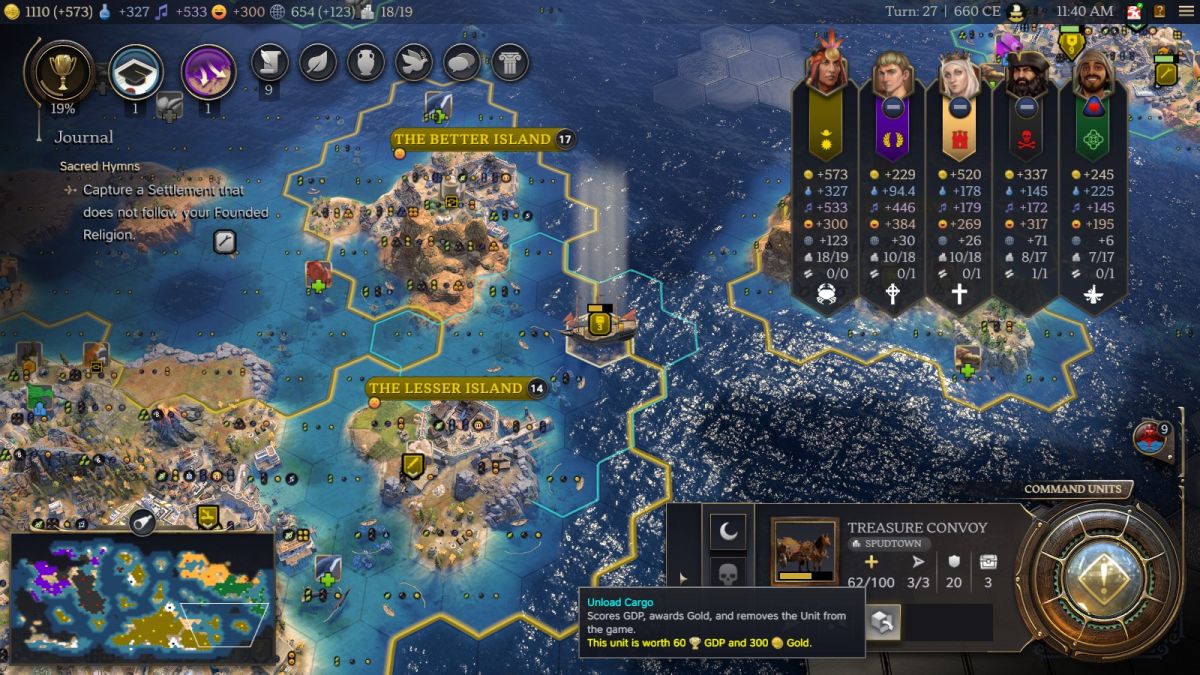
I also began returning the first treasure fleets here in the Exploration age and this is another mechanic which has experienced major changes. First of all, the treasure fleets no longer have that stupid requirement of needing to research Shipbuilding tech before they start appearing, which could cause players to settle the resources for dozens of turns before they actually did anything. Now if you settle a treasure fleet resource overseas (helpfully with their own little gold chest icons) and place an improvement on the tile, the settlement will start producing the fleets automatically. They can still be brought back to any homelands settlement and cashed in for a modest gold payment, however they no longer score the old legacy points. Instead, they are worth something called GDP which contributes towards the new economic victory:
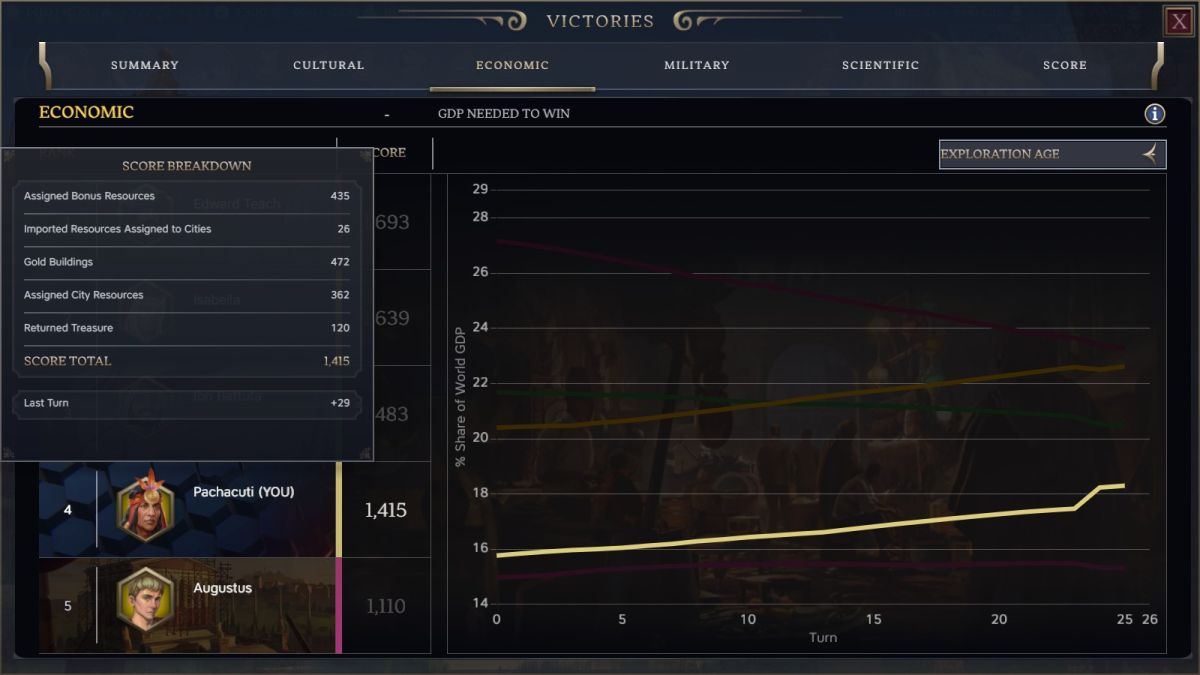
Each of the four victory types has a screen like this; I included a picture of the Military victory screen on the previous page. While that one was pretty simple and largely based on controlling as many settlements as possible, the Economic victory has each leader scoring GDP points every turn based on two main factors: resources slotted into settlements and buildings that generate gold. For some reason the interface splits the resource category into bonus resources, imported resources, and city resources but they all function the same way. The Exploration age then adds a third category for the treasure fleets which provide one-time payouts of GDP upon delivery rather than the steady per-turn GDP income from resources and gold buildings. Therefore the treasure fleet resources have been reinvented as a contributing factor towards the Economic victory instead of being the *ONLY* thing that scored legacy points in this category which is obviously far healthier for the gameplay. This has been a total no-brainer revamped mechanic and a clear improvement over the atrocious initial implementation of how the treasure fleets worked.
Surprisingly, my civ was sitting in fourth place in this scoring category even though I had done a pretty good job on the resource category. I was behind the other AI civs when it came to the gold generating buildings, particularly Isabella who must have had something in her leader and civ kit that emphasized these structures. The good news for me was the fact that the AI leaders remain horrible at settling and delivering treasure fleet resources so I would rapidly climb the Economic leaderboard over the following turns due to little more than settling unclaimed portions of the globe.
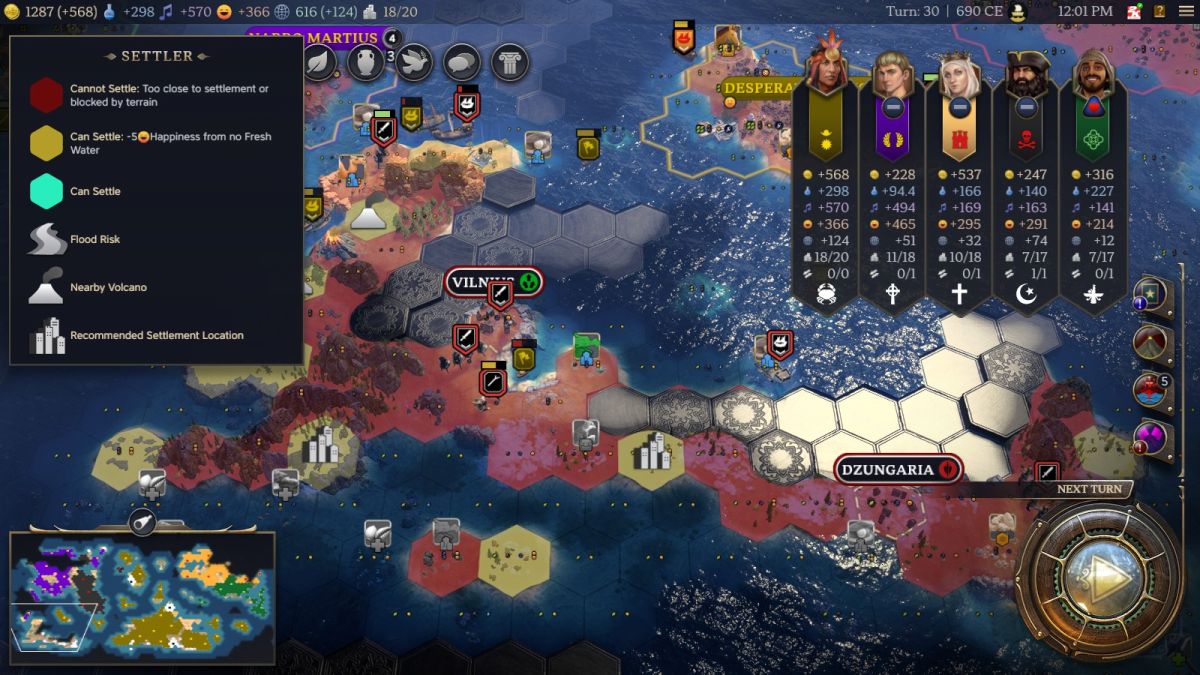
The map itself proved to be a bit disappointing as there weren't a lot of good places to establish new settlements. I gobbled up a series of islands to the north and west which were big enough to support decent-sized towns while leaving the truly awful one-tile locations for the clueless AI leaders to settle. There was basically nothing available on the other two main continents to the northeast and northwest, however, and the only other landmass of any size was this icy subcontinent in the far southwest. I knew that there was something here thanks to having discovered Mount Everest in Teague's territory, a natural wonder that reveals all mountain tiles on the same "continent" and indicated a decent chunk of land to the southwest. I was cash-rushing settlers out of the town of Desperate Struggle and sending them blindly into the fog since my cogs were only just arriving in this area too. That did cost me the forwardmost settler when I discovered a pair of hostile independent powers who ganged up on the poor settler and eliminated it. My other settler in the north barely survived to throw down a new settlement, after which my huge gold/turn income allowed me to rush out more units and additional settlers. I would eventually befriend both hostile IPs and place four different settlements on the icy island, taking advantage of all of the mountain tiles and the isolated nature of this portion of the map.
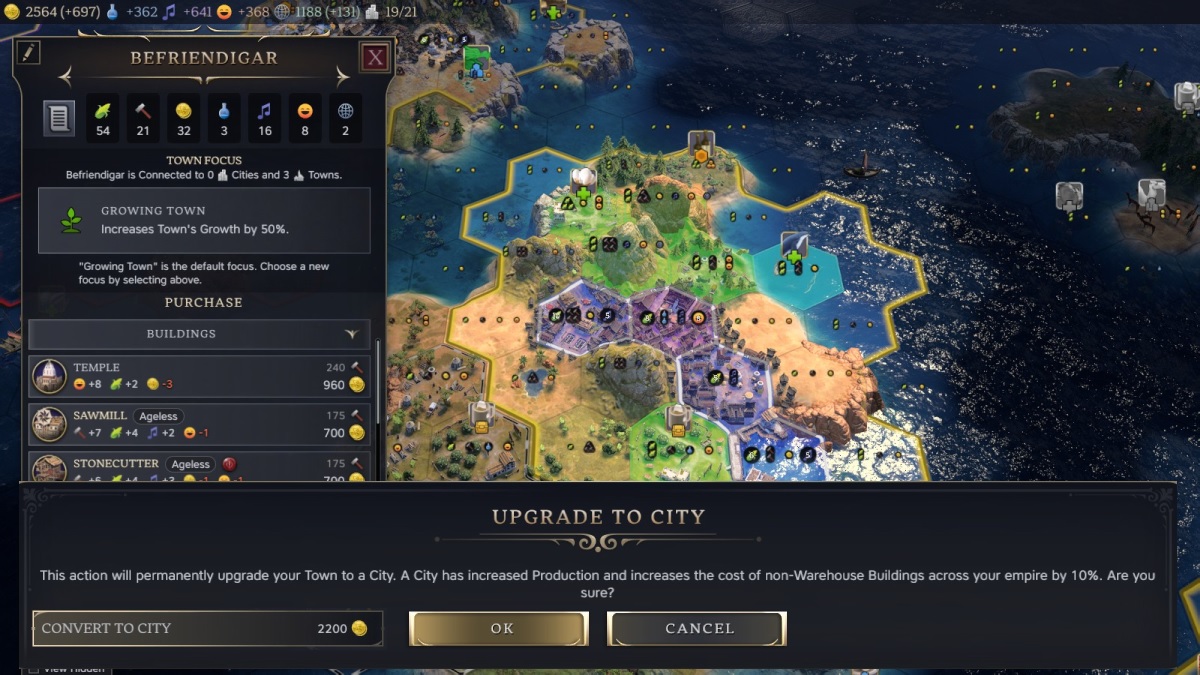
Like I said, there weren't really that many places on the map which had enough terrain to justify upgrading from towns into cities. I went into the Exploration age with three cities and was looking to find a couple more spots which would warrant turning into cities, eventually deciding that this island spot we had named Befriendigar was the best candidate. It had four mountains, several useful local resources, and enough room to add roughly eight quarters which should be enough to build everything I wanted. The issue here wasn't paying the significant cost of 2200 gold to upgrade from town to city, it was this recent mechanic that increases the cost of all non-warehouse buildings across the empire by 10%. There are actually two different forms of cost scaling on buildings in the current version of Civ7. First, there's the within-city scaling under which each building constructed increases the cost of all future buildings (which essentially forces overbuilding of everything outdated). Then there's this second form of cost scaling, under which each new city increases the cost of all non-warehouse buildings everywhere. This cost scaling stricting limits the player to a handful of cities since the building costs will quickly spiral out of control if they try to employ a mass cities strategy. That's what happened to me at the end of my Catherine culture game where I was hit hard by this patch change mid-game and it proved impossible to construct literally anything in the Modern era.
It all adds up to a total reversal from the release version of Civ7 where towns were virtually useless and the best strategy was upgrading everything to cities. I actually preferred that mechanic because you wanted to turn your weak towns into productive cities and it was a constant scramble to save up enough money to upgrade them without needing to burn it on rush-purchases and unit upgrades. Now Civ7 has become more of a simulation game where the player doesn't actually build anything in most of their settlements, just buy the basic warehouse buildings (since they don't affect any of the cost scaling) and then otherwise leave them alone. The antidote to this is the town focus system, under which each town can specialize in exactly one thing, whether that's economic buildings in a resort town or religious stuff in a religion town, etc. I can see why a lot of players like this mechanic since it limits the number of build queues that they have to manage and simplifies the gameplay to some extent. Not me though: I like controlling my own cities and the notion that roughly 75% of my settlements will never have their own build queues is not something I enjoy. Much like Civ5's obsession with having a small number of "tall" cities, this isn't a direction that I like for the series.
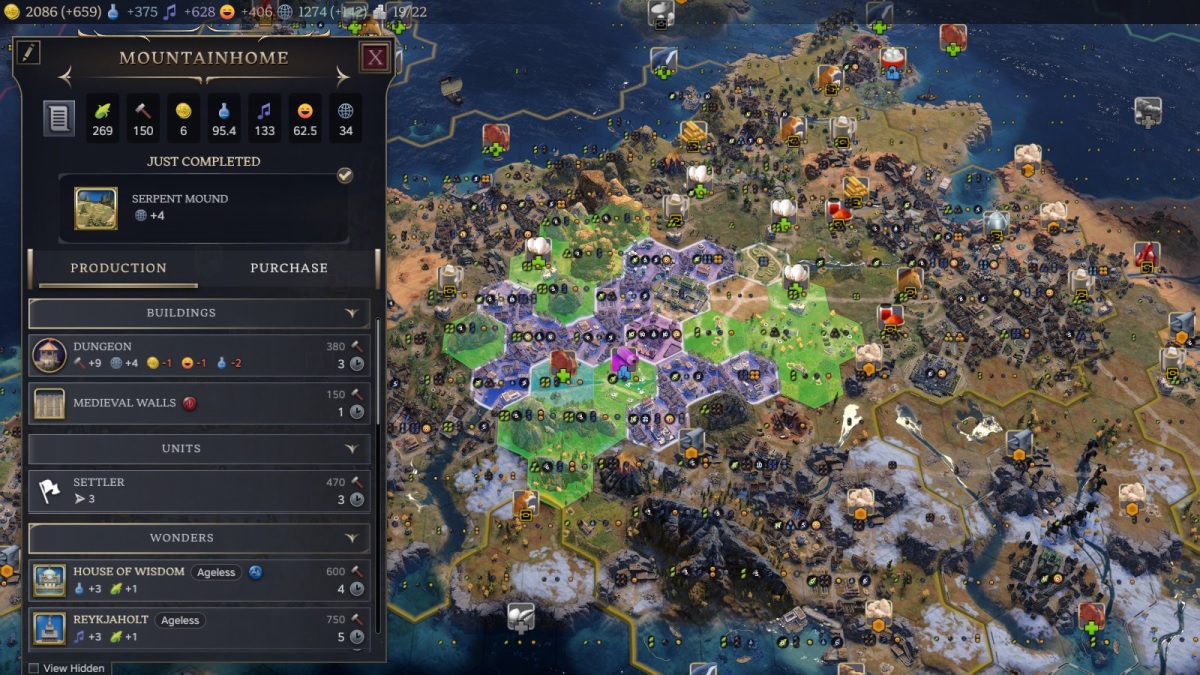
This cost scaling on buildings does some really weird stuff to the internal city building dynamics. I had limited myself to a total of five cities in this game, my original three from the Ancient era and then Befriendigar and Sherpaville upgraded to cities in this age since I couldn't find anything on the islands better than my old third settlement. Even with this limitation and an avoidance of mass city upgrades, the cost of buildings here in my capital of Mountainhome still felt weirdly out of place. Note that I could construct a dungeon, the tier 1 production building from the Exploration age, for a cost of 380 hammers in 3 turns. Or I could construct a world wonder like the House of Wisdom for 600 hammers in 4 turns or Reykjaholt for 750 hammers in 5 turns. Shouldn't the wonders be a little bit more expensive, or the standard buildings a bit cheaper? The later buildings in the era like the bank and hospital were actually more expensive than their contemporary world wonders thanks to this cost scaling being in effect. That said, I still mostly preferred adding the standard building infrastructure because so many of the world wonders in Civ7 are weak and forgettable. Using the example here, Reykjaholt grants 3 culture/turn, 3 relic slots, and bonus production on training military units in the city. The Serpent Mount adds 4 influence/turn and then 3 science / 2 production on all unique improvements within the city. These effects are pretty bad under normal gameplay and I would far prefer having a university for more science than this nonsense. I wish that Civ7 would redesign its whole approach to wonders, making them both more expensive and more powerful. Nearly all of the wonder effects are limited to a single city in this game and they just aren't impactful in the way that wonders were in past Civilization games.
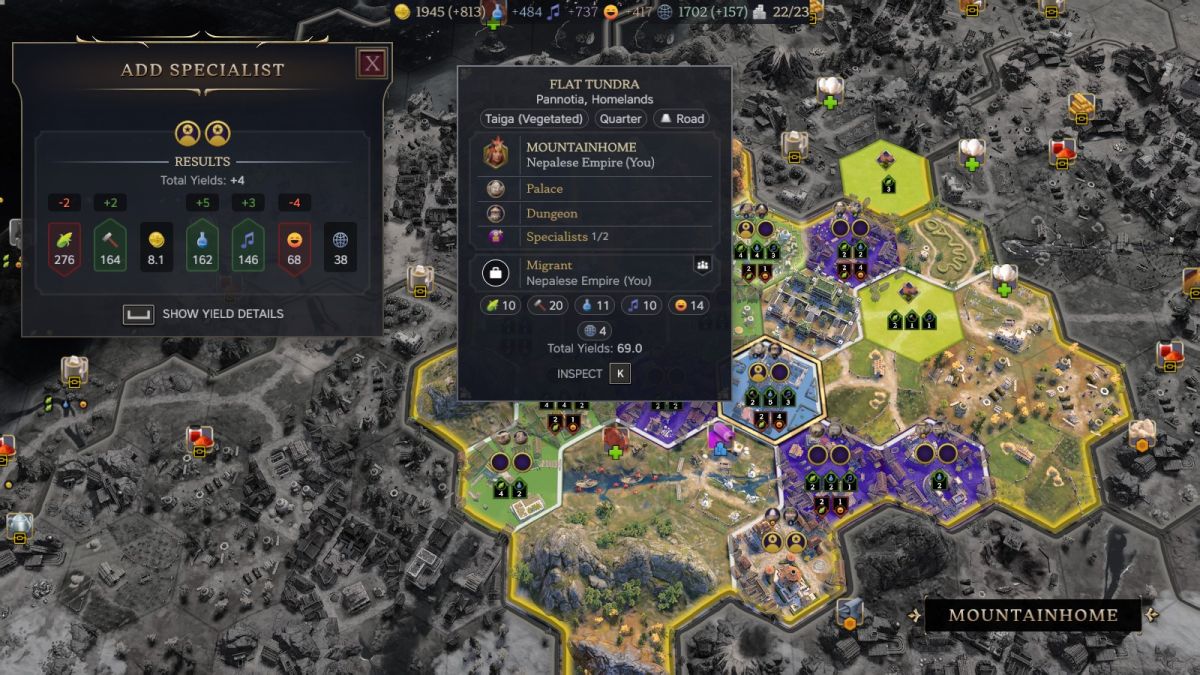
Now that I had made it a good chunk of the way through the Exploration age, specialists started to become more useful in my mature cities. The recent patch changes have altered specialists so that they provide less of a flat benefit but gain more in the way of bonuses from buildings and adjacencies. Basically specialists trade food and happiness in exchange for increased production, science, and culture which scale to a larger and larger degree as the gameplay progresses. I highlighted this particular specialist as a good example which cost 2 food and 4 happiness (both of which were ample here at the capital) and received back 2 production, 5 beakers, and 3 culture. There are also a bunch of Exploration age civics that cause specialists to cost extra food or happiness and grant more beakers or culture or gold in return. Those things start out being very weak and grow more and more powerful as time goes on. Honestly, I actually think this portion of the gameplay is working pretty well, though I do wish that there was a way to move specialists once assigned.
Anyway, I just kept expanding and building upwards as the turns rolled along in this age. The AI made little effort to place new settlements overseas and there wasn't a single point in time where they managed to deny me a spot that I wanted. I suzerained the two city states on the icy island in the southwest, picking up the fairly useless Kasbah unique improvement from one and yet another +1 settlement limit from the other. My two new cities were bootstrapped in their production capacity by stuffing them full of camels and whales, while my capital turned into an aquarium packed full of turtles for the culture bonus that they provided. Eventually I made it up to 24 settlements while still under the settlement cap; none of the AI leaders had gone past 11 settlements. In fact, between Turn 25 and Turn 70 there were exactly three settlements added by ALL FOUR of the enemy leaders combined: one for Augustus, one for Isabella, one for Ibn Battuta, zero for Teach. It isn't very difficult to outperform these turkeys when the player is constantly expanding and they fail to do the same.
Edward Teach technically did add one new town (he signed one away in a peace treaty with Augustus to net out at zero total change) which went in this obnoxious spot:
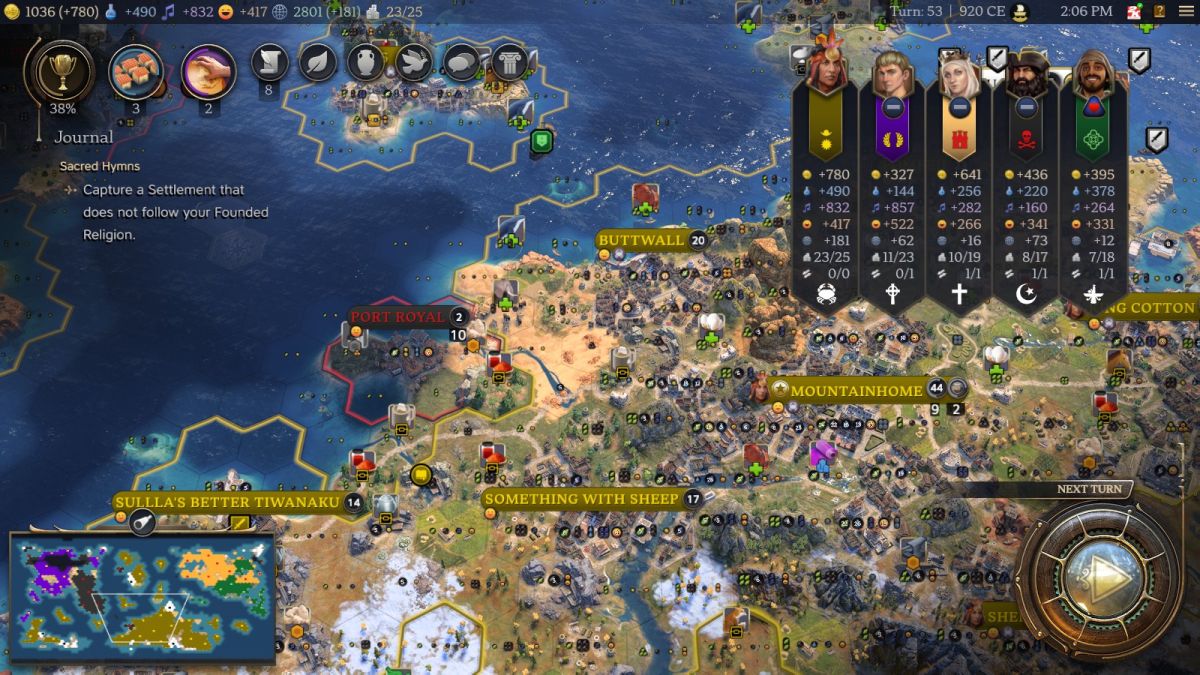
With two spices and a tea resource here, this was honestly good enough to justify a town placement - I should have grabbed it for myself, whoops. At least I could take it away from the Pirate civ with ease if they ever decided to get aggressive. The whole map was essentially settled by this point in time and I could finally stop dropping huge amounts of income into constant settler purchases. I therefore switched over to rush-purchasing the basic warehouse infrastructure in every town. These granaries and brickhouses and fishing quays were dirt cheap to purchase at 220 gold apiece; there were five of them in total which cost 1100 gold for the full set. Each of these warehouse buildings would never expire and produced solid food / production yields to help each town grow faster, plus they added extra culture via the Nepalese Kumar and Kumari tradition. The towns would output somewhere between 10-15 culture each and then grow rapidly thanks to the extra food, even slowly paying back the invested cost via higher production (since all towns still convert production into gold each turn).
Even with their huge cheats on Immortal difficulty, the AI civs couldn't compete with my civ being so much bigger and better. Soon I was outperforming everyone in every category on the yield ribbons, with culture being significantly higher than science since my Nepalese civ leaned in that direction. My civ was racing through the civics tree so quickly that I finished every available option, including all of the civic masteries, right around Turn 60. I was left with nothing left to research except the Future Civics option despite the fact that the era meter was sitting at only 43% complete. When I finished the initial Future Civic a few turns later, the era meter jumped forward to 54% and printed out this message:
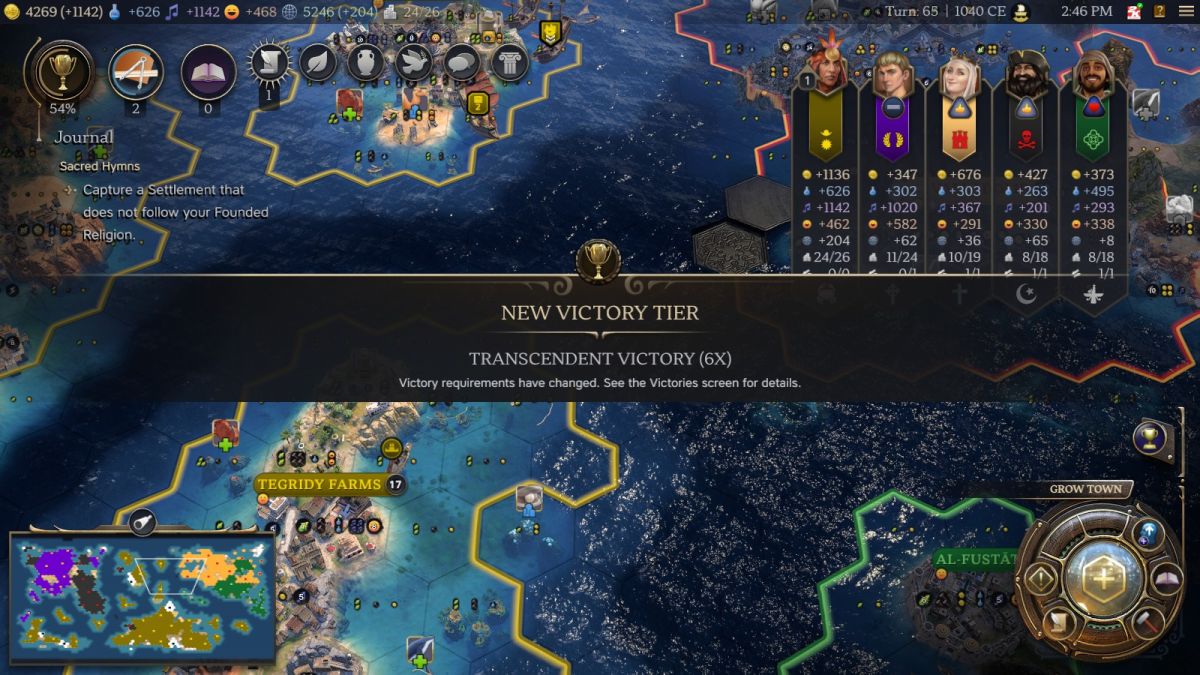
Era progression works very differently in the current version of Civ7 as compared to earlier patches. Under the old system, any civ fulfilling any of the legacy scoring goals would advance the hidden era meter which could cause the ages to end rapidly and unexpectedly. This was an even bigger issue in the Exploration age where the hidden era meter advanced twice as fast when legacy scoring goals were achieved, causing the era to move so fast that it could often be finished around Turn 60-70. The build of Civ7 that I was now playing had removed all of the legacy scoring goals and therefore they no longer existed to advance the era meter. Eliminating another civ also used to advance the era meter which no longer seems to be the case either. Instead, now the Ancient and Exploration ages will always last exactly 140 turns and the meter in the corner simply counts down the remaining turns expressed as a percentage (e.g. Turn 53 was 53/140 = 38% as displayed in my last screenshot). The *ONLY* thing that advances the era meter sooner than Turn 140 comes from researching either Future Techs or Future Civics, each of which cuts 10 turns (or roughly 8 percent) off the end of the age. Therefore the current Turn 65 advanced from being 65/140 = 46% to what was now effectively 75/140 = 54% total. Future techs/civics are the only way to advance the era faster than the otherwise predetermined 140 turns apiece - readers may recall that the Ancient era lasted exactly 140 turns in this game and the final two dozen turns had been a total snorefest.
The victory tier message was a reference to how the new victory conditions work in Civ7. With the legacy scoring goals removed, each of the four victory types has an entirely new mechanic that typically require the player to outperform all other rivals by a wide margin in that respective category. The old system was completely impossible to earn a victory prior to the Modern era; this new system does make it possible to win in the Exploration age, albeit very difficult to do so. It becomes possible to win upon reaching the halfway point of the Exploration age (normally Turn 70 though here advanced up to Turn 65 from researching that Future Civic). The victory screens then changes to looking like this:
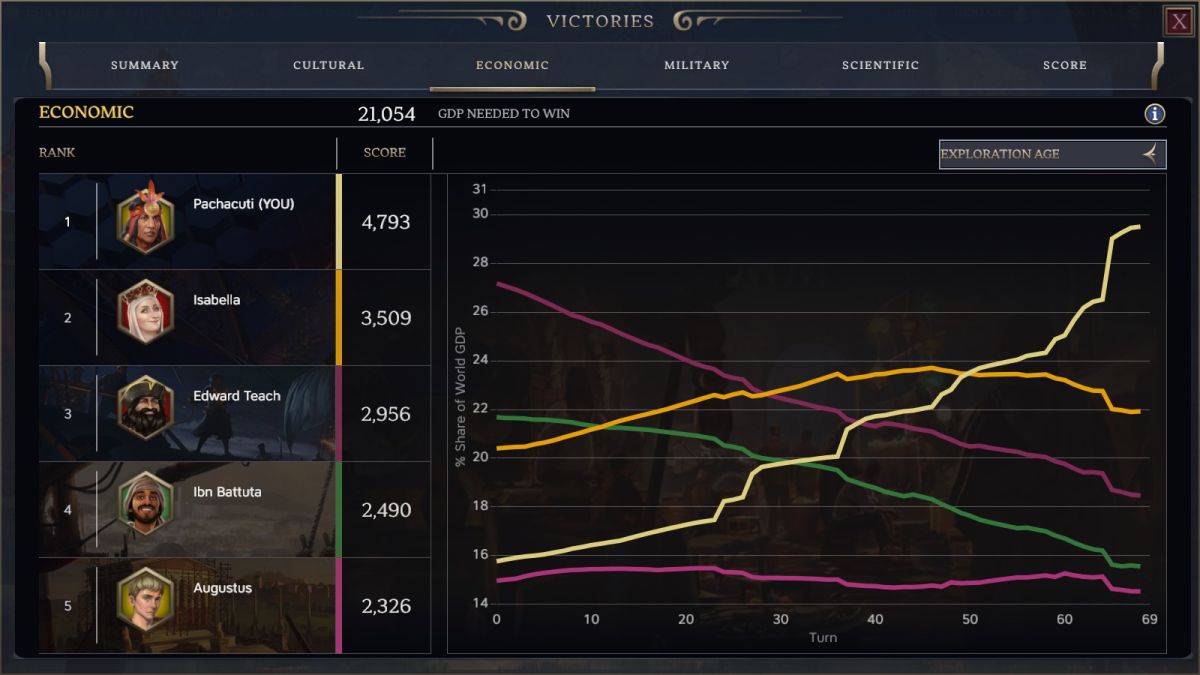
Note that the Economic category now had a "GDP Needed to Win" number at the top: a whopping 21,054 points. This number is calculated in each of the scoring categories at 6x the highest non-player total, in this case being six times Isabella's 3509 current GDP. The only exception is the Scientific category which essentially tasks players with reaching the end of the Modern era tech tree and then building the spaceship projects; the other three Cultural, Economic, and Military categories all function using this scoring methodology. I had about 2.5 times everyone else's Military scoring from owning so many settlements which was still far short of being 6 times what anyone else possessed. Even though I had absolutely rocketed ahead of everyone else in this pictured Economic category over the course of the Exploration age, zooming from roughly 16% of world GDP to 30% of GDP and leaving everyone else in the dust, the victory condition itself remained far out of reach for the moment.
So how exactly does someone win the game under this new victory system in Civ7? Well, in a nutshell the score multiplier needed to win in each category gradually decreases over time at various set intervals during the second half of the Exploration age and then the Modern era. At the 80% mark of the Exploration age, the multiplier drops down to 4x the highest score of the non-player civ in each category, then it keeps dropping further over the Modern era to 3x, 2x, 1.5x, and then finally 1.25x by the very end of the age. In other words, all of the victory conditions now look a lot like the tourism victory from Civ5/Civ6 where there's no predetermined number required and winning has as much to do with the other civs as it does your own civ. This can lead to some nonsensical gameplay like attacking and killing one of your rivals being the best way to win a Cultural victory, or alternately very passive gameplay where sitting around and doing nothing while waiting for the required score multiplier to drop will still lead inevitably to victory.
This is probably better than the old legacy scoring mechanic, where literally nothing that happened before the Modern era counted at all towards winning the game. But is this a good system in its own right? I'm much more dubious about that.
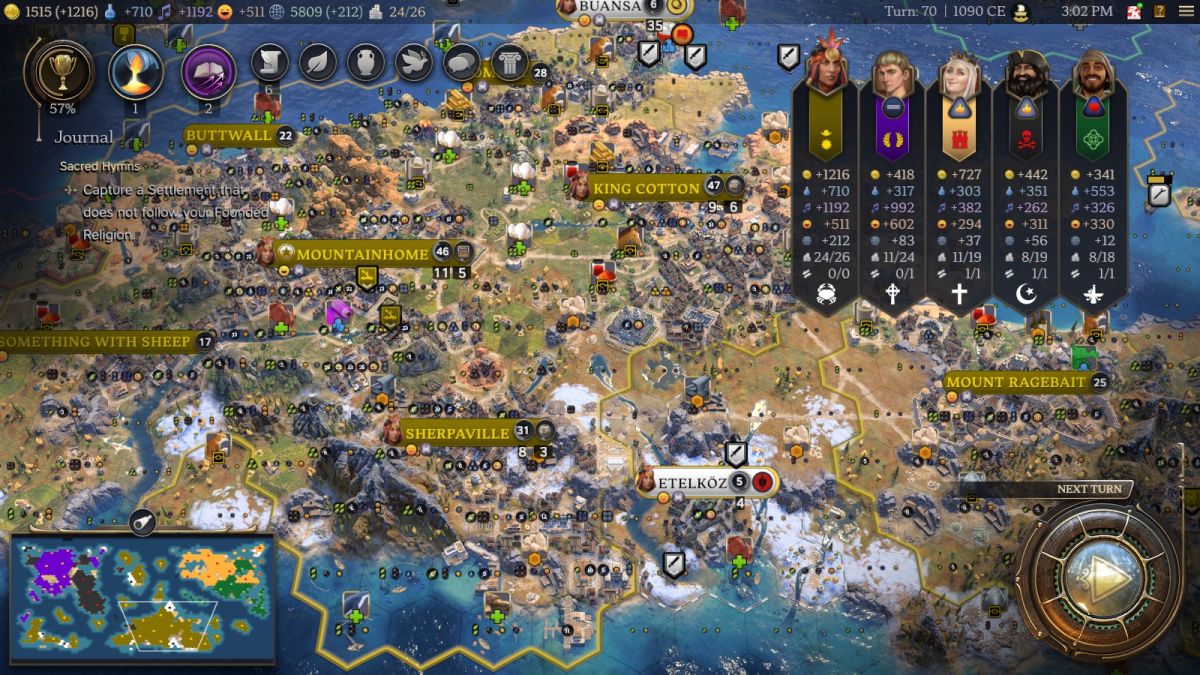
So by Turn 70 I was effectively finished with the Exploration age. I had completely finished the civics tree, researching the second Future Civic at the time of this screenshot, and the tech tree was about a dozen turns from completing as well. I was completely dumpstering the AI civs when it came to the yield ribbons, even with all of their crazy cheating, piling up thousands of influence points that I couldn't use unless a war were to break out somewhere. I had been using my huge gold/turn income to continue accelerating my science and culture output by cash-rushing more buildings out in the various towns scattered across the map. But that's when it hit me: improving my science and culture and production output past a certain point literally did not help me win the game at all here in Civ7. I was already effectively done with the science and culture trees, what point did more beakers and culture provide? And all those non-warehouse buildings would obsolete at the start of the next era and become mostly worthless thanks to the horrible age transition. Unless something very specifically provided Cultural, Economic, or Military scoring points (like creating resort towns and cash-rushing the gold generating buildings), then it was all pointless. I was literally just wasting my time.
See this is the other crippling flaw with the whole ages mechanic, one that I've discussed briefly in past reports but haven't really covered in detail. It's not just that each age transition ruthlessly obsoletes all of the stuff that the player has built and forces them to start over again in extraordinarily anti-fun fashion. No, the other massive problem with the ages mechanic is that it doesn't let the player *GET AHEAD*. In any other Civilization game, of course it would always be beneficial to keep increasing your science rate - it would let you unlock new units, new buildings, new everything faster! But that's not the case in Civ7, since after a certain point there's zero advantage to be gained from having faster science. No matter how well the player might be doing, no matter how quickly they race ahead of the AI civs in each respective era, they are pulled back to the same starting point at the outset of the next era. It didn't matter that I was ready to travel overseas long before the end of the Ancient era, the ages mechanic forbid it until the Exploration era started. I could stack up all of the science and cultural output in the world here in the Exploration age and it was totally irrelevant. I could never unlock the Modern military units until the next age, I could never unlock rail stations to pursue the Economic victory, and so on. The ages mechanic straightjackets the player into a unbreakable trap that cannot be escaped until the next era begins. I mean, I basically finished the civics tree on Turn 60 and the tech tree on Turn 80... but the gameplay told me that I was supposed to stay in the Exploration age until Turn 140?!  Even with all of the various patch improvements, Civ7's gameplay still railroads the player to a ridiculous and frustrating degree.
Anyway, since it was going to take forever to win the game under one of the peaceful victory conditions, there was really only one path forward:
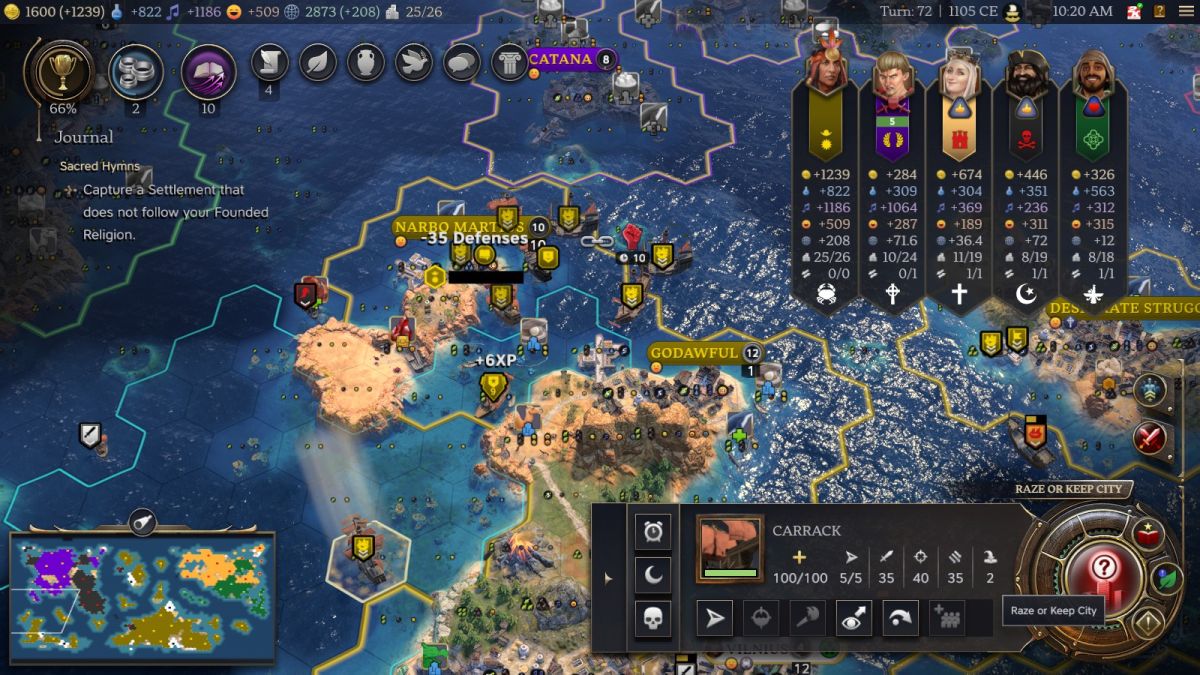
I started cash-rushing carracks out of Godawful, Desperate Struggle, and Pete's Shanty with the intention of launching them against Augustus. I could see on the victory screen that Augustus and Isabella had the most total Military points. In order to win a Domination victory, I needed to improve my own score by taking enemy settlements while simultaneously reducing the score of the leading AI civs. I could get 6 points per settlement captured (4 base points plus 1 point for being captured and 1 point for being in distant lands) while subtracting 4 points from each AI rival settlement taken. Before getting aggressive, I was sitting right around 120 Military points and Augustus was the highest-ranked AI civ at an even 50 points. Currently I needed 6x the score of Augustus to hit the victory threshold, however I knew that would drop to 4x his score when the era meter reached 80% in the Exploration era. The plan was to drop both Augustus and Isabella down under 40 Military points by capturing their settlements while boosting my score over 160 points which should be enough to wrap things up.
The good news was that both Augustus and Isabella had a series of island cities which were completely indefensible against a sustained naval attack. It tends to be difficult to capture AI cities in the middle of their territory due to terrain obstacles and the AI's tendency to spam defensive units. However, the AI does a terrible job at assembling a navy (just as it was equally bad in Civ6) and the lack of terrain obstacles on the water allows the player to sail easily from objective to objective while blasting them into smithereens. The initial blow felt at the Roman city of Narbo Martius on Turn 82, immediately after I dropped 3500 influence into boosting my war support against Augustus. I started at -4 war support for declaring a Surprise War, only to flip that over into +5 war support in my favor. I had a local fleet commander to buff up my carrack swarm and the first Roman settlement was pounded into submission - there weren't even any units there to defend it.
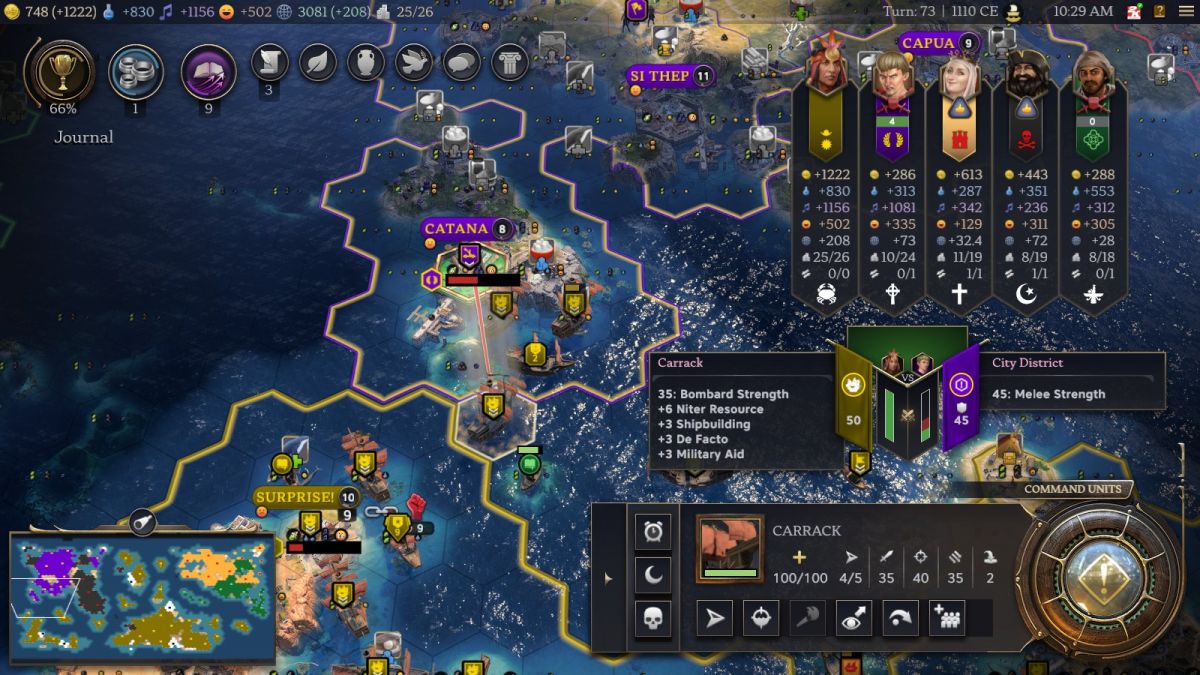
It's critically important to have a naval commander located anywhere that serious fighting takes place since some of their promotions are absoultely game-breaking. The key promotion tree for the fleet commanders is the Bombard one, where there's a second-tier promotion named Spotter that adds +1 range for all naval units within the command radius. This is an absolutely broken ability since it allows all of the Exploration age naval units to fire from three tiles away instead of the default two tiles. You can easily move the naval commander itself around so that a dozen ships can take advantage of this promotion and then hit targets well inland or use ships which otherwise wouldn't have enough movement to attack. One of the biggest issues under the One Unit Per Tile system is units getting clogged on the map and there not being physically enough tiles to get all of your military units into the fighting. This Spotter promotion enormously alleviates the traffic jam issues and just trivializes naval combat against the AI (there's a good reason why 3 range ships don't appear until Battleships in Civ6 near the end of the tech tree). It also allowed my naval commander to rack up experience points at an incredible rate, boosted by a policy that I was running which granted them 30% more XP, and I quickly worked down to the Order commendation for +5 strength. Soon afterwards I took other promotions granting +5 strength against fortified districts and another +5 strength when attacking at full HP to tilt the combat strength disparity hilariously in my favor.
My ships also had 5 movement points thanks to getting an additional +2 movement over the default rate due to some combination of techs, policies, and triumphs. Later I even gained another movement point on all naval units for being the first civ to research Gunpowder technology. There was no opposition from Augustus whatsoever as my naval surgically dismantled his island colonies followed by the settlements on the southern coast of his mainland. If I could reach it with my ships, it was completely helpless. I could furthermore rush-buy two or three new carracks every single turn which meant that the AI had no prayer of stopping the snowball from rolling down the hill. I took four cities in four turns which led to this situation:
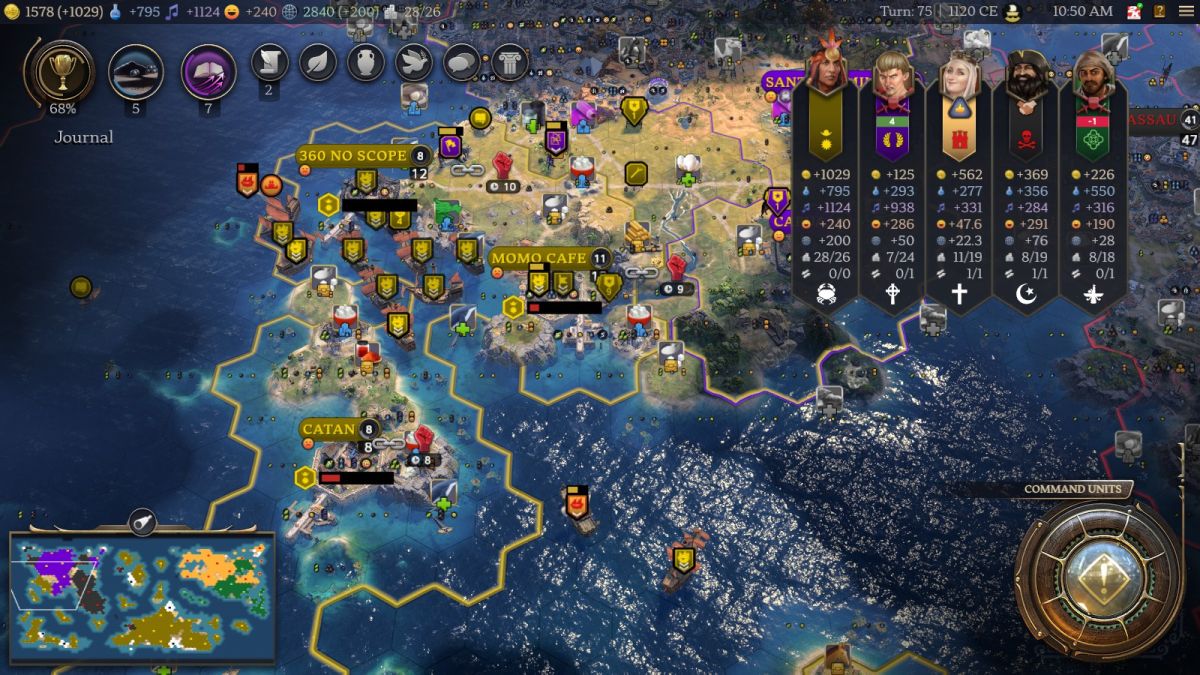
While I easily could have taken more settlements from Augustus, I needed to reduce Isabella's Military score which meant that Spain was the next target. I didn't want to grab unnecessary settlements because each of them counted against that stupid settlement limit and I knew that I was going to be going well over the cap, even after modding the settlement limit, plus researching every bonus on the tech/civic trees, plus taking +3 settlement limit from three city states across these first two eras, plus building El Escorial wonder, PLUS running the Corona Civica memento for another +2 settlements. Therefore I turned my fleet and sailed it further west across the International Date Line where Isabella had three tiny island colonies of her own which were ripe for the plucking. I was on pretty good terms with Isabella but that didn't matter: another sneak attack followed on Turn 79, followed by spending another 3000 influence to flip my war support penalty into a positive combat modifier.
The whole world had collapsed into warfare during these turns, as Ibn Battuta declared war on my civ as well. He was already in a war with Isabella but must have been convinced to join the conflict by Augustus, what an idiot. The Abbasid leader had some units randomly sailing around on the seas to the northeast of my homeland which were easily sunk by half a dozen new carrack rush-purchases which then patrolled the waters against any further incursions. Rather than face any more opponents, I dialed up Edward Teach and signed him to a full alliance: the people of Nepal and the Pirate nation working together, what a bizarre scenario. This failed to have any consequences of note but it was amusing enough that I was glad I made the diplomatic effort.
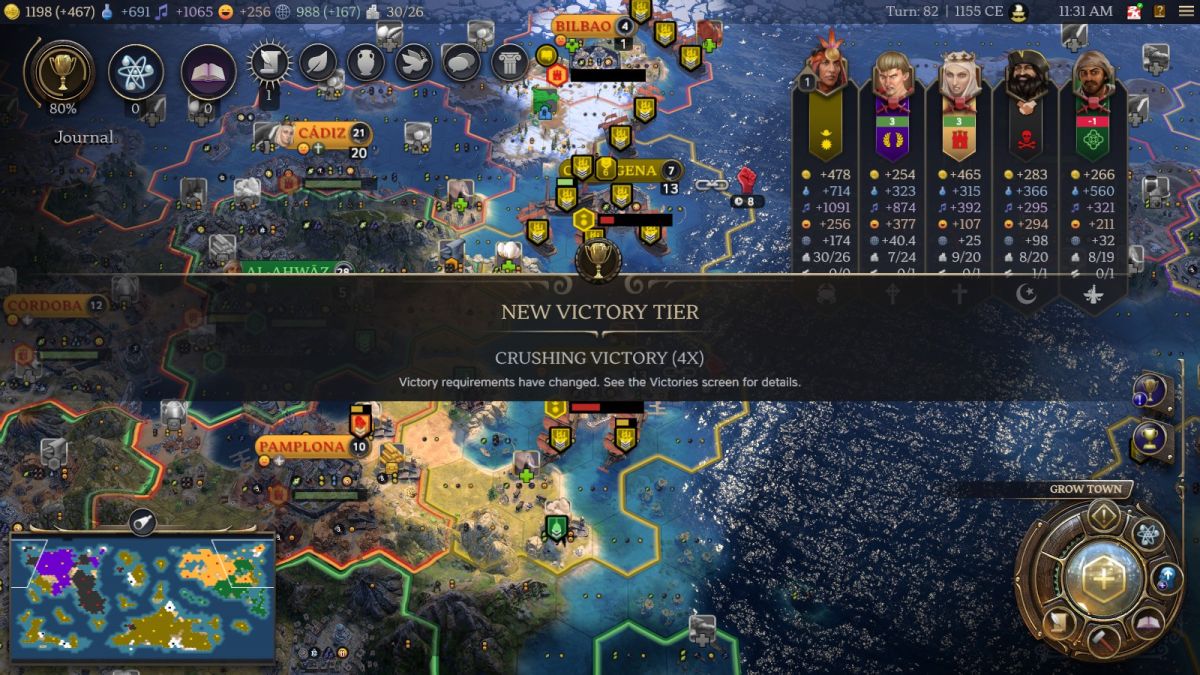
Isabella fared no better than Augustus as I swiftly divested her of the eastern Spanish island colonies. She was actually in the process of losing them to Ibn Battuta's navy when my ships swooped in and sank all of the green Abbasid ships... followed by taking the Spanish settlements as well, heh. These utter garbage one-tile island settlements were counted exactly the same under Civ7's Military scoring as taking giant cities in the middle of Isabella's core. Everything captured is worth 1 extra point and everything in "distant lands" is worth 1 extra point, with the only exception being the enemy capital which gets a further 4 extra points. I have no idea why the Military scoring isn't scaled based on population, since the gameplay should reward capturing size 40 cities in the enemy homeland over size 4 tundra wastelands. The victory condition leads to completely nonsensical strategic decisions, and with the AI's propensity to settle useless overseas colonies on tiny islands, it's trivially easy to capture these spots without ever engaging with their real defenses. This is marginally better than the old Military victory since it doesn't require being in the Modern era to make progress... but the whole system is still pretty bad overall.
The pictured Turn 82 was a key date because the last two pieces of the Military victory came together. First, I was able to capture little Bilbao in the far north for a third Spanish settlement taken, dropping Isabella down to 36 Military points and leaving my ally Edward Teach as the top AI leader at 39 Military points. Second, I researched the third Future Civic in the culture tree which advanced the end of the era by another ten turns. The era would now end on Turn 110 and this was enough to advance the era meter to the 80% mark. (Technically researching Future Techs/Civics adds 10 turns to the current date so we were effectively on Turn 82 + 30 = 112 / 140 = 80% exactly.) Hitting 80% on the era meter dropped the victory requirements from 6x the highest AI score to 4x the highest AI score. Since this was now Teach's Pirate nation and he had 39 Military points, I needed 39 * 4 = 156 points to trigger the Military victory, and that was already within reach:
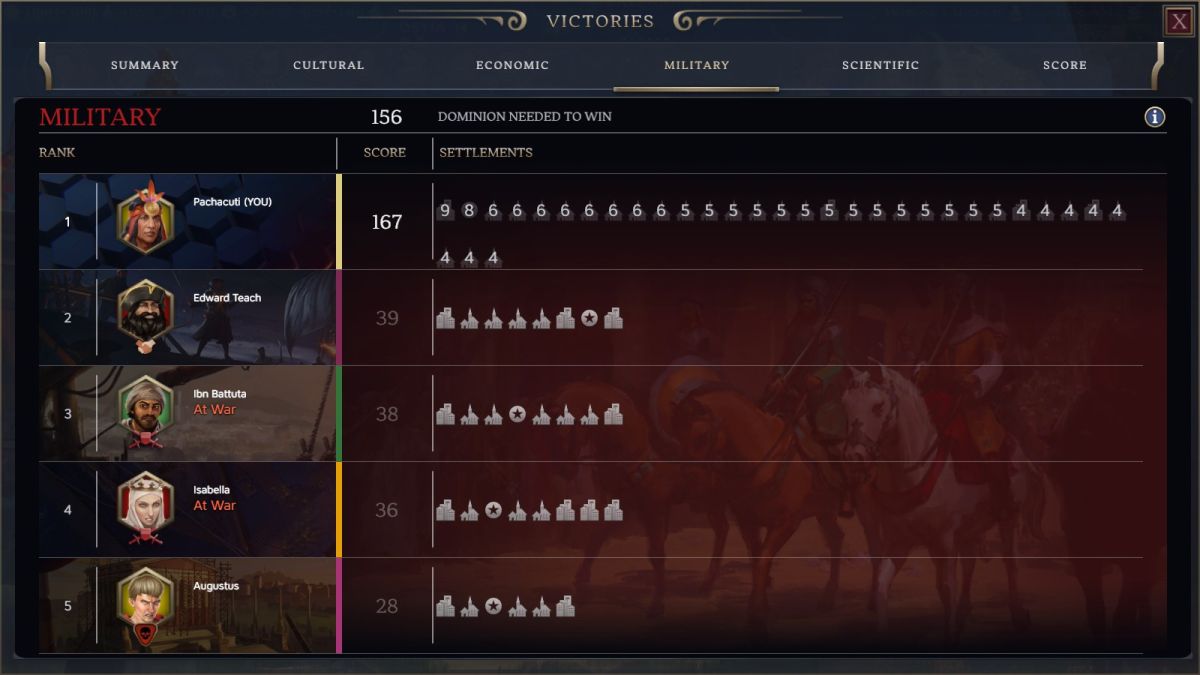
This was also ten turns since I had opened the war with Augustus and I signed a peace treaty with the sullen Roman leader. I forced him to hand over another settlement in the treaty to boost my score from 161 to 167 in this category, which would allow Isabella or Augustus to add one more settlement without putting me below the points threshold. I was still at war with Ibn Battuta and had one of his island cities sitting at zero defenses ready to be captured if necessary, and then I also had a pair of siege units right outside the tiny Pirate settlement on my homelands continent ready to capture it if needed to reduce his Military score. None of that proved to be necessary and a 5 turn countdown to the Military victory began because, uh, reasons. I guess this is to provide the player one last chance to stop an AI victory but it still seems silly to me - if someone meets the victory criteria, the game should simply be over! There's no point in dragging things out further. Drag things out we did though for five more needless turns.
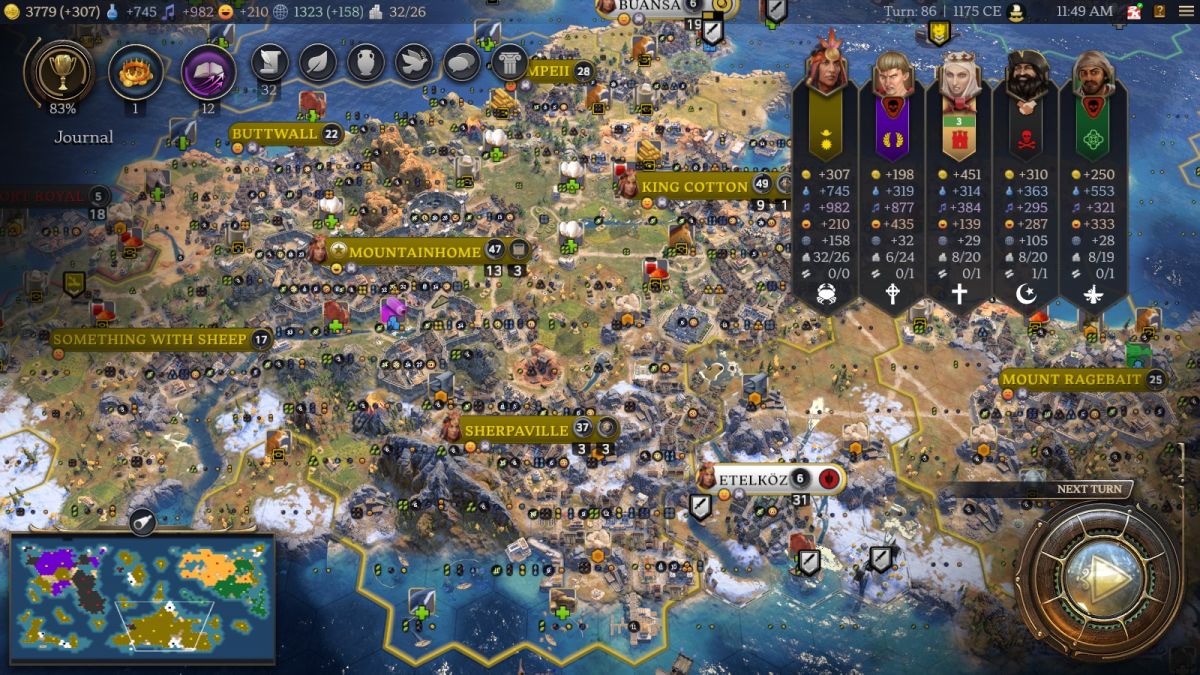
Here's a final picture of the original continent as I prepared to end the last turn of the countdown. Note that my gold/science/culture yields were actually lower than they had been before all the fighting despite adding eight more settlements to the empire. This was due to the huge happiness penalty for going so far over the settlement limit, with a total of -30 happiness in each settlement for six locations over the cap. This dropped many of the towns into unhappy or even angry status where there are major penalties to their yields; I believe the mechanic is -2% to all yields for every point of unhappiness, with a settlement at -25 unhappiness losing fully 50% of its food, production, gold, science, and culture! I want to stress again that I had taken every conceivable method of increasing the settlement limit and even modded it to double the base amount; I believe that I would have capped out at a settlement limit around 20 or 21 without that addition. And yet I still couldn't expand as much as I wanted due to that restriction which railroads the player into a gameplay style that insists "you cannot grow larger than this size at this point in time". I think this anti-fun mechanic is another reason why people continue to dislike Civ7, as it just does not let you build the empire that you want to build.
I hit next turn and the game ended with a "Crushing" Military victory on Turn 87:

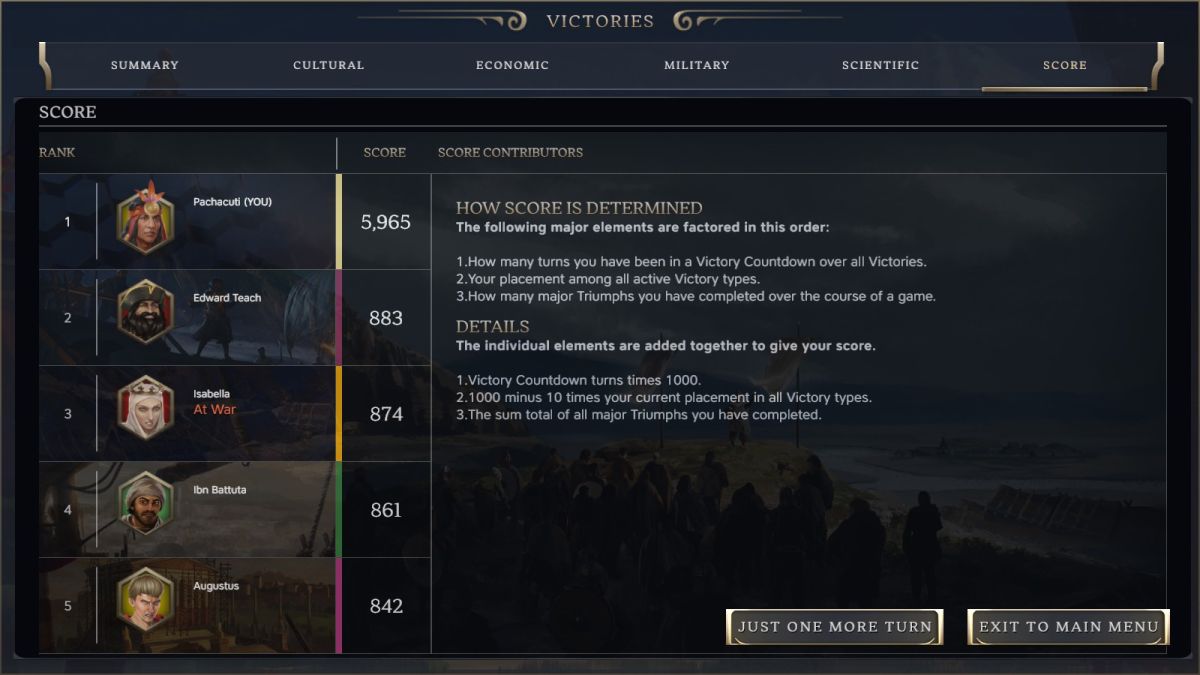
The gameplay zoomed in on my capital city and then there was a static splash screen of Pachacuti and that was it, still no bar graphs or Demographics or replays to watch. What a letdown for finishing a game, though I guess Civ7 at least does have the "One More Turn" feature to play on which didn't exist on release. I think that Turn 87 of the Exploration age was about as fast as it's possible to win under the current ruleset, since I triggered the victory countdown on the very turn that the era meter advanced to 80% and that was already boosted by having discovered three Future Civics. I'm sure there are people at CivFanatics who can and have done it faster but this was plenty good enough for me. In terms of endgame scoring, I had a truly preposterous lead in the Military category and was steadily outpacing everyone in the Economic section as well. I probably could have won that category at the 3x scoring threshold sometime in the early Modern era... but that would have required playing another 50 turns at a minimum which would have been awful to experience. I'm also confident that I could have outraced the AI to space via the end of the Modern tech tree and probably dug up the dumb relics before them if I had wanted to chase after Culture for some reason. There's also a total score ranking where I annihilated the AI leaders, though that one only matters if none of the other victory conditions are achieved.
Overall, I ended this game feeling pretty disappointed about the state of Civ7. While it's certainly true that the Test of Time update and the various patches have improved the gameplay as a whole, Civ7 is still ultimately not that much fun to play. Even with the interesting mountain setup using Pacacuti and Nepal, this game didn't really play out much differently from others that I've tried. It continues to feel heavily railroaded when it comes to expansion and the various victory conditions, with the gameplay simply not allowing the player to go off and do their own thing as was so common in past Civilization games. The era mechanic continues to be a disaster even if the worst aspects of it have been smoothed a bit; it's never going to be fun to have your buildings go obsolete on a repeated basis. And I kept running into various barriers where the ages would not allow me to progress forward until the era clock said it was OK: can't expand overseas, can't settle further until the limit increases, can't research Modern era techs or civics even if you have vastly more science/culture than the other civs, etc. The game is just lacking the open-ended nature of past Civilization games and I can't seem to find the same fun factor despite the various patch changes. This game honestly feels like something that's in Early Access and still trying to figure out its mechanics, rather than something that released fully 18 months ago!
If you want a short verdict on the Test of Time update for me, it would be this: I didn't feel much interest in starting another Civ7 game after this one finished. And, unfortunately for Firaxis, this appears to be a common sentiment among Civilization players right now.  Thanks for reading all.